

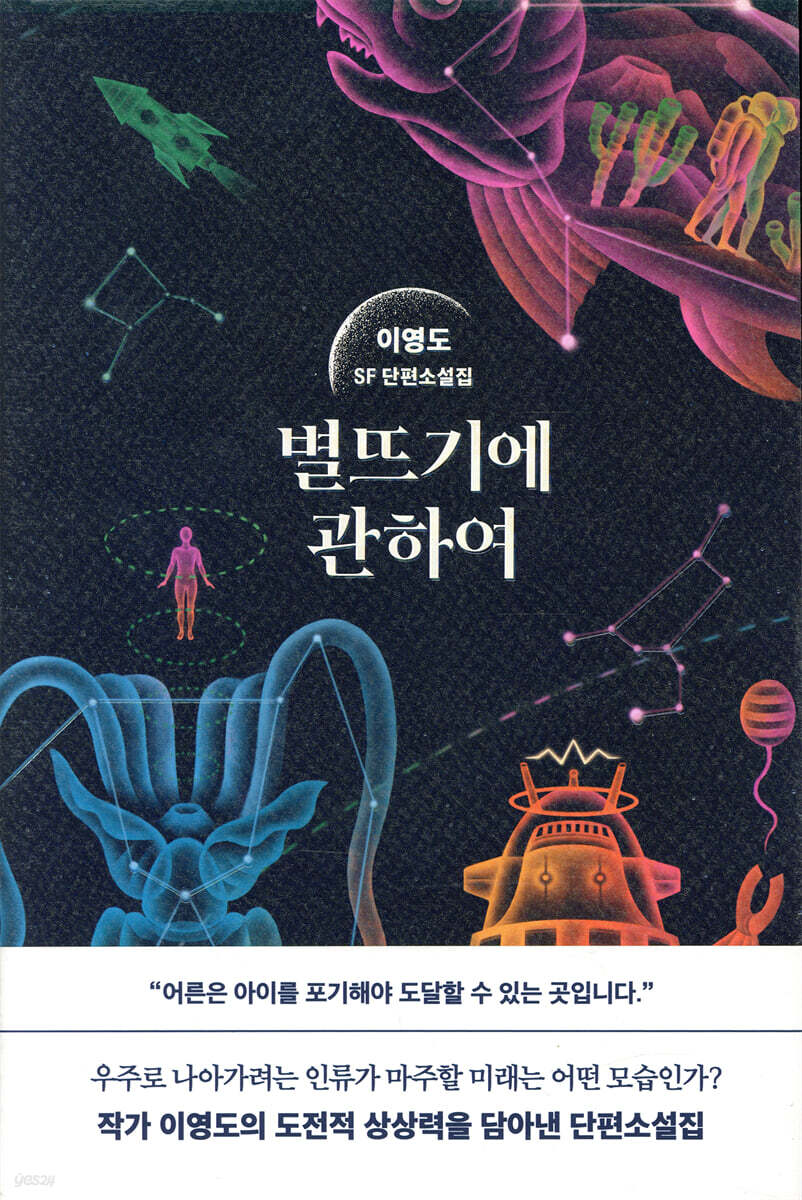
About Stargazing
 |
Description
Book Introduction
- A word from MD
-
A feast of stories that cross genresA unique tale, a world of boundless imagination, from Lee Young-do, author of "Dragon Raja." This is the author's first science fiction short story collection, compiling ten works published since 2000.
His unique humorous and bizarre developments unfold in various genres, including the 'Weitanin series', which depicts the exchange between humans and extraterrestrial civilizations, as well as science fiction, fantasy, and romance.
October 30, 2020. Novel/Poetry PD Park Hyung-wook
"Meet the Earthlings.
There are astrologers who have recently reinterpreted astrology in a fairly modern way.
He calls himself a stargazer.”
The first science fiction short story collection by Lee Young-do, a leading fantasy author whose works, including "Dragon Raja" and "The Bird that Drinks Tears," have sold over 2 million copies in Korea, Japan, Taiwan, and China, has been published by Golden Bough.
『About Star Rising』, a collection of 10 short stories by Lee Young-do published since 2000, focuses on the four stories in the 'Weitanin Series' that deal with the story of an extraterrestrial civilization that has become a growth partner for Earthlings. You can experience Lee Young-do's charming writing style that crosses genres such as science fiction, fantasy, and romance, containing extraordinary developments and explosive imagination.
There are astrologers who have recently reinterpreted astrology in a fairly modern way.
He calls himself a stargazer.”
The first science fiction short story collection by Lee Young-do, a leading fantasy author whose works, including "Dragon Raja" and "The Bird that Drinks Tears," have sold over 2 million copies in Korea, Japan, Taiwan, and China, has been published by Golden Bough.
『About Star Rising』, a collection of 10 short stories by Lee Young-do published since 2000, focuses on the four stories in the 'Weitanin Series' that deal with the story of an extraterrestrial civilization that has become a growth partner for Earthlings. You can experience Lee Young-do's charming writing style that crosses genres such as science fiction, fantasy, and romance, containing extraordinary developments and explosive imagination.
- You can preview some of the book's contents.
Preview
index
On the Translation of Kaiwapandom 7
About the robot that became the savior 45
About Stargazing 55
About the Mother of Vengeance 101
On the Meaning of Teleportation 137
Eyes on Me 169
Beautiful Tradition 205
Descendants of the Warrior 215
SINBIROUN Story 223
Spring Has Come 253
About the robot that became the savior 45
About Stargazing 55
About the Mother of Vengeance 101
On the Meaning of Teleportation 137
Eyes on Me 169
Beautiful Tradition 205
Descendants of the Warrior 215
SINBIROUN Story 223
Spring Has Come 253
Publisher's Review
Lee Young-do's space opera in the Witanin series
One day, an alien spaceship with an advanced scientific civilization appears on Earth.
They call themselves the 'Intergalactic Cultural Exchange Promotion Committee' and propose cultural exchanges with other extraterrestrial civilizations designated to Earthlings.
The idea was to create a stepping stone for the two planets, still in their infancy, to advance into the age of space through cultural exchange, and the first task was to exchange each other's 'fairy tale books'.
The first story in the series, "Regarding the Translation of Kaiwapandom," deals with the events that occurred during the process of translating "Kaiwapandom," a children's book by the "Witan people" who were designated as cultural exchange partners, into Earth languages.
After the second work, "About the Robot Who Became the Savior," which illuminates the space age that has arrived, the third work in the series, and the title work, "About Rising Stars," finally has humanity carrying out a mission in space together with the Witan people.
The final installment in the series, "About the Mother of Vengeance," is set in a space-age Earth and deals with a bizarre series of cosmic murders.
These works, named the 'Weitanin Series', contain Lee Young-do's signature humorous development and unpredictable twists, while also offering new imaginative stimulation to current humanity as it enters the space age.
“Because people who speak different languages have appeared in reality.
Capital did it last century, and now aliens do it.
Both of them use languages other than human language.
Capital speaks the language of economics, aliens speak their own fucking language.
When barbarians who speak a different language appear, people tend to unite and kill individuality.
After this final resistance, the languages of the Earth will rapidly unify.
“It’s most likely English.”
The first work, "On the Translation of Kaiwapandom," is set in a "unified Korea," and tells the story of Professor Lee, who translates the language of the Witan people, and Captain Park, a former high-ranking member of the People's Army who is assigned to guard him.
Through the image of Captain Park, who speaks North Korea's rapidly disappearing official language, "Cultural Language," and the old professor who encounters his grandson who feels more comfortable speaking English than Korean, author Lee Young-do's message about languages that have or will disappear delivers a fresh shock.
"It's not extinction, it's renunciation.
"It's a place that adults can only reach by giving up on children."
The title piece, "On Rising Stars," depicts the first story of humanity, who has entered the full-fledged space age, traveling through space with a pair of aliens.
Because each has a different living environment, the spaceship's living space is divided in half, and the process of them arguing and conflicting about their missions through a translator without being able to meet face to face provides unexpected fun.
Above all, it is a work that best fits the theme that encompasses the entire series, and it depicts a series of processes in which humanity, not alone in the vast universe, pioneers space together with a new alien civilization as a 'companion', with the wit and thematic awareness characteristic of author Lee Young-do.
“Just wait a moment.
sidekick.
It's late, but some of our children will be able to follow you.
“I wonder what pictures our children and the stars will draw.”
"About the Robot Who Became a Savior," in which an artificial intelligence robot causes a commotion by saying it will redeem someone, and "About the Mother of Vengeance," which deals with bizarre murders and clones in a zero-gravity space, are also works that contain Lee Young-do's unique SF settings and fun.
From unique fantasy to romance, discover the diverse world of author Lee Young-do's works.
"Eyes that See Me," which is of a different genre from previous works, is set in an apocalyptic worldview.
It is a story about the narrator, Garakbi, who risks his life to save humanity with his lover and singer, Baramsaekchil, while avoiding the snow squirrel that lives in the snow and preys on humans.
They give up the 'Song of Destruction' that the soundman Baramsaekchil has, and in return, they get the 'Song of the Corner', giving humanity, which is heading towards the end of its life, a chance called the Corner.
This work allows you to fully enjoy Lee Young-do's fantasy style by featuring a unique setting that deals with the destruction and salvation of humanity through 'song' and an unpredictable ending.
On the other hand, "Spring Has Come" is a work that completely lacks genre elements such as fantasy or science fiction, and you can encounter a work that is completely different from the writing style of author Lee Young-do that you have seen before.
Beginning as an everyday conversation about youth labor, including wage arrears, the story developed into the unique subject of “Seeds that Call Spring,” capturing author Lee Young-do’s perspective on modern Korean society, including the younger generation’s perspective on their parents’ generation and the difficult lives blocked by the walls of reality, such as wage arrears.
“Even after the child is born, even after the child goes to school and gets a job, the umbilical cord still hangs on.
I believe that it is the parents' job to constantly provide nutrients to keep their children alive.
Of course, it's a huge self-sacrifice, but it's also a huge shirking of responsibility.
"If you don't teach your children how to gather their own nutrients."
One day, an alien spaceship with an advanced scientific civilization appears on Earth.
They call themselves the 'Intergalactic Cultural Exchange Promotion Committee' and propose cultural exchanges with other extraterrestrial civilizations designated to Earthlings.
The idea was to create a stepping stone for the two planets, still in their infancy, to advance into the age of space through cultural exchange, and the first task was to exchange each other's 'fairy tale books'.
The first story in the series, "Regarding the Translation of Kaiwapandom," deals with the events that occurred during the process of translating "Kaiwapandom," a children's book by the "Witan people" who were designated as cultural exchange partners, into Earth languages.
After the second work, "About the Robot Who Became the Savior," which illuminates the space age that has arrived, the third work in the series, and the title work, "About Rising Stars," finally has humanity carrying out a mission in space together with the Witan people.
The final installment in the series, "About the Mother of Vengeance," is set in a space-age Earth and deals with a bizarre series of cosmic murders.
These works, named the 'Weitanin Series', contain Lee Young-do's signature humorous development and unpredictable twists, while also offering new imaginative stimulation to current humanity as it enters the space age.
“Because people who speak different languages have appeared in reality.
Capital did it last century, and now aliens do it.
Both of them use languages other than human language.
Capital speaks the language of economics, aliens speak their own fucking language.
When barbarians who speak a different language appear, people tend to unite and kill individuality.
After this final resistance, the languages of the Earth will rapidly unify.
“It’s most likely English.”
The first work, "On the Translation of Kaiwapandom," is set in a "unified Korea," and tells the story of Professor Lee, who translates the language of the Witan people, and Captain Park, a former high-ranking member of the People's Army who is assigned to guard him.
Through the image of Captain Park, who speaks North Korea's rapidly disappearing official language, "Cultural Language," and the old professor who encounters his grandson who feels more comfortable speaking English than Korean, author Lee Young-do's message about languages that have or will disappear delivers a fresh shock.
"It's not extinction, it's renunciation.
"It's a place that adults can only reach by giving up on children."
The title piece, "On Rising Stars," depicts the first story of humanity, who has entered the full-fledged space age, traveling through space with a pair of aliens.
Because each has a different living environment, the spaceship's living space is divided in half, and the process of them arguing and conflicting about their missions through a translator without being able to meet face to face provides unexpected fun.
Above all, it is a work that best fits the theme that encompasses the entire series, and it depicts a series of processes in which humanity, not alone in the vast universe, pioneers space together with a new alien civilization as a 'companion', with the wit and thematic awareness characteristic of author Lee Young-do.
“Just wait a moment.
sidekick.
It's late, but some of our children will be able to follow you.
“I wonder what pictures our children and the stars will draw.”
"About the Robot Who Became a Savior," in which an artificial intelligence robot causes a commotion by saying it will redeem someone, and "About the Mother of Vengeance," which deals with bizarre murders and clones in a zero-gravity space, are also works that contain Lee Young-do's unique SF settings and fun.
From unique fantasy to romance, discover the diverse world of author Lee Young-do's works.
"Eyes that See Me," which is of a different genre from previous works, is set in an apocalyptic worldview.
It is a story about the narrator, Garakbi, who risks his life to save humanity with his lover and singer, Baramsaekchil, while avoiding the snow squirrel that lives in the snow and preys on humans.
They give up the 'Song of Destruction' that the soundman Baramsaekchil has, and in return, they get the 'Song of the Corner', giving humanity, which is heading towards the end of its life, a chance called the Corner.
This work allows you to fully enjoy Lee Young-do's fantasy style by featuring a unique setting that deals with the destruction and salvation of humanity through 'song' and an unpredictable ending.
On the other hand, "Spring Has Come" is a work that completely lacks genre elements such as fantasy or science fiction, and you can encounter a work that is completely different from the writing style of author Lee Young-do that you have seen before.
Beginning as an everyday conversation about youth labor, including wage arrears, the story developed into the unique subject of “Seeds that Call Spring,” capturing author Lee Young-do’s perspective on modern Korean society, including the younger generation’s perspective on their parents’ generation and the difficult lives blocked by the walls of reality, such as wage arrears.
“Even after the child is born, even after the child goes to school and gets a job, the umbilical cord still hangs on.
I believe that it is the parents' job to constantly provide nutrients to keep their children alive.
Of course, it's a huge self-sacrifice, but it's also a huge shirking of responsibility.
"If you don't teach your children how to gather their own nutrients."
GOODS SPECIFICS
- Publication date: October 15, 2020
- Format: Hardcover book binding method guide
- Page count, weight, size: 288 pages | 504g | 150*221*20mm
- ISBN13: 9791158887254
- ISBN10: 1158887256
You may also like
카테고리
korean


korean

![GQ KOREA Mark (Monthly): December [2025]](http://librairie.coreenne.fr/cdn/shop/files/8ef265dbbfbf186523ed75ba7319009d.jpg?v=1765340328&width=3840)


