

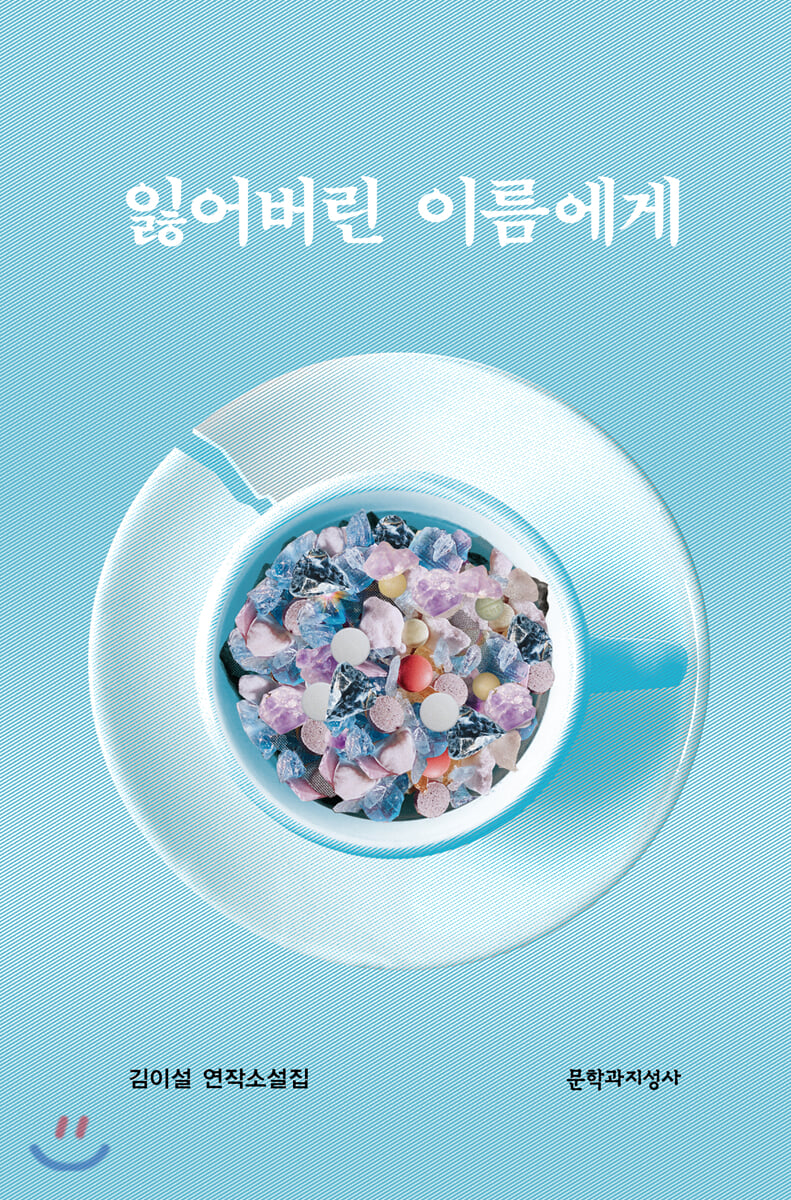
To the lost name
 |
Description
Book Introduction
- A word from MD
- [Before I Become Someone's Something, I Face My Name] A collection of short stories by Kim Yi-seul that captures the lives of middle-aged women.
The novel illuminates the bodies and minds of women becoming worn out by the social demands of marriage, childbirth, and childcare.
Those who have become someone's wife and mother without time to reflect on themselves.
This book is a consolation to those who have lost their own names, and a solidarity message to others who have lost their names.
-Novel MD Lee Ju-eun
“Don’t worry about what others think and live your life doing what you want to do, Mom.
Don't hold back on anything.
Before I get older”
Finding my true name, not mother or wife
Kim Yi-seol, who has developed a unique style by depicting the bare face of life without any exaggeration, has published a collection of short stories titled “To the Lost Name” (Munhak-kwa-Jiseongsa, 2020).
Kim Yi-seol began her career as a writer through the Seoul Shinmun New Year’s Literary Contest in 2006, and has since won the Young Writer’s Award and the Hwang Sun-won New Writer’s Award, and has published two short story collections and four light novels.
『To the Lost Name』, a collection of four short stories, is the first collection of short stories in four years since 『Quietly Like Today』, the second collection of short stories.
In this collection of short stories, Kim Yi-seol meticulously explores the sense of alienation and loss felt by middle-aged women living in a new city in the central region.
It examines the frustration and sadness that women feel as they gradually “face their aging bodies” (“Illness”) after meeting the social demands of marriage, childbirth, and childcare.
Therefore, reading 『To the Lost Name』 will be like experiencing the life of a wife and mother who confesses that she “doesn’t remember a single happy or joyful thing” (“Mia”) in the blind spot of her home.
It will also be an opportunity to witness that only the small but warm comforts we give each other can overcome loneliness and anxiety.
The women in "To the Lost Name" are each isolated islands.
Although we are isolated in the physical space of an unfamiliar city, we are fundamentally isolated from relationships.
Since we do not know what boundaries surround us, we do not know how to connect with beings outside of ourselves.
Therefore, to cross the river of depression, you must row with the hand that is crossing.
Only the hand that gives something to others can make a path for water.
While experiencing the emotions conveyed from hand to hand and eye to eye by the women in the work, my own hands flinched several times.
Park Hye-jin (literary critic)
Don't hold back on anything.
Before I get older”
Finding my true name, not mother or wife
Kim Yi-seol, who has developed a unique style by depicting the bare face of life without any exaggeration, has published a collection of short stories titled “To the Lost Name” (Munhak-kwa-Jiseongsa, 2020).
Kim Yi-seol began her career as a writer through the Seoul Shinmun New Year’s Literary Contest in 2006, and has since won the Young Writer’s Award and the Hwang Sun-won New Writer’s Award, and has published two short story collections and four light novels.
『To the Lost Name』, a collection of four short stories, is the first collection of short stories in four years since 『Quietly Like Today』, the second collection of short stories.
In this collection of short stories, Kim Yi-seol meticulously explores the sense of alienation and loss felt by middle-aged women living in a new city in the central region.
It examines the frustration and sadness that women feel as they gradually “face their aging bodies” (“Illness”) after meeting the social demands of marriage, childbirth, and childcare.
Therefore, reading 『To the Lost Name』 will be like experiencing the life of a wife and mother who confesses that she “doesn’t remember a single happy or joyful thing” (“Mia”) in the blind spot of her home.
It will also be an opportunity to witness that only the small but warm comforts we give each other can overcome loneliness and anxiety.
The women in "To the Lost Name" are each isolated islands.
Although we are isolated in the physical space of an unfamiliar city, we are fundamentally isolated from relationships.
Since we do not know what boundaries surround us, we do not know how to connect with beings outside of ourselves.
Therefore, to cross the river of depression, you must row with the hand that is crossing.
Only the hand that gives something to others can make a path for water.
While experiencing the emotions conveyed from hand to hand and eye to eye by the women in the work, my own hands flinched several times.
Park Hye-jin (literary critic)
- You can preview some of the book's contents.
Preview
index
Compatibility
For the days of deception
missing child
Age
Commentary | The Story of Four Women
Author's Note
For the days of deception
missing child
Age
Commentary | The Story of Four Women
Author's Note
Into the book
The horror of labor had long been forgotten.
But what I vividly remember is not the trembling feeling of holding my baby for the first time or the strange feeling of breastfeeding for the first time, but the abuse I suffered at the hands of the doctor who delivered my baby.
---From "Compatibility"
I wonder if there is any feeling of shame or embarrassment.
Is it really possible for a human being raising a daughter to steal such videos and go around doing beastly things?
Is that the only thought that's in your head?
---From "For the Days of Deceit"
Soyoung and Dohyun became a couple who had to have a child because they did not agree not to have children, and when that did not work out, they became a couple who could not have children.
The world too easily considered Soyoung a problematic person simply because she had no active will.
---From "Mia"
If you have the presence of mind to carry on, you should also consider such responsibilities! I should have said this, but I couldn't bring myself to say it.
It wasn't that I was uncomfortable talking to my middle school son about sex without love.
It was because I was unconsciously making a compromise, thinking, “As long as it doesn’t interfere with my son’s studies, it’s okay.”
But what I vividly remember is not the trembling feeling of holding my baby for the first time or the strange feeling of breastfeeding for the first time, but the abuse I suffered at the hands of the doctor who delivered my baby.
---From "Compatibility"
I wonder if there is any feeling of shame or embarrassment.
Is it really possible for a human being raising a daughter to steal such videos and go around doing beastly things?
Is that the only thought that's in your head?
---From "For the Days of Deceit"
Soyoung and Dohyun became a couple who had to have a child because they did not agree not to have children, and when that did not work out, they became a couple who could not have children.
The world too easily considered Soyoung a problematic person simply because she had no active will.
---From "Mia"
If you have the presence of mind to carry on, you should also consider such responsibilities! I should have said this, but I couldn't bring myself to say it.
It wasn't that I was uncomfortable talking to my middle school son about sex without love.
It was because I was unconsciously making a compromise, thinking, “As long as it doesn’t interfere with my son’s studies, it’s okay.”
---From "Gyeongnyeon"
Publisher's Review
“The company at least pays the salary, and the children at least get report cards.
Me? No one would know.”
"To the Lost Name" is a collection of loosely connected short stories centered around the body and mind of four middle-aged women.
They are all stuck in a state of lost direction in life for their own reasons, including the indifference of their families and depression caused by physical aging.
Seon-hye in "For the Days of Deception" is a full-time housewife who has given birth to and raised children in succession and has prepared breakfast for her husband for 23 years, giving up her sleep at dawn.
I have lived my life believing that “doing housework faithfully so that my husband, who goes to work, doesn’t have to worry” is “a fair division of labor and a fair relationship.”
However, when she is left home alone due to her son's enlistment and her daughter's college dormitory life, she begins to feel an inexplicable sense of emptiness and begins to seek psychiatric treatment.
While searching for the cause of her distorted daily life, she is confronted with the truth that her husband, whom she had ignored for a long time, was having an affair.
I wanted to cheat on my husband too.
I wanted to happily betray my husband.
If I meet other men and hang out with younger boys, will it be fair?
Wouldn't that be unfair? I quickly shook my head.
To become the same human being.
What had become of me, to think such cruel thoughts?
(pp.
97~98)
The protagonist of "Woo-Hwan" is also a housewife who raises two children and takes antidepressants.
She is anxiously awaiting the results of a biopsy after being told that there is something wrong with her cervix.
“I did that exactly three years ago,” “I’ve been menstruating for over 30 years, isn’t it normal for it to break?” Despite her friend’s words, Geun-ju’s anxiety grows as her mother passed away from cervical cancer.
Geun-ju has been feeling depressed frequently since last year because her body has been sending her strange signals.
Who would have thought that I would get this sick, that I would have to undergo this test, that this would happen?
Geun-ju has recently come to the keen realization that growing old isn't just about accumulating physical time, but also about facing a deteriorating body.
(p.
25)
In this way, the characters in the novel lose their self-esteem and gradually crumble due to the alienation within their families and physical decline that middle-aged women tend to experience.
You go to a psychiatrist and explain your feelings and condition, but the medication prescribed doesn't solve the fundamental problem; it just dulls your emotions like a knife that "can't cut a single sheet of paper" ("Unhappiness").
So, what kind of possibility of recovery does Kim Yi-seul discover in the realistic worries and conflicts that women inevitably face today?
“It’s not just you, the whole world is a mess.
I wanted to whisper to that young woman:
In "Mia," So-young, who was barely maintaining her daily life with antidepressants, suddenly bursts into tears and goes to the hospital, unable to hold back her tears.
“My husband doesn’t understand me” and “I always feel alone”, she tells her doctor and is prescribed stronger medication, but she feels “rather than feeling relieved, my chest feels more stuffy.”
As she watched Soyoung leave the examination room, a middle-aged woman in the waiting room took out a tissue from her handbag and handed it to her.
Soyoung finds comfort in that small favor, in the “knowing look” from the other woman, a comfort she couldn’t find in drugs.
As literary critic Park Hye-jin said, “Living comes when we feel together, when we feel connected” (literary critic Park Hye-jin), perhaps Kim Yi-seol is trying to say that women can only recover through solidarity with other women.
This is repeated in the scene in "Gyeongnyeon" where the 'I' softly calls out the names of the girls who slept with his middle school son.
When the narrator painstakingly searches for and calls out the names of women that the husband has dismissed, saying, “Young people are just being cheeky and revealing things,” and “Do you really have to see obvious things to understand?”, we are finally able to recognize the women who have been belittled and lumped together by the male gaze as unique individuals.
Through the process of calling back to reality the names that were cruelly erased with the rhetoric of “sluts” and “bad-ass women,” I witness myself breaking free from the role of someone’s wife and mother and becoming my own unique self.
Therefore, "To the Lost Name" is a story that offers the possibility of comfort and reflection through solidarity to women who have lived without time to reflect on themselves, oppressed by patriarchy and misogynistic thinking.
It is a female narrative that contains a warm embrace for one's own name that was lost long ago and the will to overcome reality.
Author's Note
A collection of novels that helped me escape the time when I was a pathological human being.
The excuse that he has not fully recovered yet is also left as an afterthought.
My eternal Son Jeong-hye, Yoon Gyu-mi,
With teacher Park Hye-jin who wrote the commentary
Ji-in Choi, who listened to my trembling voice on a bench on a spring day
The name of Park Seon-woo, who read the novel carefully
Try saying it out loud slowly.
In these days when we are concerned about the world's well-being and safety,
Please stay strong and healthy.
also
As for you, don't forget your name.
I wish that were the case.
I dedicate this collection of short stories to Kim Ji-yeon, whose name I had lost.
Me? No one would know.”
"To the Lost Name" is a collection of loosely connected short stories centered around the body and mind of four middle-aged women.
They are all stuck in a state of lost direction in life for their own reasons, including the indifference of their families and depression caused by physical aging.
Seon-hye in "For the Days of Deception" is a full-time housewife who has given birth to and raised children in succession and has prepared breakfast for her husband for 23 years, giving up her sleep at dawn.
I have lived my life believing that “doing housework faithfully so that my husband, who goes to work, doesn’t have to worry” is “a fair division of labor and a fair relationship.”
However, when she is left home alone due to her son's enlistment and her daughter's college dormitory life, she begins to feel an inexplicable sense of emptiness and begins to seek psychiatric treatment.
While searching for the cause of her distorted daily life, she is confronted with the truth that her husband, whom she had ignored for a long time, was having an affair.
I wanted to cheat on my husband too.
I wanted to happily betray my husband.
If I meet other men and hang out with younger boys, will it be fair?
Wouldn't that be unfair? I quickly shook my head.
To become the same human being.
What had become of me, to think such cruel thoughts?
(pp.
97~98)
The protagonist of "Woo-Hwan" is also a housewife who raises two children and takes antidepressants.
She is anxiously awaiting the results of a biopsy after being told that there is something wrong with her cervix.
“I did that exactly three years ago,” “I’ve been menstruating for over 30 years, isn’t it normal for it to break?” Despite her friend’s words, Geun-ju’s anxiety grows as her mother passed away from cervical cancer.
Geun-ju has been feeling depressed frequently since last year because her body has been sending her strange signals.
Who would have thought that I would get this sick, that I would have to undergo this test, that this would happen?
Geun-ju has recently come to the keen realization that growing old isn't just about accumulating physical time, but also about facing a deteriorating body.
(p.
25)
In this way, the characters in the novel lose their self-esteem and gradually crumble due to the alienation within their families and physical decline that middle-aged women tend to experience.
You go to a psychiatrist and explain your feelings and condition, but the medication prescribed doesn't solve the fundamental problem; it just dulls your emotions like a knife that "can't cut a single sheet of paper" ("Unhappiness").
So, what kind of possibility of recovery does Kim Yi-seul discover in the realistic worries and conflicts that women inevitably face today?
“It’s not just you, the whole world is a mess.
I wanted to whisper to that young woman:
In "Mia," So-young, who was barely maintaining her daily life with antidepressants, suddenly bursts into tears and goes to the hospital, unable to hold back her tears.
“My husband doesn’t understand me” and “I always feel alone”, she tells her doctor and is prescribed stronger medication, but she feels “rather than feeling relieved, my chest feels more stuffy.”
As she watched Soyoung leave the examination room, a middle-aged woman in the waiting room took out a tissue from her handbag and handed it to her.
Soyoung finds comfort in that small favor, in the “knowing look” from the other woman, a comfort she couldn’t find in drugs.
As literary critic Park Hye-jin said, “Living comes when we feel together, when we feel connected” (literary critic Park Hye-jin), perhaps Kim Yi-seol is trying to say that women can only recover through solidarity with other women.
This is repeated in the scene in "Gyeongnyeon" where the 'I' softly calls out the names of the girls who slept with his middle school son.
When the narrator painstakingly searches for and calls out the names of women that the husband has dismissed, saying, “Young people are just being cheeky and revealing things,” and “Do you really have to see obvious things to understand?”, we are finally able to recognize the women who have been belittled and lumped together by the male gaze as unique individuals.
Through the process of calling back to reality the names that were cruelly erased with the rhetoric of “sluts” and “bad-ass women,” I witness myself breaking free from the role of someone’s wife and mother and becoming my own unique self.
Therefore, "To the Lost Name" is a story that offers the possibility of comfort and reflection through solidarity to women who have lived without time to reflect on themselves, oppressed by patriarchy and misogynistic thinking.
It is a female narrative that contains a warm embrace for one's own name that was lost long ago and the will to overcome reality.
Author's Note
A collection of novels that helped me escape the time when I was a pathological human being.
The excuse that he has not fully recovered yet is also left as an afterthought.
My eternal Son Jeong-hye, Yoon Gyu-mi,
With teacher Park Hye-jin who wrote the commentary
Ji-in Choi, who listened to my trembling voice on a bench on a spring day
The name of Park Seon-woo, who read the novel carefully
Try saying it out loud slowly.
In these days when we are concerned about the world's well-being and safety,
Please stay strong and healthy.
also
As for you, don't forget your name.
I wish that were the case.
I dedicate this collection of short stories to Kim Ji-yeon, whose name I had lost.
GOODS SPECIFICS
- Publication date: October 26, 2020
- Page count, weight, size: 224 pages | 244g | 125*192*20mm
- ISBN13: 9788932037868
- ISBN10: 8932037868
You may also like
카테고리
korean


korean

![GQ KOREA Mark (Monthly): December [2025]](http://librairie.coreenne.fr/cdn/shop/files/8ef265dbbfbf186523ed75ba7319009d.jpg?v=1765340328&width=3840)


