

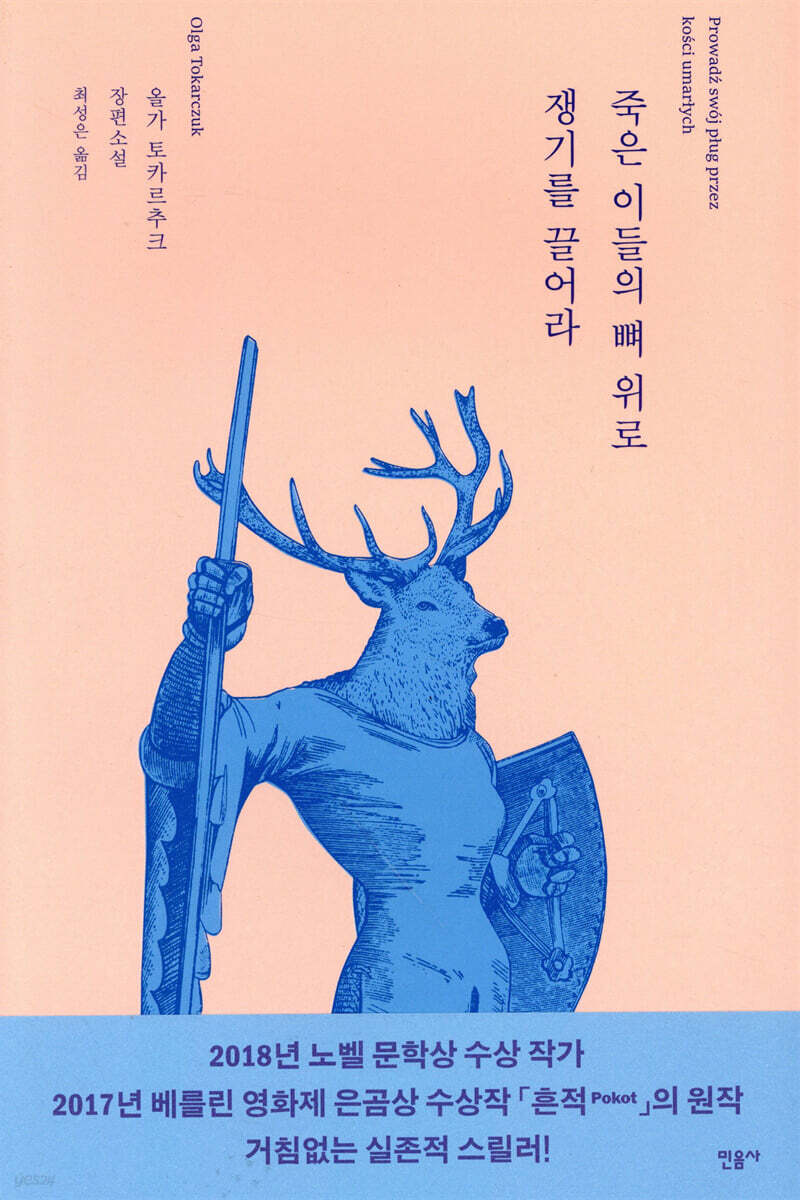
Pull the plow over the bones of the dead
 |
Description
Book Introduction
- A word from MD
-
A crime thriller from a Nobel Prize-winning authorA series of mysterious murders occur in the village, and deer footprints are found around the bodies.
Could this be the animals' revenge, as some say? The story unfolds with suspense between those who justify animal hunting and those who oppose them.
A book that clearly reveals the way writers, literature, and the world speak and change.
September 25, 2020. Novel/Poetry PD Park Hyung-wook
“Animals are taking revenge on humans.
(……)
This isn't such a weird story.
Animals are strong and wise.
“We just don’t know how smart they are.”
A crime thriller written by Nobel Prize-winning author Olga Tokarczuk
The original work of [Pokot], winner of the Silver Bear at the 2017 Berlin International Film Festival
A year after the publication of The Wanderers, Olga Tokarczuk, winner of the 2018 Nobel Prize in Literature, published the crime thriller Drive Your Plow Over the Bones of the Dead by Minumsa.
Unlike 『The Wanderers』, a so-called 'constellation novel' that requires careful reading to reveal its tightly arranged connections, this work maintains tension from beginning to end and can be read in one sitting.
This is because it follows the thriller format in which the identity of the culprit and his motive are revealed only at the end.
But this novel is different from typical mystery novels.
In the case of typical thrillers, the identity of the culprit revealed at the end is set as the key plot twist, and the focus is on finding out who the culprit is, but this work puts an emphasis on the 'story' of an insignificant person pushed to the margins of society, fighting against the world to protect those weaker than themselves through empathy and solidarity.
(……)
This isn't such a weird story.
Animals are strong and wise.
“We just don’t know how smart they are.”
A crime thriller written by Nobel Prize-winning author Olga Tokarczuk
The original work of [Pokot], winner of the Silver Bear at the 2017 Berlin International Film Festival
A year after the publication of The Wanderers, Olga Tokarczuk, winner of the 2018 Nobel Prize in Literature, published the crime thriller Drive Your Plow Over the Bones of the Dead by Minumsa.
Unlike 『The Wanderers』, a so-called 'constellation novel' that requires careful reading to reveal its tightly arranged connections, this work maintains tension from beginning to end and can be read in one sitting.
This is because it follows the thriller format in which the identity of the culprit and his motive are revealed only at the end.
But this novel is different from typical mystery novels.
In the case of typical thrillers, the identity of the culprit revealed at the end is set as the key plot twist, and the focus is on finding out who the culprit is, but this work puts an emphasis on the 'story' of an insignificant person pushed to the margins of society, fighting against the world to protect those weaker than themselves through empathy and solidarity.
- You can preview some of the book's contents.
Preview
index
1 Okay, everyone, pay attention 9
2 Testosterone Autism 32
3 Eternal Light 55
4 999th death 70
5 Light in the Rain 92
6 Small and Ordinary Things 119
7 Speech to the Poodle 140
8 Uranus in Leo 162
9 The greatest thing is in the smallest thing 193
10 Head Captain 209
11 The Song of the Bat 226
12 Chupacabra 251
13 Midnight Archer 268
14 Fall 292
15 Hubert Adult 312
16 photos 345
17 Virgo 362
Author's Note 374
Translator's Note 375
2 Testosterone Autism 32
3 Eternal Light 55
4 999th death 70
5 Light in the Rain 92
6 Small and Ordinary Things 119
7 Speech to the Poodle 140
8 Uranus in Leo 162
9 The greatest thing is in the smallest thing 193
10 Head Captain 209
11 The Song of the Bat 226
12 Chupacabra 251
13 Midnight Archer 268
14 Fall 292
15 Hubert Adult 312
16 photos 345
17 Virgo 362
Author's Note 374
Translator's Note 375
Into the book
All this was so terribly sad that I couldn't bear it.
As I gazed at the black-and-white landscape woven by the plateau, I realized that sadness is a very important word in defining the world.
Sadness is at the heart of all things, the fifth element and essence.
--- p.73
I am a ghost created by pain.
Whenever I'm at a loss as to what to do, I imagine myself wearing a shiny zipper from my neck to my groin, then slowly lowering it from top to bottom.
Then he takes the arms out of the arms, the legs out of the legs, and the head out of the head.
As I pull myself out of my body, the skin flows off me like an old garment.
The me contained within it was much more fragile, delicate, and almost transparent.
I have a fluorescent, milky white body like a jellyfish.
--- p.98
If Blake had lived to see all this, he would undoubtedly have said:
There are definitely places in the 'universe' that have not yet 'fallen'.
There, the world was not destroyed, and the Garden of Eden still exists.
There, humanity is governed not by the foolish and rigid laws of reason, but by the heart and intuition.
People don't just talk nonsense and show off what they already know, they use their imagination and create amazing things.
The state no longer shackles individuals' daily lives, but helps people realize their hopes and dreams.
Individuals are no longer cogs in a machine-like system or performers of specific roles, but are transformed into free beings.
--- p.124
Deep sorrow and grief.
The feelings of regret and sorrow I felt every time an animal died seemed like they would never end.
As one mourning ends, another follows, so I am in constant mourning.
This is my condition.
--- p.148
You can tell what kind of country it is by looking at its animals.
So, I'm talking about your attitude towards animals.
Democracy, or any system, is useless if people are cruel to animals.
--- p.148
The moment humans send animals to hell, the whole world turns into hell.
Why doesn't everyone know this? Why can't human reason escape petty, selfish pleasures?
--- p.156
An old way to deal with bad dreams is to say the dream out loud to the toilet, then flush the toilet.
--- p.161
“He who suffers sees the back of God.”
I couldn't tell if the back view here meant the back or the buttocks.
It's hard to even imagine the front of God, so what would his back look like?
Perhaps this means that those who suffer are blessed with a special window, like a kind of side door, that allows them to approach God and grasp truths that would be difficult to understand without suffering.
So, in a way, a healthy person is ultimately a person who suffers from pain.
It may sound a bit strange, but
I thought that was how harmony and balance in life was achieved.
--- p.165
As I stopped in the sloping Old Town Square, a strong sense of connection with the people passing by surged through me like a wave.
All of these people felt like my brothers and sisters.
We looked very much alike.
They are so fragile and mortal that they can be easily destroyed.
--- p.179
It is clear that the greatest things are contained in the smallest things.
There is no doubt.
Right now, on the table where I am writing this, the arrangement of the planets, and indeed the entire universe, is inhabited.
A thermometer, a coin, an aluminum spoon, a porcelain cup, keys, a cell phone, a piece of paper, a pen, an atom in one of my gray hairs, all contain memories of the origin of life and the cosmic catastrophe that gave the world its beginning.
--- p.208
Three animals, another species of human, or creatures that were half human and half animal, were talking to each other.
I realized that there are many 'us' in the garden and forest.
Our faces were covered with hair.
Strange beasts.
Our bats nested in the trees and sang songs.
--- p.232
Everything passes.
A wise man knows this from the beginning, so he regrets nothing.
--- p.250
I think the human mind has evolved to prevent us from seeing the truth.
To prevent us from facing the mechanism.
The mind is a defense mechanism that prevents us from ever understanding what is happening around us.
Although our brains have enormous capacity, the mind's primary job is to filter information.
Because it is impossible to carry the entire weight of knowledge.
Because every particle in the world is made of suffering.
--- p.310
Why must we be useful? To whom, and for what purpose, should we be useful? Whose idea is it, and by what right, do they divide the world into the useful and the useless? Does a thistle not have a right to life? What about a rat that steals grain from a granary? A bee and a wasp, a weed and a rose? Can we rationally judge which is better and which is worse? A large, crooked tree, full of holes, survives for centuries without being cut down by humans.
Because nothing can be made from that tree.
--- p.340
A medieval monk and astrologer learned of his own death while looking at his horoscope.
(This was before St. Augustine forbade reading the future by looking at the stars.) He was destined to die from being hit by a rock falling on his head.
From then on, he always wore a helmet under his monk's hood.
Good Friday, the Friday before Easter in a certain year.
On the day to commemorate the day Jesus was crucified, he took off his helmet and his larynx.
It wasn't because I loved God, but because I was afraid of attracting attention in the church.
Just then a small pebble landed on his bare head, causing a slight scratch.
But the monk was convinced that the prophecy had come true.
So he cleaned up his surroundings and passed away a month later.
That's how it all works, Digio.
But I know I still have a lot of time left.
As I gazed at the black-and-white landscape woven by the plateau, I realized that sadness is a very important word in defining the world.
Sadness is at the heart of all things, the fifth element and essence.
--- p.73
I am a ghost created by pain.
Whenever I'm at a loss as to what to do, I imagine myself wearing a shiny zipper from my neck to my groin, then slowly lowering it from top to bottom.
Then he takes the arms out of the arms, the legs out of the legs, and the head out of the head.
As I pull myself out of my body, the skin flows off me like an old garment.
The me contained within it was much more fragile, delicate, and almost transparent.
I have a fluorescent, milky white body like a jellyfish.
--- p.98
If Blake had lived to see all this, he would undoubtedly have said:
There are definitely places in the 'universe' that have not yet 'fallen'.
There, the world was not destroyed, and the Garden of Eden still exists.
There, humanity is governed not by the foolish and rigid laws of reason, but by the heart and intuition.
People don't just talk nonsense and show off what they already know, they use their imagination and create amazing things.
The state no longer shackles individuals' daily lives, but helps people realize their hopes and dreams.
Individuals are no longer cogs in a machine-like system or performers of specific roles, but are transformed into free beings.
--- p.124
Deep sorrow and grief.
The feelings of regret and sorrow I felt every time an animal died seemed like they would never end.
As one mourning ends, another follows, so I am in constant mourning.
This is my condition.
--- p.148
You can tell what kind of country it is by looking at its animals.
So, I'm talking about your attitude towards animals.
Democracy, or any system, is useless if people are cruel to animals.
--- p.148
The moment humans send animals to hell, the whole world turns into hell.
Why doesn't everyone know this? Why can't human reason escape petty, selfish pleasures?
--- p.156
An old way to deal with bad dreams is to say the dream out loud to the toilet, then flush the toilet.
--- p.161
“He who suffers sees the back of God.”
I couldn't tell if the back view here meant the back or the buttocks.
It's hard to even imagine the front of God, so what would his back look like?
Perhaps this means that those who suffer are blessed with a special window, like a kind of side door, that allows them to approach God and grasp truths that would be difficult to understand without suffering.
So, in a way, a healthy person is ultimately a person who suffers from pain.
It may sound a bit strange, but
I thought that was how harmony and balance in life was achieved.
--- p.165
As I stopped in the sloping Old Town Square, a strong sense of connection with the people passing by surged through me like a wave.
All of these people felt like my brothers and sisters.
We looked very much alike.
They are so fragile and mortal that they can be easily destroyed.
--- p.179
It is clear that the greatest things are contained in the smallest things.
There is no doubt.
Right now, on the table where I am writing this, the arrangement of the planets, and indeed the entire universe, is inhabited.
A thermometer, a coin, an aluminum spoon, a porcelain cup, keys, a cell phone, a piece of paper, a pen, an atom in one of my gray hairs, all contain memories of the origin of life and the cosmic catastrophe that gave the world its beginning.
--- p.208
Three animals, another species of human, or creatures that were half human and half animal, were talking to each other.
I realized that there are many 'us' in the garden and forest.
Our faces were covered with hair.
Strange beasts.
Our bats nested in the trees and sang songs.
--- p.232
Everything passes.
A wise man knows this from the beginning, so he regrets nothing.
--- p.250
I think the human mind has evolved to prevent us from seeing the truth.
To prevent us from facing the mechanism.
The mind is a defense mechanism that prevents us from ever understanding what is happening around us.
Although our brains have enormous capacity, the mind's primary job is to filter information.
Because it is impossible to carry the entire weight of knowledge.
Because every particle in the world is made of suffering.
--- p.310
Why must we be useful? To whom, and for what purpose, should we be useful? Whose idea is it, and by what right, do they divide the world into the useful and the useless? Does a thistle not have a right to life? What about a rat that steals grain from a granary? A bee and a wasp, a weed and a rose? Can we rationally judge which is better and which is worse? A large, crooked tree, full of holes, survives for centuries without being cut down by humans.
Because nothing can be made from that tree.
--- p.340
A medieval monk and astrologer learned of his own death while looking at his horoscope.
(This was before St. Augustine forbade reading the future by looking at the stars.) He was destined to die from being hit by a rock falling on his head.
From then on, he always wore a helmet under his monk's hood.
Good Friday, the Friday before Easter in a certain year.
On the day to commemorate the day Jesus was crucified, he took off his helmet and his larynx.
It wasn't because I loved God, but because I was afraid of attracting attention in the church.
Just then a small pebble landed on his bare head, causing a slight scratch.
But the monk was convinced that the prophecy had come true.
So he cleaned up his surroundings and passed away a month later.
That's how it all works, Digio.
But I know I still have a lot of time left.
--- p.372
Publisher's Review
“Animals are taking revenge on humans.
(……)
This isn't such a weird story.
Animals are strong and wise.
“We just don’t know how smart they are.”
2018 Nobel Prize in Literature winner
2019 Man Booker International Prize Finalist
Winner of the 2009 Silesian Babzin Literary Award
A crime thriller written by Nobel Prize-winning author Olga Tokarczuk
The original work of "Pokot," winner of the Silver Bear at the 2017 Berlin International Film Festival
A year after the publication of The Wanderers, Olga Tokarczuk, winner of the 2018 Nobel Prize in Literature, published the crime thriller Drive Your Plow Over the Bones of the Dead by Minumsa.
Unlike 『The Wanderers』, a so-called 'constellation novel' that requires careful reading to reveal its tightly arranged connections, this work maintains tension from beginning to end and can be read in one sitting.
This is because it follows the thriller format in which the identity of the culprit and his motive are revealed only at the end.
But this novel is different from typical mystery novels.
In the case of typical thrillers, the identity of the culprit revealed at the end is set as the key plot twist, and the focus is on finding out who the culprit is, but this work puts an emphasis on the 'story' of an insignificant person pushed to the margins of society, fighting against the world to protect those weaker than themselves through empathy and solidarity.
The inclusion of William Blake's poems in the title and introduction of each chapter, the repeated mention of his verses in the text, and the inclusion of fourteen black-and-white illustrations are other features that make this book feel different from other crime thrillers.
The style of the painting, reminiscent of a engraving, is connected to Blake's life, when he had to work as an engraver to make a living.
The artist who drew the illustrations is Czech illustrator Jaromir Švejczyk.
It is said that Tokarczuk, who was fascinated by his painting style that exquisitely depicts the characteristics of the subject with a simple and concise touch, personally proposed the work.
The fact that the novel is set on the border between Poland and the Czech Republic and that the Polish author proposed collaboration to a Czech painter is very suggestive.
It is also not unrelated that the writer's writing space, Nová Ruda, where he stays every summer, is on the border between Poland and the Czech Republic. (Novarda is also the setting for another of the writer's works, "The House of Day, the House of Night.") Through "Draw the Plow over the Bones of the Dead," Tokarczuk has overcome the prejudice that he is a "writer who reveals his true worth in short stories or fragments" and has proven his worth as a "natural storyteller" who shows outstanding literary quality even in long novels.
"Draw the Plow over the Bones of the Dead" is a work that embodies the author's beliefs and values, as he has actively voiced his opinions on social issues such as vegetarianism, ecology, and animal rights.
This work is also the original work of the film [Traces (pokot)] directed by Polish master Agnieszka Holland.
"Traces," which Tokarczuk co-wrote with director Holland and became a hot topic, won the Silver Bear at the 2017 Berlin International Film Festival and a Special Award from the 52nd National Society of Film Critics in 2018.
The book won the Polish literary award, the Śląski Wabzyn Prize, in 2009, and the English translation (Drive your plow over the bones of the dead), published in August 2019, was shortlisted for the Man Booker International Prize.
William Blake's successor
“Draw your plow over the bones of the dead.”
Dušejko, once a teacher in the remote Polish highlands, now works as a cottage caretaker.
His only friends are the eccentric and second-hand clothing store clerk, "Good News," and his former student, Dionysius, who translates William Blake's poetry.
One day, a series of mysterious murders begin in the village, starting with the strange death of Wangbal.
All of the victims are linked to animal hunting, and deer footprints are invariably found around the bodies.
Dusheiko, an astrology enthusiast, foresees an ominous future, reciting William Blake's profound phrase, "Draw your plough over the bones of the dead"...
"Draw the Plow over the Bones of the Dead" begins with a chilling introduction in which Wangbal, who lives next door, is murdered by someone one day.
The title of this novel is a phrase from William Blake's "The Infernal Proverbs" (1793) in his series of poems "The Marriage of Heaven and Hell" (1790-1793).
It is said that Olga Tokarczuk insisted on this rather long title despite the dissuasion of the Polish publisher's editor.
What is the reason?
The author gave a press interview commemorating the publication of this book (2009.
11.
5) was explained as follows.
Because it is such a beautiful poem.
And above all, this one line is the work's motto, message, symbol, and metaphor.
William Blake (1757-1827), a British poet and painter, experienced the material decline of England following the Industrial Revolution and expressed prophetic views on various issues related to contemporary politics, society, and culture through his poetry.
He was called an ecological artist because he aimed for a society in which nature and humans were in harmony and attempted to think integratively about nature.
It seems inevitable that Tokarczuk, who viewed humans as part of the natural ecosystem and emphasized the dignity of life, would quote Blake's poetry in his novel.
Tokarczuk is said to have referenced the image of Blake in his old age, who had not been recognized as an artist during his lifetime, in the process of portraying the protagonist Dusheiko.
The protagonist, Dusheiko, recites Blake's poem in a lonely manner in early November, when All Saints' Day has passed and winter has begun.
“Draw your plow over the bones of the dead.” (p. 317) This sentence, as the translator says, can be read as “a lonely monologue of a man who, while sensing the impending catastrophe, urges us not to give up until the very end, and a desperate effort to somehow hold on in the midst of a worn-out life.”
Another key to deciphering the work is astrology.
A desperate cry expressed through emphasized vocabulary
In "Draw Your Plow Over the Bones of the Dead," astrology is another key to deciphering the work.
Astrology is the protagonist Dusheiko's window through which he views the world, the driving force behind his words and actions, and a device that further explains the characters' personalities and destinies.
Dusheiko fights against forces full of injustice and contradiction, including villagers who publish "hunting calendars" to justify killing certain animals at certain times, the Catholic Church that defends hunting, authoritarian local police, and farms that illegally trade fur.
For Dusheiko, astrology becomes an alternative and a faith that can replace the existing order and religion that dominates the world.
Dusheiko combines Blake's philosophy with astrology to develop his own unique values.
At that moment, true anger, a rage I would dare say was divine, welled up within me.
A boiling shock surged up from somewhere in my body.
(……) A small explosion occurred in the universe of my body, and flames burned inside me like a neutron star.
(pages 95-96)
Additionally, readers will notice that certain words in the novel are in Gothic type, such as human, animal, plant, night, spider, plateau, and anger, which are capitalized in the original Polish text.
According to Tokarczuk, this notation is a device to separate and differentiate the language of the protagonist and narrator, Dusheiko, from that of the other characters.
This is to enable the protagonist to protect pathos within his own linguistic space.
In fact, the protagonist gives special meaning to the emphasized words, and uses his own unique language even when calling other people's names.
These three words are also emphasized, especially since Dusheiko believes that humans, animals, and plants are all equal beings.
Literature can change the world.
I believe that literature is the best way to empathize and connect.
Literature, as I understand it, is the most refined and sophisticated form of communication between people.
Literature is what allows us to discover ourselves in others, to shed our ego for a moment, and to embark on a grand journey into the world of the other, another form of ourselves.
(……) Literature constantly reminds us that humans are actually beings who are surprisingly similar to one another.
As long as we write and read, we are together.
― Olga Tokarczuk, article “Don’t be afraid” (2016.
4. Among 23)
In "Draw the Plow over the Bones of the Dead," the author's beliefs and values, including vegetarianism, ecology, and animal rights, are fully revealed.
Tokarczuk has been actively speaking out on social issues such as the human rights of women and sexual minorities, refugees, environmental pollution, and animal cruelty.
After winning the Nobel Prize in Literature, the author used part of the prize money to establish the Tokarczuk Foundation in Wrocław.
To promote Polish culture and arts, raise global awareness of nature, and lead environmental movements that protect animal rights.
Tokarczuk also said the following in his keynote speech commemorating his acceptance of the Nobel Prize in Literature:
Endless conflict and a lack of accountability have divided, abused, and destroyed the world.
(……)
The world is dying, and we don't even notice.
Tokarczuk sees the world as a vast, living, moving entity.
Humans are part of a small but powerful unity, and are considered to have equal value in the ecosystem.
The author, who emphasizes the interdependent symbiotic relationship between humans and animals, believes that literature can be a message to address the crises facing humanity and that literature can change the world.
Tokarczuk, who won the Nobel Prize in Literature at the age of 57, younger than any previous winner, is a writer with a social activist side, as evidenced by his acceptance speech where he confidently stated, “I am even happier to be a young winner because I can do something for the world.”
The problematic work that fully reveals the author's beliefs is "Draw the Plow over the Bones of the Dead."
I recommend this book to anyone who loves Tokarczuk's work, anyone who loves animals, anyone who believes in a connection between the universe and themselves, and anyone who believes that literature can change the world!
Despite the shocking ending that is bound to be polarizing, the reason "Draw Your Plow Over the Bones of the Dead" received such a warm response from readers around the world is because it is a story about a being alienated from the world feeling the pain of those more powerless and vulnerable than themselves and extending a helping hand to them.
“Literature can change the world,” says Tokarczuk firmly.
“The world is not the property of ‘humans’, but a vast web, and within it, we humans are connected to other beings by invisible threads and interact with them.”
(From the Translator's Note)
Olga Tokarczuk's works published by Minumsa
『The Wanderers』 translated by Choi Seong-eun
2018 Man Booker International Prize Winner
Winner of the 2008 Polish Nike Literature Prize
House of Day, House of Night, translated by Lee Ok-jin
2018 Nobel Prize in Literature winner
Winner of the 2002 Brücke Berlin Literature Prize
(……)
This isn't such a weird story.
Animals are strong and wise.
“We just don’t know how smart they are.”
2018 Nobel Prize in Literature winner
2019 Man Booker International Prize Finalist
Winner of the 2009 Silesian Babzin Literary Award
A crime thriller written by Nobel Prize-winning author Olga Tokarczuk
The original work of "Pokot," winner of the Silver Bear at the 2017 Berlin International Film Festival
A year after the publication of The Wanderers, Olga Tokarczuk, winner of the 2018 Nobel Prize in Literature, published the crime thriller Drive Your Plow Over the Bones of the Dead by Minumsa.
Unlike 『The Wanderers』, a so-called 'constellation novel' that requires careful reading to reveal its tightly arranged connections, this work maintains tension from beginning to end and can be read in one sitting.
This is because it follows the thriller format in which the identity of the culprit and his motive are revealed only at the end.
But this novel is different from typical mystery novels.
In the case of typical thrillers, the identity of the culprit revealed at the end is set as the key plot twist, and the focus is on finding out who the culprit is, but this work puts an emphasis on the 'story' of an insignificant person pushed to the margins of society, fighting against the world to protect those weaker than themselves through empathy and solidarity.
The inclusion of William Blake's poems in the title and introduction of each chapter, the repeated mention of his verses in the text, and the inclusion of fourteen black-and-white illustrations are other features that make this book feel different from other crime thrillers.
The style of the painting, reminiscent of a engraving, is connected to Blake's life, when he had to work as an engraver to make a living.
The artist who drew the illustrations is Czech illustrator Jaromir Švejczyk.
It is said that Tokarczuk, who was fascinated by his painting style that exquisitely depicts the characteristics of the subject with a simple and concise touch, personally proposed the work.
The fact that the novel is set on the border between Poland and the Czech Republic and that the Polish author proposed collaboration to a Czech painter is very suggestive.
It is also not unrelated that the writer's writing space, Nová Ruda, where he stays every summer, is on the border between Poland and the Czech Republic. (Novarda is also the setting for another of the writer's works, "The House of Day, the House of Night.") Through "Draw the Plow over the Bones of the Dead," Tokarczuk has overcome the prejudice that he is a "writer who reveals his true worth in short stories or fragments" and has proven his worth as a "natural storyteller" who shows outstanding literary quality even in long novels.
"Draw the Plow over the Bones of the Dead" is a work that embodies the author's beliefs and values, as he has actively voiced his opinions on social issues such as vegetarianism, ecology, and animal rights.
This work is also the original work of the film [Traces (pokot)] directed by Polish master Agnieszka Holland.
"Traces," which Tokarczuk co-wrote with director Holland and became a hot topic, won the Silver Bear at the 2017 Berlin International Film Festival and a Special Award from the 52nd National Society of Film Critics in 2018.
The book won the Polish literary award, the Śląski Wabzyn Prize, in 2009, and the English translation (Drive your plow over the bones of the dead), published in August 2019, was shortlisted for the Man Booker International Prize.
William Blake's successor
“Draw your plow over the bones of the dead.”
Dušejko, once a teacher in the remote Polish highlands, now works as a cottage caretaker.
His only friends are the eccentric and second-hand clothing store clerk, "Good News," and his former student, Dionysius, who translates William Blake's poetry.
One day, a series of mysterious murders begin in the village, starting with the strange death of Wangbal.
All of the victims are linked to animal hunting, and deer footprints are invariably found around the bodies.
Dusheiko, an astrology enthusiast, foresees an ominous future, reciting William Blake's profound phrase, "Draw your plough over the bones of the dead"...
"Draw the Plow over the Bones of the Dead" begins with a chilling introduction in which Wangbal, who lives next door, is murdered by someone one day.
The title of this novel is a phrase from William Blake's "The Infernal Proverbs" (1793) in his series of poems "The Marriage of Heaven and Hell" (1790-1793).
It is said that Olga Tokarczuk insisted on this rather long title despite the dissuasion of the Polish publisher's editor.
What is the reason?
The author gave a press interview commemorating the publication of this book (2009.
11.
5) was explained as follows.
Because it is such a beautiful poem.
And above all, this one line is the work's motto, message, symbol, and metaphor.
William Blake (1757-1827), a British poet and painter, experienced the material decline of England following the Industrial Revolution and expressed prophetic views on various issues related to contemporary politics, society, and culture through his poetry.
He was called an ecological artist because he aimed for a society in which nature and humans were in harmony and attempted to think integratively about nature.
It seems inevitable that Tokarczuk, who viewed humans as part of the natural ecosystem and emphasized the dignity of life, would quote Blake's poetry in his novel.
Tokarczuk is said to have referenced the image of Blake in his old age, who had not been recognized as an artist during his lifetime, in the process of portraying the protagonist Dusheiko.
The protagonist, Dusheiko, recites Blake's poem in a lonely manner in early November, when All Saints' Day has passed and winter has begun.
“Draw your plow over the bones of the dead.” (p. 317) This sentence, as the translator says, can be read as “a lonely monologue of a man who, while sensing the impending catastrophe, urges us not to give up until the very end, and a desperate effort to somehow hold on in the midst of a worn-out life.”
Another key to deciphering the work is astrology.
A desperate cry expressed through emphasized vocabulary
In "Draw Your Plow Over the Bones of the Dead," astrology is another key to deciphering the work.
Astrology is the protagonist Dusheiko's window through which he views the world, the driving force behind his words and actions, and a device that further explains the characters' personalities and destinies.
Dusheiko fights against forces full of injustice and contradiction, including villagers who publish "hunting calendars" to justify killing certain animals at certain times, the Catholic Church that defends hunting, authoritarian local police, and farms that illegally trade fur.
For Dusheiko, astrology becomes an alternative and a faith that can replace the existing order and religion that dominates the world.
Dusheiko combines Blake's philosophy with astrology to develop his own unique values.
At that moment, true anger, a rage I would dare say was divine, welled up within me.
A boiling shock surged up from somewhere in my body.
(……) A small explosion occurred in the universe of my body, and flames burned inside me like a neutron star.
(pages 95-96)
Additionally, readers will notice that certain words in the novel are in Gothic type, such as human, animal, plant, night, spider, plateau, and anger, which are capitalized in the original Polish text.
According to Tokarczuk, this notation is a device to separate and differentiate the language of the protagonist and narrator, Dusheiko, from that of the other characters.
This is to enable the protagonist to protect pathos within his own linguistic space.
In fact, the protagonist gives special meaning to the emphasized words, and uses his own unique language even when calling other people's names.
These three words are also emphasized, especially since Dusheiko believes that humans, animals, and plants are all equal beings.
Literature can change the world.
I believe that literature is the best way to empathize and connect.
Literature, as I understand it, is the most refined and sophisticated form of communication between people.
Literature is what allows us to discover ourselves in others, to shed our ego for a moment, and to embark on a grand journey into the world of the other, another form of ourselves.
(……) Literature constantly reminds us that humans are actually beings who are surprisingly similar to one another.
As long as we write and read, we are together.
― Olga Tokarczuk, article “Don’t be afraid” (2016.
4. Among 23)
In "Draw the Plow over the Bones of the Dead," the author's beliefs and values, including vegetarianism, ecology, and animal rights, are fully revealed.
Tokarczuk has been actively speaking out on social issues such as the human rights of women and sexual minorities, refugees, environmental pollution, and animal cruelty.
After winning the Nobel Prize in Literature, the author used part of the prize money to establish the Tokarczuk Foundation in Wrocław.
To promote Polish culture and arts, raise global awareness of nature, and lead environmental movements that protect animal rights.
Tokarczuk also said the following in his keynote speech commemorating his acceptance of the Nobel Prize in Literature:
Endless conflict and a lack of accountability have divided, abused, and destroyed the world.
(……)
The world is dying, and we don't even notice.
Tokarczuk sees the world as a vast, living, moving entity.
Humans are part of a small but powerful unity, and are considered to have equal value in the ecosystem.
The author, who emphasizes the interdependent symbiotic relationship between humans and animals, believes that literature can be a message to address the crises facing humanity and that literature can change the world.
Tokarczuk, who won the Nobel Prize in Literature at the age of 57, younger than any previous winner, is a writer with a social activist side, as evidenced by his acceptance speech where he confidently stated, “I am even happier to be a young winner because I can do something for the world.”
The problematic work that fully reveals the author's beliefs is "Draw the Plow over the Bones of the Dead."
I recommend this book to anyone who loves Tokarczuk's work, anyone who loves animals, anyone who believes in a connection between the universe and themselves, and anyone who believes that literature can change the world!
Despite the shocking ending that is bound to be polarizing, the reason "Draw Your Plow Over the Bones of the Dead" received such a warm response from readers around the world is because it is a story about a being alienated from the world feeling the pain of those more powerless and vulnerable than themselves and extending a helping hand to them.
“Literature can change the world,” says Tokarczuk firmly.
“The world is not the property of ‘humans’, but a vast web, and within it, we humans are connected to other beings by invisible threads and interact with them.”
(From the Translator's Note)
Olga Tokarczuk's works published by Minumsa
『The Wanderers』 translated by Choi Seong-eun
2018 Man Booker International Prize Winner
Winner of the 2008 Polish Nike Literature Prize
House of Day, House of Night, translated by Lee Ok-jin
2018 Nobel Prize in Literature winner
Winner of the 2002 Brücke Berlin Literature Prize
GOODS SPECIFICS
- Date of issue: September 18, 2020
- Page count, weight, size: 396 pages | 434g | 140*210*20mm
- ISBN13: 9788937479892
- ISBN10: 8937479893
You may also like
카테고리
korean


korean

![GQ KOREA Mark (Monthly): December [2025]](http://librairie.coreenne.fr/cdn/shop/files/8ef265dbbfbf186523ed75ba7319009d.jpg?v=1765340328&width=3840)


