

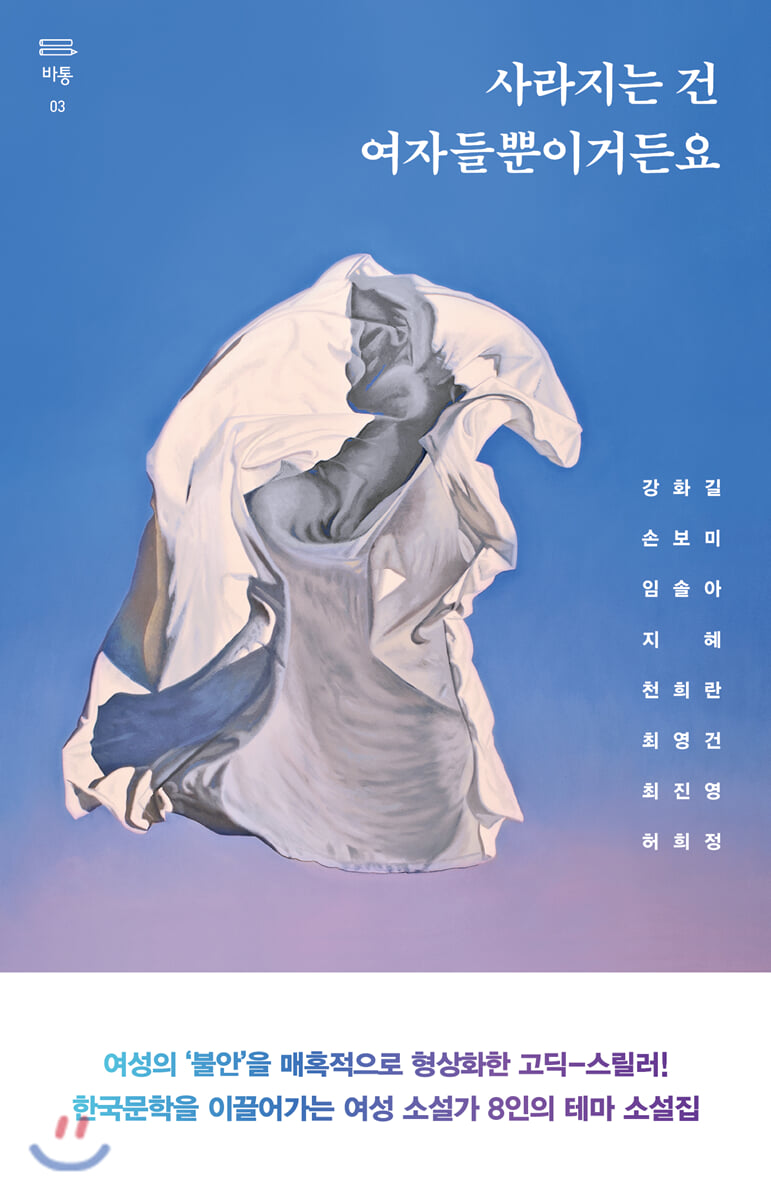
It's only women who disappear.
 |
Description
Book Introduction
- A word from MD
-
A collection of novels by eight female novelists, each with a "gothic-thriller" theme.When these women, who are considered strange, sensitive, and utterly incomprehensible, anxious, and ultimately discordant, finally reveal their unfamiliar faces, the novel rushes out of the world we have so firmly built.
Step out of the light and see the shadows.
There is a story there that will not disappear.
July 31, 2020. Novel/Poetry PD Park Hyung-wook
Records of disappearing women that will not disappear
Eight Beautiful and Powerful Metaphors That Bring Women's Anxiety to the forefront
A collection of novels titled "Only Women Disappear," a "gothic-thriller" themed novel that captivatingly portrays women's anxieties, has been published.
Eight young female novelists leading Korean literature—Hwa-gil Kang, Bo-mi Son, Sol-ah Lim, Ji-hye, Hee-ran Cheon, Yeong-geon Choi, Jin-yeong Choi, and Heo Hee-jeong—represent the anxieties experienced by women living in 2020 in various spaces and times.
From the 2015 Gangnam Station murder case to the recent Nth Room case, through a series of incidents, 'anxiety' has become the most important sense that describes women's lives.
Anxiety arises from various aversions and social pressures that threaten women's lives, but it is also formed through self-imposed limitations, contempt, and disgust.
At this time, anxiety is not something personal, but rather something common to women of different generations, where their experiences overlap.
But common experiences do not immediately lead to solidarity.
The various differences that lie across women's lives place us in the position of both victims and perpetrators, placing us in a position of heterogeneous and irrational impulses.
The gothic thriller genre, which delves into the human psyche through anxiety in specific spaces or relationships, such as Daphne du Maurier's "Rebecca" and Shirley Jackson's "The Haunting of Hill House," brings anxiety to the forefront by revealing the twisted and rough texture of the mind in a grotesque way.
Moreover, it resonates with various social issues surrounding that anxiety, and dismantles and reorganizes 'hysteria', which has long been considered a feminine thing.
By going through the genre of the 'Gothic Thriller', we can now restore the narrative of a woman who has been lost for reasons such as 'strange and unreadable', 'suspicious', and 'crazy', in the most literary way possible.
We hope that the eight gothic thriller novels we will encounter will accurately ignite the anxieties of the socially disadvantaged within the world, while also evoking the empathy and solidarity so desperately needed in this era.
Eight Beautiful and Powerful Metaphors That Bring Women's Anxiety to the forefront
A collection of novels titled "Only Women Disappear," a "gothic-thriller" themed novel that captivatingly portrays women's anxieties, has been published.
Eight young female novelists leading Korean literature—Hwa-gil Kang, Bo-mi Son, Sol-ah Lim, Ji-hye, Hee-ran Cheon, Yeong-geon Choi, Jin-yeong Choi, and Heo Hee-jeong—represent the anxieties experienced by women living in 2020 in various spaces and times.
From the 2015 Gangnam Station murder case to the recent Nth Room case, through a series of incidents, 'anxiety' has become the most important sense that describes women's lives.
Anxiety arises from various aversions and social pressures that threaten women's lives, but it is also formed through self-imposed limitations, contempt, and disgust.
At this time, anxiety is not something personal, but rather something common to women of different generations, where their experiences overlap.
But common experiences do not immediately lead to solidarity.
The various differences that lie across women's lives place us in the position of both victims and perpetrators, placing us in a position of heterogeneous and irrational impulses.
The gothic thriller genre, which delves into the human psyche through anxiety in specific spaces or relationships, such as Daphne du Maurier's "Rebecca" and Shirley Jackson's "The Haunting of Hill House," brings anxiety to the forefront by revealing the twisted and rough texture of the mind in a grotesque way.
Moreover, it resonates with various social issues surrounding that anxiety, and dismantles and reorganizes 'hysteria', which has long been considered a feminine thing.
By going through the genre of the 'Gothic Thriller', we can now restore the narrative of a woman who has been lost for reasons such as 'strange and unreadable', 'suspicious', and 'crazy', in the most literary way possible.
We hope that the eight gothic thriller novels we will encounter will accurately ignite the anxieties of the socially disadvantaged within the world, while also evoking the empathy and solidarity so desperately needed in this era.
- You can preview some of the book's contents.
Preview
index
Walking | Ganghwa-gil 007
The Woman Before, The Woman After | Son Bo-mi 037
Danyoung | Im Sol-ah 091
The Woman Under the Triangular Roof | Wisdom 115
The Legacy of the Camilla Convent | Cheon Hee-ran 147
The Night of Peace and Completion | Choi Young-geon 177
Peace | Choi Jin-young 203
At the Window of a Little House in the Forest | Heo Hee-jeong 231
Preface: Women Who Reject Extinction | Kang Ji-hee (Literary Critic) 263
The Woman Before, The Woman After | Son Bo-mi 037
Danyoung | Im Sol-ah 091
The Woman Under the Triangular Roof | Wisdom 115
The Legacy of the Camilla Convent | Cheon Hee-ran 147
The Night of Peace and Completion | Choi Young-geon 177
Peace | Choi Jin-young 203
At the Window of a Little House in the Forest | Heo Hee-jeong 231
Preface: Women Who Reject Extinction | Kang Ji-hee (Literary Critic) 263
Detailed image
Publisher's Review
Records of disappearing women that will not disappear
Eight Beautiful and Powerful Metaphors That Bring Women's Anxiety to the forefront
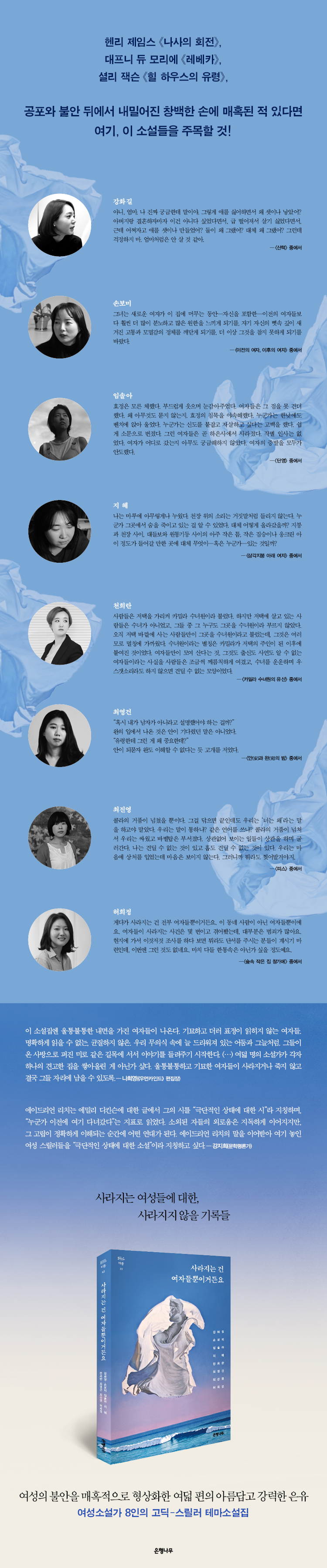
A collection of novels titled "Only Women Disappear," a "gothic-thriller" themed novel that captivatingly portrays women's anxieties, has been published.
Eight young female novelists leading Korean literature—Hwa-gil Kang, Bo-mi Son, Sol-ah Lim, Ji-hye, Hee-ran Cheon, Yeong-geon Choi, Jin-yeong Choi, and Heo Hee-jeong—represent the anxieties experienced by women living in 2020 in various spaces and times.
From the 2015 Gangnam Station murder case to the recent Nth Room case, through a series of incidents, 'anxiety' has become the most important sense that describes women's lives.
Anxiety arises from various aversions and social pressures that threaten women's lives, but it is also formed through self-imposed limitations, contempt, and disgust.
At this time, anxiety is not something personal, but rather something common to women of different generations, where their experiences overlap.
But common experiences do not immediately lead to solidarity.
The various differences that lie across women's lives place us in the position of both victims and perpetrators, placing us in a position of heterogeneous and irrational impulses.
The gothic thriller genre, which delves into the human psyche through anxiety in specific spaces or relationships, such as Daphne du Maurier's "Rebecca" and Shirley Jackson's "The Haunting of Hill House," brings anxiety to the forefront by revealing the twisted and rough texture of the mind in a grotesque way.
Moreover, it resonates with various social issues surrounding that anxiety, and dismantles and reorganizes 'hysteria', which has long been considered a feminine thing.
By going through the genre of the 'Gothic Thriller', we can now restore the narrative of a woman who has been lost for reasons such as 'strange and unreadable', 'suspicious', and 'crazy', in the most literary way possible.
We hope that the eight gothic thriller novels we will encounter will accurately ignite the anxieties of the socially disadvantaged within the world, while also evoking the empathy and solidarity so desperately needed in this era.
“May you feel much more angry and resentful,
I hoped I wouldn't be able to bear it any longer.”
Anxiety is associated with direct and indirect experiences of death.
Here is a story that begins with the voices of women standing by the side of death.
Kang Hwa-gil's "Walk" features a voice heard from beyond death as its speaker.
The voice, which sounds like that of a medium, narrates the history of three generations of women in the family: 'I', my mother ('Youngso'), and 'Jongsuk', a friend of Youngso's, and her mother.
Jinyoung Choi's "Peace" also tells the story through the voice of a younger sibling who witnessed their older sister's suicide attempt.
The sisters' mother, prophetess Oh Pil-nam, puts psychological pressure on her two daughters by 'predicting' things like weight gain and premarital pregnancy.
The prophecy uttered by Oh Pil-nam resembles the social regulations imposed on women for a long time, but it cleverly conceals the structure of exploitation by being delivered through the mouth of a female senior.
Meanwhile, the sister's suicide attempt casts another shadow of anxiety over the speaker.
These novels reveal the uneven and prickly aspects of that relationship, pointing out that the conflict between mother and daughter and sisters is as difficult to bridge as the boundary between life and death.
And then we ask women of all generations, or ourselves, in the voice of the dead.
“Why did you do that?” This is a question that readers will carry with them for a long time.
There are also works that tell the story of a woman in a medieval setting, following the Gothic tradition.
Son Bo-mi's "Woman Before, Woman After" contains the strange story of a woman who begins working as a tutor in a two-story house built in the 1930s.
This short story, reminiscent of Henry James's The Turn of the Screw, highlights female hysteria by bringing to the forefront an "unreliable female narrator."
Im Sol-a's "Danyeong" grotesquely depicts the strange scenery of Haeunsa Temple, where the nun Hyojeong is the head priest.
Hyojeong knows what people expect of her as a female abbot and actively exploits it, and some of the women entrusted to the temple cannot stand it and leave the temple.
Heo Hee-jeong's "At the Window of a Little House in the Forest" also sheds light on things that exist faintly in the world, using the motif of the repeated disappearances of women who visit P City and the strange forest on its outskirts.
But as an uncooperative narrator, his female protagonist becomes a thriller in her own right, deferring the horror and tension by not simply fading away.
The hysteria of the protagonist in this novel is closely related to space and metaphorically shows the source of the anxiety that the socially disadvantaged cannot help but feel.
The way the vast spaces (mansions, temples, forests) move in a direction that exhausts women before and after is a metaphor for the way a vast male-dominated society deals with women's anxieties.
There are also novels about relationships formed in new spaces.
Jihye's "The Woman Under the Triangular Roof" is a story that takes place in the confiscated house owned by Aunt Maehyang, who came to Korea from Japan.
The thumping sound coming from the ceiling of the old house reminds me of the neighborhood's 'crazy girl' and the protagonist's strange cohabitation, and makes me keep wandering down the endless alleys of the story.
In Cheon Hee-ran's "The Legacy of the Camilla Convent," a mother and daughter appear who enter a fictional women's community called the "Camilla Convent" built in Goseong.
However, the mother and daughter's judgments about this seemingly perfect female community are mixed, and the conflict continues unresolved, heading towards destruction.
The 'house' passed down to the two women as a legacy is both a place of life and an incomprehensible object.
These novels ask us what we have inherited in the lineage of female narrative.
In this extension, Choi Young-geon's "Night of Peace and Completeness," which explores an abandoned house to meet a ghost, can also be read as a piece about identity anxiety regarding one's own possessions - one's body - and the conflicting internal and external perspectives on gender, as well as the method of reconciling them.
Indications that someone has been here before,
A voice that tells you that you are not alone in the midst of division and anxiety.
A striking feature of the eight novels is that the anxieties of the female characters, either intentionally or involuntarily, are directed at and influence other women.
However, this narrative cannot be simply understood as a 'woman's enemy is another woman' structure.
This overlapping anxiety is part of the history of suffering that is recreated through 'repetition' and 'generational sense,' and is an expression of the effort to appropriately represent the women who have disappeared.
More importantly, we need to understand the dense mechanisms of psychological exploitation hidden in the language passed from one generation of women to another.
Therefore, reading the female narratives that pour out in a grotesque manner is not an act of passively stuffing women, but of recording them as entities with active aggression, as beings with intense energy.
In her ‘Preface,’ critic Kang Ji-hee borrows Adrienne Rich’s words and calls these eight novels “novels about extreme states.”
The unreal voices, ghosts, and hallucinations in the novel remain unexplained until the end.
It remains and becomes an indicator.
It's a sign that someone has been here before.
It offers a possibility of solidarity, however feeble and unbalanced and irrational it may be.
I hope that this collection of short stories will leave an enduring record of women through the trajectory it leaves here, and that readers will interpret these novels in a way that suits them, thus opening the door to the possibility of solidarity.
Eight Beautiful and Powerful Metaphors That Bring Women's Anxiety to the forefront
A collection of novels titled "Only Women Disappear," a "gothic-thriller" themed novel that captivatingly portrays women's anxieties, has been published.
Eight young female novelists leading Korean literature—Hwa-gil Kang, Bo-mi Son, Sol-ah Lim, Ji-hye, Hee-ran Cheon, Yeong-geon Choi, Jin-yeong Choi, and Heo Hee-jeong—represent the anxieties experienced by women living in 2020 in various spaces and times.
From the 2015 Gangnam Station murder case to the recent Nth Room case, through a series of incidents, 'anxiety' has become the most important sense that describes women's lives.
Anxiety arises from various aversions and social pressures that threaten women's lives, but it is also formed through self-imposed limitations, contempt, and disgust.
At this time, anxiety is not something personal, but rather something common to women of different generations, where their experiences overlap.
But common experiences do not immediately lead to solidarity.
The various differences that lie across women's lives place us in the position of both victims and perpetrators, placing us in a position of heterogeneous and irrational impulses.
The gothic thriller genre, which delves into the human psyche through anxiety in specific spaces or relationships, such as Daphne du Maurier's "Rebecca" and Shirley Jackson's "The Haunting of Hill House," brings anxiety to the forefront by revealing the twisted and rough texture of the mind in a grotesque way.
Moreover, it resonates with various social issues surrounding that anxiety, and dismantles and reorganizes 'hysteria', which has long been considered a feminine thing.
By going through the genre of the 'Gothic Thriller', we can now restore the narrative of a woman who has been lost for reasons such as 'strange and unreadable', 'suspicious', and 'crazy', in the most literary way possible.
We hope that the eight gothic thriller novels we will encounter will accurately ignite the anxieties of the socially disadvantaged within the world, while also evoking the empathy and solidarity so desperately needed in this era.
“May you feel much more angry and resentful,
I hoped I wouldn't be able to bear it any longer.”
Anxiety is associated with direct and indirect experiences of death.
Here is a story that begins with the voices of women standing by the side of death.
Kang Hwa-gil's "Walk" features a voice heard from beyond death as its speaker.
The voice, which sounds like that of a medium, narrates the history of three generations of women in the family: 'I', my mother ('Youngso'), and 'Jongsuk', a friend of Youngso's, and her mother.
Jinyoung Choi's "Peace" also tells the story through the voice of a younger sibling who witnessed their older sister's suicide attempt.
The sisters' mother, prophetess Oh Pil-nam, puts psychological pressure on her two daughters by 'predicting' things like weight gain and premarital pregnancy.
The prophecy uttered by Oh Pil-nam resembles the social regulations imposed on women for a long time, but it cleverly conceals the structure of exploitation by being delivered through the mouth of a female senior.
Meanwhile, the sister's suicide attempt casts another shadow of anxiety over the speaker.
These novels reveal the uneven and prickly aspects of that relationship, pointing out that the conflict between mother and daughter and sisters is as difficult to bridge as the boundary between life and death.
And then we ask women of all generations, or ourselves, in the voice of the dead.
“Why did you do that?” This is a question that readers will carry with them for a long time.
There are also works that tell the story of a woman in a medieval setting, following the Gothic tradition.
Son Bo-mi's "Woman Before, Woman After" contains the strange story of a woman who begins working as a tutor in a two-story house built in the 1930s.
This short story, reminiscent of Henry James's The Turn of the Screw, highlights female hysteria by bringing to the forefront an "unreliable female narrator."
Im Sol-a's "Danyeong" grotesquely depicts the strange scenery of Haeunsa Temple, where the nun Hyojeong is the head priest.
Hyojeong knows what people expect of her as a female abbot and actively exploits it, and some of the women entrusted to the temple cannot stand it and leave the temple.
Heo Hee-jeong's "At the Window of a Little House in the Forest" also sheds light on things that exist faintly in the world, using the motif of the repeated disappearances of women who visit P City and the strange forest on its outskirts.
But as an uncooperative narrator, his female protagonist becomes a thriller in her own right, deferring the horror and tension by not simply fading away.
The hysteria of the protagonist in this novel is closely related to space and metaphorically shows the source of the anxiety that the socially disadvantaged cannot help but feel.
The way the vast spaces (mansions, temples, forests) move in a direction that exhausts women before and after is a metaphor for the way a vast male-dominated society deals with women's anxieties.
There are also novels about relationships formed in new spaces.
Jihye's "The Woman Under the Triangular Roof" is a story that takes place in the confiscated house owned by Aunt Maehyang, who came to Korea from Japan.
The thumping sound coming from the ceiling of the old house reminds me of the neighborhood's 'crazy girl' and the protagonist's strange cohabitation, and makes me keep wandering down the endless alleys of the story.
In Cheon Hee-ran's "The Legacy of the Camilla Convent," a mother and daughter appear who enter a fictional women's community called the "Camilla Convent" built in Goseong.
However, the mother and daughter's judgments about this seemingly perfect female community are mixed, and the conflict continues unresolved, heading towards destruction.
The 'house' passed down to the two women as a legacy is both a place of life and an incomprehensible object.
These novels ask us what we have inherited in the lineage of female narrative.
In this extension, Choi Young-geon's "Night of Peace and Completeness," which explores an abandoned house to meet a ghost, can also be read as a piece about identity anxiety regarding one's own possessions - one's body - and the conflicting internal and external perspectives on gender, as well as the method of reconciling them.
Indications that someone has been here before,
A voice that tells you that you are not alone in the midst of division and anxiety.
A striking feature of the eight novels is that the anxieties of the female characters, either intentionally or involuntarily, are directed at and influence other women.
However, this narrative cannot be simply understood as a 'woman's enemy is another woman' structure.
This overlapping anxiety is part of the history of suffering that is recreated through 'repetition' and 'generational sense,' and is an expression of the effort to appropriately represent the women who have disappeared.
More importantly, we need to understand the dense mechanisms of psychological exploitation hidden in the language passed from one generation of women to another.
Therefore, reading the female narratives that pour out in a grotesque manner is not an act of passively stuffing women, but of recording them as entities with active aggression, as beings with intense energy.
In her ‘Preface,’ critic Kang Ji-hee borrows Adrienne Rich’s words and calls these eight novels “novels about extreme states.”
The unreal voices, ghosts, and hallucinations in the novel remain unexplained until the end.
It remains and becomes an indicator.
It's a sign that someone has been here before.
It offers a possibility of solidarity, however feeble and unbalanced and irrational it may be.
I hope that this collection of short stories will leave an enduring record of women through the trajectory it leaves here, and that readers will interpret these novels in a way that suits them, thus opening the door to the possibility of solidarity.
GOODS SPECIFICS
- Date of issue: July 20, 2020
- Page count, weight, size: 268 pages | 352g | 135*210*16mm
- ISBN13: 9791190492829
- ISBN10: 1190492822
You may also like
카테고리
korean


korean

![GQ KOREA Mark (Monthly): December [2025]](http://librairie.coreenne.fr/cdn/shop/files/8ef265dbbfbf186523ed75ba7319009d.jpg?v=1765340328&width=3840)


