

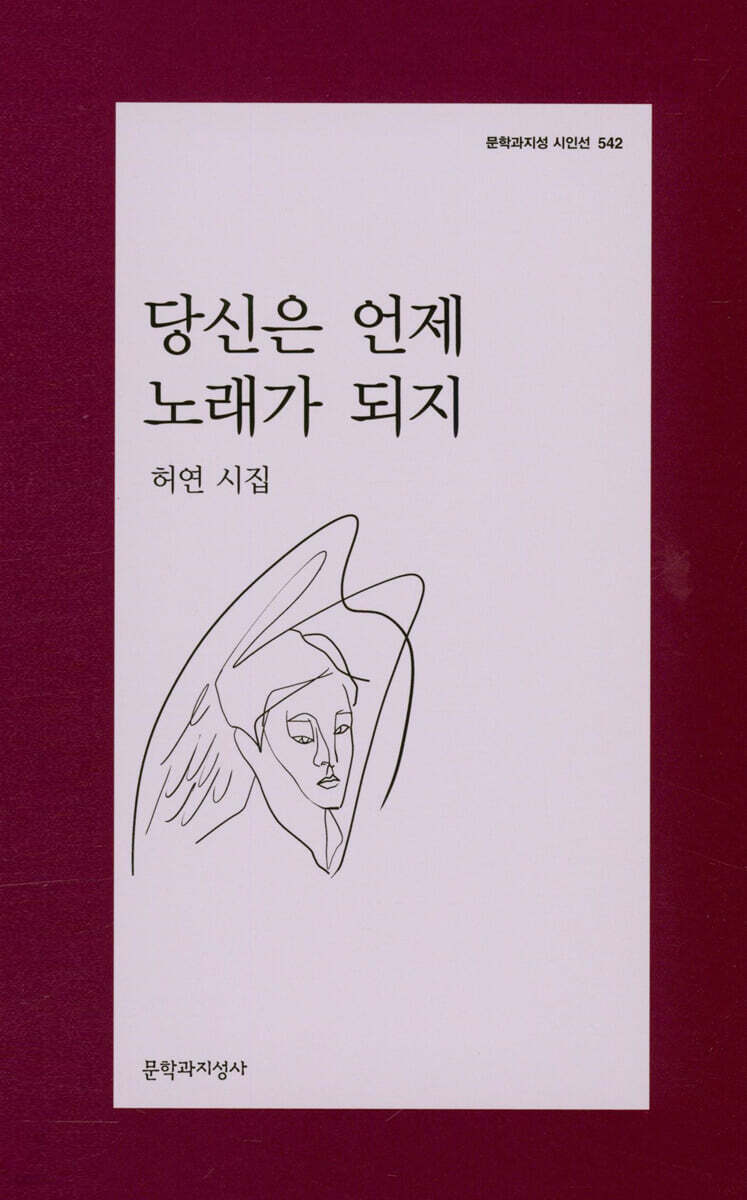
When will you become a song
 |
Description
Book Introduction
- A word from MD
- A bookshelf full of ripe poet's songsPoet Heo Yeon, who has been writing poetry for 30 years, has returned with her fifth poetry collection.
He, who had been the 'unsettling' face of youth, now tells a new story of Heo Yeon.
The poet speaks of this collection of poems as, 'a recognition that poetry is not something I created, but something that just existed in the world.'
Still a sharp sense, a voice that is honest and plain without embellishment.
June 26, 2020. Novel/Poetry PD Park Hyung-wook
Poet Heo Yeon, who celebrated her 30th anniversary this year, has published her fifth poetry collection, “When Will You Become a Song,” by Munhak-kwa-Jiseongsa.
In this collection of poems, the poet senses and discovers the world through poetry.
These are poems that are natural and spoken in everyday life, but his senses are still sharp and he can see through the core of things.
It was a poem of emptiness that stretched endlessly into nothingness, but its center was ultimately on the low and miserable land of this world.
A poet who looks at a bird flying towards the Tropic of Cancer, embracing dirty streets, poor people, sickness and death.
He now begins to tell the story of Heo Yeon, a story that only he can tell, in more honest and plain language.
This collection of poems provides a time for you to sing.
In this collection of poems, the poet senses and discovers the world through poetry.
These are poems that are natural and spoken in everyday life, but his senses are still sharp and he can see through the core of things.
It was a poem of emptiness that stretched endlessly into nothingness, but its center was ultimately on the low and miserable land of this world.
A poet who looks at a bird flying towards the Tropic of Cancer, embracing dirty streets, poor people, sickness and death.
He now begins to tell the story of Heo Yeon, a story that only he can tell, in more honest and plain language.
This collection of poems provides a time for you to sing.
- You can preview some of the book's contents.
Preview
index
Poet's words
Part 1
Trampoline/The Face Value of the World/A Certain Street/November/A Butterfly on a 10,000 Won Subway/A Sad Habit/Sangsu-dong/The Village Chief/That Year's Heavy Snow Advisory/A Bridge Negative/The Beach/Memories Are Busy in a Place I Don't Know/Cafeteria/Unaccompanied Music/1 AM/When Will You Become a Song/I Wish Our Lives Wouldn't Be Discovered/October/Early Spring/A Scene with a Bakery/Illustration of a Subway Station/The North Sea/Seaside Customs/Tropical
Part 2
A certain love story/24-hour hangover soup/Fearful room/Because no one is him/Only the river sheds tears/Track/I'll keep it a secret from my lover/Starbucks at the opposite end/Singing/Funeral/80s/Gyeongwon Line obituary/Boy's note/Your comb-pattern/My back view/Dead pine tree/Thoughts in the eyes/Yonggung seolleongtang/Book of farewell/Library of disillusionment/The face value of the world 2/Mountain bird/San 31
Part 3
Parting is a good ritual/Life is pitiful/The Vampire Boy/What are tears 2/The defenseless city/Unaccompanied 4/Unaccompanied 3/The Nile River/Poets/Memories, True Landscape/Strait/About hell/21st century/Poems in bed/Shanghai Old Days/Municipal crematorium/Revelation/Defeat/Rain on the riverside/White you/Poison/About the center/The room left behind
Preface: May all futures march in blue light here. Park Hyung-jun
Part 1
Trampoline/The Face Value of the World/A Certain Street/November/A Butterfly on a 10,000 Won Subway/A Sad Habit/Sangsu-dong/The Village Chief/That Year's Heavy Snow Advisory/A Bridge Negative/The Beach/Memories Are Busy in a Place I Don't Know/Cafeteria/Unaccompanied Music/1 AM/When Will You Become a Song/I Wish Our Lives Wouldn't Be Discovered/October/Early Spring/A Scene with a Bakery/Illustration of a Subway Station/The North Sea/Seaside Customs/Tropical
Part 2
A certain love story/24-hour hangover soup/Fearful room/Because no one is him/Only the river sheds tears/Track/I'll keep it a secret from my lover/Starbucks at the opposite end/Singing/Funeral/80s/Gyeongwon Line obituary/Boy's note/Your comb-pattern/My back view/Dead pine tree/Thoughts in the eyes/Yonggung seolleongtang/Book of farewell/Library of disillusionment/The face value of the world 2/Mountain bird/San 31
Part 3
Parting is a good ritual/Life is pitiful/The Vampire Boy/What are tears 2/The defenseless city/Unaccompanied 4/Unaccompanied 3/The Nile River/Poets/Memories, True Landscape/Strait/About hell/21st century/Poems in bed/Shanghai Old Days/Municipal crematorium/Revelation/Defeat/Rain on the riverside/White you/Poison/About the center/The room left behind
Preface: May all futures march in blue light here. Park Hyung-jun
Into the book
He says as he throws me on the trampoline
“Tell me, if possible, I want to choose the world.”
I believed that if you had any thoughts, you would tell me
The trampoline is just
Drop me
You drop me without even hating me
Then my situation will also fall as best as I can
I wish all trampolines would disappear from the world.
But it's a pity
Because the few seconds of flying were sweet
--- From "Trampoline"
childhood.
The morning when the great waters swept away,
I wonder if the beggar girl who lived under the bridge pier floated away.
The bridge I ran to without even taking a breath
I ran with a pounding heart,
That sad negative came to mind.
I wonder if I'm sick.
In the stuck eye booger
Cats that can't even open their eyes properly
They mate.
Because I won't come back to this world again
At least I know that much
Under the piers that look like dinosaur bones
Cats burn life.
If you walk under the bridge pier
Everything strangely turns into a dirty word?
On the bridge pier where green water flows like tears
There are immature wills
There is someone's surrender
With friends who died young
There are swear words.
A few forced slogans written with spray paint
Threatening middle age day
On the occasional rattling table top
Concrete powder poured down like a blessing.
Hidden under the Han River bridge that stretches out like a track
I can't erase that secret negative.
That I was negative.
--- From "The Bridge Negation"
Losing your center
A carousel that appeared from nowhere
Carrying both dreams and non-dreams
Disappearing into a vacuum
The center may leave me
As I live
It's the most frustrating thing
Only after I got a dizzying illness
I knew what the center was
The center is shaking
The city and the whole country are shaking
Longing and resentment are all shaken
Wake up at dawn
It's hard to even get to the refrigerator
I also had a center during that time
I lived like a seesaw
It didn't bounce off
I ignored the center
It was expensive and cumbersome
I thought that I could fly infinitely only if I had no center.
Now I understand
There is a center
I was able to fly, flow, and leave.
“Tell me, if possible, I want to choose the world.”
I believed that if you had any thoughts, you would tell me
The trampoline is just
Drop me
You drop me without even hating me
Then my situation will also fall as best as I can
I wish all trampolines would disappear from the world.
But it's a pity
Because the few seconds of flying were sweet
--- From "Trampoline"
childhood.
The morning when the great waters swept away,
I wonder if the beggar girl who lived under the bridge pier floated away.
The bridge I ran to without even taking a breath
I ran with a pounding heart,
That sad negative came to mind.
I wonder if I'm sick.
In the stuck eye booger
Cats that can't even open their eyes properly
They mate.
Because I won't come back to this world again
At least I know that much
Under the piers that look like dinosaur bones
Cats burn life.
If you walk under the bridge pier
Everything strangely turns into a dirty word?
On the bridge pier where green water flows like tears
There are immature wills
There is someone's surrender
With friends who died young
There are swear words.
A few forced slogans written with spray paint
Threatening middle age day
On the occasional rattling table top
Concrete powder poured down like a blessing.
Hidden under the Han River bridge that stretches out like a track
I can't erase that secret negative.
That I was negative.
--- From "The Bridge Negation"
Losing your center
A carousel that appeared from nowhere
Carrying both dreams and non-dreams
Disappearing into a vacuum
The center may leave me
As I live
It's the most frustrating thing
Only after I got a dizzying illness
I knew what the center was
The center is shaking
The city and the whole country are shaking
Longing and resentment are all shaken
Wake up at dawn
It's hard to even get to the refrigerator
I also had a center during that time
I lived like a seesaw
It didn't bounce off
I ignored the center
It was expensive and cumbersome
I thought that I could fly infinitely only if I had no center.
Now I understand
There is a center
I was able to fly, flow, and leave.
---From "On the Center"
Publisher's Review
30 years since debut,
Heoyeon now tells Heoyeon's story
Poet Heo Yeon, who celebrated her 30th anniversary this year, has published her fifth poetry collection, “When Will You Become a Song,” by Munhak-kwa-Jiseongsa.
In the early 1990s, Heo Yeon emerged as a newcomer to the contemporary poetry world with seven poems, including “Kwon Jin-gyu’s Funeral,” and announced the emergence of a new generation by vividly portraying the desires and fears of individual urban dwellers.
After his first poetry collection, 『Unsettling Black Blood』, was published in 1995, rumors circulated for a long time that “the critic who wrote the commentary is dead and the poet who wrote the poems has disappeared,” and countless unsettling youths suffered from heumyeon while copying this poetry collection.
After breaking his 13-year silence and returning to the poetry world with his second collection of poems, “A Bad Boy Is Standing,” he has continued to work steadily while maintaining his characteristically youthful and sophisticated sensibility, publishing a series of hit works, including “The Angel I Want” and “Fifty Meters.”
The poet described this journey in a written interview with poet Park Hyeong-jun, who wrote the preface to this collection of poems.
My first poetry collection, 『Unsettling Black Blood』, was written with the feeling of breaking a soju bottle and stabbing the world in the ribs. My second, 『The Bad Boy Stands』, was a declaration that I had returned to poetry like the prodigal son. My third, 『The Angel I Want』, was a reconciliation to no longer fight poetry but embrace it. My fourth, 『Fifty Meters』, was a surrender that I had finally lived in poetry.
This collection of poems is a recognition that poetry is not something I created, but something that just existed in the world… … (p.
151)
As can be seen from the quote, the poet senses and discovers the world through poetry in this collection.
These are poems that are written in the context of everyday life, poems that are natural, but his senses are still sharp and he can see through the core of things.
It was a poem of emptiness that stretched endlessly into nothingness, but its center was ultimately on the low and miserable land of this world.
A poet who looks at a bird flying towards the Tropic of Cancer, embracing dirty streets, poor people, sickness and death.
He now begins to tell the story of Heo Yeon, a story that only he can tell, in more honest and plain language.
This collection of poems provides a time for you to sing.
A nihilist who failed to voluntarily escape
Heo Yeon, a nihilist by nature, often expressed his sense of revenge against the world without reservation in his early poems.
In the days when he wrote with the feeling of 'stabbing the world in the side' like an eccentric and unkind swordsman, his poetry yearned for escape from a world he could not bear to set foot in.
His poem "Unaccompanied Song," which he wrote in his youth, dreaming of freedom through death along with a strong desire for aesthetics, appears in this collection as a series with the same title, but his changed attitude can be seen in the way it is presented in a completely different tone.
Eric Satie was a man. Eric Satie wanted to make money. Eric Satie was an alcoholic. Eric Satie didn't go to the bank. Eric Satie was dead. Freedom is like death. Death is like freedom. Eric Satie was going to the desert. He was going to the sandstorm.
- "Unaccompanied Song" section (『Uncomfortable Black Blood』, Segyesa, 1995)
Every time I ask if I'm happy
Spitting on the floor
deep-seated faces
Come out of the re-release theater
Gather at a shy restaurant
Eat plain rice
When night comes
Under the cracked security light
Children without shoulders
Play with shadows
[… … ]
When midnight comes
Fortunately
The god of that day was born
Children with clenched fists
Wipe your nose with bread in one hand
Hope here
I come home on crutches
- "Unaccompanied" part
Now, Heoyeon's world will not disappear in the sandstorm.
Even in the midst of the indifferent daily life, violence and darkness, a god is born every day and returns with hope on crutches.
The poet also revealed that the reason his poetry gradually became stronger and more luminous was because of the self-confidence he gained from constant study and reading.
This will not be unfamiliar to readers, as Heo Yeon has extensively and deeply studied the classics and written numerous essays on the subject.
Heo Yeon, who neither learned poetry from a teacher nor copied other people's texts, simply read the poetry collections on her uncle's bookshelf, becoming immersed in the language of poetry that creates big waves with small ripples, and cultivated her own unique style.
The world he reveals in his fifth poetry collection, which has suffered from poetry and grown through poetry, is constantly moving towards some kind of completion.
Even if it's cynical and cold, "A Certain Love Story" will ultimately be remembered as a song.
Rushing is a boring game.
Think carefully.
You must not become addicted.
If you get addicted
Who will live longer? That's the kind of thing you have to worry about.
[… … ]
So don't let your heart thump again.
There are so many types of breakups.
Because it will happen again.
There are too many signs pointing the way and standing
With birds flying in too many directions
With so many ships going to sea
Too many stones
love you.
but
Get out of a burning car.
- "When will you become a song" part
Although Heo Yeon is a cynic from a secular city, he knows that only those who have burned can cool down ("Parting is a good ritual") and only those who have soared can fall ("Trampoline"), so he stands tall as a poet who faces love head-on in this collection of poems.
Accepting the fact that you can't run at top speed every moment, and that's why you have to get out of the burning car, you still manage to love someone and become a butterfly again.
His story, which can only be told by those who have experienced love most faithfully, leads the reader into song, allowing them to completely immerse themselves in the poem without realizing it.
Heo Yeon, who always meets us with honest stories without worrying about what others think, is ready to meet you with his deep love and infinite enlightenment.
The poet's song, which will pour down like monsoon rain, has now arrived.
[Poet's Note]
Poet's words
There was no news.
Wounds made at night don't heal for long.
Couldn't escape
June 2020
Heo Yeon
[Back cover text]
It rained often.
Every morning, a magpie would come and cry on the pine tree outside the window, and joy and sorrow would switch places without me even realizing it.
I heard the sound of a train passing by in the distance, and I was lying there like a newborn, listening to a very long piece of music.
I knew the glare of the excluded
I thought singing was the domain of the excluded
Heoyeon now tells Heoyeon's story
Poet Heo Yeon, who celebrated her 30th anniversary this year, has published her fifth poetry collection, “When Will You Become a Song,” by Munhak-kwa-Jiseongsa.
In the early 1990s, Heo Yeon emerged as a newcomer to the contemporary poetry world with seven poems, including “Kwon Jin-gyu’s Funeral,” and announced the emergence of a new generation by vividly portraying the desires and fears of individual urban dwellers.
After his first poetry collection, 『Unsettling Black Blood』, was published in 1995, rumors circulated for a long time that “the critic who wrote the commentary is dead and the poet who wrote the poems has disappeared,” and countless unsettling youths suffered from heumyeon while copying this poetry collection.
After breaking his 13-year silence and returning to the poetry world with his second collection of poems, “A Bad Boy Is Standing,” he has continued to work steadily while maintaining his characteristically youthful and sophisticated sensibility, publishing a series of hit works, including “The Angel I Want” and “Fifty Meters.”
The poet described this journey in a written interview with poet Park Hyeong-jun, who wrote the preface to this collection of poems.
My first poetry collection, 『Unsettling Black Blood』, was written with the feeling of breaking a soju bottle and stabbing the world in the ribs. My second, 『The Bad Boy Stands』, was a declaration that I had returned to poetry like the prodigal son. My third, 『The Angel I Want』, was a reconciliation to no longer fight poetry but embrace it. My fourth, 『Fifty Meters』, was a surrender that I had finally lived in poetry.
This collection of poems is a recognition that poetry is not something I created, but something that just existed in the world… … (p.
151)
As can be seen from the quote, the poet senses and discovers the world through poetry in this collection.
These are poems that are written in the context of everyday life, poems that are natural, but his senses are still sharp and he can see through the core of things.
It was a poem of emptiness that stretched endlessly into nothingness, but its center was ultimately on the low and miserable land of this world.
A poet who looks at a bird flying towards the Tropic of Cancer, embracing dirty streets, poor people, sickness and death.
He now begins to tell the story of Heo Yeon, a story that only he can tell, in more honest and plain language.
This collection of poems provides a time for you to sing.
A nihilist who failed to voluntarily escape
Heo Yeon, a nihilist by nature, often expressed his sense of revenge against the world without reservation in his early poems.
In the days when he wrote with the feeling of 'stabbing the world in the side' like an eccentric and unkind swordsman, his poetry yearned for escape from a world he could not bear to set foot in.
His poem "Unaccompanied Song," which he wrote in his youth, dreaming of freedom through death along with a strong desire for aesthetics, appears in this collection as a series with the same title, but his changed attitude can be seen in the way it is presented in a completely different tone.
Eric Satie was a man. Eric Satie wanted to make money. Eric Satie was an alcoholic. Eric Satie didn't go to the bank. Eric Satie was dead. Freedom is like death. Death is like freedom. Eric Satie was going to the desert. He was going to the sandstorm.
- "Unaccompanied Song" section (『Uncomfortable Black Blood』, Segyesa, 1995)
Every time I ask if I'm happy
Spitting on the floor
deep-seated faces
Come out of the re-release theater
Gather at a shy restaurant
Eat plain rice
When night comes
Under the cracked security light
Children without shoulders
Play with shadows
[… … ]
When midnight comes
Fortunately
The god of that day was born
Children with clenched fists
Wipe your nose with bread in one hand
Hope here
I come home on crutches
- "Unaccompanied" part
Now, Heoyeon's world will not disappear in the sandstorm.
Even in the midst of the indifferent daily life, violence and darkness, a god is born every day and returns with hope on crutches.
The poet also revealed that the reason his poetry gradually became stronger and more luminous was because of the self-confidence he gained from constant study and reading.
This will not be unfamiliar to readers, as Heo Yeon has extensively and deeply studied the classics and written numerous essays on the subject.
Heo Yeon, who neither learned poetry from a teacher nor copied other people's texts, simply read the poetry collections on her uncle's bookshelf, becoming immersed in the language of poetry that creates big waves with small ripples, and cultivated her own unique style.
The world he reveals in his fifth poetry collection, which has suffered from poetry and grown through poetry, is constantly moving towards some kind of completion.
Even if it's cynical and cold, "A Certain Love Story" will ultimately be remembered as a song.
Rushing is a boring game.
Think carefully.
You must not become addicted.
If you get addicted
Who will live longer? That's the kind of thing you have to worry about.
[… … ]
So don't let your heart thump again.
There are so many types of breakups.
Because it will happen again.
There are too many signs pointing the way and standing
With birds flying in too many directions
With so many ships going to sea
Too many stones
love you.
but
Get out of a burning car.
- "When will you become a song" part
Although Heo Yeon is a cynic from a secular city, he knows that only those who have burned can cool down ("Parting is a good ritual") and only those who have soared can fall ("Trampoline"), so he stands tall as a poet who faces love head-on in this collection of poems.
Accepting the fact that you can't run at top speed every moment, and that's why you have to get out of the burning car, you still manage to love someone and become a butterfly again.
His story, which can only be told by those who have experienced love most faithfully, leads the reader into song, allowing them to completely immerse themselves in the poem without realizing it.
Heo Yeon, who always meets us with honest stories without worrying about what others think, is ready to meet you with his deep love and infinite enlightenment.
The poet's song, which will pour down like monsoon rain, has now arrived.
[Poet's Note]
Poet's words
There was no news.
Wounds made at night don't heal for long.
Couldn't escape
June 2020
Heo Yeon
[Back cover text]
It rained often.
Every morning, a magpie would come and cry on the pine tree outside the window, and joy and sorrow would switch places without me even realizing it.
I heard the sound of a train passing by in the distance, and I was lying there like a newborn, listening to a very long piece of music.
I knew the glare of the excluded
I thought singing was the domain of the excluded
GOODS SPECIFICS
- Date of issue: June 17, 2020
- Page count, weight, size: 158 pages | 228g | 128*205*10mm
- ISBN13: 9788932037479
- ISBN10: 8932037477
You may also like
카테고리
korean


korean

![GQ KOREA Mark (Monthly): December [2025]](http://librairie.coreenne.fr/cdn/shop/files/8ef265dbbfbf186523ed75ba7319009d.jpg?v=1765340328&width=3840)


