

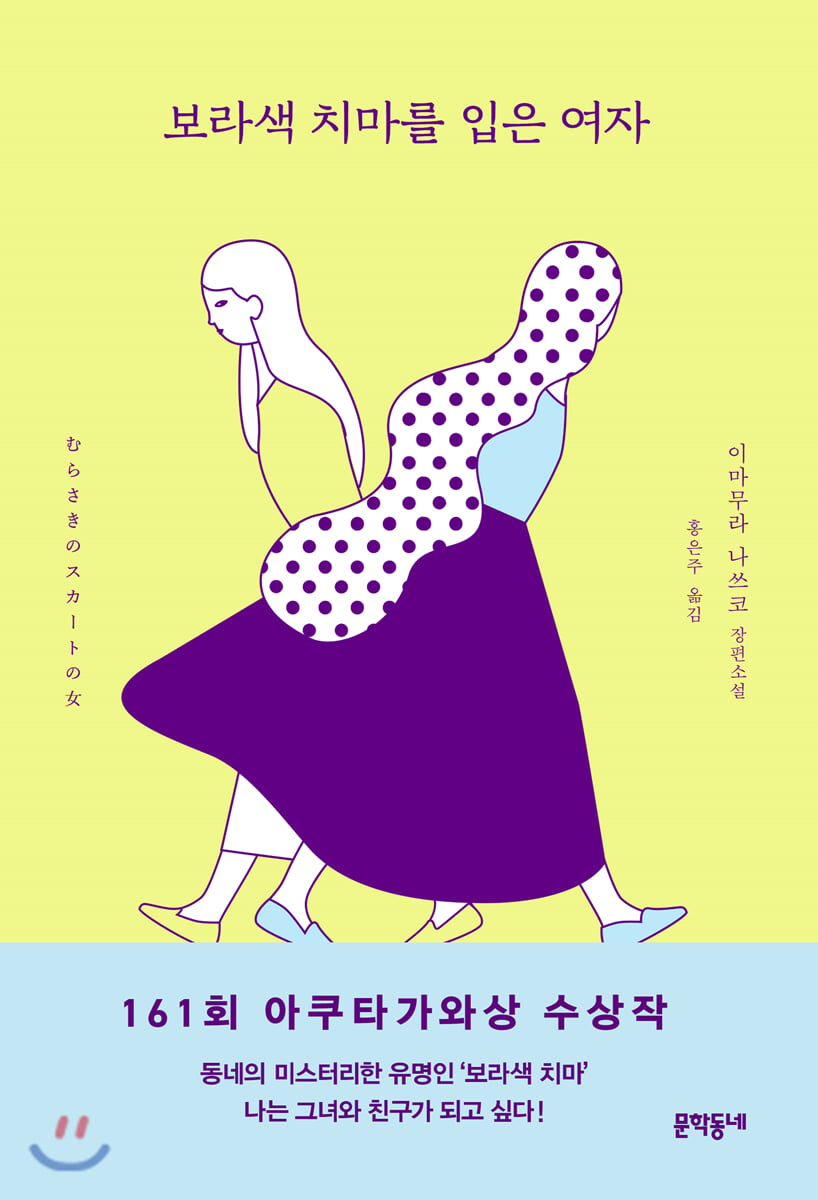
woman in purple skirt
 |
Description
Book Introduction
- A word from MD
-
161st Akutagawa Prize WinnerThe story of 'Purple Skirt', a local celebrity who always wears the same clothes and has hair that looks like it hasn't been washed, and 'I' who observes and records everything about her in order to get closer to her.
As you immerse yourself and follow along, you will naturally encounter the diverse aspects of human relationships that lie beneath, and the duality that moves between the normal and the abnormal.
April 14, 2020. Novel/Poetry PD Park Hyung-wook
161st Akutagawa Prize Winner
The neighborhood's mysterious celebrity, the 'purple skirt'
I want to be friends with her!
The Akutagawa Prize is considered a benchmark of modern Japanese literature and the highest honor given to new writers.
The 161st award-winning work, “The Woman in the Purple Skirt,” announced in the second half of 2019, is the new work of Natsuko Imamura, who has expanded her position by winning major literary awards such as the Yukio Mishima Award, the Osamu Dazai Award, and the Noma Literary New Writer’s Award with only two full-length novels and one short story collection since her debut in 2010.
Recognized for her keen observation of surrounding phenomena and her literary universality, unconstrained by any particular society or era, she is currently considered one of the most notable female writers in Japanese literature.
The so-called 'Purple Skirt' is a famous person known to everyone in the neighborhood where 'I' live.
He always wears the same clothes and has disheveled hair that looks like it hasn't been washed in days. He shows up at the shopping district once a week and stops by a bakery and a park.
There is a jinx going around among the people in the shopping district that seeing a purple skirt once a day is good luck and seeing it more than twice is bad luck, and the neighborhood children play a game where the loser of rock-paper-scissors sneaks up on her, hits her on the back, and runs away.
In the beginning of the novel, 'Purple Skirt' is portrayed as a sinister figure, like the protagonist of an urban legend.
As we follow the protagonist's perspective, which describes her as having a poor living environment and as lacking even basic communication skills, we are reminded of the images of street eccentrics or social misfits that anyone would have seen in real life at least once.
However, as 'Purple Skirt', who has a regular job and is integrated into society, gradually finds normalcy, it is the narrator 'I' who makes the reader feel uneasy and on edge.
For what purpose does "I" want to approach "Purple Skirt"? Even my actions, bordering on stalking, seem abnormal from a third-party perspective. Aren't "Purple Skirt" and "I", upon closer inspection, like two sides of a mirror, exactly alike? Or is "Purple Skirt" perhaps a figment of "I"'s imagination? These nagging questions reach a crescendo when the two finally meet face-to-face, sending the story spiraling into an unexpected direction.
The neighborhood's mysterious celebrity, the 'purple skirt'
I want to be friends with her!
The Akutagawa Prize is considered a benchmark of modern Japanese literature and the highest honor given to new writers.
The 161st award-winning work, “The Woman in the Purple Skirt,” announced in the second half of 2019, is the new work of Natsuko Imamura, who has expanded her position by winning major literary awards such as the Yukio Mishima Award, the Osamu Dazai Award, and the Noma Literary New Writer’s Award with only two full-length novels and one short story collection since her debut in 2010.
Recognized for her keen observation of surrounding phenomena and her literary universality, unconstrained by any particular society or era, she is currently considered one of the most notable female writers in Japanese literature.
The so-called 'Purple Skirt' is a famous person known to everyone in the neighborhood where 'I' live.
He always wears the same clothes and has disheveled hair that looks like it hasn't been washed in days. He shows up at the shopping district once a week and stops by a bakery and a park.
There is a jinx going around among the people in the shopping district that seeing a purple skirt once a day is good luck and seeing it more than twice is bad luck, and the neighborhood children play a game where the loser of rock-paper-scissors sneaks up on her, hits her on the back, and runs away.
In the beginning of the novel, 'Purple Skirt' is portrayed as a sinister figure, like the protagonist of an urban legend.
As we follow the protagonist's perspective, which describes her as having a poor living environment and as lacking even basic communication skills, we are reminded of the images of street eccentrics or social misfits that anyone would have seen in real life at least once.
However, as 'Purple Skirt', who has a regular job and is integrated into society, gradually finds normalcy, it is the narrator 'I' who makes the reader feel uneasy and on edge.
For what purpose does "I" want to approach "Purple Skirt"? Even my actions, bordering on stalking, seem abnormal from a third-party perspective. Aren't "Purple Skirt" and "I", upon closer inspection, like two sides of a mirror, exactly alike? Or is "Purple Skirt" perhaps a figment of "I"'s imagination? These nagging questions reach a crescendo when the two finally meet face-to-face, sending the story spiraling into an unexpected direction.
- You can preview some of the book's contents.
Preview
Into the book
I want to be friends with the purple skirt.
But how?
While I was thinking about it, time just kept passing by.
It's strange to suddenly start talking to someone.
Purple Skirt has probably never heard the words, “Will you be my friend?”
Neither do I.
Most people probably don't have that experience.
That kind of meeting is unnatural.
I'm not even hunting.
Then what should we do?
First of all, I would like to introduce myself formally.
And in a natural way too.
Wouldn't that be possible if we went to the same school or worked at the same company?
--- pp.15-16
Adults should be able to do this at least, but because many people can't do it, this workplace is short-staffed all year round.
The senior staff harass the new employee who doesn't know how to greet others and make him quit.
If you think about it, it's obvious that the one who's bullying is the one who's at fault, but it's also a bit much for someone who can't even say "good morning" at their age.
I'm not in a position to talk about others, though.
--- pp.33-34
So let me try again.
This time, more definitely, the nail dug into the bridge of my nose enough to draw blood.
The purple skirt might make me so angry that I'd be dragged off the bus.
It doesn't matter though.
I'll reveal my name, apologize to Purple Skirt, be forgiven, and then we'll be friends.
--- p.65
But if you open your eyes wide and pay attention, you can see it.
The true meaning of the purple skirt.
The purple skirt is not really enjoying the place.
Even if you smile, your eyes don't.
Compared to the vivid expressions of the other staff members, the purple skirt gives off a somewhat pitiful vibe.
I just force myself to keep in sync so as not to disturb my seniors' enjoyable time.
But how?
While I was thinking about it, time just kept passing by.
It's strange to suddenly start talking to someone.
Purple Skirt has probably never heard the words, “Will you be my friend?”
Neither do I.
Most people probably don't have that experience.
That kind of meeting is unnatural.
I'm not even hunting.
Then what should we do?
First of all, I would like to introduce myself formally.
And in a natural way too.
Wouldn't that be possible if we went to the same school or worked at the same company?
--- pp.15-16
Adults should be able to do this at least, but because many people can't do it, this workplace is short-staffed all year round.
The senior staff harass the new employee who doesn't know how to greet others and make him quit.
If you think about it, it's obvious that the one who's bullying is the one who's at fault, but it's also a bit much for someone who can't even say "good morning" at their age.
I'm not in a position to talk about others, though.
--- pp.33-34
So let me try again.
This time, more definitely, the nail dug into the bridge of my nose enough to draw blood.
The purple skirt might make me so angry that I'd be dragged off the bus.
It doesn't matter though.
I'll reveal my name, apologize to Purple Skirt, be forgiven, and then we'll be friends.
--- p.65
But if you open your eyes wide and pay attention, you can see it.
The true meaning of the purple skirt.
The purple skirt is not really enjoying the place.
Even if you smile, your eyes don't.
Compared to the vivid expressions of the other staff members, the purple skirt gives off a somewhat pitiful vibe.
I just force myself to keep in sync so as not to disturb my seniors' enjoyable time.
--- p.79
Publisher's Review
161st Akutagawa Prize Winner
The neighborhood's mysterious celebrity, the 'purple skirt'
I want to be friends with her!
The Akutagawa Prize is considered a benchmark of modern Japanese literature and the highest honor given to new writers.
The 161st award-winning work, “The Woman in the Purple Skirt,” announced in the second half of 2019, is the new work of Natsuko Imamura, who has expanded her position by winning major literary awards such as the Yukio Mishima Award, the Osamu Dazai Award, and the Noma Literary New Writer’s Award with only two full-length novels and one short story collection since her debut in 2010.
Recognized for her keen observation of surrounding phenomena and her literary universality, unconstrained by any particular society or era, she is currently considered one of the most notable female writers in Japanese literature.
“In short, what I want to say is that for quite some time now,
“I have an idea that I want to be friends with the purple skirt.”
The so-called 'Purple Skirt' is a famous person known to everyone in the neighborhood where 'I' live.
He always wears the same clothes and has disheveled hair that looks like it hasn't been washed in days. He shows up at the shopping district once a week and stops by a bakery and a park.
There is a jinx going around among the people in the shopping district that seeing a purple skirt once a day is good luck and seeing it more than twice is bad luck, and the neighborhood children play a game where the loser of rock-paper-scissors sneaks up on her, hits her on the back, and runs away.
The purple skirt, who lives alone in an old villa without a clear job and who doesn't even make eye contact with people she passes by, is someone everyone knows but no one pays attention to, but 'I' want to be her friend, so I follow her every day, observing and recording her every move.
After working behind the scenes to place a job advertisement on the bench where she always sits in the park, she succeeds in getting Purple Skirt a job at the downtown hotel where she works as a housekeeper. However, even though she ends up working at the same place as she wished, it is not easy to even start a conversation.
And judging by how she's adapting to the workplace, it seems like the purple skirt is more social than I thought.
Maybe even more than 'me'.
In the beginning of the novel, 'Purple Skirt' is portrayed as a sinister figure, like the protagonist of an urban legend.
As we follow the protagonist's perspective, which describes her as having a poor living environment and as lacking even basic communication skills, we are reminded of the images of street eccentrics or social misfits that anyone would have seen in real life at least once.
However, as 'Purple Skirt', who has a regular job and is integrated into society, gradually finds normalcy, it is the narrator 'I' who makes the reader feel uneasy and on edge.
For what purpose does "I" want to approach "Purple Skirt"? Even my actions, bordering on stalking, seem abnormal from a third-party perspective. Aren't "Purple Skirt" and "I", upon closer inspection, like two sides of a mirror, exactly alike? Or is "Purple Skirt" perhaps a figment of "I"'s imagination? These nagging questions reach a crescendo when the two finally meet face-to-face, sending the story spiraling into an unexpected direction.
The narrator in the novel, who spies on the other person's daily life and hovers around, looking for opportunities with the sole thought of wanting to get closer to them, is sometimes overly serious and even comical, but in reality, it seems like an aspect of the fragmented human relationships in modern society where we spy on other people's lives in real time on social media and have no connection with them in reality.
Imamura Natsuko uses the limitations and pitfalls of first-person perspective in refreshing ways to create protagonists with compelling contradictions.
Depending on the perspective and the situation, the protagonist's psychology, which moves between normalcy and madness by a single sheet of paper, evokes vivid empathy in each and every 'me' who reads the book.
A fable of duality that precariously straddles the line between normal and abnormal
An Akutagawa Prize-winning work that captivated the Japanese literary world with its unique worldview.
Imamura Natsuko said that she started writing novels at the age of twenty-nine after suddenly being fired from her job while working various part-time jobs after graduating from college.
(Her long experience as a hotel cleaning staff also influenced this work.) Despite having a relatively short probationary period, her works have shown surprising perfection from the beginning, and are characterized by a simple and easy-to-read style. However, by using characters who are slightly outside the norm as narrators, they create an unstable and mysterious atmosphere at first glance.
Her debut work, "Amiko", which won both the Osamu Dazai Award and the Yukio Mishima Award, is about an elementary school student who is alienated because she cannot learn how to communicate with her family and friends. The film "Star Child", which is set to be released in 2020 and stars child actor Mana Ashida, is a story told from the perspective of a middle school girl who grew up under the influence of her parents who are followers of a cult.
『The Woman in a Purple Skirt』 is also a multifaceted novel that can be read as a completely different story depending on how much the reader trusts or doubts the protagonist. It has received reviews such as “a story whose genre changes every time you read it” (Jun Sasaki, literary critic), “the structure of delving into the narrator’s nature using an unidentified character as a mirror is very successful” (Yoko Ogawa, novelist), and “it delves into a side of the human psyche that we don’t want to know about but want to touch” (『Da Vinci』).
Although she has received considerable attention and recognition since her debut, Natsuko Imamura has not rushed her activities and waited until she “had a story she wanted to tell” before writing this work, which not only bore great fruit in the form of the Akutagawa Prize, but is also predicted to follow in the footsteps of female authors such as Eimi Yamada, Yoko Ogawa, and Hitomi Kanehara, who have showcased unique writing styles and worlds.
The author's sincerity in writing for five hours every day starting at two in the morning, even while raising a three-year-old child, makes us look forward to her future activities.
Akutagawa Prize Judges' Comments
It's not easy to tell a story with a strangely twisted person as the narrator, but by establishing the character of 'Purple Skirt', the narrator's shades are instantly given more depth.
It is Natsuko Imamura's talent to be able to portray human charm that goes beyond common sense so vividly.
_Yoko Ogawa
I was amazed by the writing style that thrust the speaker into a world filled with unreasonable fear and unreality, using language that was not at all exaggerated.
_Eimi Yamada
A work that will appeal to a wide range of readers, from beginners to critics, with its simple sentences, allegorical and dense story, clear characterization, and distinct critical points.
_Masahiko Shimada
Personally, I was drawn to the portrayal of women in this novel.
I've seen a lot of dirty yet attractive men in novels, but this is the first time I've seen a woman like this.
_Shuichi Yoshida
The ambiguous boundary between normal and abnormal leads directly to a labyrinth of humanity.
Although his unique talent was evident in his previous works, I believe he truly shines in this one.
_Teru Miyamoto
The neighborhood's mysterious celebrity, the 'purple skirt'
I want to be friends with her!
The Akutagawa Prize is considered a benchmark of modern Japanese literature and the highest honor given to new writers.
The 161st award-winning work, “The Woman in the Purple Skirt,” announced in the second half of 2019, is the new work of Natsuko Imamura, who has expanded her position by winning major literary awards such as the Yukio Mishima Award, the Osamu Dazai Award, and the Noma Literary New Writer’s Award with only two full-length novels and one short story collection since her debut in 2010.
Recognized for her keen observation of surrounding phenomena and her literary universality, unconstrained by any particular society or era, she is currently considered one of the most notable female writers in Japanese literature.
“In short, what I want to say is that for quite some time now,
“I have an idea that I want to be friends with the purple skirt.”
The so-called 'Purple Skirt' is a famous person known to everyone in the neighborhood where 'I' live.
He always wears the same clothes and has disheveled hair that looks like it hasn't been washed in days. He shows up at the shopping district once a week and stops by a bakery and a park.
There is a jinx going around among the people in the shopping district that seeing a purple skirt once a day is good luck and seeing it more than twice is bad luck, and the neighborhood children play a game where the loser of rock-paper-scissors sneaks up on her, hits her on the back, and runs away.
The purple skirt, who lives alone in an old villa without a clear job and who doesn't even make eye contact with people she passes by, is someone everyone knows but no one pays attention to, but 'I' want to be her friend, so I follow her every day, observing and recording her every move.
After working behind the scenes to place a job advertisement on the bench where she always sits in the park, she succeeds in getting Purple Skirt a job at the downtown hotel where she works as a housekeeper. However, even though she ends up working at the same place as she wished, it is not easy to even start a conversation.
And judging by how she's adapting to the workplace, it seems like the purple skirt is more social than I thought.
Maybe even more than 'me'.
In the beginning of the novel, 'Purple Skirt' is portrayed as a sinister figure, like the protagonist of an urban legend.
As we follow the protagonist's perspective, which describes her as having a poor living environment and as lacking even basic communication skills, we are reminded of the images of street eccentrics or social misfits that anyone would have seen in real life at least once.
However, as 'Purple Skirt', who has a regular job and is integrated into society, gradually finds normalcy, it is the narrator 'I' who makes the reader feel uneasy and on edge.
For what purpose does "I" want to approach "Purple Skirt"? Even my actions, bordering on stalking, seem abnormal from a third-party perspective. Aren't "Purple Skirt" and "I", upon closer inspection, like two sides of a mirror, exactly alike? Or is "Purple Skirt" perhaps a figment of "I"'s imagination? These nagging questions reach a crescendo when the two finally meet face-to-face, sending the story spiraling into an unexpected direction.
The narrator in the novel, who spies on the other person's daily life and hovers around, looking for opportunities with the sole thought of wanting to get closer to them, is sometimes overly serious and even comical, but in reality, it seems like an aspect of the fragmented human relationships in modern society where we spy on other people's lives in real time on social media and have no connection with them in reality.
Imamura Natsuko uses the limitations and pitfalls of first-person perspective in refreshing ways to create protagonists with compelling contradictions.
Depending on the perspective and the situation, the protagonist's psychology, which moves between normalcy and madness by a single sheet of paper, evokes vivid empathy in each and every 'me' who reads the book.
A fable of duality that precariously straddles the line between normal and abnormal
An Akutagawa Prize-winning work that captivated the Japanese literary world with its unique worldview.
Imamura Natsuko said that she started writing novels at the age of twenty-nine after suddenly being fired from her job while working various part-time jobs after graduating from college.
(Her long experience as a hotel cleaning staff also influenced this work.) Despite having a relatively short probationary period, her works have shown surprising perfection from the beginning, and are characterized by a simple and easy-to-read style. However, by using characters who are slightly outside the norm as narrators, they create an unstable and mysterious atmosphere at first glance.
Her debut work, "Amiko", which won both the Osamu Dazai Award and the Yukio Mishima Award, is about an elementary school student who is alienated because she cannot learn how to communicate with her family and friends. The film "Star Child", which is set to be released in 2020 and stars child actor Mana Ashida, is a story told from the perspective of a middle school girl who grew up under the influence of her parents who are followers of a cult.
『The Woman in a Purple Skirt』 is also a multifaceted novel that can be read as a completely different story depending on how much the reader trusts or doubts the protagonist. It has received reviews such as “a story whose genre changes every time you read it” (Jun Sasaki, literary critic), “the structure of delving into the narrator’s nature using an unidentified character as a mirror is very successful” (Yoko Ogawa, novelist), and “it delves into a side of the human psyche that we don’t want to know about but want to touch” (『Da Vinci』).
Although she has received considerable attention and recognition since her debut, Natsuko Imamura has not rushed her activities and waited until she “had a story she wanted to tell” before writing this work, which not only bore great fruit in the form of the Akutagawa Prize, but is also predicted to follow in the footsteps of female authors such as Eimi Yamada, Yoko Ogawa, and Hitomi Kanehara, who have showcased unique writing styles and worlds.
The author's sincerity in writing for five hours every day starting at two in the morning, even while raising a three-year-old child, makes us look forward to her future activities.
Akutagawa Prize Judges' Comments
It's not easy to tell a story with a strangely twisted person as the narrator, but by establishing the character of 'Purple Skirt', the narrator's shades are instantly given more depth.
It is Natsuko Imamura's talent to be able to portray human charm that goes beyond common sense so vividly.
_Yoko Ogawa
I was amazed by the writing style that thrust the speaker into a world filled with unreasonable fear and unreality, using language that was not at all exaggerated.
_Eimi Yamada
A work that will appeal to a wide range of readers, from beginners to critics, with its simple sentences, allegorical and dense story, clear characterization, and distinct critical points.
_Masahiko Shimada
Personally, I was drawn to the portrayal of women in this novel.
I've seen a lot of dirty yet attractive men in novels, but this is the first time I've seen a woman like this.
_Shuichi Yoshida
The ambiguous boundary between normal and abnormal leads directly to a labyrinth of humanity.
Although his unique talent was evident in his previous works, I believe he truly shines in this one.
_Teru Miyamoto
GOODS SPECIFICS
- Date of issue: April 10, 2020
- Format: Hardcover book binding method guide
- Page count, weight, size: 140 pages | 270g | 135*195*15mm
- ISBN13: 9788954671101
- ISBN10: 8954671101
You may also like
카테고리
korean


korean

![GQ KOREA Mark (Monthly): December [2025]](http://librairie.coreenne.fr/cdn/shop/files/8ef265dbbfbf186523ed75ba7319009d.jpg?v=1765340328&width=3840)


