

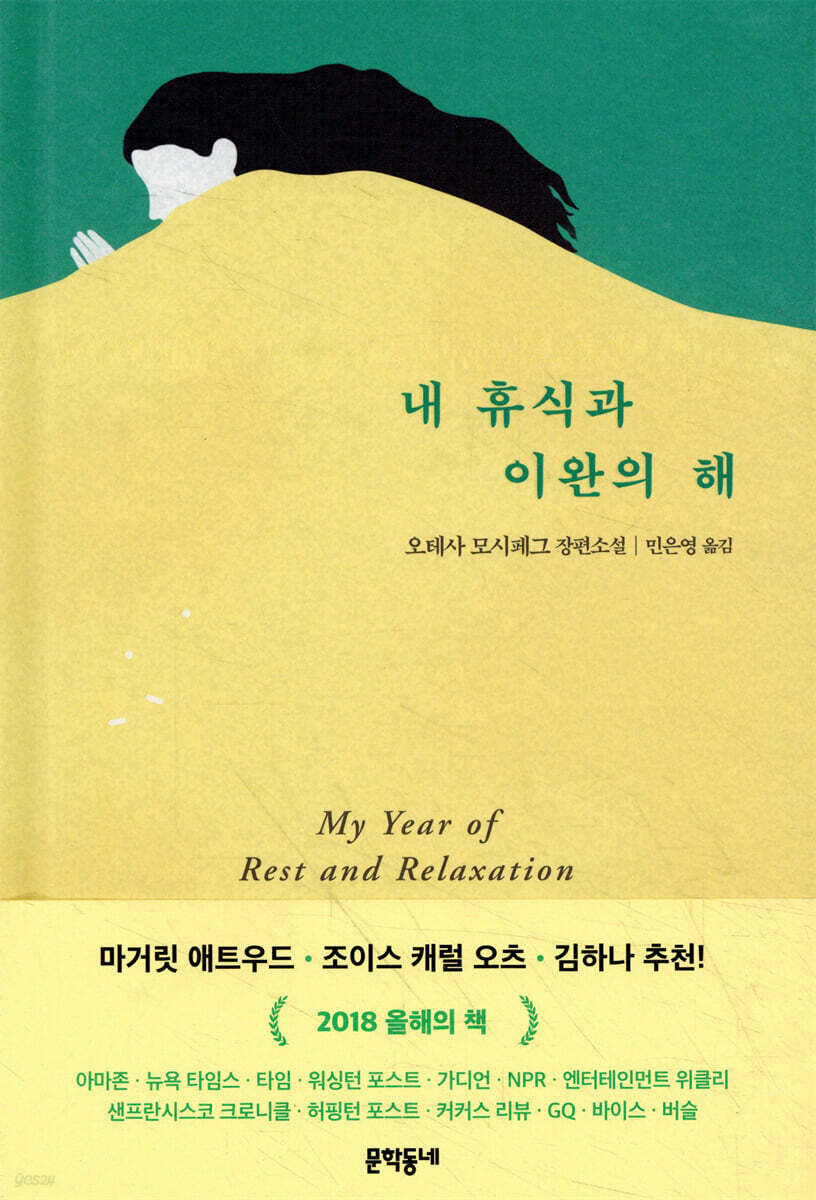
My year of rest and relaxation
 |
Description
Book Introduction
- A word from MD
-
A life filled with nothing but pain, I decided to hibernate.The protagonist decides to sleep for a year to escape from the meaningless and painful reality.
Can sleep save him? What will this "year of rest and relaxation" leave him with? A captivating black comedy that depicts the emotional wanderings and pain we experience in life with direct, cool humor.March 27, 2020. Novel/Poetry PD Park Hyung-wook
A merciless black comedy that brings the fantasy of human hibernation to life.
Otessa Moshfegh's second novel, following Eileen
Otessa Moshfegh's second novel, "My Year of Rest and Relaxation," which has been receiving rave reviews from the English-American literary world for its unique personality, depicts the story of a protagonist who "plans to hibernate for a year to escape her painful reality" in a cold and sharp black comedy. It was named a "Book of the Year" by more than a dozen media outlets and received favorable reviews from Margaret Atwood and Joyce Carol Oates.
Mosifeg, the writer who persistently and boldly writes about characters who would be difficult to like in real life, exquisitely expands the spectrum of empathy.
Following her debut novel, "Eileen," which depicted the youth of a 24-year-old woman consumed by self-loathing while working as a secretary in a juvenile detention center, "My Years of Rest and Relaxation" unfolds the cynical and desperate days of a 26-year-old New Yorker who inherited her deceased parents' estate and earns money literally by sitting still.
If one were to live enjoying the wealth given to them, the hurdles to living in this world would be considerably lowered, but the protagonist, 'I', is in constant pain every day due to the wounds of the past that he has not been able to overcome, all kinds of memories that constantly come to mind, hatred towards everyone, and the futility of everything.
As Lauren Groff (author of Fates and Furies) said, “I envy Mosifeg’s satirical cynicism,” the author pours out direct and cold humor through the protagonist’s mouth, calmly striking at the disillusionment and futility that come with life.
Otessa Moshfegh's second novel, following Eileen
Otessa Moshfegh's second novel, "My Year of Rest and Relaxation," which has been receiving rave reviews from the English-American literary world for its unique personality, depicts the story of a protagonist who "plans to hibernate for a year to escape her painful reality" in a cold and sharp black comedy. It was named a "Book of the Year" by more than a dozen media outlets and received favorable reviews from Margaret Atwood and Joyce Carol Oates.
Mosifeg, the writer who persistently and boldly writes about characters who would be difficult to like in real life, exquisitely expands the spectrum of empathy.
Following her debut novel, "Eileen," which depicted the youth of a 24-year-old woman consumed by self-loathing while working as a secretary in a juvenile detention center, "My Years of Rest and Relaxation" unfolds the cynical and desperate days of a 26-year-old New Yorker who inherited her deceased parents' estate and earns money literally by sitting still.
If one were to live enjoying the wealth given to them, the hurdles to living in this world would be considerably lowered, but the protagonist, 'I', is in constant pain every day due to the wounds of the past that he has not been able to overcome, all kinds of memories that constantly come to mind, hatred towards everyone, and the futility of everything.
As Lauren Groff (author of Fates and Furies) said, “I envy Mosifeg’s satirical cynicism,” the author pours out direct and cold humor through the protagonist’s mouth, calmly striking at the disillusionment and futility that come with life.
- You can preview some of the book's contents.
Preview
index
One | Two | Three | Four | Five | Six | Seven | Eight | Translator's Note
Into the book
There was a lot going on in New York City, but none of it affected me.
That was the wonderful thing about sleep.
--- p.14
I'm not saying I tried to commit suicide.
In fact, it was the exact opposite of suicide.
My hibernation was for self-preservation.
I thought that would save my life.
--- p.18
“Are you happy that Julie Delpy has flab on her arms?” I asked.
“No,” she said after thinking for a while.
“I don’t think that’s happiness.
“It would be closer to satisfaction.”
--- p.22
“I can’t talk to my mom like I used to.
I'm so sad.
I feel abandoned.
“I’m really, really lonely.” “We’re all lonely, Riva,” I said.
That was the truth.
Both she and I were lonely.
This was the most comfort I could give.
--- p.25
I can't pinpoint my decision to hibernate as the result of any one event.
At first, I just wanted a tranquilizer to block my thoughts and judgments, because the constant onslaught made me hate everyone and everything.
I thought life would be more bearable if my brain would just blame the world around me a little less.
--- p.31
The Cutts sought to create art that was subversive, irreverent and shocking, but in reality they were banal countercultural trash, 'expensive punks' whose only inspiration was to make viewers go to the Comme des Garçons store on the corner and buy mismatched clothes.
--- p.54
Ah, sleep.
Nothing but sleep will give me such pleasure, such freedom, the ability to feel, move, think, and imagine free from the pain of waking consciousness.
I was not a narcoleptic.
So, I didn't fall asleep when I didn't want to.
I was close to having insomnia.
Sleep lover.
I've always loved sleep.
--- p.65
Riva's pain was felt in the room.
It was a sadness that only a young woman who had lost her mother could feel.
I feel complicated, angry, and hazy, but strangely hopeful.
I figured it out.
--- p.169
Sometimes, when I felt abandoned and afraid, and heard a voice inside me saying, “I need my mother,” I would take it out and read it, and I would remember what kind of person she really was and how indifferent she was to me.
It was useful.
I realized that the experience of rejection may be the only antidote to delusion.
--- p.190
Life could go on like this forever, I thought.
If we don't take action, that's what will happen.
--- p.236
I will not die quietly and passively, being eaten alive by cancer like my father.
At least my mother did it her way.
I never thought that I would come to respect my mother because of that.
At least my mother had guts.
At least he took matters into his own hands.
--- p.250
“Have you ever considered that you might not know the full story of why I am in this state?”
--- p.295
Pain isn't the only criterion for growth, I told myself.
Sleep worked.
I felt soft and calm, and my emotions came alive.
That's a good thing.
This is my life now.
That was the wonderful thing about sleep.
--- p.14
I'm not saying I tried to commit suicide.
In fact, it was the exact opposite of suicide.
My hibernation was for self-preservation.
I thought that would save my life.
--- p.18
“Are you happy that Julie Delpy has flab on her arms?” I asked.
“No,” she said after thinking for a while.
“I don’t think that’s happiness.
“It would be closer to satisfaction.”
--- p.22
“I can’t talk to my mom like I used to.
I'm so sad.
I feel abandoned.
“I’m really, really lonely.” “We’re all lonely, Riva,” I said.
That was the truth.
Both she and I were lonely.
This was the most comfort I could give.
--- p.25
I can't pinpoint my decision to hibernate as the result of any one event.
At first, I just wanted a tranquilizer to block my thoughts and judgments, because the constant onslaught made me hate everyone and everything.
I thought life would be more bearable if my brain would just blame the world around me a little less.
--- p.31
The Cutts sought to create art that was subversive, irreverent and shocking, but in reality they were banal countercultural trash, 'expensive punks' whose only inspiration was to make viewers go to the Comme des Garçons store on the corner and buy mismatched clothes.
--- p.54
Ah, sleep.
Nothing but sleep will give me such pleasure, such freedom, the ability to feel, move, think, and imagine free from the pain of waking consciousness.
I was not a narcoleptic.
So, I didn't fall asleep when I didn't want to.
I was close to having insomnia.
Sleep lover.
I've always loved sleep.
--- p.65
Riva's pain was felt in the room.
It was a sadness that only a young woman who had lost her mother could feel.
I feel complicated, angry, and hazy, but strangely hopeful.
I figured it out.
--- p.169
Sometimes, when I felt abandoned and afraid, and heard a voice inside me saying, “I need my mother,” I would take it out and read it, and I would remember what kind of person she really was and how indifferent she was to me.
It was useful.
I realized that the experience of rejection may be the only antidote to delusion.
--- p.190
Life could go on like this forever, I thought.
If we don't take action, that's what will happen.
--- p.236
I will not die quietly and passively, being eaten alive by cancer like my father.
At least my mother did it her way.
I never thought that I would come to respect my mother because of that.
At least my mother had guts.
At least he took matters into his own hands.
--- p.250
“Have you ever considered that you might not know the full story of why I am in this state?”
--- p.295
Pain isn't the only criterion for growth, I told myself.
Sleep worked.
I felt soft and calm, and my emotions came alive.
That's a good thing.
This is my life now.
--- p.350
Publisher's Review
A merciless black comedy that brings the fantasy of human hibernation to life.
Otessa Moshfegh's second novel, following Eileen
Otessa Moshfegh's second novel, "My Year of Rest and Relaxation," which has been receiving rave reviews from the English-American literary world for its unique personality, depicts the story of a protagonist who "plans to hibernate for a year to escape her painful reality" in a cold and sharp black comedy. It was named a "Book of the Year" by more than a dozen media outlets and received favorable reviews from Margaret Atwood and Joyce Carol Oates.
Mosifeg, the writer who persistently and boldly writes about characters who would be difficult to like in real life, exquisitely expands the spectrum of empathy.
Following her debut novel, "Eileen," which depicted the youth of a 24-year-old woman consumed by self-loathing while working as a secretary in a juvenile detention center, "My Years of Rest and Relaxation" unfolds the cynical and desperate days of a 26-year-old New Yorker who inherited her deceased parents' estate and earns money literally by sitting still.
I can't pinpoint my decision to hibernate as the result of any one event.
At first, I just wanted a tranquilizer to block my thoughts and judgments, because the constant onslaught made me hate everyone and everything.
I thought life would be more bearable if my brain would just blame the world around me a little less.
(31p)
“Sometimes I feel dead inside,” I said.
“And I hate everyone.” (p. 33)
If one were to live enjoying the wealth given to them, the hurdles to living in this world would be considerably lowered, but the protagonist, 'I', is in constant pain every day due to the wounds of the past that he has not been able to overcome, all kinds of memories that constantly come to mind, hatred towards everyone, and the futility of everything.
As Lauren Groff (author of Fates and Furies) said, “I envy Mosifeg’s satirical cynicism,” the author pours out direct and cold humor through the protagonist’s mouth, calmly striking at the disillusionment and futility that come with life.
“Pain is not the only criterion for growth.
“Sleep worked.”
A cozy fantasy of escaping from disillusioning reality and into sleep
The protagonist's 'hibernation plan' begins thoroughly in its own way.
I arranged for laundry to be picked up once a week, set up automatic payments for all utility bills, and prepaid a year's worth of property taxes.
When I open my eyes, I eat, watch a video, and then fall asleep again, repeating this process, and I only stay awake for two or three hours a day.
I firmly believe that after sleeping as much as I want for a year, I will be able to start a new life, that my past life will be a dream, and that I will be able to start anew, empowered by the joy and peace that will accumulate during this year of rest and relaxation.
In this process, the protagonist receives help from drugs.
When I tell Dr. Turtle, a psychiatrist I found in the phone book, that I am tormented and have trouble sleeping because of my “desire to escape the prison of my mind and body,” Dr. Turtle says that it is “not so uncommon,” and readily prescribes me various tranquilizers, even giving me tips on dealing with health authorities and insurance companies.
Will this enviable and fantastic plan of 'sleeping soundly for a year without worrying about money or people' be able to come to fruition?
There was a lot going on in New York City, but none of it affected me.
That was the wonderful thing about sleep.
(14p)
I slept all day and all night, only staying up for two or three hours in between.
That's really good, I thought.
Finally, I was doing something really important.
Sleep felt productive, and something was being sorted out.
I'll be fine after I get enough sleep.
It will be renewed and reborn again.
(71p)
Half of the drugs the protagonist takes in his mouth to achieve peace of mind are real and half are made up by the author.
While his hibernation plan is disrupted by unexpected drug side effects and incidents that disrupt his sleep, the protagonist encounters a virtual drug called 'Infermiterol', reminiscent of the inferno, and finally resumes a smooth sleep life by waking up once every three days.
Will the protagonist, who wakes up refreshed after spending a year like that, be able to be saved?
The protagonist opens his eyes on June 1, 2001, and three months later, the World Trade Center collapses.
What would the protagonist have thought when he opened his eyes and faced the sight of death after spending a year in sleep, wanting to live?
Whatever appears at the end of your cozy escape, haven't you finally realized the stark truth that you must open your eyes and look at it with a clear mind to reach your next destination?
Even if it means death.
Look away or face it, get rich or go crazy or die
As the vitality of life wanes, each person clings to existence and daily life.
Before the protagonist decided to hibernate, she had no one to rely on emotionally.
My cynical and selfish mother died from alcohol and drugs, and my father, a respected professor, lived a colorless and insignificant life next to my mother until he died of cancer.
They were parents who were so caught up in their own problems that they could not give love to their children.
The protagonist's only friend, Riva, repeats a daily routine of binge eating and vomiting, and dresses up in fake luxury goods to fit into New York's mainstream society.
He is always drunk and feels a mixture of admiration and jealousy towards the pretty and wealthy protagonist.
Dr. Tuttle, a psychiatrist who overuses tranquilizers and is steeped in mysticism, and Trevor, an ex-boyfriend who appears to be a handsome financier but only demands unpleasant and one-sided sexual acts in relationships, are not normal people.
The protagonist, too, is mired in cynicism and nihilism, and does not give himself to the world or other people.
“It feels like I’m waiting for the train to hell,” he whispered.
“I’m so tired I could die.” Hell was the only destination in the metaphors my mother used.
(178p)
Riva felt angry, passionate, depressed, or joyful at times.
I didn't do that.
He refused to do so.
I felt nothing and became a blank slate.
One day Trevor told me I was feeling a bit insensitive, and I was okay with that.
are you okay.
She's going to be a cold-hearted bitch.
I'm going to be an ice queen.
(249p)
The author holds a magnifying glass to the twisted and pathological aspects of the characters.
At first, you may feel distant because of its unfavorable appearance, but as you follow the realistic, cold, or humorous descriptions, at some point you will find yourself laughing or being struck by a certain coolness.
Even though they may seem bizarre and pathetic to the protagonist, these characters rely on alcohol, vanity, or whatever to sustain their spirits and get through their daily lives.
Go to work, exercise, insist on being yourself, and accept the path of death that comes.
And such scenes of life inevitably find their way into the cracks in the curtain of sleep that surrounds the protagonist, disturbing his deep sleep.
At the end of this journey of sleep, one question remains before us.
When I feel myself faltering and about to collapse at the boundary between myself and others, between the self and the outside world, will I muster up the courage to open my eyes, or will I close them?
Otessa Moshfegh's second novel, following Eileen
Otessa Moshfegh's second novel, "My Year of Rest and Relaxation," which has been receiving rave reviews from the English-American literary world for its unique personality, depicts the story of a protagonist who "plans to hibernate for a year to escape her painful reality" in a cold and sharp black comedy. It was named a "Book of the Year" by more than a dozen media outlets and received favorable reviews from Margaret Atwood and Joyce Carol Oates.
Mosifeg, the writer who persistently and boldly writes about characters who would be difficult to like in real life, exquisitely expands the spectrum of empathy.
Following her debut novel, "Eileen," which depicted the youth of a 24-year-old woman consumed by self-loathing while working as a secretary in a juvenile detention center, "My Years of Rest and Relaxation" unfolds the cynical and desperate days of a 26-year-old New Yorker who inherited her deceased parents' estate and earns money literally by sitting still.
I can't pinpoint my decision to hibernate as the result of any one event.
At first, I just wanted a tranquilizer to block my thoughts and judgments, because the constant onslaught made me hate everyone and everything.
I thought life would be more bearable if my brain would just blame the world around me a little less.
(31p)
“Sometimes I feel dead inside,” I said.
“And I hate everyone.” (p. 33)
If one were to live enjoying the wealth given to them, the hurdles to living in this world would be considerably lowered, but the protagonist, 'I', is in constant pain every day due to the wounds of the past that he has not been able to overcome, all kinds of memories that constantly come to mind, hatred towards everyone, and the futility of everything.
As Lauren Groff (author of Fates and Furies) said, “I envy Mosifeg’s satirical cynicism,” the author pours out direct and cold humor through the protagonist’s mouth, calmly striking at the disillusionment and futility that come with life.
“Pain is not the only criterion for growth.
“Sleep worked.”
A cozy fantasy of escaping from disillusioning reality and into sleep
The protagonist's 'hibernation plan' begins thoroughly in its own way.
I arranged for laundry to be picked up once a week, set up automatic payments for all utility bills, and prepaid a year's worth of property taxes.
When I open my eyes, I eat, watch a video, and then fall asleep again, repeating this process, and I only stay awake for two or three hours a day.
I firmly believe that after sleeping as much as I want for a year, I will be able to start a new life, that my past life will be a dream, and that I will be able to start anew, empowered by the joy and peace that will accumulate during this year of rest and relaxation.
In this process, the protagonist receives help from drugs.
When I tell Dr. Turtle, a psychiatrist I found in the phone book, that I am tormented and have trouble sleeping because of my “desire to escape the prison of my mind and body,” Dr. Turtle says that it is “not so uncommon,” and readily prescribes me various tranquilizers, even giving me tips on dealing with health authorities and insurance companies.
Will this enviable and fantastic plan of 'sleeping soundly for a year without worrying about money or people' be able to come to fruition?
There was a lot going on in New York City, but none of it affected me.
That was the wonderful thing about sleep.
(14p)
I slept all day and all night, only staying up for two or three hours in between.
That's really good, I thought.
Finally, I was doing something really important.
Sleep felt productive, and something was being sorted out.
I'll be fine after I get enough sleep.
It will be renewed and reborn again.
(71p)
Half of the drugs the protagonist takes in his mouth to achieve peace of mind are real and half are made up by the author.
While his hibernation plan is disrupted by unexpected drug side effects and incidents that disrupt his sleep, the protagonist encounters a virtual drug called 'Infermiterol', reminiscent of the inferno, and finally resumes a smooth sleep life by waking up once every three days.
Will the protagonist, who wakes up refreshed after spending a year like that, be able to be saved?
The protagonist opens his eyes on June 1, 2001, and three months later, the World Trade Center collapses.
What would the protagonist have thought when he opened his eyes and faced the sight of death after spending a year in sleep, wanting to live?
Whatever appears at the end of your cozy escape, haven't you finally realized the stark truth that you must open your eyes and look at it with a clear mind to reach your next destination?
Even if it means death.
Look away or face it, get rich or go crazy or die
As the vitality of life wanes, each person clings to existence and daily life.
Before the protagonist decided to hibernate, she had no one to rely on emotionally.
My cynical and selfish mother died from alcohol and drugs, and my father, a respected professor, lived a colorless and insignificant life next to my mother until he died of cancer.
They were parents who were so caught up in their own problems that they could not give love to their children.
The protagonist's only friend, Riva, repeats a daily routine of binge eating and vomiting, and dresses up in fake luxury goods to fit into New York's mainstream society.
He is always drunk and feels a mixture of admiration and jealousy towards the pretty and wealthy protagonist.
Dr. Tuttle, a psychiatrist who overuses tranquilizers and is steeped in mysticism, and Trevor, an ex-boyfriend who appears to be a handsome financier but only demands unpleasant and one-sided sexual acts in relationships, are not normal people.
The protagonist, too, is mired in cynicism and nihilism, and does not give himself to the world or other people.
“It feels like I’m waiting for the train to hell,” he whispered.
“I’m so tired I could die.” Hell was the only destination in the metaphors my mother used.
(178p)
Riva felt angry, passionate, depressed, or joyful at times.
I didn't do that.
He refused to do so.
I felt nothing and became a blank slate.
One day Trevor told me I was feeling a bit insensitive, and I was okay with that.
are you okay.
She's going to be a cold-hearted bitch.
I'm going to be an ice queen.
(249p)
The author holds a magnifying glass to the twisted and pathological aspects of the characters.
At first, you may feel distant because of its unfavorable appearance, but as you follow the realistic, cold, or humorous descriptions, at some point you will find yourself laughing or being struck by a certain coolness.
Even though they may seem bizarre and pathetic to the protagonist, these characters rely on alcohol, vanity, or whatever to sustain their spirits and get through their daily lives.
Go to work, exercise, insist on being yourself, and accept the path of death that comes.
And such scenes of life inevitably find their way into the cracks in the curtain of sleep that surrounds the protagonist, disturbing his deep sleep.
At the end of this journey of sleep, one question remains before us.
When I feel myself faltering and about to collapse at the boundary between myself and others, between the self and the outside world, will I muster up the courage to open my eyes, or will I close them?
GOODS SPECIFICS
- Date of issue: March 20, 2020
- Format: Hardcover book binding method guide
- Page count, weight, size: 360 pages | 448g | 135*195*27mm
- ISBN13: 9788954671033
- ISBN10: 8954671039
You may also like
카테고리
korean


korean

![GQ KOREA Mark (Monthly): December [2025]](http://librairie.coreenne.fr/cdn/shop/files/8ef265dbbfbf186523ed75ba7319009d.jpg?v=1765340328&width=3840)


