

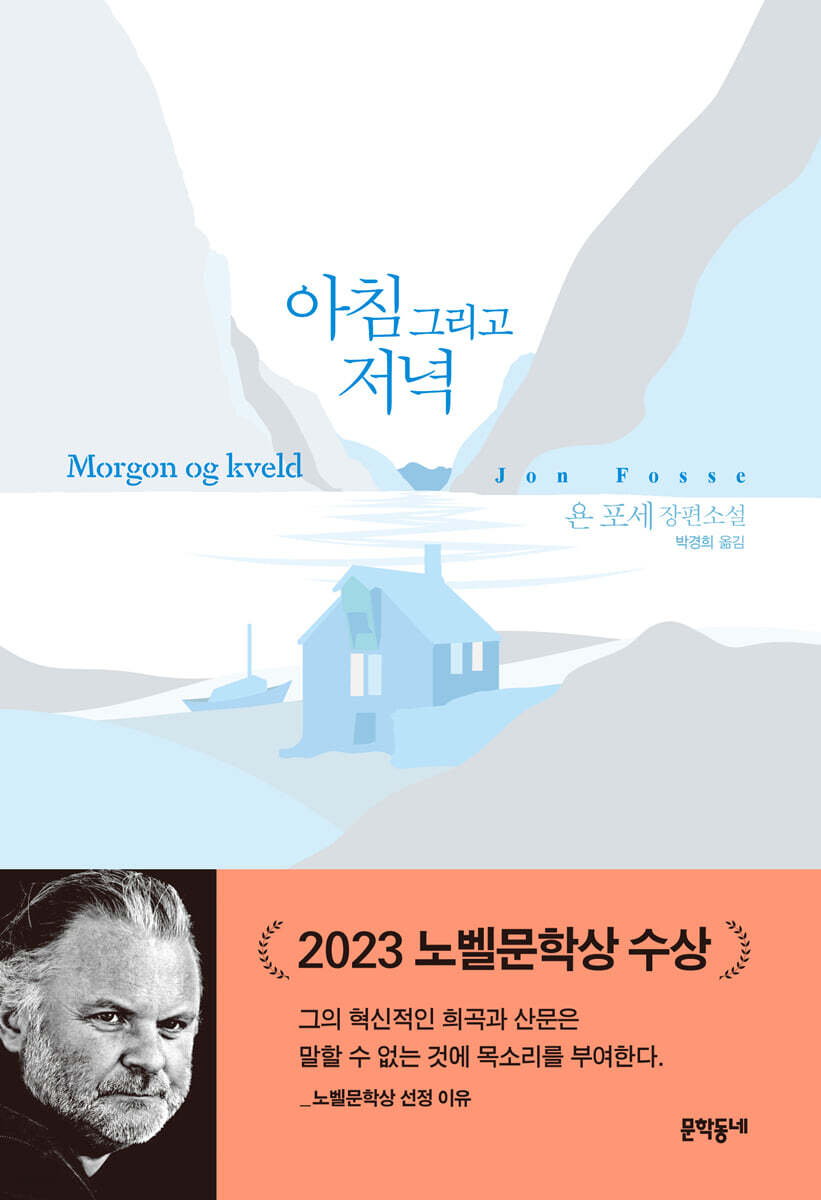
Morning and evening
 |
Description
Book Introduction
- A word from MD
- A masterpiece depicting life and death without a periodA masterpiece depicting life and death that continue without a period.
A novel that uniquely depicts 'the morning of birth and the evening of death', it is a story that will remain deep in the heart for a long time, reminding us that just as life and death continue without a period, the life and death of one person permeate those who remain, and that their lives are connected by commas.
August 2, 2019. Novel/Poetry PD Kim Do-hoon
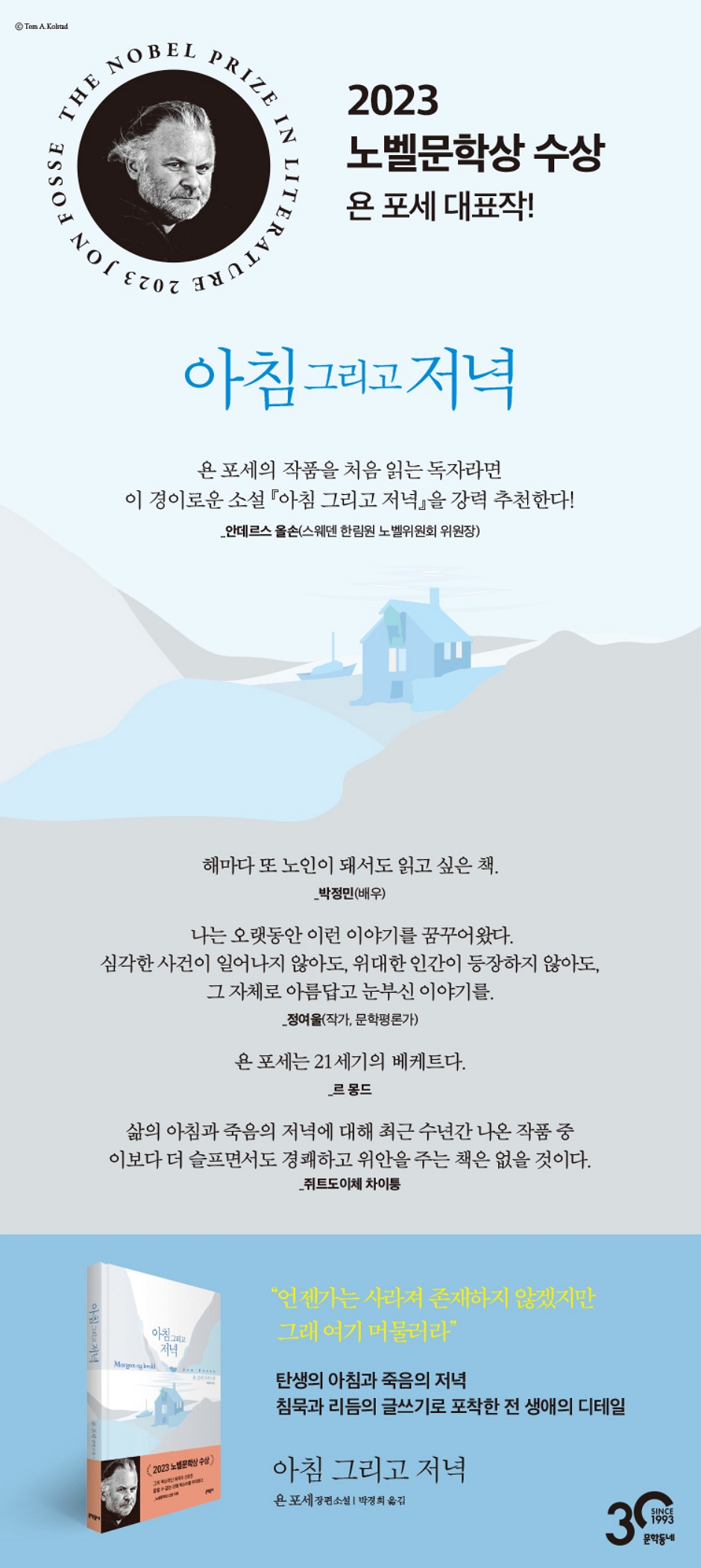
John Fosse wins the 2023 Nobel Prize in Literature
Human life, struggle for survival, and death depicted in a poetic and musical style
At the beginning of the novel, the father, who is about to have a child, says:
When a street musician plays a great piece, you can hear a little bit of what his god is trying to say, that God is there.
But Satan doesn't like this, so when a really great musician tries to play, he always prepares a lot of noise and noise.
The music this book creates is particularly soft, quiet, and short.
There isn't much to talk about.
No special events occur, no extraordinary characters appear, and no flashy rhetoric catches the eye.
While the inner voice of the protagonist resonates ceaselessly like an actor delivering a monologue on stage, the conversations between characters are extremely taciturn and desolate.
Silence creates space, and words like 'yes', 'no', and 'and' are repeated, creating a special rhythm.
From nothing to nothing, that is the process of living, the music that speaks of “death in life, life in death” is so beautiful that Satan’s interference is not in vain.
Jon Fosse creates profound stories using simple and concise language.
It is up to the readers to fill in the silence beyond the comma and its intimate nuances.
Human life, struggle for survival, and death depicted in a poetic and musical style
At the beginning of the novel, the father, who is about to have a child, says:
When a street musician plays a great piece, you can hear a little bit of what his god is trying to say, that God is there.
But Satan doesn't like this, so when a really great musician tries to play, he always prepares a lot of noise and noise.
The music this book creates is particularly soft, quiet, and short.
There isn't much to talk about.
No special events occur, no extraordinary characters appear, and no flashy rhetoric catches the eye.
While the inner voice of the protagonist resonates ceaselessly like an actor delivering a monologue on stage, the conversations between characters are extremely taciturn and desolate.
Silence creates space, and words like 'yes', 'no', and 'and' are repeated, creating a special rhythm.
From nothing to nothing, that is the process of living, the music that speaks of “death in life, life in death” is so beautiful that Satan’s interference is not in vain.
Jon Fosse creates profound stories using simple and concise language.
It is up to the readers to fill in the silence beyond the comma and its intimate nuances.
- You can preview some of the book's contents.
Preview
index
Ⅰ 7
Ⅱ 31
Translator's Note 137
Ⅱ 31
Translator's Note 137
Detailed image
Into the book
Could God be so cruel? No, it couldn't be. But I never doubted that Satan, no less than a benevolent God, rules this world. The world is run by lesser gods and evils. But that's not all. A benevolent God exists, too.
--- p.13
To put it bluntly, his god is not a god that exists in this world, only something one can vaguely guess when one turns his back on the world.
--- p.17
When a street musician plays well, he can hear a little bit of what his god is trying to say, and then God is there, because good music makes you forget the troubles of the world.
--- p.18
Disappearance is nothing but old age, but it is not like that at all, that clear cry, that clear cry, clear as a star, like a name, like a sense, the wind, this breath, this quiet breath, and then still, still, still movements, and soft, white cloth, not so long ago, but a piece of cloth from the sea, and instead of darkness and red, a dry, fearful silence.
--- p.20
Little Johannes cries and cries and hears his voice echoing out into the world, his cries filling the world he now belongs to, and there is nothing warm and black and a little red and a little wet and whole anymore, only his own movements, something that seems to fill everything, everything that exists,
--- p.24
It's no use being too slack, he had to move his body, or he'd eventually rust completely. Youth was a distant memory, Johannes thought. Now, he really had to get up.
--- p.34
"It's a real pain," says Peter. "The sea doesn't want you anymore," he says. "So, all that's left is land," says Peter.
--- p.81
He sits down at his table in the kitchen, takes a sip of coffee, relights the cigarette he left in the ashtray, takes a few puffs, then stands by the window and looks out. "How sad," Johannes thinks, "to be alone like this is terrible."
--- p.112
Everything you love is there, says Peter, and there is nothing you don't love.
--- p.13
To put it bluntly, his god is not a god that exists in this world, only something one can vaguely guess when one turns his back on the world.
--- p.17
When a street musician plays well, he can hear a little bit of what his god is trying to say, and then God is there, because good music makes you forget the troubles of the world.
--- p.18
Disappearance is nothing but old age, but it is not like that at all, that clear cry, that clear cry, clear as a star, like a name, like a sense, the wind, this breath, this quiet breath, and then still, still, still movements, and soft, white cloth, not so long ago, but a piece of cloth from the sea, and instead of darkness and red, a dry, fearful silence.
--- p.20
Little Johannes cries and cries and hears his voice echoing out into the world, his cries filling the world he now belongs to, and there is nothing warm and black and a little red and a little wet and whole anymore, only his own movements, something that seems to fill everything, everything that exists,
--- p.24
It's no use being too slack, he had to move his body, or he'd eventually rust completely. Youth was a distant memory, Johannes thought. Now, he really had to get up.
--- p.34
"It's a real pain," says Peter. "The sea doesn't want you anymore," he says. "So, all that's left is land," says Peter.
--- p.81
He sits down at his table in the kitchen, takes a sip of coffee, relights the cigarette he left in the ashtray, takes a few puffs, then stands by the window and looks out. "How sad," Johannes thinks, "to be alone like this is terrible."
--- p.112
Everything you love is there, says Peter, and there is nothing you don't love.
--- p.133
Publisher's Review
John Fosse wins the 2023 Nobel Prize in Literature
Human life, struggle for survival, and death depicted in a poetic and musical style
The 2023 Nobel Prize in Literature has been awarded to John Fosse.
Norwegian writer Jon Fosse, who has been called “the return of Ibsen” and “the Samuel Beckett of the 21st century,” is one of the most widely active playwrights in the world today and has been evaluated as leading the way in contemporary theater.
In addition to plays, he has written a vast body of work across a variety of genres, including novels, poetry, essays, picture books, and translations, and his works have been translated into over 40 languages, receiving worldwide attention.
His works sharply and densely depict universal issues of life and death and fundamental reflections on human existence revealed in ordinary daily life and human relationships through minimalist compositions that severely limit unnecessary elements, repetition techniques expressed between realism and absurdism, and a unique poetic and musical style that emphasizes rhythm while excluding periods.
His innovative plays and prose give voice to the unspeakable.
_Reasons for selection for the Nobel Prize in Literature
“It’s overwhelming and a little scary.
“I think this award is given, above all, to literature that aims to be literature for no other reason than to be literature.” _Jon Fosse (in an interview with the Norwegian publisher Samlaget immediately after receiving the Nobel Prize in Literature)
“When the call came, I was both surprised and not surprised at the same time.
It was a great pleasure to receive that call.
“For the past ten years, the Nobel Prize in Literature has been a topic of discussion, and I have been somewhat cautiously preparing for the situation where it actually happens.” _Jon Fosse (interview with Norwegian public broadcaster NRK)
John Fosse debuted in 1983 with the novel Red, Black.
Since the publication of his first play, "And We Shall Never Part Part," in 1994, he has performed dozens of plays on stages around the world more than 900 times. As "the most performed Norwegian playwright after Ibsen," he has earned the nickname "Beckett of the 21st century" for his experimental form that delves into the space of silence and blankness between languages, rather than between words.
In 2000, he published the novel "Morning and Evening", which received critical acclaim and won the Melsom Literary Award, given to a "worthy work that brought glory to the Norwegian language."
From this point on, he declared that he would focus more on writing novels than plays, and in 2014, he published a series of novels titled “Trilogy” (“The Sleepless,” “Olaf’s Dream,” “At Dusk”) that criticized human hypocrisy and duplicity through the reality of refugees in Europe, and in 2022, he published a novel titled “Seven-Party” (“I-II Another Name,” “III IV V I Am Another Person,” “VI VII A New Name”).
He has won the Nynorsk Prize for Literature, given to the best literary work written in Norwegian, three times: in 1992, 2003, and 2019.
He received the Dobloug Prize awarded by the Swedish Academy for Swedish and Norwegian literature in 1999, the Honorary Award of the Norwegian Arts Council in 2003, the Brage Prize, Norway's highest literary award, in 2005, the Swedish Academy's Nordic Literature Prize in 2007, the International Ibsen Award in 2010, and the Nordic Council Literature Prize in 2015. He was awarded the French Order of Merit in 2003 and the Norwegian Order of St. Olav by the King of Norway in 2005.
He was named one of the '100 Living Geniuses' by the British Daily Telegraph.
He won the 2023 Nobel Prize in Literature.
Fosse's work approaches your deepest emotions, anxieties, instability, concerns about life and death.
Fosse combines a strong linguistic and topographical regionality with modernist artistic techniques.
Everything he wrote has universal meaning.
His work, whether plays, poetry or prose, contains an appeal to humanism.
Anders Olsson (Chairman of the Academy)
The morning of birth and the evening of death
Details of a lifetime captured through writing in silence and rhythm
I've been dreaming of a story like this for a long time.
A beautiful and dazzling story in itself, even without serious incidents or the appearance of great people.
_Jeong Yeo-ul (writer, literary critic)
The diligent movements of the midwife, the laboring breaths of the mother, the anticipation and worry of the man who is about to become a father.
The novel begins with a scene of childbirth in a house somewhere in a coastal Norwegian village.
The inner monologue of a man, filled with anxiety that something might go wrong and he might lose his wife or child, or both, continues, and his thoughts turn to God, who will surely help them and save them from all evil.
But if there's one thing that's certain for a man who doesn't believe everything happens according to God's will, it's that the child will be named Johannes, like his grandfather.
The anxious moments finally end when the baby is born after a long string of screams from his wife mixed with unspoken vowels that cannot be formed into words.
And so, a child named Johannes was born.
As the chapter changed and a long time passed, Johannes became an old man.
He married his lover, started a family, left his remote hometown, settled in a new place, and went out on a fishing boat to make a living.
Now that his wife and friends have left him, Johannes's life is lonely and desolate, and his youngest daughter, who lives nearby, is the only one who can provide support.
His day, no different from any other, had just begun.
I wake up alone in a cold house, drink coffee, smoke a cigarette, and eat bread.
A daily life without any particular expectations, everything is as usual and original, yet at the same time, it seems completely different.
Even the old body feels light, as if it has almost no weight.
The objects and scenery that come into view somehow look so different.
Johannes looks at the ordinary as if it were from another world.
He can't be sure what happened, anyway. If something changed, it's most likely internal, or perhaps it came from outside? What could have happened in the outside world, even if it was nothing significant, that gave him this feeling, something very small but that made everything seem completely different? But he's just as he always was, isn't he? (p. 49)
And as usual, while out for a walk to the West Bay, I meet Peter.
A close friend who sailed together and cut each other's hair for over fifty years, but who is no longer in this world.
He fell asleep in the attic as usual, and then one day he suddenly stopped coming down. His wife, who had been gone for the last time, turned on the lights in the house and waited for him, making coffee for him.
He runs into his youngest daughter, but she passes him by as if she is not there.
Everything seems as usual, yet on this day, unlike any other in the past, what on earth happened to Johannes? Was it all just his imagination? And what ending awaits him in the unnumbered, blank-spaced final chapter?
A child named Johannes is born into the world, and an old fisherman named Johannes is about to face the end of his life.
The life between these two ends is filled with Johannes' illusions, hallucinations, and fragmented memories.
The memories that the dead breathe into him and bring back to life make Johannes feel things he had not felt in his past life, and make things he had been certain of uncertain.
In this way, life and death, the material reality and the metaphysical world naturally overlap in the story.
Time also does not flow linearly, so present and past, past and future are interwoven.
The form of the work also embodies this.
There are almost no periods used in this work.
After a brief pause with a comma, the sentence slides into the next sentence.
“The process of death and life is ultimately contained within a single, never-ending sentence” (Jeong Yeo-ul).
Just as a father passes his name to his child and, as time passes, that child passes his name to his own child, the world of life and death are connected, overlapped, and permeated like a chain of sentences.
This state of being that ‘goes over to the other side’ is also connected to the ‘melancholic’ that researcher Kruger described as a characteristic of the characters of John Fosse.
Like Johannes, who thinks and thinks again, they constantly contemplate the true meaning of life and the anxious existence.
“A melancholic person is someone who ponders the meaning and purpose of existence and is faced with the dilemma of not being able to find answers about the afterlife.
“[They] do not deny the past, but accept the anxiety.”
“Someday you will disappear and cease to exist, but stay here.”
The most profound story written in the simplest language
At the beginning of the novel, the father, who is about to have a child, says:
When a street musician plays a great piece, you can hear a little bit of what his god is trying to say, that God is there.
But Satan doesn't like this, so when a really great musician tries to play, he always prepares a lot of noise and noise.
The music this book creates is particularly soft, quiet, and short.
There isn't much to talk about.
No special events occur, no extraordinary characters appear, and no flashy rhetoric catches the eye.
While the inner voice of the protagonist resonates ceaselessly like an actor delivering a monologue on stage, the conversations between characters are extremely taciturn and desolate.
Silence creates space, and words like 'yes', 'no', and 'and' are repeated, creating a special rhythm.
From nothing to nothing, that is the process of living, the music that speaks of “death in life, life in death” is so beautiful that Satan’s interference is not in vain.
Jon Fosse creates profound stories using simple and concise language.
It is up to the readers to fill in the silence beyond the comma and its intimate nuances.
Human life, struggle for survival, and death depicted in a poetic and musical style
The 2023 Nobel Prize in Literature has been awarded to John Fosse.
Norwegian writer Jon Fosse, who has been called “the return of Ibsen” and “the Samuel Beckett of the 21st century,” is one of the most widely active playwrights in the world today and has been evaluated as leading the way in contemporary theater.
In addition to plays, he has written a vast body of work across a variety of genres, including novels, poetry, essays, picture books, and translations, and his works have been translated into over 40 languages, receiving worldwide attention.
His works sharply and densely depict universal issues of life and death and fundamental reflections on human existence revealed in ordinary daily life and human relationships through minimalist compositions that severely limit unnecessary elements, repetition techniques expressed between realism and absurdism, and a unique poetic and musical style that emphasizes rhythm while excluding periods.
His innovative plays and prose give voice to the unspeakable.
_Reasons for selection for the Nobel Prize in Literature
“It’s overwhelming and a little scary.
“I think this award is given, above all, to literature that aims to be literature for no other reason than to be literature.” _Jon Fosse (in an interview with the Norwegian publisher Samlaget immediately after receiving the Nobel Prize in Literature)
“When the call came, I was both surprised and not surprised at the same time.
It was a great pleasure to receive that call.
“For the past ten years, the Nobel Prize in Literature has been a topic of discussion, and I have been somewhat cautiously preparing for the situation where it actually happens.” _Jon Fosse (interview with Norwegian public broadcaster NRK)
John Fosse debuted in 1983 with the novel Red, Black.
Since the publication of his first play, "And We Shall Never Part Part," in 1994, he has performed dozens of plays on stages around the world more than 900 times. As "the most performed Norwegian playwright after Ibsen," he has earned the nickname "Beckett of the 21st century" for his experimental form that delves into the space of silence and blankness between languages, rather than between words.
In 2000, he published the novel "Morning and Evening", which received critical acclaim and won the Melsom Literary Award, given to a "worthy work that brought glory to the Norwegian language."
From this point on, he declared that he would focus more on writing novels than plays, and in 2014, he published a series of novels titled “Trilogy” (“The Sleepless,” “Olaf’s Dream,” “At Dusk”) that criticized human hypocrisy and duplicity through the reality of refugees in Europe, and in 2022, he published a novel titled “Seven-Party” (“I-II Another Name,” “III IV V I Am Another Person,” “VI VII A New Name”).
He has won the Nynorsk Prize for Literature, given to the best literary work written in Norwegian, three times: in 1992, 2003, and 2019.
He received the Dobloug Prize awarded by the Swedish Academy for Swedish and Norwegian literature in 1999, the Honorary Award of the Norwegian Arts Council in 2003, the Brage Prize, Norway's highest literary award, in 2005, the Swedish Academy's Nordic Literature Prize in 2007, the International Ibsen Award in 2010, and the Nordic Council Literature Prize in 2015. He was awarded the French Order of Merit in 2003 and the Norwegian Order of St. Olav by the King of Norway in 2005.
He was named one of the '100 Living Geniuses' by the British Daily Telegraph.
He won the 2023 Nobel Prize in Literature.
Fosse's work approaches your deepest emotions, anxieties, instability, concerns about life and death.
Fosse combines a strong linguistic and topographical regionality with modernist artistic techniques.
Everything he wrote has universal meaning.
His work, whether plays, poetry or prose, contains an appeal to humanism.
Anders Olsson (Chairman of the Academy)
The morning of birth and the evening of death
Details of a lifetime captured through writing in silence and rhythm
I've been dreaming of a story like this for a long time.
A beautiful and dazzling story in itself, even without serious incidents or the appearance of great people.
_Jeong Yeo-ul (writer, literary critic)
The diligent movements of the midwife, the laboring breaths of the mother, the anticipation and worry of the man who is about to become a father.
The novel begins with a scene of childbirth in a house somewhere in a coastal Norwegian village.
The inner monologue of a man, filled with anxiety that something might go wrong and he might lose his wife or child, or both, continues, and his thoughts turn to God, who will surely help them and save them from all evil.
But if there's one thing that's certain for a man who doesn't believe everything happens according to God's will, it's that the child will be named Johannes, like his grandfather.
The anxious moments finally end when the baby is born after a long string of screams from his wife mixed with unspoken vowels that cannot be formed into words.
And so, a child named Johannes was born.
As the chapter changed and a long time passed, Johannes became an old man.
He married his lover, started a family, left his remote hometown, settled in a new place, and went out on a fishing boat to make a living.
Now that his wife and friends have left him, Johannes's life is lonely and desolate, and his youngest daughter, who lives nearby, is the only one who can provide support.
His day, no different from any other, had just begun.
I wake up alone in a cold house, drink coffee, smoke a cigarette, and eat bread.
A daily life without any particular expectations, everything is as usual and original, yet at the same time, it seems completely different.
Even the old body feels light, as if it has almost no weight.
The objects and scenery that come into view somehow look so different.
Johannes looks at the ordinary as if it were from another world.
He can't be sure what happened, anyway. If something changed, it's most likely internal, or perhaps it came from outside? What could have happened in the outside world, even if it was nothing significant, that gave him this feeling, something very small but that made everything seem completely different? But he's just as he always was, isn't he? (p. 49)
And as usual, while out for a walk to the West Bay, I meet Peter.
A close friend who sailed together and cut each other's hair for over fifty years, but who is no longer in this world.
He fell asleep in the attic as usual, and then one day he suddenly stopped coming down. His wife, who had been gone for the last time, turned on the lights in the house and waited for him, making coffee for him.
He runs into his youngest daughter, but she passes him by as if she is not there.
Everything seems as usual, yet on this day, unlike any other in the past, what on earth happened to Johannes? Was it all just his imagination? And what ending awaits him in the unnumbered, blank-spaced final chapter?
A child named Johannes is born into the world, and an old fisherman named Johannes is about to face the end of his life.
The life between these two ends is filled with Johannes' illusions, hallucinations, and fragmented memories.
The memories that the dead breathe into him and bring back to life make Johannes feel things he had not felt in his past life, and make things he had been certain of uncertain.
In this way, life and death, the material reality and the metaphysical world naturally overlap in the story.
Time also does not flow linearly, so present and past, past and future are interwoven.
The form of the work also embodies this.
There are almost no periods used in this work.
After a brief pause with a comma, the sentence slides into the next sentence.
“The process of death and life is ultimately contained within a single, never-ending sentence” (Jeong Yeo-ul).
Just as a father passes his name to his child and, as time passes, that child passes his name to his own child, the world of life and death are connected, overlapped, and permeated like a chain of sentences.
This state of being that ‘goes over to the other side’ is also connected to the ‘melancholic’ that researcher Kruger described as a characteristic of the characters of John Fosse.
Like Johannes, who thinks and thinks again, they constantly contemplate the true meaning of life and the anxious existence.
“A melancholic person is someone who ponders the meaning and purpose of existence and is faced with the dilemma of not being able to find answers about the afterlife.
“[They] do not deny the past, but accept the anxiety.”
“Someday you will disappear and cease to exist, but stay here.”
The most profound story written in the simplest language
At the beginning of the novel, the father, who is about to have a child, says:
When a street musician plays a great piece, you can hear a little bit of what his god is trying to say, that God is there.
But Satan doesn't like this, so when a really great musician tries to play, he always prepares a lot of noise and noise.
The music this book creates is particularly soft, quiet, and short.
There isn't much to talk about.
No special events occur, no extraordinary characters appear, and no flashy rhetoric catches the eye.
While the inner voice of the protagonist resonates ceaselessly like an actor delivering a monologue on stage, the conversations between characters are extremely taciturn and desolate.
Silence creates space, and words like 'yes', 'no', and 'and' are repeated, creating a special rhythm.
From nothing to nothing, that is the process of living, the music that speaks of “death in life, life in death” is so beautiful that Satan’s interference is not in vain.
Jon Fosse creates profound stories using simple and concise language.
It is up to the readers to fill in the silence beyond the comma and its intimate nuances.
GOODS SPECIFICS
- Date of publication: July 26, 2019
- Format: Hardcover book binding method guide
- Page count, weight, size: 152 pages | 274g | 135*193*15mm
- ISBN13: 9788954657129
- ISBN10: 8954657125
You may also like
카테고리
korean


korean

![GQ KOREA Mark (Monthly): December [2025]](http://librairie.coreenne.fr/cdn/shop/files/8ef265dbbfbf186523ed75ba7319009d.jpg?v=1765340328&width=3840)


