

Bad Love Trilogy Set
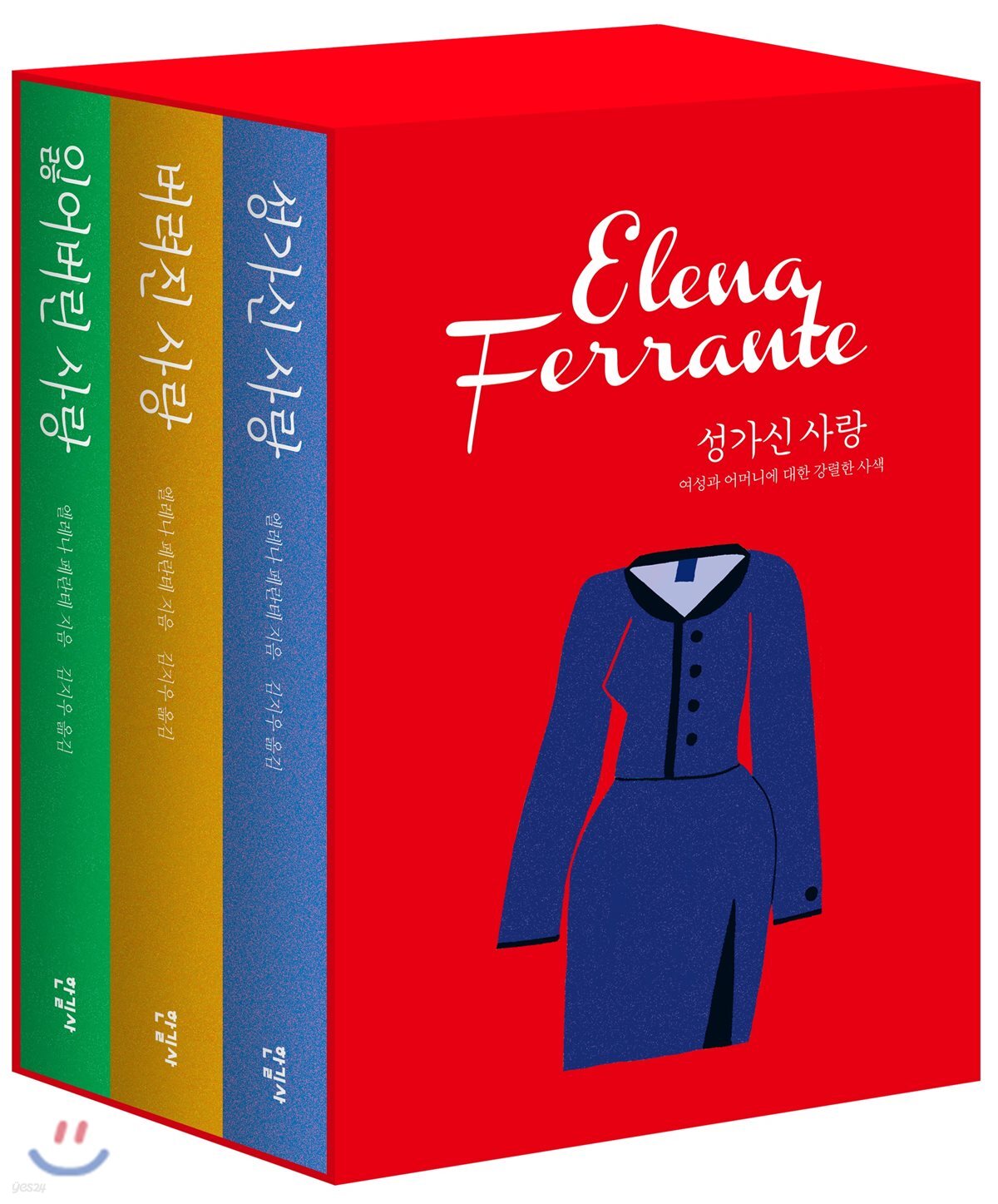 |
Description
Book Introduction
- A word from MD
- Ferrante's Neapolitan Quartet: The Lives of WomenThe Bad Love Trilogy, a novel by Elena Ferrante, a representative Italian author, that explores the themes of women and self-exploration.
The reality of women as seen by Ferrante is bleak and cold.
A story of strong women who struggle to find their true selves despite being oppressed in a male-centered society.
July 2, 2019. Novel/Poetry PD Kim Do-hoon
The 'Bad Love Trilogy' is a masterpiece that depicts Elena Ferrante's process of self-discovery while experiencing painful love.
These three works, each speaking about women in a primal and self-destructive language, are independent stories.
However, all three protagonists have something in common: they were born in Naples and grew up in a rough and patriarchal environment.
It also has a 'chronicle' quality in that it seeks to find women's identity by focusing on women's lives.
"Troublesome Love" depicts the cruel yet unique love between a mother and daughter from the daughter's perspective, "Abandoned Love" depicts the midsummer night's nightmare that comes to a woman abandoned by her husband from the wife's perspective, and "Lost Love" depicts the dark side of beautiful maternal love from the mother's perspective in a secretive and powerful way.
The meaning becomes clearer when we hear the sentences describing Ferrante's abstract emotions.
Her vivid and sensual language provides deep insight into our lives.
Ferrante is a writer who not only completely destroys the existing female narrative but also ruthlessly sinks herself.
Through this novel, Ferrante constantly asks questions to her female readers.
“Is my mother’s image the ideal image I want to resemble?
Are children really a blessing from God for women?
“Does a woman feel happy as a wife when she takes care of her children and supports her husband well?”
While reading this book, we cannot define anything precisely about women.
Behind the role of women that we define as beautiful and sublime, there is a female ego that is helplessly destroyed by the pain that tears apart life and flesh and by others.
Exploring themes of women and self-exploration, the Bad Love Trilogy is a brutal and beautiful feminist novel that shatters universal truths about women and redefines them.
These three works, each speaking about women in a primal and self-destructive language, are independent stories.
However, all three protagonists have something in common: they were born in Naples and grew up in a rough and patriarchal environment.
It also has a 'chronicle' quality in that it seeks to find women's identity by focusing on women's lives.
"Troublesome Love" depicts the cruel yet unique love between a mother and daughter from the daughter's perspective, "Abandoned Love" depicts the midsummer night's nightmare that comes to a woman abandoned by her husband from the wife's perspective, and "Lost Love" depicts the dark side of beautiful maternal love from the mother's perspective in a secretive and powerful way.
The meaning becomes clearer when we hear the sentences describing Ferrante's abstract emotions.
Her vivid and sensual language provides deep insight into our lives.
Ferrante is a writer who not only completely destroys the existing female narrative but also ruthlessly sinks herself.
Through this novel, Ferrante constantly asks questions to her female readers.
“Is my mother’s image the ideal image I want to resemble?
Are children really a blessing from God for women?
“Does a woman feel happy as a wife when she takes care of her children and supports her husband well?”
While reading this book, we cannot define anything precisely about women.
Behind the role of women that we define as beautiful and sublime, there is a female ego that is helplessly destroyed by the pain that tears apart life and flesh and by others.
Exploring themes of women and self-exploration, the Bad Love Trilogy is a brutal and beautiful feminist novel that shatters universal truths about women and redefines them.
- You can preview some of the book's contents.
Preview
index
Abandoned love
annoying love
Lost Love
annoying love
Lost Love
Into the book
I wanted to erase everything that had anything to do with my mother, even the deepest roots within me.
I tried to erase my mother's gestures and speech from me.
I tried to erase everything: the way she held the cup, the way she drank tea from the cup, the way she moved when putting on her skirt or clothes, the way she organized things in the kitchen and drawers, the way she washed her private parts, her food preferences, and the things she liked and disliked.
I wanted to erase the language my mother used and the city she lived in.
I didn't even want to resemble my mother's breathing.
I wanted to break away from my mother and create everything anew to become fully myself.
--- "Troublesome Love, 124"
Let's be faithful to today.
Let's not regress.
Let's not give up.
Cheer up.
Let's stop with the pointless, malicious, and angry monologues.
Excessive expression of emotion is also prohibited.
He's gone, but I have to stay here.
Now I won't be able to enjoy his sparkling eyes or his affectionate words.
But what does that mean?
Let's prepare ourselves for defense and not lose our original form.
It cannot be ruined like a trivial ornament.
I am not an ornament.
Women are not ornaments.
--- "Abandoned Love, 105"
I wanted to erase everything that had anything to do with my mother, even the deepest roots within me.
I tried to erase my mother's gestures and speech from me.
I tried to erase everything: the way she held the cup, the way she drank tea from the cup, the way she moved when putting on her skirt or clothes, the way she organized things in the kitchen and drawers, the way she washed her private parts, her food preferences, and the things she liked and disliked.
I wanted to erase the language my mother used and the city she lived in.
I didn't even want to resemble my mother's breathing.
I wanted to break away from my mother and create everything anew to become fully myself.
I tried to erase my mother's gestures and speech from me.
I tried to erase everything: the way she held the cup, the way she drank tea from the cup, the way she moved when putting on her skirt or clothes, the way she organized things in the kitchen and drawers, the way she washed her private parts, her food preferences, and the things she liked and disliked.
I wanted to erase the language my mother used and the city she lived in.
I didn't even want to resemble my mother's breathing.
I wanted to break away from my mother and create everything anew to become fully myself.
--- "Troublesome Love, 124"
Let's be faithful to today.
Let's not regress.
Let's not give up.
Cheer up.
Let's stop with the pointless, malicious, and angry monologues.
Excessive expression of emotion is also prohibited.
He's gone, but I have to stay here.
Now I won't be able to enjoy his sparkling eyes or his affectionate words.
But what does that mean?
Let's prepare ourselves for defense and not lose our original form.
It cannot be ruined like a trivial ornament.
I am not an ornament.
Women are not ornaments.
--- "Abandoned Love, 105"
I wanted to erase everything that had anything to do with my mother, even the deepest roots within me.
I tried to erase my mother's gestures and speech from me.
I tried to erase everything: the way she held the cup, the way she drank tea from the cup, the way she moved when putting on her skirt or clothes, the way she organized things in the kitchen and drawers, the way she washed her private parts, her food preferences, and the things she liked and disliked.
I wanted to erase the language my mother used and the city she lived in.
I didn't even want to resemble my mother's breathing.
I wanted to break away from my mother and create everything anew to become fully myself.
--- "Lost Love, 149"
Publisher's Review
Elena Ferrante, calling out feminism from the center of the world
Elena Ferrante is a novelist currently attracting attention from the world of literature, but little is known about her identity.
Since her debut in 1992, Ferrante has never appeared in front of the public, and is called a “faceless writer.” She says that everything is in the novel, and that she wants to approach readers only through her work, not through her fame or status as a writer.
Shortlisted for the 2016 Man Booker International Prize and nominated for Italy's top literary prize, the Strega Prize, in 2015, she rarely appears in public, telling her story only through written interviews.
There have been several attempts to uncover Ferrante's true identity, but readers have agreed that they are no longer curious about her identity and wish to encounter her only through her works.
The empty space left by the author is richly filled with the work itself and the readers' various interpretations.
Ferrante's works are imbued with her own distinctive honesty and sincerity.
She portrays the hidden truths of the world in a passionate and explosive style, which becomes even more evident when she encounters characters with conflicting emotions that cannot coexist.
Her work often features characters who truly understand humanity and unite with one another to create a better world.
Her work is all the more beautiful and captivating because these well-intentioned characters are at the center of the story.
She boldly expresses her thoughts on feminism through her works, columns, and interviews.
All of her works are imbued with her perspective on women.
I have a rule: 'Never, under any circumstances, speak badly of another woman.'
Even if a woman behaves in a way that is unbearably unpleasant.
I feel obligated to do so because I know so much about women's lives.
…Even today, 100 years after the beginning of feminist history, we still cannot be fully ourselves, and we do not belong to ourselves.
Our flaws, our cruelties, our sins, our virtues, our joys, our language—all these are obediently inscribed within the male hierarchy, and we are worn down by being punished or praised according to norms that do not really belong to us.
It is a situation where we can easily feel disgusted towards others and ourselves.
To be independent and prove who we are, we must constantly pay attention to ourselves.
- From Elena Ferrante's column in The Guardian
Born from Ferrante's fingertips, the "Bad Love Trilogy" is infinitely fatal and groundbreaking, speaking of the need for women to assert their subjectivity and constantly speak out to prove who they are.
"Troublesome Love": A Dangerous and Deadly Love for a Mother
Elena Ferrante's debut novel, Troublesome Love, is the only one of the three that exhibits genre characteristics.
This work, which centers around the story of a daughter tracing her mother's death, plunges readers into a world of tense tension and breathtaking twists reminiscent of a mystery suspense.
"Troublesome Love" was made into a film in Italy and has been praised for its structural excellence and is recognized as a work that highlights Ferrante's unique, unrefined, sensual language.
The protagonist, Delia, loves her mother so much that she identifies with her and wants to become completely like her.
However, her desires are not fulfilled, which ultimately leads to a tragic ending.
This unique love story by Ferrante is so dangerous and fatal to the object of love that it is treated as a nuisance.
Delia, a cartoonist in her early 40s working in Rome, receives a call one day saying that her mother Amalia has died and goes to check the body.
Delia is more impressed by the bruises all over her mother's body, the heavy makeup, and the stylish design of her bra, which is different from the rag-like underwear her mother usually wears, than by the fact that her mother is dead.
Delia sets out for Naples to trace her mother's whereabouts, recalling her last phone call with her mother to uncover the truth behind her death.
Delia's father could not accept her mother laughing and chatting with the men around her.
He was always anxious that his wife would look at him, and his anxiety was due to the fear that she might abandon him.
Caserta, a business partner with his father, continues to show affection for his mother.
When the father discovers the gift from Caserta being delivered to his mother, he begins to control her by punching her until she is covered in blood and grabbing her by the hair.
The father is obsessed with his wife to the point of being willing to kill her, but paradoxically, he paints nude photos of his wife and sells them to men.
He would resort to violence whenever his wife disobeyed him, further enslaving her.
Meanwhile, young Delia tells her father that she saw her mother meeting Caserta and touching each other's bodies.
Eventually, his father threatens to kill him by going to Caserta with his uncle, carrying a knife, and he leaves the village with his family in fear.
Delia believes that Caserta killed her mother in revenge for this, but at the novel's conclusion, she is confronted with the shocking truth.
Delia is confused, fearing abandonment by her attractive mother and feeling inferior about never being able to be like her.
The process of uncovering the truth is also a process of unraveling the knot of lies that binds her family, Delia herself, and them all.
Delia reflects on the present and the past, reconstructing her mother's final days and confronting memories of the past she had tried to forget.
When a red dress and her mother's old blue suit, which she received as a birthday present, become the trigger that shakes Delia's life up, the fragments of memories that had sunk into her subconscious remain as disturbing and blurry images and torment her.
When we experience the overlapping of imperfect memories of the past and present anxieties, we are forced to piece together the torn pieces and figure out what is true.
Elena Ferrante's "Troublesome Love," dedicated to her mother, is a persistent meditation on women and mothers, mixing past and present, imagination and reality, lies and truth, intentional forgetting and memory.
This work, reminiscent of a twisted Oedipus complex, is interesting enough to be the subject of psychological analysis.
Abandoned Love: A Midsummer Night's Nightmare Experienced by an Abandoned Woman
"Abandoned Love" sharply deals with the dark abyss of a woman whose ordinary daily life turns into hell after her husband unilaterally notifies her of a breakup, and depicts her process of finding herself as an independent woman.
This work, which depicts the psychology of an abandoned woman with brilliant and honesty, depicts the protagonist Olga's precarious independence as she shatters the stereotype of women as wives with raw and sensual language.
Ferrante delves into the confused psychology of a woman abandoned by her husband in a subtle and vivid style, while also offering deep insight into women as wives.
Caring for the kids and the dog, going to the grocery store, preparing lunch and dinner, worrying about money… these were all the real problems that came to me after my husband abandoned me.
My husband has taken away all my thoughts and desires.
From now on, I will continue to live like this.
I guess I'll have to handle the work that the two of us used to do together by myself.
-『Abandoned Love』, page 29
The way people around a woman abandoned by her husband look at her and the situation she describes as a woman are so realistic that they feel even sharper and clearer.
"Abandoned Love" reminds us of the women we already think we know so well, the women who are forced to make sacrifices in the name of wife and mother.
This work, which vividly depicts the inner world of a woman, is the most heartbreaking love story among the 'Bad Love Trilogy'.
Olga was an ordinary housewife in her 30s, living with her husband Mario, a university professor, and raising her children.
One afternoon in April, Olga receives a sudden breakup notice from Mario.
Mario leaves his family, saying that he is ugly and useless and that everything is his fault.
Olga, who thought there was nothing wrong between them, feels unbearable anger and anxiety, believing that her husband has taken away her basic dignity and self-respect as a woman.
Olga begins to identify with the 'poor woman' of her childhood in Naples.
Olga encounters a vision of a 'poor woman' who was abandoned by her husband and took her own life, and begins to talk to her.
Olga suffers as she feels the vision of the 'poor woman' more vividly.
Now all the misfortunes of this world are on her shoulders.
Olga was left with a young sibling, a shepherd named Otto, and the burden of housework and finances.
She gradually loses her mind as she blames herself for being abandoned by her husband.
Olga's trauma over her loss makes even simple tasks like locking the front door and turning off the gas stove a burden, and her ordinary daily life gradually turns into hell.
To make matters worse, she accidentally meets her husband and his young lover on the street and loses all sense of reason.
In an attempt to regain her lost self-esteem and femininity, she allows herself to have a one-night stand with the musician Carano who lives downstairs, but she is overcome with a sense of defeat when she fails to even allow the man she thought was nothing to ejaculate, and she is sucked into deeper despair.
She has the worst day of her life one summer.
Gianni is sick and Otto is dying, but they are locked in their own home because the front door lock won't open.
Moreover, my phone is broken, so I can't call anyone for help.
But she doesn't give up and tries to face her problems and the reality she faces.
Unlike Mario, who escaped from reality because of the emptiness, Olga, who struggled to return to her normal daily life despite the pain, escapes the roles of wife and mother and regains her self as an independent woman.
This work explosively displays the resentment and anger of a woman forced to make a one-sided sacrifice.
Nominated for the Golden Lion Award at the 62nd Venice International Film Festival and beloved by filmmakers, "Abandoned Love" cruelly delves into the inner self of the narrator, making us think about what women must boldly abandon and resist.
The ending, which seems to guarantee a leap to a new life, is the only happy ending in all of Ferrante's novels.
"Lost Love": Exploring the Dark Side of Beautiful Motherhood
"Lost Love" thoroughly destroys the maternal love we have thought of as noble and beautiful through the "twisted mother" Leda.
The novel begins with Leda's car accident and progresses through the flashback technique, recalling what happened during the summer vacation before the accident, and the doll serves as an important device that drives the novel.
Ferrante portrays the dark shadows of beautiful motherhood with powerful language and immerses us with her uniquely wild imagination.
The protagonist, Leda, yearns to escape her two daughters, but is also confused by the accusations she is failing as a mother. "Lost Love" is a captivating work that reveals Leda's duality: her love for her daughters and her desire to fulfill her responsibilities as a mother, but also her desire to separate from them and find her own life.
Leda, a university English instructor who has separated from her husband and raised her two daughters alone, goes on a summer vacation to the beach after her daughters leave to join her husband in Canada.
There, Leda is captivated by a beautiful young mother named Nina.
She watches in fascination as Nina and her daughter Elena play with dolls, and is reminded of her own mother and two daughters.
Reda's mother threatened to run away and leave her young daughters behind, and she cruelly left her two daughters, whom she had raised alone for decades, to return to her husband in Canada.
On the other hand, the mother and daughter Nina met at the beach seemed very close-knit and seemed like an alien presence who had nothing to do with the noisy Neapolitan family.
Leda looks at Nina like that and feels a mixture of jealousy and envy.
Leda finds Elena's beloved doll, Nani, buried in the sand and impulsively steals it.
Perhaps, inside this doll, there is a dark side that she does not want anyone to see.
That is why, if you translate the original Italian title directly, it is “Daughter of Darkness.”
After losing her doll, Elena starts crying and throwing tantrums out of the blue, giving Nina a hard time.
Nina finds it difficult to tolerate Elena like that, and she feels aversion to her role as a mother in a patriarchal family relationship, revealing her desire to escape from reality.
Leda feels a sense of kinship with Nina, and Nina admires Leda, who lives the life of an ideal, independent woman, as she imagines.
Leda tells Nina the story of how she left her daughters for a while to try to piece herself back together after being shattered into pieces.
It is said that Leda loved her daughters so much, but because of that love, she felt like she was losing her true self, so she left home for three years.
But when the kids weren't around, I found myself feeling more useless and back to square one.
Nina discovers her own identity as a mother and a wife in her relationship with Leda and tries to escape from life.
Nina gives Leda the keys to her house so she can stay with her lover Gino.
However, Nina finds Elena's doll in Leda's house and is haunted by memories of the pain she suffered because of the doll. Unable to overcome her betrayal and anger, she stabs Leda in the side with the brooch she received as a gift from Leda.
The motherhood that Ferrante deals with in this work is extremely deformed and thoroughly self-centered.
In particular, the sight of young Elena as seen from Leda is surprisingly eerie.
Elena's endless demands and the merciless destruction of her dolls make her seem like a little devil.
What kind of being is a child to a mother?
Ferrante boldly shatters the illusions about women and asks what they have lost.
Ferrante's women find agency in the face of male violence.
The reality of women as seen by Ferrante is bleak and cold.
The women she draws all appear anxious and tied down somewhere.
Delia, the protagonist of 'Troublesome Love', is a single woman who cannot form deep relationships with the opposite sex.
Also, I don't feel any bond or closeness with any of my family members.
This attitude of hers is connected to the terrible experiences she had as a child.
Caserta glanced at me from three steps down through a small door, bending down.
“Come here.”
As I imagined Caserta's voice telling me to come here, I heard someone calling me 'Amalia'.
He gently stroked my legs with his lumpy, sticky fingers, covered in cream, as he slid them under the dress my mother had made for me.
…I couldn't breathe.
I felt pleasure and fear at the same time.
I tried to tolerate both conflicting emotions, but unfortunately I couldn't.
The pleasure was solely Amalia's.
All that was left for me was fear.
The more the behavior continued, the more irritated I became.
Because I wanted to be completely myself in Amalia's pleasure, but I couldn't.
I was just trembling with fear.
-『Troublesome Love』, pp. 269-271
Delia is unable to form deep relationships with the opposite sex even as an adult due to memories of her father's violence against her mother and of being sexually abused by Caserta's father during her childhood.
Ferrante vividly exposes the rampant male violence in our society and the trauma suffered by women exposed to such a violent environment.
In 『Abandoned Love』, the gender roles of men and women are shown as fixed, and even in a couple's relationship where they help and rely on each other's growth, the center of the relationship appears to be skewed to one side.
It's almost bizarre to see Olga abandon her goals and follow her husband's advice, returning to being a housewife.
Just two years ago, I was the one who told him I wanted some time to myself.
He said he wanted to work so he could get out of the house for even just a few hours.
At that time, I got a job at a small publishing company.
I was enjoying my work, but I quit because of Mario.
I told my husband that I needed some money to spend on myself, even if it was only a small amount, but he told me to quit my job.
"Why do you insist on working now? The hard times are over.
If you want to write again, then do so.”
I took my husband's advice, quit my publishing job after a few months, and for the first time in my life, I found someone to help me with the housework.
…I couldn't stand the thought of someone else doing my work when I couldn't fully enjoy the joy and sense of accomplishment that comes with creating.
In the end, I was stuck with housework, taking care of the children, and supporting my husband, just like before.
It seemed like that was all I could do.
-『Abandoned Love』, pp. 32-34
In 'Lost Love', the pain of childbirth that Leda experiences as a mother is horrific.
Leda feels such intense pain that she compares Martha to a violent, tormented animal.
Women experience the pain of giving birth to children while an unknown creature destroys their bodies.
This experience of Leda can never be replaced by the word maternal love that men talk about.
I gave birth to Martha again.
Martha attacked my body, leaving me uncontrollable.
Unlike Bianca, Marta wasn't Marta from the beginning.
It felt like there was a living piece of iron in my stomach.
Throughout my pregnancy, my entire body felt like a liquid mass of blood.
There was a sticky sediment inside, and it seemed like something like a violent, venomous animal was growing inside that sediment.
That substance, so far removed from humanity, would have turned me into a lifeless, rotting corpse if it were to take in its nutrients and expand.
-『Lost Love』, p. 225
Ferrante's women live within the framework firmly established by men and are subordinate to them.
But if these women had surrendered to their lives and stopped questioning their own existence, the "Bad Love Trilogy," beloved by readers around the world, would not have been born.
The women Ferrante portrays are oppressed in a male-centered society, but they are nevertheless strong women who struggle to find their true selves.
Ferrante's women are constantly exploring where they are and where they should go, never hesitating.
Even as they fall into the abyss, they struggle to regain their own identity, and they are strong and beautiful.
We will discover true love in the fierce lives of women.
Elena Ferrante is a novelist currently attracting attention from the world of literature, but little is known about her identity.
Since her debut in 1992, Ferrante has never appeared in front of the public, and is called a “faceless writer.” She says that everything is in the novel, and that she wants to approach readers only through her work, not through her fame or status as a writer.
Shortlisted for the 2016 Man Booker International Prize and nominated for Italy's top literary prize, the Strega Prize, in 2015, she rarely appears in public, telling her story only through written interviews.
There have been several attempts to uncover Ferrante's true identity, but readers have agreed that they are no longer curious about her identity and wish to encounter her only through her works.
The empty space left by the author is richly filled with the work itself and the readers' various interpretations.
Ferrante's works are imbued with her own distinctive honesty and sincerity.
She portrays the hidden truths of the world in a passionate and explosive style, which becomes even more evident when she encounters characters with conflicting emotions that cannot coexist.
Her work often features characters who truly understand humanity and unite with one another to create a better world.
Her work is all the more beautiful and captivating because these well-intentioned characters are at the center of the story.
She boldly expresses her thoughts on feminism through her works, columns, and interviews.
All of her works are imbued with her perspective on women.
I have a rule: 'Never, under any circumstances, speak badly of another woman.'
Even if a woman behaves in a way that is unbearably unpleasant.
I feel obligated to do so because I know so much about women's lives.
…Even today, 100 years after the beginning of feminist history, we still cannot be fully ourselves, and we do not belong to ourselves.
Our flaws, our cruelties, our sins, our virtues, our joys, our language—all these are obediently inscribed within the male hierarchy, and we are worn down by being punished or praised according to norms that do not really belong to us.
It is a situation where we can easily feel disgusted towards others and ourselves.
To be independent and prove who we are, we must constantly pay attention to ourselves.
- From Elena Ferrante's column in The Guardian
Born from Ferrante's fingertips, the "Bad Love Trilogy" is infinitely fatal and groundbreaking, speaking of the need for women to assert their subjectivity and constantly speak out to prove who they are.
"Troublesome Love": A Dangerous and Deadly Love for a Mother
Elena Ferrante's debut novel, Troublesome Love, is the only one of the three that exhibits genre characteristics.
This work, which centers around the story of a daughter tracing her mother's death, plunges readers into a world of tense tension and breathtaking twists reminiscent of a mystery suspense.
"Troublesome Love" was made into a film in Italy and has been praised for its structural excellence and is recognized as a work that highlights Ferrante's unique, unrefined, sensual language.
The protagonist, Delia, loves her mother so much that she identifies with her and wants to become completely like her.
However, her desires are not fulfilled, which ultimately leads to a tragic ending.
This unique love story by Ferrante is so dangerous and fatal to the object of love that it is treated as a nuisance.
Delia, a cartoonist in her early 40s working in Rome, receives a call one day saying that her mother Amalia has died and goes to check the body.
Delia is more impressed by the bruises all over her mother's body, the heavy makeup, and the stylish design of her bra, which is different from the rag-like underwear her mother usually wears, than by the fact that her mother is dead.
Delia sets out for Naples to trace her mother's whereabouts, recalling her last phone call with her mother to uncover the truth behind her death.
Delia's father could not accept her mother laughing and chatting with the men around her.
He was always anxious that his wife would look at him, and his anxiety was due to the fear that she might abandon him.
Caserta, a business partner with his father, continues to show affection for his mother.
When the father discovers the gift from Caserta being delivered to his mother, he begins to control her by punching her until she is covered in blood and grabbing her by the hair.
The father is obsessed with his wife to the point of being willing to kill her, but paradoxically, he paints nude photos of his wife and sells them to men.
He would resort to violence whenever his wife disobeyed him, further enslaving her.
Meanwhile, young Delia tells her father that she saw her mother meeting Caserta and touching each other's bodies.
Eventually, his father threatens to kill him by going to Caserta with his uncle, carrying a knife, and he leaves the village with his family in fear.
Delia believes that Caserta killed her mother in revenge for this, but at the novel's conclusion, she is confronted with the shocking truth.
Delia is confused, fearing abandonment by her attractive mother and feeling inferior about never being able to be like her.
The process of uncovering the truth is also a process of unraveling the knot of lies that binds her family, Delia herself, and them all.
Delia reflects on the present and the past, reconstructing her mother's final days and confronting memories of the past she had tried to forget.
When a red dress and her mother's old blue suit, which she received as a birthday present, become the trigger that shakes Delia's life up, the fragments of memories that had sunk into her subconscious remain as disturbing and blurry images and torment her.
When we experience the overlapping of imperfect memories of the past and present anxieties, we are forced to piece together the torn pieces and figure out what is true.
Elena Ferrante's "Troublesome Love," dedicated to her mother, is a persistent meditation on women and mothers, mixing past and present, imagination and reality, lies and truth, intentional forgetting and memory.
This work, reminiscent of a twisted Oedipus complex, is interesting enough to be the subject of psychological analysis.
Abandoned Love: A Midsummer Night's Nightmare Experienced by an Abandoned Woman
"Abandoned Love" sharply deals with the dark abyss of a woman whose ordinary daily life turns into hell after her husband unilaterally notifies her of a breakup, and depicts her process of finding herself as an independent woman.
This work, which depicts the psychology of an abandoned woman with brilliant and honesty, depicts the protagonist Olga's precarious independence as she shatters the stereotype of women as wives with raw and sensual language.
Ferrante delves into the confused psychology of a woman abandoned by her husband in a subtle and vivid style, while also offering deep insight into women as wives.
Caring for the kids and the dog, going to the grocery store, preparing lunch and dinner, worrying about money… these were all the real problems that came to me after my husband abandoned me.
My husband has taken away all my thoughts and desires.
From now on, I will continue to live like this.
I guess I'll have to handle the work that the two of us used to do together by myself.
-『Abandoned Love』, page 29
The way people around a woman abandoned by her husband look at her and the situation she describes as a woman are so realistic that they feel even sharper and clearer.
"Abandoned Love" reminds us of the women we already think we know so well, the women who are forced to make sacrifices in the name of wife and mother.
This work, which vividly depicts the inner world of a woman, is the most heartbreaking love story among the 'Bad Love Trilogy'.
Olga was an ordinary housewife in her 30s, living with her husband Mario, a university professor, and raising her children.
One afternoon in April, Olga receives a sudden breakup notice from Mario.
Mario leaves his family, saying that he is ugly and useless and that everything is his fault.
Olga, who thought there was nothing wrong between them, feels unbearable anger and anxiety, believing that her husband has taken away her basic dignity and self-respect as a woman.
Olga begins to identify with the 'poor woman' of her childhood in Naples.
Olga encounters a vision of a 'poor woman' who was abandoned by her husband and took her own life, and begins to talk to her.
Olga suffers as she feels the vision of the 'poor woman' more vividly.
Now all the misfortunes of this world are on her shoulders.
Olga was left with a young sibling, a shepherd named Otto, and the burden of housework and finances.
She gradually loses her mind as she blames herself for being abandoned by her husband.
Olga's trauma over her loss makes even simple tasks like locking the front door and turning off the gas stove a burden, and her ordinary daily life gradually turns into hell.
To make matters worse, she accidentally meets her husband and his young lover on the street and loses all sense of reason.
In an attempt to regain her lost self-esteem and femininity, she allows herself to have a one-night stand with the musician Carano who lives downstairs, but she is overcome with a sense of defeat when she fails to even allow the man she thought was nothing to ejaculate, and she is sucked into deeper despair.
She has the worst day of her life one summer.
Gianni is sick and Otto is dying, but they are locked in their own home because the front door lock won't open.
Moreover, my phone is broken, so I can't call anyone for help.
But she doesn't give up and tries to face her problems and the reality she faces.
Unlike Mario, who escaped from reality because of the emptiness, Olga, who struggled to return to her normal daily life despite the pain, escapes the roles of wife and mother and regains her self as an independent woman.
This work explosively displays the resentment and anger of a woman forced to make a one-sided sacrifice.
Nominated for the Golden Lion Award at the 62nd Venice International Film Festival and beloved by filmmakers, "Abandoned Love" cruelly delves into the inner self of the narrator, making us think about what women must boldly abandon and resist.
The ending, which seems to guarantee a leap to a new life, is the only happy ending in all of Ferrante's novels.
"Lost Love": Exploring the Dark Side of Beautiful Motherhood
"Lost Love" thoroughly destroys the maternal love we have thought of as noble and beautiful through the "twisted mother" Leda.
The novel begins with Leda's car accident and progresses through the flashback technique, recalling what happened during the summer vacation before the accident, and the doll serves as an important device that drives the novel.
Ferrante portrays the dark shadows of beautiful motherhood with powerful language and immerses us with her uniquely wild imagination.
The protagonist, Leda, yearns to escape her two daughters, but is also confused by the accusations she is failing as a mother. "Lost Love" is a captivating work that reveals Leda's duality: her love for her daughters and her desire to fulfill her responsibilities as a mother, but also her desire to separate from them and find her own life.
Leda, a university English instructor who has separated from her husband and raised her two daughters alone, goes on a summer vacation to the beach after her daughters leave to join her husband in Canada.
There, Leda is captivated by a beautiful young mother named Nina.
She watches in fascination as Nina and her daughter Elena play with dolls, and is reminded of her own mother and two daughters.
Reda's mother threatened to run away and leave her young daughters behind, and she cruelly left her two daughters, whom she had raised alone for decades, to return to her husband in Canada.
On the other hand, the mother and daughter Nina met at the beach seemed very close-knit and seemed like an alien presence who had nothing to do with the noisy Neapolitan family.
Leda looks at Nina like that and feels a mixture of jealousy and envy.
Leda finds Elena's beloved doll, Nani, buried in the sand and impulsively steals it.
Perhaps, inside this doll, there is a dark side that she does not want anyone to see.
That is why, if you translate the original Italian title directly, it is “Daughter of Darkness.”
After losing her doll, Elena starts crying and throwing tantrums out of the blue, giving Nina a hard time.
Nina finds it difficult to tolerate Elena like that, and she feels aversion to her role as a mother in a patriarchal family relationship, revealing her desire to escape from reality.
Leda feels a sense of kinship with Nina, and Nina admires Leda, who lives the life of an ideal, independent woman, as she imagines.
Leda tells Nina the story of how she left her daughters for a while to try to piece herself back together after being shattered into pieces.
It is said that Leda loved her daughters so much, but because of that love, she felt like she was losing her true self, so she left home for three years.
But when the kids weren't around, I found myself feeling more useless and back to square one.
Nina discovers her own identity as a mother and a wife in her relationship with Leda and tries to escape from life.
Nina gives Leda the keys to her house so she can stay with her lover Gino.
However, Nina finds Elena's doll in Leda's house and is haunted by memories of the pain she suffered because of the doll. Unable to overcome her betrayal and anger, she stabs Leda in the side with the brooch she received as a gift from Leda.
The motherhood that Ferrante deals with in this work is extremely deformed and thoroughly self-centered.
In particular, the sight of young Elena as seen from Leda is surprisingly eerie.
Elena's endless demands and the merciless destruction of her dolls make her seem like a little devil.
What kind of being is a child to a mother?
Ferrante boldly shatters the illusions about women and asks what they have lost.
Ferrante's women find agency in the face of male violence.
The reality of women as seen by Ferrante is bleak and cold.
The women she draws all appear anxious and tied down somewhere.
Delia, the protagonist of 'Troublesome Love', is a single woman who cannot form deep relationships with the opposite sex.
Also, I don't feel any bond or closeness with any of my family members.
This attitude of hers is connected to the terrible experiences she had as a child.
Caserta glanced at me from three steps down through a small door, bending down.
“Come here.”
As I imagined Caserta's voice telling me to come here, I heard someone calling me 'Amalia'.
He gently stroked my legs with his lumpy, sticky fingers, covered in cream, as he slid them under the dress my mother had made for me.
…I couldn't breathe.
I felt pleasure and fear at the same time.
I tried to tolerate both conflicting emotions, but unfortunately I couldn't.
The pleasure was solely Amalia's.
All that was left for me was fear.
The more the behavior continued, the more irritated I became.
Because I wanted to be completely myself in Amalia's pleasure, but I couldn't.
I was just trembling with fear.
-『Troublesome Love』, pp. 269-271
Delia is unable to form deep relationships with the opposite sex even as an adult due to memories of her father's violence against her mother and of being sexually abused by Caserta's father during her childhood.
Ferrante vividly exposes the rampant male violence in our society and the trauma suffered by women exposed to such a violent environment.
In 『Abandoned Love』, the gender roles of men and women are shown as fixed, and even in a couple's relationship where they help and rely on each other's growth, the center of the relationship appears to be skewed to one side.
It's almost bizarre to see Olga abandon her goals and follow her husband's advice, returning to being a housewife.
Just two years ago, I was the one who told him I wanted some time to myself.
He said he wanted to work so he could get out of the house for even just a few hours.
At that time, I got a job at a small publishing company.
I was enjoying my work, but I quit because of Mario.
I told my husband that I needed some money to spend on myself, even if it was only a small amount, but he told me to quit my job.
"Why do you insist on working now? The hard times are over.
If you want to write again, then do so.”
I took my husband's advice, quit my publishing job after a few months, and for the first time in my life, I found someone to help me with the housework.
…I couldn't stand the thought of someone else doing my work when I couldn't fully enjoy the joy and sense of accomplishment that comes with creating.
In the end, I was stuck with housework, taking care of the children, and supporting my husband, just like before.
It seemed like that was all I could do.
-『Abandoned Love』, pp. 32-34
In 'Lost Love', the pain of childbirth that Leda experiences as a mother is horrific.
Leda feels such intense pain that she compares Martha to a violent, tormented animal.
Women experience the pain of giving birth to children while an unknown creature destroys their bodies.
This experience of Leda can never be replaced by the word maternal love that men talk about.
I gave birth to Martha again.
Martha attacked my body, leaving me uncontrollable.
Unlike Bianca, Marta wasn't Marta from the beginning.
It felt like there was a living piece of iron in my stomach.
Throughout my pregnancy, my entire body felt like a liquid mass of blood.
There was a sticky sediment inside, and it seemed like something like a violent, venomous animal was growing inside that sediment.
That substance, so far removed from humanity, would have turned me into a lifeless, rotting corpse if it were to take in its nutrients and expand.
-『Lost Love』, p. 225
Ferrante's women live within the framework firmly established by men and are subordinate to them.
But if these women had surrendered to their lives and stopped questioning their own existence, the "Bad Love Trilogy," beloved by readers around the world, would not have been born.
The women Ferrante portrays are oppressed in a male-centered society, but they are nevertheless strong women who struggle to find their true selves.
Ferrante's women are constantly exploring where they are and where they should go, never hesitating.
Even as they fall into the abyss, they struggle to regain their own identity, and they are strong and beautiful.
We will discover true love in the fierce lives of women.
GOODS SPECIFICS
- Date of issue: June 24, 2019
- Page count, weight, size: 1,024 pages | 1,034g | 127*188*80mm
- ISBN13: 9788935667987
- ISBN10: 8935667986
You may also like
카테고리
korean


korean

![GQ KOREA Mark (Monthly): December [2025]](http://librairie.coreenne.fr/cdn/shop/files/8ef265dbbfbf186523ed75ba7319009d.jpg?v=1765340328&width=3840)


