

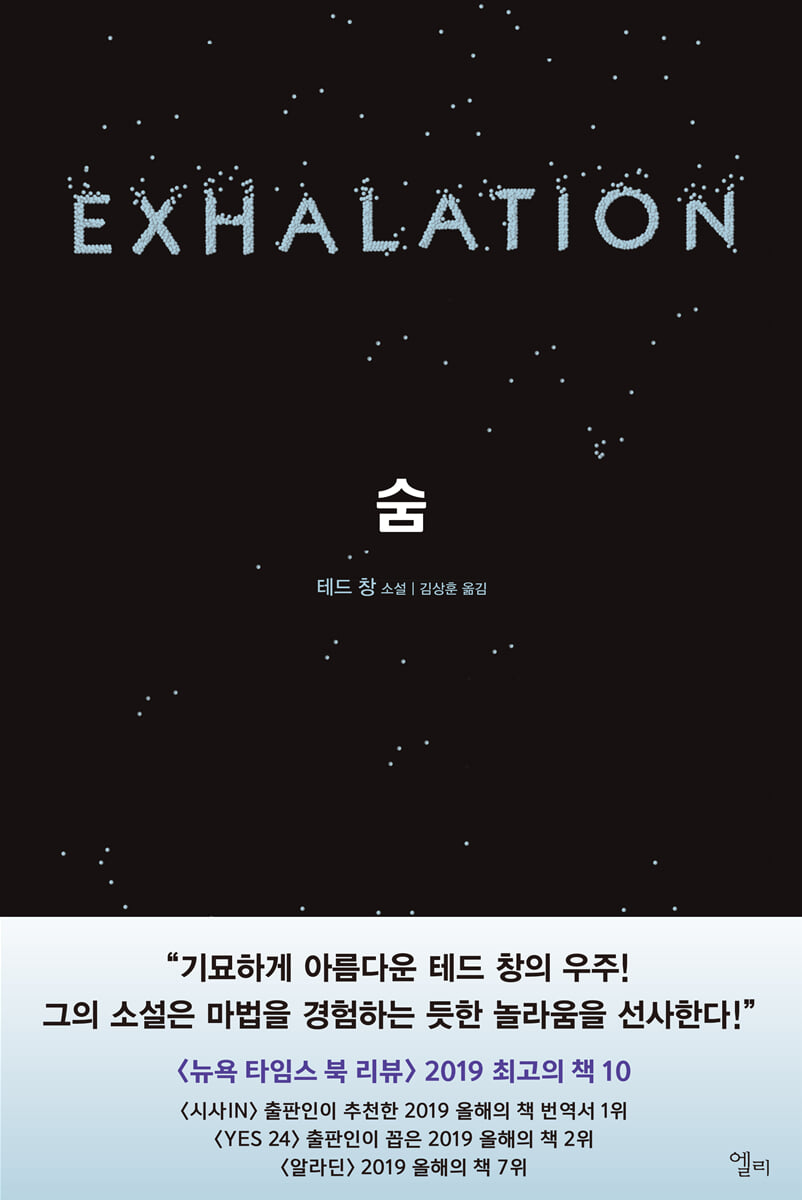
breath
 |
Description
Book Introduction
Four Hugo Awards, four Nebula Awards, and four Locus Awards. The return of Ted Chiang, a man the world has been waiting for. This is the second collection of works by Ted Chiang, author of Story of Your Life, which won every award given to the best science fiction novel and has been translated into 21 languages worldwide. This is the first collection of short stories published in 17 years since the publication of "Story of Your Life" in 2002, and includes a total of 9 short stories and medium-length stories, including the title story "Breath," which won the Locus Award, the Hugo Award, and the British Science Fiction Association Award. Among them, "Omphalos" and "Anxiety is the Vertigo of Freedom" are new short stories being published for the first time. "Breath" has been contracted for translation in 12 countries around the world. For us who are facing a new world overflowing with unfamiliar technologies, A question posed by a novelist armed with unparalleled imagination and prophetic insight. “So how will you live?” When new technologies arrive in human society, how do their potential transform humans and society? How does human attitude towards the world change, and where does it lead humans as a result? In this fantastical and elegant collection of works that explore time travel, artificial intelligence, extraterrestrial intelligence, parallel universes, free will, biological and digital memory, and the future of humanity, Ted Chiang grapples with some of humanity's oldest questions through a fresh and imaginative lens. And it clearly demonstrates that great science fiction can evoke beauty, meaning, and empathy. |
- You can preview some of the book's contents.
Preview
index
1.
The Merchant and the Alchemist's Gate / 9
2.
Breath / 59
3.
What We Must Do / 89
4.
Life Cycle of Software Objects / 97
5.
Daisy's Mechanical Automatic Nanny / 249
6.
Factual Truth, Emotional Truth / 267
7.
The Great Silence / 333
8.
Omphalos / 345
9.
Anxiety is the Dizziness of Freedom / 395
Creative Notes / 493
Acknowledgments / 509
Translator's Note / 511
The Merchant and the Alchemist's Gate / 9
2.
Breath / 59
3.
What We Must Do / 89
4.
Life Cycle of Software Objects / 97
5.
Daisy's Mechanical Automatic Nanny / 249
6.
Factual Truth, Emotional Truth / 267
7.
The Great Silence / 333
8.
Omphalos / 345
9.
Anxiety is the Dizziness of Freedom / 395
Creative Notes / 493
Acknowledgments / 509
Translator's Note / 511
Detailed image

Into the book
We cannot change the future or the past.
But you can get to know them better.
--- p.43
There are four things in this world that never return.
Words spoken, arrows shot into the air, lives lost, and opportunities missed.
--- p.49
Meditate on the wonder of your existence and rejoice in the fact that you can.
--- p.87
Our universe could have simply settled into a state of equilibrium, hissing softly.
It is a miracle that it gave birth to such a full life.
As if it were a miracle that your universe gave birth to life as you.
--- p.87
If you want to teach the common sense you've acquired over twenty years of living in this world, you have to spend twenty years doing it.
Experience cannot be compressed algorithmically.
--- p.234
Every trait that makes humans more valuable than a database was, without exception, a product of experience.
--- p.234
Writing was not just a way to record what someone said.
Writing was also a way to decide what to say before speaking it out loud.
Words were not just mere fragments of speech either.
Words were fragments of thoughts.
--- p.296
People are beings made up of countless stories.
Memories are not the result of an equal accumulation of all the moments we have lived, but rather a narrative created by combining moments we have painstakingly selected.
But you can get to know them better.
--- p.43
There are four things in this world that never return.
Words spoken, arrows shot into the air, lives lost, and opportunities missed.
--- p.49
Meditate on the wonder of your existence and rejoice in the fact that you can.
--- p.87
Our universe could have simply settled into a state of equilibrium, hissing softly.
It is a miracle that it gave birth to such a full life.
As if it were a miracle that your universe gave birth to life as you.
--- p.87
If you want to teach the common sense you've acquired over twenty years of living in this world, you have to spend twenty years doing it.
Experience cannot be compressed algorithmically.
--- p.234
Every trait that makes humans more valuable than a database was, without exception, a product of experience.
--- p.234
Writing was not just a way to record what someone said.
Writing was also a way to decide what to say before speaking it out loud.
Words were not just mere fragments of speech either.
Words were fragments of thoughts.
--- p.296
People are beings made up of countless stories.
Memories are not the result of an equal accumulation of all the moments we have lived, but rather a narrative created by combining moments we have painstakingly selected.
--- p.301
Publisher's Review
The Gate of the Merchant and the Alchemist
: If we could go back in time, what would change? If we could see into the future, would our present be different?
Fuwad, a textile merchant in Baghdad, stumbles into a shop while looking for gifts to send to his business associates.
The owner of this shop is an alchemist who creates and sells unique items. He invites Fuwad inside and shows him the 'Gate of Time' he created.
The 'Gate of Time' is a door that leads to the past or future 20 years in the future.
The shop owner tells the story of three people who passed through the door and met their future selves.
However, the place that Fuwad wants to go after hearing the story is not the future 20 years from now, but the past 20 years ago.
Despite the alchemist's warning that "what's done can never be undone," he travels back in time to try to make up for a mistake he made 20 years ago.
"breath"
: Our universe could have simply settled into a state of equilibrium, hissing softly.
It is a miracle that it gave birth to such a full life.
The story takes the form of a letter from an anatomist to other species and civilizations in the universe.
The world in which the story unfolds is an argon chamber within a solid chrome structure that stretches out infinitely, where pneumatically powered machine humans live as a civilization.
The scientist, who is the speaker, suspects that his brain is running slower than the clock, and performs an autopsy to open his own brain.
And we learn that air not only powers the engine that generates their thoughts, but is in fact the medium through which their thoughts are imprinted.
And we realize that the source of life is not air, but pressure differences.
When this pressure reaches equilibrium, the universe will cease all operations.
It would mean the complete annihilation of their species and civilization.
Scientists hold out hope that equilibrium may not be the fate of the entire universe, and leave messages for other future civilizations that may exist in other universes.
"What We Must Do"
: If free will were an illusion, what choices would you make?
This short story, with no characters or dialogue, speaks to the consequences for humanity when it becomes clear that human free will is an illusion.
Some people stop making choices when they realize that their choices don't matter.
They no longer engage in any voluntary actions.
But the speaker says:
It doesn't matter what is real.
What really matters is what you believe, and believing this lie is the only way to avoid falling into a waking coma.
Life Cycle of Software Objects
: Is this a story about the product cycle of artificial intelligence? Or is it a story about the human life cycle?
Anna Alvarado is a former zookeeper who takes a job at cutting-edge software company Bluegam to train their latest creation, the Digient.
'Digients' are digital organisms created within the digital world called Data Earth, created to be sold as pets to players.
Anna's colleague, Derek Brooks, is a former animator who designs avatars, the bodies for Digients.
The story follows Anna Alvarado from the moment she receives the offer to become a Digiant trainer to the moment she decides to prepare Jax, the Digiant she adopted, to live on her own.
Time passes quickly in the story.
As Digits develop, they grow, learn new skills, and understand their world.
But eventually, the virtual platform called Data Earth is in danger of disappearing.
What will happen to the Digients when their universe ceases to exist or is devastated? Only a handful of owners are desperately trying to raise the funds to port their Digients to the currently dominant platforms.
So much so that they're considering handing over Digiant's copyright to sex doll developers.
"Daisy's Mechanical Automatic Nanny"
: What are the advantages of a mechanical automatic nanny that can replace a human nanny?
Born in London in 1861, mathematician Reginald Dacey develops a mechanical, automatic nanny for his son after discovering that he is being abused by his human nanny.
Was it really a rational and successful invention?
"Factual truth, emotional truth"
: On the replacement of biological memories with digital memories
The story is told in a cross-edited format, with two male narrators.
A man is a journalist, and the time he lives in is the near future.
He still uses a keyboard, but in the future he lives in, he no longer writes with a pen or keyboard.
When you subvocalize what you want to say in your head, the retinal projector displays the sentence in your field of vision, and uses a combination of gestures and eye movements to modify the sentence.
The reporter is writing an article about a memory device called 'Remem'.
Remember monitors people's conversations and subvocalizations, and when a past event is mentioned, it displays a video of that event in the lower left corner of the field of view.
It has become virtually impossible for humans to remember something incorrectly.
The man writing the article is shocked to discover through his daughter Nicole's teenage life log that some events he believed were actually fabricated memories of his own.
Another speaker is a boy from the Tiv tribe, Jijinggi.
He was the first of his tribe to learn to read and write through a European missionary who came to live in the village.
Jijingi, who has learned to read and write, realizes that the stories the village storyteller tells this year are slightly different from the stories he told last year.
As time passes, Jijinggi becomes the clerk of the village court.
And when the debate about joining clans comes up, he realizes that he is thinking like a European.
He had come to believe more in what the Europeans wrote on paper than in the words of the Tiv people.
The narrator, a journalist, fears the possibility that personal subjectivity may be completely removed from memories of certain events.
But just as the oral culture of the Tiv people could not prevent the advent of writing, if we cannot prevent the trend of people adopting perfect digital memories in place of imperfect bio-memory, I wonder if the best option is not to exploit its advantages.
Could Remember, which shows us everything in vivid detail, force us to acknowledge our wrongdoings and thus avoid repeating them in the future?
The Great Silence
: Why the universe is so quiet, says a member of a species driven to the brink of extinction by humans.
The narrator of this short and interesting story is the Puerto Rican cockatoo, a species on the verge of extinction.
He speaks of human curiosity to search for extraterrestrial life in the vast universe.
The reason the universe is so eerily quiet, he says, may be a survival strategy of cosmic intelligence to avoid being wiped out by humans.
In that sense, this story may be a warning about the future of humanity.
Could it be that humanity, in its quest for something greater, has forgotten the humblest beings around us? The voice of Earth's intelligence, once echoing through the rainforests, is now in danger of disappearing, joining the vast silence of the universe.
Could humans, who cannot hear even the sounds of those closest to them, detect extraterrestrial intelligence by eavesdropping on sounds a hundred light-years away?
Omphalos
Are humans truly the center of the universe? Is our species truly the "omphalos"?
Anxiety is the vertigo of freedom.
: What if there were multiple yous living in multiple worlds? If no matter what choice you made, there was always another universe with the exact opposite choice, would your choices still be meaningful?
: If we could go back in time, what would change? If we could see into the future, would our present be different?
Fuwad, a textile merchant in Baghdad, stumbles into a shop while looking for gifts to send to his business associates.
The owner of this shop is an alchemist who creates and sells unique items. He invites Fuwad inside and shows him the 'Gate of Time' he created.
The 'Gate of Time' is a door that leads to the past or future 20 years in the future.
The shop owner tells the story of three people who passed through the door and met their future selves.
However, the place that Fuwad wants to go after hearing the story is not the future 20 years from now, but the past 20 years ago.
Despite the alchemist's warning that "what's done can never be undone," he travels back in time to try to make up for a mistake he made 20 years ago.
"breath"
: Our universe could have simply settled into a state of equilibrium, hissing softly.
It is a miracle that it gave birth to such a full life.
The story takes the form of a letter from an anatomist to other species and civilizations in the universe.
The world in which the story unfolds is an argon chamber within a solid chrome structure that stretches out infinitely, where pneumatically powered machine humans live as a civilization.
The scientist, who is the speaker, suspects that his brain is running slower than the clock, and performs an autopsy to open his own brain.
And we learn that air not only powers the engine that generates their thoughts, but is in fact the medium through which their thoughts are imprinted.
And we realize that the source of life is not air, but pressure differences.
When this pressure reaches equilibrium, the universe will cease all operations.
It would mean the complete annihilation of their species and civilization.
Scientists hold out hope that equilibrium may not be the fate of the entire universe, and leave messages for other future civilizations that may exist in other universes.
"What We Must Do"
: If free will were an illusion, what choices would you make?
This short story, with no characters or dialogue, speaks to the consequences for humanity when it becomes clear that human free will is an illusion.
Some people stop making choices when they realize that their choices don't matter.
They no longer engage in any voluntary actions.
But the speaker says:
It doesn't matter what is real.
What really matters is what you believe, and believing this lie is the only way to avoid falling into a waking coma.
Life Cycle of Software Objects
: Is this a story about the product cycle of artificial intelligence? Or is it a story about the human life cycle?
Anna Alvarado is a former zookeeper who takes a job at cutting-edge software company Bluegam to train their latest creation, the Digient.
'Digients' are digital organisms created within the digital world called Data Earth, created to be sold as pets to players.
Anna's colleague, Derek Brooks, is a former animator who designs avatars, the bodies for Digients.
The story follows Anna Alvarado from the moment she receives the offer to become a Digiant trainer to the moment she decides to prepare Jax, the Digiant she adopted, to live on her own.
Time passes quickly in the story.
As Digits develop, they grow, learn new skills, and understand their world.
But eventually, the virtual platform called Data Earth is in danger of disappearing.
What will happen to the Digients when their universe ceases to exist or is devastated? Only a handful of owners are desperately trying to raise the funds to port their Digients to the currently dominant platforms.
So much so that they're considering handing over Digiant's copyright to sex doll developers.
"Daisy's Mechanical Automatic Nanny"
: What are the advantages of a mechanical automatic nanny that can replace a human nanny?
Born in London in 1861, mathematician Reginald Dacey develops a mechanical, automatic nanny for his son after discovering that he is being abused by his human nanny.
Was it really a rational and successful invention?
"Factual truth, emotional truth"
: On the replacement of biological memories with digital memories
The story is told in a cross-edited format, with two male narrators.
A man is a journalist, and the time he lives in is the near future.
He still uses a keyboard, but in the future he lives in, he no longer writes with a pen or keyboard.
When you subvocalize what you want to say in your head, the retinal projector displays the sentence in your field of vision, and uses a combination of gestures and eye movements to modify the sentence.
The reporter is writing an article about a memory device called 'Remem'.
Remember monitors people's conversations and subvocalizations, and when a past event is mentioned, it displays a video of that event in the lower left corner of the field of view.
It has become virtually impossible for humans to remember something incorrectly.
The man writing the article is shocked to discover through his daughter Nicole's teenage life log that some events he believed were actually fabricated memories of his own.
Another speaker is a boy from the Tiv tribe, Jijinggi.
He was the first of his tribe to learn to read and write through a European missionary who came to live in the village.
Jijingi, who has learned to read and write, realizes that the stories the village storyteller tells this year are slightly different from the stories he told last year.
As time passes, Jijinggi becomes the clerk of the village court.
And when the debate about joining clans comes up, he realizes that he is thinking like a European.
He had come to believe more in what the Europeans wrote on paper than in the words of the Tiv people.
The narrator, a journalist, fears the possibility that personal subjectivity may be completely removed from memories of certain events.
But just as the oral culture of the Tiv people could not prevent the advent of writing, if we cannot prevent the trend of people adopting perfect digital memories in place of imperfect bio-memory, I wonder if the best option is not to exploit its advantages.
Could Remember, which shows us everything in vivid detail, force us to acknowledge our wrongdoings and thus avoid repeating them in the future?
The Great Silence
: Why the universe is so quiet, says a member of a species driven to the brink of extinction by humans.
The narrator of this short and interesting story is the Puerto Rican cockatoo, a species on the verge of extinction.
He speaks of human curiosity to search for extraterrestrial life in the vast universe.
The reason the universe is so eerily quiet, he says, may be a survival strategy of cosmic intelligence to avoid being wiped out by humans.
In that sense, this story may be a warning about the future of humanity.
Could it be that humanity, in its quest for something greater, has forgotten the humblest beings around us? The voice of Earth's intelligence, once echoing through the rainforests, is now in danger of disappearing, joining the vast silence of the universe.
Could humans, who cannot hear even the sounds of those closest to them, detect extraterrestrial intelligence by eavesdropping on sounds a hundred light-years away?
Omphalos
Are humans truly the center of the universe? Is our species truly the "omphalos"?
Anxiety is the vertigo of freedom.
: What if there were multiple yous living in multiple worlds? If no matter what choice you made, there was always another universe with the exact opposite choice, would your choices still be meaningful?
GOODS SPECIFICS
- Date of publication: May 20, 2019
- Format: Paperback book binding method guide
- Page count, weight, size: 520 pages | 648g | 140*210*35mm
- ISBN13: 9791164050277
- ISBN10: 1164050273
You may also like
카테고리
korean


korean

![GQ KOREA Mark (Monthly): December [2025]](http://librairie.coreenne.fr/cdn/shop/files/8ef265dbbfbf186523ed75ba7319009d.jpg?v=1765340328&width=3840)


