

As a boy
 |
Description
Book Introduction
- A word from MD
-
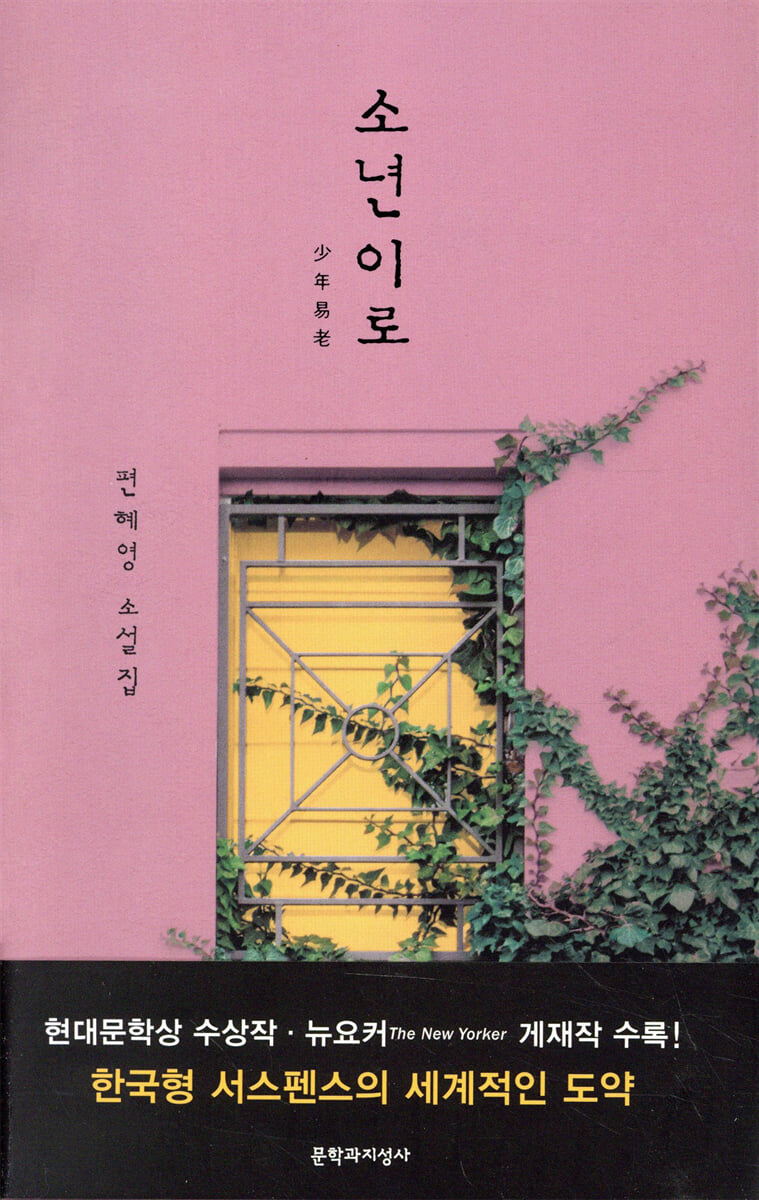
A collection of short stories by Pyeon Hye-young that will have you confronting the breaking points of life.The tenth book and fifth novel collection by Korea's representative author, Hye-Young Pyeon.
The world of eight stories unfolds, including the winner of the Contemporary Literature Award, “Boyhood,” and the hit story “Plant Lover,” published in the New Yorker.
What answers can we offer in the face of the difficult problem of 'life', a series of unforeseen events and unknown traps?May 3, 2019. Novel/Poetry PD Kim Do-hoon
The mystery of life, where questions lead to questions
Can we answer this difficult question?
The short story collection 『Boyhood and Age』 by Pyeon Hye-young, who has been making endless leaps at the forefront of Korean suspense, has been published by Munhak-kwa-Jiseongsa.
This is the author's tenth book and fifth collection of short stories, and is the first collection of short stories in six years since "Night Passes by" (2013).
This collection of short stories includes “Plant Lover,” which led to the globalization of Korean literature when it was published in The New Yorker, and “Boyhood Changes” which won the Contemporary Literature Award.
The author won the Shirley Jackson Award in 2017 for her novel “Hole” (2016), proving the potential of Korean literature in the American literary market.
Pyeon Hye-young's novels begin by casting a hazy curtain over the characters' eyes, like fine dust covering the sky.
As you trace the causes of the incidents and accidents that lie before you, the curtain that has been cast over your life gradually lifts and the hidden truth gradually reveals itself.
The characters' attempts to erase the darkness of life, combined with Pyeon Hye-young's prose, plunge readers into a breathtaking tension and engage them in the mystery drama within the work.
Once you step in, no one can easily escape until you find the answer to this difficult problem.
Can we find answers to the problems created by the writer, or rather, by life?
Reading the author's novels is also like encountering an abyss of unknown depths.
As readers are drawn into the novel's space, they encounter the life hidden deep within themselves, or the true face of the world, and they tremble at the oppression and fear of being suddenly thrown into an unfamiliar place, situation, and time.
Oh Jeong-hee (novelist)
It's not a big deal to stand there with one foot stuck in one of the painful traps hidden throughout life.
Pyeon Hye-young's short stories are small warning signs erected next to traps.
Read this warning and I hope you will avoid the trap safely.
_Kim Yong-eon (Editor-in-Chief of Mysteria)
Can we answer this difficult question?
The short story collection 『Boyhood and Age』 by Pyeon Hye-young, who has been making endless leaps at the forefront of Korean suspense, has been published by Munhak-kwa-Jiseongsa.
This is the author's tenth book and fifth collection of short stories, and is the first collection of short stories in six years since "Night Passes by" (2013).
This collection of short stories includes “Plant Lover,” which led to the globalization of Korean literature when it was published in The New Yorker, and “Boyhood Changes” which won the Contemporary Literature Award.
The author won the Shirley Jackson Award in 2017 for her novel “Hole” (2016), proving the potential of Korean literature in the American literary market.
Pyeon Hye-young's novels begin by casting a hazy curtain over the characters' eyes, like fine dust covering the sky.
As you trace the causes of the incidents and accidents that lie before you, the curtain that has been cast over your life gradually lifts and the hidden truth gradually reveals itself.
The characters' attempts to erase the darkness of life, combined with Pyeon Hye-young's prose, plunge readers into a breathtaking tension and engage them in the mystery drama within the work.
Once you step in, no one can easily escape until you find the answer to this difficult problem.
Can we find answers to the problems created by the writer, or rather, by life?
Reading the author's novels is also like encountering an abyss of unknown depths.
As readers are drawn into the novel's space, they encounter the life hidden deep within themselves, or the true face of the world, and they tremble at the oppression and fear of being suddenly thrown into an unfamiliar place, situation, and time.
Oh Jeong-hee (novelist)
It's not a big deal to stand there with one foot stuck in one of the painful traps hidden throughout life.
Pyeon Hye-young's short stories are small warning signs erected next to traps.
Read this warning and I hope you will avoid the trap safely.
_Kim Yong-eon (Editor-in-Chief of Mysteria)
- You can preview some of the book's contents.
Preview
index
Boy, Iro
We are side by side
plant lover
Wonderbox
Dog's Night
grass
Monday Chat
Next guest
Author's Note
We are side by side
plant lover
Wonderbox
Dog's Night
grass
Monday Chat
Next guest
Author's Note
Into the book
In fact, Woozi didn't bleed.
Even though the shock of the fall was considerable, he still winked at me.
A wink to put me at ease.
Woozi knew it well.
How should people who have nothing separate?
“Thank goodness it only took 87 days.” ---From “We Are Side by Side”
It was my brother-in-law's choice to become a person who constantly assaults others.
Regardless of his past, a brother-in-law could be someone who assaults his successor or someone who treats him like a friend.
You have come to where you are today simply by choosing which of the two you will become.
---From "The Night of the Dog"
Yu hugged her father who was lying down.
Several thin hoses got in the way, but the embrace was still warm.
I could hear a faint heartbeat.
It was a similar interval to the pulse of a child.
When Yu hugged someone, he noticed how different the interval between each person's heartbeats was, but it was almost the same with his father.
Then I felt ashamed of myself for not saying anything in response to my brother's words that I had done enough.
---From "Monday Chat"
I often think of swear words I've seen in text messages.
When you see your husband looking aggrieved while talking to the person in charge, when a man bumps into you on the street and walks away without apologizing, when a supermarket cashier carelessly drops something you put down to pay for on the floor, you feel like biting your lip to keep the curse in.
---From "Grass"
I closed my eyes and took the man's fist.
I finally felt a little free from the thought that I might become a father or a grandfather, something I had been afraid of for a long time.
It happened by being both at the same time, not just one or the other.
The man stopped punching and greeted me.
I'll go first.
Even though the shock of the fall was considerable, he still winked at me.
A wink to put me at ease.
Woozi knew it well.
How should people who have nothing separate?
“Thank goodness it only took 87 days.” ---From “We Are Side by Side”
It was my brother-in-law's choice to become a person who constantly assaults others.
Regardless of his past, a brother-in-law could be someone who assaults his successor or someone who treats him like a friend.
You have come to where you are today simply by choosing which of the two you will become.
---From "The Night of the Dog"
Yu hugged her father who was lying down.
Several thin hoses got in the way, but the embrace was still warm.
I could hear a faint heartbeat.
It was a similar interval to the pulse of a child.
When Yu hugged someone, he noticed how different the interval between each person's heartbeats was, but it was almost the same with his father.
Then I felt ashamed of myself for not saying anything in response to my brother's words that I had done enough.
---From "Monday Chat"
I often think of swear words I've seen in text messages.
When you see your husband looking aggrieved while talking to the person in charge, when a man bumps into you on the street and walks away without apologizing, when a supermarket cashier carelessly drops something you put down to pay for on the floor, you feel like biting your lip to keep the curse in.
---From "Grass"
I closed my eyes and took the man's fist.
I finally felt a little free from the thought that I might become a father or a grandfather, something I had been afraid of for a long time.
It happened by being both at the same time, not just one or the other.
The man stopped punching and greeted me.
I'll go first.
---From "The Next Guest"
Publisher's Review
“Whose fault is it?”
The unknown traps that lie before us as adults
The title of the work, "Boyhood is easy to grow old" seems to be taken from the first part of the poem "Boyhood is easy to grow old, but learning is difficult" included in Zhu Xi's collected works, which is commonly known to mean "Boyhood is easy to grow old, but learning is difficult."
When focusing on the changes that occur when a boy becomes an adult, it is truly significant that "Boyhood Changes" is placed at the front of the collection.
What does an older boy, or an adult in a novel, look like?
What does it mean to become an adult?
Does being an adult mean knowing yourself better than anyone else, and therefore being able to remain calm in any situation?
At this very point, Pyeon Hye-young poses a weighty question to her readers.
I wonder if I can handle all the unexpected things that happen in life.
The father, who was so affectionate, loses that affection while caring for his sick grandfather ("The Next Guest"), he works hard but gets seriously injured helplessly ("Wonder Box"), and he uses the right amount of herbicide but for some reason the yard becomes a mess ("Grass").
Faced with the unimaginable, we become paralyzed, sometimes even paralyzed, and eventually become fixated on a single question.
Whose fault is it? Whose fault is it that I am suffering like this?
I lost my place to return to.
It wasn't lost just now.
I lost it in a car accident.
Or even before that.
It was hard to fathom how long I had been running towards this, not knowing that I would eventually lose it all.
―The “plant lover” section
In Soyoung's view, Su-man couldn't have thought more harshly.
For example, why did he end up going to the apartment where Kim lives?
Suman was so focused on the damage he suffered from other people's mistakes or irresponsible actions that he forgot his own mistake of not looking closely at the transaction.
It could be that he was deliberately pretending not to care.
Because when you get caught up in blaming someone, it's clearly someone else's fault.
―「Wonderbox」 section
Once you start asking, you can't stop.
Because we must find the person responsible for this misfortune.
We ask more questions about who is to blame, but at the end, there is only one answer waiting for us.
It was perhaps the answer I most wanted to avoid: that I was at the beginning of all this misfortune.
I don't know when it started, but life pulls us by one leg, dragging us into a trap that was already prepared, as if it knew we would fall into it.
Can we bear that uncomfortable truth in the midst of suffering that is difficult to blame anyone but ourselves?
“Some faces only reveal themselves in the dark.”
About our crumbling relationships and their fragile foundations.
Those who suffer from unknown causes are surrounded by those who 'watch' their struggles.
Next to Su-man, who asks whose fault it is, are So-young ("Wonder Box") who asks back, "Then whose fault is it that I have to take care of the child all day?"; Ji-min ("A Dog's Night") who doesn't understand why she has to defend the faults of her brother-in-law, whom she's not even close with; and So-jin ("Boyhood Changes") who witnessed Yu-jun's house falling apart from up close.
And these 'watchers' also take a step closer to the truth of life.
Instead, I thought about what we had lost.
I wondered how I could get it back, and if I couldn't find it, how I would live without it.
I also thought that I hadn't lived long enough to know my husband well.
Now, you have to accept that your husband is a person who acts differently depending on the person and the topic.
The same goes for myself.
I've been living for nearly 50 years, but I never thought I'd become a person who would feel angry at a temporary teacher who just brushed me off.
―The "Grass" section
It comes from the realization that I, as well as you, didn't know much about our relationship, something I thought I knew enough about.
When an unbearable bomb explodes in our lives, which were mostly stable and peaceful days, even though there were occasional big and small incidents, many things that had been holding us together crumble at once.
It doesn't matter if someone's daily life is lost because of me.
“What we lost”, there is only me who is absorbed in it.
The chilling power of this book comes perhaps not simply from the narrative's mystery, but from the truth of life itself: the fear that our lives and relationships can be turned upside down in an instant, and that we ourselves don't know how to live again in the face of that fear.
Let's go back to "Boyhood Changes".
At an age when it is difficult to even understand the chaos of the environment surrounding them, Yujun and Sojin suddenly become adults.
Life awaits them, hiding cruel secrets or setting up evil traps.
The unknown traps that lie before us as adults
The title of the work, "Boyhood is easy to grow old" seems to be taken from the first part of the poem "Boyhood is easy to grow old, but learning is difficult" included in Zhu Xi's collected works, which is commonly known to mean "Boyhood is easy to grow old, but learning is difficult."
When focusing on the changes that occur when a boy becomes an adult, it is truly significant that "Boyhood Changes" is placed at the front of the collection.
What does an older boy, or an adult in a novel, look like?
What does it mean to become an adult?
Does being an adult mean knowing yourself better than anyone else, and therefore being able to remain calm in any situation?
At this very point, Pyeon Hye-young poses a weighty question to her readers.
I wonder if I can handle all the unexpected things that happen in life.
The father, who was so affectionate, loses that affection while caring for his sick grandfather ("The Next Guest"), he works hard but gets seriously injured helplessly ("Wonder Box"), and he uses the right amount of herbicide but for some reason the yard becomes a mess ("Grass").
Faced with the unimaginable, we become paralyzed, sometimes even paralyzed, and eventually become fixated on a single question.
Whose fault is it? Whose fault is it that I am suffering like this?
I lost my place to return to.
It wasn't lost just now.
I lost it in a car accident.
Or even before that.
It was hard to fathom how long I had been running towards this, not knowing that I would eventually lose it all.
―The “plant lover” section
In Soyoung's view, Su-man couldn't have thought more harshly.
For example, why did he end up going to the apartment where Kim lives?
Suman was so focused on the damage he suffered from other people's mistakes or irresponsible actions that he forgot his own mistake of not looking closely at the transaction.
It could be that he was deliberately pretending not to care.
Because when you get caught up in blaming someone, it's clearly someone else's fault.
―「Wonderbox」 section
Once you start asking, you can't stop.
Because we must find the person responsible for this misfortune.
We ask more questions about who is to blame, but at the end, there is only one answer waiting for us.
It was perhaps the answer I most wanted to avoid: that I was at the beginning of all this misfortune.
I don't know when it started, but life pulls us by one leg, dragging us into a trap that was already prepared, as if it knew we would fall into it.
Can we bear that uncomfortable truth in the midst of suffering that is difficult to blame anyone but ourselves?
“Some faces only reveal themselves in the dark.”
About our crumbling relationships and their fragile foundations.
Those who suffer from unknown causes are surrounded by those who 'watch' their struggles.
Next to Su-man, who asks whose fault it is, are So-young ("Wonder Box") who asks back, "Then whose fault is it that I have to take care of the child all day?"; Ji-min ("A Dog's Night") who doesn't understand why she has to defend the faults of her brother-in-law, whom she's not even close with; and So-jin ("Boyhood Changes") who witnessed Yu-jun's house falling apart from up close.
And these 'watchers' also take a step closer to the truth of life.
Instead, I thought about what we had lost.
I wondered how I could get it back, and if I couldn't find it, how I would live without it.
I also thought that I hadn't lived long enough to know my husband well.
Now, you have to accept that your husband is a person who acts differently depending on the person and the topic.
The same goes for myself.
I've been living for nearly 50 years, but I never thought I'd become a person who would feel angry at a temporary teacher who just brushed me off.
―The "Grass" section
It comes from the realization that I, as well as you, didn't know much about our relationship, something I thought I knew enough about.
When an unbearable bomb explodes in our lives, which were mostly stable and peaceful days, even though there were occasional big and small incidents, many things that had been holding us together crumble at once.
It doesn't matter if someone's daily life is lost because of me.
“What we lost”, there is only me who is absorbed in it.
The chilling power of this book comes perhaps not simply from the narrative's mystery, but from the truth of life itself: the fear that our lives and relationships can be turned upside down in an instant, and that we ourselves don't know how to live again in the face of that fear.
Let's go back to "Boyhood Changes".
At an age when it is difficult to even understand the chaos of the environment surrounding them, Yujun and Sojin suddenly become adults.
Life awaits them, hiding cruel secrets or setting up evil traps.
GOODS SPECIFICS
- Date of issue: April 29, 2019
- Format: Hardcover book binding method guide
- Page count, weight, size: 256 pages | 310g | 116*186*20mm
- ISBN13: 9788932035338
- ISBN10: 8932035334
You may also like
카테고리
korean


korean

![GQ KOREA Mark (Monthly): December [2025]](http://librairie.coreenne.fr/cdn/shop/files/8ef265dbbfbf186523ed75ba7319009d.jpg?v=1765340328&width=3840)


