

The King is well 1
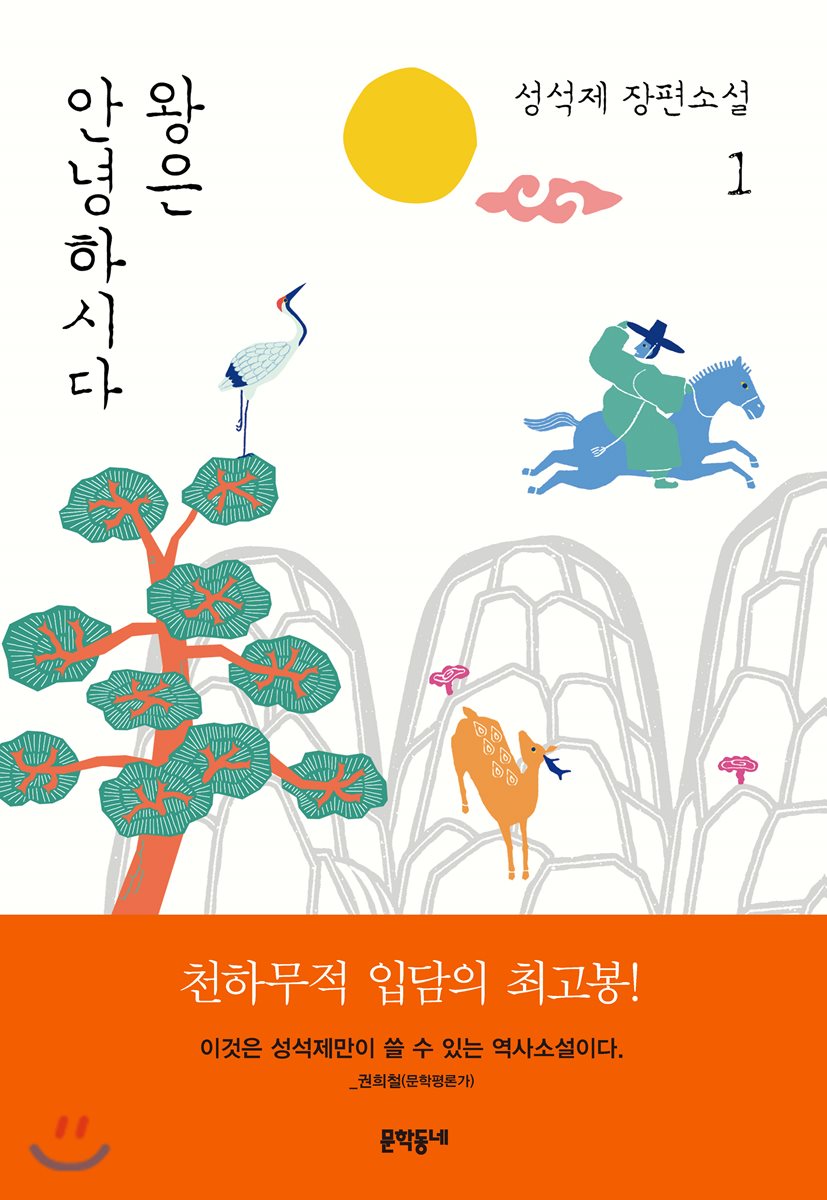 |
Description
Book Introduction
The pinnacle of invincible wit
A funny and heartbreaking story that overturns a solemn history.
This is a historical novel that only Seong Seok-je could write.
Kwon Hee-cheol (literary critic)
Seong Seok-je, a storyteller with an unrivaled wit and humor that no one can match, has returned with his new work, “The King is Well.”
This is a full-length novel, his first in five years since 『Invisible Man』, and a full-scale historical novel with 3,000 pages of manuscript paper. After serializing the first half on the Munhakdongne Naver Cafe, he spent a long time rewriting the second half and drastically revising the entire novel to complete it.
Set during the reign of King Sukjong of Joseon, the story of the protagonist, who becomes sworn brothers with the king by chance, and his adventures to protect the king amidst the turbulent times unfolds with his characteristically lively and eloquent speech.
In this freewheeling story that crosses between a weighty historical novel and a sharp martial arts novel, the flow of history, the bare face of power, and the joys and sorrows of the ordinary people living in that era are vivid and tangible.
A thrilling play of humanity and history, laughter and tears, this is truly a historical novel that only Seong Seok-je could write (literary critic Kwon Hee-chul).
A funny and heartbreaking story that overturns a solemn history.
This is a historical novel that only Seong Seok-je could write.
Kwon Hee-cheol (literary critic)
Seong Seok-je, a storyteller with an unrivaled wit and humor that no one can match, has returned with his new work, “The King is Well.”
This is a full-length novel, his first in five years since 『Invisible Man』, and a full-scale historical novel with 3,000 pages of manuscript paper. After serializing the first half on the Munhakdongne Naver Cafe, he spent a long time rewriting the second half and drastically revising the entire novel to complete it.
Set during the reign of King Sukjong of Joseon, the story of the protagonist, who becomes sworn brothers with the king by chance, and his adventures to protect the king amidst the turbulent times unfolds with his characteristically lively and eloquent speech.
In this freewheeling story that crosses between a weighty historical novel and a sharp martial arts novel, the flow of history, the bare face of power, and the joys and sorrows of the ordinary people living in that era are vivid and tangible.
A thrilling play of humanity and history, laughter and tears, this is truly a historical novel that only Seong Seok-je could write (literary critic Kwon Hee-chul).
- You can preview some of the book's contents.
Preview
index
letter
Chapter 1 The Boy King
Chapter 2: Brothers of the Resolution
Chapter 3: Entering the Palace
Chapter 4: Ascension
Chapter 5: Acorns in Dog Food
Chapter 6: The History of Giwangjisa
Chapter 7: Obtaining a Magical Sword
Chapter 8 comparison
Chapter 9: National Rejection
Chapter 10: Seeing the Fairy
Chapter 11: Training
Chapter 12 Jang Ok-jeong
Chapter 13: A Petition from a Countryside Scholar
Chapter 14: Moving the Public
Chapter 15: Raid
Chapter 16: Secret
Chapter 17: Haengjang
Chapter 18: Misu and Baekho
Chapter 19: Defeating the Grand Prince
Chapter 20 Exile
Chapter 21: The Sword of the Living
Chapter 22: Heo Gyo
Chapter 23: The Woman of the Three Hottest Days
Chapter 24 Night Watch
Chapter 25: The Division of the Southerners
Chapter 26: The King Who Brings Blessings
Chapter 27 Jang Hyeon
Chapter 28: Internal Investigation
Chapter 29: Secret Business
Chapter 30 Yunhyu
Chapter 31 Military
Chapter 32 Showdown
Chapter 33: Master of the Sword World
Chapter 34: Friendship
Chapter 35: Encounter
Chapter 36: The Queen Mother
Chapter 37: Song of Parting
main
Chapter 1 The Boy King
Chapter 2: Brothers of the Resolution
Chapter 3: Entering the Palace
Chapter 4: Ascension
Chapter 5: Acorns in Dog Food
Chapter 6: The History of Giwangjisa
Chapter 7: Obtaining a Magical Sword
Chapter 8 comparison
Chapter 9: National Rejection
Chapter 10: Seeing the Fairy
Chapter 11: Training
Chapter 12 Jang Ok-jeong
Chapter 13: A Petition from a Countryside Scholar
Chapter 14: Moving the Public
Chapter 15: Raid
Chapter 16: Secret
Chapter 17: Haengjang
Chapter 18: Misu and Baekho
Chapter 19: Defeating the Grand Prince
Chapter 20 Exile
Chapter 21: The Sword of the Living
Chapter 22: Heo Gyo
Chapter 23: The Woman of the Three Hottest Days
Chapter 24 Night Watch
Chapter 25: The Division of the Southerners
Chapter 26: The King Who Brings Blessings
Chapter 27 Jang Hyeon
Chapter 28: Internal Investigation
Chapter 29: Secret Business
Chapter 30 Yunhyu
Chapter 31 Military
Chapter 32 Showdown
Chapter 33: Master of the Sword World
Chapter 34: Friendship
Chapter 35: Encounter
Chapter 36: The Queen Mother
Chapter 37: Song of Parting
main
Into the book
The way to survive in this harsh world is to pretend to get stabbed when you stab it, to crush it when you step on it, and to burst it when you pop it.
--- p.27
I wanted to see how vainly those who boast of favor and power, of strength, of wealth and honor, would crumble.
The palace was a place with many such people and abundant harvests.
--- p.85
The king, the position of king, and the power that a king possesses are things that anyone can seek, so the king has always been a target of countless people.
In the dark, swords, arrows, bullets, and bombs of words like justification and duty were targeting the king.
--- p.184
It is beyond my control where, how, and to whom I am born.
But as I grew older, I thought I could choose who I met.
If you like it, we can be friends, and if you don't like it, we can just not meet.
--- p.223
Even if you memorize the holy scriptures and preach the way of Confucius and Mencius, people do not change easily.
The so-called scholars, gentlemen, and Confucian scholars had an even greater desire to pass on their reputation and bloodline to future generations.
--- p.250
There are times when it is better to let things go without knowing anything, and when it is better to do nothing than to try and do something.
I too had that realization without doing anything.
--- p.367
I don't know about other things, but things between men and women, or rather, things about love between people, did not go as planned.
Is it really true that the old man under the moon has no choice but to do as he has decided on his spouse?
--- p.383
You shouldn't try to force something out of nothing.
From what I've seen, life is about waiting for someone, something, or a certain time to come.
--- p.27
I wanted to see how vainly those who boast of favor and power, of strength, of wealth and honor, would crumble.
The palace was a place with many such people and abundant harvests.
--- p.85
The king, the position of king, and the power that a king possesses are things that anyone can seek, so the king has always been a target of countless people.
In the dark, swords, arrows, bullets, and bombs of words like justification and duty were targeting the king.
--- p.184
It is beyond my control where, how, and to whom I am born.
But as I grew older, I thought I could choose who I met.
If you like it, we can be friends, and if you don't like it, we can just not meet.
--- p.223
Even if you memorize the holy scriptures and preach the way of Confucius and Mencius, people do not change easily.
The so-called scholars, gentlemen, and Confucian scholars had an even greater desire to pass on their reputation and bloodline to future generations.
--- p.250
There are times when it is better to let things go without knowing anything, and when it is better to do nothing than to try and do something.
I too had that realization without doing anything.
--- p.367
I don't know about other things, but things between men and women, or rather, things about love between people, did not go as planned.
Is it really true that the old man under the moon has no choice but to do as he has decided on his spouse?
--- p.383
You shouldn't try to force something out of nothing.
From what I've seen, life is about waiting for someone, something, or a certain time to come.
--- p.391
Publisher's Review
“Yes, you protect yourself.
I will protect you too.”
Joseon's greatest villain becomes the king's sworn brother!
The main character, Seong-sung, is a “gangster who is famous in the capital” who lives off his grandmother, the owner of the best gisaeng house in Hanyang.
The story begins when he meets a boy of extraordinary appearance one day and becomes his sworn brother.
As it turned out, the boy was the future Crown Prince (Sukjong), and soon after, when he ascended to the throne at the young age of fourteen, Seong-Seong suddenly became the king's closest confidant, staying around him like a shadow and protecting him.
I will never break the oath we made to die on the same day.
From now on, you must always stay close to me and be on my side.
So I desperately need you, hyung.
Someone I can confide in, someone who will do anything for me. (Volume 1, pp. 66-67)
While the young king struggles to protect his precarious throne amidst the divided and vocal court officials of the Namin and Seoin factions, Seong-Seong travels inside and outside the palace, experiencing the lives of people from all walks of life, judging the various people surrounding the king, and working tirelessly for the king's safety.
It is well known that the political history of the reign of King Sukjong, which is the basis of the story, is marked by three turbulent national upheavals in which the center of power shifted from the Namin to the Seoin, then back to the Namin, and then back to the Seoin. It is also well known that the process was intertwined with a power struggle within the royal family, from the appearance of Lady Jang Hui-bin to the dethronement of the queen and the restoration of Queen Inhyeon.
However, the familiar historical material is transformed into an exciting story through the eyes and ears of Seong-sung, a fictional character who is active as the king's secret brother and who, as befitting a commoner, is obedient to those in power and tells the story through his mouth.
Seong-sung, while hiding his true identity, witnesses or secretly intervenes in crucial moments that determine the direction of power, and also uses his grandmother's background and connections to demonstrate his business acumen to increase the royal family's wealth.
He obtains a rare sword and saves the life of a king in danger, and also engages in a duel with a martial arts master from the Qing Dynasty.
He is close to Kim Man-jung, who wrote 『Guunmong』 and 『Sassi Namjeonggi』, and treats him as an older brother. He also watches over and admires Park Tae-bo, who is renowned as an upright scholar. He also develops feelings for Jang Ok-jeong, who later becomes Lady Jang Hui-bin.
Seong Seok-je's signature witty humor is added at every turn of the breathless events, controlling the pace of the story and making it difficult to put down the reader.
“One person cannot overcome the will of a thousand or ten thousand people.”
People who are desperately trying to survive in the turbulent times…
Their sorrow and joy ultimately change history.
As the conflicts, infighting, confrontations, and divisions between the king and the powers surrounding him continue, the fates of those who are connected to the protagonist Seong-sung through various connections also rise and fall according to the direction of power.
The king gradually becomes a fearsome being who manipulates countless lives for his position, and the relationship between Seong-sung and the king begins to waver little by little.
In this way, 『The King is Well』 is an adventure story about the king's sworn brother, Seong-sang, and at the same time a story about the nature of power.
The process in which justification and duty, a single word from the king and a single petition from a subject or scholar become weapons of immense power, determining the difference between advancement and retreat and life and death, and an unknown rumor sways the public's mind and eventually becomes reality is depicted in a poignant manner.
The brutal face of power that ultimately drives its sworn enemies to death and the determination of those who are willing to sacrifice their lives for a greater cause are clearly clashed.
“One person cannot overcome the will of a thousand or ten thousand people.
No matter how right a person's intentions are or how much he knows, he cannot always be right.
Rather than trying to win over one person, you should try to win over everyone.
Then you will automatically win over that one person.” (Volume 1, page 171)
However, 『The King is Well』 does not forget that history is ultimately a story about the five desires and seven emotions of the people.
That may be why the story is so deeply rooted in interest not only in the political situation, economy, and culture of the time, but also in the social conditions, customs, the lives of ordinary people, food, and the gossip and folk tales of the city.
On that vivid stage, some laugh and some smile, some struggle to save others, some disappear and some remain, and in the process, the world and people gradually become different.
In this way, the story of plastic surgery soon becomes a story about, as the author says, “an anonymous or nameless being who cannot find traces in history but who changed the course of history or became history itself” (Author’s Note).
In that respect, it is also interesting that this story is based on a manuscript that was added to and revised by several people and was included in the complete 『National Translation of Yeonryeosilgisul』 collection that was obtained from a used bookstore in Noryangjin, and that the author in the novel rewrote it.
As if that's how the original story came to be.
The will of people who somehow 'strive to survive and strive to survive' and leave something behind for someone, whether it is real or fictional, continues and continues to create history and stories. Perhaps that is the story of the Seongseokje ceremony, the history of the Seongseokje ceremony that 'The King is Well' shows us.
A story that is funny but doesn't make you laugh all the time, sad but doesn't make you cry all the time, a story that leaves you with an inexplicable feeling of sadness in the end - a story that only Seong Seok-je could write.
★
It's been so long since I've tried to write a novel featuring an anonymous or nameless being who changed the course of history or became history itself, though I can't find any trace of it in history.
They broke down bad habits and cracked down on unreasonable systems, surviving the fierce competition for survival and passing on their genes to their descendants, who are now us.
Ultimately, this novel is a story about me, or rather, about our ancestors.
_From the author's note
"The King is Well" is, of course, a 'historical' novel.
However, this is not because the novel is faithfully based on historical facts from the reign of King Sukjong.
A mean and rebellious lower-class man becomes sworn brothers with a young crown prince by chance, and as he experiences all the highs and lows of the country, he and his surroundings change one after another, ultimately revealing the collective flow of change of an era. This is why "The King is Well" becomes a true historical novel.
"The King is Well" is, of course, a historical novel.
But that's not because the novel inserts a fictional character between historical facts and goes so far as to become an adventure story reminiscent of a martial arts novel.
This adventure story is a thrilling historical novel because it plays with the truth of life: that life itself is alive and moving; that humans determine their own small lives by resisting, joining, or accelerating this movement; that these small lives thus determined interfere with each other and bring about change, and at the same time, that the entirety of such change causes the movement of life, which is totalized, to ripple in different directions and with different amplitudes.
Who else but him could write a historical novel like this?
Kwon Hee-cheol (literary critic)
I will protect you too.”
Joseon's greatest villain becomes the king's sworn brother!
The main character, Seong-sung, is a “gangster who is famous in the capital” who lives off his grandmother, the owner of the best gisaeng house in Hanyang.
The story begins when he meets a boy of extraordinary appearance one day and becomes his sworn brother.
As it turned out, the boy was the future Crown Prince (Sukjong), and soon after, when he ascended to the throne at the young age of fourteen, Seong-Seong suddenly became the king's closest confidant, staying around him like a shadow and protecting him.
I will never break the oath we made to die on the same day.
From now on, you must always stay close to me and be on my side.
So I desperately need you, hyung.
Someone I can confide in, someone who will do anything for me. (Volume 1, pp. 66-67)
While the young king struggles to protect his precarious throne amidst the divided and vocal court officials of the Namin and Seoin factions, Seong-Seong travels inside and outside the palace, experiencing the lives of people from all walks of life, judging the various people surrounding the king, and working tirelessly for the king's safety.
It is well known that the political history of the reign of King Sukjong, which is the basis of the story, is marked by three turbulent national upheavals in which the center of power shifted from the Namin to the Seoin, then back to the Namin, and then back to the Seoin. It is also well known that the process was intertwined with a power struggle within the royal family, from the appearance of Lady Jang Hui-bin to the dethronement of the queen and the restoration of Queen Inhyeon.
However, the familiar historical material is transformed into an exciting story through the eyes and ears of Seong-sung, a fictional character who is active as the king's secret brother and who, as befitting a commoner, is obedient to those in power and tells the story through his mouth.
Seong-sung, while hiding his true identity, witnesses or secretly intervenes in crucial moments that determine the direction of power, and also uses his grandmother's background and connections to demonstrate his business acumen to increase the royal family's wealth.
He obtains a rare sword and saves the life of a king in danger, and also engages in a duel with a martial arts master from the Qing Dynasty.
He is close to Kim Man-jung, who wrote 『Guunmong』 and 『Sassi Namjeonggi』, and treats him as an older brother. He also watches over and admires Park Tae-bo, who is renowned as an upright scholar. He also develops feelings for Jang Ok-jeong, who later becomes Lady Jang Hui-bin.
Seong Seok-je's signature witty humor is added at every turn of the breathless events, controlling the pace of the story and making it difficult to put down the reader.
“One person cannot overcome the will of a thousand or ten thousand people.”
People who are desperately trying to survive in the turbulent times…
Their sorrow and joy ultimately change history.
As the conflicts, infighting, confrontations, and divisions between the king and the powers surrounding him continue, the fates of those who are connected to the protagonist Seong-sung through various connections also rise and fall according to the direction of power.
The king gradually becomes a fearsome being who manipulates countless lives for his position, and the relationship between Seong-sung and the king begins to waver little by little.
In this way, 『The King is Well』 is an adventure story about the king's sworn brother, Seong-sang, and at the same time a story about the nature of power.
The process in which justification and duty, a single word from the king and a single petition from a subject or scholar become weapons of immense power, determining the difference between advancement and retreat and life and death, and an unknown rumor sways the public's mind and eventually becomes reality is depicted in a poignant manner.
The brutal face of power that ultimately drives its sworn enemies to death and the determination of those who are willing to sacrifice their lives for a greater cause are clearly clashed.
“One person cannot overcome the will of a thousand or ten thousand people.
No matter how right a person's intentions are or how much he knows, he cannot always be right.
Rather than trying to win over one person, you should try to win over everyone.
Then you will automatically win over that one person.” (Volume 1, page 171)
However, 『The King is Well』 does not forget that history is ultimately a story about the five desires and seven emotions of the people.
That may be why the story is so deeply rooted in interest not only in the political situation, economy, and culture of the time, but also in the social conditions, customs, the lives of ordinary people, food, and the gossip and folk tales of the city.
On that vivid stage, some laugh and some smile, some struggle to save others, some disappear and some remain, and in the process, the world and people gradually become different.
In this way, the story of plastic surgery soon becomes a story about, as the author says, “an anonymous or nameless being who cannot find traces in history but who changed the course of history or became history itself” (Author’s Note).
In that respect, it is also interesting that this story is based on a manuscript that was added to and revised by several people and was included in the complete 『National Translation of Yeonryeosilgisul』 collection that was obtained from a used bookstore in Noryangjin, and that the author in the novel rewrote it.
As if that's how the original story came to be.
The will of people who somehow 'strive to survive and strive to survive' and leave something behind for someone, whether it is real or fictional, continues and continues to create history and stories. Perhaps that is the story of the Seongseokje ceremony, the history of the Seongseokje ceremony that 'The King is Well' shows us.
A story that is funny but doesn't make you laugh all the time, sad but doesn't make you cry all the time, a story that leaves you with an inexplicable feeling of sadness in the end - a story that only Seong Seok-je could write.
★
It's been so long since I've tried to write a novel featuring an anonymous or nameless being who changed the course of history or became history itself, though I can't find any trace of it in history.
They broke down bad habits and cracked down on unreasonable systems, surviving the fierce competition for survival and passing on their genes to their descendants, who are now us.
Ultimately, this novel is a story about me, or rather, about our ancestors.
_From the author's note
"The King is Well" is, of course, a 'historical' novel.
However, this is not because the novel is faithfully based on historical facts from the reign of King Sukjong.
A mean and rebellious lower-class man becomes sworn brothers with a young crown prince by chance, and as he experiences all the highs and lows of the country, he and his surroundings change one after another, ultimately revealing the collective flow of change of an era. This is why "The King is Well" becomes a true historical novel.
"The King is Well" is, of course, a historical novel.
But that's not because the novel inserts a fictional character between historical facts and goes so far as to become an adventure story reminiscent of a martial arts novel.
This adventure story is a thrilling historical novel because it plays with the truth of life: that life itself is alive and moving; that humans determine their own small lives by resisting, joining, or accelerating this movement; that these small lives thus determined interfere with each other and bring about change, and at the same time, that the entirety of such change causes the movement of life, which is totalized, to ripple in different directions and with different amplitudes.
Who else but him could write a historical novel like this?
Kwon Hee-cheol (literary critic)
GOODS SPECIFICS
- Date of issue: January 8, 2019
- Page count, weight, size: 404 pages | 552g | 145*210*30mm
- ISBN13: 9788954654517
- ISBN10: 8954654517
You may also like
카테고리
korean


korean

![GQ KOREA Mark (Monthly): December [2025]](http://librairie.coreenne.fr/cdn/shop/files/8ef265dbbfbf186523ed75ba7319009d.jpg?v=1765340328&width=3840)


