

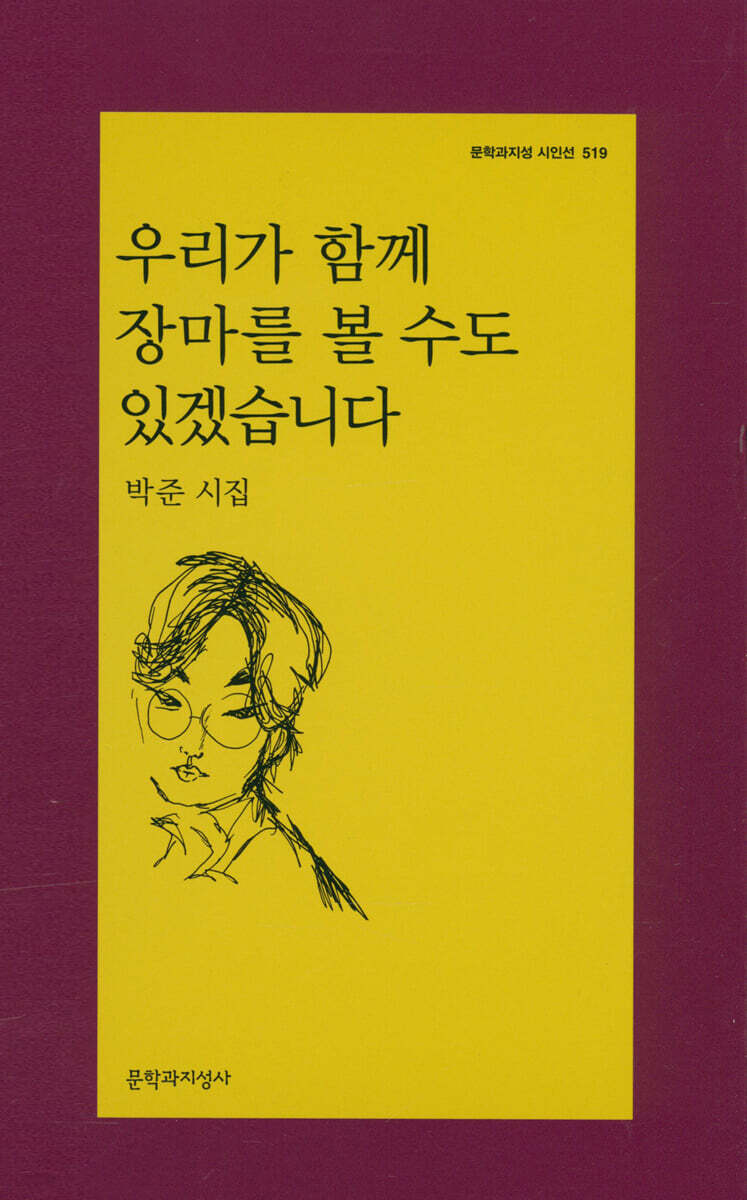
We might be able to see the rainy season together
 |
Description
Book Introduction
"I named it after you and ate it for several days."
A new work by Park Jun, author of "Nothing Will Change Even If You Cry"
Poet Park Jun, who immediately captured the hearts of readers with just one poetry collection and one prose collection, has published his second poetry collection, “We Could See the Rainy Season Together” (Munhak-kwa-Jiseongsa, 2018).
This is his first new work in six years since his first poetry collection in 2012.
The addition of a thoughtful preface by literary critic Shin Hyeong-cheol, who read Park Jun's poems "a little bit before" the readers over the past six years, adds to the solidity.
The poet says:
We might be able to see the rainy season together.
“I want to see you” is not a word of desire, nor is “I saw you” a language of reminiscence.
In the language that indicates the future, such as 'I might see you,' we point to a time when we might be together someday.
The poet's lyricism and delicate language, which fill the remaining time before we see the rainy season together with a calm wait, make the reader feel a silent, rising hope.
Poet Heo Su-gyeong, who wrote the preface to her previous poetry collection, said, “I hope you believe that this is not a cheap hope.”
With these words in mind, I once again believe in the beauty contained in Park Jun's reply, and in the beginning of our journey to come.
A new work by Park Jun, author of "Nothing Will Change Even If You Cry"
Poet Park Jun, who immediately captured the hearts of readers with just one poetry collection and one prose collection, has published his second poetry collection, “We Could See the Rainy Season Together” (Munhak-kwa-Jiseongsa, 2018).
This is his first new work in six years since his first poetry collection in 2012.
The addition of a thoughtful preface by literary critic Shin Hyeong-cheol, who read Park Jun's poems "a little bit before" the readers over the past six years, adds to the solidity.
The poet says:
We might be able to see the rainy season together.
“I want to see you” is not a word of desire, nor is “I saw you” a language of reminiscence.
In the language that indicates the future, such as 'I might see you,' we point to a time when we might be together someday.
The poet's lyricism and delicate language, which fill the remaining time before we see the rainy season together with a calm wait, make the reader feel a silent, rising hope.
Poet Heo Su-gyeong, who wrote the preface to her previous poetry collection, said, “I hope you believe that this is not a cheap hope.”
With these words in mind, I once again believe in the beauty contained in Park Jun's reply, and in the beginning of our journey to come.
- You can preview some of the book's contents.
Preview
index
Poet's words
Part 1: Why I Still Like the World
Sleep/March Tree/84p/Mugwort Soup/That Spring/April Sleep/Condolences/On the Way to the Bathhouse/Ah,/Life and Forecast/Yeonpung/Only Our Lies/Day and Night
Part 2: Keep your eyes far away
Summer's work/ Chobok/ At the end of the night and the hand/ Our heaven/ Sweet rain/ Where the heart leans/ Voice/ Rock/ Baemsagol/ Oreum/ Rainy season/ Buckwheat noodles/ Chuseok/ Perennials
Part 3: The Good Things That Come After a Day or Two
Neunggok Villa/ The end of autumn/ The heart, the hill/ Lake guesthouse/ In front of your clear eyes, things like your clear eyes/ Side by side/ Full of names/ Inside and outside/ The house of the maze/ Jongam-dong/ A child by the riverside/ Anchovies/ Autumn rites
Part 4 Those words will shake each other's heads
Forest/Winter's Words/Good World/Southbound Train/Sleep's Flesh is Cold/Big Snow, Paju/Sal/Winter Rain/Today/Ipchun Diary/Lighthouse at the End of the World 3
Part 1: Why I Still Like the World
Sleep/March Tree/84p/Mugwort Soup/That Spring/April Sleep/Condolences/On the Way to the Bathhouse/Ah,/Life and Forecast/Yeonpung/Only Our Lies/Day and Night
Part 2: Keep your eyes far away
Summer's work/ Chobok/ At the end of the night and the hand/ Our heaven/ Sweet rain/ Where the heart leans/ Voice/ Rock/ Baemsagol/ Oreum/ Rainy season/ Buckwheat noodles/ Chuseok/ Perennials
Part 3: The Good Things That Come After a Day or Two
Neunggok Villa/ The end of autumn/ The heart, the hill/ Lake guesthouse/ In front of your clear eyes, things like your clear eyes/ Side by side/ Full of names/ Inside and outside/ The house of the maze/ Jongam-dong/ A child by the riverside/ Anchovies/ Autumn rites
Part 4 Those words will shake each other's heads
Forest/Winter's Words/Good World/Southbound Train/Sleep's Flesh is Cold/Big Snow, Paju/Sal/Winter Rain/Today/Ipchun Diary/Lighthouse at the End of the World 3
Into the book
Faced with the dam where annuals once died and the resurgence of new annuals, the hardened gravel, and the birds sharpening their beaks as they pierced the air, the silence was nothing new. However, when I pressed my ear to the thin plaster wall, hoping to hear even the slightest unfamiliar sound, all I could hear was the murmur of our lies, the lies we had once uttered in our pasts.
―Full text from "Only Our Lies"
I actually walked this road with flowers and fruit
I've walked with other people
Once upon a time, hydrangeas were in bloom
Another time it snowed
There is a large ranch nearby.
I wanted to talk but
My time
Walking down
Your steps were just quick
―The "ascent" part
I don't know if I'll be here until then, but these days, it's good to think about the long term. When I do, I open my mouth slightly, stick my chin out, and make a face that seems to indicate I'm waiting for someone. My eyes are also quite distant, as if I'm willing to wait longer.
―The "Buckwheat Noodles" section
―Full text from "Only Our Lies"
I actually walked this road with flowers and fruit
I've walked with other people
Once upon a time, hydrangeas were in bloom
Another time it snowed
There is a large ranch nearby.
I wanted to talk but
My time
Walking down
Your steps were just quick
―The "ascent" part
I don't know if I'll be here until then, but these days, it's good to think about the long term. When I do, I open my mouth slightly, stick my chin out, and make a face that seems to indicate I'm waiting for someone. My eyes are also quite distant, as if I'm willing to wait longer.
―The "Buckwheat Noodles" section
--- From "Buckwheat Noodles"
Publisher's Review
After enduring all the time alone
Words from the past arriving in the present
The words we shared long ago have not been forgotten, and even now, we are walking deep into the forest. By today, the words of that summer will have just arrived.
―The “Forest” section
The speaker of this collection of poems is a person who waits.
The answers to “things we wonder about during the day” can only be found “when the night falls” (“Day and Night”).
However, what Park Jun's speaker "I" is waiting for is not something in the future, but something that has already passed in the past.
The words of greeting we used to affectionately call each other in the past, the everyday words that could have been quickly forgotten.
The words that come to me today are scenes from memories that happened in the past.
According to Shin Hyeong-cheol, for Park Jun, the past “does not flow away to a distant past, but rather comes back to the present when the time comes.”
By the time this article reaches you
We might be able to see the rainy season together, he said.
I wrote a new letter to start with
―Excerpt from "Rainy Season - Letter from Taebaek"
If the past arrives in the present, then this moment will inevitably lead to the future.
In Taebaek, “I” write two letters.
In my first letter I write about the “miners who died in the mines,” but I soon “crumpled up the paper.”
And in the second letter, he writes a new letter that begins with the sentence, “Maybe we can see the rainy season together.”
If the first letter tells what has already happened, the next letter contains instructions for what will happen in the future.
I haven't reached the future yet, but if I spend my present faithfully, my future self can head to that very place where I can watch the rainy season with you.
Living one step ahead of you
'caretaker
I don't know if I'll be here until then, but these days, it's good to think about the long term. When I do, I open my mouth slightly, stick my chin out, and make a face that seems to indicate I'm waiting for someone. My eyes are also quite distant, as if I'm willing to wait longer.
―Excerpt from "Buckwheat Noodles - Letters from Cheorwon"
So then, what exactly is the speaker waiting for in this collection of poems?
Earlier we discussed the point at which the words you and I shared in the past reach me in the present.
Perhaps what the speaker is waiting for is the person with whom he shared those words, in other words, 'you', or in the poet's words, 'beauty'.
The 'I' who "counts the long time" and "makes an expression of waiting for someone" is someone I broke up with in the past.
And he would be someone who would want to care for you enough to immediately stop what he was doing at the slightest sound of “you opening the window” (p. 84).
Although not intense, Shin Hyeong-cheol uses the word “care” to describe the mind that sharpens one’s sense of touch at every moment in life.
According to him, Park Jun's care is "living the other person's future once first and then living it once more with you," and therefore the speaker of this poetry collection can be seen as "someone who lives a little earlier."
In Park Jun's first collection of poems, the speaker comes down "after pushing you into the fire pit today," and recalls the small birthday meal he received from you in the past.
In the last collection of poems, “I”, who was taking care of my ruined place with memories of being cared for by the other person, goes on to take care of you in this collection of poems.
The way the poet chose to take care of you was through food.
Just like the birthday table that soothed my heart in the past, it is not fancy, but I am preparing simple food that you will enjoy eating.
“Take out the winter radish” and “cut it into similar sizes” and store it (“Tree of March”), or “dissolve mugwort and soybean paste” and think about making soup (“Mugwort Soup”).
I think of wrapping up stir-fried doraji for someone who cannot eat rice ("April Sleep"), or making dumpling filling with white cabbage ("Buckwheat Noodles").
The mindset to prepare things that you will enjoy eating, “This kind of determination is often called ‘resolution,’” but here I will call it “resolution.”
“The determination to care, that is Park Jun’s love” (Shin Hyeong-cheol).
Words from the past arriving in the present
The words we shared long ago have not been forgotten, and even now, we are walking deep into the forest. By today, the words of that summer will have just arrived.
―The “Forest” section
The speaker of this collection of poems is a person who waits.
The answers to “things we wonder about during the day” can only be found “when the night falls” (“Day and Night”).
However, what Park Jun's speaker "I" is waiting for is not something in the future, but something that has already passed in the past.
The words of greeting we used to affectionately call each other in the past, the everyday words that could have been quickly forgotten.
The words that come to me today are scenes from memories that happened in the past.
According to Shin Hyeong-cheol, for Park Jun, the past “does not flow away to a distant past, but rather comes back to the present when the time comes.”
By the time this article reaches you
We might be able to see the rainy season together, he said.
I wrote a new letter to start with
―Excerpt from "Rainy Season - Letter from Taebaek"
If the past arrives in the present, then this moment will inevitably lead to the future.
In Taebaek, “I” write two letters.
In my first letter I write about the “miners who died in the mines,” but I soon “crumpled up the paper.”
And in the second letter, he writes a new letter that begins with the sentence, “Maybe we can see the rainy season together.”
If the first letter tells what has already happened, the next letter contains instructions for what will happen in the future.
I haven't reached the future yet, but if I spend my present faithfully, my future self can head to that very place where I can watch the rainy season with you.
Living one step ahead of you
'caretaker
I don't know if I'll be here until then, but these days, it's good to think about the long term. When I do, I open my mouth slightly, stick my chin out, and make a face that seems to indicate I'm waiting for someone. My eyes are also quite distant, as if I'm willing to wait longer.
―Excerpt from "Buckwheat Noodles - Letters from Cheorwon"
So then, what exactly is the speaker waiting for in this collection of poems?
Earlier we discussed the point at which the words you and I shared in the past reach me in the present.
Perhaps what the speaker is waiting for is the person with whom he shared those words, in other words, 'you', or in the poet's words, 'beauty'.
The 'I' who "counts the long time" and "makes an expression of waiting for someone" is someone I broke up with in the past.
And he would be someone who would want to care for you enough to immediately stop what he was doing at the slightest sound of “you opening the window” (p. 84).
Although not intense, Shin Hyeong-cheol uses the word “care” to describe the mind that sharpens one’s sense of touch at every moment in life.
According to him, Park Jun's care is "living the other person's future once first and then living it once more with you," and therefore the speaker of this poetry collection can be seen as "someone who lives a little earlier."
In Park Jun's first collection of poems, the speaker comes down "after pushing you into the fire pit today," and recalls the small birthday meal he received from you in the past.
In the last collection of poems, “I”, who was taking care of my ruined place with memories of being cared for by the other person, goes on to take care of you in this collection of poems.
The way the poet chose to take care of you was through food.
Just like the birthday table that soothed my heart in the past, it is not fancy, but I am preparing simple food that you will enjoy eating.
“Take out the winter radish” and “cut it into similar sizes” and store it (“Tree of March”), or “dissolve mugwort and soybean paste” and think about making soup (“Mugwort Soup”).
I think of wrapping up stir-fried doraji for someone who cannot eat rice ("April Sleep"), or making dumpling filling with white cabbage ("Buckwheat Noodles").
The mindset to prepare things that you will enjoy eating, “This kind of determination is often called ‘resolution,’” but here I will call it “resolution.”
“The determination to care, that is Park Jun’s love” (Shin Hyeong-cheol).
GOODS SPECIFICS
- Publication date: December 13, 2018
- Page count, weight, size: 116 pages | 174g | 128*205*20mm
- ISBN13: 9788932034942
- ISBN10: 893203494X
You may also like
카테고리
korean


korean

![GQ KOREA Mark (Monthly): December [2025]](http://librairie.coreenne.fr/cdn/shop/files/8ef265dbbfbf186523ed75ba7319009d.jpg?v=1765340328&width=3840)


