

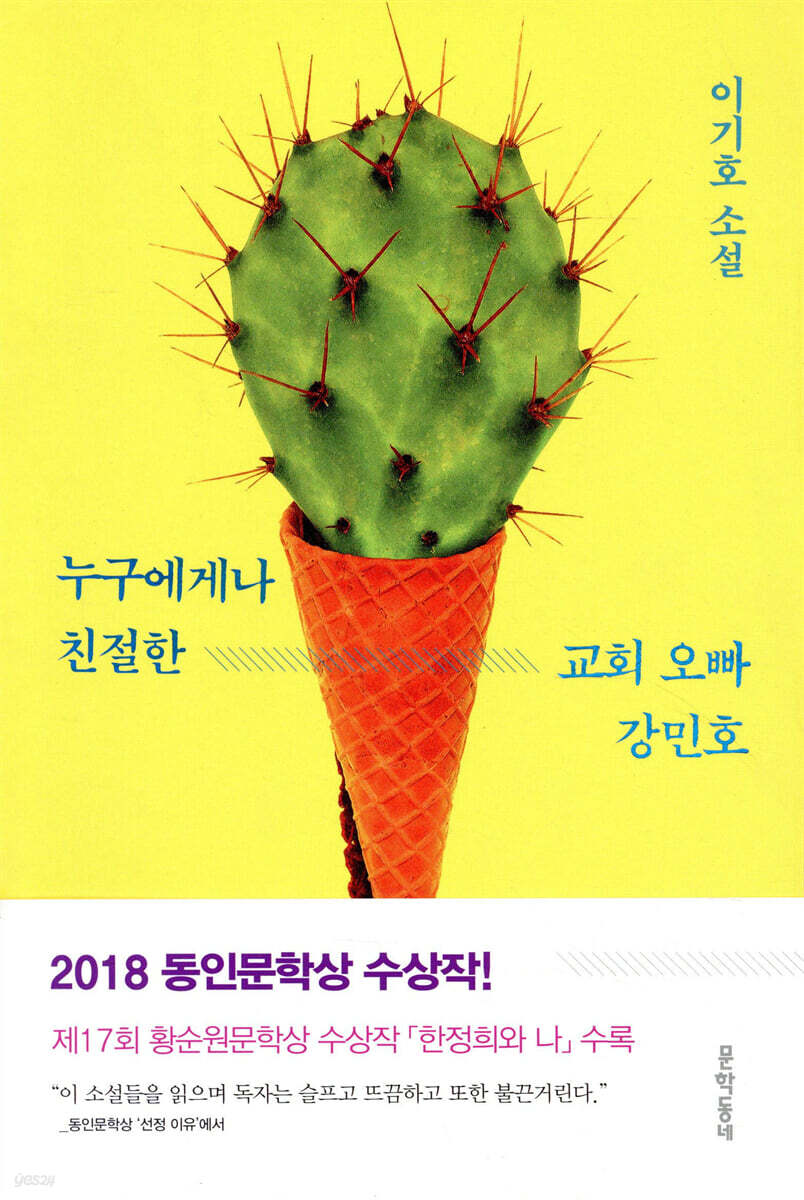
Kang Min-ho, a church brother who is kind to everyone
 |
Description
Book Introduction
Lee Ki-ho's new novel collection, his first in five years
Includes the 17th Hwang Sun-won Literary Award winner, "Han Jeong-hee and I"
A new collection of short stories by Lee Ki-ho, published five years after “Who is Dr. Kim?”
This book collects seven novels that have been highly praised by critics since their publication, including “Han Jeong-hee and I,” which won the Hwang Sun-won Literary Award and was nominated for prestigious literary awards such as the Yi Sang Literary Award, the Contemporary Literary Award, the Hwang Sun-won Literary Award, and the Kim Yu-jeong Literary Award, for their candid display of “the most urgent literary ethics of today” called “precise failure.”
In this collection of short stories, he goes beyond his previous reputation as a representative "humorist" of Korean literature, and instead takes a slightly more humorous approach. Using his characteristically fast-paced and witty prose, he explores why it has become difficult to live in this world without losing a sense of humor.
Includes the 17th Hwang Sun-won Literary Award winner, "Han Jeong-hee and I"
A new collection of short stories by Lee Ki-ho, published five years after “Who is Dr. Kim?”
This book collects seven novels that have been highly praised by critics since their publication, including “Han Jeong-hee and I,” which won the Hwang Sun-won Literary Award and was nominated for prestigious literary awards such as the Yi Sang Literary Award, the Contemporary Literary Award, the Hwang Sun-won Literary Award, and the Kim Yu-jeong Literary Award, for their candid display of “the most urgent literary ethics of today” called “precise failure.”
In this collection of short stories, he goes beyond his previous reputation as a representative "humorist" of Korean literature, and instead takes a slightly more humorous approach. Using his characteristically fast-paced and witty prose, he explores why it has become difficult to live in this world without losing a sense of humor.
- You can preview some of the book's contents.
Preview
index
Where is Choi Mi-jin _7
Na Jeong-man's slightly downward-bent boom _35
Kwon Soon-chan and the Good People _69
To Park Chang-soo, who will come to hate me _105
Long ago, Kim Sook-hee _169
Kang Min-ho, a church brother who is kind to everyone _205
Han Jeong-hee and I _237
Kim Hyung-joong's Commentary? Again, on "Hospitality" _273
Lee Ki-ho's Words _295
Na Jeong-man's slightly downward-bent boom _35
Kwon Soon-chan and the Good People _69
To Park Chang-soo, who will come to hate me _105
Long ago, Kim Sook-hee _169
Kang Min-ho, a church brother who is kind to everyone _205
Han Jeong-hee and I _237
Kim Hyung-joong's Commentary? Again, on "Hospitality" _273
Lee Ki-ho's Words _295
Into the book
“Fuck, you don’t know anything… Why am I selling books… How long have I been looking at your writing… Where and how does our Mijin live… You don’t know anything… You just act like that without knowing anything… But fuck, what did I do so wrong… How many times have I said I’m sorry… You really wanted to hear those words… You really wanted to hear those words…” --- From “Where is Choi Mijin?”
Sometimes I think.
About a life where you feel insult first, afraid of being insulted, and then return the insult.
I find that a bit sad and embarrassing.
---From "Where is Choi Mi-jin?"
So, you're saying that you're similar to me?
Isn't it true that what's sad is sad and what's scary is scary?
Huh? Am I wrong? ---From "Na Jeong-man's Slightly Bent Boom"
The image that came to my mind when I saw the man was 'a lump of dust'.
A round, swollen 'ball of dust' with hair in the corner of the room from not cleaning for a long time.
A 'dust ball' that looks like it could be pulled out by a thread.
I found that a bit odd.
Why do people not appear human, but like panels on a windowpane, like snowflakes fluttering helplessly? What is it about that man that makes me think of such things? --- From "Kwon Soon-chan and the Good People"
I increasingly suspect that we each have many different lines, and that trying to see them as just one line is not trying to see the person themselves, but rather trying to see ourselves looking at the person.
---From "To Park Chang-soo, Who Will Come to Hate Me"
Why do some people become murderers and others become normal?
Why do some people feel shame, while others feel shame?
I still don't know it.
---From "To Park Chang-soo, Who Will Come to Hate Me"
It was true that I didn't really know what it meant to welcome one person as another, or what trials awaited us.
That's not something you can figure out on your own, no matter how many children you raise.
There is no such thing as a predictable child in this world... --- From "Han Jeong-hee and I"
Is it really possible to be hospitable without asking for one's identity, without demanding anything in return, without thinking of revenge? Is it really possible to hate the sin but not the person? If so, how can sin and the person be separated? Our inner selves are always filled with anxiety, despair, and conflict, and how can we understand and accept others when even ourselves often seem unfamiliar? ... I didn't quite understand that.
I feel like I'm lying to myself...
Sometimes I think.
About a life where you feel insult first, afraid of being insulted, and then return the insult.
I find that a bit sad and embarrassing.
---From "Where is Choi Mi-jin?"
So, you're saying that you're similar to me?
Isn't it true that what's sad is sad and what's scary is scary?
Huh? Am I wrong? ---From "Na Jeong-man's Slightly Bent Boom"
The image that came to my mind when I saw the man was 'a lump of dust'.
A round, swollen 'ball of dust' with hair in the corner of the room from not cleaning for a long time.
A 'dust ball' that looks like it could be pulled out by a thread.
I found that a bit odd.
Why do people not appear human, but like panels on a windowpane, like snowflakes fluttering helplessly? What is it about that man that makes me think of such things? --- From "Kwon Soon-chan and the Good People"
I increasingly suspect that we each have many different lines, and that trying to see them as just one line is not trying to see the person themselves, but rather trying to see ourselves looking at the person.
---From "To Park Chang-soo, Who Will Come to Hate Me"
Why do some people become murderers and others become normal?
Why do some people feel shame, while others feel shame?
I still don't know it.
---From "To Park Chang-soo, Who Will Come to Hate Me"
It was true that I didn't really know what it meant to welcome one person as another, or what trials awaited us.
That's not something you can figure out on your own, no matter how many children you raise.
There is no such thing as a predictable child in this world... --- From "Han Jeong-hee and I"
Is it really possible to be hospitable without asking for one's identity, without demanding anything in return, without thinking of revenge? Is it really possible to hate the sin but not the person? If so, how can sin and the person be separated? Our inner selves are always filled with anxiety, despair, and conflict, and how can we understand and accept others when even ourselves often seem unfamiliar? ... I didn't quite understand that.
I feel like I'm lying to myself...
---From "Han Jeong-hee and I"
Publisher's Review
Living in a world where it is extremely difficult to not lose your sense of humor
A gentle and gentle voice calling out my, your and our 'names'
In the author's note for the short story collection 『I Knew This Would Happen After Hesitating』 published in 2006, Lee Ki-ho said that he had “made up his mind to write ‘my’ stories,” and in the author's note for his previous short story collection 『Who is Dr. Kim?』, he said that he had “only now begun to turn his eyes to others.”
And in this collection of short stories, the author has written more earnestly than ever before about “stories about people who suffer.”
Lee Ki-ho's novels often feature characters with common and somewhat unsophisticated names, and in this collection of short stories, he deliberately discusses these 'names' that are so ordinary that they seem easily forgotten.
Through the names Choi Mi-jin, Na Jeong-man, Kwon Soon-chan, Park Chang-soo, Kim Sook-hee, Kang Min-ho, and Han Jeong-hee engraved on each of the seven included works, that is, through the 'unique' existences that cannot be thought of other than someone with these names, we want to ask and clarify why we live without humor, and why we must live feeling shame even when we suffer.
Ironically, it is said that the character ‘I’, the ‘novelist’, and the ‘Lee Ki-ho’ are at the forefront.
The seven works seem to be stories about the author himself, to the point where it is difficult to tell whether they are novels or essays, or the words of the real novelist Lee Ki-ho or the character Lee Ki-ho, but compared to his previous works, they are closer to the stories of ‘us.’
In the past few years we have experienced painful events.
I felt an unbearable sadness through certain incidents that came to mind just by hearing certain words like 'Yongsan', 'sea', and 'sinking', and I felt 'shame' for not being able to prevent those incidents or protect someone from those incidents.
In "Na Jeong-man's Slightly Bent Boom," the 'novelist' who is covering the Yongsan disaster meets a crane operator who was not on site, but a reporter who was unable to go to the scene, perhaps because of this shame, and (perhaps) the shame felt by the narrator 'Lee Ki-ho' of "Where is Choi Mi-jin Going," which can be said to have the most Lee Ki-ho-style humor in this collection, is the same.
The story of Lee Ki-ho, who feels insulted by James Shutterner, who is selling his novel at a low price on 'Junggonara', and meets him, is humorously portrayed, but in the end, the real reason he feels insulted is probably the shame he feels for being so eager to defend himself even in these suspicious times.
The same goes for me, a university professor and novelist in “Kwon Soon-chan and Good People.”
One day, Kwon Soon-chan appears on the hill across from the apartment complex where he lives, holding a poster that reads, “Mr. Kim Seok-man, Unit 502, Building 103, return the 7 million won I deposited!” and is holding a quiet protest.
Kwon Soon-chan doesn't make any demands on or cause any harm to the residents of the apartment complex, but the residents grow increasingly tired of his presence as time passes.
Eventually, Kwon Soon-chan becomes a thorn in his side when he rejects the seven million won that he had collected and donated out of pure 'neighborhood love'.
This novel painfully reflects on why, through a series of events reminiscent of the events following the Sewol Ferry disaster, 'good and innocent' people, rather than those who should be blamed, end up feeling ashamed and hurting each other.
In two series about Kim Sook-hee, who murdered her husband ("To Park Chang-soo, Who Will Come to Hate Me" and "Kim Sook-hee Long Ago"), shame becomes a motive for murder.
But Lee Ki-ho adds one more question here.
About a life where you feel insult first and then return it, for fear of being insulted.
When you welcome others, think about the feelings of the person being welcomed.
Why do we get angry at innocent people?
Lee Ki-ho's novels "make readers feel uncomfortable and ashamed" (Kim Hyung-jung's Commentary).
This is because it asks, 'Is your hospitality truly for the benefit of the person being welcomed, or for yourself who is offering the hospitality?'
Because it makes people who believe they have welcomed someone feel a pang of guilt and shame.
The scene in “Kwon Soon-chan and the Good People” where the “I” confesses that Kwon Soon-chan is “a shame, but annoying” is rather honest.
Kang Min-ho, the kind church brother who is kind to everyone, is kind to both his wife and his junior, Yoon-hee. However, his kindness eventually leads to a strange misunderstanding and locks Yoon-hee in a hijab, but Kang Min-ho has no memory of that hospitality.
In "Han Jeong-hee and I," the 'I' also unconditionally welcomes 'Han Jeong-hee', the granddaughter of 'Maseok Mom and Dad' who raised his wife when she was in elementary school.
Just as ‘Ma Seok Mom and Dad’ unconditionally welcomed their wife.
However, 'I' explodes when 'Jeong-hee' becomes a perpetrator of school violence and yet shows no shame.
This is because the hospitality that 'I' showed to Jeong-hee did not include unexpected factors such as 'violence' or 'shamelessness'.
In this way, the novel continues to ask:
'Is unconditional hospitality truly possible?'
This question, which makes readers feel uncomfortable and troubled throughout, is also directed at Lee Ki-ho himself without exception.
"When faced with a certain event, will I be able to act realistically? Isn't the role of a novel to help us realize that unconditional hospitality is impossible?" Traces of this author's concerns are revealed more candidly in "Lee Ki-ho's Words," which could be considered a novel in its own right, and is included as a bonus track.
It is not difficult for Lee Ki-ho, who has returned after five years, to reaffirm his image as a representative storyteller of Korean literature.
This is because the ability to understand and accept the feelings of the wife, Kim Sook-hee, who killed her husband, Kim Jun-su, who was always welcoming and faithful to his wife, solely out of shame, is not common.
However, what is quite different is that there is a sense of intentional pause in scenes that would have been depicted as noisy or comical, almost slapstick, in previous novels.
It may be surprising to say that the aesthetic of Lee Ki-ho's novels is 'humor', but this moment of pause makes us think again about what novels can do in these times when it has become difficult to live our daily lives calmly and talk about 'humor'.
And it makes me think about why he, who has always written stories about 'ordinary people' and 'suffering people', had to call out their names one by one and squeeze himself into their midst.
And when we recall that Lee Ki-ho's novels, now in his 19th year since his debut, have continued to advance in a better direction without a single moment of hesitation, we will once again nod our heads at the seven novels included here.
●
Do you think you can learn ethics from books or novels?
Do you think you can feel shame together through books, through novels?
In my opinion, that's almost impossible.
Realizing that it is impossible.
That is the only truth we can learn through novels and books.
I came here to say this.
How unpredictable can you be when the truth is right in front of you?
I still have a long way to go.
_From 'Lee Ki-ho's Words'
A gentle and gentle voice calling out my, your and our 'names'
In the author's note for the short story collection 『I Knew This Would Happen After Hesitating』 published in 2006, Lee Ki-ho said that he had “made up his mind to write ‘my’ stories,” and in the author's note for his previous short story collection 『Who is Dr. Kim?』, he said that he had “only now begun to turn his eyes to others.”
And in this collection of short stories, the author has written more earnestly than ever before about “stories about people who suffer.”
Lee Ki-ho's novels often feature characters with common and somewhat unsophisticated names, and in this collection of short stories, he deliberately discusses these 'names' that are so ordinary that they seem easily forgotten.
Through the names Choi Mi-jin, Na Jeong-man, Kwon Soon-chan, Park Chang-soo, Kim Sook-hee, Kang Min-ho, and Han Jeong-hee engraved on each of the seven included works, that is, through the 'unique' existences that cannot be thought of other than someone with these names, we want to ask and clarify why we live without humor, and why we must live feeling shame even when we suffer.
Ironically, it is said that the character ‘I’, the ‘novelist’, and the ‘Lee Ki-ho’ are at the forefront.
The seven works seem to be stories about the author himself, to the point where it is difficult to tell whether they are novels or essays, or the words of the real novelist Lee Ki-ho or the character Lee Ki-ho, but compared to his previous works, they are closer to the stories of ‘us.’
In the past few years we have experienced painful events.
I felt an unbearable sadness through certain incidents that came to mind just by hearing certain words like 'Yongsan', 'sea', and 'sinking', and I felt 'shame' for not being able to prevent those incidents or protect someone from those incidents.
In "Na Jeong-man's Slightly Bent Boom," the 'novelist' who is covering the Yongsan disaster meets a crane operator who was not on site, but a reporter who was unable to go to the scene, perhaps because of this shame, and (perhaps) the shame felt by the narrator 'Lee Ki-ho' of "Where is Choi Mi-jin Going," which can be said to have the most Lee Ki-ho-style humor in this collection, is the same.
The story of Lee Ki-ho, who feels insulted by James Shutterner, who is selling his novel at a low price on 'Junggonara', and meets him, is humorously portrayed, but in the end, the real reason he feels insulted is probably the shame he feels for being so eager to defend himself even in these suspicious times.
The same goes for me, a university professor and novelist in “Kwon Soon-chan and Good People.”
One day, Kwon Soon-chan appears on the hill across from the apartment complex where he lives, holding a poster that reads, “Mr. Kim Seok-man, Unit 502, Building 103, return the 7 million won I deposited!” and is holding a quiet protest.
Kwon Soon-chan doesn't make any demands on or cause any harm to the residents of the apartment complex, but the residents grow increasingly tired of his presence as time passes.
Eventually, Kwon Soon-chan becomes a thorn in his side when he rejects the seven million won that he had collected and donated out of pure 'neighborhood love'.
This novel painfully reflects on why, through a series of events reminiscent of the events following the Sewol Ferry disaster, 'good and innocent' people, rather than those who should be blamed, end up feeling ashamed and hurting each other.
In two series about Kim Sook-hee, who murdered her husband ("To Park Chang-soo, Who Will Come to Hate Me" and "Kim Sook-hee Long Ago"), shame becomes a motive for murder.
But Lee Ki-ho adds one more question here.
About a life where you feel insult first and then return it, for fear of being insulted.
When you welcome others, think about the feelings of the person being welcomed.
Why do we get angry at innocent people?
Lee Ki-ho's novels "make readers feel uncomfortable and ashamed" (Kim Hyung-jung's Commentary).
This is because it asks, 'Is your hospitality truly for the benefit of the person being welcomed, or for yourself who is offering the hospitality?'
Because it makes people who believe they have welcomed someone feel a pang of guilt and shame.
The scene in “Kwon Soon-chan and the Good People” where the “I” confesses that Kwon Soon-chan is “a shame, but annoying” is rather honest.
Kang Min-ho, the kind church brother who is kind to everyone, is kind to both his wife and his junior, Yoon-hee. However, his kindness eventually leads to a strange misunderstanding and locks Yoon-hee in a hijab, but Kang Min-ho has no memory of that hospitality.
In "Han Jeong-hee and I," the 'I' also unconditionally welcomes 'Han Jeong-hee', the granddaughter of 'Maseok Mom and Dad' who raised his wife when she was in elementary school.
Just as ‘Ma Seok Mom and Dad’ unconditionally welcomed their wife.
However, 'I' explodes when 'Jeong-hee' becomes a perpetrator of school violence and yet shows no shame.
This is because the hospitality that 'I' showed to Jeong-hee did not include unexpected factors such as 'violence' or 'shamelessness'.
In this way, the novel continues to ask:
'Is unconditional hospitality truly possible?'
This question, which makes readers feel uncomfortable and troubled throughout, is also directed at Lee Ki-ho himself without exception.
"When faced with a certain event, will I be able to act realistically? Isn't the role of a novel to help us realize that unconditional hospitality is impossible?" Traces of this author's concerns are revealed more candidly in "Lee Ki-ho's Words," which could be considered a novel in its own right, and is included as a bonus track.
It is not difficult for Lee Ki-ho, who has returned after five years, to reaffirm his image as a representative storyteller of Korean literature.
This is because the ability to understand and accept the feelings of the wife, Kim Sook-hee, who killed her husband, Kim Jun-su, who was always welcoming and faithful to his wife, solely out of shame, is not common.
However, what is quite different is that there is a sense of intentional pause in scenes that would have been depicted as noisy or comical, almost slapstick, in previous novels.
It may be surprising to say that the aesthetic of Lee Ki-ho's novels is 'humor', but this moment of pause makes us think again about what novels can do in these times when it has become difficult to live our daily lives calmly and talk about 'humor'.
And it makes me think about why he, who has always written stories about 'ordinary people' and 'suffering people', had to call out their names one by one and squeeze himself into their midst.
And when we recall that Lee Ki-ho's novels, now in his 19th year since his debut, have continued to advance in a better direction without a single moment of hesitation, we will once again nod our heads at the seven novels included here.
●
Do you think you can learn ethics from books or novels?
Do you think you can feel shame together through books, through novels?
In my opinion, that's almost impossible.
Realizing that it is impossible.
That is the only truth we can learn through novels and books.
I came here to say this.
How unpredictable can you be when the truth is right in front of you?
I still have a long way to go.
_From 'Lee Ki-ho's Words'
GOODS SPECIFICS
- Date of publication: May 28, 2018
- Page count, weight, size: 316 pages | 392g | 133*200*30mm
- ISBN13: 9788954651127
- ISBN10: 8954651127
You may also like
카테고리
korean


korean

![GQ KOREA Mark (Monthly): December [2025]](http://librairie.coreenne.fr/cdn/shop/files/8ef265dbbfbf186523ed75ba7319009d.jpg?v=1765340328&width=3840)


