

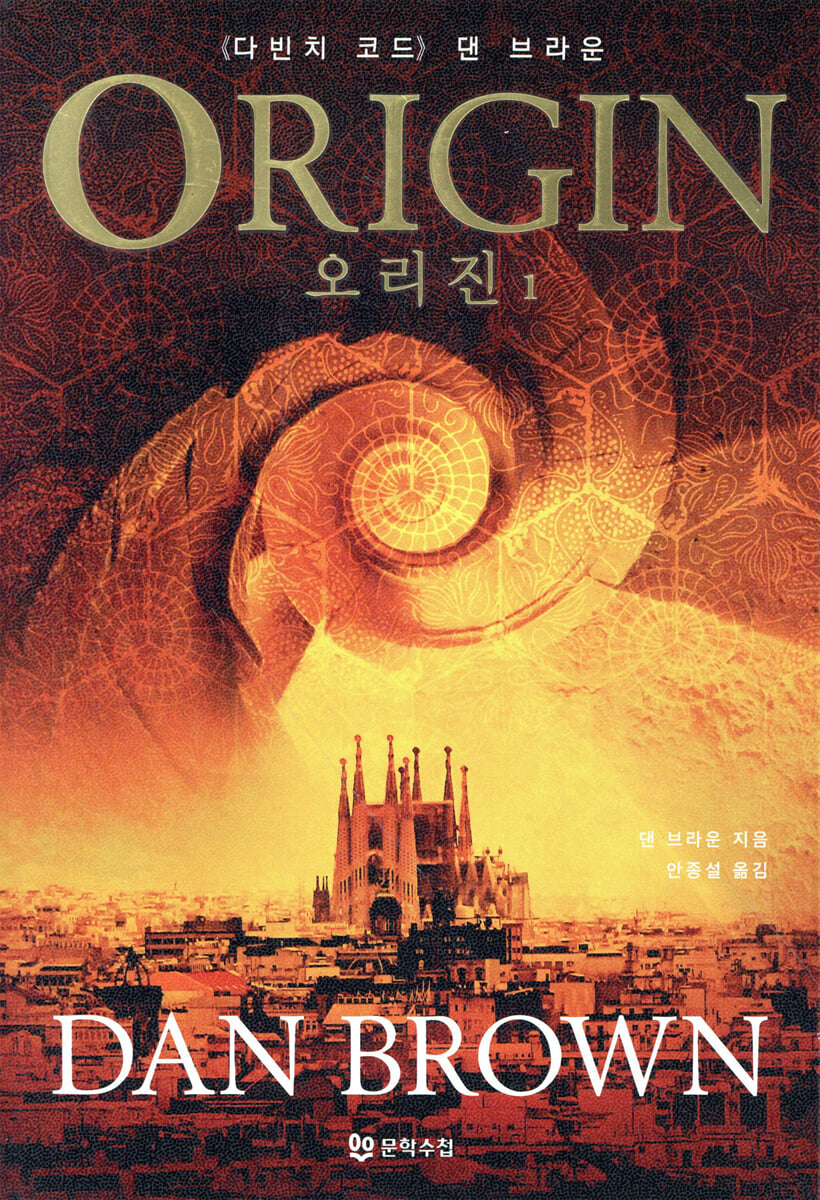
Origin 1
 |
Description
Book Introduction
Where do we come from and where do we go? No matter who you are or what you believe, everything will change tonight. Immediately after publication, it reached number one on the [Amazon] and [New York Times] bestseller lists! E-book and audiobook sales also reached #1! First edition sold 2 million copies! Released simultaneously in 12 countries, selling over 100,000 copies in the UK in its first week alone! Dan Brown, author of 'The Da Vinci Code' Bold Questions About God, Science, and the Future Dan Brown, he's back. He is a master of intellectual thrillers who tackle hot and sharp issues in a sharp and exciting way. Living up to his title of 'Big Bang of the novel world', his previous works have been translated into 56 languages and sold over 200 million copies. Dan Brown was selected as one of the '100 Most Influential People in the World' by Time magazine and also ranked 4th in the 'World's Highest-Paid Authors of 2017' list published by the American business magazine Forbes. This novel, which aroused curiosity from its title and cover, received a hot response as expected immediately after its publication. It was published simultaneously in 12 countries (USA, UK, France, Germany, Spain, Italy, Netherlands, Australia, Canada, Mexico, Brazil, and Turkey) in early October 2017, and immediately took the #1 spot on the New York Times bestseller list, and also ranked #1 in e-book and audiobook sales, demonstrating Dan Brown's enduring fame. Like his previous works, including The Da Vinci Code, Origin also questions the truths we have taken for granted. That question mark is not at all unfamiliar. Because it is the oldest question that all of humanity has ever asked. "Where do we come from and where are we going?" Now, open the book and trace the answer to that question! No matter who you are or what you believe, everything changes tonight! |
- You can preview some of the book's contents.
Preview
Into the book
“At the heart of human knowledge lie these two mysteries.
Where did we come from? Where are we going? In other words, it's about human "creation" and human "destiny."
This is the most universal riddle.” --- p.82
“Countless gods have filled in countless gaps,” Langdon said.
“But as time went by, scientific knowledge began to accumulate.” This time, various symbols from the fields of mathematics and technology filled the sky in clusters.
“As the gap in our understanding of the natural world gradually disappeared, the pantheon, once filled with gods, also gradually shrank.” --- p.128
In connection with Kersey's discovery, the Internet has been flooded with a wide range of theories, from Darwinism to aliens to creationism.
The motive behind this murder remains unknown, with numerous speculations ranging from religious fanaticism to corporate rivalry and jealousy.
--- p.236
This bold idea that humans must become gods in order to kill God was central to Nietzsche's thinking, and perhaps partly explains why pioneering technological geniuses like Edmund attacked the very idea of God.
'To destroy God... ... one must become God.'
Where did we come from? Where are we going? In other words, it's about human "creation" and human "destiny."
This is the most universal riddle.” --- p.82
“Countless gods have filled in countless gaps,” Langdon said.
“But as time went by, scientific knowledge began to accumulate.” This time, various symbols from the fields of mathematics and technology filled the sky in clusters.
“As the gap in our understanding of the natural world gradually disappeared, the pantheon, once filled with gods, also gradually shrank.” --- p.128
In connection with Kersey's discovery, the Internet has been flooded with a wide range of theories, from Darwinism to aliens to creationism.
The motive behind this murder remains unknown, with numerous speculations ranging from religious fanaticism to corporate rivalry and jealousy.
--- p.236
This bold idea that humans must become gods in order to kill God was central to Nietzsche's thinking, and perhaps partly explains why pioneering technological geniuses like Edmund attacked the very idea of God.
'To destroy God... ... one must become God.'
--- p.366
Publisher's Review
Dan Brown's latest work will shake the foundations of religion around the world!
The beginning and end of humanity: scientific answers to bold questions!
Dan Brown has been pursuing religion relentlessly and fiercely.
These include 『Angels & Demons』, which depicts the conflict between science and religion surrounding the Vatican; 『The Da Vinci Code』, which uncovers the secrets of Christianity hidden in da Vinci's works; 『Lost Symbol』, which sets out to find the 'lost symbol' of the Freemasons, the world's largest secret society; and 『Inferno』, which solves the puzzle-like code hidden in Dante's [Divine Comedy] with the future of humanity at stake.
『Origin』 also touches on religion.
No, it fundamentally goes beyond religion and confronts ‘God’.
It is a head-on confrontation between God and science.
Just as Dan Brown once said that his novels are “entertaining stories that provoke religious discussion and reflection” and “are not anti-Christian,” Origins is also a novel that will serve as a positive catalyst for exploring faith and providing an opportunity for self-reflection.
Origin, the fifth novel in the Robert Langdon series, questions the beginning and end of humanity, the origin and destiny of existence, trapped in religious dogma.
Dan Brown took the time to weave a dense narrative to boldly tackle this long-standing challenge.
Indeed, the author's hard work is clearly evident throughout the work, as he conducted preliminary research for five years without reading a single novel in order to conceive of "Origin."
It is no exaggeration to say that the history of science is based on the theories of renowned scientists such as Charles Darwin, Stephen Hawking, and Jeremy England.
Kersey's passionate presentation scene is a scene that highlights the obsession of author Dan Brown, who studied and researched intensely to create a novel.
Drawing on real religious groups, scientific facts, works of art, and architecture, this novel answers humanity's greatest questions and features a vibrant and captivating cast of characters, including Robert Langdon, who tells a compelling story.
This novel is particularly noteworthy because it is the first novel among Dan Brown's works to feature 'modern art'.
The Guggenheim Museum appears as the background in the introduction of the novel, and works of art in the museum, such as [Maman], [Fog Sculpture], and [David], are introduced.
Moreover, from Joan Mirage to Spain's legendary Gaudi's masterpiece, the Sagrada Familia cathedral, a feast of beauty unfolds across artistic genres and time and space.
Dan Brown's unique writing style of finding answers by following 'codes' and 'symbols' is clearly evident in the novel 'Origin'.
This time, you have to find a password of forty-seven characters.
The truth that will shake the foundations of world religions, which have been accepted without question until now, lies within that code.
Will Robert Langdon be able to figure out the code?
The amazing discovery of a billionaire futurist and genius computer scientist!
Scientific truth confronts 'God' and 'religion', and the surprising twist unfolds!
Edmund Kersey takes an old mountain railway to a historic monastery in Catalonia, Spain.
He is a genius computer scientist and the first disciple of Harvard University professor Robert Langdon.
Having become a billionaire overnight and hailed as a "prophet" for his repeated astonishing predictions, he meets with three prominent religious leaders at the Montserrat Library in the Catalan monastery before announcing a devastating pronouncement that will "fly in the face of the dogmas of almost all established religions."
Edmund Kersey's presentation at the Guggenheim Museum begins as two religious leaders present at the event die mysteriously one after another.
Robert Langdon, invited to the event, becomes determined to spread the word about Kersey's discovery, which is comparable to the Copernican Revolution, when Kersey is shot and killed during his presentation.
Robert Langdon, accompanied by Guggenheim Museum director Ambra Vidal, leaves the museum and travels to world-famous landmarks such as Casa Mila, Sagrada Familia, and Montjuïc in Barcelona, Spain, to uncover Kersey's secrets and his discoveries.
A schism in the Catholic Church, a conspiracy that seems to have come from the palace, the pursuit of the royal guard… … .
Meanwhile, the world's attention is focused on the online news of 'Conspiracy Net'.
Smartphones, self-driving cars, and supercomputers appear in the novel as key tools for tracking down secrets, adding to the thrill of the story.
Winston, the 'artificial intelligence' created by Edmund Kersey, serves as Langdon's steadfast supporter, along with Ambra Vidal.
Winston reminds me of Siri, created by the icon of innovation, Steve Jobs.
Between God and man, Winston, an artificial intelligence born from the fruits of science, may be the embodiment of Kersey's challenge.
While mourning the sudden death of his student Edmund Kersey, Langdon is driven by an intellectual curiosity about presentations and takes a risk to share Kersey's discoveries with the world.
Nevertheless, Kersey's announcement was not made public immediately.
The truth remains veiled until a tangled series of events unravels.
Impatient readers might wonder, 'So what are you trying to say?'
You may feel the urge to skip ahead and read the ending, wanting to know the truth as soon as possible.
However, if you don't carefully cross the tightropes placed throughout the novel before reaching the conclusion, you might miss the main point.
What is the discovery of Edmund Kersey, the driving force behind this novel and a bold challenge to God? Now, savor the thrilling intellectual pleasure coupled with the dizzying shock.
The moment you close the last page, you will no longer be able to see the world from the same perspective as before.
The beginning and end of humanity: scientific answers to bold questions!
Dan Brown has been pursuing religion relentlessly and fiercely.
These include 『Angels & Demons』, which depicts the conflict between science and religion surrounding the Vatican; 『The Da Vinci Code』, which uncovers the secrets of Christianity hidden in da Vinci's works; 『Lost Symbol』, which sets out to find the 'lost symbol' of the Freemasons, the world's largest secret society; and 『Inferno』, which solves the puzzle-like code hidden in Dante's [Divine Comedy] with the future of humanity at stake.
『Origin』 also touches on religion.
No, it fundamentally goes beyond religion and confronts ‘God’.
It is a head-on confrontation between God and science.
Just as Dan Brown once said that his novels are “entertaining stories that provoke religious discussion and reflection” and “are not anti-Christian,” Origins is also a novel that will serve as a positive catalyst for exploring faith and providing an opportunity for self-reflection.
Origin, the fifth novel in the Robert Langdon series, questions the beginning and end of humanity, the origin and destiny of existence, trapped in religious dogma.
Dan Brown took the time to weave a dense narrative to boldly tackle this long-standing challenge.
Indeed, the author's hard work is clearly evident throughout the work, as he conducted preliminary research for five years without reading a single novel in order to conceive of "Origin."
It is no exaggeration to say that the history of science is based on the theories of renowned scientists such as Charles Darwin, Stephen Hawking, and Jeremy England.
Kersey's passionate presentation scene is a scene that highlights the obsession of author Dan Brown, who studied and researched intensely to create a novel.
Drawing on real religious groups, scientific facts, works of art, and architecture, this novel answers humanity's greatest questions and features a vibrant and captivating cast of characters, including Robert Langdon, who tells a compelling story.
This novel is particularly noteworthy because it is the first novel among Dan Brown's works to feature 'modern art'.
The Guggenheim Museum appears as the background in the introduction of the novel, and works of art in the museum, such as [Maman], [Fog Sculpture], and [David], are introduced.
Moreover, from Joan Mirage to Spain's legendary Gaudi's masterpiece, the Sagrada Familia cathedral, a feast of beauty unfolds across artistic genres and time and space.
Dan Brown's unique writing style of finding answers by following 'codes' and 'symbols' is clearly evident in the novel 'Origin'.
This time, you have to find a password of forty-seven characters.
The truth that will shake the foundations of world religions, which have been accepted without question until now, lies within that code.
Will Robert Langdon be able to figure out the code?
The amazing discovery of a billionaire futurist and genius computer scientist!
Scientific truth confronts 'God' and 'religion', and the surprising twist unfolds!
Edmund Kersey takes an old mountain railway to a historic monastery in Catalonia, Spain.
He is a genius computer scientist and the first disciple of Harvard University professor Robert Langdon.
Having become a billionaire overnight and hailed as a "prophet" for his repeated astonishing predictions, he meets with three prominent religious leaders at the Montserrat Library in the Catalan monastery before announcing a devastating pronouncement that will "fly in the face of the dogmas of almost all established religions."
Edmund Kersey's presentation at the Guggenheim Museum begins as two religious leaders present at the event die mysteriously one after another.
Robert Langdon, invited to the event, becomes determined to spread the word about Kersey's discovery, which is comparable to the Copernican Revolution, when Kersey is shot and killed during his presentation.
Robert Langdon, accompanied by Guggenheim Museum director Ambra Vidal, leaves the museum and travels to world-famous landmarks such as Casa Mila, Sagrada Familia, and Montjuïc in Barcelona, Spain, to uncover Kersey's secrets and his discoveries.
A schism in the Catholic Church, a conspiracy that seems to have come from the palace, the pursuit of the royal guard… … .
Meanwhile, the world's attention is focused on the online news of 'Conspiracy Net'.
Smartphones, self-driving cars, and supercomputers appear in the novel as key tools for tracking down secrets, adding to the thrill of the story.
Winston, the 'artificial intelligence' created by Edmund Kersey, serves as Langdon's steadfast supporter, along with Ambra Vidal.
Winston reminds me of Siri, created by the icon of innovation, Steve Jobs.
Between God and man, Winston, an artificial intelligence born from the fruits of science, may be the embodiment of Kersey's challenge.
While mourning the sudden death of his student Edmund Kersey, Langdon is driven by an intellectual curiosity about presentations and takes a risk to share Kersey's discoveries with the world.
Nevertheless, Kersey's announcement was not made public immediately.
The truth remains veiled until a tangled series of events unravels.
Impatient readers might wonder, 'So what are you trying to say?'
You may feel the urge to skip ahead and read the ending, wanting to know the truth as soon as possible.
However, if you don't carefully cross the tightropes placed throughout the novel before reaching the conclusion, you might miss the main point.
What is the discovery of Edmund Kersey, the driving force behind this novel and a bold challenge to God? Now, savor the thrilling intellectual pleasure coupled with the dizzying shock.
The moment you close the last page, you will no longer be able to see the world from the same perspective as before.
GOODS SPECIFICS
- Publication date: November 23, 2017
- Page count, weight, size: 372 pages | 578g | 152*224*30mm
- ISBN13: 9788983926845
- ISBN10: 8983926848
You may also like
카테고리
korean


korean

![GQ KOREA Mark (Monthly): December [2025]](http://librairie.coreenne.fr/cdn/shop/files/8ef265dbbfbf186523ed75ba7319009d.jpg?v=1765340328&width=3840)


