

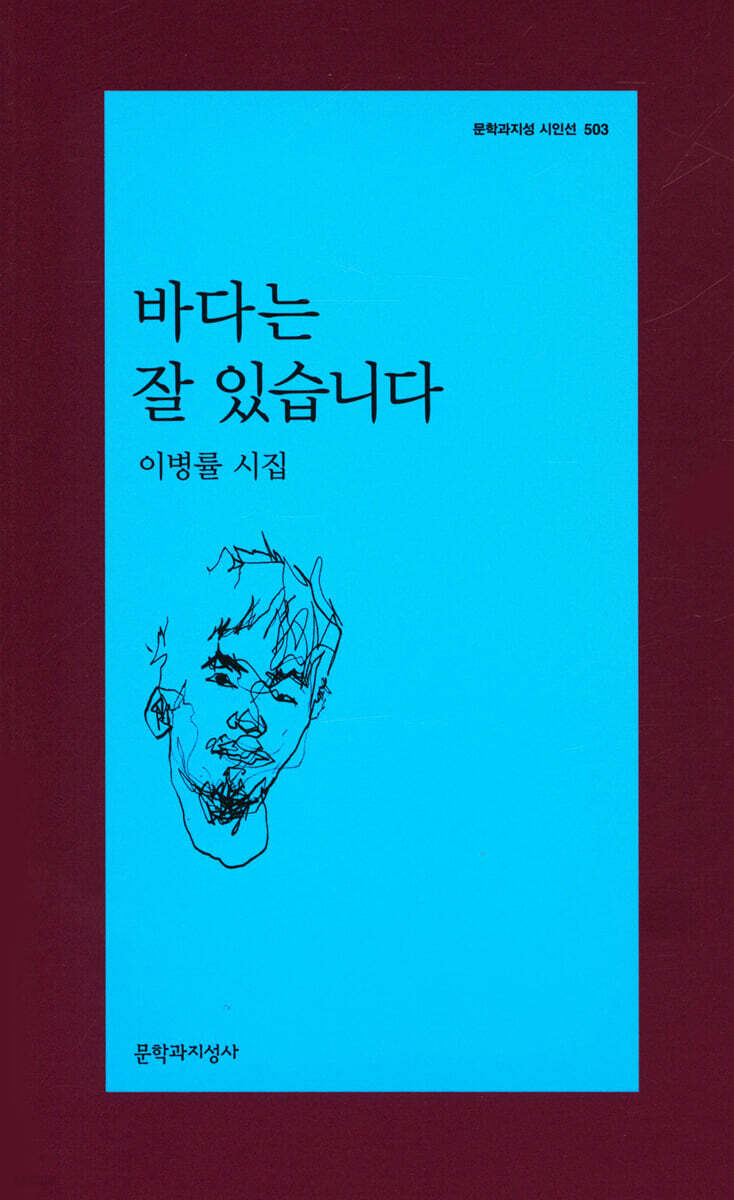
The sea is fine
 |
Description
Book Introduction
The resolutions that come after countless disappointments,
The final thoughts that cannot be helped
Poet Lee Byeong-ryul, who has shaken the boundaries of our hearts with deep and poignant poems that gaze upon the inexplicable desperation of life and bottomless sorrow, has published his fifth poetry collection, “The Sea is Well” (Munhak-kwa-Jiseongsa, 2017).
This book is a collection of 60 poems written and published after 『Snowman Inn』(2013), which garnered attention for its passionate and clear moments of awareness, in which the author was absorbed in being completely alone, confirming himself and discovering others at the same time.
In this collection of poetry, filled with language that maximizes the power of sense and emotion, Lee Byeong-ryul questions and re-questions the place of a person born from faith, and perhaps devotes his efforts to becoming closer to love.
“His poetry is neither wrapped in great determination, nor easily replaced by cynicism or disillusionment, nor does it pretend that it is somehow worth living.
“He stands with a gentle yet strong appearance, gathering strength to hold on in a place of discouragement” (Poet Kim So-yeon).
The final thoughts that cannot be helped
Poet Lee Byeong-ryul, who has shaken the boundaries of our hearts with deep and poignant poems that gaze upon the inexplicable desperation of life and bottomless sorrow, has published his fifth poetry collection, “The Sea is Well” (Munhak-kwa-Jiseongsa, 2017).
This book is a collection of 60 poems written and published after 『Snowman Inn』(2013), which garnered attention for its passionate and clear moments of awareness, in which the author was absorbed in being completely alone, confirming himself and discovering others at the same time.
In this collection of poetry, filled with language that maximizes the power of sense and emotion, Lee Byeong-ryul questions and re-questions the place of a person born from faith, and perhaps devotes his efforts to becoming closer to love.
“His poetry is neither wrapped in great determination, nor easily replaced by cynicism or disillusionment, nor does it pretend that it is somehow worth living.
“He stands with a gentle yet strong appearance, gathering strength to hold on in a place of discouragement” (Poet Kim So-yeon).
- You can preview some of the book's contents.
Preview
index
Poet's words
Ⅰ
Living 9
Person 10
Person's Seat 12
Trip 14
How to get to Iguazu Falls 16
Such a rough and heavy love 18
Source of Love 20
That person is not here 22
Yes 24
Endoscopy 26
At the end of November 27
Old age 28
Half and Half 30
Human Material 32
Excommunication 34
Wooden Horses 36
History of the Wall 38
Seolsan 40
Settlement 42
People are coming 44
Ⅱ
What spring 49
Surprise Attack of Youth 50
One Side of the Heart 52
Earth Drawer 54
Two people 56
Lake 58
New 60
What fills the valley of the night? 62
Concern 64
Fire pit 66
Superstition 68
Bag 70
If you ask me when I write poetry, I say 72
Summer is important 74
Salt Gravity 76
Suchaek Station 78
Scenery until yesterday 79
The Rebellion of Solitude 80
Why would you say that? 82
What is the first 84
Ⅲ
Birthstone 89
Life Saving Lesson 90
The Emotional Trajectory of Life 92
A flock of birds flew to the camellia tree, 94
What I wrote 96
Successor 98
I feel sorry for living and it seems like it's all wrong, so 100
The Centrifugal Force of Parting 102
This generous loneliness 104
Face 106
Don't disappear 108
Dawn Fragment 110
Ice 112
Tongs 113
Last House on the Beach 116
If you come out again 117
The Other Side of the Cross-Country Train 118
121 to avoid the rain
Good placement 122
Landing 124
Preface | Let's Meet Again as Loving People_Kim So-yeon 126
Ⅰ
Living 9
Person 10
Person's Seat 12
Trip 14
How to get to Iguazu Falls 16
Such a rough and heavy love 18
Source of Love 20
That person is not here 22
Yes 24
Endoscopy 26
At the end of November 27
Old age 28
Half and Half 30
Human Material 32
Excommunication 34
Wooden Horses 36
History of the Wall 38
Seolsan 40
Settlement 42
People are coming 44
Ⅱ
What spring 49
Surprise Attack of Youth 50
One Side of the Heart 52
Earth Drawer 54
Two people 56
Lake 58
New 60
What fills the valley of the night? 62
Concern 64
Fire pit 66
Superstition 68
Bag 70
If you ask me when I write poetry, I say 72
Summer is important 74
Salt Gravity 76
Suchaek Station 78
Scenery until yesterday 79
The Rebellion of Solitude 80
Why would you say that? 82
What is the first 84
Ⅲ
Birthstone 89
Life Saving Lesson 90
The Emotional Trajectory of Life 92
A flock of birds flew to the camellia tree, 94
What I wrote 96
Successor 98
I feel sorry for living and it seems like it's all wrong, so 100
The Centrifugal Force of Parting 102
This generous loneliness 104
Face 106
Don't disappear 108
Dawn Fragment 110
Ice 112
Tongs 113
Last House on the Beach 116
If you come out again 117
The Other Side of the Cross-Country Train 118
121 to avoid the rain
Good placement 122
Landing 124
Preface | Let's Meet Again as Loving People_Kim So-yeon 126
Publisher's Review
The conversation in my mind becomes a question
Asking after each other again
The poet has been listening to his “heart” all along because he “cannot stop talking to himself” (the poet’s words).
“Words quietly taken out of a drawer/Words like clothes thrown away”, “Words that don’t arrive because you don’t know where they are thrown”, “Words that cannot be said are like that”, “Words that cannot be put on a scale no matter how much you hear them” (「Itji」), these are all monologues originating from the poet.
Why do you say
If it doesn't stay in your mind
Where on the body do you wander?
Are you trying to become a stick for a long time?
Why do you keep repeating these words to yourself and then tossing and turning?
Are you turning over the night and smelling yourself for a long time?
―The “Why would you say that?” part
His soliloquy, like building a wall, repeatedly overlaps and covers itself, repeatedly giving rise to questions, and becomes “words that are no longer alone” (“There Is”), bringing to life “the infinite facets of the world that cannot be opened” (“Endoscope”), and is finally completed as poetry.
For this reason, for Lee Byeong-ryul, poetry is more often “poetry because he cannot write” (“What I Wrote”) than “poetry because he writes to write.”
In between these poetic longings, which “take direction uncontrollably even when one does not want to write,” he also fanned the flames of a furnace with vows and pledges, such as “I will occupy/not let go of a proper despair” (“What is First”).
Between a boy's sadness and the future
The frequency and the width of the randomness
Between the agonizing distances
If you want to let go of your emotions
I want to move one face
All the true arrangements in the world
Parallel from point to point
Just before something huge happens
A tense intention that seems like it will crack if you touch it
―The “good layout” part
I hear that sound on the second floor of my mind
Yesterday and the day before, I was collecting those kinds of sounds
My second floor is heavy
I gather the precious words of the people who pass by me.
Things that don't flow into the first layer of the mind
Combine the first and second floors of that mind
I'm trying to become human somehow
To build a house for people
―The "Earth Drawer" section
Things outside can be done, but things inside can't be done.
I will continue to bear it
I will continue to remain in Iceland
A blizzard is coming.
The sea is fine
We will forget each other as much as we alone.
―The "Centrifugal Force of Parting" section
Beneath the world's most massive and precise organization
People - Connecting in Love
The poet is completely alone, often walking and looking outside, sometimes with a heavy sense of anxiety, until he becomes numb.
The outside constantly shifts from a man you encounter on the way home late at night, to a window frame covered in nails, to a terminal waiting for someone who will never come, to a cobwebbed library locker, to a blank sheet of paper on a desk facing the dawn when you toss and turn, unable to fall back asleep.
“There is no reason for what flows/There is nothing that can be done about what seeps in” (“Bird”), “Not knowing whether I am beginning/or ending my feelings” (“Such a Rough and Heavy Love”), the poet stretches out his hand as long as his gaze is focused on the void, passing through the secret place of life, that is, the place of people.
Blood and flesh that make up one body
A lifetime of volume that requires looking at the river
Everyone has their own capacity
It is limited
It's a scarier fact than you might think.
[… … ]
The disconnect between the outside and the inside
Crossing from this cell to that cell
While I was making up my mind that life would be a long train crossing the continent
―Excerpt from "The Other Side of the Cross-country Train"
Draw a line from the tip of that branch and connect it to me.
Draw a line from me again and connect it to the man upstairs.
A night where I search for a place to continue and become a constellation
Every time I draw a line
Leaving marks in the air
It seems like they're going to sleep without letting each other go
It's a night when one person's seat is created.
―The “People’s Place” section
The poet, who connects his heart by being frozen in place for a long time, like a still image, where people and emotions outside his jurisdiction have stayed, of course, is a person who tries not to “become overly attached to anything” (“Ice”), but is also a person who is willing to experience something.
The secret of Lee Byeong-ryul's poetry, "From what has been moved/I can be moved like this" ("Travel"), is ultimately "because there are people there" ("People Come"), and he realizes at every moment that "I have to connect someone to myself" and "to support, to support, emotions gather their own strength by spinning in one direction" ("The Emotional Orbit Called Life").
The world we live in
It will be different from the world we have to live in.
Let's meet again when we become people with a lot of love
Indifference
Simplicity
Let's meet and become someone who looks at each other for a long time
The evening light is the inner wall of the heart
The scenery spreads out everywhere
Let's wait for it to arrive in full
Is it true that we came as a single dot?
So is it a mountain or a mountain?
Even that question often made me feel lonely and suddenly stopped.
Let's live so that we can't help but embrace each other.
―The "This Abundant Loneliness" section
Lee Byeong-ryul seems to be well aware that the poet's moderation is not something that operates to preserve the dignity of poetry, but rather a duty that the poet must adopt in order to best construct what he has experienced.
When he “comforts his heart and comforts it/and makes a promise not to speak while the laundry dries,” Lee Byeong-ryul’s life is read as starting anew from this promise.
It may be that I am “sick” or that I am “going crazy like this”, and I do not know whether I will start with this heart or end with this heart, but I can vaguely understand that this is what it takes to become a human being and live like a human being.
Although I said it was a resolution, it would be more accurate to say that it was a resolution that came after countless disappointments, so it was a feeling that I had no choice but to make.
This commitment is not a choice, but a final decision that cannot be helped.
―Kim So-yeon, from the preface to her poetry collection, “Let’s Meet as People with Lots of Love”
[Poet's Note]
Maybe by some fate
Or by someone with bad vibes
A poem that might have been abandoned.
And yet, growing in the mountains and deep in the sea
This tree with its roots spread out,
Because I can't stop talking to myself
I'm on my way to hear that heart.
Lee Byeong-ryul, September 2017
[Back cover poet's prose]
We say we're okay when we're not.
You pretend not to know the power that only you can increase by being alone.
Anyone can be biased, but I hope you, alone, come out of the room and despair even more.
It's been a while since I've said hello.
The sea is fine.
Asking after each other again
The poet has been listening to his “heart” all along because he “cannot stop talking to himself” (the poet’s words).
“Words quietly taken out of a drawer/Words like clothes thrown away”, “Words that don’t arrive because you don’t know where they are thrown”, “Words that cannot be said are like that”, “Words that cannot be put on a scale no matter how much you hear them” (「Itji」), these are all monologues originating from the poet.
Why do you say
If it doesn't stay in your mind
Where on the body do you wander?
Are you trying to become a stick for a long time?
Why do you keep repeating these words to yourself and then tossing and turning?
Are you turning over the night and smelling yourself for a long time?
―The “Why would you say that?” part
His soliloquy, like building a wall, repeatedly overlaps and covers itself, repeatedly giving rise to questions, and becomes “words that are no longer alone” (“There Is”), bringing to life “the infinite facets of the world that cannot be opened” (“Endoscope”), and is finally completed as poetry.
For this reason, for Lee Byeong-ryul, poetry is more often “poetry because he cannot write” (“What I Wrote”) than “poetry because he writes to write.”
In between these poetic longings, which “take direction uncontrollably even when one does not want to write,” he also fanned the flames of a furnace with vows and pledges, such as “I will occupy/not let go of a proper despair” (“What is First”).
Between a boy's sadness and the future
The frequency and the width of the randomness
Between the agonizing distances
If you want to let go of your emotions
I want to move one face
All the true arrangements in the world
Parallel from point to point
Just before something huge happens
A tense intention that seems like it will crack if you touch it
―The “good layout” part
I hear that sound on the second floor of my mind
Yesterday and the day before, I was collecting those kinds of sounds
My second floor is heavy
I gather the precious words of the people who pass by me.
Things that don't flow into the first layer of the mind
Combine the first and second floors of that mind
I'm trying to become human somehow
To build a house for people
―The "Earth Drawer" section
Things outside can be done, but things inside can't be done.
I will continue to bear it
I will continue to remain in Iceland
A blizzard is coming.
The sea is fine
We will forget each other as much as we alone.
―The "Centrifugal Force of Parting" section
Beneath the world's most massive and precise organization
People - Connecting in Love
The poet is completely alone, often walking and looking outside, sometimes with a heavy sense of anxiety, until he becomes numb.
The outside constantly shifts from a man you encounter on the way home late at night, to a window frame covered in nails, to a terminal waiting for someone who will never come, to a cobwebbed library locker, to a blank sheet of paper on a desk facing the dawn when you toss and turn, unable to fall back asleep.
“There is no reason for what flows/There is nothing that can be done about what seeps in” (“Bird”), “Not knowing whether I am beginning/or ending my feelings” (“Such a Rough and Heavy Love”), the poet stretches out his hand as long as his gaze is focused on the void, passing through the secret place of life, that is, the place of people.
Blood and flesh that make up one body
A lifetime of volume that requires looking at the river
Everyone has their own capacity
It is limited
It's a scarier fact than you might think.
[… … ]
The disconnect between the outside and the inside
Crossing from this cell to that cell
While I was making up my mind that life would be a long train crossing the continent
―Excerpt from "The Other Side of the Cross-country Train"
Draw a line from the tip of that branch and connect it to me.
Draw a line from me again and connect it to the man upstairs.
A night where I search for a place to continue and become a constellation
Every time I draw a line
Leaving marks in the air
It seems like they're going to sleep without letting each other go
It's a night when one person's seat is created.
―The “People’s Place” section
The poet, who connects his heart by being frozen in place for a long time, like a still image, where people and emotions outside his jurisdiction have stayed, of course, is a person who tries not to “become overly attached to anything” (“Ice”), but is also a person who is willing to experience something.
The secret of Lee Byeong-ryul's poetry, "From what has been moved/I can be moved like this" ("Travel"), is ultimately "because there are people there" ("People Come"), and he realizes at every moment that "I have to connect someone to myself" and "to support, to support, emotions gather their own strength by spinning in one direction" ("The Emotional Orbit Called Life").
The world we live in
It will be different from the world we have to live in.
Let's meet again when we become people with a lot of love
Indifference
Simplicity
Let's meet and become someone who looks at each other for a long time
The evening light is the inner wall of the heart
The scenery spreads out everywhere
Let's wait for it to arrive in full
Is it true that we came as a single dot?
So is it a mountain or a mountain?
Even that question often made me feel lonely and suddenly stopped.
Let's live so that we can't help but embrace each other.
―The "This Abundant Loneliness" section
Lee Byeong-ryul seems to be well aware that the poet's moderation is not something that operates to preserve the dignity of poetry, but rather a duty that the poet must adopt in order to best construct what he has experienced.
When he “comforts his heart and comforts it/and makes a promise not to speak while the laundry dries,” Lee Byeong-ryul’s life is read as starting anew from this promise.
It may be that I am “sick” or that I am “going crazy like this”, and I do not know whether I will start with this heart or end with this heart, but I can vaguely understand that this is what it takes to become a human being and live like a human being.
Although I said it was a resolution, it would be more accurate to say that it was a resolution that came after countless disappointments, so it was a feeling that I had no choice but to make.
This commitment is not a choice, but a final decision that cannot be helped.
―Kim So-yeon, from the preface to her poetry collection, “Let’s Meet as People with Lots of Love”
[Poet's Note]
Maybe by some fate
Or by someone with bad vibes
A poem that might have been abandoned.
And yet, growing in the mountains and deep in the sea
This tree with its roots spread out,
Because I can't stop talking to myself
I'm on my way to hear that heart.
Lee Byeong-ryul, September 2017
[Back cover poet's prose]
We say we're okay when we're not.
You pretend not to know the power that only you can increase by being alone.
Anyone can be biased, but I hope you, alone, come out of the room and despair even more.
It's been a while since I've said hello.
The sea is fine.
GOODS SPECIFICS
- Date of publication: September 20, 2017
- Page count, weight, size: 144 pages | 214g | 128*205*20mm
- ISBN13: 9788932030395
- ISBN10: 8932030391
You may also like
카테고리
korean


korean

![GQ KOREA Mark (Monthly): December [2025]](http://librairie.coreenne.fr/cdn/shop/files/8ef265dbbfbf186523ed75ba7319009d.jpg?v=1765340328&width=3840)


