

Light or shadow
 |
Description
Book Introduction
Whether you are someone who finds joy in reading stories,
Whether you are someone who finds joy in telling stories,
At some point, we become fans of Edward Hopper.
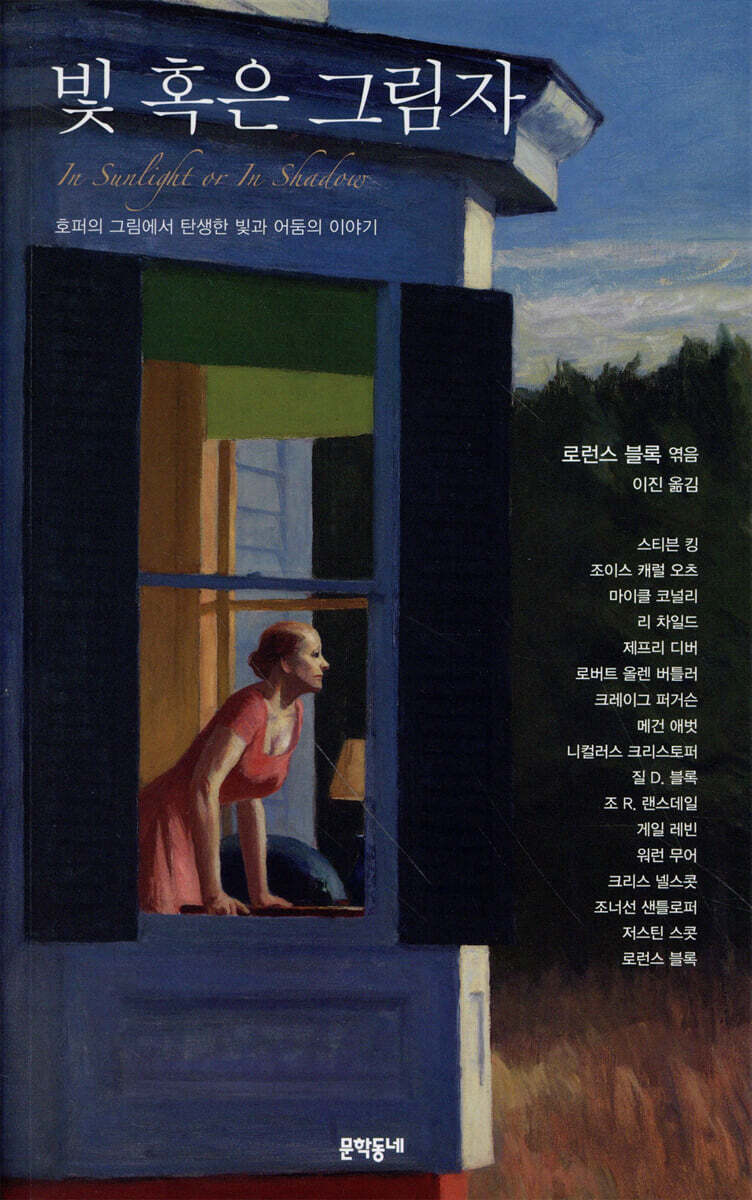
Edward Hopper, a representative American realist painter, has received enthusiastic acclaim and love around the world for his masterful portrayal of modern American life, loneliness, and loss.
In particular, writers and readers are particularly fond of Hopper and are fascinated by his paintings, perhaps because Hopper's paintings capture a moment of everyday life, a fleeting moment from which any story can be born.
Writing a novel based on Hopper's paintings.
This project, which was anticipated just by its concept, was brought to fruition under the leadership of Lawrence Block.
After coming up with the idea for this book, master writer Lawrence Block, a five-time winner of the Mystery Writers of America Award for Excellence in Fiction, the Grand Master Award, and numerous other awards, made a list of authors he wanted to collaborate with, and almost all of them accepted the invitation.
The world's most famous bestselling author Stephen King, Joyce Carol Oates, a strong candidate for the Nobel Prize in Literature, Lee Child of the Jack Reacher series, Jeffrey Deaver of The Bone Collector, Michael Connolly of the Harry Bosch series, and Pulitzer Prize-winning author Robert Olen Butler, all of whom are renowned writers, each chose one of Hopper's works and wrote short stories inspired by it.
As a result, novels of as diverse genres as the authors, including thrillers, dramas, crimes, mysteries, and fantasy, were collected, and these 17 novels were born as this collection, “Light or Shadow.”
The book includes color illustrations of Hopper's illustrations corresponding to each novel.
Whether you are someone who finds joy in telling stories,
At some point, we become fans of Edward Hopper.
Edward Hopper, a representative American realist painter, has received enthusiastic acclaim and love around the world for his masterful portrayal of modern American life, loneliness, and loss.
In particular, writers and readers are particularly fond of Hopper and are fascinated by his paintings, perhaps because Hopper's paintings capture a moment of everyday life, a fleeting moment from which any story can be born.
Writing a novel based on Hopper's paintings.
This project, which was anticipated just by its concept, was brought to fruition under the leadership of Lawrence Block.
After coming up with the idea for this book, master writer Lawrence Block, a five-time winner of the Mystery Writers of America Award for Excellence in Fiction, the Grand Master Award, and numerous other awards, made a list of authors he wanted to collaborate with, and almost all of them accepted the invitation.
The world's most famous bestselling author Stephen King, Joyce Carol Oates, a strong candidate for the Nobel Prize in Literature, Lee Child of the Jack Reacher series, Jeffrey Deaver of The Bone Collector, Michael Connolly of the Harry Bosch series, and Pulitzer Prize-winning author Robert Olen Butler, all of whom are renowned writers, each chose one of Hopper's works and wrote short stories inspired by it.
As a result, novels of as diverse genres as the authors, including thrillers, dramas, crimes, mysteries, and fantasy, were collected, and these 17 novels were born as this collection, “Light or Shadow.”
The book includes color illustrations of Hopper's illustrations corresponding to each novel.
- You can preview some of the book's contents.
Preview
index
Introduction 7
Nude Show × Megan Abbott 15
Caroline's Story × Jill D.
Block 47
Blue Evening × Robert Olen Butler 73
The Full Story of the Incident × Lee Child 91
Beach Room × Nicholas Christopher 107
The Night Watchers × Michael Connolly 133
The Incident of November 10th × Jeffrey Deaver 149
Professional Attitude × Craig Ferguson 169
The Music Room × Stephen King 187
Consular Reporter × Joe R.
Lansdale 199
Pastor's Collection × Gayle Levin 243
The Night Office × Warren Moore 261
The Woman at the Window × Joyce Carol Oates 287
Still Life 1931 × Chris Nelscott 321
Window of the Night × Jonathan Santlofer 361
Woman in the Sun × Justin Scott 397
Autumn in the Vending Machine Restaurant × Lawrence Block 409
Image Permission 431
Translator's Note 437
Nude Show × Megan Abbott 15
Caroline's Story × Jill D.
Block 47
Blue Evening × Robert Olen Butler 73
The Full Story of the Incident × Lee Child 91
Beach Room × Nicholas Christopher 107
The Night Watchers × Michael Connolly 133
The Incident of November 10th × Jeffrey Deaver 149
Professional Attitude × Craig Ferguson 169
The Music Room × Stephen King 187
Consular Reporter × Joe R.
Lansdale 199
Pastor's Collection × Gayle Levin 243
The Night Office × Warren Moore 261
The Woman at the Window × Joyce Carol Oates 287
Still Life 1931 × Chris Nelscott 321
Window of the Night × Jonathan Santlofer 361
Woman in the Sun × Justin Scott 397
Autumn in the Vending Machine Restaurant × Lawrence Block 409
Image Permission 431
Translator's Note 437
Publisher's Review
Only two common denominators in 17 novels.
The brilliance of each artist and the fact that they were inspired by Hopper's paintings.
When planning 'Light or Shadow' and recruiting writers to participate in the book, Lawrence Block presented only one condition: 'Edward Hopper.'
There were no restrictions on subject or genre, and the only request was a novel inspired by Hopper's paintings.
As a result, this book contains short stories of a wider variety of content and genres than any other anthology.
The ways in which artists utilize Hopper's paintings are also diverse, and as Lawrence Block says in the introduction, "Some stories seem to leap straight from the canvas, fitting perfectly with the artist's chosen image."
“Some stories are triggered in some way by a painting, and they pop out at an ambiguous angle onto the canvas.”
Some writers use Hopper's work to inform their own stories.
At this time, Hopper's paintings represent the author's entire short story, or depict a scene from a story.
Joyce Carol Oates chose Hopper's 1926 work Eleven O'Clock in the Morning and wrote the story of a woman sitting 'nude' by a window, waiting for eleven o'clock in the morning, and the man waiting for her, following their stream of consciousness ("Woman at the Window").
Joe R.
Lansdale uses the 1939 film [New York Film] as the starting point for a story that traces the projectionist's childhood and the gangsters who intrude on his life and his resistance to them ("The Projectionist").
There are also artists who have created stories by incorporating Hopper's work itself into their work.
Michael Connolly, who was inspired by Hopper's Nighthawks while writing the first installment of the Harry Bosch series and included an illustration at the end of the novel, also wrote a short story featuring Harry Bosch in this book.
In this short story, which shares the same title as the painting, novice private investigator Bosch is hired by a client to spy on a woman admiring the painting "Nighthawks" in front of the Art Institute of Chicago.
Jeffrey Deaver tells the story of how a postcard featuring Hopper's painting "Hotel by the Railroad" played a crucial role for a German scientist who was assisting the Soviet Union in weapons development during the Cold War ("The Incident of November 10th").
The shortest, yet most powerful, story in this book is probably Stephen King's.
Stephen King, who has mastered a wide range of genres from horror to mystery, chooses Hopper's 1932 novel [A Room in New York] to tell the story of a couple living during the Great Depression.
A husband reading a newspaper in a room with a closet and a wife sitting in front of a piano appear to be living a peaceful daily life at first glance, but there is an unexpected twist behind it ("The Music Room").
When Stephen King was first approached to contribute to this collection, he declined, saying he simply couldn't find the time.
However, he chose the painting, saying that if he were to write a short story, he would write about [A Room in New York], where a replica was hung in his house, and eventually completed [The Music Room] out of his love for Hopper.
There's also a surprising twist in "Autumn in the Vending Machine Restaurant," written by Lawrence Block, who planned and edited this book.
Inspired by Hopper's 1927 work [The Vending Machine Restaurant], this short story is about a woman who eats in a restaurant that sold food from vending machines in the early 20th century. The unexpected ending gives readers the fun and pleasure of reading a well-written short story.
This short story by Lawrence Block won the 2017 Edgar Award for Best Short Story.
It is also noteworthy that Gail Levin, known as an Edward Hopper authority for having written several books on Hopper while working as a curator at the Whitney Museum, has published her first novel through this book.
As a researcher devoted to Hopper's life and paintings, Levin tells the story of Reverend Sanborn, a real-life man who owned many of Hopper's paintings, in the form of a novel in his short story "The Reverend's Collection."
The circumstances surrounding the pastor's acquisition of Hopper's paintings remain shrouded in mystery, but Levin has crafted a compelling work that blurs the lines between fiction and nonfiction by writing about these suspicions in the first-person perspective of Reverend Sanborn.
“Absolutely outstanding.
“The concept is compelling and every single piece is top-notch.”_USA Today
The escapades of a wife who stalks her artist husband or the beginning of a new life (“Nude Show”), a pastor who lives as a religious person despite not believing in God (“Professional Man’s Attitude”), a man who observes the female tenants of the apartment across the street from his apartment window (“Window of the Night”), a woman who spends a night with a man who threatens suicide the next day (“Woman in the Sunlight”)… … The 17 short stories featuring diverse characters are “absolutely excellent and top-notch” in their own right.
Just as Hopper's paintings depict scenes from ordinary, everyday spaces in an unfamiliar way that seems to transcend time and space, the short stories in this book unfold colorful stories that are sometimes familiar and sometimes unfamiliar.
Some of Hopper's works deal with the social conditions of the early to mid-20th century, especially women's lives and racial discrimination ("Caroline's Story," "The Office at Night," "Still Life 1931"), while others depict a dreamy yet eerie atmosphere without distinguishing between reality and fantasy, or are reminiscent of magical realism ("Blue Evening," "Room by the Sea").
Lawrence Block says in his introduction that Hopper's paintings "don't tell stories."
“It only suggests—in a powerful and irresistible way—that within those pictures lie stories waiting to be read.”
Perhaps that is precisely why Hopper's paintings stimulate the imagination of artists even more.
Because Hopper was devoted to depicting form and color, and especially light and darkness, novelists cannot help but read life with light and shadow, and powerful stories, into his paintings.
The brilliance of each artist and the fact that they were inspired by Hopper's paintings.
When planning 'Light or Shadow' and recruiting writers to participate in the book, Lawrence Block presented only one condition: 'Edward Hopper.'
There were no restrictions on subject or genre, and the only request was a novel inspired by Hopper's paintings.
As a result, this book contains short stories of a wider variety of content and genres than any other anthology.
The ways in which artists utilize Hopper's paintings are also diverse, and as Lawrence Block says in the introduction, "Some stories seem to leap straight from the canvas, fitting perfectly with the artist's chosen image."
“Some stories are triggered in some way by a painting, and they pop out at an ambiguous angle onto the canvas.”
Some writers use Hopper's work to inform their own stories.
At this time, Hopper's paintings represent the author's entire short story, or depict a scene from a story.
Joyce Carol Oates chose Hopper's 1926 work Eleven O'Clock in the Morning and wrote the story of a woman sitting 'nude' by a window, waiting for eleven o'clock in the morning, and the man waiting for her, following their stream of consciousness ("Woman at the Window").
Joe R.
Lansdale uses the 1939 film [New York Film] as the starting point for a story that traces the projectionist's childhood and the gangsters who intrude on his life and his resistance to them ("The Projectionist").
There are also artists who have created stories by incorporating Hopper's work itself into their work.
Michael Connolly, who was inspired by Hopper's Nighthawks while writing the first installment of the Harry Bosch series and included an illustration at the end of the novel, also wrote a short story featuring Harry Bosch in this book.
In this short story, which shares the same title as the painting, novice private investigator Bosch is hired by a client to spy on a woman admiring the painting "Nighthawks" in front of the Art Institute of Chicago.
Jeffrey Deaver tells the story of how a postcard featuring Hopper's painting "Hotel by the Railroad" played a crucial role for a German scientist who was assisting the Soviet Union in weapons development during the Cold War ("The Incident of November 10th").
The shortest, yet most powerful, story in this book is probably Stephen King's.
Stephen King, who has mastered a wide range of genres from horror to mystery, chooses Hopper's 1932 novel [A Room in New York] to tell the story of a couple living during the Great Depression.
A husband reading a newspaper in a room with a closet and a wife sitting in front of a piano appear to be living a peaceful daily life at first glance, but there is an unexpected twist behind it ("The Music Room").
When Stephen King was first approached to contribute to this collection, he declined, saying he simply couldn't find the time.
However, he chose the painting, saying that if he were to write a short story, he would write about [A Room in New York], where a replica was hung in his house, and eventually completed [The Music Room] out of his love for Hopper.
There's also a surprising twist in "Autumn in the Vending Machine Restaurant," written by Lawrence Block, who planned and edited this book.
Inspired by Hopper's 1927 work [The Vending Machine Restaurant], this short story is about a woman who eats in a restaurant that sold food from vending machines in the early 20th century. The unexpected ending gives readers the fun and pleasure of reading a well-written short story.
This short story by Lawrence Block won the 2017 Edgar Award for Best Short Story.
It is also noteworthy that Gail Levin, known as an Edward Hopper authority for having written several books on Hopper while working as a curator at the Whitney Museum, has published her first novel through this book.
As a researcher devoted to Hopper's life and paintings, Levin tells the story of Reverend Sanborn, a real-life man who owned many of Hopper's paintings, in the form of a novel in his short story "The Reverend's Collection."
The circumstances surrounding the pastor's acquisition of Hopper's paintings remain shrouded in mystery, but Levin has crafted a compelling work that blurs the lines between fiction and nonfiction by writing about these suspicions in the first-person perspective of Reverend Sanborn.
“Absolutely outstanding.
“The concept is compelling and every single piece is top-notch.”_USA Today
The escapades of a wife who stalks her artist husband or the beginning of a new life (“Nude Show”), a pastor who lives as a religious person despite not believing in God (“Professional Man’s Attitude”), a man who observes the female tenants of the apartment across the street from his apartment window (“Window of the Night”), a woman who spends a night with a man who threatens suicide the next day (“Woman in the Sunlight”)… … The 17 short stories featuring diverse characters are “absolutely excellent and top-notch” in their own right.
Just as Hopper's paintings depict scenes from ordinary, everyday spaces in an unfamiliar way that seems to transcend time and space, the short stories in this book unfold colorful stories that are sometimes familiar and sometimes unfamiliar.
Some of Hopper's works deal with the social conditions of the early to mid-20th century, especially women's lives and racial discrimination ("Caroline's Story," "The Office at Night," "Still Life 1931"), while others depict a dreamy yet eerie atmosphere without distinguishing between reality and fantasy, or are reminiscent of magical realism ("Blue Evening," "Room by the Sea").
Lawrence Block says in his introduction that Hopper's paintings "don't tell stories."
“It only suggests—in a powerful and irresistible way—that within those pictures lie stories waiting to be read.”
Perhaps that is precisely why Hopper's paintings stimulate the imagination of artists even more.
Because Hopper was devoted to depicting form and color, and especially light and darkness, novelists cannot help but read life with light and shadow, and powerful stories, into his paintings.
GOODS SPECIFICS
- Date of issue: September 11, 2017
- Page count, weight, size: 440 pages | 712g | 140*224*30mm
- ISBN13: 9788954646796
- ISBN10: 8954646794
You may also like
카테고리
korean


korean

![GQ KOREA Mark (Monthly): December [2025]](http://librairie.coreenne.fr/cdn/shop/files/8ef265dbbfbf186523ed75ba7319009d.jpg?v=1765340328&width=3840)


