

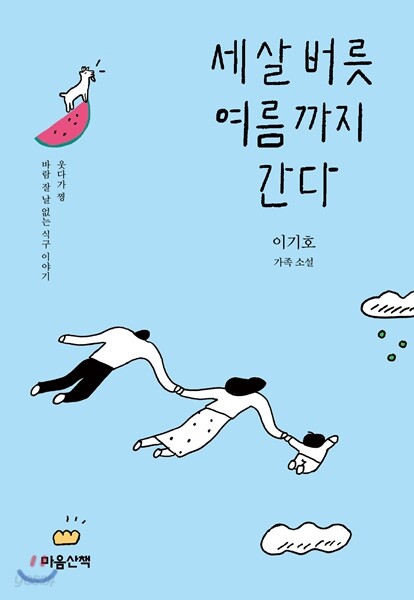
Three-year-old habits last until summer
 |
Description
Book Introduction
- A word from MD
- [A Harmony of Laughter and Tears, Lee Ki-ho's Family Novel] A new work by the delightful storyteller Lee Ki-ho.
He says.
The very name family seems to be another word for a novel.
The image of a hesitant father, a tough mother, and three children living together is not so unfamiliar.
The place we lie down is small, but that's why we get closer to each other, that's what family is all about.
- Literature MD Kim Do-hoon
A true storyteller, a master of laughter and tears.
Lee Ki-ho's special family novel
As can be seen in reviews such as “Among the many pleasures presented by literature in the 2000s, this is one of the most ‘conceptual’ pleasures” and “In Lee Ki-ho’s novels, the more you laugh, the more you end up hurting, so even comedy is already a part of tragedy” (literary critic Shin Hyeong-cheol), author Lee Ki-ho has created his own unique world that can be called ‘tragi-comedy.’
Following Park Wan-seo's "Three Wishes" and Jeong Yi-hyeon's "A Good Person, So to speak," the third book in the Mind Walk short story series, "It's Nothing Wrong If It's Mostly Okay," has received the love of countless readers and has once again confirmed the "genre" of Lee Ki-ho.
He published a novel titled "Habits of a Three-Year-Old Last Until Summer," which is his first and last novel about family and a story of children's growth.
Not to mention the unique tears and laughter, the emotions became more loving and affectionate than ever before, and became deeper as they wore the clothes of 'family'.
This book is a compilation of articles that were serialized in a monthly magazine for over three years starting in 2011 under the title “Cheerful Kiho Cine.”
It was originally intended to be serialized for 30 years, but was discontinued in April 2014 due to the author's circumstances.
It may not be possible to restart it, but it remains intact as an autobiographical record of a special family.
The author's confession that "the very word 'family' seems to be another word for a novel" resonates deeply.
Lee Ki-ho's special family novel
As can be seen in reviews such as “Among the many pleasures presented by literature in the 2000s, this is one of the most ‘conceptual’ pleasures” and “In Lee Ki-ho’s novels, the more you laugh, the more you end up hurting, so even comedy is already a part of tragedy” (literary critic Shin Hyeong-cheol), author Lee Ki-ho has created his own unique world that can be called ‘tragi-comedy.’
Following Park Wan-seo's "Three Wishes" and Jeong Yi-hyeon's "A Good Person, So to speak," the third book in the Mind Walk short story series, "It's Nothing Wrong If It's Mostly Okay," has received the love of countless readers and has once again confirmed the "genre" of Lee Ki-ho.
He published a novel titled "Habits of a Three-Year-Old Last Until Summer," which is his first and last novel about family and a story of children's growth.
Not to mention the unique tears and laughter, the emotions became more loving and affectionate than ever before, and became deeper as they wore the clothes of 'family'.
This book is a compilation of articles that were serialized in a monthly magazine for over three years starting in 2011 under the title “Cheerful Kiho Cine.”
It was originally intended to be serialized for 30 years, but was discontinued in April 2014 due to the author's circumstances.
It may not be possible to restart it, but it remains intact as an autobiographical record of a special family.
The author's confession that "the very word 'family' seems to be another word for a novel" resonates deeply.
index
The family grows
The family grows
introverted husband
his shoulder
eight years difference
A night left alone
The day we first met
Mother-in-law's seaweed soup
a box of cakes
No cooking on Sundays
Walking with my son
So we were a little closer
Goat and School
Goat and School
Learn to be ashamed
family photo
Where to live, where to live
girl friend
Where can I rest my weary body?
I think I'm in love
Whether the sea splits or the land rises,
The Return of the Wife
When you get old and sick
Cool breakup
Which star are you from?
Ox head soup
Which star are you from?
What does the cello say?
Romantic factual humanism
When summer comes
She runs to Wonderland
The King of Nagging
Let's draw a picture
Neverending Story
When the sweet potato roots take root
I don't want to break up
A world we know little about
The charm of lottery
Bathing is fun
Take charge of the longicorn beetle
something that obscures one's vision
What I really want to do
Everyone's Diary
I like udon
Mother and gulbi
The path of boasting and bluffing
Super powers go out
A world we know little about
Epilogue
The family grows
introverted husband
his shoulder
eight years difference
A night left alone
The day we first met
Mother-in-law's seaweed soup
a box of cakes
No cooking on Sundays
Walking with my son
So we were a little closer
Goat and School
Goat and School
Learn to be ashamed
family photo
Where to live, where to live
girl friend
Where can I rest my weary body?
I think I'm in love
Whether the sea splits or the land rises,
The Return of the Wife
When you get old and sick
Cool breakup
Which star are you from?
Ox head soup
Which star are you from?
What does the cello say?
Romantic factual humanism
When summer comes
She runs to Wonderland
The King of Nagging
Let's draw a picture
Neverending Story
When the sweet potato roots take root
I don't want to break up
A world we know little about
The charm of lottery
Bathing is fun
Take charge of the longicorn beetle
something that obscures one's vision
What I really want to do
Everyone's Diary
I like udon
Mother and gulbi
The path of boasting and bluffing
Super powers go out
A world we know little about
Epilogue
Detailed image
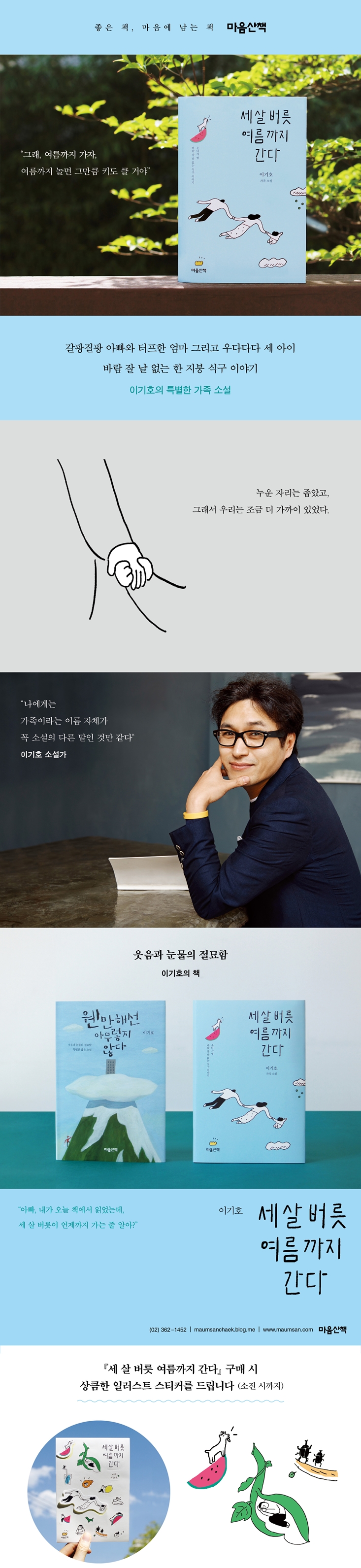
Into the book
The reason I titled this book 'Family Novel' is because there are more things I didn't write about than what I did.
Novels are often completed by pushing deleted and erased sentences off the page, but that doesn't mean they all disappear.
Rather, it is because of them that a novel comes out into the world in its entirety.
All the family stories in the world are very similar to those novels.
To me, the very word family seems like another word for a novel.
---From the author's note
Just laugh it off.
Protecting his wife's long-term housing savings, and continuing to be the lover of the farting king, Pungpung.
---From "The Inward-Oriented Husband"
“Look, it’s our daughter… isn’t she so pretty?”
I followed my wife's gaze and looked at my daughter.
The daughter was very small and had a lot of hair.
It was the first time in my life that I met my daughter.
My heart raced like it did when I first met my wife.
---From "The Day We First Met"
Late that night, I left the study and went into the bedroom to find my wife and three children lying side by side asleep on blankets spread out on the narrow floor just below the bed.
My wife always slept on the floor, afraid that the kids would follow her up to the bed and that she might fall down.
As I looked at my wife and children sleeping close together, something touched my heart.
So I couldn't get on the bed either, so I lay down slightly between them.
I could hear the children's wheezing and my wife's breath on my cheek.
I could also smell the scent of my children's flesh and my wife's flesh.
The space we were lying in was narrow, so we were a little closer together.
---From "So We Were A Little Closer"
As I rubbed my cheek against the child's, I realized that a certain moment in our family was passing by.
---From "Family Photo"
Perhaps because every corner of my father's face contained the whole family, it felt as if my father's solo photo was truly our family photo.
---From "Family Photo"
I just thought about how much I could afford, and I felt like I only cared for my children within that limit.
It seems that he deluded himself into thinking that he was a father who did a lot for his children like a big mart.
I decided to live in a somewhat uncomfortable place.
I was grateful to my wife for making that decision.
---From "Where to Live, Where to Live"
Adults don't know children well.
---From "Girlfriend"
If sons felt like friends, daughters gave me the excitement of a lover, and if boys were like newly planted seedlings, girls were like the first spring rain of the year.
---From "Which Star Are You From?"
Right after I got back from school, I cautiously said to my wife, “Shouldn’t we teach her Korean before she goes to school?”
My wife nodded silently as if she knew what had happened without even looking.
Then, two weeks ago, as I was lying in bed with my first child, this question suddenly popped into my head.
“Dad, I read in a book today, do you know how long three-year-old habits last?”
I thought to myself, 'This is pretty good. I guess I can go to school now.'
“Well? How long will it last?”
I lay down on my side towards the child and gave him a curious look.
Then the child answered in his usual cheerful voice.
“That’s right… it’ll last until summer!”
I closed my eyes for a moment, biting my lower lip.
And then I had this very thought.
Yeah, let's go until summer. If you play until summer, you'll grow taller.
I hugged my first child tightly without saying a word.
---From "When Summer Comes"
Something that makes both the child and the father think the same way.
What makes us all friends?
It's true that it's a bit 'off-topic', but still, friends...
---From "The Charm of Drawing"
“There’s still a lot we don’t know.”
As I listened to my wife's words, I vaguely realized that I had accumulated more 'misconceptions about being a parent' than 'growth as a parent.'
---From "The World We Don't Know Well"
When the cherry blossoms fall and the greenery grows lush, the children will have grown up again.
The smell of children's sweat, their white fingernails growing, their whining after naps, and their tiny shoes.
How will all those times be remembered?
If I remember, will I be able to fully preserve those daily lives?
Being with children makes happy moments happier and sad moments sadder.
My wife and I were standing right in the middle of it.
May the Force always be with all the children of the world, their parents, and the grieving parents and children.
That's all I can say right now.
Novels are often completed by pushing deleted and erased sentences off the page, but that doesn't mean they all disappear.
Rather, it is because of them that a novel comes out into the world in its entirety.
All the family stories in the world are very similar to those novels.
To me, the very word family seems like another word for a novel.
---From the author's note
Just laugh it off.
Protecting his wife's long-term housing savings, and continuing to be the lover of the farting king, Pungpung.
---From "The Inward-Oriented Husband"
“Look, it’s our daughter… isn’t she so pretty?”
I followed my wife's gaze and looked at my daughter.
The daughter was very small and had a lot of hair.
It was the first time in my life that I met my daughter.
My heart raced like it did when I first met my wife.
---From "The Day We First Met"
Late that night, I left the study and went into the bedroom to find my wife and three children lying side by side asleep on blankets spread out on the narrow floor just below the bed.
My wife always slept on the floor, afraid that the kids would follow her up to the bed and that she might fall down.
As I looked at my wife and children sleeping close together, something touched my heart.
So I couldn't get on the bed either, so I lay down slightly between them.
I could hear the children's wheezing and my wife's breath on my cheek.
I could also smell the scent of my children's flesh and my wife's flesh.
The space we were lying in was narrow, so we were a little closer together.
---From "So We Were A Little Closer"
As I rubbed my cheek against the child's, I realized that a certain moment in our family was passing by.
---From "Family Photo"
Perhaps because every corner of my father's face contained the whole family, it felt as if my father's solo photo was truly our family photo.
---From "Family Photo"
I just thought about how much I could afford, and I felt like I only cared for my children within that limit.
It seems that he deluded himself into thinking that he was a father who did a lot for his children like a big mart.
I decided to live in a somewhat uncomfortable place.
I was grateful to my wife for making that decision.
---From "Where to Live, Where to Live"
Adults don't know children well.
---From "Girlfriend"
If sons felt like friends, daughters gave me the excitement of a lover, and if boys were like newly planted seedlings, girls were like the first spring rain of the year.
---From "Which Star Are You From?"
Right after I got back from school, I cautiously said to my wife, “Shouldn’t we teach her Korean before she goes to school?”
My wife nodded silently as if she knew what had happened without even looking.
Then, two weeks ago, as I was lying in bed with my first child, this question suddenly popped into my head.
“Dad, I read in a book today, do you know how long three-year-old habits last?”
I thought to myself, 'This is pretty good. I guess I can go to school now.'
“Well? How long will it last?”
I lay down on my side towards the child and gave him a curious look.
Then the child answered in his usual cheerful voice.
“That’s right… it’ll last until summer!”
I closed my eyes for a moment, biting my lower lip.
And then I had this very thought.
Yeah, let's go until summer. If you play until summer, you'll grow taller.
I hugged my first child tightly without saying a word.
---From "When Summer Comes"
Something that makes both the child and the father think the same way.
What makes us all friends?
It's true that it's a bit 'off-topic', but still, friends...
---From "The Charm of Drawing"
“There’s still a lot we don’t know.”
As I listened to my wife's words, I vaguely realized that I had accumulated more 'misconceptions about being a parent' than 'growth as a parent.'
---From "The World We Don't Know Well"
When the cherry blossoms fall and the greenery grows lush, the children will have grown up again.
The smell of children's sweat, their white fingernails growing, their whining after naps, and their tiny shoes.
How will all those times be remembered?
If I remember, will I be able to fully preserve those daily lives?
Being with children makes happy moments happier and sad moments sadder.
My wife and I were standing right in the middle of it.
May the Force always be with all the children of the world, their parents, and the grieving parents and children.
That's all I can say right now.
---From the "Epilogue"
Publisher's Review
A true storyteller, a master of laughter and tears.
Lee Ki-ho's special family novel
As can be seen in reviews such as “Among the many pleasures presented by literature in the 2000s, this is one of the most ‘conceptual’ pleasures” and “In Lee Ki-ho’s novels, the more you laugh, the more you end up hurting, so even comedy is already a part of tragedy” (literary critic Shin Hyeong-cheol), author Lee Ki-ho has created his own unique world that can be called ‘tragi-comedy.’
Following Park Wan-seo's "Three Wishes" and Jeong Yi-hyeon's "A Good Person, So to speak," the third book in the Mind Walk short story series, "It's Nothing Wrong If It's Mostly Okay," has received the love of countless readers and has once again confirmed the "genre" of Lee Ki-ho.
"It's okay if you try hard" is a story that resonates with all of us today, where the question of how to live in an unstable reality that doesn't improve no matter how hard we try has become the most important question for each individual.
The author has deeply resonated with people of all ages and genders by calling out the moments faced by ordinary people who struggle and struggle, not by people who are flashy or sophisticated, but by those who have done their best, with sadness and humor.
He published a novel titled "Habits of a Three-Year-Old Last Until Summer," which is his first and last novel about family and a story of children's growth.
Not to mention the unique tears and laughter, the emotions became more loving and affectionate than ever before, and became deeper as they wore the clothes of 'family'.
This book is a compilation of articles that were serialized in a monthly magazine for over three years starting in 2011 under the title “Cheerful Kihossi.”
It was originally intended to be serialized for 30 years, but was discontinued in April 2014 due to the author's circumstances.
It may not be possible to restart it, but it remains intact as an autobiographical record of a special family.
The author's confession that "the very word 'family' seems to be another word for a novel" resonates deeply.
The reason I titled this book 'Family Novel' is because there are more things I didn't write about than what I did.
Novels are often completed by pushing deleted and erased sentences off the page, but that doesn't mean they all disappear.
Rather, it is because of them that a novel comes out into the world in its entirety.
All the family stories in the world are very similar to those novels.
To me, the very word family seems like another word for a novel.
―From the author's note
A hesitant father, a tough mother, and three children who are always on the move
A story of a family living under one roof who never gets a break
One day, a girl was born into a house with two sons who were busy running around the house like puppies.
A father who is always hesitating and trying to figure out what to do, a wise and tough mother who is somewhere between cautious and dull, an illiterate eldest child who falls in love too easily, a second child who loves his mother's belly button and is absorbed in drawing day and night, and a third child who keeps the beat by saying "Eolssu!" whenever his father sings.
The exciting and enjoyable growth diary of the entire family, including the three children, unfolds.
Right after I got back from school, I cautiously said to my wife, “Shouldn’t we teach her Korean before she goes to school?”
My wife nodded silently as if she knew what had happened without even looking.
Then, two weeks ago, as I was lying in bed with my first child, this question suddenly popped into my head.
“Dad, I read in a book today, do you know how long three-year-old habits last?”
I thought to myself, 'This is pretty good. I guess I can go to school now.'
“Well? How long will it last?”
I lay down on my side towards the child and gave him a curious look.
Then the child answered in his usual cheerful voice.
“That’s right… it’ll last until summer!”
I closed my eyes for a moment, biting my lower lip.
And then I had this very thought.
Yeah, let's go until summer. If you play until summer, you'll grow taller.
I hugged my first child tightly without saying a word.
―From “When Summer Comes”
This family novel, which begins with the announcement of the birth of a third child, naturally unfolds over time, capturing the family's daily life, both big and small, the affection shared with relatives and neighbors, the times of quarrels, regrets, and complaints, and even the smallest dreams.
The joy of life that we learn through family and the times surrounding them is very inspiring.
As we spend time together sharing the sweet and detailed moments that are etched like family fingerprints, we nod our heads and think, if there is happiness and hope, this is the pattern.
In this way, the 'I' in "So We Were a Little Closer" poignantly depicts the scenery of an ordinary family spending every moment of every moment together in the same space.
Late that night, I left the study and went into the bedroom to find my wife and three children lying side by side asleep on blankets spread out on the narrow floor just below the bed.
My wife always slept on the floor, afraid that the kids would follow her up to the bed and that she might fall down.
As I looked at my wife and children sleeping close together, something touched my heart.
So I couldn't get on the bed either, so I lay down between them.
I could hear the children's wheezing and my wife's breath on my cheek.
I could also smell the scent of my children's flesh and my wife's flesh.
The space we were lying in was narrow, so we were a little closer together.
―From “So We Were A Little Closer”
Joy becomes happier and sadness becomes sadder
Families grow together
Through the laughter and tears of a family in 44 stories, the author ultimately makes us accept the universality of all families.
"Family Photo" contains an episode of the day when the whole family gathered at a photo studio to take a first birthday photo of their third child, and then took a memorial photo of the father in advance.
The current 'me' who is finally looking at the face of my father who sacrificed himself for me when I was young from outside the camera is still awkward in my father's position, but I am still learning step by step using 'bluff and jokes' as my weapons.
That's how you become a father.
Perhaps because every corner of my father's face contained the whole family, it felt as if my father's solo photo was truly our family photo.
―From “Family Photo”
It is a touching scene where I, a son, father, and husband, reminisce about the times we spent together, sensing that a certain time in the family is passing by.
The realization that “spending time with children makes happy things happier and sad things sadder” resonates deeply.
Families grow together.
The ordinary yet special life of this family, captured through 'egoistic' laughter and tears, will provide readers with a moment of empathy and comfort in this time of mixed sadness and confusion.
When the cherry blossoms fall and the greenery grows lush, the children will have grown up again.
The smell of children's sweat, their white fingernails growing, their whining after naps, and their tiny shoes.
How will all those times be remembered?
If I remember, will I be able to fully preserve those daily lives?
Being with children makes happy moments happier and sad moments sadder.
My wife and I were standing right in the middle of it.
May the Force always be with all the children of the world, their parents, and the grieving parents and children.
That's all I can say right now.
―From the “Epilogue”
Lee Ki-ho's special family novel
As can be seen in reviews such as “Among the many pleasures presented by literature in the 2000s, this is one of the most ‘conceptual’ pleasures” and “In Lee Ki-ho’s novels, the more you laugh, the more you end up hurting, so even comedy is already a part of tragedy” (literary critic Shin Hyeong-cheol), author Lee Ki-ho has created his own unique world that can be called ‘tragi-comedy.’
Following Park Wan-seo's "Three Wishes" and Jeong Yi-hyeon's "A Good Person, So to speak," the third book in the Mind Walk short story series, "It's Nothing Wrong If It's Mostly Okay," has received the love of countless readers and has once again confirmed the "genre" of Lee Ki-ho.
"It's okay if you try hard" is a story that resonates with all of us today, where the question of how to live in an unstable reality that doesn't improve no matter how hard we try has become the most important question for each individual.
The author has deeply resonated with people of all ages and genders by calling out the moments faced by ordinary people who struggle and struggle, not by people who are flashy or sophisticated, but by those who have done their best, with sadness and humor.
He published a novel titled "Habits of a Three-Year-Old Last Until Summer," which is his first and last novel about family and a story of children's growth.
Not to mention the unique tears and laughter, the emotions became more loving and affectionate than ever before, and became deeper as they wore the clothes of 'family'.
This book is a compilation of articles that were serialized in a monthly magazine for over three years starting in 2011 under the title “Cheerful Kihossi.”
It was originally intended to be serialized for 30 years, but was discontinued in April 2014 due to the author's circumstances.
It may not be possible to restart it, but it remains intact as an autobiographical record of a special family.
The author's confession that "the very word 'family' seems to be another word for a novel" resonates deeply.
The reason I titled this book 'Family Novel' is because there are more things I didn't write about than what I did.
Novels are often completed by pushing deleted and erased sentences off the page, but that doesn't mean they all disappear.
Rather, it is because of them that a novel comes out into the world in its entirety.
All the family stories in the world are very similar to those novels.
To me, the very word family seems like another word for a novel.
―From the author's note
A hesitant father, a tough mother, and three children who are always on the move
A story of a family living under one roof who never gets a break
One day, a girl was born into a house with two sons who were busy running around the house like puppies.
A father who is always hesitating and trying to figure out what to do, a wise and tough mother who is somewhere between cautious and dull, an illiterate eldest child who falls in love too easily, a second child who loves his mother's belly button and is absorbed in drawing day and night, and a third child who keeps the beat by saying "Eolssu!" whenever his father sings.
The exciting and enjoyable growth diary of the entire family, including the three children, unfolds.
Right after I got back from school, I cautiously said to my wife, “Shouldn’t we teach her Korean before she goes to school?”
My wife nodded silently as if she knew what had happened without even looking.
Then, two weeks ago, as I was lying in bed with my first child, this question suddenly popped into my head.
“Dad, I read in a book today, do you know how long three-year-old habits last?”
I thought to myself, 'This is pretty good. I guess I can go to school now.'
“Well? How long will it last?”
I lay down on my side towards the child and gave him a curious look.
Then the child answered in his usual cheerful voice.
“That’s right… it’ll last until summer!”
I closed my eyes for a moment, biting my lower lip.
And then I had this very thought.
Yeah, let's go until summer. If you play until summer, you'll grow taller.
I hugged my first child tightly without saying a word.
―From “When Summer Comes”
This family novel, which begins with the announcement of the birth of a third child, naturally unfolds over time, capturing the family's daily life, both big and small, the affection shared with relatives and neighbors, the times of quarrels, regrets, and complaints, and even the smallest dreams.
The joy of life that we learn through family and the times surrounding them is very inspiring.
As we spend time together sharing the sweet and detailed moments that are etched like family fingerprints, we nod our heads and think, if there is happiness and hope, this is the pattern.
In this way, the 'I' in "So We Were a Little Closer" poignantly depicts the scenery of an ordinary family spending every moment of every moment together in the same space.
Late that night, I left the study and went into the bedroom to find my wife and three children lying side by side asleep on blankets spread out on the narrow floor just below the bed.
My wife always slept on the floor, afraid that the kids would follow her up to the bed and that she might fall down.
As I looked at my wife and children sleeping close together, something touched my heart.
So I couldn't get on the bed either, so I lay down between them.
I could hear the children's wheezing and my wife's breath on my cheek.
I could also smell the scent of my children's flesh and my wife's flesh.
The space we were lying in was narrow, so we were a little closer together.
―From “So We Were A Little Closer”
Joy becomes happier and sadness becomes sadder
Families grow together
Through the laughter and tears of a family in 44 stories, the author ultimately makes us accept the universality of all families.
"Family Photo" contains an episode of the day when the whole family gathered at a photo studio to take a first birthday photo of their third child, and then took a memorial photo of the father in advance.
The current 'me' who is finally looking at the face of my father who sacrificed himself for me when I was young from outside the camera is still awkward in my father's position, but I am still learning step by step using 'bluff and jokes' as my weapons.
That's how you become a father.
Perhaps because every corner of my father's face contained the whole family, it felt as if my father's solo photo was truly our family photo.
―From “Family Photo”
It is a touching scene where I, a son, father, and husband, reminisce about the times we spent together, sensing that a certain time in the family is passing by.
The realization that “spending time with children makes happy things happier and sad things sadder” resonates deeply.
Families grow together.
The ordinary yet special life of this family, captured through 'egoistic' laughter and tears, will provide readers with a moment of empathy and comfort in this time of mixed sadness and confusion.
When the cherry blossoms fall and the greenery grows lush, the children will have grown up again.
The smell of children's sweat, their white fingernails growing, their whining after naps, and their tiny shoes.
How will all those times be remembered?
If I remember, will I be able to fully preserve those daily lives?
Being with children makes happy moments happier and sad moments sadder.
My wife and I were standing right in the middle of it.
May the Force always be with all the children of the world, their parents, and the grieving parents and children.
That's all I can say right now.
―From the “Epilogue”
GOODS SPECIFICS
- Date of issue: May 5, 2017
- Page count, weight, size: 248 pages | 398g | 128*185*20mm
- ISBN13: 9788960903128
- ISBN10: 8960903124
You may also like
카테고리
korean


korean

![GQ KOREA Mark (Monthly): December [2025]](http://librairie.coreenne.fr/cdn/shop/files/8ef265dbbfbf186523ed75ba7319009d.jpg?v=1765340328&width=3840)


