

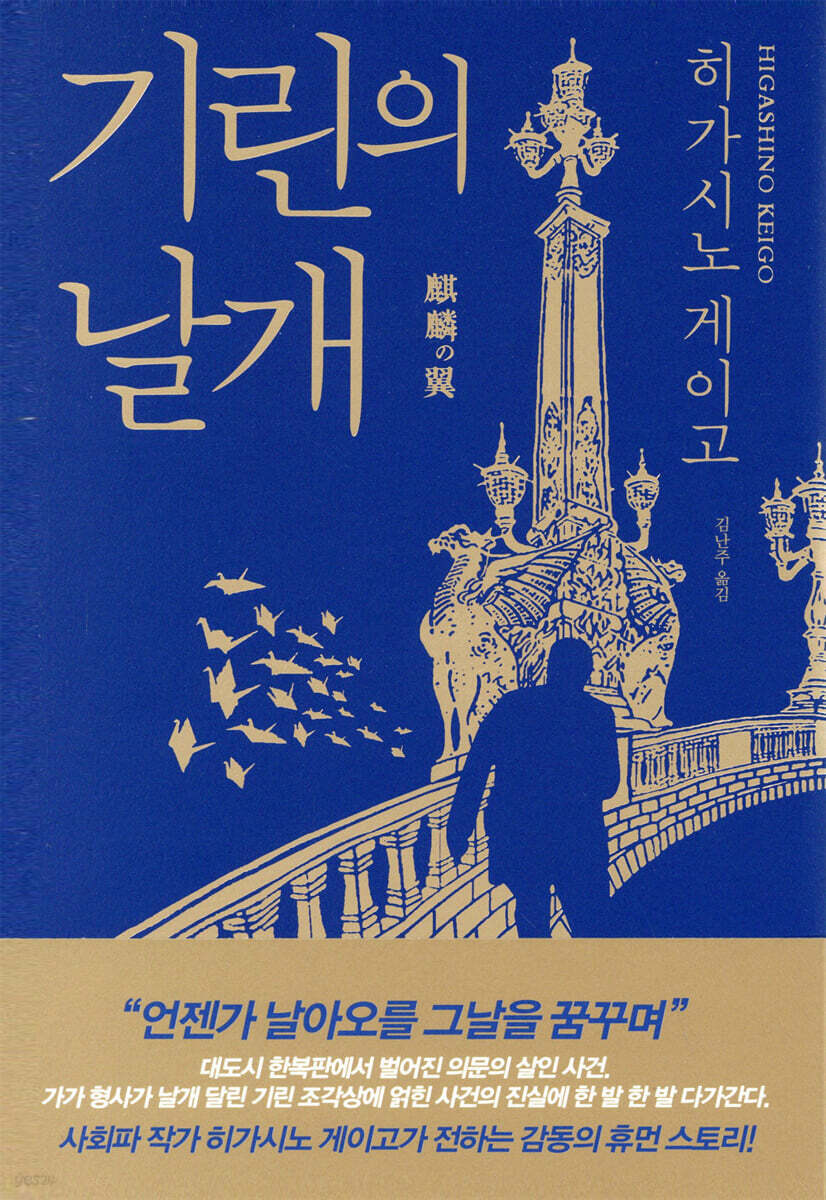
Giraffe's Wings
 |
Description
Book Introduction
“Take courage, don’t run from the truth, do what you believe.”
A touching final message from a father facing death to his son!
A mysterious murder case in the heart of a big city
One late autumn night, a middle-aged man is found by police on the Nihonbashi Bridge in the heart of Tokyo, stabbed in the chest.
The scene of the incident was an underpass one block from the bridge.
There, the man who was stabbed walked to the bridge with all his might, bleeding profusely, and fell down in a praying posture toward the giraffe statue in the middle of the bridge.
He is taken to the hospital but soon dies.
Two hours later, a young man is hit by a truck and rendered unconscious while trying to escape a police checkpoint in a park near the scene of the incident.
The deceased man's driver's license and wallet are found in the young man's possession, and the police identify him as a suspect in the murder.
Police investigation revealed that the deceased man was Takeaki Aoyagi, the head of a construction parts manufacturing company.
It was revealed that the suspect, who had fallen into a coma, was named Yashima Fuyuki, and that he had been working as a contract worker at the victim's company, but had been fired six months earlier after being injured in an on-site accident without even receiving industrial accident compensation from the company.
On the surface, it appears to be a simple murder out of resentment, or a robbery-murder case.
The police are moving their investigation towards concluding the case quickly.
And the media rushed to cover this murder case in the heart of Tokyo as if it were a stroke of luck, and did not hesitate to make sensational reports claiming that "there was a cover-up behind the murder."
Meanwhile, the upper management of the victim company is trying hard to shift all responsibility for covering up the industrial accident onto the 'dead person'.
However, the suspect is unconscious and cannot confess, and the police cannot close the case because they cannot find the suspect's fingerprints on the knife, which is a crucial piece of evidence. To make matters worse, the suspect's alibi on the day of the incident is belatedly confirmed.
With the investigation back to square one, Detective Kaga Kyoichiro, after persistent investigation, uncovers that the victim had been visiting shrines in the Nihonbashi area, offering paper cranes he had folded and praying for atonement and salvation for someone, gradually getting closer to the shocking truth behind the incident involving the winged giraffe statue.
A touching final message from a father facing death to his son!
A mysterious murder case in the heart of a big city
One late autumn night, a middle-aged man is found by police on the Nihonbashi Bridge in the heart of Tokyo, stabbed in the chest.
The scene of the incident was an underpass one block from the bridge.
There, the man who was stabbed walked to the bridge with all his might, bleeding profusely, and fell down in a praying posture toward the giraffe statue in the middle of the bridge.
He is taken to the hospital but soon dies.
Two hours later, a young man is hit by a truck and rendered unconscious while trying to escape a police checkpoint in a park near the scene of the incident.
The deceased man's driver's license and wallet are found in the young man's possession, and the police identify him as a suspect in the murder.
Police investigation revealed that the deceased man was Takeaki Aoyagi, the head of a construction parts manufacturing company.
It was revealed that the suspect, who had fallen into a coma, was named Yashima Fuyuki, and that he had been working as a contract worker at the victim's company, but had been fired six months earlier after being injured in an on-site accident without even receiving industrial accident compensation from the company.
On the surface, it appears to be a simple murder out of resentment, or a robbery-murder case.
The police are moving their investigation towards concluding the case quickly.
And the media rushed to cover this murder case in the heart of Tokyo as if it were a stroke of luck, and did not hesitate to make sensational reports claiming that "there was a cover-up behind the murder."
Meanwhile, the upper management of the victim company is trying hard to shift all responsibility for covering up the industrial accident onto the 'dead person'.
However, the suspect is unconscious and cannot confess, and the police cannot close the case because they cannot find the suspect's fingerprints on the knife, which is a crucial piece of evidence. To make matters worse, the suspect's alibi on the day of the incident is belatedly confirmed.
With the investigation back to square one, Detective Kaga Kyoichiro, after persistent investigation, uncovers that the victim had been visiting shrines in the Nihonbashi area, offering paper cranes he had folded and praying for atonement and salvation for someone, gradually getting closer to the shocking truth behind the incident involving the winged giraffe statue.
- You can preview some of the book's contents.
Preview
Publisher's Review
Detective Gaga gets closer to the truth behind the winged giraffe statue.
"The Wings of the Giraffe" is the ninth work in the "Detective Gaga" series.
In Japan, it was made into a movie and became a huge hit.
Many Japanese people shed tears and cheered at the touching human story depicting familial love.
The author himself has stated that he considers this work, which depicts family love, to be the greatest masterpiece in the 'Detective Gaga series'.
Detective Gaga is a far cry from the typical mystery novel character who enjoys sophisticated deductions from his armchair.
He runs around the scene on foot, not overlooking even the smallest clue.
He is a detective armed with the belief that “the results of an investigation depend on how many times you make wasted steps,” or “if you get stuck, you go back to the starting point no matter how many times.”
As with the previous work, "Newcomer," Detective Kaga's activities take place in the Nihonbashi area in this work.
This area, which retains the atmosphere of old Tokyo, is an interesting area with a mix of old, traditional shops and modern buildings.
The lyrical and human-filled landscape of Nihonbashi featured in the work adds to the fun of reading this exciting brain game.
Based on the victim's belongings, Detective Kaga visits soba noodle shops, tea houses, Japanese paper shops, and handmade craft shops in the Nihonbashi area, and doggedly tracks the victim's whereabouts on the day of the accident and in recent times.
The greatest appeal of this work is his investigative technique of solving the case by taking a taxi and navigating narrow alleys, even while suffering from the pressure of his superiors to piece together the events of the case and conclude the investigation early.
It is difficult to ignore any of the conversations that Detective Kaga has with people as he walks around Nihonbashi, as they all serve as clues to the case.
Readers will enjoy following his path and playing a brain game of 'who is the culprit?'
However, if you follow Gaga's outstanding reasoning skills, surprising counter-intuition, and flawless reconstruction of events, you will often lose track of the clues.
It is a work that highlights the author's solid composition and imagination.
Detective Kaga's extensive investigation reveals that the victim had been making a pilgrimage to the shrines in the Nihonbashi area, folding a thousand origami cranes to atone for his sins and pray for the salvation of others.
Kaga learns that it is not unrelated that he desperately walked to Nihonbashi Bridge while stabbed and collapsed in a prayer position in front of a giraffe statue.
It was the last message a dying father left with his whole body to his son.
However, the incident does not reveal the full story until the end of the work, and the final twist inevitably brings readers to tears.
A moving human story from socialist author Keigo Higashino.
In "The Wings of the Giraffe," the Nihonbashi Bridge and the giraffe statue are keywords that dominate the entire work.
Nihonbashi Bridge is the starting point of all roads extending across Japan.
A giraffe statue is installed in the center of this bridge.
The giraffe is an imaginary animal that symbolizes prosperity in Chinese legend. It originally had no wings, but when Nihonbashi was rebuilt about 100 years ago, a winged giraffe statue was created, giving it the meaning of “flapping its wings toward the entire country.”
So to speak, it is a place that has symbolic meaning for people who are starting something new or designing a hopeful future.
In the film, the young man who is framed as a suspect comes to Tokyo from Fukushima with his live-in girlfriend and the first place he sets foot on is Nihonbashi Bridge.
This young couple, from impoverished families, come to Tokyo to escape poverty and work hard, but the world is not easy.
Men work as day laborers and women work part-time jobs, but they can't escape the situation of barely making ends meet.
Even though they worked and worked, their lives did not improve, but they were still full of hope. But when the man got into an accident at work, he lost his job, and eventually became a suspect in a murder case, they suffered the misfortune of being a suspect in a murder case.
Detective Gaga tells a pregnant woman that although things are difficult, she will give birth and live on bravely.
“If you take the world for granted, you’ll feel more at ease.
“I’m more worried that they might despair, thinking there’s no hope anywhere.” Throughout the series, Detective Gaga warmly comforts those in trouble.
Throughout his works, author Keigo Higashino expresses boundless affection for the Japanese common people who live difficult and harsh lives.
And this is precisely why he is called a 'socialist' writer.
In addition, the author points out the problems in Japanese society caused by the nuclear family and materialism in the work.
But on the other hand, the author does not let go of the message of hope.
Even in the midst of structural social problems, it emphasizes the moral conscience that individuals must maintain until the end, and calls out "Ganbare" (Cheer up) to ordinary people who steadfastly overcome all difficulties and move forward toward the future, one step at a time.
It talks about having hope and dreaming of the day when we can fly.
"The Wings of the Giraffe" is the ninth work in the "Detective Gaga" series.
In Japan, it was made into a movie and became a huge hit.
Many Japanese people shed tears and cheered at the touching human story depicting familial love.
The author himself has stated that he considers this work, which depicts family love, to be the greatest masterpiece in the 'Detective Gaga series'.
Detective Gaga is a far cry from the typical mystery novel character who enjoys sophisticated deductions from his armchair.
He runs around the scene on foot, not overlooking even the smallest clue.
He is a detective armed with the belief that “the results of an investigation depend on how many times you make wasted steps,” or “if you get stuck, you go back to the starting point no matter how many times.”
As with the previous work, "Newcomer," Detective Kaga's activities take place in the Nihonbashi area in this work.
This area, which retains the atmosphere of old Tokyo, is an interesting area with a mix of old, traditional shops and modern buildings.
The lyrical and human-filled landscape of Nihonbashi featured in the work adds to the fun of reading this exciting brain game.
Based on the victim's belongings, Detective Kaga visits soba noodle shops, tea houses, Japanese paper shops, and handmade craft shops in the Nihonbashi area, and doggedly tracks the victim's whereabouts on the day of the accident and in recent times.
The greatest appeal of this work is his investigative technique of solving the case by taking a taxi and navigating narrow alleys, even while suffering from the pressure of his superiors to piece together the events of the case and conclude the investigation early.
It is difficult to ignore any of the conversations that Detective Kaga has with people as he walks around Nihonbashi, as they all serve as clues to the case.
Readers will enjoy following his path and playing a brain game of 'who is the culprit?'
However, if you follow Gaga's outstanding reasoning skills, surprising counter-intuition, and flawless reconstruction of events, you will often lose track of the clues.
It is a work that highlights the author's solid composition and imagination.
Detective Kaga's extensive investigation reveals that the victim had been making a pilgrimage to the shrines in the Nihonbashi area, folding a thousand origami cranes to atone for his sins and pray for the salvation of others.
Kaga learns that it is not unrelated that he desperately walked to Nihonbashi Bridge while stabbed and collapsed in a prayer position in front of a giraffe statue.
It was the last message a dying father left with his whole body to his son.
However, the incident does not reveal the full story until the end of the work, and the final twist inevitably brings readers to tears.
A moving human story from socialist author Keigo Higashino.
In "The Wings of the Giraffe," the Nihonbashi Bridge and the giraffe statue are keywords that dominate the entire work.
Nihonbashi Bridge is the starting point of all roads extending across Japan.
A giraffe statue is installed in the center of this bridge.
The giraffe is an imaginary animal that symbolizes prosperity in Chinese legend. It originally had no wings, but when Nihonbashi was rebuilt about 100 years ago, a winged giraffe statue was created, giving it the meaning of “flapping its wings toward the entire country.”
So to speak, it is a place that has symbolic meaning for people who are starting something new or designing a hopeful future.
In the film, the young man who is framed as a suspect comes to Tokyo from Fukushima with his live-in girlfriend and the first place he sets foot on is Nihonbashi Bridge.
This young couple, from impoverished families, come to Tokyo to escape poverty and work hard, but the world is not easy.
Men work as day laborers and women work part-time jobs, but they can't escape the situation of barely making ends meet.
Even though they worked and worked, their lives did not improve, but they were still full of hope. But when the man got into an accident at work, he lost his job, and eventually became a suspect in a murder case, they suffered the misfortune of being a suspect in a murder case.
Detective Gaga tells a pregnant woman that although things are difficult, she will give birth and live on bravely.
“If you take the world for granted, you’ll feel more at ease.
“I’m more worried that they might despair, thinking there’s no hope anywhere.” Throughout the series, Detective Gaga warmly comforts those in trouble.
Throughout his works, author Keigo Higashino expresses boundless affection for the Japanese common people who live difficult and harsh lives.
And this is precisely why he is called a 'socialist' writer.
In addition, the author points out the problems in Japanese society caused by the nuclear family and materialism in the work.
But on the other hand, the author does not let go of the message of hope.
Even in the midst of structural social problems, it emphasizes the moral conscience that individuals must maintain until the end, and calls out "Ganbare" (Cheer up) to ordinary people who steadfastly overcome all difficulties and move forward toward the future, one step at a time.
It talks about having hope and dreaming of the day when we can fly.
GOODS SPECIFICS
- Date of publication: February 6, 2017
- Format: Hardcover book binding method guide
- Page count, weight, size: 420 pages | 522g | 140*194*30mm
- ISBN13: 9788990982674
- ISBN10: 8990982677
You may also like
카테고리
korean


korean

![GQ KOREA Mark (Monthly): December [2025]](http://librairie.coreenne.fr/cdn/shop/files/8ef265dbbfbf186523ed75ba7319009d.jpg?v=1765340328&width=3840)


