

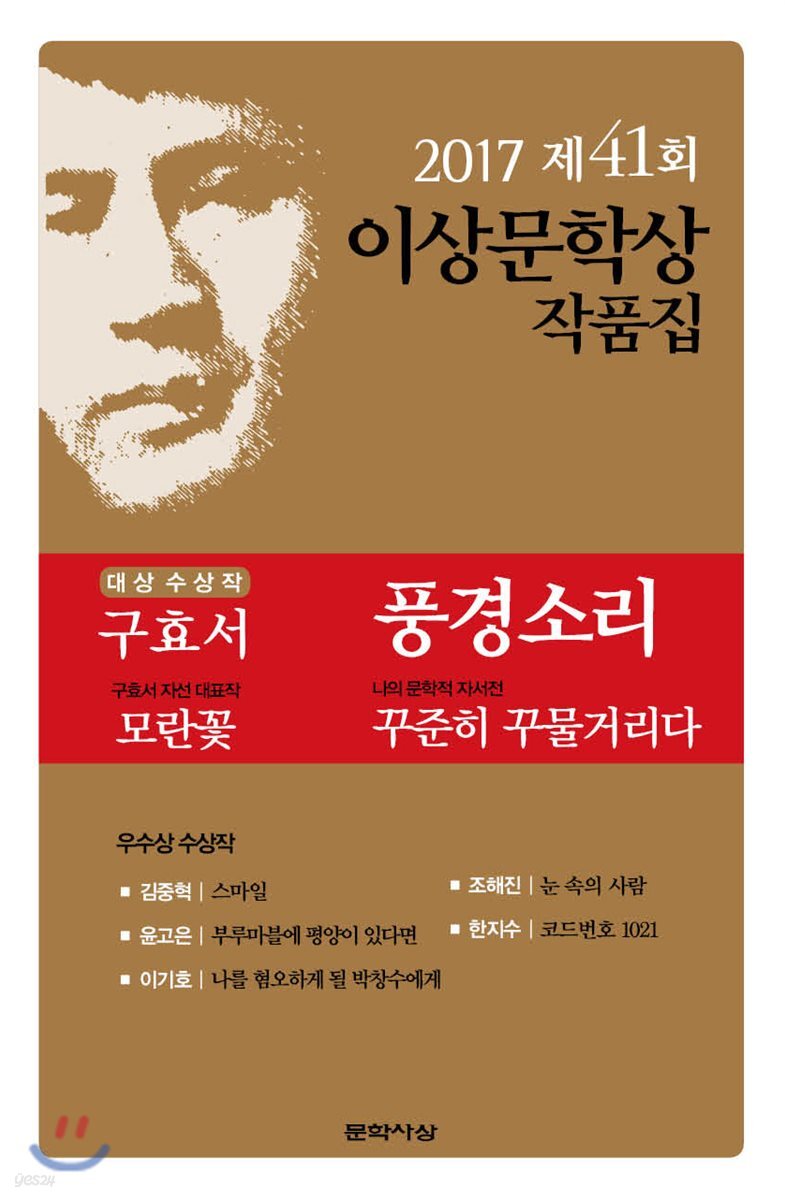
Sound of the wind
 |
Description
Book Introduction
Novelist Gu Hyo-seo wins the 41st Yi Sang Literary Award in 2017!
The 『Lee Sang Literary Award Anthology』, which all readers who love Korean literature eagerly await every year, has finally been published.
The Yi Sang Literary Award selects the best short and medium-length novels published throughout the year through a fair and rational review process.
As a result, the Yi Sang Literary Award is comprised of award-winning works of outstanding quality that clearly highlight the golden part of Korean novel literature, and is called the pinnacle of novel aesthetics that represents the flow of modern novels.
The five judges for the 2017 Yi Sang Literary Award (Kwon Young-min, Kwon Taek-yeong, Kim Seong-gon, Yoon Hu-myeong, and Jeong Gwa-ri) unanimously selected Gu Hyo-seo's "The Sound of the Landscape" as the grand prize winner.
"The Sound of the Wind" is an experimental attempt that presents a unique narrative technique that portrays the female protagonist "Miwa" as the focal point while also giving the first-person point of view of "I."
The use of dual perspectives not only densely reveals the protagonist's inner landscape, but also greatly contributes to the process of reaching the theme.
When the narrator's narrative intersects with Miwa's description, the question: "Who am I?" resonates peacefully with the protagonist Miwa's answer to the existential question: "Where did I come from and where am I going?"
In addition to the grand prize winner, Koo Hyo-seo's "Sound of the Wind" and the charity work, "Peony," this collection also includes the Excellence Award winners, Kim Jung-hyuk's "Smile," Yoon Go-eun's "If Pyongyang Was in Blue Marble," Lee Ki-ho's "To Park Chang-soo Who Will Come to Hate Me," Jo Hae-jin's "People in the Snow," and Han Ji-su's "Code Number 1021."
All of these were cited as having the strength of a humorous perspective on real life and restrained sentences.
The 『Lee Sang Literary Award Anthology』, which all readers who love Korean literature eagerly await every year, has finally been published.
The Yi Sang Literary Award selects the best short and medium-length novels published throughout the year through a fair and rational review process.
As a result, the Yi Sang Literary Award is comprised of award-winning works of outstanding quality that clearly highlight the golden part of Korean novel literature, and is called the pinnacle of novel aesthetics that represents the flow of modern novels.
The five judges for the 2017 Yi Sang Literary Award (Kwon Young-min, Kwon Taek-yeong, Kim Seong-gon, Yoon Hu-myeong, and Jeong Gwa-ri) unanimously selected Gu Hyo-seo's "The Sound of the Landscape" as the grand prize winner.
"The Sound of the Wind" is an experimental attempt that presents a unique narrative technique that portrays the female protagonist "Miwa" as the focal point while also giving the first-person point of view of "I."
The use of dual perspectives not only densely reveals the protagonist's inner landscape, but also greatly contributes to the process of reaching the theme.
When the narrator's narrative intersects with Miwa's description, the question: "Who am I?" resonates peacefully with the protagonist Miwa's answer to the existential question: "Where did I come from and where am I going?"
In addition to the grand prize winner, Koo Hyo-seo's "Sound of the Wind" and the charity work, "Peony," this collection also includes the Excellence Award winners, Kim Jung-hyuk's "Smile," Yoon Go-eun's "If Pyongyang Was in Blue Marble," Lee Ki-ho's "To Park Chang-soo Who Will Come to Hate Me," Jo Hae-jin's "People in the Snow," and Han Ji-su's "Code Number 1021."
All of these were cited as having the strength of a humorous perspective on real life and restrained sentences.
- You can preview some of the book's contents.
Preview
index
Reasons for Selecting the 41st Yi Sang Literary Award Grand Prize Winner
Part 1 Grand Prize Winner and Koo Hyo-seo as an Author
Grand Prize Winner|Gu Hyo-seo - Sound of the Wind
Charity masterpiece | Peony
Acceptance Speech|Refining and Standing Again at the First Moment
My Literary Autobiography | Steadily Procrastinating
Author's Note | This Good Day's Sharing, or Repaying a Debt - Lee Soon-won
Works | Where Did You Come From, Where Are You Going? - Jang Du-yeong
Part 2 Excellence Award Winner
Kim Jung-hyuk Smile
If there is Pyongyang in Yoon Go-eun's Blue Marble
Lee Ki-ho to Park Chang-soo who will come to hate me
The man in the snow
Han Ji-soo code number 1021
Part 3 Selection Process and Judging Comments
Evaluation and selection process
Judges' comments
-Kwon Young-min: The power of imagination that densely interprets human destiny and the bonds of fate.
-Kwon Taek-young, a calm peace in my heart
-Kim Seong-gon: How to escape the voices of a dark past
-Yoon Hu-myeong, the beautiful image of Zen
-Jeong Gwari, breathtaking events, knowledge or ignorance, and the elegant sounds of the scenery
The purpose and selection rules of the 'Lee Sang Literary Award'
Part 1 Grand Prize Winner and Koo Hyo-seo as an Author
Grand Prize Winner|Gu Hyo-seo - Sound of the Wind
Charity masterpiece | Peony
Acceptance Speech|Refining and Standing Again at the First Moment
My Literary Autobiography | Steadily Procrastinating
Author's Note | This Good Day's Sharing, or Repaying a Debt - Lee Soon-won
Works | Where Did You Come From, Where Are You Going? - Jang Du-yeong
Part 2 Excellence Award Winner
Kim Jung-hyuk Smile
If there is Pyongyang in Yoon Go-eun's Blue Marble
Lee Ki-ho to Park Chang-soo who will come to hate me
The man in the snow
Han Ji-soo code number 1021
Part 3 Selection Process and Judging Comments
Evaluation and selection process
Judges' comments
-Kwon Young-min: The power of imagination that densely interprets human destiny and the bonds of fate.
-Kwon Taek-young, a calm peace in my heart
-Kim Seong-gon: How to escape the voices of a dark past
-Yoon Hu-myeong, the beautiful image of Zen
-Jeong Gwari, breathtaking events, knowledge or ignorance, and the elegant sounds of the scenery
The purpose and selection rules of the 'Lee Sang Literary Award'
Publisher's Review
A daughter's memories of her mother
Connected with the Buddhist 'string of fate'
A dense portrayal of humans and their fate
A touching masterpiece!
"The Sound of the Wind" is a work of high novelistic achievement that, through its novella format, has been able to add weight to the interpretation of its novelistic themes, and its exquisite harmony of creative techniques and stylistic experiments has made it a work that will forever shine in the history of Korean literature.
This work, which connects the meaning of human life and its fate to the Buddhist bond of fate, allows for a new interpretation, and its sensuous style exquisitely combines the autumnal scenery of a mountain temple with the inner world of the protagonist who visits the temple, further enhancing the novel's responsiveness.
―Among the reasons for selecting the grand prize winner
Introducing the Grand Prize-winning "Sound of the Wind" and five other excellent Excellence Award winners.
1.
Gu Hyo-seo, "Sound of the Wind"
The award-winning work, "The Sound of the Wind," is a work that has achieved a high level of novelistic achievement by maintaining a sense of weight in the interpretation of its novelistic theme through the form of a novella, and by achieving an exquisite harmony of experimentation with its techniques and style.
The protagonist Miwa heads to Seongbulsa Temple after hearing from her friend that if she wants to be different, she should go there and listen to the sounds of the wind chimes.
Miwa's records, written with a notebook and three pencils instead of a laptop, depict the daily life of Seongbulsa Temple as plainly as temple food.
Her mother secretly gave birth to a fatherless child when she was over 30, raised him in secret for 24 years, married an American man, took the cat she had raised with her and moved to a foreign country, where she is now buried on a hill overlooking a lake.
After her mother's death, Miwa, who had been hallucinating the sound of a cat's cry, came to Seongbulsa Temple because the sound would not go away.
The Buddhist temple, where there is no question of “why,” guides her to become a part of nature greater than her family.
Monks live in a world of taste, not logic or possession.
A world of infinite space and time awaits her, with only food from nature, the sounds of the wind, birds, and water.
This work gently depicts the process of reviving a body suppressed by thoughts and senses suppressed by logic.
All sounds have the same source.
A cat's cry is just one of the many sounds of nature.
And in the latter half of the novel, another self is revealed that can view the self objectively.
And at the point where the work has been described so far, the first-person point of view of 'I' is given and the 'origin of all sounds' is revealed as an image of the absolute being that has been watching over Miwa so far, and its awe is appropriately expressed in the novel.
'I' asks Miwa, who is leaving Seongbulsa Temple, "Where are you going?" and Miwa, who cannot answer, thinks that she will have to 'ask me over and over again as we walk along the road'.
The process by which Miwa arrives at such thoughts is depicted as a Buddhist process of question-and-answer leading to enlightenment.
The question of origins and the process of reaching an answer to that question are also processes of healing, and so this novel is not simply a story of mourning the death of a mother, but is poised to leap forward into a story that transcends the bonds of family.
2.
Kim Jung-hyuk's "Smile"
This work tells the story of the extreme life of a drug mule (swallower) who transports drugs by pretending to be an airplane passenger.
The story progresses through a conversation between Dave Hahn and an American who sits next to him on the plane, and through flashbacks that go back and forth in Dave Hahn's mind.
The fun of this novel comes from the uncertainty surrounding whether all the events that unfold on the plane are a perfect scenario for a successful drug smuggling operation or just coincidences that keep the protagonist in a state of constant anxiety.
3.
Lee Ki-ho, "To Park Chang-soo, Who Will Come to Hate Me"
A story written in the form of a statement by a woman who murdered her husband, written in front of a detective as a suspect.
The person involved in the murder case, which was intertwined with the problem of adultery, explains in detail the course of his life and the reasons why he became involved in the adultery.
To the protagonist, a low-class person named Kim Sook-hee, to affirm her life as it is or to console her by saying that it is also life is truly insulting to her.
The novel is simultaneously entertaining, twisted, and brutal, as the protagonist's secret outbursts emerge from it.
4.
Yoon Go-eun: "If Pyongyang Were in Blue Marble"
Through the premise of receiving pre-sales of apartments in North Korea that have not yet been built in preparation for unification, the film cleverly but bitterly parodies the issues of North and South Korea, territorial issues, and the future of the Korean Peninsula.
The model house for Kaesong New Town is located in Yongin, and the model house for Pyongyang 2nd Apartment is located on the Han River with a view of Namsan Tower, metaphorically touching on our historical and psychological wounds.
5.
Jo Hae-jin's "The Man in the Snow"
This is the story of two people who participated in an oral history project and went together to pay their respects to the person whose story was told when he passed away.
Through the story of the dead (based on their experiences during the war) and the story of two men and women who tried to reconstruct it through oral history in reality, this novel explores 'testimony', which has emerged as the most important form of behavior today.
6.
Han Ji-soo "Code Number 1021"
This is a suicide note from a former torturer.
The belated wisdom that a life filled with the stench of intense blood was nothing but a vain one is woven like a sorrowful thread.
From the 'Acceptance Speech' by award-winning author Koo Hyo-seo
A novelist comes to the frightening realization that he has no other purpose than to write novels.
It's not so much that I realize it, but rather that the realization is coming at me as if it's defeating me.
In front of this thrill, I write line by line, as if I were climbing a cliff with my bare hands, while falling into a deep sleep.
What used to be written once and read ten times, is now written once and read a hundred times.
We give you a month for the amount that used to take a week.
The work becomes endlessly slower and slower and longer and longer.
But I cannot stop this work even for a moment, because it is the fate of a novelist to lose his or her existence immediately if he or she cannot write.
Can I really say that this is something I chose because I liked it?
There is a more genuinely cruel reason that can only be gripped by fear and trembling.
The point is that a novelist's life is not sustained just by writing.
But, I have to write a novel, not something else.
I wrote it as a novel, but if it isn't a novel, it's worse than not writing it at all, and that's...
I couldn't help but be very surprised at such a desperate situation.
What a prize.
Yes, that's right.
Would joy without surprise be joy?
And what joy can surpass the joy of prolonging life?
I was surprised but grateful to receive the award.
It's not a ten-year impression, it's a ten-year singer.
I'm really happy.
Review of "Sound of the Wind"
"The Sound of the Wind" is a medium-length novel that exquisitely combines the autumn scenery of a mountain temple with the inner world of the protagonist who visits the temple.
In terms of narrative technique, the author portrays the female protagonist 'Miwa' as the focal point, but also gives her the first-person point of view of 'I'.
This use of dual perspectives succeeds in densely revealing the protagonist's inner landscape.
―Kwon Young-min, editor-in-chief of this newspaper
Gu Hyo-seo's "The Sound of the Wind" is a novel that brings a sense of calm peace.
It is a journey to the origin of all things, ‘where are they born and where are they going?’
―Kwon Taek-young, literary critic
Gu Hyo-seo's "Sound of the Wind", which seems to be a novelization of the song "Night at Seongbulsa Temple," demonstrates a new narrative technique in which the narrator's narration and the protagonist's monologue intersect.
Through the 'sounds' we hear and remember, we ask the ontological question, 'Where do humans come from and where are they going?'
―Kim Seong-gon, literary critic
I was amazed at how far Korean novels had come.
It was also accepted that the beauty of Hangul was an aspect of Zen.
Of course.
There's no way our novel would be defeated so easily.
For the first time in a long time, I was able to take a deep breath and breathe freely.
―Novelist Yoon Hu-myeong
"The Sound of the Wind" is a very clear novel.
Now, it seems that Gu Hyo-seo has reached a certain level.
It is also very natural that the Lee Sang Literary Award goes to him.
But I just want to shout to him, 'You still have to be young.'
―Jeong Gwa-ri, literary critic
Connected with the Buddhist 'string of fate'
A dense portrayal of humans and their fate
A touching masterpiece!
"The Sound of the Wind" is a work of high novelistic achievement that, through its novella format, has been able to add weight to the interpretation of its novelistic themes, and its exquisite harmony of creative techniques and stylistic experiments has made it a work that will forever shine in the history of Korean literature.
This work, which connects the meaning of human life and its fate to the Buddhist bond of fate, allows for a new interpretation, and its sensuous style exquisitely combines the autumnal scenery of a mountain temple with the inner world of the protagonist who visits the temple, further enhancing the novel's responsiveness.
―Among the reasons for selecting the grand prize winner
Introducing the Grand Prize-winning "Sound of the Wind" and five other excellent Excellence Award winners.
1.
Gu Hyo-seo, "Sound of the Wind"
The award-winning work, "The Sound of the Wind," is a work that has achieved a high level of novelistic achievement by maintaining a sense of weight in the interpretation of its novelistic theme through the form of a novella, and by achieving an exquisite harmony of experimentation with its techniques and style.
The protagonist Miwa heads to Seongbulsa Temple after hearing from her friend that if she wants to be different, she should go there and listen to the sounds of the wind chimes.
Miwa's records, written with a notebook and three pencils instead of a laptop, depict the daily life of Seongbulsa Temple as plainly as temple food.
Her mother secretly gave birth to a fatherless child when she was over 30, raised him in secret for 24 years, married an American man, took the cat she had raised with her and moved to a foreign country, where she is now buried on a hill overlooking a lake.
After her mother's death, Miwa, who had been hallucinating the sound of a cat's cry, came to Seongbulsa Temple because the sound would not go away.
The Buddhist temple, where there is no question of “why,” guides her to become a part of nature greater than her family.
Monks live in a world of taste, not logic or possession.
A world of infinite space and time awaits her, with only food from nature, the sounds of the wind, birds, and water.
This work gently depicts the process of reviving a body suppressed by thoughts and senses suppressed by logic.
All sounds have the same source.
A cat's cry is just one of the many sounds of nature.
And in the latter half of the novel, another self is revealed that can view the self objectively.
And at the point where the work has been described so far, the first-person point of view of 'I' is given and the 'origin of all sounds' is revealed as an image of the absolute being that has been watching over Miwa so far, and its awe is appropriately expressed in the novel.
'I' asks Miwa, who is leaving Seongbulsa Temple, "Where are you going?" and Miwa, who cannot answer, thinks that she will have to 'ask me over and over again as we walk along the road'.
The process by which Miwa arrives at such thoughts is depicted as a Buddhist process of question-and-answer leading to enlightenment.
The question of origins and the process of reaching an answer to that question are also processes of healing, and so this novel is not simply a story of mourning the death of a mother, but is poised to leap forward into a story that transcends the bonds of family.
2.
Kim Jung-hyuk's "Smile"
This work tells the story of the extreme life of a drug mule (swallower) who transports drugs by pretending to be an airplane passenger.
The story progresses through a conversation between Dave Hahn and an American who sits next to him on the plane, and through flashbacks that go back and forth in Dave Hahn's mind.
The fun of this novel comes from the uncertainty surrounding whether all the events that unfold on the plane are a perfect scenario for a successful drug smuggling operation or just coincidences that keep the protagonist in a state of constant anxiety.
3.
Lee Ki-ho, "To Park Chang-soo, Who Will Come to Hate Me"
A story written in the form of a statement by a woman who murdered her husband, written in front of a detective as a suspect.
The person involved in the murder case, which was intertwined with the problem of adultery, explains in detail the course of his life and the reasons why he became involved in the adultery.
To the protagonist, a low-class person named Kim Sook-hee, to affirm her life as it is or to console her by saying that it is also life is truly insulting to her.
The novel is simultaneously entertaining, twisted, and brutal, as the protagonist's secret outbursts emerge from it.
4.
Yoon Go-eun: "If Pyongyang Were in Blue Marble"
Through the premise of receiving pre-sales of apartments in North Korea that have not yet been built in preparation for unification, the film cleverly but bitterly parodies the issues of North and South Korea, territorial issues, and the future of the Korean Peninsula.
The model house for Kaesong New Town is located in Yongin, and the model house for Pyongyang 2nd Apartment is located on the Han River with a view of Namsan Tower, metaphorically touching on our historical and psychological wounds.
5.
Jo Hae-jin's "The Man in the Snow"
This is the story of two people who participated in an oral history project and went together to pay their respects to the person whose story was told when he passed away.
Through the story of the dead (based on their experiences during the war) and the story of two men and women who tried to reconstruct it through oral history in reality, this novel explores 'testimony', which has emerged as the most important form of behavior today.
6.
Han Ji-soo "Code Number 1021"
This is a suicide note from a former torturer.
The belated wisdom that a life filled with the stench of intense blood was nothing but a vain one is woven like a sorrowful thread.
From the 'Acceptance Speech' by award-winning author Koo Hyo-seo
A novelist comes to the frightening realization that he has no other purpose than to write novels.
It's not so much that I realize it, but rather that the realization is coming at me as if it's defeating me.
In front of this thrill, I write line by line, as if I were climbing a cliff with my bare hands, while falling into a deep sleep.
What used to be written once and read ten times, is now written once and read a hundred times.
We give you a month for the amount that used to take a week.
The work becomes endlessly slower and slower and longer and longer.
But I cannot stop this work even for a moment, because it is the fate of a novelist to lose his or her existence immediately if he or she cannot write.
Can I really say that this is something I chose because I liked it?
There is a more genuinely cruel reason that can only be gripped by fear and trembling.
The point is that a novelist's life is not sustained just by writing.
But, I have to write a novel, not something else.
I wrote it as a novel, but if it isn't a novel, it's worse than not writing it at all, and that's...
I couldn't help but be very surprised at such a desperate situation.
What a prize.
Yes, that's right.
Would joy without surprise be joy?
And what joy can surpass the joy of prolonging life?
I was surprised but grateful to receive the award.
It's not a ten-year impression, it's a ten-year singer.
I'm really happy.
Review of "Sound of the Wind"
"The Sound of the Wind" is a medium-length novel that exquisitely combines the autumn scenery of a mountain temple with the inner world of the protagonist who visits the temple.
In terms of narrative technique, the author portrays the female protagonist 'Miwa' as the focal point, but also gives her the first-person point of view of 'I'.
This use of dual perspectives succeeds in densely revealing the protagonist's inner landscape.
―Kwon Young-min, editor-in-chief of this newspaper
Gu Hyo-seo's "The Sound of the Wind" is a novel that brings a sense of calm peace.
It is a journey to the origin of all things, ‘where are they born and where are they going?’
―Kwon Taek-young, literary critic
Gu Hyo-seo's "Sound of the Wind", which seems to be a novelization of the song "Night at Seongbulsa Temple," demonstrates a new narrative technique in which the narrator's narration and the protagonist's monologue intersect.
Through the 'sounds' we hear and remember, we ask the ontological question, 'Where do humans come from and where are they going?'
―Kim Seong-gon, literary critic
I was amazed at how far Korean novels had come.
It was also accepted that the beauty of Hangul was an aspect of Zen.
Of course.
There's no way our novel would be defeated so easily.
For the first time in a long time, I was able to take a deep breath and breathe freely.
―Novelist Yoon Hu-myeong
"The Sound of the Wind" is a very clear novel.
Now, it seems that Gu Hyo-seo has reached a certain level.
It is also very natural that the Lee Sang Literary Award goes to him.
But I just want to shout to him, 'You still have to be young.'
―Jeong Gwa-ri, literary critic
GOODS SPECIFICS
- Date of issue: January 18, 2017
- Page count, weight, size: 352 pages | 488g | 143*218*30mm
- ISBN13: 9788970129631
- ISBN10: 8970129634
You may also like
카테고리
korean


korean

![GQ KOREA Mark (Monthly): December [2025]](http://librairie.coreenne.fr/cdn/shop/files/8ef265dbbfbf186523ed75ba7319009d.jpg?v=1765340328&width=3840)


