

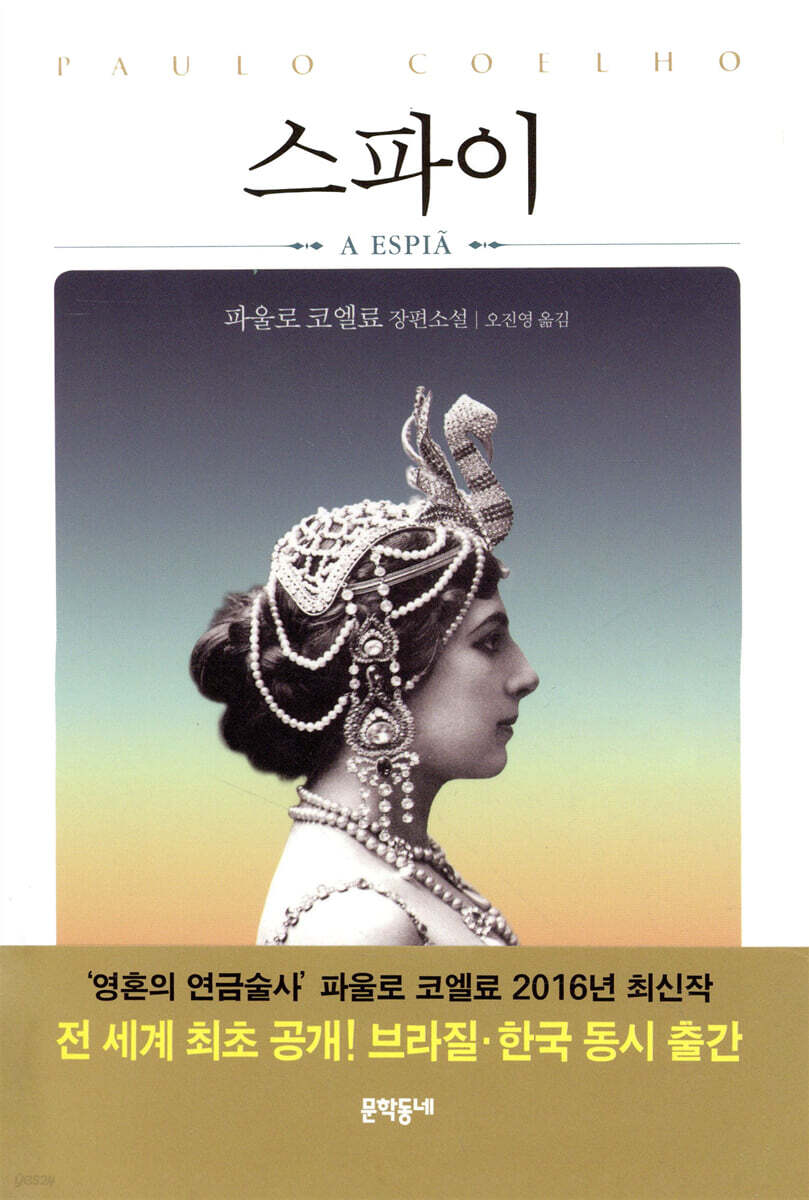
spy
 |
Description
Book Introduction
Mata Hari, the most captivating woman in history, ahead of her time Paulo Coelho's new 2016 work premieres worldwide! Mata Hari was a feminist ahead of her time, who resisted the demands of men of her time and chose an independent life unbound by convention. In today's world, where innocent lives are still sacrificed by those in power, her life resonates deeply with us. _Paulo Coelho A new work by Paulo Coelho, the "Alchemist of the Soul," who has conveyed warm comfort and inspiration to 200 million readers around the world with sentences full of life wisdom, is being released. His new book, "Spy," which depicts the life of the legendary dancer Mata Hari, who met a tragic end on charges of being a double agent during World War I, will be published simultaneously in Brazil and elsewhere in September 2016, and will be released first worldwide through an online pre-serialization. Mata Hari was a fascinating dancer who captivated Paris and all of Europe in the early 20th century with her exotic and sensual Oriental dance. During the Belle Époque era, she was a fashionista who led trends and received applause on the glamorous stage. She was a person who gained enormous wealth along with her great popularity, had numerous affairs with the powerful men of the time, and kept many secrets within those relationships. He was also a person who was arrested by the French army on charges of being a double spy who passed information to Germany during World War I and had to end his life in the midst of gunfire. As the centenary of Mata Hari's death approaches, Paulo Coelho focuses on the life of Mata Hari, who strived to be free and independent at every moment of her life. Unlike her previous portrayal as a veiled, sensual femme fatale, Mata Hari in Coelho's new work, The Spy, is portrayed as a courageous character who bravely confronts the world to live as her true self, unfettered by social norms. Mata Hari, who lived a life filled with intense and dangerous adventures, will now take her place in the public's heart anew as a symbol of a strong and courageous woman. |
- You can preview some of the book's contents.
Preview
index
Prologue … 011
Part 1… 021
Part 2… 069
Part 3… 167
Epilogue … 211
Author's Note … 217
Part 1… 021
Part 2… 069
Part 3… 167
Epilogue … 211
Author's Note … 217
Detailed image

Into the book
“Flowers teach us.
Nothing lasts forever.
Beauty and withering will pass away and leave behind new seeds.
I hope you remember that when you are happy, when you are sick, and when you are sad.
“Everything passes, grows old, dies, and is reborn.” --- p.33
“Never fall in love.
Love is poison.
“That inexplicable and dangerous thing called love completely wipes you from the face of the earth, leaving behind only the image of the person you love.” --- p.81~82
There is no way to get lost when you don't know where life will take you.
--- p.86
I thought I would sink into a dark pit if I finally admitted that I wasn't who I thought I was, but instead, I suddenly realized that facing my wounds and scars made me stronger.
--- p.101
“Sin was not created by God, but by us when we tried to transform the absolute into something relative.
We cannot see the whole picture, but only a part of it.
And as some of them decide what is good against sin, rules, and evil, in the end, each of them thinks he is right.” --- p.133~134
I wasn't looking for happiness, I was looking for what the French call 'la vraie vie', the real life.
A true life where moments of indescribable beauty and deep heartbreak coexist, moments of loyalty and betrayal, fear and peace.
--- p.157
I realized that I had always been a warrior and that I had continued to fight my battles without giving in to pain.
Those battles were a part of life.
--- p.158
Unfortunately, what happened today happened yesterday and will happen again tomorrow.
It will continue until the end of the world, or until humans realize that what makes them human is not just what they think, but what they feel.
Even though the body tires easily, the soul is always free, and it will help us one day break free from this hellish wheel where we repeat the same mistakes generation after generation.
Even though thoughts always stay in the same place, there is a power even stronger than that, and we call it love.
Nothing lasts forever.
Beauty and withering will pass away and leave behind new seeds.
I hope you remember that when you are happy, when you are sick, and when you are sad.
“Everything passes, grows old, dies, and is reborn.” --- p.33
“Never fall in love.
Love is poison.
“That inexplicable and dangerous thing called love completely wipes you from the face of the earth, leaving behind only the image of the person you love.” --- p.81~82
There is no way to get lost when you don't know where life will take you.
--- p.86
I thought I would sink into a dark pit if I finally admitted that I wasn't who I thought I was, but instead, I suddenly realized that facing my wounds and scars made me stronger.
--- p.101
“Sin was not created by God, but by us when we tried to transform the absolute into something relative.
We cannot see the whole picture, but only a part of it.
And as some of them decide what is good against sin, rules, and evil, in the end, each of them thinks he is right.” --- p.133~134
I wasn't looking for happiness, I was looking for what the French call 'la vraie vie', the real life.
A true life where moments of indescribable beauty and deep heartbreak coexist, moments of loyalty and betrayal, fear and peace.
--- p.157
I realized that I had always been a warrior and that I had continued to fight my battles without giving in to pain.
Those battles were a part of life.
--- p.158
Unfortunately, what happened today happened yesterday and will happen again tomorrow.
It will continue until the end of the world, or until humans realize that what makes them human is not just what they think, but what they feel.
Even though the body tires easily, the soul is always free, and it will help us one day break free from this hellish wheel where we repeat the same mistakes generation after generation.
Even though thoughts always stay in the same place, there is a power even stronger than that, and we call it love.
--- p.209~210
Publisher's Review
Paulo Coelho, 'The Alchemist of the Soul'
The latest work, "Spy," was published in 2016.
Paulo Coelho, the best-selling author of our time and the most beloved foreign author among Korean readers, has sold over 210 million copies and has been translated into 81 languages in over 170 countries worldwide.
Coelho, who explores the inner self of humanity with his unique writing style and conveys a deep resonance to our souls, has created a great sensation worldwide with each of his published works.
In 2016, 30 years after the publication of his debut work, The Pilgrim, Coelho returned with his new novel, The Spy, and once again continued his legend.
"Spy" was first released worldwide on September 5th through Naver Dictionary, and is scheduled to be translated and published in over 40 languages.
"Spy" is the story of the legendary dancer Mata Hari, who tragically met her end after being accused of being a double spy during World War I.
Although Coelho has featured independent female narrators as protagonists on several occasions, this is the first time he has dealt with a historical figure.
He made the novel more enjoyable to read by directly and indirectly featuring figures who dominated the cultural and artistic world of the time, such as Pablo Picasso, Freud, Oscar Wilde, Nijinsky, and Modigliani, throughout the work, set in Europe during the most turbulent time in history, when the clouds of war were high and the Paris World's Fair was taking place.
Mata Hari was a feminist ahead of her time, who resisted the demands of men of her time and chose an independent life unbound by convention.
In today's world, where innocent lives are still sacrificed by those in power, her life resonates deeply with us.
_Paulo Coelho
Mata Hari, a woman ahead of her time and one of the most free and independent women in history
Mata Hari was a legendary dancer who captivated Paris and all of Europe in the early 20th century with her exotic and sensual Oriental dance.
During the Belle Époque era, she was a fashionista who led trends and received applause on the glamorous stage. She was a woman who gained enormous wealth along with her great popularity, and she was rumored to have affairs with many powerful men of the time and kept many secrets through those relationships.
He was also an unfortunate figure who was arrested by the French army on charges of being a double spy who passed information to Germany during World War I and had to end his life in the midst of gunfire.
Ahead of the 100th anniversary of Mata Hari's death, Coelho focuses on her life, which strived to be free and independent at every moment.
He wrote "Spy" by referencing numerous sources, including confidential documents from Britain, Germany, the Netherlands, and other countries published over the past 20 years, as well as related books and articles.
Coelho reconstructs Mata Hari's life in the form of letters, drawing on the fact that while awaiting execution in a Paris prison, she asked only for a pen and a few sheets of paper to write letters.
What story did Mata Hari write in her final moments? And how did she fall into the enemy's trap?
Madame Macleot from Margareta Zeller,
Mata Hari and the code name H21
The novel begins with a letter written by Mata Hari to her lawyer a week before her execution while she was imprisoned in the Saint-Lazare prison in France.
She hopes that this letter will reach her daughter, who will be left alone after her death, and she writes the story of how she was forced to take such risks and make such choices.
“They say that even beautiful trees grow from such small seeds.
Remember that fact and never be impatient.”
Part 1 tells the story of her childhood, her troubled married life in the Dutch East Indies, and her journey to Paris, the 'city of dreams', under the name Mata Hari.
Born in the Netherlands in 1876, she spent her school years there, married a Dutch officer in 1895, and moved to the Indonesian island of Java.
One day, while she was struggling with her painful marriage due to her husband's violence and surveillance, she had an ecstatic experience watching dancers performing a magnificent ancient Indian traditional dance.
And soon after, he witnesses a shocking incident and decides to leave his past life behind and find a 'true life'.
Madame Macleot ends her marriage and, under the new name of Mata Hari, finally heads to the Paris of her dreams.
Part 2 follows Mata Hari's journey from her rise to fame and fortune as a dancer in Paris, to the outbreak of war, to her departure to the Netherlands, and then her return to Paris.
After her first performance at the Guimet Museum was a success and made headlines, she gained immense popularity with her exotic looks and sensual dance, and she performed on world-class stages such as the Moulin Rouge in France and the Teatro alla Scala in Milan.
And he frequents French society, mingling with high-ranking officials.
The German intelligence agency, which had been keeping an eye on her since the outbreak of World War I, offered her a spy mission in exchange for 20,000 francs.
Working for France, she traveled the world on a neutral Dutch passport, constantly being suspected by Allied intelligence, and was arrested by French authorities on February 13, 1917, on charges of being a double agent.
Part 3 is a letter written by Cluny, the lawyer who defended Mata Hari, the day before her execution.
He shows how Mata Hari traveled the world, developing relationships with high-ranking officials, and eventually came to be suspected of being a double agent, and portrays her as a scapegoat for France's repeated defeats, without clear evidence that she had leaked French secrets to the Germans.
It also vividly portrays a moment in history when Europe was at war, facing dizzyingly rapid changes following the 1889 Paris World's Fair.
The fierce story of a woman who gave up everything for true freedom in a chaotic world.
And the noble message she sends to our times
I am a woman born in the wrong era, and nothing can change that.
I don't know if my name will be remembered in the future, but if it is, I hope to be remembered not as a victim, but as someone who bravely stepped forward, someone who paid the price he had to pay.
(Page 29)
Mata Hari, whose name means 'eye of the dawn' in Malay, was executed under the dawn on October 15, 1917, just like her name.
She stared death in the face, unblinking and unbound.
She lived the life she wanted, even when the world called her a prostitute, a liar, and “the Salome of our time, whose only goal was to offer the heads of French soldiers to the Germans.”
Unlike her previous portrayal as a sultry femme fatale shrouded in mystery, Mata Hari in Coelho's new work, The Spy, is portrayed as a courageous character who bravely confronts the world to live as her true self, unfettered by social norms.
Was Mata Hari a double agent or an innocent victim of the turmoil of war?
It is unknown whether she actually provided French secrets to Germany as a double agent.
A French court ruled that Mata Hari's leak of military secrets cost the lives of 50,000 Allied soldiers, but no evidence was ever presented that she passed French secrets to Germany.
Along with Alfred Dreyfus, the Jewish French army officer falsely accused of being a spy in 1894, Mata Hari shared the commonality of having been a victim of the extreme right-wing nationalism of conservative European societies in the late 19th and early 20th centuries.
But unlike socialist politicians like Émile Zola who came forward to support Dreyfus and secure his acquittal, she was shunned by the influential people she had been dating and even betrayed by her lover.
Mata Hari was unjustly executed for the crimes of being a woman, of being naked in public, and of having relationships with men who had to maintain their reputations by any means necessary.
She was not forgiven not only because of the accusation of being a double agent, but also because of her fearless defiance of moral conventions.
A hundred years after Mata Hari's death, in an age where wars still rage and lives are consumed and sacrificed for the benefit of one side, Paulo Coelho's extraordinary portrait of a woman remains deeply moving.
Mata Hari, whose life was filled with intense and dangerous adventures, will now be remembered in the public's mind as a symbol of a strong and courageous woman and a feminist ahead of her time.
The latest work, "Spy," was published in 2016.
Paulo Coelho, the best-selling author of our time and the most beloved foreign author among Korean readers, has sold over 210 million copies and has been translated into 81 languages in over 170 countries worldwide.
Coelho, who explores the inner self of humanity with his unique writing style and conveys a deep resonance to our souls, has created a great sensation worldwide with each of his published works.
In 2016, 30 years after the publication of his debut work, The Pilgrim, Coelho returned with his new novel, The Spy, and once again continued his legend.
"Spy" was first released worldwide on September 5th through Naver Dictionary, and is scheduled to be translated and published in over 40 languages.
"Spy" is the story of the legendary dancer Mata Hari, who tragically met her end after being accused of being a double spy during World War I.
Although Coelho has featured independent female narrators as protagonists on several occasions, this is the first time he has dealt with a historical figure.
He made the novel more enjoyable to read by directly and indirectly featuring figures who dominated the cultural and artistic world of the time, such as Pablo Picasso, Freud, Oscar Wilde, Nijinsky, and Modigliani, throughout the work, set in Europe during the most turbulent time in history, when the clouds of war were high and the Paris World's Fair was taking place.
Mata Hari was a feminist ahead of her time, who resisted the demands of men of her time and chose an independent life unbound by convention.
In today's world, where innocent lives are still sacrificed by those in power, her life resonates deeply with us.
_Paulo Coelho
Mata Hari, a woman ahead of her time and one of the most free and independent women in history
Mata Hari was a legendary dancer who captivated Paris and all of Europe in the early 20th century with her exotic and sensual Oriental dance.
During the Belle Époque era, she was a fashionista who led trends and received applause on the glamorous stage. She was a woman who gained enormous wealth along with her great popularity, and she was rumored to have affairs with many powerful men of the time and kept many secrets through those relationships.
He was also an unfortunate figure who was arrested by the French army on charges of being a double spy who passed information to Germany during World War I and had to end his life in the midst of gunfire.
Ahead of the 100th anniversary of Mata Hari's death, Coelho focuses on her life, which strived to be free and independent at every moment.
He wrote "Spy" by referencing numerous sources, including confidential documents from Britain, Germany, the Netherlands, and other countries published over the past 20 years, as well as related books and articles.
Coelho reconstructs Mata Hari's life in the form of letters, drawing on the fact that while awaiting execution in a Paris prison, she asked only for a pen and a few sheets of paper to write letters.
What story did Mata Hari write in her final moments? And how did she fall into the enemy's trap?
Madame Macleot from Margareta Zeller,
Mata Hari and the code name H21
The novel begins with a letter written by Mata Hari to her lawyer a week before her execution while she was imprisoned in the Saint-Lazare prison in France.
She hopes that this letter will reach her daughter, who will be left alone after her death, and she writes the story of how she was forced to take such risks and make such choices.
“They say that even beautiful trees grow from such small seeds.
Remember that fact and never be impatient.”
Part 1 tells the story of her childhood, her troubled married life in the Dutch East Indies, and her journey to Paris, the 'city of dreams', under the name Mata Hari.
Born in the Netherlands in 1876, she spent her school years there, married a Dutch officer in 1895, and moved to the Indonesian island of Java.
One day, while she was struggling with her painful marriage due to her husband's violence and surveillance, she had an ecstatic experience watching dancers performing a magnificent ancient Indian traditional dance.
And soon after, he witnesses a shocking incident and decides to leave his past life behind and find a 'true life'.
Madame Macleot ends her marriage and, under the new name of Mata Hari, finally heads to the Paris of her dreams.
Part 2 follows Mata Hari's journey from her rise to fame and fortune as a dancer in Paris, to the outbreak of war, to her departure to the Netherlands, and then her return to Paris.
After her first performance at the Guimet Museum was a success and made headlines, she gained immense popularity with her exotic looks and sensual dance, and she performed on world-class stages such as the Moulin Rouge in France and the Teatro alla Scala in Milan.
And he frequents French society, mingling with high-ranking officials.
The German intelligence agency, which had been keeping an eye on her since the outbreak of World War I, offered her a spy mission in exchange for 20,000 francs.
Working for France, she traveled the world on a neutral Dutch passport, constantly being suspected by Allied intelligence, and was arrested by French authorities on February 13, 1917, on charges of being a double agent.
Part 3 is a letter written by Cluny, the lawyer who defended Mata Hari, the day before her execution.
He shows how Mata Hari traveled the world, developing relationships with high-ranking officials, and eventually came to be suspected of being a double agent, and portrays her as a scapegoat for France's repeated defeats, without clear evidence that she had leaked French secrets to the Germans.
It also vividly portrays a moment in history when Europe was at war, facing dizzyingly rapid changes following the 1889 Paris World's Fair.
The fierce story of a woman who gave up everything for true freedom in a chaotic world.
And the noble message she sends to our times
I am a woman born in the wrong era, and nothing can change that.
I don't know if my name will be remembered in the future, but if it is, I hope to be remembered not as a victim, but as someone who bravely stepped forward, someone who paid the price he had to pay.
(Page 29)
Mata Hari, whose name means 'eye of the dawn' in Malay, was executed under the dawn on October 15, 1917, just like her name.
She stared death in the face, unblinking and unbound.
She lived the life she wanted, even when the world called her a prostitute, a liar, and “the Salome of our time, whose only goal was to offer the heads of French soldiers to the Germans.”
Unlike her previous portrayal as a sultry femme fatale shrouded in mystery, Mata Hari in Coelho's new work, The Spy, is portrayed as a courageous character who bravely confronts the world to live as her true self, unfettered by social norms.
Was Mata Hari a double agent or an innocent victim of the turmoil of war?
It is unknown whether she actually provided French secrets to Germany as a double agent.
A French court ruled that Mata Hari's leak of military secrets cost the lives of 50,000 Allied soldiers, but no evidence was ever presented that she passed French secrets to Germany.
Along with Alfred Dreyfus, the Jewish French army officer falsely accused of being a spy in 1894, Mata Hari shared the commonality of having been a victim of the extreme right-wing nationalism of conservative European societies in the late 19th and early 20th centuries.
But unlike socialist politicians like Émile Zola who came forward to support Dreyfus and secure his acquittal, she was shunned by the influential people she had been dating and even betrayed by her lover.
Mata Hari was unjustly executed for the crimes of being a woman, of being naked in public, and of having relationships with men who had to maintain their reputations by any means necessary.
She was not forgiven not only because of the accusation of being a double agent, but also because of her fearless defiance of moral conventions.
A hundred years after Mata Hari's death, in an age where wars still rage and lives are consumed and sacrificed for the benefit of one side, Paulo Coelho's extraordinary portrait of a woman remains deeply moving.
Mata Hari, whose life was filled with intense and dangerous adventures, will now be remembered in the public's mind as a symbol of a strong and courageous woman and a feminist ahead of her time.
GOODS SPECIFICS
- Date of publication: September 23, 2016
- Format: Hardcover book binding method guide
- Page count, weight, size: 224 pages | 384g | 128*188*20mm
- ISBN13: 9788954642019
- ISBN10: 8954642012
You may also like
카테고리
korean


korean

![GQ KOREA Mark (Monthly): December [2025]](http://librairie.coreenne.fr/cdn/shop/files/8ef265dbbfbf186523ed75ba7319009d.jpg?v=1765340328&width=3840)


