

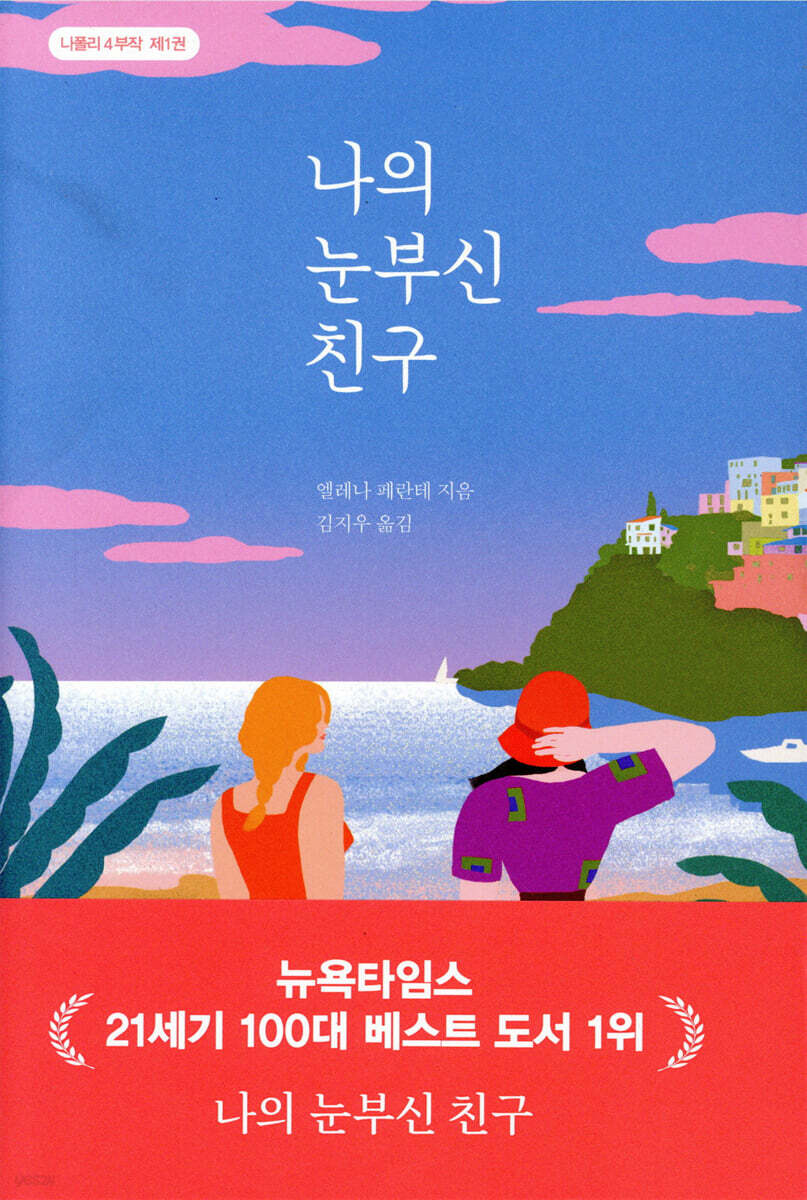
My dazzling friend
 |
Description
Book Introduction
Two women whose friendship was their life ask you: Is your friendship dazzling? The Neapolitan Quartet, Volume 1: "My Brilliant Friend" The first volume of the 'Neapolitan Quartet' that has captivated the world, 'My Brilliant Friend', is a story about the friendship between two women that shines even in the ruins of Naples, Italy. Stories about friendship are clichés. But Elena Ferrante's Neapolitan Quartet, which covers the lives of two women over 60 years, is beautiful but ruthless, and their lives are fierce. The emotional lines are intense and the characters are filled with desire and anger. Although it appears cold on the outside, the novel is full of expansive sentences that contain hot magma. Ferrante doesn't beat around the bush. It's natural and direct. The two main characters also do not regress. In a world filled with contradictions, the protagonist only looks forward. They just move forward, turning the pages of life sequentially. A story that makes you want to turn the next page as if you're hungry. But it's a story I hope will never end. It is 『My Dazzling Friend』. |
- You can preview some of the book's contents.
Preview
index
Characters
9
prolog
Erase traces
13
babyhood
The Story of Don Achille
23
puberty
shoe story
111
Translator's Note
443
9
prolog
Erase traces
13
babyhood
The Story of Don Achille
23
puberty
shoe story
111
Translator's Note
443
Detailed image
Publisher's Review
To avoid being arrogant
conceal one's identity
Elena Ferrante.
He is currently the most famous writer in the world of literature, but his identity is shrouded in mystery.
Ferrante, who speaks only of herself through her work, has not appeared in public since her debut in 1992.
Little is known about her other than the fact that she was a writer born in Naples who studied classical literature and spent a long time abroad, and even her name, 'Elena Ferrante', is a pen name.
Ferrante, who chose seclusion, revealed through Italy's Corriere della Sera that the 1,600-page 'Neapolitan Quartet' originated from her own friendship, and wrote about the friendship and lives of two women with great intensity and without hesitation, with Naples as the background.
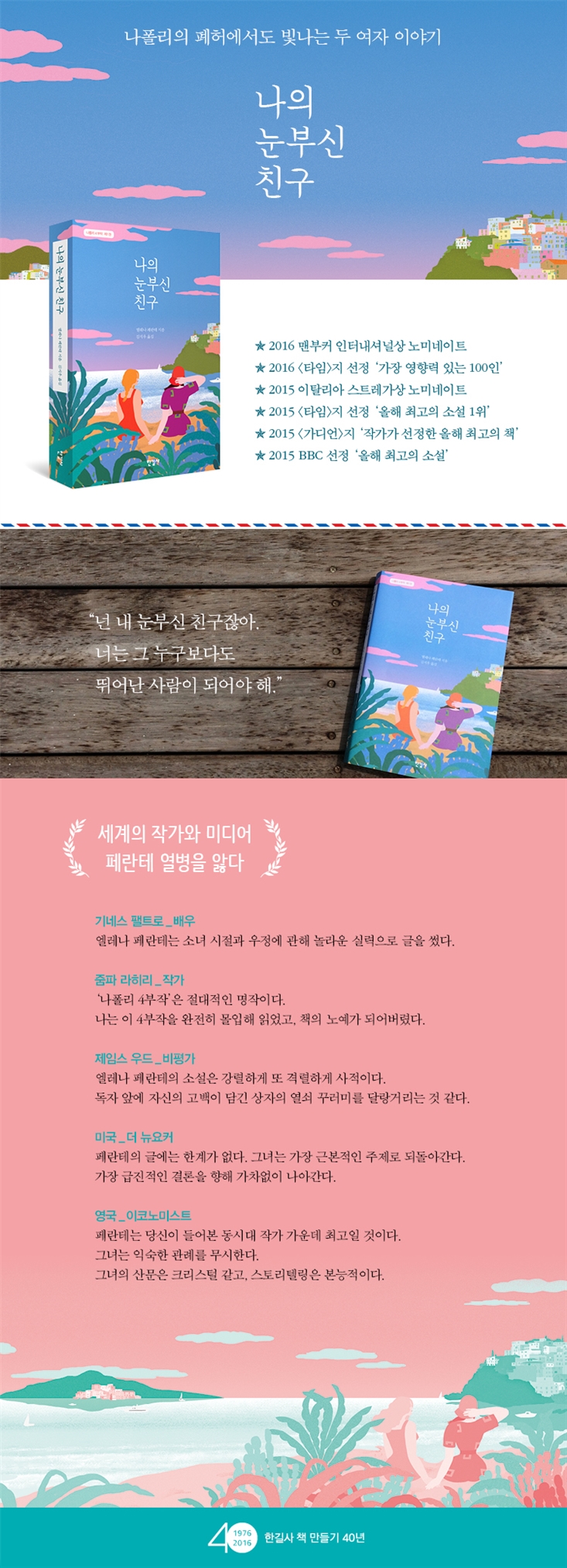
Ferrante was shortlisted for the 2016 Man Booker International Prize for her novel, The Story of the Lost Child, part of the Neapolitan Quartet, and was also nominated for Italy's top literary award, the Strega Prize, in 2015.
However, Ferrante did not attend any of the events and only expressed her acceptance speech in writing.
When Ferrante was nominated for the Strega Prize, Italian writer Roberto Saviano publicly requested through La Repubblica that she attend the award ceremony, but Ferrante only expressed her gratitude and did not attend.
Ferrante says that everything about a writer is in the novel.
The author's point is that promoting himself through TV appearances or lectures is sufficient within his work.
In a written interview with The Paris Review, Ferrante also criticized the media for following only the author's reputation and not the value of the book itself or the work.
The collective intelligence that has been accumulated over a long period of time, including literary traditions and techniques, and is contained within literature, is weakened the moment a writer appears.
“I believe that once a book is published, it no longer needs an author.
If the author has something left to say about the book, he will go out and find readers; if not, there is no need to go out and say anything.”
-Elena Ferrante
Ferrante says that the most important thing during her 25 years of seclusion was the creative space created by absence.
The moment the author is erased, the work creates a new space that did not exist before.
And the work fills the empty space created by the writer's absence.
If children have Harry Potter
For adults, there's Elena Ferrante.
The 'Neapolitan Quartet' is receiving an explosive response not only from Italian but also from English-speaking readers.
According to a recent survey by Nielsen Books in the UK, while overall novel sales in the UK declined between 2001 and 2015, sales of translated novels from overseas more than doubled, and the main factor driving this unusual phenomenon was the Neapolitan Quartet.
Additionally, in the United States, the Neapolitan Quartet sold over 1.2 million copies without any special advertising.
Readers praise her with the tag '#ferrantefever' (Ferrante fever).
Pulitzer Prize-winning Indian author Jhumpa Lahiri said, “I am enslaved by the Neapolitan Quartet,” and author Elizabeth Strout praised it, saying, “I want everyone in the world to read this book.”
Actress Gwyneth Paltrow also praised Ferrante's "remarkable ability to tell the story of girlhood friendship," and Amazon editor-in-chief Sarah Nelson said, "Ferrante is to women in America what Harry Potter was to children," proving Ferrante's status in the global literary world.
We are reading a masterpiece.
_ USA, 『Time』
A wonderful epic tale of friendship, filled with adventure and surprise.
_ France, 『Le Monde』
Ferrante's prose is crystalline and her storytelling is instinctive.
_ UK, 『The Economist』
Not only writers and the media, but also readers around the world are suffering from 'Ferrante fever'.
The owner of a used bookstore in Williamsburg, Brooklyn, New York, says that Ferrante's novels are so hard to find that they are not even available in used bookstores.
In a conference room at Columbia University, readers' discussions are held under the name "Ferrante," regardless of gender or age.
An event related to Ferrante held at Sydney Hall in Australia in May of this year was attended by some 3,000 readers and the English-language translator Anne Goldstein.
Italy's state-run broadcaster RAI is producing a 32-part drama series called 'Naples 4-part series'.
It's amazing.
Why are readers around the world so enthusiastic about the novels of this unknown author?
My friendship with you
It was soon my life
The first volume of the Neapolitan Quartet, My Brilliant Friend, focuses on the friendship between the two main characters, Lila and Lenù, from childhood to adolescence.
The story begins from Lenu's perspective as she recalls Lila, who suddenly disappeared one day.
Lila and Lenu, who grew up in a poor neighborhood in Naples, are best friends.
They have a special relationship where they can read each other's minds, but even within their friendship, subtle feelings exist.
To them, each other's existence is a lifelong rival and an inspiring muse.
Lila is born with a bright mind, but due to her family circumstances, she cannot attend middle school and instead teaches herself Latin and Greek.
Lenu, a model student and hard worker, is inspired by Lila and studies hard, but she cannot keep up with Lila's intelligence.
Even the assignments that were recognized at school couldn't be denied as being Lila's idea.
But it's not just about studying.
As Lila grows older, she becomes more beautiful and captures the attention of all men.
Lenu feels inferior to Lila, believing that she is not better than her in anything, and Lila's dreams are frustrated by external circumstances.
Their emotions fluctuate depending on their environment.
Their friendship is like a muddy mess of emotions like love, hate, jealousy, and pity.
The greatest emotion that drives the entire novel is the love between Lila and Lenu.
Lenu laments her own insignificant life, but also wishes Lila a happy married life.
Lila also says she will help Lenu continue her studies.
Having true friendship is not easy.
There is no one who is without friends, but it is not easy to have even one friend you can rely on for life.
That is why the friendship between the two main characters is universal but special.
Ferrante portrays that friendship with honesty and boldness.
The storytelling is instinctive, but the sentences are delicate and dense.
The most fundamental cause that evokes their mysterious emotions is ‘economic poverty.’
Lila, the daughter of a shoemaker, and Lenu, the daughter of a city janitor, are both poor.
The economy of the neighborhood where Lila and Lenú live is controlled by the moneylender Don Achille and the mafia man Silvio Solara.
They set up a grocery store and a tavern/bakery, influencing the lives of the locals.
Scannone, a vegetable vendor, also benefits from their wealth, and even Lila's shoe business is influenced by them.
The Solarane tavern was said to have been a den of usurious mafia groups and smugglers since ancient times, and a means of raising funds for the restorationists.
He also said that Don Achille was a spy for the Nazis and the Fascists, and that Stefano had built a grocery store with the money his father had saved in a black bag.
_ Page 197
‘Economic poverty’ and ‘mafia’ are the main keywords that run through not only ‘My Brilliant Friend’ but also the entire ‘Neapolitan Quartet’.
Italy in the 1950s, where Lila and Lenu grew up, was a very poor country after losing World War II, and the economic gap between the 'poor' south and the 'rich' north was particularly severe.
Accordingly, the government enacted the 'Southern Regional Development Act' to promote economic growth in the south, but did not achieve significant results.
The Mafia effectively ruled the poor south, and the situation in Naples was no different.
The Mafia, which still wields considerable influence today, was the absolute power and order in southern Italy in the 1950s, when administrative power was weak.
Mafia is usually written as 'M' or 'm', 'M' refers to the mafia as an 'international criminal organization', while 'm' refers to a kind of mental system, or mentalite.
Considering that the Mafia was organized by the community members themselves in a situation where there was no law enforcement or administrative power, we can guess that the Mafia was deeply ingrained in the ordinary lives of the Neapolitans, just like in the situation in "My Brilliant Friend."
Then and now
full of violence
Another factor that affects both protagonists is violence.
The Neapolitan Quartet is not just a story about friendship.
Lila, Lenu, and many of the people surrounding them are social minorities.
Their lives are rife with violence.
"My Brilliant Friend" is a story with a female protagonist.
Lila's father and brother love her, but they also throw her out the window, yell at her, and are violent towards her.
When Lenu's father gets angry, he yells and hits his mother and Lenu.
Not only Lenu and Lila, but everyone in the neighborhood is exposed to violence.
The angry women fight, grabbing each other's hair.
“Our childhood was full of violence,” says Lenu.
Lenu admires Donato Saratorre, who is intelligent and kind, unlike other men she sees in the neighborhood.
But one day, she is sexually assaulted by Donato without any chance to defend herself.
Lenu recalls that day as follows:
I felt an unbearable anger towards Uncle Donato, but the pleasant feeling that lingered in my body made me feel disgusted.
It may be hard to believe by today's standards, but as far as I can remember, I had never experienced physical pleasure before.
I was embarrassed when I actually experienced it because I had never experienced that feeling before.
(…) I finally felt like I had something to tell Lila.
This time, she couldn't possibly have had a more intense experience.
But the disgust he felt for Uncle Donato and the contempt he felt for himself were so great that he felt he couldn't bring himself to tell Lila about it.
This is actually the first time I'm talking about that summer vacation that ended unexpectedly.
_ Pages 309-310
“When we can speak of reality, we feel fear,” Ferrante says. “The women in the novel are strong, educated, and aware of themselves and their rights.
However, it is easily broken by unexpected shocks,” he says.
Although Lenu is an educated woman, she is unable to cope with the situation at the time.
As you turn the pages without knowing what will happen, you will be taken aback by the straightforward content of this novel.
Ferrante's excessive honesty in using the word pleasure after being sexually assaulted even causes a sense of rejection.
As the Magazine Literaire observed, “The story is very violent, but her language is restrained,” Ferrante’s writing further exaggerates violence and cruelty.
Recently, in Rome, Italy, there was an incident where a man burned his ex-girlfriend to death for breaking up with her.
Two weeks before that incident, the 'Gangnam Station Random Murder Case' also occurred in Korea.
Every day, the media covers murder and violent incidents, and we are openly exposed to violence.
We are perplexed as we read Ferrante's writings that depict violence.
But what is truly awkward is that the spatiotemporal background of Naples in the 1950s is not at all different from that of Korean society today.
“The most personal thing is
“It is the most political.”
My Brilliant Friend is, as critic James Wood puts it, “intensely and intensely personal.” Why would Ferrante, who tried so hard to conceal herself, write such a personal novel?
Friendship is everyday life.
It is an ordinary and private relationship that is created in everyday life.
But we are reluctant to express the many emotions that swirl within the relationship called friendship.
He keeps his most secret emotions to himself.
Ferrante captures this very point in her novel.
The most intimate part that can be discovered in a relationship between friends.
Lila and Lenu's friendship is aggressive and unstable, but our friendship isn't so different, so we read through their lives in one breath.
Perhaps this is why Ferrante set friendship as the main theme of her autobiographical novels, the Neapolitan Quartet.
Ferrante tells us that the friendship and lives of the two protagonists are transformed by society.
As Ferrante says, “The most intimate and private concerns of our lives are influenced by politics,” Lila and Lenú’s friendship is not simply a personal relationship.
Their friendship spans and intertwines the lives of generations.
They struggle, make choices, and change to survive.
Their words, actions, and daily lives all become part of history.
They are the figures who give truth to trivial historical facts, and our daily lives as we watch their stories are also part of history.
Friendship is life's first conflict and solidarity.
And only through solidarity between people can the world be set right.
We have lost our friendships in the face of the unstoppable pace of capitalism.
How is our friendship today?
Is our daily life okay?
It's time to ask what really matters.
conceal one's identity
Elena Ferrante.
He is currently the most famous writer in the world of literature, but his identity is shrouded in mystery.
Ferrante, who speaks only of herself through her work, has not appeared in public since her debut in 1992.
Little is known about her other than the fact that she was a writer born in Naples who studied classical literature and spent a long time abroad, and even her name, 'Elena Ferrante', is a pen name.
Ferrante, who chose seclusion, revealed through Italy's Corriere della Sera that the 1,600-page 'Neapolitan Quartet' originated from her own friendship, and wrote about the friendship and lives of two women with great intensity and without hesitation, with Naples as the background.
Ferrante was shortlisted for the 2016 Man Booker International Prize for her novel, The Story of the Lost Child, part of the Neapolitan Quartet, and was also nominated for Italy's top literary award, the Strega Prize, in 2015.
However, Ferrante did not attend any of the events and only expressed her acceptance speech in writing.
When Ferrante was nominated for the Strega Prize, Italian writer Roberto Saviano publicly requested through La Repubblica that she attend the award ceremony, but Ferrante only expressed her gratitude and did not attend.
Ferrante says that everything about a writer is in the novel.
The author's point is that promoting himself through TV appearances or lectures is sufficient within his work.
In a written interview with The Paris Review, Ferrante also criticized the media for following only the author's reputation and not the value of the book itself or the work.
The collective intelligence that has been accumulated over a long period of time, including literary traditions and techniques, and is contained within literature, is weakened the moment a writer appears.
“I believe that once a book is published, it no longer needs an author.
If the author has something left to say about the book, he will go out and find readers; if not, there is no need to go out and say anything.”
-Elena Ferrante
Ferrante says that the most important thing during her 25 years of seclusion was the creative space created by absence.
The moment the author is erased, the work creates a new space that did not exist before.
And the work fills the empty space created by the writer's absence.
If children have Harry Potter
For adults, there's Elena Ferrante.
The 'Neapolitan Quartet' is receiving an explosive response not only from Italian but also from English-speaking readers.
According to a recent survey by Nielsen Books in the UK, while overall novel sales in the UK declined between 2001 and 2015, sales of translated novels from overseas more than doubled, and the main factor driving this unusual phenomenon was the Neapolitan Quartet.
Additionally, in the United States, the Neapolitan Quartet sold over 1.2 million copies without any special advertising.
Readers praise her with the tag '#ferrantefever' (Ferrante fever).
Pulitzer Prize-winning Indian author Jhumpa Lahiri said, “I am enslaved by the Neapolitan Quartet,” and author Elizabeth Strout praised it, saying, “I want everyone in the world to read this book.”
Actress Gwyneth Paltrow also praised Ferrante's "remarkable ability to tell the story of girlhood friendship," and Amazon editor-in-chief Sarah Nelson said, "Ferrante is to women in America what Harry Potter was to children," proving Ferrante's status in the global literary world.
We are reading a masterpiece.
_ USA, 『Time』
A wonderful epic tale of friendship, filled with adventure and surprise.
_ France, 『Le Monde』
Ferrante's prose is crystalline and her storytelling is instinctive.
_ UK, 『The Economist』
Not only writers and the media, but also readers around the world are suffering from 'Ferrante fever'.
The owner of a used bookstore in Williamsburg, Brooklyn, New York, says that Ferrante's novels are so hard to find that they are not even available in used bookstores.
In a conference room at Columbia University, readers' discussions are held under the name "Ferrante," regardless of gender or age.
An event related to Ferrante held at Sydney Hall in Australia in May of this year was attended by some 3,000 readers and the English-language translator Anne Goldstein.
Italy's state-run broadcaster RAI is producing a 32-part drama series called 'Naples 4-part series'.
It's amazing.
Why are readers around the world so enthusiastic about the novels of this unknown author?
My friendship with you
It was soon my life
The first volume of the Neapolitan Quartet, My Brilliant Friend, focuses on the friendship between the two main characters, Lila and Lenù, from childhood to adolescence.
The story begins from Lenu's perspective as she recalls Lila, who suddenly disappeared one day.
Lila and Lenu, who grew up in a poor neighborhood in Naples, are best friends.
They have a special relationship where they can read each other's minds, but even within their friendship, subtle feelings exist.
To them, each other's existence is a lifelong rival and an inspiring muse.
Lila is born with a bright mind, but due to her family circumstances, she cannot attend middle school and instead teaches herself Latin and Greek.
Lenu, a model student and hard worker, is inspired by Lila and studies hard, but she cannot keep up with Lila's intelligence.
Even the assignments that were recognized at school couldn't be denied as being Lila's idea.
But it's not just about studying.
As Lila grows older, she becomes more beautiful and captures the attention of all men.
Lenu feels inferior to Lila, believing that she is not better than her in anything, and Lila's dreams are frustrated by external circumstances.
Their emotions fluctuate depending on their environment.
Their friendship is like a muddy mess of emotions like love, hate, jealousy, and pity.
The greatest emotion that drives the entire novel is the love between Lila and Lenu.
Lenu laments her own insignificant life, but also wishes Lila a happy married life.
Lila also says she will help Lenu continue her studies.
Having true friendship is not easy.
There is no one who is without friends, but it is not easy to have even one friend you can rely on for life.
That is why the friendship between the two main characters is universal but special.
Ferrante portrays that friendship with honesty and boldness.
The storytelling is instinctive, but the sentences are delicate and dense.
The most fundamental cause that evokes their mysterious emotions is ‘economic poverty.’
Lila, the daughter of a shoemaker, and Lenu, the daughter of a city janitor, are both poor.
The economy of the neighborhood where Lila and Lenú live is controlled by the moneylender Don Achille and the mafia man Silvio Solara.
They set up a grocery store and a tavern/bakery, influencing the lives of the locals.
Scannone, a vegetable vendor, also benefits from their wealth, and even Lila's shoe business is influenced by them.
The Solarane tavern was said to have been a den of usurious mafia groups and smugglers since ancient times, and a means of raising funds for the restorationists.
He also said that Don Achille was a spy for the Nazis and the Fascists, and that Stefano had built a grocery store with the money his father had saved in a black bag.
_ Page 197
‘Economic poverty’ and ‘mafia’ are the main keywords that run through not only ‘My Brilliant Friend’ but also the entire ‘Neapolitan Quartet’.
Italy in the 1950s, where Lila and Lenu grew up, was a very poor country after losing World War II, and the economic gap between the 'poor' south and the 'rich' north was particularly severe.
Accordingly, the government enacted the 'Southern Regional Development Act' to promote economic growth in the south, but did not achieve significant results.
The Mafia effectively ruled the poor south, and the situation in Naples was no different.
The Mafia, which still wields considerable influence today, was the absolute power and order in southern Italy in the 1950s, when administrative power was weak.
Mafia is usually written as 'M' or 'm', 'M' refers to the mafia as an 'international criminal organization', while 'm' refers to a kind of mental system, or mentalite.
Considering that the Mafia was organized by the community members themselves in a situation where there was no law enforcement or administrative power, we can guess that the Mafia was deeply ingrained in the ordinary lives of the Neapolitans, just like in the situation in "My Brilliant Friend."
Then and now
full of violence
Another factor that affects both protagonists is violence.
The Neapolitan Quartet is not just a story about friendship.
Lila, Lenu, and many of the people surrounding them are social minorities.
Their lives are rife with violence.
"My Brilliant Friend" is a story with a female protagonist.
Lila's father and brother love her, but they also throw her out the window, yell at her, and are violent towards her.
When Lenu's father gets angry, he yells and hits his mother and Lenu.
Not only Lenu and Lila, but everyone in the neighborhood is exposed to violence.
The angry women fight, grabbing each other's hair.
“Our childhood was full of violence,” says Lenu.
Lenu admires Donato Saratorre, who is intelligent and kind, unlike other men she sees in the neighborhood.
But one day, she is sexually assaulted by Donato without any chance to defend herself.
Lenu recalls that day as follows:
I felt an unbearable anger towards Uncle Donato, but the pleasant feeling that lingered in my body made me feel disgusted.
It may be hard to believe by today's standards, but as far as I can remember, I had never experienced physical pleasure before.
I was embarrassed when I actually experienced it because I had never experienced that feeling before.
(…) I finally felt like I had something to tell Lila.
This time, she couldn't possibly have had a more intense experience.
But the disgust he felt for Uncle Donato and the contempt he felt for himself were so great that he felt he couldn't bring himself to tell Lila about it.
This is actually the first time I'm talking about that summer vacation that ended unexpectedly.
_ Pages 309-310
“When we can speak of reality, we feel fear,” Ferrante says. “The women in the novel are strong, educated, and aware of themselves and their rights.
However, it is easily broken by unexpected shocks,” he says.
Although Lenu is an educated woman, she is unable to cope with the situation at the time.
As you turn the pages without knowing what will happen, you will be taken aback by the straightforward content of this novel.
Ferrante's excessive honesty in using the word pleasure after being sexually assaulted even causes a sense of rejection.
As the Magazine Literaire observed, “The story is very violent, but her language is restrained,” Ferrante’s writing further exaggerates violence and cruelty.
Recently, in Rome, Italy, there was an incident where a man burned his ex-girlfriend to death for breaking up with her.
Two weeks before that incident, the 'Gangnam Station Random Murder Case' also occurred in Korea.
Every day, the media covers murder and violent incidents, and we are openly exposed to violence.
We are perplexed as we read Ferrante's writings that depict violence.
But what is truly awkward is that the spatiotemporal background of Naples in the 1950s is not at all different from that of Korean society today.
“The most personal thing is
“It is the most political.”
My Brilliant Friend is, as critic James Wood puts it, “intensely and intensely personal.” Why would Ferrante, who tried so hard to conceal herself, write such a personal novel?
Friendship is everyday life.
It is an ordinary and private relationship that is created in everyday life.
But we are reluctant to express the many emotions that swirl within the relationship called friendship.
He keeps his most secret emotions to himself.
Ferrante captures this very point in her novel.
The most intimate part that can be discovered in a relationship between friends.
Lila and Lenu's friendship is aggressive and unstable, but our friendship isn't so different, so we read through their lives in one breath.
Perhaps this is why Ferrante set friendship as the main theme of her autobiographical novels, the Neapolitan Quartet.
Ferrante tells us that the friendship and lives of the two protagonists are transformed by society.
As Ferrante says, “The most intimate and private concerns of our lives are influenced by politics,” Lila and Lenú’s friendship is not simply a personal relationship.
Their friendship spans and intertwines the lives of generations.
They struggle, make choices, and change to survive.
Their words, actions, and daily lives all become part of history.
They are the figures who give truth to trivial historical facts, and our daily lives as we watch their stories are also part of history.
Friendship is life's first conflict and solidarity.
And only through solidarity between people can the world be set right.
We have lost our friendships in the face of the unstoppable pace of capitalism.
How is our friendship today?
Is our daily life okay?
It's time to ask what really matters.
GOODS SPECIFICS
- Date of issue: July 7, 2016
- Page count, weight, size: 456 pages | 464g | 148*210*30mm
- ISBN13: 9788935669738
- ISBN10: 8935669733
You may also like
카테고리
korean


korean

![GQ KOREA Mark (Monthly): December [2025]](http://librairie.coreenne.fr/cdn/shop/files/8ef265dbbfbf186523ed75ba7319009d.jpg?v=1765340328&width=3840)


