

Lee Seong-bok's poetry collection
 |
Description
Book Introduction
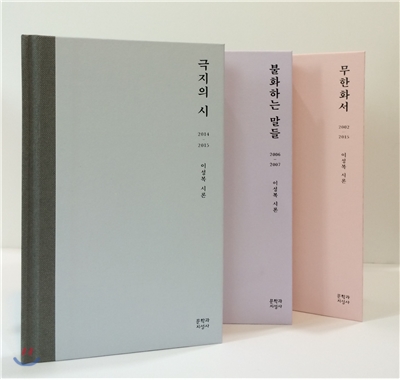
The first name loved by poets, Lee Seong-bok. The poetry of Lee Seong-bok, who has captivated us for nearly 40 years with his gaze toward humanity standing before the rawness of life, his powerful language that is reborn with the depth of thought and sense that comes from deep and long study, and all of his intimate words and language, has been collected into a poetry collection called 『Polar Poetry』, 『Discordant Words』, and 『Infinite Flower Book』, published by Munhak-kwa-Jiseong-sa (2015). Full of questions and reflections on life, art, humanity and literature. The pinnacle of Lee Seong-bok's thoughts Poet Lee Seong-bok's long history of reflecting on poetry, as well as his deep reading and study across various fields such as Eastern and Western philosophy, mathematics, and astrophysics, has been revealed little by little through interviews and conversations held after the publication of his poetry collection "Raeyeoaebandara" in 2013, his first in 10 years. Those who seek out his poetry and are interested in literature naturally develop a desire to follow the trajectory of his studies. His poetry collections were never published frequently, and his activities were almost like a seclusion, studying with students in Daegu where he lived and concentrating solely on his own writing. As a result, the size of his desire did not diminish, but only increased curiosity. The third volume of this collection of poetry is a book that answers precisely these readers' questions and longings. The poetry collections are a complete transcript of the poetry writing classes the poet gave to students and readers from 2002 to 2015. Even after the poet retired in 2012, he did not forget to continue studying and conversing with graduates who visited his study room. These books, newly organized into prose, dialogue, poetry, and aphorisms, focus on maximizing Lee Seong-bok's unique metaphors rooted in everyday life and his friendly writing style and tone. Thanks to this, the poet's voice, as if heard right in front of you, has become one of the virtues of these books. The titles of all three books are keywords that indicate Lee Seong-bok's literary or poetic orientation. 『Poetry of the Polar Regions』 is a collection of essays compiled in chronological order from lectures, conversations, and acceptance speeches given in the latter half of 2014 and early 2015. The title of the book is taken from the acceptance speech for the 11th Lee Yuk-sa Poetry Literature Award in 2014 (the winning work, 『Raeyeoaebandara』). Lee Seong-bok says, “The poetry of the military academy not only tells of the difficult circumstances of the time, but also harshly reveals the fact that the genre of poetry is, from the beginning, a ‘peak’ and a ‘wilderness,’” and that “the place that poetry aims for, the place where the poet must remain, is the ‘polar region’ from which one can neither retreat nor advance any further.” He then emphasizes that “poetry is written with the legs, not the head, and the place of poetry can only be revealed not through the eyes of others, but by burning one’s own life,” and that “the study of poetry is a thorough examination of oneself.” 『Discordant Words』 is a reorganization of the contents of poetry writing classes held between 2006 and 2007 into the form of ‘poems.’ “If you take it for granted, it will only lead to destructive thinking. Art comes from discord. Discord is a characteristic of youth. You are at odds with yourself, at odds with the world, and only reconciled with poetry. “It will strip us bare and (at the same time) give us a terrifying beauty,” he says. It contains a total of 128 stories, including the introduction. 『Infinite Flower Preface』 is a compilation of the contents of graduate school poetry classes from 2002 to 2015 in the form of ‘aphorisms.’ In the title ‘Infinite Flower Order’, ‘flower order’ refers to the way flowers grow on the stem. The phrase 'infinite flower', which has no limits to growth, is an expression that takes into account the centripetal nature of blooming from the bottom up, from the outside in, and is a metaphor for poetry that progresses from the concrete to the abstract, from the humble to the sacred. This is the core of Lee Seong-bok's theory of poetry, which believes that poetry is a form that endlessly fails to express what cannot be expressed in words. Including the introduction, it contains 471 aphorisms that contain various realizations and perspectives embedded in life, as well as exquisite metaphors that lead back to poetry and literature. |
- You can preview some of the book's contents.
Preview
Publisher's Review
The first name loved by poets, Lee Seong-bok.
The poetry of Lee Seong-bok, who has captivated us for nearly 40 years with his gaze toward humanity standing before the rawness of life, his powerful language that is reborn with the depth of thought and sense that comes from deep and long study, and all of his intimate words and language, has been collected into a poetry collection called 『Polar Poetry』, 『Discordant Words』, and 『Infinite Flower Book』, published by Munhak-kwa-Jiseong-sa (2015).
Full of questions and reflections on life, art, humanity and literature.
The pinnacle of Lee Seong-bok's thoughts
Poet Lee Seong-bok's long history of reflecting on poetry, as well as his deep reading and study across various fields such as Eastern and Western philosophy, mathematics, and astrophysics, has been revealed little by little through interviews and conversations held after the publication of his poetry collection "Raeyeoaebandara" in 2013, his first in 10 years.
Those who seek out his poetry and are interested in literature naturally develop a desire to follow the trajectory of his studies.
His poetry collections were never published frequently, and his activities were almost like a seclusion, studying with students in Daegu where he lived and concentrating solely on his own writing. As a result, the size of his desire did not diminish, but only increased curiosity.
The third volume of this collection of poetry is a book that answers precisely these readers' questions and longings.
The poetry collections are a complete transcript of the poetry writing classes the poet gave to students and readers from 2002 to 2015.
Even after the poet retired in 2012, he did not forget to continue studying and conversing with graduates who visited his study room.
These books, newly organized into prose, dialogue, poetry, and aphorisms, focus on maximizing Lee Seong-bok's unique metaphors rooted in everyday life and his friendly writing style and tone.
Thanks to this, the poet's voice, as if heard right in front of you, has become one of the virtues of these books.
“The injured little toe, this is poetry.”
As revealed in the prose collection published a year ago (Forms of Confession), the poet's concerns about "can one live without poetry" are closely related to several episodes that capture the poet's questions about poetry keywords during creative writing classes and the students' responses to them. These are more effective teaching materials than any creative writing theory and are sufficient to be read as a poem in their own right.
During the past eight months, during which the poet traveled back and forth between Seoul and Chilgok, Gyeongsangbuk-do, to finalize the structure and order of each volume, the length of each piece, and the number of chapters, he demonstrated remarkable concentration and thoroughness in his rigorous search for a single poetic word and the most accurate metaphor.
Moreover, the poet's thoughts on poetry and literature are by no means light, but the binding of the book containing them is not heavy, so that it can be taken out and read anytime, anywhere, and can be repeatedly reflected on and engraved in one's memory.
The titles of all three books are keywords that indicate Lee Seong-bok's literary or poetic orientation.
『Poetry of the Polar Regions』 is a collection of essays compiled in chronological order from lectures, conversations, and acceptance speeches given in the latter half of 2014 and early 2015. The title of the book is taken from the acceptance speech for the 11th Lee Yuk-sa Poetry Literature Award in 2014 (the winning work, 『Raeyeoaebandara』).
Lee Seong-bok says, “The poetry of the military academy not only tells of the difficult circumstances of the time, but also harshly reveals the fact that the genre of poetry is, from the beginning, a ‘peak’ and a ‘wilderness,’” and that “the place that poetry aims for, the place where the poet must remain, is the ‘polar region’ from which one can neither retreat nor advance any further.”
He then emphasizes that “poetry is written with the legs, not the head, and the place of poetry can only be revealed not through the eyes of others, but by burning one’s own life,” and that “the study of poetry is a thorough examination of oneself.”
『Discordant Words』 is a reorganization of the contents of poetry writing classes held between 2006 and 2007 into the form of ‘poems.’
“If you take it for granted, it will only lead to destructive thinking.
Art comes from discord.
Discord is a characteristic of youth.
You are at odds with yourself, at odds with the world, and only reconciled with poetry.
“It will strip us bare and (at the same time) give us a terrifying beauty,” he says.
It contains a total of 128 stories, including the introduction.
『Infinite Flower Preface』 is a compilation of the contents of graduate school poetry classes from 2002 to 2015 in the form of ‘aphorisms.’
In the title ‘Infinite Flower Order’, ‘flower order’ refers to the way flowers grow on the stem.
The phrase 'infinite flower', which has no limits to growth, is an expression that takes into account the centripetal nature of blooming from the bottom up, from the outside in, and is a metaphor for poetry that progresses from the concrete to the abstract, from the humble to the sacred.
This is the core of Lee Seong-bok's theory of poetry, which believes that poetry is a form that endlessly fails to express what cannot be expressed in words.
Including the introduction, it contains 471 aphorisms that contain various realizations and perspectives embedded in life, as well as exquisite metaphors that lead back to poetry and literature.
“In the end, it all seems to be a story about my attitude toward literature.”
The poet's attitude toward literature is as serious and poignant as that of an honest seeker.
However, Lee Seong-bok's stories, each filled with the ethos of life, repeatedly ask the question of what kind of person a writer should be in everyday life, and are honest and unadorned.
Sometimes it gives the rare pleasure of discovering the humorous and lively voice of Lee Seong-bok.
No matter which book or which page you open in these anthologies, the depth of emotion conveyed is extraordinary, not only to literary youth thirsting for poetry, but also to readers seeking poetic tension and emotion in everyday life, and to all those seeking awakened sensibilities and the true meaning of life.
As you read these books, which lead to the poet's attitude, confessions, questions, and reflections that question and answer the meaning of poetry as a "vessel that receives love for life," you will experience a very special time where tranquility and smiles, tension and passion intersect.
The poetry of Lee Seong-bok, who has captivated us for nearly 40 years with his gaze toward humanity standing before the rawness of life, his powerful language that is reborn with the depth of thought and sense that comes from deep and long study, and all of his intimate words and language, has been collected into a poetry collection called 『Polar Poetry』, 『Discordant Words』, and 『Infinite Flower Book』, published by Munhak-kwa-Jiseong-sa (2015).
Full of questions and reflections on life, art, humanity and literature.
The pinnacle of Lee Seong-bok's thoughts
Poet Lee Seong-bok's long history of reflecting on poetry, as well as his deep reading and study across various fields such as Eastern and Western philosophy, mathematics, and astrophysics, has been revealed little by little through interviews and conversations held after the publication of his poetry collection "Raeyeoaebandara" in 2013, his first in 10 years.
Those who seek out his poetry and are interested in literature naturally develop a desire to follow the trajectory of his studies.
His poetry collections were never published frequently, and his activities were almost like a seclusion, studying with students in Daegu where he lived and concentrating solely on his own writing. As a result, the size of his desire did not diminish, but only increased curiosity.
The third volume of this collection of poetry is a book that answers precisely these readers' questions and longings.
The poetry collections are a complete transcript of the poetry writing classes the poet gave to students and readers from 2002 to 2015.
Even after the poet retired in 2012, he did not forget to continue studying and conversing with graduates who visited his study room.
These books, newly organized into prose, dialogue, poetry, and aphorisms, focus on maximizing Lee Seong-bok's unique metaphors rooted in everyday life and his friendly writing style and tone.
Thanks to this, the poet's voice, as if heard right in front of you, has become one of the virtues of these books.
“The injured little toe, this is poetry.”
As revealed in the prose collection published a year ago (Forms of Confession), the poet's concerns about "can one live without poetry" are closely related to several episodes that capture the poet's questions about poetry keywords during creative writing classes and the students' responses to them. These are more effective teaching materials than any creative writing theory and are sufficient to be read as a poem in their own right.
During the past eight months, during which the poet traveled back and forth between Seoul and Chilgok, Gyeongsangbuk-do, to finalize the structure and order of each volume, the length of each piece, and the number of chapters, he demonstrated remarkable concentration and thoroughness in his rigorous search for a single poetic word and the most accurate metaphor.
Moreover, the poet's thoughts on poetry and literature are by no means light, but the binding of the book containing them is not heavy, so that it can be taken out and read anytime, anywhere, and can be repeatedly reflected on and engraved in one's memory.
The titles of all three books are keywords that indicate Lee Seong-bok's literary or poetic orientation.
『Poetry of the Polar Regions』 is a collection of essays compiled in chronological order from lectures, conversations, and acceptance speeches given in the latter half of 2014 and early 2015. The title of the book is taken from the acceptance speech for the 11th Lee Yuk-sa Poetry Literature Award in 2014 (the winning work, 『Raeyeoaebandara』).
Lee Seong-bok says, “The poetry of the military academy not only tells of the difficult circumstances of the time, but also harshly reveals the fact that the genre of poetry is, from the beginning, a ‘peak’ and a ‘wilderness,’” and that “the place that poetry aims for, the place where the poet must remain, is the ‘polar region’ from which one can neither retreat nor advance any further.”
He then emphasizes that “poetry is written with the legs, not the head, and the place of poetry can only be revealed not through the eyes of others, but by burning one’s own life,” and that “the study of poetry is a thorough examination of oneself.”
『Discordant Words』 is a reorganization of the contents of poetry writing classes held between 2006 and 2007 into the form of ‘poems.’
“If you take it for granted, it will only lead to destructive thinking.
Art comes from discord.
Discord is a characteristic of youth.
You are at odds with yourself, at odds with the world, and only reconciled with poetry.
“It will strip us bare and (at the same time) give us a terrifying beauty,” he says.
It contains a total of 128 stories, including the introduction.
『Infinite Flower Preface』 is a compilation of the contents of graduate school poetry classes from 2002 to 2015 in the form of ‘aphorisms.’
In the title ‘Infinite Flower Order’, ‘flower order’ refers to the way flowers grow on the stem.
The phrase 'infinite flower', which has no limits to growth, is an expression that takes into account the centripetal nature of blooming from the bottom up, from the outside in, and is a metaphor for poetry that progresses from the concrete to the abstract, from the humble to the sacred.
This is the core of Lee Seong-bok's theory of poetry, which believes that poetry is a form that endlessly fails to express what cannot be expressed in words.
Including the introduction, it contains 471 aphorisms that contain various realizations and perspectives embedded in life, as well as exquisite metaphors that lead back to poetry and literature.
“In the end, it all seems to be a story about my attitude toward literature.”
The poet's attitude toward literature is as serious and poignant as that of an honest seeker.
However, Lee Seong-bok's stories, each filled with the ethos of life, repeatedly ask the question of what kind of person a writer should be in everyday life, and are honest and unadorned.
Sometimes it gives the rare pleasure of discovering the humorous and lively voice of Lee Seong-bok.
No matter which book or which page you open in these anthologies, the depth of emotion conveyed is extraordinary, not only to literary youth thirsting for poetry, but also to readers seeking poetic tension and emotion in everyday life, and to all those seeking awakened sensibilities and the true meaning of life.
As you read these books, which lead to the poet's attitude, confessions, questions, and reflections that question and answer the meaning of poetry as a "vessel that receives love for life," you will experience a very special time where tranquility and smiles, tension and passion intersect.
GOODS SPECIFICS
- Page count, weight, size: Checking page count | 124*195*60mm
You may also like
카테고리
korean


korean

![GQ KOREA Mark (Monthly): December [2025]](http://librairie.coreenne.fr/cdn/shop/files/8ef265dbbfbf186523ed75ba7319009d.jpg?v=1765340328&width=3840)


