

Mabel's Story
 |
Description
Book Introduction
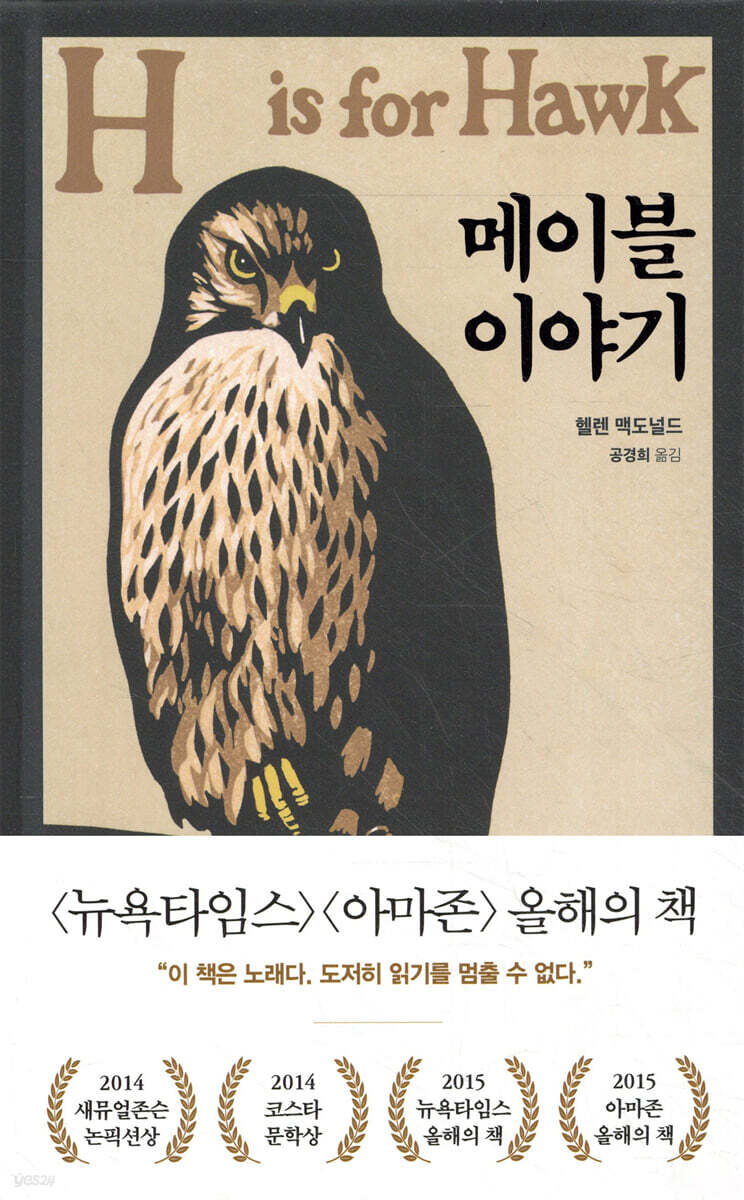
"Mabel's Story" is a book that honestly and beautifully captures the process of overcoming the grief of loss that everyone experiences at least once in their lives. Author Helen McDonald dreams of becoming a falconer while exploring the wilds with her journalist father. Then one day, when his father suddenly dies of a heart attack on the street, to overcome the shock, he decides to tame a wild falcon, something he had wanted to raise since childhood. Author Helen MacDonald discovered her own anger and sadness in the wild falcon itself. Furthermore, this book, which poetically captures the process of extreme mourning, in which the author examines himself through the eyes and spirit of each day, tests the limits of humanity, and attempts to change life itself, encompasses humanity and nature, life and death, loss and healing, and presents the reader with the highest level of experience that can be gained through reading. |
- You can preview some of the book's contents.
Preview
index
Part 1
Grief is untamable 5
1.
Patience 15
2.
Loss 28
3.
Small Worlds 40
4.
White 62
5.
Hold on tight 81
6.
Star Cluster Box 97
7.
Invisible 109
8.
Rembrandt Interior 125
9.
Rite of Passage 137
10.
Darkness 150
11.
Leaving Home 164
12.
Strangers 177
13.
Alice, Fall 196
14.
String 215
15.
For Whom Is This Bell 231
16.
Rain 245
17.
Heat 253
Part 2
18.
Fly Free 265
19.
Extinction 282
20.
Hideout 293
21 Fear 308
22 Apple Festival 322
23 Memorial 336
24 about 347
25 Magical Places 363
26-hour emergency 379
27 New World 389
28 Winter's Tale 404
29 Spring Begins 421
30 Moving Earth 432
Review 438
Acknowledgments 443
Week 446
Grief is untamable 5
1.
Patience 15
2.
Loss 28
3.
Small Worlds 40
4.
White 62
5.
Hold on tight 81
6.
Star Cluster Box 97
7.
Invisible 109
8.
Rembrandt Interior 125
9.
Rite of Passage 137
10.
Darkness 150
11.
Leaving Home 164
12.
Strangers 177
13.
Alice, Fall 196
14.
String 215
15.
For Whom Is This Bell 231
16.
Rain 245
17.
Heat 253
Part 2
18.
Fly Free 265
19.
Extinction 282
20.
Hideout 293
21 Fear 308
22 Apple Festival 322
23 Memorial 336
24 about 347
25 Magical Places 363
26-hour emergency 379
27 New World 389
28 Winter's Tale 404
29 Spring Begins 421
30 Moving Earth 432
Review 438
Acknowledgments 443
Week 446
Detailed image

Into the book
The eagle flaps its striped wings, and the pointed, finger-like projections of its black-edged first row of feathers slash through the air.
The bird's feathers stand up like the scattered quills of a restless hedgehog.
Two big eyes.
My heart sinks.
The female is a witch.
It's a reptile.
He is a fallen angel.
It is a griffin (a monster with the head and wings of an eagle and the body of a lion) that appears in a picture book of animal fables.
--- p.93
There is one thing I have learned from many years of taming falcons.
It is 'becoming invisible'.
That's what I do when a young falcon sits on my left hand, its prey at its feet in a state of primitive, defensive fear.
Hawks are not sociable animals like dogs or horses, and they do not understand coercion or corporal punishment.
The only way to tame a falcon is through positive reinforcement by giving it food.
I wait for the falcon to eat the food I gave it. This is the first step in teaching the falcon, and eventually, I will become your hunting partner.
But when there is a huge gap between fear and food, they must cross it together.
I used to think that I could do it with infinite patience.
But that's not all.
I must become completely invisible.
--- p.113
I have trained dozens of falcons and am familiar with every step of the training process.
But while each step was familiar, it was unfamiliar to the person taking it.
I was in a pile of ruins.
Something deep inside me was trying to rebuild itself, and the model was right there in my fist.
The hawk was everything I wanted to be.
Alone, cold, free from sorrow, and indifferent to the pain of life.
I was becoming a hawk.
--- p.142
As I sit there happily feeding the falcon meat, the falcon's name pops into my head.
'Mabel' means lovely or cute.
It's a slightly old-fashioned, somewhat immature name that's out of style.
The name has a grandmotherly feel, with decorative covers and afternoon tea (a traditional British tea time around 3 p.m.).
There is a superstition among falconers that the falcon's power is inversely proportional to the ferocity of its name.
--- p.148
I used to think that to heal my deep wounds I had to escape into the wild.
People healed that way.
The books about nature I've read say that.
Many people have become explorers, inspired by sorrow or grief.
Some dedicated themselves to becoming masters of rare animals.
Some people were looking for white geese.
Some people chased the white leopard.
There were also those who were obsessed with the land and walked along paths, mountain trails, coasts, and valleys.
Some pursued the wild from afar, while others pursued it with great desperation.
John Muir (the first environmental activist and author to advocate for forest protection) wrote:
“In the green and quiet forest, nature heals and soothes all suffering.
There is no sorrow on earth that the earth cannot heal."
Now I know the essence of this saying.
This was a seductive but dangerous lie.
I was angry at myself and at my unconscious conviction that this was the cure I needed.
Hands are there to hold the hands of others.
Hands should not be left to serve only as torches for the eagle.
And the wild is not a panacea for the human soul.
--- p.342~343
I am in a reflective mood.
I brought the falcon into my world and then pretended that I lived in the falcon's world.
It feels different now.
We share our lives happily, yet separately.
I look down at my hands.
There are scars on my hands.
Thin white lines.
One is a scratch from Mabel's claws when she gets angry and hungry.
It feels like a warning to life and death.
There is also a scar on Blackthorn from when he went into a hedge while searching for Mabel, thinking he had lost her.
There are other scars, but they are not visible to the eye.
They are wounds that Mabel didn't create, but rather helped heal.
The bird's feathers stand up like the scattered quills of a restless hedgehog.
Two big eyes.
My heart sinks.
The female is a witch.
It's a reptile.
He is a fallen angel.
It is a griffin (a monster with the head and wings of an eagle and the body of a lion) that appears in a picture book of animal fables.
--- p.93
There is one thing I have learned from many years of taming falcons.
It is 'becoming invisible'.
That's what I do when a young falcon sits on my left hand, its prey at its feet in a state of primitive, defensive fear.
Hawks are not sociable animals like dogs or horses, and they do not understand coercion or corporal punishment.
The only way to tame a falcon is through positive reinforcement by giving it food.
I wait for the falcon to eat the food I gave it. This is the first step in teaching the falcon, and eventually, I will become your hunting partner.
But when there is a huge gap between fear and food, they must cross it together.
I used to think that I could do it with infinite patience.
But that's not all.
I must become completely invisible.
--- p.113
I have trained dozens of falcons and am familiar with every step of the training process.
But while each step was familiar, it was unfamiliar to the person taking it.
I was in a pile of ruins.
Something deep inside me was trying to rebuild itself, and the model was right there in my fist.
The hawk was everything I wanted to be.
Alone, cold, free from sorrow, and indifferent to the pain of life.
I was becoming a hawk.
--- p.142
As I sit there happily feeding the falcon meat, the falcon's name pops into my head.
'Mabel' means lovely or cute.
It's a slightly old-fashioned, somewhat immature name that's out of style.
The name has a grandmotherly feel, with decorative covers and afternoon tea (a traditional British tea time around 3 p.m.).
There is a superstition among falconers that the falcon's power is inversely proportional to the ferocity of its name.
--- p.148
I used to think that to heal my deep wounds I had to escape into the wild.
People healed that way.
The books about nature I've read say that.
Many people have become explorers, inspired by sorrow or grief.
Some dedicated themselves to becoming masters of rare animals.
Some people were looking for white geese.
Some people chased the white leopard.
There were also those who were obsessed with the land and walked along paths, mountain trails, coasts, and valleys.
Some pursued the wild from afar, while others pursued it with great desperation.
John Muir (the first environmental activist and author to advocate for forest protection) wrote:
“In the green and quiet forest, nature heals and soothes all suffering.
There is no sorrow on earth that the earth cannot heal."
Now I know the essence of this saying.
This was a seductive but dangerous lie.
I was angry at myself and at my unconscious conviction that this was the cure I needed.
Hands are there to hold the hands of others.
Hands should not be left to serve only as torches for the eagle.
And the wild is not a panacea for the human soul.
--- p.342~343
I am in a reflective mood.
I brought the falcon into my world and then pretended that I lived in the falcon's world.
It feels different now.
We share our lives happily, yet separately.
I look down at my hands.
There are scars on my hands.
Thin white lines.
One is a scratch from Mabel's claws when she gets angry and hungry.
It feels like a warning to life and death.
There is also a scar on Blackthorn from when he went into a hedge while searching for Mabel, thinking he had lost her.
There are other scars, but they are not visible to the eye.
They are wounds that Mabel didn't create, but rather helped heal.
--- p.431
Publisher's Review
#1 Amazon Book of the Year 2015
“This book is a song.
“I just can’t stop reading.”
2014 Samuel Johnson Nonfiction Award
2014 Costa Literary Award
[Amazon] #1 Overall
[Guardian] [Economist] Book of the Year
“Tame Mabel and endure the sorrow
“I wanted to live my life again.”
Humans and nature, life and death, mourning and healing
A blend of 'currently ongoing classics'
The hit novel "Mabel's Story," which honestly and beautifully depicts the process of taming a wild falcon named Mabel and overcoming the grief of losing her father, has been published by Panmidong Publishing.
Published in 2014, this book was recognized for its literary quality by winning the Samuel Johnson Award, often called the Oscar of non-fiction, and the Costa Award, a prestigious British literary award given to the best book of the year regardless of genre. It was also selected as the 'Book of the Year' by The Guardian and The Economist, and rose to number one on the bestseller list, receiving much love from general readers.
Furthermore, influential media outlets around the world, including The New York Times, The Wall Street Journal, Time, People, and The Telegraph, praised it as the best book of the year and predicted that it would continue to be a classic.
It is currently at the top of Amazon's list of "Best Books of the Year" for 2015, and its reputation is growing as it has been published in over 20 countries, including Germany, Italy, Spain, Brazil, Turkey, China, and Japan, making it a "current classic."
Why has "Mabel's Story" received such enthusiastic acclaim from media outlets, critics, and readers worldwide? While it may seem like a novel about taming a falcon, it embodies the universal process of coping with the grief of loss, a process we all experience at least once in our lives.
As readers progress through this book, they empathize with the author's personal grief over the loss of her family, and follow her journey as she tames the wild Mabel and manages her grief.
This book's undeniable charm lies in its threefold insight, which balances the author's work as a naturalist, historian, and poet on the vast subjects of humanity and nature, life and death, loss and healing; its short, eloquent speech that maximizes inner anxiety and sadness; and its wild style, as if expressing what an eagle sees and feels, as if it were a falcon.
"Mabel's Story," offering the ultimate reading experience, will be a refreshing stimulus for readers accustomed to established reading habits, and a book that will quench the thirst of those thirsty for new reading pleasures.
When you lose a loved one
How to Distance Yourself from Grief
Author Helen McDonald dreamed of becoming a falconer from a young age, exploring nature with her photojournalist father.
Then one day, her father suddenly dies of a heart attack on the street, and her entire life is shaken to its core.
It was not the usual grief of bereavement that people might feel, but the great shock that comes from losing the most precious thing in life.
In an effort to escape the shock, she decides to try to tame a wild falcon, something she had always wanted to raise since she was little.
And he buys Mabel, a wild falcon, for eight hundred pounds on a Scottish dockside and takes her home to Cambridge.
As she trains the falcon, she not only discovers her own anger and sorrow in the falcon, a creature of savage wildness itself, but also goes further, seeing herself through the falcon's eyes and spirit, testing the limits of her humanity and attempting to change her life itself.
For the author, raising a falcon is like taming sadness.
If Mabel the wild falcon symbolizes raw suffering beyond human control, then training a falcon can be seen as a way of dealing with that suffering.
At first, you will be able to fly further and further by attaching leather strings to your feet, and eventually, through a gradual training process of flying freely without strings, you will naturally let go of your pain and wounds.
In particular, the book's highlight is the passage where Mabel's reckless attempt to turn her back on human society and become a falcon and blend into the wild ultimately transforms into a mature conviction that "Mabel and the author each have their own lives and can share them," and she returns to her original life.
This book, which contains a long journey of facing loss and grief head-on, overcoming it, and then returning to one's place, rather than relying on nature to forget sorrow and numb the pain, has a special meaning because it is clearly different from the countless books that call for temporary comfort and easy cures.
It has both popularity and artistic value.
Rediscovering Reading
"Mabel's Story" is not a novel made into a movie, an autobiography written by a celebrity, or a self-help book that teaches you how to navigate the harsh realities of life. It is the personal memoir of an ordinary woman.
Nevertheless, it not only proved its popularity by receiving love from readers by reaching the number one bestseller list, but also its literary quality was verified by being the first memoir to win the Samuel Johnson Award, which is called the Academy Award of non-fiction, which has been awarded to authentic non-fiction works such as academic research papers, social criticism, and reportage, in its 16-year history.
It also received favorable reviews from the Costa Award jury, a prestigious British literary award that honors the best book of the year regardless of genre, saying, “A book of burning honesty, delicate descriptions rarely found in modern literature, and a unique and beautiful book.”
This book is not full of the sharp aphorisms or vague proverbs that we often come across.
This book is a living, breathing experience, with its heart-wrenching depictions of the grief of losing a father, the struggle to tame a falcon, and the beauty of nature and the wonders of life.
It is thanks to the author's immersive and dense writing style that we can deeply empathize with the author's sorrow, vividly feel the scenery he sees, and feel as if we are inside a beautiful natural landscape.
In fact, many readers around the world have voluntarily sought out this book, recited it themselves, shared it, and used it as an opportunity to rediscover the power of reading.
"Mabel's Story," which speaks of the universal experience of grief over loss through the eyes of an observer and the voice of a poet, will be remembered as a precious book that presents readers with a new and beautiful reading experience.
Recommendation
This book will undoubtedly become an absolute classic among books about nature.
- Guardian
A unique work.
Through the eyes of an observer and the voice of a poet, he speaks of the universal experience of loss and grief.
- Chicago Tribune
If there were an award for the best new book across all genres, this book would win.
- New Yorker
It's breathtaking... The author paints unforgettable images of the falcon and his own ferocious nature in feather-like language.
I can't help but be amazed by the amazing craftsmanship.
- The New York Times
It contains some of the best quotes from books I've read in the past 10 years.
- Time
A captivating work that meditates on the suffering and beauty of living beings, beasts and humans.
- People
It is a delicate blend of writing about nature, personal recollections, literary portraits, and descriptions of the pain of loss.
It is a work in which all of its parts are excellently balanced.
- Washington Post
A book of fiery honesty, nuanced descriptions rarely seen in modern literature, and a unique and beautiful book.
Reasons for being selected for the Costa Award
The grief and pain Helen MacDonald describes in Mabel's Story are personal and cannot be shared with anyone else.
… she seeks to convey her sorrow and mourning for the loss of her father through this rich and excellent book.
It is too excellent a book to be hastily categorized as a memoir, a writing about nature, or a spiritual writing.
The Wall Street Journal
A dazzling work.
A captivating book that touches deeply and shines with love and intelligence.
I don't think there's a better book published this year.
Financial Times
Through the beautiful and wild "Mabel's Story," we learn that great writing about nature can reveal the intimacy of the wild.
Her books are very good, but I was sometimes hurt while reading them.
The book contains a method of healing through bleeding.
The New York Times
A deeply moving story of mourning, one I have never read before.
A recollection of winged sorrow.
Bookseller
Attractive, decisive and shocking.
MacDonald is a brilliant nature writer and arguably the best writer in the field today.
Sunday Express
A wonderful book about loss and recovery.
This is a special book that combines practical methods with poetic visuals to achieve ecstatic growth.
National
The process of taming a falcon is described in astonishing detail, like a slow, careful, and heart-pounding thriller.
Observer
As a naturalist, she has a keen eye like a falcon.
As a writer, she has a creative passion for new language, meticulously refining words or breathing fresh life into old vocabulary.
Her primary concern is to accurately convey what she sees and feels.
Guardian
Memories pierce my heart like sharp claws, sending shivers down my spine.
MacDonald is a writer who is a good mix of scientist and poet.
On the one hand, observe, on the other hand, feel.
Daily Mail
What MacDonald has accomplished is a rare feat in literature: to portray the relationship between animal consciousness and human beings with such perfect realism.
There is a sense of tension and suspense throughout the process of training Mabel the True Falcon.
It is even possible to capture the slightest movement of a single feather.
It is a soaring performance with Mabel as the main character.
The Sunday Times
A memoir with a sharp, razor-sharp edge that thrills the heart and chills the soul… captivating.
Mail on Sunday
MacDonald's writing is poetic and rhetorical, yet at times pulse-pounding.
Vibrant vocabulary soars freely like birds.
New Scientist
A well-crafted book filled with splendid recreations of memories and nature, and literary meditations.
The Economist
It's sad and beautiful.
Vogue
This book is a song.
I just couldn't stop reading.
Mark Haddon, author of The Curious Incident of the Dog in the Night-Time
People talk about books that change their lives.
But I love that this book is talking about something much more valuable than that.
That nothing changes.
And everything just remains as it was.
This book helps us realize such facts.
And it deepens what we've always known.
We live together with the living things around us.
It means living side by side with each other as if we were living together.
Laura Betti (author)
A book that speaks from heart to heart… It weaves together ancient nature, new nature, and human nature in a truly unique way.
Tim D (writer)
It's delicate.
The story flows naturally like a mountain breeze, swirling through the pain of personal loss, moving seamlessly between literature, ecology, natural history, and falconry techniques.
Readers will gradually become absorbed in this book, savoring each bite of a well-prepared, sumptuous meal.
Lynn Schooler (author)
It is a book that is both genuine and intelligent.
This beautiful book blends a lament for a deceased father, the joy of rediscovering a new love, and a celebration of nature, which embraces life even in death.
This is an excellent piece of writing that beautifully illustrates the relationship between humanity and the environment.
Andrew Motion (poet)
“This book is a song.
“I just can’t stop reading.”
2014 Samuel Johnson Nonfiction Award
2014 Costa Literary Award
[Amazon] #1 Overall
[Guardian] [Economist] Book of the Year
“Tame Mabel and endure the sorrow
“I wanted to live my life again.”
Humans and nature, life and death, mourning and healing
A blend of 'currently ongoing classics'
The hit novel "Mabel's Story," which honestly and beautifully depicts the process of taming a wild falcon named Mabel and overcoming the grief of losing her father, has been published by Panmidong Publishing.
Published in 2014, this book was recognized for its literary quality by winning the Samuel Johnson Award, often called the Oscar of non-fiction, and the Costa Award, a prestigious British literary award given to the best book of the year regardless of genre. It was also selected as the 'Book of the Year' by The Guardian and The Economist, and rose to number one on the bestseller list, receiving much love from general readers.
Furthermore, influential media outlets around the world, including The New York Times, The Wall Street Journal, Time, People, and The Telegraph, praised it as the best book of the year and predicted that it would continue to be a classic.
It is currently at the top of Amazon's list of "Best Books of the Year" for 2015, and its reputation is growing as it has been published in over 20 countries, including Germany, Italy, Spain, Brazil, Turkey, China, and Japan, making it a "current classic."
Why has "Mabel's Story" received such enthusiastic acclaim from media outlets, critics, and readers worldwide? While it may seem like a novel about taming a falcon, it embodies the universal process of coping with the grief of loss, a process we all experience at least once in our lives.
As readers progress through this book, they empathize with the author's personal grief over the loss of her family, and follow her journey as she tames the wild Mabel and manages her grief.
This book's undeniable charm lies in its threefold insight, which balances the author's work as a naturalist, historian, and poet on the vast subjects of humanity and nature, life and death, loss and healing; its short, eloquent speech that maximizes inner anxiety and sadness; and its wild style, as if expressing what an eagle sees and feels, as if it were a falcon.
"Mabel's Story," offering the ultimate reading experience, will be a refreshing stimulus for readers accustomed to established reading habits, and a book that will quench the thirst of those thirsty for new reading pleasures.
When you lose a loved one
How to Distance Yourself from Grief
Author Helen McDonald dreamed of becoming a falconer from a young age, exploring nature with her photojournalist father.
Then one day, her father suddenly dies of a heart attack on the street, and her entire life is shaken to its core.
It was not the usual grief of bereavement that people might feel, but the great shock that comes from losing the most precious thing in life.
In an effort to escape the shock, she decides to try to tame a wild falcon, something she had always wanted to raise since she was little.
And he buys Mabel, a wild falcon, for eight hundred pounds on a Scottish dockside and takes her home to Cambridge.
As she trains the falcon, she not only discovers her own anger and sorrow in the falcon, a creature of savage wildness itself, but also goes further, seeing herself through the falcon's eyes and spirit, testing the limits of her humanity and attempting to change her life itself.
For the author, raising a falcon is like taming sadness.
If Mabel the wild falcon symbolizes raw suffering beyond human control, then training a falcon can be seen as a way of dealing with that suffering.
At first, you will be able to fly further and further by attaching leather strings to your feet, and eventually, through a gradual training process of flying freely without strings, you will naturally let go of your pain and wounds.
In particular, the book's highlight is the passage where Mabel's reckless attempt to turn her back on human society and become a falcon and blend into the wild ultimately transforms into a mature conviction that "Mabel and the author each have their own lives and can share them," and she returns to her original life.
This book, which contains a long journey of facing loss and grief head-on, overcoming it, and then returning to one's place, rather than relying on nature to forget sorrow and numb the pain, has a special meaning because it is clearly different from the countless books that call for temporary comfort and easy cures.
It has both popularity and artistic value.
Rediscovering Reading
"Mabel's Story" is not a novel made into a movie, an autobiography written by a celebrity, or a self-help book that teaches you how to navigate the harsh realities of life. It is the personal memoir of an ordinary woman.
Nevertheless, it not only proved its popularity by receiving love from readers by reaching the number one bestseller list, but also its literary quality was verified by being the first memoir to win the Samuel Johnson Award, which is called the Academy Award of non-fiction, which has been awarded to authentic non-fiction works such as academic research papers, social criticism, and reportage, in its 16-year history.
It also received favorable reviews from the Costa Award jury, a prestigious British literary award that honors the best book of the year regardless of genre, saying, “A book of burning honesty, delicate descriptions rarely found in modern literature, and a unique and beautiful book.”
This book is not full of the sharp aphorisms or vague proverbs that we often come across.
This book is a living, breathing experience, with its heart-wrenching depictions of the grief of losing a father, the struggle to tame a falcon, and the beauty of nature and the wonders of life.
It is thanks to the author's immersive and dense writing style that we can deeply empathize with the author's sorrow, vividly feel the scenery he sees, and feel as if we are inside a beautiful natural landscape.
In fact, many readers around the world have voluntarily sought out this book, recited it themselves, shared it, and used it as an opportunity to rediscover the power of reading.
"Mabel's Story," which speaks of the universal experience of grief over loss through the eyes of an observer and the voice of a poet, will be remembered as a precious book that presents readers with a new and beautiful reading experience.
Recommendation
This book will undoubtedly become an absolute classic among books about nature.
- Guardian
A unique work.
Through the eyes of an observer and the voice of a poet, he speaks of the universal experience of loss and grief.
- Chicago Tribune
If there were an award for the best new book across all genres, this book would win.
- New Yorker
It's breathtaking... The author paints unforgettable images of the falcon and his own ferocious nature in feather-like language.
I can't help but be amazed by the amazing craftsmanship.
- The New York Times
It contains some of the best quotes from books I've read in the past 10 years.
- Time
A captivating work that meditates on the suffering and beauty of living beings, beasts and humans.
- People
It is a delicate blend of writing about nature, personal recollections, literary portraits, and descriptions of the pain of loss.
It is a work in which all of its parts are excellently balanced.
- Washington Post
A book of fiery honesty, nuanced descriptions rarely seen in modern literature, and a unique and beautiful book.
Reasons for being selected for the Costa Award
The grief and pain Helen MacDonald describes in Mabel's Story are personal and cannot be shared with anyone else.
… she seeks to convey her sorrow and mourning for the loss of her father through this rich and excellent book.
It is too excellent a book to be hastily categorized as a memoir, a writing about nature, or a spiritual writing.
The Wall Street Journal
A dazzling work.
A captivating book that touches deeply and shines with love and intelligence.
I don't think there's a better book published this year.
Financial Times
Through the beautiful and wild "Mabel's Story," we learn that great writing about nature can reveal the intimacy of the wild.
Her books are very good, but I was sometimes hurt while reading them.
The book contains a method of healing through bleeding.
The New York Times
A deeply moving story of mourning, one I have never read before.
A recollection of winged sorrow.
Bookseller
Attractive, decisive and shocking.
MacDonald is a brilliant nature writer and arguably the best writer in the field today.
Sunday Express
A wonderful book about loss and recovery.
This is a special book that combines practical methods with poetic visuals to achieve ecstatic growth.
National
The process of taming a falcon is described in astonishing detail, like a slow, careful, and heart-pounding thriller.
Observer
As a naturalist, she has a keen eye like a falcon.
As a writer, she has a creative passion for new language, meticulously refining words or breathing fresh life into old vocabulary.
Her primary concern is to accurately convey what she sees and feels.
Guardian
Memories pierce my heart like sharp claws, sending shivers down my spine.
MacDonald is a writer who is a good mix of scientist and poet.
On the one hand, observe, on the other hand, feel.
Daily Mail
What MacDonald has accomplished is a rare feat in literature: to portray the relationship between animal consciousness and human beings with such perfect realism.
There is a sense of tension and suspense throughout the process of training Mabel the True Falcon.
It is even possible to capture the slightest movement of a single feather.
It is a soaring performance with Mabel as the main character.
The Sunday Times
A memoir with a sharp, razor-sharp edge that thrills the heart and chills the soul… captivating.
Mail on Sunday
MacDonald's writing is poetic and rhetorical, yet at times pulse-pounding.
Vibrant vocabulary soars freely like birds.
New Scientist
A well-crafted book filled with splendid recreations of memories and nature, and literary meditations.
The Economist
It's sad and beautiful.
Vogue
This book is a song.
I just couldn't stop reading.
Mark Haddon, author of The Curious Incident of the Dog in the Night-Time
People talk about books that change their lives.
But I love that this book is talking about something much more valuable than that.
That nothing changes.
And everything just remains as it was.
This book helps us realize such facts.
And it deepens what we've always known.
We live together with the living things around us.
It means living side by side with each other as if we were living together.
Laura Betti (author)
A book that speaks from heart to heart… It weaves together ancient nature, new nature, and human nature in a truly unique way.
Tim D (writer)
It's delicate.
The story flows naturally like a mountain breeze, swirling through the pain of personal loss, moving seamlessly between literature, ecology, natural history, and falconry techniques.
Readers will gradually become absorbed in this book, savoring each bite of a well-prepared, sumptuous meal.
Lynn Schooler (author)
It is a book that is both genuine and intelligent.
This beautiful book blends a lament for a deceased father, the joy of rediscovering a new love, and a celebration of nature, which embraces life even in death.
This is an excellent piece of writing that beautifully illustrates the relationship between humanity and the environment.
Andrew Motion (poet)
GOODS SPECIFICS
- Date of issue: August 24, 2015
- Format: Hardcover book binding method guide
- Page count, weight, size: 456 pages | 664g | 135*215*30mm
- ISBN13: 9788960179486
- ISBN10: 8960179485
You may also like
카테고리
korean


korean

![ELLE 엘르 스페셜 에디션 A형 : 12월 [2025]](http://librairie.coreenne.fr/cdn/shop/files/b8e27a3de6c9538896439686c6b0e8fb.jpg?v=1766436872&width=3840)


