

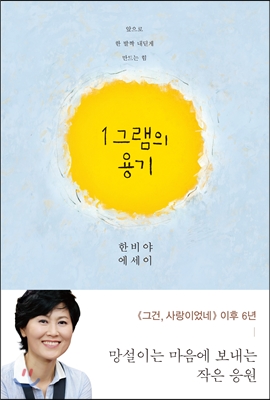
1 gram container
 |
Description
Book Introduction
Hanbi, your first new work in six years! A small cheer for those hesitant. Hanbi has proven with her whole body what it means to live a life filled with excitement and purpose, whether at emergency relief sites, on remote road trips, in classrooms and libraries, or on the Baekdudaegan Trail. She, who has lived more fiercely and passionately than anyone else, is now taking a break to prepare for the second half of her life. As we live, we all stand at the transfer station of life several times. When your career changes or ends, when you get married or have children, or when you raise your children and want to try something new. But in today's uncertain times, many people are afraid to take the next step at their transfer station. What about Hanbiya, who always seems as proud as a rhinoceros horn, seemingly free from fear, loneliness, and anxiety? She confesses that, like us, she constantly gets lost, wanders, and struggles to find her way. This book is a '1 gram of courage' and 'message of support' to those who are cowering, told by Han Bi-ya, who quit her job as 'World Vision Emergency Relief Team Leader' and left for the United States six years ago, and returned as a 'professor at Ewha Womans University Graduate School of International Studies', 'principal of the World Citizen School', and 'UN Advisory Committee member'. |
- You can preview some of the book's contents.
Preview
index
Introduction _5
Chapter 1: Small Things in Life
Milk Coffee, 24th, Full Moon… _15
All together 16,500 won _25
Yeah, I'm Gilchida _29
Camels in the desert, tigers in the forest _35
It's all mine! _40
Baekdudaegan, Walking 1,000 Kilometers _47
Even if you stop along the way, you'll still benefit from the progress you made. _62
When you are unsure whether to do it or not _69
Chapter 2: Strong Thinking
Boston, Moments of Passion _75
My Degree Co-Recipients _92
You are my first student and my first love _107
Think instead of searching _113
Prayer on the Road _119
How to Deal with Malicious Comments _129
So were they happy? _139
Things You Get Better at as You Get Older _146
I'm sorry about that back then _153
Write it all down _157
Chapter 3: A Special Scene
The Africa We Didn't Know_165
Keyword 4 for Entering West Africa _175
Even a spider's web can bind a lion _184
South Sudan Dispatch Journal _191
West Africa Report _216
The Field, That Painful Paradise _236
So, should I starve for three more days? _243
The Answer Is on the Spot _254
What's Happening Between China and Africa _262
The Story of Mayon Volcano in the Philippines _276
Chapter 4: Bold Steps
Growing Global Citizen School _285
To my friends who dream of becoming relief workers _294
The Pain and Joy of Special Lectures _301
People, people, and things you meet in the mountains _311
My Baekrak, Chairman Oh Jae-sik _319
We have a Pope like this! _329
Daughter of the Wind, and Daughter of Light _338
Let my prayer be like this _346
Outgoing Post _356
Chapter 1: Small Things in Life
Milk Coffee, 24th, Full Moon… _15
All together 16,500 won _25
Yeah, I'm Gilchida _29
Camels in the desert, tigers in the forest _35
It's all mine! _40
Baekdudaegan, Walking 1,000 Kilometers _47
Even if you stop along the way, you'll still benefit from the progress you made. _62
When you are unsure whether to do it or not _69
Chapter 2: Strong Thinking
Boston, Moments of Passion _75
My Degree Co-Recipients _92
You are my first student and my first love _107
Think instead of searching _113
Prayer on the Road _119
How to Deal with Malicious Comments _129
So were they happy? _139
Things You Get Better at as You Get Older _146
I'm sorry about that back then _153
Write it all down _157
Chapter 3: A Special Scene
The Africa We Didn't Know_165
Keyword 4 for Entering West Africa _175
Even a spider's web can bind a lion _184
South Sudan Dispatch Journal _191
West Africa Report _216
The Field, That Painful Paradise _236
So, should I starve for three more days? _243
The Answer Is on the Spot _254
What's Happening Between China and Africa _262
The Story of Mayon Volcano in the Philippines _276
Chapter 4: Bold Steps
Growing Global Citizen School _285
To my friends who dream of becoming relief workers _294
The Pain and Joy of Special Lectures _301
People, people, and things you meet in the mountains _311
My Baekrak, Chairman Oh Jae-sik _319
We have a Pope like this! _329
Daughter of the Wind, and Daughter of Light _338
Let my prayer be like this _346
Outgoing Post _356
Into the book
Add 1 gram of container
I know.
That we all have the power to do what we want to do, the confidence to do what we ought to do, and the discernment to avoid what we ought not to do.
But what blocks it is anxiety and fear.
(…)
This book is a story that takes place six years after the writing of "That Was Love."
Looking back, I was so busy studying, then going to the field, then going to the mountains, then studying, then having meetings, then teaching students, I was completely out of it.
I felt both happy and sad at the thought of myself working so hard.
Then, one day, I started to feel like sharing my experiences and thoughts with my readers.
(…)
After writing it down, I feel good because it seems to be a mixture of the hard work of "A Travelogue of China," the spirited attitude of "March Off the Map," and the affectionate attitude of "That Was Love."
In Chapter 1, 'Small Daily Life,' I tried to show my thoughts and principles of life gleaned from the small details of daily life and my thoughts.
In Chapter 2, 'Solid Thinking', I talked about what drives me to live a difficult but enjoyable life and how I establish the roots of my thoughts.
In Chapter 3, 'A Special Field,' I wanted to show the big picture and details, joys and sorrows of the relief field where I spend half of the year, and in Chapter 4, 'A Brave Step,' I included my thoughts on the process of my dream becoming our dream.
(…)
I wanted to convey warmth throughout this book.
I wanted to talk about the kindness and comfort I received from people, the love I wanted to convey with all my heart, and the small bits of courage I shared with many people during difficult times in life.
I hope that this book will be as clear and warm as the morning sunlight, and thus pleasant, rather than as scorchingly hot as a furnace or as dazzlingly intense as the midsummer sun.
Above all, when the odds are evenly balanced between possibility and fear, when the desire to do something and the hesitation are in a tug-of-war, I hope you can gain just one gram of courage from my book.
I would be happy to give you that 1 gram of courage.
I know.
That we all have the power to do what we want to do, the confidence to do what we ought to do, and the discernment to avoid what we ought not to do.
But what blocks it is anxiety and fear.
(…)
This book is a story that takes place six years after the writing of "That Was Love."
Looking back, I was so busy studying, then going to the field, then going to the mountains, then studying, then having meetings, then teaching students, I was completely out of it.
I felt both happy and sad at the thought of myself working so hard.
Then, one day, I started to feel like sharing my experiences and thoughts with my readers.
(…)
After writing it down, I feel good because it seems to be a mixture of the hard work of "A Travelogue of China," the spirited attitude of "March Off the Map," and the affectionate attitude of "That Was Love."
In Chapter 1, 'Small Daily Life,' I tried to show my thoughts and principles of life gleaned from the small details of daily life and my thoughts.
In Chapter 2, 'Solid Thinking', I talked about what drives me to live a difficult but enjoyable life and how I establish the roots of my thoughts.
In Chapter 3, 'A Special Field,' I wanted to show the big picture and details, joys and sorrows of the relief field where I spend half of the year, and in Chapter 4, 'A Brave Step,' I included my thoughts on the process of my dream becoming our dream.
(…)
I wanted to convey warmth throughout this book.
I wanted to talk about the kindness and comfort I received from people, the love I wanted to convey with all my heart, and the small bits of courage I shared with many people during difficult times in life.
I hope that this book will be as clear and warm as the morning sunlight, and thus pleasant, rather than as scorchingly hot as a furnace or as dazzlingly intense as the midsummer sun.
Above all, when the odds are evenly balanced between possibility and fear, when the desire to do something and the hesitation are in a tug-of-war, I hope you can gain just one gram of courage from my book.
I would be happy to give you that 1 gram of courage.
----From the "Preface"
Publisher's Review
“Okay, take one more step with courage!”
Hanbiya's 'morning sunlight' courage, sent to those in hesitation
I know.
That we all have the power to do what we want to do, the confidence to do what we ought to do, and the discernment to avoid what we ought not to do.
But what blocks it is anxiety and fear.
This book is a story that takes place six years after the writing of "That Was Love."
Looking back, I was so busy studying, then going to the field, then going to the mountains, then studying, then having meetings, then teaching students, I was completely out of it.
I felt both happy and sad at the thought of myself working so hard.
Then, one day, I started to feel like sharing my experiences and thoughts with my readers.
After writing it down, I feel good because it seems to be a mixture of the hard work of "A Travelogue of China," the spirited attitude of "March Off the Map," and the affectionate attitude of "That Was Love."
In Chapter 1, 'Small Daily Life,' I tried to show my thoughts and principles of life gleaned from the small details of daily life and my thoughts.
In Chapter 2, 'Solid Thinking', I talked about what drives me to live a difficult but enjoyable life and how I establish the roots of my thoughts.
In Chapter 3, 'A Special Field,' I wanted to show the big picture and details, joys and sorrows of the relief field where I spend half of the year, and in Chapter 4, 'A Brave Step,' I included my thoughts on the process of my dream becoming our dream.
I wanted to convey warmth throughout this book.
I wanted to talk about the kindness and comfort I received from people, the love I wanted to convey with all my heart, and the small bits of courage I shared with many people during difficult times in life.
I hope that this book will be as clear and warm as the morning sunlight, and thus pleasant, rather than as scorchingly hot as a furnace or as dazzlingly intense as the midsummer sun.
Above all, when the odds are evenly balanced between possibility and fear, when the desire to do something and the hesitation are in a tug-of-war, I hope you can gain just one gram of courage from my book.
I would be happy to give you that 1 gram of courage.
Spring 2015, Hanbiya
Chapter 1: Small daily life_ Through ordinary objects, simple pleasures, and an optimistic attitude
A peek into the daily life of Hanbiya, a self-loving and life-affirming individual.
Chapter 1 contains Hanbiya's unique philosophy of life, which is always bright and lively, and the life know-how that makes such a life possible.
〈Milk Coffee, 24th, Full Moon…〉 and 〈A Total of 16,500 Won〉 introduce how Hanbiya, who has spent her life caring for people on the brink of death in emergency relief sites, enjoys her daily life, and in 〈Walking 1,000 Kilometers of Baekdudaegan〉 and 〈It’s All Mine!〉, you can get a glimpse of her heart that cherishes and loves nature more than anyone else.
Through “Yes, I’m a Gilchida,” “The Camel is in the Desert, the Tiger is in the Forest,” “Even if You Stop, It’s as Good as Going,” and “When You’re Not Sure Whether to Do It or Not,” we can see where Hanbiya’s passionate and positive thoughts and attitude come from.
The TV program “How to Be Happy” concludes as follows:
If you are happy every day, you can be happy for the rest of your life.
Happiness is not something grand and far away, but a small bird in the palm of my hand.
Only those who experience small happiness close to them every day, rather than the great happiness they experience once in a while, can be truly happy.
If this is true, then I'm doing pretty well.
A simple cup of milk coffee, a glass of wine, a full moon, and the 24th of every month that comes without fail. Classical music that I can listen to whenever I turn on the radio is a treasure chest that makes me happy for the rest of my life.
I really got the Sampalgwangdaeng.
_23~24p
I thought about this while climbing Mt. Bukhan today.
All the beautiful things in the world are free.
Isn't that a hundredfold truth? Love, friendship, loyalty, trust—things like that can't be bought for a million dollars.
Instead, these are things you can never have without putting in the effort, time, and wholehearted dedication.
The same goes for nature, which we encounter just by turning our eyes.
It doesn't cost money, but if I obey, am grateful, and enjoy, those beautiful things become mine.
I say that the sky and Mt. Bukhan are all mine, but in reality, they belong to everyone who enjoys them and enjoys them to their heart's content.
The world is so fair.
_45~46p
Are the plans you so desperately laid out on New Year's Day falling through? No problem.
You can make a new plan by revising and supplementing it on the first day of the following lunar month.
What if that plan also falters and falls through? That's okay.
To welcome the new spring in March, to plant a tree on Arbor Day on April 5th, to start the second half of the year on July 1st, or to celebrate a birthday, you can revise your plans and start anew.
The important thing is to keep a detailed plan in mind and take a courageous step forward.
_67p.
Chapter 2: Strong Thoughts_ My time studying abroad in Boston, where I struggled like rolling on hot gravel
The secret of 'Studying Hanbiya' who shakes but never loses her balance
One of the most important things that happened to Han Bi-ya in the past six years since "That Was Love" was studying abroad in Boston.
Chapter 2 introduces the year of studying abroad as a late-blooming student, “Boston, Moments of Passionate Immersion,” and the first lecture as a professor at Ewha Womans University, “You Are My First Student and My First Love.”
He also shares various lessons he has learned and experienced as a celebrity through books such as “How to Deal with Malicious Comments,” “Things You Can Get Better at as You Get Older,” “So Were They Happy?” and “Write It All Down.”
Readers will be able to glimpse how Hanbiya developed and established her own thoughts and values through these times, and apply the methods she recommends, such as 'writing a diary' and 'traveling alone,' to their own lives.
Maybe we are all much more wonderful and full of potential than we think.
So, you shouldn't hastily assume that I am this kind of person.
How can you know how far you can go without trying?
In my experience, the limit is how far you can go.
Now my limit for writing in English is ten pages in eight hours.
I want to continue to expand the horizons of this limitation.
To do that, no matter how scary or painful it may be, you must not miss that opportunity when it comes.
_87p.
'Never miss an opportunity to help.'
This is a major life principle that I have once again solidified through this study abroad trip.
The principle is that we live thanks to the kindness of countless people, whether we know it or not, so we should never miss an opportunity to be kind to someone.
Even if I give generously every time, I won't be able to repay half of the kindness I've received.
If I knew this and still let the opportunity pass me by because I was lazy, bothered, or thought it wasn't worth it, then I'm not even human.
I'd like to repay the kindness shown to me, but the odds of that happening are slim, so instead I do what I can to the person right in front of me.
That would be a virtuous cycle of kindness connecting people to people.
I also want to become a small link in that wonderful cycle of goodness and goodness.
_106p.
There is not a single person who lives their entire life as either A or B.
Just like that gag show I saw a few days ago, the situations of A and B go round and round.
If you are a college student, going to a coffee shop as a customer is A, and working part-time at that coffee shop is B.
If you are an office worker, aren't you a superior to your boss and a superior to your team members?
I hate being the subordinate, but I hate being the subordinate, and I'm even more afraid of being the subordinate who abuses the power and authority given to me, the unlucky subordinate, the shameful subordinate, and the shabby subordinate.
_145p.
Chapter 3: A Special Scene - 'International Relief Expert' Hanbiya tells us about Africa we didn't know about.
And the truth or lies surrounding international aid
What makes "1 Gram of Courage" different from its eight predecessors is that it presents the truth and value of Africa as told by Han Biya, an "international relief expert," rather than Han Biya, an individual or activist.
Through “The Africa We Didn’t Know” and “Even Spiderwebs Can Bind a Lion,” we can see how narrow the image of Africa, which we have remembered until now as a kingdom of jungles, dense forests, poverty, and disease, is. In “South Sudan Dispatch Journal,” “West Africa Report,” “On the Scene, That Painful Paradise,” “Then, Should We Starve for Three More Days?” and “The Answer Is in the Scene,” not only heartbreaking stories encountered at disaster sites, but also a variety of information about international relief that no one but Hanbiya can tell, such as the gap between the international relief system and the field, the exact concept and stages of international relief activities, and unfair trade between countries.
Meanwhile, we can also see the figure of Han Bi-ya, the 'relief team leader' who, despite suffering serious aftereffects from working at numerous disaster sites around the world for 15 years, loves the site more than anyone else and seeks answers in the field.
All the strength drained from my shoulders.
The residents reacted like this. What's the point of working under the blazing sun, eating biscuits for meals, being bitten by mosquitoes and all sorts of bugs, and barely getting a sip of water? I felt so frustrated, resentful, and aggrieved that tears welled up in my eyes.
I am reminded of something I heard when I first started this job.
'You have to endure being cursed while giving your all to help in order to continue relief work.'
Our chairman and regional general manager, veterans of relief work, never raise their voices or change their expressions.
I guess I still have a long way to go.
_198p.
The cathedral courtyard, which we arrived at after walking for about 30 minutes, was already full of about 100 chairs of all kinds, even before the mass began.
I shouldn't even think about going inside the cathedral.
First of all, the building is so cramped that it can't even accommodate 100 people, and there aren't even any windows, let alone fans, so the inside is probably like a steamer.
Only then did I realize why I had to bring my own chair.
The 'Sun Mass' held under the blazing sun without any shade was painful, but very special.
Inside the cathedral, the priest celebrated mass, and outside, the sound was only heard through the speakers, but the people who came as families sang and celebrated mass happily as if they were at a banquet.
During the offering time, it was touching to see how carefully the eggs, mangoes, pineapples, and other items brought as Mass offerings were placed in the basket.
_214~215p.
Still can't do it.
No, that's okay too.
And I'm not the only one.
Veteran relief workers in the field usually have one or two of these traumas.
Nevertheless, we are willing to run when the field calls.
Me too.
I believe that this kind of trauma is the price and tuition we must pay to work in a field where we work with a passionate heart.
So, when a major disaster occurs, I'm not worried about going to the most dangerous site, but rather anxious about not being able to go.
When a large fire breaks out, can't firefighters with the skills and equipment to put it out just stand by and watch? _232p.
Chapter 4: A Bold Step_ And yet, just one more step!
Hanbiya's new challenge to brighten the world with good intentions.
The final chapter shows the thoughts and next plans of Hanbiya, a public good who has established herself as a nation's older sister and sister beyond the 'daughter of the wind', and another dream within her faith.
In “Growing Global Citizen School,” she reveals the achievements of the Global Citizen School she founded with all her heart and soul in 2007, and in “To Friends Who Dream of Becoming Relief Workers,” she corrects misunderstandings and incorrect perceptions about “relief workers.”
In “The Pain and Joy of Special Lectures,” which tells us about the mindset and standards with which she gives lectures, we can feel Hanbiya’s warm heart that seeks to have a positive influence on everyone she meets. In “Guys, People, and People You Meet in the Mountains,” we can learn how to love the mountains through her, a natural mountaineer.
〈My Baekrak, Chairman Oh Jae-sik〉, 〈A Pope Like This to Us!〉, 〈Daughter of the Wind, and Daughter of Light〉, and 〈Let My Prayer Be Like This〉 are about Han Bi-ya, an ordinary person who no one paid attention to, and her relationship with former World Vision Chairman Oh Jae-sik, who offered her the position of emergency relief team leader, and her encounter with God, her strong 'backer', and her story of faith, through which we can get a glimpse of Han Bi-ya's good dream to become a 'daughter of light' who brightens the world.
At our school, we call the Earth a glass house where everyone can see through it, a globe house.
They say that since 7 billion people live in this house as one family, it is natural for them to help each other.
It also teaches us to think together about and find solutions to problems that are 'our home' such as poverty, inequality, human rights, the environment, and peace.
For example, while elegantly drinking coffee in a fancy coffee shop, I sometimes think of the Kenyan girl who has to pick those coffee beans to make a living, let alone go to school. While excitedly enjoying the Brazil World Cup, I think of the Pakistani children who work their fingernails off making those soccer balls. While looking at the silver ring shining on their finger, I think of the Bolivian father who works himself to pieces in a silver mine all day but can't feed his family even one full meal a day.
_289p.
I advise students who dream of becoming relief workers like me to do this.
Change the adjective in front of the job you want to do, relief team leader.
A relief team leader who receives media attention at the scene of a major disaster, a relief team leader who is always praised because helping others is their job, a famous relief team leader who appears on television, a relief team leader who could become a best-selling author, but a poor relief team leader, a relief team leader who is misunderstood and cursed no matter how hard they try, a relief team leader who rolls around on hot gravel until bruises form all over his body but no one recognizes him… … .
Even if you are a relief team leader like this, if you want to do that work, it is your path, so don't be afraid and go down that path.
Go without changing your mind.
I sincerely wish you the best of luck.
_300p.
“Team Leader Han, all the answers are on the spot.
“You must never forget that.”
I must confess that I worked even harder not to betray this person's faith and expectations, and to prove that his choice was right.
After the six-year term as World Vision President ended, we were able to meet much more frequently and more freely.
The chairman liked sushi, so I always saw him at a Japanese restaurant. Whether on the street or in a restaurant, whenever someone recognized me and greeted me, he would smile brightly without saying a word.
Still, he says something.
“Teacher Han, you still have a long way to go, so please be wary of sweet candies.”
He often said that while some people should teach the craft of building a good ship, others should tell stories about the horizon at the end of the sea and the world they will arrive at when they set sail on that ship. That is our job.
_325p.
I really want to be a daughter of light too.
I want to be a clear, warm, and affectionate light like the winter morning sun, not a strong light that is too hot, dazzling, and even threatening like the midsummer sun.
So, I want to share this warmth and vitality I received from God with everyone I meet.
Wherever I go in the world and whatever I do there, I hope that my most important role, my mission, my reason for being, is to be a daughter of light.
I hope that my writing will be like the morning sunlight to the readers of this article.
I sincerely hope that my writing has warmed and brightened your heart even a little, given you a little strength when you were feeling weak, a little consolation when you needed comfort, a little stimulation when you were tired, and a little courage when you needed it.
_344~345p.
'Just one more step, nonetheless!'
Hanbiya's other dream is to reach her next goal with just a gram of courage.
In commemoration of the publication of “1 Gram of Courage,” Han Bi-ya said in the “2015 Big 10 Lectures” held at Kyobo Bookstore on February 28th, “I hope that everyone gathered here will realize that ‘we all deserve to be loved.’
He emphasized, “I especially wanted to convey to young people in their 10s and 20s how wonderful a person I am, and to people in their 30s and 40s that ‘it’s never too late.’”
“Shouldn’t you do something that makes your heart race at least once in your life?
Those of you who have read my book and come to hear my lectures have already felt their hearts warm at 99 degrees.
If I add just one gram to that, your heart will boil at 100 degrees.
At her cry, “Please accept it,” the audience gathered in the lecture hall reddened their eyes, nodded, and applauded each other.
Meanwhile, in order to gain strength and courage from the 'small things in life', to deeply root her own 'solid thoughts', and to continue to 'take bold steps' in a 'special field' more than anywhere else, Hanbiya decided to pursue a doctoral degree at Ewha Womans University starting this year.
The topic of my doctoral dissertation was “The Link between Humanitarian Aid and Development Cooperation Focusing on Disaster Preparedness.”
While working in the field, she decided to muster up "a gram of courage" to uncover two questions that had always puzzled her: "Why doesn't all the money and energy poured into humanitarian aid translate into development cooperation?" and "How can we connect the two fields?"
Hanbiya says. Regret that she might have to give up her UN entry, which had become easier thanks to her UN advisory committee position. The disappointment of having to put aside her regular lectures and special lectures for the world for three years, which she had been discussing with foreign universities. The fear of having to study like crazy for three or four years. The worried gaze of nine out of ten dissenting colleagues…
Despite all this reality, I too decided to take a step forward with courage.
If there's something you really want to do but are hesitating for one reason or another, close your eyes tightly and take a step forward.
If you need even a gram of courage, I'd be happy to give it to you.
Hanbiya's 'morning sunlight' courage, sent to those in hesitation
I know.
That we all have the power to do what we want to do, the confidence to do what we ought to do, and the discernment to avoid what we ought not to do.
But what blocks it is anxiety and fear.
This book is a story that takes place six years after the writing of "That Was Love."
Looking back, I was so busy studying, then going to the field, then going to the mountains, then studying, then having meetings, then teaching students, I was completely out of it.
I felt both happy and sad at the thought of myself working so hard.
Then, one day, I started to feel like sharing my experiences and thoughts with my readers.
After writing it down, I feel good because it seems to be a mixture of the hard work of "A Travelogue of China," the spirited attitude of "March Off the Map," and the affectionate attitude of "That Was Love."
In Chapter 1, 'Small Daily Life,' I tried to show my thoughts and principles of life gleaned from the small details of daily life and my thoughts.
In Chapter 2, 'Solid Thinking', I talked about what drives me to live a difficult but enjoyable life and how I establish the roots of my thoughts.
In Chapter 3, 'A Special Field,' I wanted to show the big picture and details, joys and sorrows of the relief field where I spend half of the year, and in Chapter 4, 'A Brave Step,' I included my thoughts on the process of my dream becoming our dream.
I wanted to convey warmth throughout this book.
I wanted to talk about the kindness and comfort I received from people, the love I wanted to convey with all my heart, and the small bits of courage I shared with many people during difficult times in life.
I hope that this book will be as clear and warm as the morning sunlight, and thus pleasant, rather than as scorchingly hot as a furnace or as dazzlingly intense as the midsummer sun.
Above all, when the odds are evenly balanced between possibility and fear, when the desire to do something and the hesitation are in a tug-of-war, I hope you can gain just one gram of courage from my book.
I would be happy to give you that 1 gram of courage.
Spring 2015, Hanbiya
Chapter 1: Small daily life_ Through ordinary objects, simple pleasures, and an optimistic attitude
A peek into the daily life of Hanbiya, a self-loving and life-affirming individual.
Chapter 1 contains Hanbiya's unique philosophy of life, which is always bright and lively, and the life know-how that makes such a life possible.
〈Milk Coffee, 24th, Full Moon…〉 and 〈A Total of 16,500 Won〉 introduce how Hanbiya, who has spent her life caring for people on the brink of death in emergency relief sites, enjoys her daily life, and in 〈Walking 1,000 Kilometers of Baekdudaegan〉 and 〈It’s All Mine!〉, you can get a glimpse of her heart that cherishes and loves nature more than anyone else.
Through “Yes, I’m a Gilchida,” “The Camel is in the Desert, the Tiger is in the Forest,” “Even if You Stop, It’s as Good as Going,” and “When You’re Not Sure Whether to Do It or Not,” we can see where Hanbiya’s passionate and positive thoughts and attitude come from.
The TV program “How to Be Happy” concludes as follows:
If you are happy every day, you can be happy for the rest of your life.
Happiness is not something grand and far away, but a small bird in the palm of my hand.
Only those who experience small happiness close to them every day, rather than the great happiness they experience once in a while, can be truly happy.
If this is true, then I'm doing pretty well.
A simple cup of milk coffee, a glass of wine, a full moon, and the 24th of every month that comes without fail. Classical music that I can listen to whenever I turn on the radio is a treasure chest that makes me happy for the rest of my life.
I really got the Sampalgwangdaeng.
_23~24p
I thought about this while climbing Mt. Bukhan today.
All the beautiful things in the world are free.
Isn't that a hundredfold truth? Love, friendship, loyalty, trust—things like that can't be bought for a million dollars.
Instead, these are things you can never have without putting in the effort, time, and wholehearted dedication.
The same goes for nature, which we encounter just by turning our eyes.
It doesn't cost money, but if I obey, am grateful, and enjoy, those beautiful things become mine.
I say that the sky and Mt. Bukhan are all mine, but in reality, they belong to everyone who enjoys them and enjoys them to their heart's content.
The world is so fair.
_45~46p
Are the plans you so desperately laid out on New Year's Day falling through? No problem.
You can make a new plan by revising and supplementing it on the first day of the following lunar month.
What if that plan also falters and falls through? That's okay.
To welcome the new spring in March, to plant a tree on Arbor Day on April 5th, to start the second half of the year on July 1st, or to celebrate a birthday, you can revise your plans and start anew.
The important thing is to keep a detailed plan in mind and take a courageous step forward.
_67p.
Chapter 2: Strong Thoughts_ My time studying abroad in Boston, where I struggled like rolling on hot gravel
The secret of 'Studying Hanbiya' who shakes but never loses her balance
One of the most important things that happened to Han Bi-ya in the past six years since "That Was Love" was studying abroad in Boston.
Chapter 2 introduces the year of studying abroad as a late-blooming student, “Boston, Moments of Passionate Immersion,” and the first lecture as a professor at Ewha Womans University, “You Are My First Student and My First Love.”
He also shares various lessons he has learned and experienced as a celebrity through books such as “How to Deal with Malicious Comments,” “Things You Can Get Better at as You Get Older,” “So Were They Happy?” and “Write It All Down.”
Readers will be able to glimpse how Hanbiya developed and established her own thoughts and values through these times, and apply the methods she recommends, such as 'writing a diary' and 'traveling alone,' to their own lives.
Maybe we are all much more wonderful and full of potential than we think.
So, you shouldn't hastily assume that I am this kind of person.
How can you know how far you can go without trying?
In my experience, the limit is how far you can go.
Now my limit for writing in English is ten pages in eight hours.
I want to continue to expand the horizons of this limitation.
To do that, no matter how scary or painful it may be, you must not miss that opportunity when it comes.
_87p.
'Never miss an opportunity to help.'
This is a major life principle that I have once again solidified through this study abroad trip.
The principle is that we live thanks to the kindness of countless people, whether we know it or not, so we should never miss an opportunity to be kind to someone.
Even if I give generously every time, I won't be able to repay half of the kindness I've received.
If I knew this and still let the opportunity pass me by because I was lazy, bothered, or thought it wasn't worth it, then I'm not even human.
I'd like to repay the kindness shown to me, but the odds of that happening are slim, so instead I do what I can to the person right in front of me.
That would be a virtuous cycle of kindness connecting people to people.
I also want to become a small link in that wonderful cycle of goodness and goodness.
_106p.
There is not a single person who lives their entire life as either A or B.
Just like that gag show I saw a few days ago, the situations of A and B go round and round.
If you are a college student, going to a coffee shop as a customer is A, and working part-time at that coffee shop is B.
If you are an office worker, aren't you a superior to your boss and a superior to your team members?
I hate being the subordinate, but I hate being the subordinate, and I'm even more afraid of being the subordinate who abuses the power and authority given to me, the unlucky subordinate, the shameful subordinate, and the shabby subordinate.
_145p.
Chapter 3: A Special Scene - 'International Relief Expert' Hanbiya tells us about Africa we didn't know about.
And the truth or lies surrounding international aid
What makes "1 Gram of Courage" different from its eight predecessors is that it presents the truth and value of Africa as told by Han Biya, an "international relief expert," rather than Han Biya, an individual or activist.
Through “The Africa We Didn’t Know” and “Even Spiderwebs Can Bind a Lion,” we can see how narrow the image of Africa, which we have remembered until now as a kingdom of jungles, dense forests, poverty, and disease, is. In “South Sudan Dispatch Journal,” “West Africa Report,” “On the Scene, That Painful Paradise,” “Then, Should We Starve for Three More Days?” and “The Answer Is in the Scene,” not only heartbreaking stories encountered at disaster sites, but also a variety of information about international relief that no one but Hanbiya can tell, such as the gap between the international relief system and the field, the exact concept and stages of international relief activities, and unfair trade between countries.
Meanwhile, we can also see the figure of Han Bi-ya, the 'relief team leader' who, despite suffering serious aftereffects from working at numerous disaster sites around the world for 15 years, loves the site more than anyone else and seeks answers in the field.
All the strength drained from my shoulders.
The residents reacted like this. What's the point of working under the blazing sun, eating biscuits for meals, being bitten by mosquitoes and all sorts of bugs, and barely getting a sip of water? I felt so frustrated, resentful, and aggrieved that tears welled up in my eyes.
I am reminded of something I heard when I first started this job.
'You have to endure being cursed while giving your all to help in order to continue relief work.'
Our chairman and regional general manager, veterans of relief work, never raise their voices or change their expressions.
I guess I still have a long way to go.
_198p.
The cathedral courtyard, which we arrived at after walking for about 30 minutes, was already full of about 100 chairs of all kinds, even before the mass began.
I shouldn't even think about going inside the cathedral.
First of all, the building is so cramped that it can't even accommodate 100 people, and there aren't even any windows, let alone fans, so the inside is probably like a steamer.
Only then did I realize why I had to bring my own chair.
The 'Sun Mass' held under the blazing sun without any shade was painful, but very special.
Inside the cathedral, the priest celebrated mass, and outside, the sound was only heard through the speakers, but the people who came as families sang and celebrated mass happily as if they were at a banquet.
During the offering time, it was touching to see how carefully the eggs, mangoes, pineapples, and other items brought as Mass offerings were placed in the basket.
_214~215p.
Still can't do it.
No, that's okay too.
And I'm not the only one.
Veteran relief workers in the field usually have one or two of these traumas.
Nevertheless, we are willing to run when the field calls.
Me too.
I believe that this kind of trauma is the price and tuition we must pay to work in a field where we work with a passionate heart.
So, when a major disaster occurs, I'm not worried about going to the most dangerous site, but rather anxious about not being able to go.
When a large fire breaks out, can't firefighters with the skills and equipment to put it out just stand by and watch? _232p.
Chapter 4: A Bold Step_ And yet, just one more step!
Hanbiya's new challenge to brighten the world with good intentions.
The final chapter shows the thoughts and next plans of Hanbiya, a public good who has established herself as a nation's older sister and sister beyond the 'daughter of the wind', and another dream within her faith.
In “Growing Global Citizen School,” she reveals the achievements of the Global Citizen School she founded with all her heart and soul in 2007, and in “To Friends Who Dream of Becoming Relief Workers,” she corrects misunderstandings and incorrect perceptions about “relief workers.”
In “The Pain and Joy of Special Lectures,” which tells us about the mindset and standards with which she gives lectures, we can feel Hanbiya’s warm heart that seeks to have a positive influence on everyone she meets. In “Guys, People, and People You Meet in the Mountains,” we can learn how to love the mountains through her, a natural mountaineer.
〈My Baekrak, Chairman Oh Jae-sik〉, 〈A Pope Like This to Us!〉, 〈Daughter of the Wind, and Daughter of Light〉, and 〈Let My Prayer Be Like This〉 are about Han Bi-ya, an ordinary person who no one paid attention to, and her relationship with former World Vision Chairman Oh Jae-sik, who offered her the position of emergency relief team leader, and her encounter with God, her strong 'backer', and her story of faith, through which we can get a glimpse of Han Bi-ya's good dream to become a 'daughter of light' who brightens the world.
At our school, we call the Earth a glass house where everyone can see through it, a globe house.
They say that since 7 billion people live in this house as one family, it is natural for them to help each other.
It also teaches us to think together about and find solutions to problems that are 'our home' such as poverty, inequality, human rights, the environment, and peace.
For example, while elegantly drinking coffee in a fancy coffee shop, I sometimes think of the Kenyan girl who has to pick those coffee beans to make a living, let alone go to school. While excitedly enjoying the Brazil World Cup, I think of the Pakistani children who work their fingernails off making those soccer balls. While looking at the silver ring shining on their finger, I think of the Bolivian father who works himself to pieces in a silver mine all day but can't feed his family even one full meal a day.
_289p.
I advise students who dream of becoming relief workers like me to do this.
Change the adjective in front of the job you want to do, relief team leader.
A relief team leader who receives media attention at the scene of a major disaster, a relief team leader who is always praised because helping others is their job, a famous relief team leader who appears on television, a relief team leader who could become a best-selling author, but a poor relief team leader, a relief team leader who is misunderstood and cursed no matter how hard they try, a relief team leader who rolls around on hot gravel until bruises form all over his body but no one recognizes him… … .
Even if you are a relief team leader like this, if you want to do that work, it is your path, so don't be afraid and go down that path.
Go without changing your mind.
I sincerely wish you the best of luck.
_300p.
“Team Leader Han, all the answers are on the spot.
“You must never forget that.”
I must confess that I worked even harder not to betray this person's faith and expectations, and to prove that his choice was right.
After the six-year term as World Vision President ended, we were able to meet much more frequently and more freely.
The chairman liked sushi, so I always saw him at a Japanese restaurant. Whether on the street or in a restaurant, whenever someone recognized me and greeted me, he would smile brightly without saying a word.
Still, he says something.
“Teacher Han, you still have a long way to go, so please be wary of sweet candies.”
He often said that while some people should teach the craft of building a good ship, others should tell stories about the horizon at the end of the sea and the world they will arrive at when they set sail on that ship. That is our job.
_325p.
I really want to be a daughter of light too.
I want to be a clear, warm, and affectionate light like the winter morning sun, not a strong light that is too hot, dazzling, and even threatening like the midsummer sun.
So, I want to share this warmth and vitality I received from God with everyone I meet.
Wherever I go in the world and whatever I do there, I hope that my most important role, my mission, my reason for being, is to be a daughter of light.
I hope that my writing will be like the morning sunlight to the readers of this article.
I sincerely hope that my writing has warmed and brightened your heart even a little, given you a little strength when you were feeling weak, a little consolation when you needed comfort, a little stimulation when you were tired, and a little courage when you needed it.
_344~345p.
'Just one more step, nonetheless!'
Hanbiya's other dream is to reach her next goal with just a gram of courage.
In commemoration of the publication of “1 Gram of Courage,” Han Bi-ya said in the “2015 Big 10 Lectures” held at Kyobo Bookstore on February 28th, “I hope that everyone gathered here will realize that ‘we all deserve to be loved.’
He emphasized, “I especially wanted to convey to young people in their 10s and 20s how wonderful a person I am, and to people in their 30s and 40s that ‘it’s never too late.’”
“Shouldn’t you do something that makes your heart race at least once in your life?
Those of you who have read my book and come to hear my lectures have already felt their hearts warm at 99 degrees.
If I add just one gram to that, your heart will boil at 100 degrees.
At her cry, “Please accept it,” the audience gathered in the lecture hall reddened their eyes, nodded, and applauded each other.
Meanwhile, in order to gain strength and courage from the 'small things in life', to deeply root her own 'solid thoughts', and to continue to 'take bold steps' in a 'special field' more than anywhere else, Hanbiya decided to pursue a doctoral degree at Ewha Womans University starting this year.
The topic of my doctoral dissertation was “The Link between Humanitarian Aid and Development Cooperation Focusing on Disaster Preparedness.”
While working in the field, she decided to muster up "a gram of courage" to uncover two questions that had always puzzled her: "Why doesn't all the money and energy poured into humanitarian aid translate into development cooperation?" and "How can we connect the two fields?"
Hanbiya says. Regret that she might have to give up her UN entry, which had become easier thanks to her UN advisory committee position. The disappointment of having to put aside her regular lectures and special lectures for the world for three years, which she had been discussing with foreign universities. The fear of having to study like crazy for three or four years. The worried gaze of nine out of ten dissenting colleagues…
Despite all this reality, I too decided to take a step forward with courage.
If there's something you really want to do but are hesitating for one reason or another, close your eyes tightly and take a step forward.
If you need even a gram of courage, I'd be happy to give it to you.
GOODS SPECIFICS
- Date of issue: February 24, 2015
- Page count, weight, size: 360 pages | 562g | 153*225*18mm
- ISBN13: 9791156755371
- ISBN10: 1156755379
You may also like
카테고리
korean


korean

![GQ KOREA Mark (Monthly): December [2025]](http://librairie.coreenne.fr/cdn/shop/files/8ef265dbbfbf186523ed75ba7319009d.jpg?v=1765340328&width=3840)


