

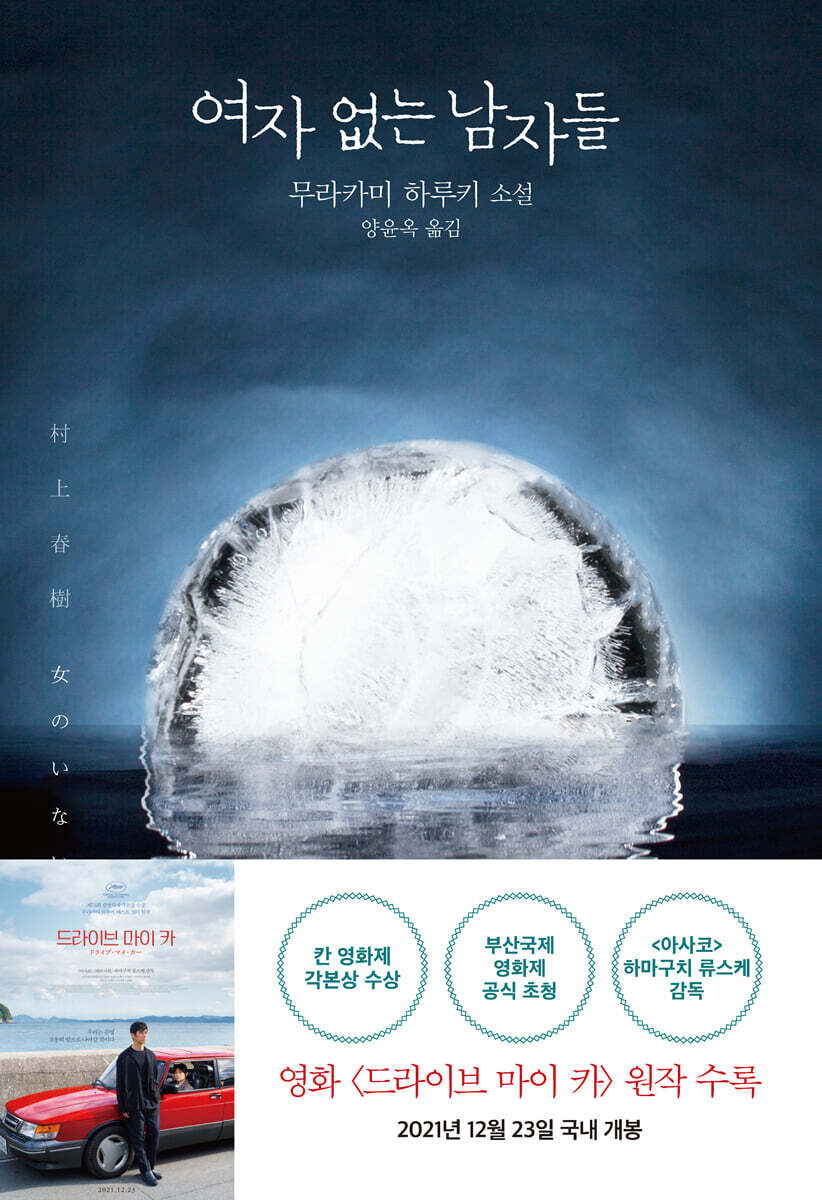
Men without women
 |
Description
Book Introduction
“Is it really possible for us to fully understand someone? Even if you love that person deeply.” Haruki Murakami's first new novel in nine years Includes 6 Japanese episodes + "Beloved Sleep", a total of 7 episodes It has been nine years since Haruki Murakami published a collection of short stories, since “Tokyo Strange Stories” in 2005. Meanwhile, he had been concentrating on writing long novels, including the masterpiece "1Q84," which is considered the culmination of Haruki Murakami's world. While translating "Missing You," a collection of short stories from English-speaking countries that he had personally selected in 2013, he suddenly thought, "I'm tired of writing long stories, so why don't I try writing short stories now?" This collection of short stories was completed by gathering five short stories published from the end of that year to the spring of the following year, as well as the newly written title story “Men Without Women” to coincide with the publication of the book. In this Korean edition, the original short story “Beloved Sleep” that was included in “Because I Miss You” has been specially added. As the title suggests, this collection of short stories, which takes the theme of “Men Without Women,” features protagonists who literally lack or have lost women as lovers or wives. Some people become widowed due to illness ("Drive My Car"), others divorce after discovering an affair ("Kino"), others deliberately avoid deep relationships ("Independent Agency"), and others are cut off from the outside world for no apparent reason ("Scheherazade"). Except for "Yesterday," which is structured to recall college days, and "Dear Sleep," which is set in the world of Kafka's novels, all of the works feature middle-aged men as the main characters. Perhaps because of this, compared to his previous works, the atmosphere is more realistic and serious, and he feels as if he is much more candid in depicting the deep points of human relationships, including those between men and women. Haruki Murakami's novels, once considered the exclusive domain of wandering youth, are now in touch with reality, presenting universal themes in a way that is not clichéd. This collection of short stories is expected to resonate with not only existing fans but also readers of a wider age range. Watch the video "Men Without Women" *Click* Click here to watch the 'Monthly Yoon Jong-shin August Issue Music Video and Materials' video. |
- You can preview some of the book's contents.
Preview
index
Drive My Car
Yesterday
independent organization
Scheherazade
Kino
Dear Sleep
Men without women
Yesterday
independent organization
Scheherazade
Kino
Dear Sleep
Men without women
Detailed image
Into the book
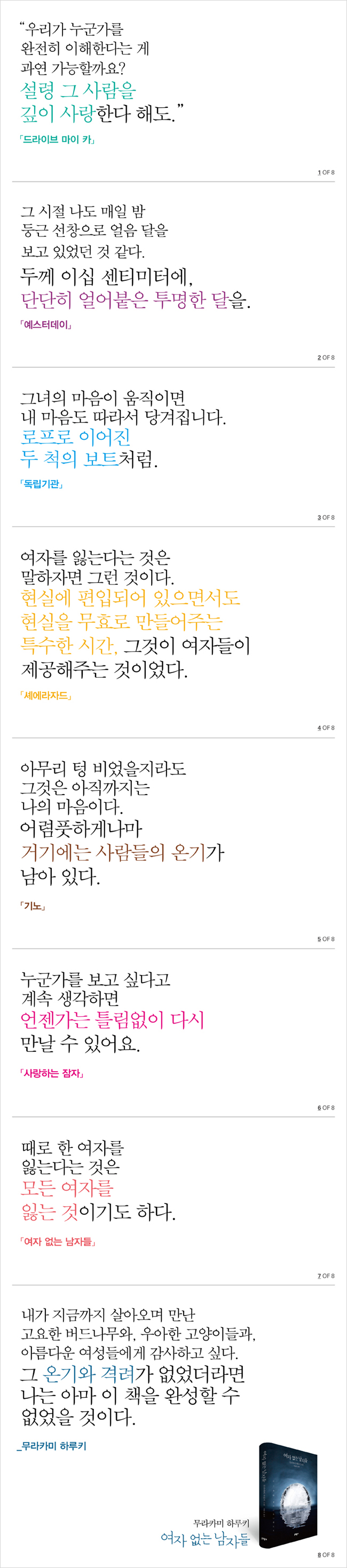
When it comes to relationships between people, especially between men and women, it's a more holistic issue.
It's more ambiguous, more arbitrary, and more sad.
_Drive My Car, p. 37
Isn't it impossible for us to know exactly what a woman is thinking? That's what I'm trying to say.
It's the same no matter what kind of woman the other person is.
So, that's probably not just Kafuku-san's unique blind spot.
If that's a blind spot, then we're all living with a similar blind spot.
_Drive My Car, page 50
I often have the same dream.
Aki and I are on the boat.
It's a large ship on a long voyage.
We are alone in a small cabin, and it is late at night, so the full moon is visible through the round window.
But the moon is made of transparent, clean ice.
The lower half is submerged in the sea.
'It looks like the moon, but it's actually made of ice, and it's about twenty centimeters thick,' Aki tells me.
'So when morning comes and the sun rises, it melts away.
It's good to look at it carefully while you can.' _「Yesterday」, pp. 96-97
When her heart is moved, mine is also pulled along.
Like two boats connected by a rope.
Even if you try to cut the rope, there is no knife to cut it.
This is a feeling I've never experienced before.
That makes me anxious.
If I continue to miss you like this, what will become of me?
_「Independent Organization」, pp. 145-146
That's what love is all about.
I feel like I can't control my mind and am at the mercy of unreasonable forces.
_「Independent Organization」, p. 146
I can't even remember what it was about him that made me so fascinated at seventeen.
Life is a strange thing.
What was once considered incredibly brilliant and absolute, something that we would have given up everything to get, appears surprisingly faded over time, or when viewed from a slightly different angle.
I was dumbfounded, wondering what on earth my eyes were looking at.
_Scheherazade, pp. 211-212
That's what it's like to lose a woman.
Women provided a special time that allowed us to be immersed in reality while simultaneously nullifying it.
And Scheherazade gave him plenty of it, literally infinitely.
That fact, and the fact that he would inevitably lose it one day, saddened him more than anything else.
_Scheherazade, p. 214
Of all the emotions that humans harbor, perhaps none are as troublesome as jealousy and pride.
And for some reason, Kino has been suffering from both sides.
Kino sometimes wondered if there was something about him that triggered such dark sides in others.
_「Kino」, p. 238
No matter how empty it may be, it is still my heart.
Even if it's faint, the warmth of the people still remains there.
A few personal memories lie silently waiting for the high tide, like seaweed tangled on a beach stake.
If you expose some emotions, you will surely bleed red.
I can't let that heart wander off to an unknown place yet.
_「Kino」, p. 268
When he opened his eyes, he found himself transformed into Gregor Samsa on his bed.
(…) I had no idea where I was or what I should do from now on.
All he could barely grasp was that he was now a human being named Gregor Samsa.
How did he know? Perhaps someone whispered in his ear while he was sleeping.
“Your name is Gregor Samsa.”
_「Beloved Sleep」, pp. 275-277
One day, suddenly, you become a man without a woman.
That day, without even the slightest warning or hint, without any premonition or omen, without even knocking or coughing, he comes to you out of the blue.
You turn a corner and you know you're already there.
But now there is no going back.
Once you turn the corner, it becomes a world unto itself.
In that world, you are called 'men without women'.
In an endlessly cold plural form.
It's more ambiguous, more arbitrary, and more sad.
_Drive My Car, p. 37
Isn't it impossible for us to know exactly what a woman is thinking? That's what I'm trying to say.
It's the same no matter what kind of woman the other person is.
So, that's probably not just Kafuku-san's unique blind spot.
If that's a blind spot, then we're all living with a similar blind spot.
_Drive My Car, page 50
I often have the same dream.
Aki and I are on the boat.
It's a large ship on a long voyage.
We are alone in a small cabin, and it is late at night, so the full moon is visible through the round window.
But the moon is made of transparent, clean ice.
The lower half is submerged in the sea.
'It looks like the moon, but it's actually made of ice, and it's about twenty centimeters thick,' Aki tells me.
'So when morning comes and the sun rises, it melts away.
It's good to look at it carefully while you can.' _「Yesterday」, pp. 96-97
When her heart is moved, mine is also pulled along.
Like two boats connected by a rope.
Even if you try to cut the rope, there is no knife to cut it.
This is a feeling I've never experienced before.
That makes me anxious.
If I continue to miss you like this, what will become of me?
_「Independent Organization」, pp. 145-146
That's what love is all about.
I feel like I can't control my mind and am at the mercy of unreasonable forces.
_「Independent Organization」, p. 146
I can't even remember what it was about him that made me so fascinated at seventeen.
Life is a strange thing.
What was once considered incredibly brilliant and absolute, something that we would have given up everything to get, appears surprisingly faded over time, or when viewed from a slightly different angle.
I was dumbfounded, wondering what on earth my eyes were looking at.
_Scheherazade, pp. 211-212
That's what it's like to lose a woman.
Women provided a special time that allowed us to be immersed in reality while simultaneously nullifying it.
And Scheherazade gave him plenty of it, literally infinitely.
That fact, and the fact that he would inevitably lose it one day, saddened him more than anything else.
_Scheherazade, p. 214
Of all the emotions that humans harbor, perhaps none are as troublesome as jealousy and pride.
And for some reason, Kino has been suffering from both sides.
Kino sometimes wondered if there was something about him that triggered such dark sides in others.
_「Kino」, p. 238
No matter how empty it may be, it is still my heart.
Even if it's faint, the warmth of the people still remains there.
A few personal memories lie silently waiting for the high tide, like seaweed tangled on a beach stake.
If you expose some emotions, you will surely bleed red.
I can't let that heart wander off to an unknown place yet.
_「Kino」, p. 268
When he opened his eyes, he found himself transformed into Gregor Samsa on his bed.
(…) I had no idea where I was or what I should do from now on.
All he could barely grasp was that he was now a human being named Gregor Samsa.
How did he know? Perhaps someone whispered in his ear while he was sleeping.
“Your name is Gregor Samsa.”
_「Beloved Sleep」, pp. 275-277
One day, suddenly, you become a man without a woman.
That day, without even the slightest warning or hint, without any premonition or omen, without even knocking or coughing, he comes to you out of the blue.
You turn a corner and you know you're already there.
But now there is no going back.
Once you turn the corner, it becomes a world unto itself.
In that world, you are called 'men without women'.
In an endlessly cold plural form.
---"Men Without Women," p. 327
Publisher's Review
A secret melody flowing through the deep gap between men and women
Haruki Murakami's short story world is reborn after nine years.
Haruki Murakami's new short story collection sold 300,000 copies through pre-orders alone when it was first published in Japan.
Since his first collection of short stories, Slow Boat to China, published in 1983, his short stories have served as indicators of his future works and as a platform for new attempts, sometimes displaying unconventional imagination and other times containing delicate sensibilities that resonate with the memories of youth, gaining steady popularity.
In this collection of short stories, you can find six works written under the single theme of “Men Without Women,” as well as “Dear Sleep,” a unique homage to Franz Kafka’s masterpiece “The Metamorphosis.”
It has been nine years since Haruki Murakami published a collection of short stories, since “Tokyo Strange Stories” in 2005.
Meanwhile, he had been concentrating on writing long novels, including the masterpiece "1Q84," which is considered the culmination of Haruki Murakami's world. While translating "I Miss You," a collection of short stories from English-speaking countries that he had personally selected in 2013, he suddenly thought, "I'm tired of writing long stories, so why don't I try writing short stories now?"
This collection of short stories was completed by gathering five short stories published from the end of that year to the spring of the following year, as well as the newly written title story “Men Without Women” to coincide with the publication of the book. In this Korean edition, the original short story “Beloved Sleep” that was included in “Because I Miss You” has been specially added.
As the title suggests, this collection of short stories, which takes the theme of “Men Without Women,” features protagonists who literally lack or have lost women as lovers or wives.
Some people become widowed due to illness ("Drive My Car"), others divorce after discovering an affair ("Kino"), others deliberately avoid deep relationships ("Independent Agency"), and others are cut off from the outside world for no apparent reason ("Scheherazade").
Except for "Yesterday," which is structured to recall college days, and "Dear Sleep," which is set in the world of Kafka's novels, all of the works feature middle-aged men as the main characters. Perhaps because of this, compared to his previous works, the atmosphere is more realistic and serious, and he feels as if he is much more candid in depicting the deep points of human relationships, including those between men and women.
Haruki Murakami's novels, once considered the exclusive domain of wandering youth, are now in touch with reality, presenting universal themes in a way that is not clichéd. This collection of short stories is expected to resonate with not only existing fans but also readers of a wider age range.
The translation of this Korean edition was done by Yang Yun-ok, a professional translator who translated works such as “1Q84” and “Slow Boat to China,” and has preserved the references within Haruki Murakami’s world as well as the unique characteristics of each short story.
In addition, singer Yoon Jong-shin, who is a self-proclaimed ardent fan of Haruki Murakami, plans to release a song of the same name, “Men Without Women,” through his project “Monthly Yoon Jong-shin,” which is the first collaboration between literature and music, drawing attention from the entire cultural world.
Munhakdongne is also presenting a new, definitive edition of Haruki Murakami's previously published early short story collections, "Fireflies," "Dead Heat on the Merry-Go-Round," and "Bakery Raid," which reflect the author's revisions and include unpublished short stories.
The phrase "Men Without Women" will bring to mind many readers Ernest Hemingway's masterpiece collection of short stories.
Of course I did too.
However, translator Tsukuru Takami changed the title of the book from 'Men Without Women' to 'A World Only for Men', and I also think that translating it as 'Men Excluding Women' rather than 'Men Without Women' would be closer to the feeling of the original title.
But what this book means is more literal, 'men without women.'
Men who have sent women away for various reasons, or are trying to send women away.
I don't really know why my creative consciousness was caught up in that motif (the expression "caught up" is the right word).
No specific incident similar to this has happened to me recently (thankfully), nor have I witnessed any examples around me.
I just wanted to paraphrase and elaborate on the appearance and feelings of those men in the form of several different stories.
It may be a metaphor for the 'present' of humanity.
Or maybe it's a kind of indirect prophecy.
Or maybe I personally need such an exorcism.
It's hard for me to explain this myself.
But anyway, the title of this book was decided as 'Men Without Women' from the beginning, and I didn't waver in the middle of the idea.
In other words, I was probably naturally hoping for this series of stories somewhere in my heart.
_From the preface of the Japanese edition
Haruki Murakami's short story world is reborn after nine years.
Haruki Murakami's new short story collection sold 300,000 copies through pre-orders alone when it was first published in Japan.
Since his first collection of short stories, Slow Boat to China, published in 1983, his short stories have served as indicators of his future works and as a platform for new attempts, sometimes displaying unconventional imagination and other times containing delicate sensibilities that resonate with the memories of youth, gaining steady popularity.
In this collection of short stories, you can find six works written under the single theme of “Men Without Women,” as well as “Dear Sleep,” a unique homage to Franz Kafka’s masterpiece “The Metamorphosis.”
It has been nine years since Haruki Murakami published a collection of short stories, since “Tokyo Strange Stories” in 2005.
Meanwhile, he had been concentrating on writing long novels, including the masterpiece "1Q84," which is considered the culmination of Haruki Murakami's world. While translating "I Miss You," a collection of short stories from English-speaking countries that he had personally selected in 2013, he suddenly thought, "I'm tired of writing long stories, so why don't I try writing short stories now?"
This collection of short stories was completed by gathering five short stories published from the end of that year to the spring of the following year, as well as the newly written title story “Men Without Women” to coincide with the publication of the book. In this Korean edition, the original short story “Beloved Sleep” that was included in “Because I Miss You” has been specially added.
As the title suggests, this collection of short stories, which takes the theme of “Men Without Women,” features protagonists who literally lack or have lost women as lovers or wives.
Some people become widowed due to illness ("Drive My Car"), others divorce after discovering an affair ("Kino"), others deliberately avoid deep relationships ("Independent Agency"), and others are cut off from the outside world for no apparent reason ("Scheherazade").
Except for "Yesterday," which is structured to recall college days, and "Dear Sleep," which is set in the world of Kafka's novels, all of the works feature middle-aged men as the main characters. Perhaps because of this, compared to his previous works, the atmosphere is more realistic and serious, and he feels as if he is much more candid in depicting the deep points of human relationships, including those between men and women.
Haruki Murakami's novels, once considered the exclusive domain of wandering youth, are now in touch with reality, presenting universal themes in a way that is not clichéd. This collection of short stories is expected to resonate with not only existing fans but also readers of a wider age range.
The translation of this Korean edition was done by Yang Yun-ok, a professional translator who translated works such as “1Q84” and “Slow Boat to China,” and has preserved the references within Haruki Murakami’s world as well as the unique characteristics of each short story.
In addition, singer Yoon Jong-shin, who is a self-proclaimed ardent fan of Haruki Murakami, plans to release a song of the same name, “Men Without Women,” through his project “Monthly Yoon Jong-shin,” which is the first collaboration between literature and music, drawing attention from the entire cultural world.
Munhakdongne is also presenting a new, definitive edition of Haruki Murakami's previously published early short story collections, "Fireflies," "Dead Heat on the Merry-Go-Round," and "Bakery Raid," which reflect the author's revisions and include unpublished short stories.
The phrase "Men Without Women" will bring to mind many readers Ernest Hemingway's masterpiece collection of short stories.
Of course I did too.
However, translator Tsukuru Takami changed the title of the book from 'Men Without Women' to 'A World Only for Men', and I also think that translating it as 'Men Excluding Women' rather than 'Men Without Women' would be closer to the feeling of the original title.
But what this book means is more literal, 'men without women.'
Men who have sent women away for various reasons, or are trying to send women away.
I don't really know why my creative consciousness was caught up in that motif (the expression "caught up" is the right word).
No specific incident similar to this has happened to me recently (thankfully), nor have I witnessed any examples around me.
I just wanted to paraphrase and elaborate on the appearance and feelings of those men in the form of several different stories.
It may be a metaphor for the 'present' of humanity.
Or maybe it's a kind of indirect prophecy.
Or maybe I personally need such an exorcism.
It's hard for me to explain this myself.
But anyway, the title of this book was decided as 'Men Without Women' from the beginning, and I didn't waver in the middle of the idea.
In other words, I was probably naturally hoping for this series of stories somewhere in my heart.
_From the preface of the Japanese edition
GOODS SPECIFICS
- Date of issue: August 28, 2014
- Format: Hardcover book binding method guide
- Page count, weight, size: 340 pages | 440g | 128*188*22mm
- ISBN13: 9788954625586
- ISBN10: 8954625584
You may also like
카테고리
korean


korean

![GQ KOREA Mark (Monthly): December [2025]](http://librairie.coreenne.fr/cdn/shop/files/8ef265dbbfbf186523ed75ba7319009d.jpg?v=1765340328&width=3840)


