

Jungle Manri 1
 |
Description
Book Introduction
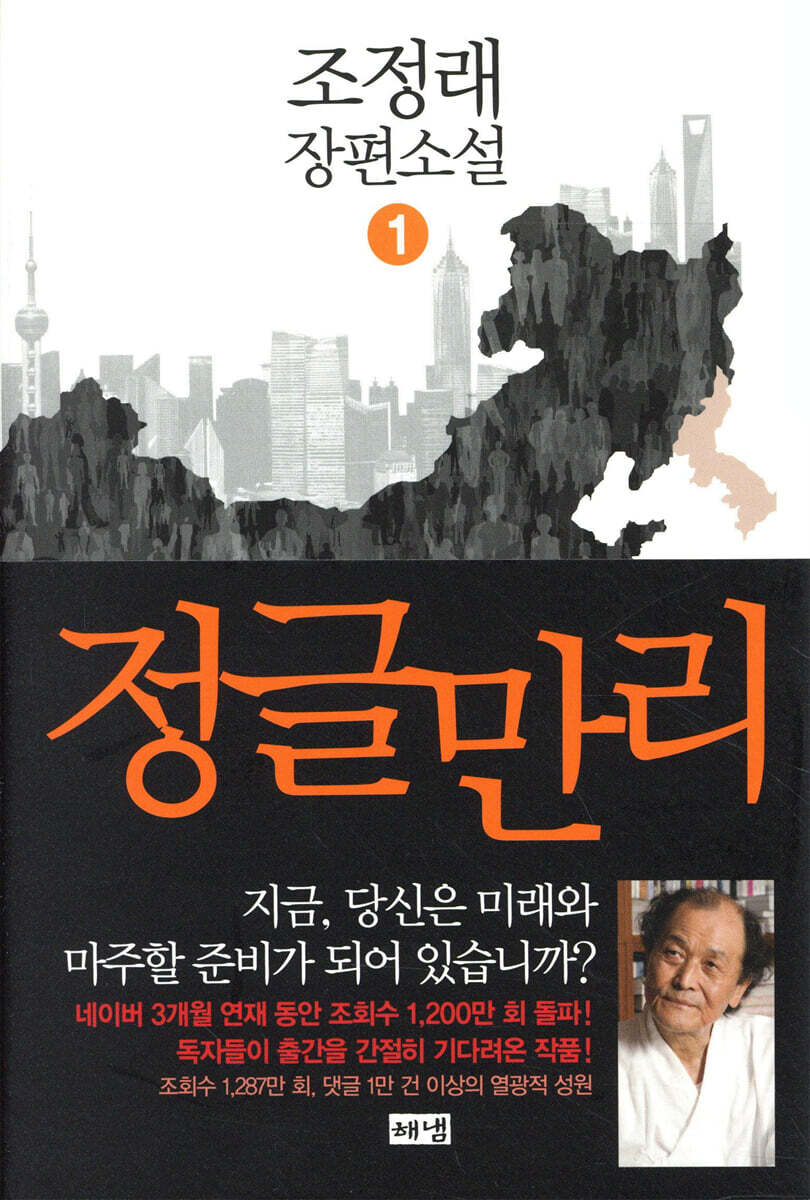
Are you ready to face the future now? The rapid rise of China, which has become the center of the world, taking over the global economy. Are we friends or foes, sharing a border for thousands of years? Jo Jeong-rae's immortal masterpiece, written across the vast Chinese continent Amidst China's rapid growth, transforming from the "world's factory" to the "world's market," and its emergence as a global economic powerhouse, and the rapidly changing political situation on the Korean Peninsula, what should we face now, and what should we prepare for? 『Jungle Manri』 is a new full-length novel by Jo Jeong-rae, who has keenly depicted modern and contemporary tragedies in Korea through 『Taebaek Mountains』, 『Arirang』, and 『Han River』. This book, published in three volumes, has been serialized daily with illustrations on the internet portal site Naver for about three months, and has been in touch with readers, receiving a hot response from netizens with over 1 million views and over 10,000 comments. In 『Jungle Manri』, the author shows the dynamic changes of China, which has become the center of the global economic flow and has risen to become a G2 through rapid economic development, but also vividly depicts the dark side of economic development, such as the cities suffering from overdevelopment and the lives of migrant workers treated as cheap, through the stories of businessmen from five countries, Korea, China, Japan, the United States, and France, and the people around them. Furthermore, the unique cultural character and background of China, which are difficult to judge from either a Western or a Korean perspective, are expressed through various voices through the narrators in the novel, clearly revealing our own dual perspectives and prejudices, as well as the national sentiments formed by the complexly intertwined modern and contemporary history of Korea, China, and Japan. Through this work, readers will be able to follow the economic and political currents of 21st-century Korea and the surrounding Korean Peninsula, and contemplate truth, justice, and values, as well as a vision for the future of our people. |
- You can preview some of the book's contents.
Preview
index
Author's Note
Clean money, dirty money
I am the master of my life
Pouring Korean Wine
Law of the Jungle, Survival of the Fittest
Mother's white flag
Fight without surrender
The unfortunate old city of Xi'an
The courage of college students
Migrant workers, just a bubble
Forgiveness is the gift of reflection
Clean money, dirty money
I am the master of my life
Pouring Korean Wine
Law of the Jungle, Survival of the Fittest
Mother's white flag
Fight without surrender
The unfortunate old city of Xi'an
The courage of college students
Migrant workers, just a bubble
Forgiveness is the gift of reflection
Into the book
“Thank you for coming.
“I am Jeon Dae-kwang.”
The man folded the paper with the other person's name written on it in half, then immediately handed over his business card.
The continuous movement was fast and natural, like the operation of a well-oiled machine.
His movements, along with his resonant voice and gentle expression, gave him the impression of a sophisticated travel agent.
“Oh, yes……, I have a business card…….”
The other person, perhaps not expecting a business card exchange, fumbled in his suit pocket with a flustered gesture.
(syncopation)
As befitting an airport known as China's 'economic capital,' the spacious waiting room wasn't just teeming with people.
The sound of so many people chatting freely seemed to lift the high ceiling even higher.
Those loud noises weren't just due to the exchange of words.
There were more sounds of cell phones ringing.
The Chinese people, despite using cutting-edge telephones with excellent radio transmission performance, somehow managed to shout at the top of their lungs.
With the rapid pace of economic development, the number of cell phone users is increasing day by day, and the buzzing noise is bound to become more intense.
---From "Clean Money, Dirty Money"
The Chinese word guanxi is written in Chinese characters as relationship (關係), and its meaning can be understood as a combination of 'connection? backing? network'.
It was a chronic disease of Korean society, something that was caused by a combination of school ties, regional ties, and blood ties that were ruining the country.
Because of this guanxi, which cannot be seen or touched, yet clearly exists, foreign companies that first entered China had to go through difficulties like wandering through a jungle for a while, stepping on empty spaces, falling down, getting lost and being confused.
But fortunately, Jeon Dae-gwang was in a relationship with Xiang Xinyuan.
So, Xiang Xinyuan secretly asked Jeon Dae-gwang to take care of his cousin's business.
Because I believed that confidentiality would be completely guaranteed.
It was also thanks to Xiang Xinyuan that Jeon Dae-gwang was promoted to manager faster than others.
Xiang Xinyuan always facilitated Jeon Dae-gwang's company's import and export business, which led to Jeon Dae-gwang's rapid promotion.
---From "I am the master of my life"
“Born in 1977, Chinese name Wang Lingling, American name Sophia.
MBA from Berkeley University.
Entered China in 2004.
Real estate companies, construction companies, chemical companies, securities companies, etc… … .
You have good reasoning skills.
“What suspicions do you have?”
As if telling him to guess, Ito Hideo stared at Toyotomi Araki.
“Hey, look at this.” Toyotomi Araki wiped his lips as if his mouth was watering, and said, “If you were born in 1977, how old are you?” His expression was one of bewilderment.
“Thirty-four, what?”
Shiro Ishihara, who had been silent until now, spoke bluntly.
“Isn’t this the real problem woman full of suspicions?
“Why did you graduate from the most prestigious universities in the US, such as Harvard East and Berkeley West? Why do you have both a Chinese name and an American name? What is the background of having so many companies in China in less than 10 years since entering the market in 2004? In capitalism, where money is everything, you can’t have achieved that with nothing. And whose family does that belong to?”
Toyotomi Araki said in a tone that he was extremely offended.
“Yes, you have covered everything very well.
“It’s a setting that’s just like the heroine of a detective novel, but the fact that it’s so difficult to figure out what’s going on makes it even more like a detective novel.”
---From "Law of the Jungle, Survival of the Fittest"
“Does Yanling also think Chairman Mao is God?”
“I also guessed that Jaehyung would find that problem strange.
Hmm… … , well, what should I say, as time goes by, he feels like a god… … .
No, that's not the correct answer, and wouldn't it be okay to worship him as a god... ..., that kind of thought keeps getting deeper.
As we live, whenever something happens, there are times when we suddenly want to pray to someone.
“At times like that, the person who comes to mind is Chairman Mao.” Li Yanling spoke slowly, her face serious, as if she was summarizing the thoughts deep in her heart.
"Why Chairman Mao? Jesus is a bit distant from China, but there's Buddha, Confucius, Bodhidharma, Guan Yu... there are many, many figures the Chinese worship as gods."
“Not a lot.
There are many, but the targets are so far away that it doesn't seem like they will be effective... no, it doesn't seem like they will be very effective.
Instead, Chairman Mao is likely to be of great help if he stays close to us.”
“Even though you knew full well that he was human?”
Song Jae-hyung made a pitiful expression.
---From "College Students' Guts"
The life of a businessperson may be more vain than that of a farmer.
Farmers use land as capital and reap the harvest by receiving the blessings of nature, but what about the merchant?
Aren't they a swarm of moths chasing that great being who crowned the absolute power of exchange value with the illusion of money, which is nothing more than a drawing on a piece of paper?
Capitalism is an ideology that worships money as its god.
It is honest, straightforward, and simple, yet cruel and merciless.
The mercenaries who fought on the front lines of the silent war to obtain as many items as possible with the power of the gods were the Sangsawon.
What do you gain by fighting like that…?
What do you get… … .
What kept growing in the face of that question was doubt and sadness.
Even though no one dies after taking revenge on money, the lives of the executives who have spent their entire lives chasing money, running around in a desperate manner, ultimately end in a miserable old age, hanging on to a paltry retirement pay.
It was an inescapable sadness and emptiness.
The sight of my seniors' drooping backs sliding down the icy slopes after they passed the age of 50 was not something that happened to me alone.
“I am Jeon Dae-kwang.”
The man folded the paper with the other person's name written on it in half, then immediately handed over his business card.
The continuous movement was fast and natural, like the operation of a well-oiled machine.
His movements, along with his resonant voice and gentle expression, gave him the impression of a sophisticated travel agent.
“Oh, yes……, I have a business card…….”
The other person, perhaps not expecting a business card exchange, fumbled in his suit pocket with a flustered gesture.
(syncopation)
As befitting an airport known as China's 'economic capital,' the spacious waiting room wasn't just teeming with people.
The sound of so many people chatting freely seemed to lift the high ceiling even higher.
Those loud noises weren't just due to the exchange of words.
There were more sounds of cell phones ringing.
The Chinese people, despite using cutting-edge telephones with excellent radio transmission performance, somehow managed to shout at the top of their lungs.
With the rapid pace of economic development, the number of cell phone users is increasing day by day, and the buzzing noise is bound to become more intense.
---From "Clean Money, Dirty Money"
The Chinese word guanxi is written in Chinese characters as relationship (關係), and its meaning can be understood as a combination of 'connection? backing? network'.
It was a chronic disease of Korean society, something that was caused by a combination of school ties, regional ties, and blood ties that were ruining the country.
Because of this guanxi, which cannot be seen or touched, yet clearly exists, foreign companies that first entered China had to go through difficulties like wandering through a jungle for a while, stepping on empty spaces, falling down, getting lost and being confused.
But fortunately, Jeon Dae-gwang was in a relationship with Xiang Xinyuan.
So, Xiang Xinyuan secretly asked Jeon Dae-gwang to take care of his cousin's business.
Because I believed that confidentiality would be completely guaranteed.
It was also thanks to Xiang Xinyuan that Jeon Dae-gwang was promoted to manager faster than others.
Xiang Xinyuan always facilitated Jeon Dae-gwang's company's import and export business, which led to Jeon Dae-gwang's rapid promotion.
---From "I am the master of my life"
“Born in 1977, Chinese name Wang Lingling, American name Sophia.
MBA from Berkeley University.
Entered China in 2004.
Real estate companies, construction companies, chemical companies, securities companies, etc… … .
You have good reasoning skills.
“What suspicions do you have?”
As if telling him to guess, Ito Hideo stared at Toyotomi Araki.
“Hey, look at this.” Toyotomi Araki wiped his lips as if his mouth was watering, and said, “If you were born in 1977, how old are you?” His expression was one of bewilderment.
“Thirty-four, what?”
Shiro Ishihara, who had been silent until now, spoke bluntly.
“Isn’t this the real problem woman full of suspicions?
“Why did you graduate from the most prestigious universities in the US, such as Harvard East and Berkeley West? Why do you have both a Chinese name and an American name? What is the background of having so many companies in China in less than 10 years since entering the market in 2004? In capitalism, where money is everything, you can’t have achieved that with nothing. And whose family does that belong to?”
Toyotomi Araki said in a tone that he was extremely offended.
“Yes, you have covered everything very well.
“It’s a setting that’s just like the heroine of a detective novel, but the fact that it’s so difficult to figure out what’s going on makes it even more like a detective novel.”
---From "Law of the Jungle, Survival of the Fittest"
“Does Yanling also think Chairman Mao is God?”
“I also guessed that Jaehyung would find that problem strange.
Hmm… … , well, what should I say, as time goes by, he feels like a god… … .
No, that's not the correct answer, and wouldn't it be okay to worship him as a god... ..., that kind of thought keeps getting deeper.
As we live, whenever something happens, there are times when we suddenly want to pray to someone.
“At times like that, the person who comes to mind is Chairman Mao.” Li Yanling spoke slowly, her face serious, as if she was summarizing the thoughts deep in her heart.
"Why Chairman Mao? Jesus is a bit distant from China, but there's Buddha, Confucius, Bodhidharma, Guan Yu... there are many, many figures the Chinese worship as gods."
“Not a lot.
There are many, but the targets are so far away that it doesn't seem like they will be effective... no, it doesn't seem like they will be very effective.
Instead, Chairman Mao is likely to be of great help if he stays close to us.”
“Even though you knew full well that he was human?”
Song Jae-hyung made a pitiful expression.
---From "College Students' Guts"
The life of a businessperson may be more vain than that of a farmer.
Farmers use land as capital and reap the harvest by receiving the blessings of nature, but what about the merchant?
Aren't they a swarm of moths chasing that great being who crowned the absolute power of exchange value with the illusion of money, which is nothing more than a drawing on a piece of paper?
Capitalism is an ideology that worships money as its god.
It is honest, straightforward, and simple, yet cruel and merciless.
The mercenaries who fought on the front lines of the silent war to obtain as many items as possible with the power of the gods were the Sangsawon.
What do you gain by fighting like that…?
What do you get… … .
What kept growing in the face of that question was doubt and sadness.
Even though no one dies after taking revenge on money, the lives of the executives who have spent their entire lives chasing money, running around in a desperate manner, ultimately end in a miserable old age, hanging on to a paltry retirement pay.
It was an inescapable sadness and emptiness.
The sight of my seniors' drooping backs sliding down the icy slopes after they passed the age of 50 was not something that happened to me alone.
---From "The Business of Friendship"
Publisher's Review
Are you ready to face the future now?
Over 1 million netizens during the 3 months of serialization on Naver
A work we've been reading together and eagerly awaiting its publication!
Over 1 million views, 10,000 comments, and enthusiastic support!
The rapid rise of China, which has become the center of the world, taking over the global economy.
Are we friends or enemies, sharing a border for thousands of years?
Jo Jeong-rae's immortal masterpiece, written across the vast Chinese continent
Global businesspeople are flocking to China, "a country with 1.4 billion people and 1.4 billion things happening," in pursuit of wealth and success! How should we respond to this transformation from a country once considered the "world's factory" to a "global market" and a towering economic powerhouse? What impact will this have on the Korean Peninsula, a nation we've shared for thousands of years, and what must we prepare for now?
Author Jo Jeong-rae, who has keenly depicted modern and contemporary tragedies in Korea through his epic novels 『Taebaek Mountains』, 『Arirang』, and 『Han River』, which span the eras and history of Korea, has returned with his new full-length novel 『Jungle Manri』.
Three years after 『Scarecrow Dance』, which presented a blueprint for economic democratization, the author's concerns about the future of our country led to insights and outlooks on the global economy, including China, and this resulted in the publication of 『Jungle Manri』, which consists of approximately 1,200 manuscript pages per volume, totaling 3,615 pages in three volumes.
This is the result of the author's first visit to China in the early 1990s, and his constant contemplation over the past 20 years, which led him to decide to write a novel set in China after seeing the country's robust state, unlike the sudden collapse of the Soviet Union.
The author portrays the breathtaking economic war waged by businessmen from five countries—Korea, China, Japan, the United States, and France—in a captivating way amidst the dynamic transformation of China, which has emerged as the center of the global economy and a G2 power.
In a place where you can't move without 'guanxi', the desires and struggles of those chasing success unfold against the backdrop of diverse Chinese-style capitalism.
In addition, the film reveals the negative effects of rapid growth through issues such as pollution caused by rapid development, the disregard for human life behind China's unique "runtaiduo" (人太多), and the images of low-income migrant workers who leave their hometowns behind to make a living and fall into poverty in big cities, making us ponder the meaning of human existence.
It also accurately captures the historical conflicts and the subtle emotions underlying them that Korean, Japanese, Chinese, and Korean businessmen inevitably face as they compete for large-scale business.
After traveling all over China to establish the basic structure and focusing on writing in earnest, the author completed the work by meticulously writing 20 to 40 pages of manuscript paper with a pen every day.
At the same time, it was serialized daily on the portal site Naver for about three months (from March 25 to July 10) with each episode being about 30 pages long, and it interacted with netizens.
The author's unique vivid descriptions and thrilling narrative brought out a passionate emotion, resulting in over 1 million views and over 10,000 comments.
Like the characters in the work, it evoked empathy in businessmen residing in China, provided know-how on Chinese business to office workers actually engaged in Chinese business, provided historical awareness to students who had little interest in Korea-Japan or Korea-China relations, brought nostalgia to readers who remember the author's previously published works such as "Taebaek Mountains," and gave heart-fluttering emotions to the public who yearn for the joy of reading a vivid novel. After three months of serialization, ahead of its publication in July, 70,000 sets, a total of 210,000 copies, were pre-ordered at major bookstores nationwide, and 100,000 sets of the first edition, a total of 300,000 copies, were produced.
"Literature must contribute to humanity for a humane life," the author's insightful writing, which has penetrated the times through his works, will remind readers of human values and the direction of humanity amidst the economic trends of the Korean Peninsula and the world in the 21st century, while also providing readers with an opportunity to envision the future.
Author's Note
Now China's population has reached 1.4 billion, and China has become a G2.
The world is shocked by this unexpected fact, and China itself is also surprised.
Because it was 40 years ahead of schedule.
But that is not what is commonly called a 'miracle'.
It is the fruit of the blood, sweat, and tears shed by all the Chinese people for over 30 years.
As was our past.
No one denies that China will soon become the G1.
However, China's growing power is a global problem of the 21st century, and it is also a problem directly related to the Korean Peninsula, which has shared a border with China for thousands of years.
The joys and sorrows of life that the Chinese have experienced while achieving what they have today are no different from our own experiences.
I wanted to weave that story together.
Over 1 million netizens during the 3 months of serialization on Naver
A work we've been reading together and eagerly awaiting its publication!
Over 1 million views, 10,000 comments, and enthusiastic support!
The rapid rise of China, which has become the center of the world, taking over the global economy.
Are we friends or enemies, sharing a border for thousands of years?
Jo Jeong-rae's immortal masterpiece, written across the vast Chinese continent
Global businesspeople are flocking to China, "a country with 1.4 billion people and 1.4 billion things happening," in pursuit of wealth and success! How should we respond to this transformation from a country once considered the "world's factory" to a "global market" and a towering economic powerhouse? What impact will this have on the Korean Peninsula, a nation we've shared for thousands of years, and what must we prepare for now?
Author Jo Jeong-rae, who has keenly depicted modern and contemporary tragedies in Korea through his epic novels 『Taebaek Mountains』, 『Arirang』, and 『Han River』, which span the eras and history of Korea, has returned with his new full-length novel 『Jungle Manri』.
Three years after 『Scarecrow Dance』, which presented a blueprint for economic democratization, the author's concerns about the future of our country led to insights and outlooks on the global economy, including China, and this resulted in the publication of 『Jungle Manri』, which consists of approximately 1,200 manuscript pages per volume, totaling 3,615 pages in three volumes.
This is the result of the author's first visit to China in the early 1990s, and his constant contemplation over the past 20 years, which led him to decide to write a novel set in China after seeing the country's robust state, unlike the sudden collapse of the Soviet Union.
The author portrays the breathtaking economic war waged by businessmen from five countries—Korea, China, Japan, the United States, and France—in a captivating way amidst the dynamic transformation of China, which has emerged as the center of the global economy and a G2 power.
In a place where you can't move without 'guanxi', the desires and struggles of those chasing success unfold against the backdrop of diverse Chinese-style capitalism.
In addition, the film reveals the negative effects of rapid growth through issues such as pollution caused by rapid development, the disregard for human life behind China's unique "runtaiduo" (人太多), and the images of low-income migrant workers who leave their hometowns behind to make a living and fall into poverty in big cities, making us ponder the meaning of human existence.
It also accurately captures the historical conflicts and the subtle emotions underlying them that Korean, Japanese, Chinese, and Korean businessmen inevitably face as they compete for large-scale business.
After traveling all over China to establish the basic structure and focusing on writing in earnest, the author completed the work by meticulously writing 20 to 40 pages of manuscript paper with a pen every day.
At the same time, it was serialized daily on the portal site Naver for about three months (from March 25 to July 10) with each episode being about 30 pages long, and it interacted with netizens.
The author's unique vivid descriptions and thrilling narrative brought out a passionate emotion, resulting in over 1 million views and over 10,000 comments.
Like the characters in the work, it evoked empathy in businessmen residing in China, provided know-how on Chinese business to office workers actually engaged in Chinese business, provided historical awareness to students who had little interest in Korea-Japan or Korea-China relations, brought nostalgia to readers who remember the author's previously published works such as "Taebaek Mountains," and gave heart-fluttering emotions to the public who yearn for the joy of reading a vivid novel. After three months of serialization, ahead of its publication in July, 70,000 sets, a total of 210,000 copies, were pre-ordered at major bookstores nationwide, and 100,000 sets of the first edition, a total of 300,000 copies, were produced.
"Literature must contribute to humanity for a humane life," the author's insightful writing, which has penetrated the times through his works, will remind readers of human values and the direction of humanity amidst the economic trends of the Korean Peninsula and the world in the 21st century, while also providing readers with an opportunity to envision the future.
Author's Note
Now China's population has reached 1.4 billion, and China has become a G2.
The world is shocked by this unexpected fact, and China itself is also surprised.
Because it was 40 years ahead of schedule.
But that is not what is commonly called a 'miracle'.
It is the fruit of the blood, sweat, and tears shed by all the Chinese people for over 30 years.
As was our past.
No one denies that China will soon become the G1.
However, China's growing power is a global problem of the 21st century, and it is also a problem directly related to the Korean Peninsula, which has shared a border with China for thousands of years.
The joys and sorrows of life that the Chinese have experienced while achieving what they have today are no different from our own experiences.
I wanted to weave that story together.
GOODS SPECIFICS
- Date of publication: July 15, 2013
- Format: Hardcover book binding method guide
- Page count, weight, size: 420 pages | 590g | 127*187*30mm
- ISBN13: 9788965744023
- ISBN10: 8965744024
You may also like
카테고리
korean


korean

![GQ KOREA Mark (Monthly): December [2025]](http://librairie.coreenne.fr/cdn/shop/files/8ef265dbbfbf186523ed75ba7319009d.jpg?v=1765340328&width=3840)


