

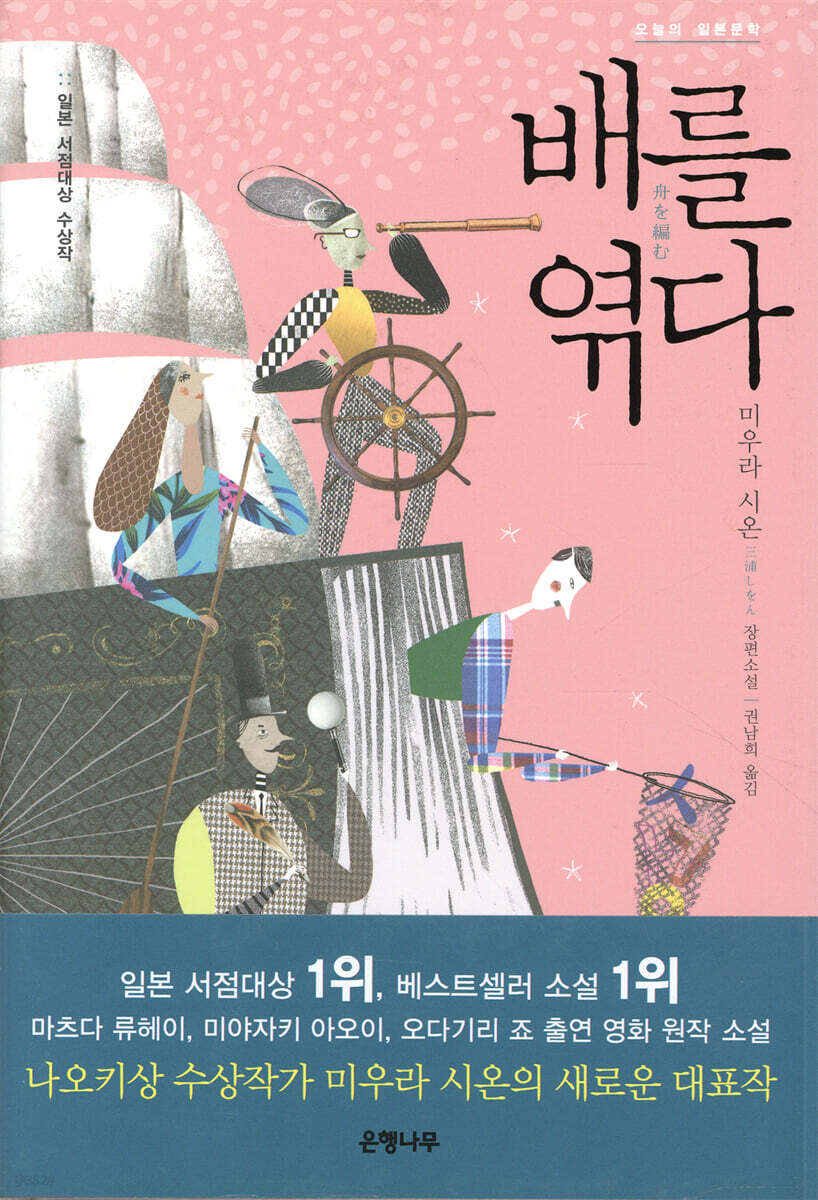
tie a boat
 |
Description
Book Introduction
2012 Bookstore Awards: #1, sold over 600,000 copies, and ranked #1 in the novel category. Words, relationships, sincerity, passion… … a tribute to things that are fading away The Bookstore Award, which responds more immediately to the public's popularity than any other literary award in Japan. In 2012, Shion Miura's "Weaving a Boat" won first place at the Bookstore Grand Prize, becoming the best-selling novel in the genre and selling over 600,000 copies. Based on the book, a film starring renowned Korean actors like Ryuhei Matsuda, Aoi Miyazaki, and Joe Odagiri is about to be released, and the book continues to make daily news and sells steadily! "Weaving a Boat" has finally been published in Korea. "Weaving a Boat" begins with Majime, who has a sharp linguistic sense that most people don't have, arriving at the dictionary editorial department of Genbushobo, a major publishing company that is preparing to compile the dictionary "Daedohae." A 'dictionary editing story' might seem boring at first, but the author melts the process into the novel with realistic episodes and delicate emotional descriptions to show the preciousness of various analog values that society has forgotten. Editor Araki, who dedicated his life to dictionary creation, proofreader Matsumoto, Nishioka, the mood maker of the dictionary editing department, quick-witted female editor Sasaki, and young editor Kishibe with a fashion magazine background, each performing their roles for over ten years to quietly work on creating a single dictionary, show the value of serious words, meticulous handwriting, and work that one can passionately immerse oneself in, rather than light text. "Weaving a Boat" is a work that captures the joy of working diligently for something, filled with unexpected laughter, tears, and warm emotions. Watch related videos ▶ |
- You can preview some of the book's contents.
Preview
Publisher's Review
2012 Bookstore Awards: #1 · Sales of over 600,000 copies, #1 bestseller in the novel category
“Why didn’t I know there was such a wonderful world?”
The moving story of those who edit and compile the dictionary.
Warm support for us who work passionately
Words, relationships, sincerity, passion… … a tribute to things that are fading away
Winner of the Bookstore Award, No. 1 in sales in the novel category, and sold over 600,000 copies.
A work that surprised the Japanese publishing world last year.
The book is still selling steadily and making daily news even before the release of the movie based on it.
Miura Shion's "Weaving Boats" (published by Eunhaengnamu), which has been the center of the biggest buzz in Japan since "1Q84," has finally been published in Korea.
The story begins when Majime, who has a sharp linguistic sense that most people do not have, arrives at the dictionary editing department of Genbushobo, a major publishing company that is preparing to compile the dictionary "Daedohae."
Editor Araki, who has dedicated his life to dictionary creation, proofreader Matsumoto, Nishioka, the mood maker of the dictionary editing department, quick-witted female editor Sasaki, and young editor Kishibe with a fashion magazine background, each perform their roles for over ten years, silently working to create a single dictionary.
Here, Kaguya, a woman Majime falls in love with at first sight, appears, and a 'Majime-like' love story is added.
A story about dictionary editing that may seem boring at first glance.
However, author Miura Shion melts the process into a novel, using realistic episodes and delicate emotional descriptions to convey the importance of various analog values that society has forgotten.
Serious words and sincere handwriting, rather than light texts, work you can devote yourself to with passion, concerns within interpersonal relationships, people working together toward a common goal.
"Weaving a Boat" is a work that weaves together unexpected laughter, tears, and warm emotions, showing how joyful it is to work diligently for something.
A moving drama that overwhelmingly surpassed Genocide.
Shion Miura rises to prominence as a leading Japanese author with "Weaving a Boat."
560 people representing 431 bookstores nationwide selected 10 works in the first round of voting, and the winners were selected in the second round by 371 people from 302 bookstores.
The Japan Bookstore Award is an award given over several months to bookstore employees across the country.
The idea is to vote on 'works published in the past year that did not win the Naoki Prize but that you really want to sell' and select the work that receives the most points.
The Bookstore Awards has discovered excellent works of various genres, including the first place winner, Yoko Ogawa's "The Equation Loved by the Doctor," as well as "Golden Slumber," "Confession," and "Night Picnic." The Bookstore Awards are an award that is trusted by general readers to the extent that it guarantees a bestseller.
《The Ship Weaving》 ranked first last year with 510 points, overwhelmingly beating 《Genocide》 (355.5 points).
As bookstore employees who are interested in books themselves, they may have been particularly fond of the "dictionary editorial department" theme, but above all, they gave high marks to the work's portrayal of passion, the people who overcome long and difficult times, and its love for humanity. (For the Bookstore Award, you must include a reason for voting.)
Author Shion Miura, who said in his acceptance speech that “this work was written while thinking about how to convey hope through words,” has now become the first author in Japan to win both the Naoki Prize and the Booksellers’ Award.
“Being honest is a bit uncool, but it’s fun!”
A shy but brilliant confession to those who work hard
Now, electronic dictionaries are a thing of the past. In this age where we use smartphones to look up the meaning of unknown words, this is the story of people who create paper dictionaries.
Through "Weaving a Boat," the author speaks of the importance of "things we forget," represented by "paper dictionaries," and conveys hope within them.
Majime, who is clumsy at everything, is simply sincere.
He is slow to act and has no eloquence.
He doesn't know how to be clever, he just works hard at his job.
He doesn't know how to dress up, but he knows how to worry endlessly about the problems that come his way.
They worry more about not being able to properly express their true feelings than about how others perceive them.
He, who had been an outsider since his school days, meets someone who recognizes him, and his 'strangeness' is recognized as 'ability'.
Because of this, people around him begin to change little by little.
Nishioka, who thought that working hard at something was old-fashioned, and Kishibe, who valued outward appearance, began to devote themselves to work 'passionately'.
They discover the joy of working together toward a common goal.
It's okay if nothing like a name is left behind.
Even if all traces of the editorial department have disappeared and Majime says, “Come to think of it, there was someone like that,” it doesn’t matter.
The important thing is to complete a good dictionary.
Respond to someone's passion with passion.
I was embarrassed and avoided doing something, but when I decided to do it, I felt surprisingly relieved and my heart fluttered. _ From the text
Nowadays, we live in a world where people who work hard and sincerely but lack sense are the target of ridicule and teasing.
Just like Majime was treated as a 'peculiar guy'.
But there are still many 'Majime' in this world.
People who don't know how to work hard and only know how to do their work quietly and diligently.
《Weaving a Boat》 is a message of encouragement and praise to so many of us.
Delicate sentences that bring laughter, tears, excitement, and emotion
The God of Expression, Shion Miura's New Realm
Author Shion Miura's greatest strength is his ability to express himself in concrete terms.
The episodes and dialogue details born from this, the unique character settings, and their realistic and subtle psychological descriptions, combined with the author's unique wit and sensitivity, bring out a reality, fun, and emotion not found in other works.
This strength of the author is evident in the Naoki Prize-winning work “Mahoro Station Tada Errand Shop,” but it reaches its peak in “Weaving a Boat.”
'Of all the amusement park rides, I like the Ferris wheel the best.
It's a bit lonely, but it's a ride that hides a quietly lasting energy.' The author doesn't explain in detail what kind of character Majime is, but rather describes him in just two sentences.
This is how we learn that Nishioka, who we thought was just a rough-and-tumble person, is actually a person with many worries and who does his best in his own way.
“I really regret that Mr. Nishioka has been transferred to another department.
“Mr. Nishioka is absolutely essential to the dictionary editorial department.”
I tried to stare at the computer screen without blinking as much as possible.
If you're not careful, you might end up crying.
I was happy.
If someone other than Majime had said it, I would have taken it as sympathy or insincere consolation.
Nishioka knows.
Majime's words came from the heart.
I was needed.
He was definitely not a 'useless member of the dictionary editorial department'.
_ From the text
"If you write the numbers in white on a black circle, the numbers get squished and hard to read, don't they?" This conversation between editors about the numbers printed in the definitions section of the dictionary sample, which most people don't even pay attention to, shows just how meticulous and detailed the process of dictionary creation is.
Of course, this is likely the result of the author going to the dictionary editing department of a publishing company called Iwanami Shoten almost every day and researching the dictionary-making process.
Thanks to this, the potentially tedious story of dictionary compilation, involving the same repetitive tasks over a long period of time, was transformed into a breathtaking spectacle drama.
After reading "Weaving Boats," Naoki Prize-winning author Mitsuyo Kakuta wrote in a review that "making dictionaries, which had seemed boring, now felt like a sport I couldn't take my eyes off of."
This is a compliment that can only be given to Shion Miura and this work.
“You can be a little more confident.
“If you are as sincere as I am, everything will definitely turn out well.”
Empathy and comfort from a leading professional novelist
"Leisurely Days in the Forest of Kamusari" is about a young man who becomes involved in forestry, "Mahoro Station Tada's Errand Center" is about young people at an errand center who will do any job they are asked to do, and "Hoshima Trading Company History Compilation Office" is about people in the company history compilation office.
In the meantime, Shion Miura has featured protagonists of various professions in his works.
And this time, it's the people from the dictionary editing department of the publishing company.
However, what makes “Weaving a Boat” different from previous works is that it is a full-fledged “professional novel.”
While existing novels focus on the protagonist's growth through their profession, "Weaving a Boat" comprehensively depicts not only individual growth but also the unavoidable space of the "workplace" for modern people, the relationships with colleagues encountered within it, the joys and sorrows of office life, and the meaning of one's work.
Majime, who still doesn't know what he's good at, meets a good senior and finds his 'vocation', and Kishibe, a third-year office worker who is anxious and nervous about everything, both work and interpersonal relationships, gradually relieves his anxiety by observing and feeling the people he works with.
Nishioka, who felt that he was working simply because it was a job, regardless of whether he liked it or not, and just to earn a salary to live, begins to learn how to find meaning in his work and himself in his position.
There is also Araki who dedicated his company life, and his life, to the work he loved.
Nishioka also has pride.
I couldn't get too caught up in anything, and although I was doing my job well, I wasn't getting a good evaluation, and I was always anxious, comparing my abilities to others.
I didn't want anyone to know about my cowardly self.
If we trace the source of the painful emotions that gush forth like a hot spring, we arrive at a truly pitiful conclusion.
In short, it's jealousy.
I can't help but feel jealous of Majime, who doesn't have as much enthusiasm for dictionaries as I do.
I feel like I'm falling behind at work and I can't help but feel anxious.
_ From the text
These are nothing special.
I worry about the same things you do every morning on the subway to work, and I also have meetings with business partners just like you, suffering from a hangover after a company dinner.
When you suddenly think, 'Am I doing well now?', you gain strength from your superiors and colleagues, and as a result of quietly digging a well, you may even gain the honor of retirement.
The social atmosphere and corporate life in Japan are not very different from those in our country, so the realistic portrayal of office workers in "The Boatman" resonates with us.
It might have been the same for me when I was younger.
No, it might still be the same now.
I'm anxious about whether I can maintain good relationships, and whether I can properly compile a dictionary, so I struggle desperately.
I was anxious about things that were difficult to convey through words and about not being able to communicate with each other.
But in the end, I have no choice but to muster up the courage to send the clumsy words that express my feelings.
Hoping the other person will accept it.
_ From the text
“Why didn’t I know there was such a wonderful world?”
The moving story of those who edit and compile the dictionary.
Warm support for us who work passionately
Words, relationships, sincerity, passion… … a tribute to things that are fading away
Winner of the Bookstore Award, No. 1 in sales in the novel category, and sold over 600,000 copies.
A work that surprised the Japanese publishing world last year.
The book is still selling steadily and making daily news even before the release of the movie based on it.
Miura Shion's "Weaving Boats" (published by Eunhaengnamu), which has been the center of the biggest buzz in Japan since "1Q84," has finally been published in Korea.
The story begins when Majime, who has a sharp linguistic sense that most people do not have, arrives at the dictionary editing department of Genbushobo, a major publishing company that is preparing to compile the dictionary "Daedohae."
Editor Araki, who has dedicated his life to dictionary creation, proofreader Matsumoto, Nishioka, the mood maker of the dictionary editing department, quick-witted female editor Sasaki, and young editor Kishibe with a fashion magazine background, each perform their roles for over ten years, silently working to create a single dictionary.
Here, Kaguya, a woman Majime falls in love with at first sight, appears, and a 'Majime-like' love story is added.
A story about dictionary editing that may seem boring at first glance.
However, author Miura Shion melts the process into a novel, using realistic episodes and delicate emotional descriptions to convey the importance of various analog values that society has forgotten.
Serious words and sincere handwriting, rather than light texts, work you can devote yourself to with passion, concerns within interpersonal relationships, people working together toward a common goal.
"Weaving a Boat" is a work that weaves together unexpected laughter, tears, and warm emotions, showing how joyful it is to work diligently for something.
A moving drama that overwhelmingly surpassed Genocide.
Shion Miura rises to prominence as a leading Japanese author with "Weaving a Boat."
560 people representing 431 bookstores nationwide selected 10 works in the first round of voting, and the winners were selected in the second round by 371 people from 302 bookstores.
The Japan Bookstore Award is an award given over several months to bookstore employees across the country.
The idea is to vote on 'works published in the past year that did not win the Naoki Prize but that you really want to sell' and select the work that receives the most points.
The Bookstore Awards has discovered excellent works of various genres, including the first place winner, Yoko Ogawa's "The Equation Loved by the Doctor," as well as "Golden Slumber," "Confession," and "Night Picnic." The Bookstore Awards are an award that is trusted by general readers to the extent that it guarantees a bestseller.
《The Ship Weaving》 ranked first last year with 510 points, overwhelmingly beating 《Genocide》 (355.5 points).
As bookstore employees who are interested in books themselves, they may have been particularly fond of the "dictionary editorial department" theme, but above all, they gave high marks to the work's portrayal of passion, the people who overcome long and difficult times, and its love for humanity. (For the Bookstore Award, you must include a reason for voting.)
Author Shion Miura, who said in his acceptance speech that “this work was written while thinking about how to convey hope through words,” has now become the first author in Japan to win both the Naoki Prize and the Booksellers’ Award.
“Being honest is a bit uncool, but it’s fun!”
A shy but brilliant confession to those who work hard
Now, electronic dictionaries are a thing of the past. In this age where we use smartphones to look up the meaning of unknown words, this is the story of people who create paper dictionaries.
Through "Weaving a Boat," the author speaks of the importance of "things we forget," represented by "paper dictionaries," and conveys hope within them.
Majime, who is clumsy at everything, is simply sincere.
He is slow to act and has no eloquence.
He doesn't know how to be clever, he just works hard at his job.
He doesn't know how to dress up, but he knows how to worry endlessly about the problems that come his way.
They worry more about not being able to properly express their true feelings than about how others perceive them.
He, who had been an outsider since his school days, meets someone who recognizes him, and his 'strangeness' is recognized as 'ability'.
Because of this, people around him begin to change little by little.
Nishioka, who thought that working hard at something was old-fashioned, and Kishibe, who valued outward appearance, began to devote themselves to work 'passionately'.
They discover the joy of working together toward a common goal.
It's okay if nothing like a name is left behind.
Even if all traces of the editorial department have disappeared and Majime says, “Come to think of it, there was someone like that,” it doesn’t matter.
The important thing is to complete a good dictionary.
Respond to someone's passion with passion.
I was embarrassed and avoided doing something, but when I decided to do it, I felt surprisingly relieved and my heart fluttered. _ From the text
Nowadays, we live in a world where people who work hard and sincerely but lack sense are the target of ridicule and teasing.
Just like Majime was treated as a 'peculiar guy'.
But there are still many 'Majime' in this world.
People who don't know how to work hard and only know how to do their work quietly and diligently.
《Weaving a Boat》 is a message of encouragement and praise to so many of us.
Delicate sentences that bring laughter, tears, excitement, and emotion
The God of Expression, Shion Miura's New Realm
Author Shion Miura's greatest strength is his ability to express himself in concrete terms.
The episodes and dialogue details born from this, the unique character settings, and their realistic and subtle psychological descriptions, combined with the author's unique wit and sensitivity, bring out a reality, fun, and emotion not found in other works.
This strength of the author is evident in the Naoki Prize-winning work “Mahoro Station Tada Errand Shop,” but it reaches its peak in “Weaving a Boat.”
'Of all the amusement park rides, I like the Ferris wheel the best.
It's a bit lonely, but it's a ride that hides a quietly lasting energy.' The author doesn't explain in detail what kind of character Majime is, but rather describes him in just two sentences.
This is how we learn that Nishioka, who we thought was just a rough-and-tumble person, is actually a person with many worries and who does his best in his own way.
“I really regret that Mr. Nishioka has been transferred to another department.
“Mr. Nishioka is absolutely essential to the dictionary editorial department.”
I tried to stare at the computer screen without blinking as much as possible.
If you're not careful, you might end up crying.
I was happy.
If someone other than Majime had said it, I would have taken it as sympathy or insincere consolation.
Nishioka knows.
Majime's words came from the heart.
I was needed.
He was definitely not a 'useless member of the dictionary editorial department'.
_ From the text
"If you write the numbers in white on a black circle, the numbers get squished and hard to read, don't they?" This conversation between editors about the numbers printed in the definitions section of the dictionary sample, which most people don't even pay attention to, shows just how meticulous and detailed the process of dictionary creation is.
Of course, this is likely the result of the author going to the dictionary editing department of a publishing company called Iwanami Shoten almost every day and researching the dictionary-making process.
Thanks to this, the potentially tedious story of dictionary compilation, involving the same repetitive tasks over a long period of time, was transformed into a breathtaking spectacle drama.
After reading "Weaving Boats," Naoki Prize-winning author Mitsuyo Kakuta wrote in a review that "making dictionaries, which had seemed boring, now felt like a sport I couldn't take my eyes off of."
This is a compliment that can only be given to Shion Miura and this work.
“You can be a little more confident.
“If you are as sincere as I am, everything will definitely turn out well.”
Empathy and comfort from a leading professional novelist
"Leisurely Days in the Forest of Kamusari" is about a young man who becomes involved in forestry, "Mahoro Station Tada's Errand Center" is about young people at an errand center who will do any job they are asked to do, and "Hoshima Trading Company History Compilation Office" is about people in the company history compilation office.
In the meantime, Shion Miura has featured protagonists of various professions in his works.
And this time, it's the people from the dictionary editing department of the publishing company.
However, what makes “Weaving a Boat” different from previous works is that it is a full-fledged “professional novel.”
While existing novels focus on the protagonist's growth through their profession, "Weaving a Boat" comprehensively depicts not only individual growth but also the unavoidable space of the "workplace" for modern people, the relationships with colleagues encountered within it, the joys and sorrows of office life, and the meaning of one's work.
Majime, who still doesn't know what he's good at, meets a good senior and finds his 'vocation', and Kishibe, a third-year office worker who is anxious and nervous about everything, both work and interpersonal relationships, gradually relieves his anxiety by observing and feeling the people he works with.
Nishioka, who felt that he was working simply because it was a job, regardless of whether he liked it or not, and just to earn a salary to live, begins to learn how to find meaning in his work and himself in his position.
There is also Araki who dedicated his company life, and his life, to the work he loved.
Nishioka also has pride.
I couldn't get too caught up in anything, and although I was doing my job well, I wasn't getting a good evaluation, and I was always anxious, comparing my abilities to others.
I didn't want anyone to know about my cowardly self.
If we trace the source of the painful emotions that gush forth like a hot spring, we arrive at a truly pitiful conclusion.
In short, it's jealousy.
I can't help but feel jealous of Majime, who doesn't have as much enthusiasm for dictionaries as I do.
I feel like I'm falling behind at work and I can't help but feel anxious.
_ From the text
These are nothing special.
I worry about the same things you do every morning on the subway to work, and I also have meetings with business partners just like you, suffering from a hangover after a company dinner.
When you suddenly think, 'Am I doing well now?', you gain strength from your superiors and colleagues, and as a result of quietly digging a well, you may even gain the honor of retirement.
The social atmosphere and corporate life in Japan are not very different from those in our country, so the realistic portrayal of office workers in "The Boatman" resonates with us.
It might have been the same for me when I was younger.
No, it might still be the same now.
I'm anxious about whether I can maintain good relationships, and whether I can properly compile a dictionary, so I struggle desperately.
I was anxious about things that were difficult to convey through words and about not being able to communicate with each other.
But in the end, I have no choice but to muster up the courage to send the clumsy words that express my feelings.
Hoping the other person will accept it.
_ From the text
GOODS SPECIFICS
- Date of issue: April 10, 2013
- Format: Hardcover book binding method guide
- Page count, weight, size: 340 pages | 416g | 128*188*30mm
- ISBN13: 9788956606798
- ISBN10: 895660679X
You may also like
카테고리
korean


korean

![GQ KOREA Mark (Monthly): December [2025]](http://librairie.coreenne.fr/cdn/shop/files/8ef265dbbfbf186523ed75ba7319009d.jpg?v=1765340328&width=3840)


