

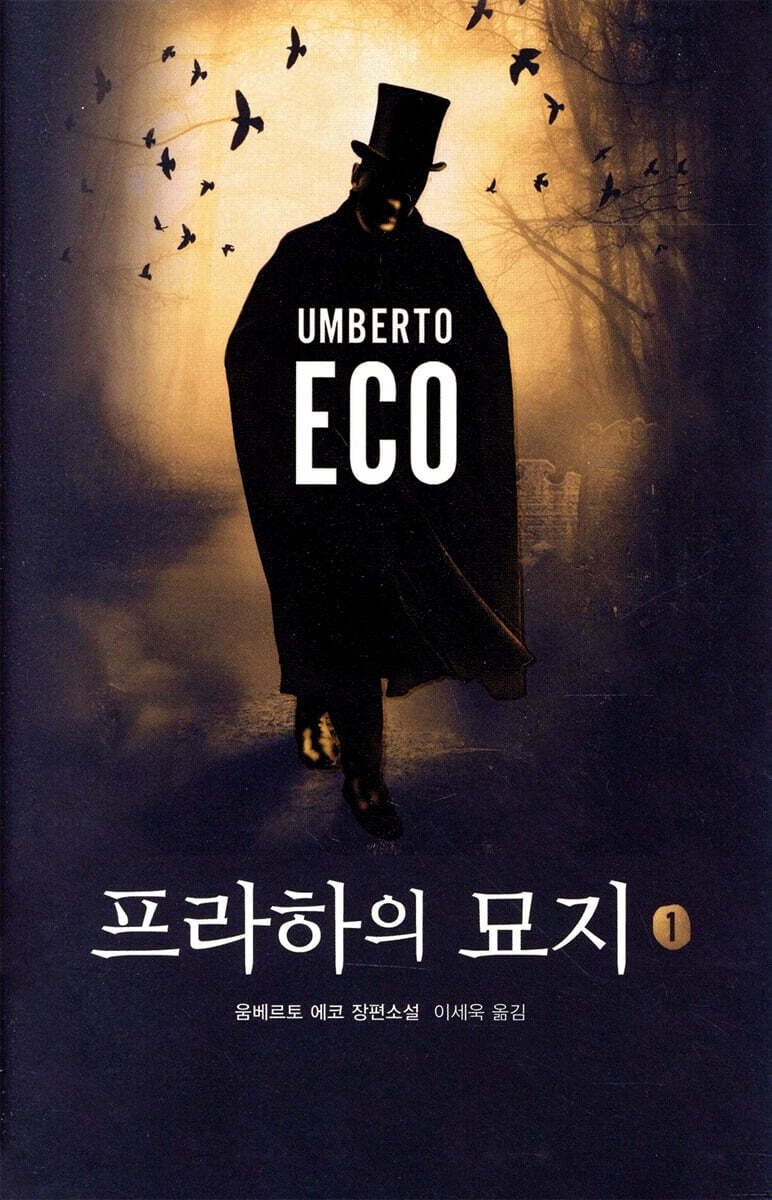
Prague Cemetery 1
 |
Description
Book Introduction
|
Echo returns with a new novel after six years. Umberto Eco's new novel, back after six years! How lies are made, and how they survive! The most influential thinker of our time.
A leading semiotician, a distinguished philosopher, historian, aesthetician, and world-renowned bestselling novelist. Umberto Eco, the greatest intellectual of our time who cannot be defined in a single word, has published a new novel, 『The Prague Cemetery』, translated by Lee Se-wook, by Open Books. In his new work, Echo presents a condensed version of his past research and practice, which has continuously delved into the mechanisms of lies, through the protagonist Simonini, who declares, “I hate, therefore I am.” Simonini, who did not hesitate to frame others, falsify documents, or kill people for his own gain, shows readers how conspiracy theories were produced and spread in the political turmoil of 19th-century Europe. In particular, as Eco revealed in the afterword, the only fictional character in this work is Simonini, and all the main characters are real people, leaving readers confused as to where fact ends and fiction begins. There has also been criticism that the method used to most effectively demonstrate how conspiracy theories are created and spread, in which the conspirators themselves talk about the conspiracies they have fabricated, may serve to reinforce false prejudices rather than unmask the villains. However, these criticisms are claims that will naturally subside when you read the work. Echo's structural arrangement prevents readers from becoming too immersed in the story. Unlike previous works that had a relatively ordinary format, this work unfolds with three narrators taking turns recalling their pasts or organizing their stories. This can be seen as a device to prevent readers from unknowingly identifying with the main characters. When one speaker speaks, another speaker intervenes and raises objections, allowing readers to maintain a critical perspective. This work is a novel that condenses Eco's research and practice, having long explored the mechanisms of lies and the reasons why people fall for blatant lies, and has been more critical than anyone else of the lies of power. It depicts how conspiracy theories were produced and spread in the political turmoil of 19th-century Europe, featuring Simonini, a man who did not hesitate to frame others, falsify documents, or kill people for his own gain. As Eco put it, the protagonist, who is “the most repulsive protagonist in the history of world literature” and the heart of the conspiracy, not only chooses a narrative style that justifies the conspiracy, but also exposes various racial and religious prejudices through his mouth, causing a huge controversy throughout Europe after its publication. The book sold 650,000 copies immediately after its publication in Italy, and the Spanish edition sold 2 million copies in its first edition, becoming a huge bestseller that matched the impact the work had on the world. |
- You can preview some of the book's contents.
Preview
Publisher's Review
Umberto Eco's new full-length novel returns after six years!
The most influential thinker of our time.
A leading semiotician, a distinguished philosopher, historian, aesthetician, and world-renowned bestselling novelist.
Umberto Eco, the greatest intellectual of our time who cannot be defined in a single word, has published a new novel, 『The Prague Cemetery』, translated by Lee Se-wook, by Open Books.
This work is a novel that condenses Eco's research and practice, having long explored the mechanisms of lies and the reasons why people fall for blatant lies, and has been more critical than anyone else of the lies of power.
It depicts how conspiracy theories were produced and spread in the political turmoil of 19th-century Europe, featuring Simonini, a man who did not hesitate to frame others, falsify documents, or kill people for his own gain.
As Eco put it, the protagonist, who is “the most repulsive protagonist in the history of world literature” and the heart of the conspiracy, not only chooses a narrative style that justifies the conspiracy, but also exposes various racial and religious prejudices through his mouth, causing a huge controversy throughout Europe after its publication.
The book sold 650,000 copies immediately after its publication in Italy, and the Spanish edition sold 2 million copies in its first edition, becoming a huge bestseller that matched the impact the work had on the world.
Europe is inflamed by the debate surrounding the Prague Cemetery.
Simonini, the protagonist of this work, is a character who hates everything in this world to the point of declaring, “I hate, therefore I am.”
And of all of them, I hate Jews the most.
The prejudice and hatred against Jews that poured out from his mouth while he was involved in all kinds of dirty conspiracies gave rise to heated debate in European society, which cannot help but be sensitive to anti-Semitism.
The focus of the debate was whether the narrative strategy adopted by this novel would properly convey the truth to the readers, whether it might mix fiction and fact, leading to misunderstandings about what was true, and whether there was a possibility that the readers would interpret it arbitrarily, contrary to the author's intention.
As Eco reveals in his afterword, the only fictional character in this novel is Simonini, while all the main characters are real people.
The events of the 19th century, vividly brought to life by Eco's characteristic erudition, are intricately woven around Simonini, and it is true that readers may be confused about where fact ends and fiction begins.
There has also been criticism that the method used to most effectively demonstrate how conspiracy theories are created and spread, in which the conspirators themselves talk about the conspiracies they have fabricated, may serve to reinforce false prejudices rather than unmask the villains.
However, these criticisms are claims that will naturally subside when you read the work.
Echo's structural arrangement prevents readers from becoming too immersed in the story.
Unlike previous works that had a relatively ordinary format, this work unfolds with three narrators taking turns recalling their pasts or organizing their stories. This can be seen as a device to prevent readers from unknowingly identifying with the main characters.
When one speaker speaks, another speaker intervenes and raises objections, allowing readers to maintain a critical perspective.
The Protocol: The Detonator That Ignited Anti-Semitism
The Protocols of the Elders of Zion, a false document that was later used by the Nazis as a basis for persecuting Jews and changed the course of world history, and is said to have caused the greatest harm in human history.
What historical context and process led to the fabrication of this false document, which incited immense hatred against Jews by claiming they were plotting world domination? What Eco sought to reveal through Simonini, the creator of "Protocols," was the universal form of conspiracy theories and how the establishment creates enemies to maintain power.
In fact, this document was already proven to be false by the London Times in 1921, and has since been proven to be a complete fabrication several times.
Nevertheless, this document has survived to this day, and those who believe it to be authentic have not disappeared.
Eco, who has been interested in the subject of forgery for over 30 to 40 years, says, "People crave mystery (and conspiracy), and even if there is just one clue that provides it, they will think beyond that" (『Crayfish Walk』, p. 373).
Even if you tell them that it is the creation of a con artist, they are ready to believe it.
It is perhaps only natural that Eco would focus on this topic during the Berlusconi era, when he seized power by fully leveraging his position as head of a large broadcasting and media conglomerate despite all the illegalities and corruption he committed.
Whether in the past or present, those who control the media and public opinion have great power.
For the same reason, those in power in our society have waged a fierce battle to bring the mass media, which exerts great influence over the press, to their side as much as possible.
That is why Eco's efforts to illuminate the public's eyes by uncovering the mechanisms of deception, so that they are not fooled by another Simoni "still among us," another protocol that constantly appears, are all the more valuable.
Writing style borrowed from literature and newspaper serial novels
Eco, now in his eighties, has published only six novels in the 30 years since he published The Name of the Rose in 1980.
In an interview with the Paris Review, he revealed that it takes him about six years on average to write a piece, which means he does a lot of thorough research and writes with great care.
In particular, in this work, all characters, backgrounds, and events except for the main character were set as real, so more research and a meticulous strategy to connect the materials would have been necessary.
One of the methods Eco used to solve this problem was “borrowing literature.”
When depicting the streets of 19th-century Paris, recreating the menu of a famous restaurant of the time, or portraying the appearance of a person, he actively referred to literature describing the customs of the time.
For example, the description of the back alleys of Paris is based on Huysmans's monograph, the sea turtle soup is based on Dumas's cookbook, and Garibaldi's Sicilian expedition is based on the later stories of Giuseppe Bandi and Giuseppe Cesare Abba.
Another thing that stands out is the writing style that reproduces the style of 19th century newspaper serial novels.
He does not simply research, but also recreates the style of popular novels that were widely read during the era in which the novel is set.
Eco advised translators in various countries to reproduce the style of 19th-century popular novels without exaggeration, as he had done.
Accordingly, the style that translator Lee Se-wook chose to write in is the adapted novel serialized in our newspaper in the 1910s.
After much effort to translate the work, written in a seemingly old-fashioned style, in accordance with the author's intentions and studying the style of the original Italian text, the Korean edition of "The Prague Cemetery" was completed as a beautiful translation that retains the flavor of the language and a sense of old-fashionedness, yet is not difficult.
The fun things you find in novels
One of the joys of this work, which features a large number of real people and events, is the chance encounters with famous people from the 19th century.
This is because, in addition to the main characters, many characters we know appear in passing, sometimes as supporting characters or sometimes as extras throughout the work.
For example, the person that Simonini, who lost his memory, recalls in order to recall the past is the famous Freud.
The young Freud Simonini met in Paris (he remembers him as "Freud") was a mere greenhorn, lacking confidence, uncertain about his future, and addicted to cocaine, which feels refreshing to modern people who knew him for his later enormous achievements.
Also, the person Simonini meets on the ship to Sicily on his first mission is Alexandre Dumas, the author of The Three Musketeers, and here we also discover his side as a gourmet.
The illustrations placed throughout the novel also enhance the pleasure of reading.
Most of the works, with a few exceptions, are drawn from Eco's own collection, and many of them serve as evidence that the characters and events in the work are not fictional but real.
The 59 illustrations in total will bring the contemporary era to life even more vividly.
*For more detailed information, see the “Translator’s Note” in Volume 2 of “The Prague Cemetery” and the attached materials at the end of this press release (1.
Foreign press articles, 2.
(See the summary of 『The Prague Cemetery』)
Press reviews
It's scholarly yet popular, eerie yet exciting.
I was shocked by the fact that the story of the spies' conspiracy unfolded smoothly over 500 pages.
This book will become a classic.
La Republica
A novel that revives the irreverent and provocative spirit of great literature - "El Cultural"
Here, Echo revives and invokes the vanished literary genre of newspaper serials, touching on the festering wounds of our time: a society built on hypocrisy and lies, hidden power, and racism.
Umberto Eco deals with a very topical yet very dangerous subject between grand political scenarios, crime, murderers, sexy women possessed by the devil, cynical blackmailers and bomb experts.
Liberation
In this novel, which unfolds across 19th-century Paris, Turin, and Palermo, everything is true.
Umberto Eco said he wanted to "create the most disgusting character in the world," but he was so talented.
Simone Simonini, the protagonist inserted into an album of portraits of real people, appears to be a real person in every way, as if enveloped in an aura of truth.
Le Monde
Echo's great virtue is that he is an intellectual who does not carry too much weight.
Life, like fiction, is a wonderful game.
The Guardian
The great trick Eco masterfully employs in this novel is to combine the chilling theme of a single false document leading to genocide with a light-hearted tone.
The light touch that can be found throughout the novel often makes us laugh.
At the heart of "The Prague Cemetery" is a lesson not only about the harm of racism, but also about the mechanisms by which certain groups are demonized and persecuted.
It could have been a frightening and brutal novel, but despite all its dark aspects, readers will ultimately feel that Eco belongs to the most optimistic literature.
The Telegraph
In "The Prague Cemetery," Eco revives and invokes the vanished literary genre of the newspaper serial novel, touching on the festering wounds of our time: a society based on hypocrisy and lies, hidden power, and racism.
- "Liberation"
The most influential thinker of our time.
A leading semiotician, a distinguished philosopher, historian, aesthetician, and world-renowned bestselling novelist.
Umberto Eco, the greatest intellectual of our time who cannot be defined in a single word, has published a new novel, 『The Prague Cemetery』, translated by Lee Se-wook, by Open Books.
This work is a novel that condenses Eco's research and practice, having long explored the mechanisms of lies and the reasons why people fall for blatant lies, and has been more critical than anyone else of the lies of power.
It depicts how conspiracy theories were produced and spread in the political turmoil of 19th-century Europe, featuring Simonini, a man who did not hesitate to frame others, falsify documents, or kill people for his own gain.
As Eco put it, the protagonist, who is “the most repulsive protagonist in the history of world literature” and the heart of the conspiracy, not only chooses a narrative style that justifies the conspiracy, but also exposes various racial and religious prejudices through his mouth, causing a huge controversy throughout Europe after its publication.
The book sold 650,000 copies immediately after its publication in Italy, and the Spanish edition sold 2 million copies in its first edition, becoming a huge bestseller that matched the impact the work had on the world.
Europe is inflamed by the debate surrounding the Prague Cemetery.
Simonini, the protagonist of this work, is a character who hates everything in this world to the point of declaring, “I hate, therefore I am.”
And of all of them, I hate Jews the most.
The prejudice and hatred against Jews that poured out from his mouth while he was involved in all kinds of dirty conspiracies gave rise to heated debate in European society, which cannot help but be sensitive to anti-Semitism.
The focus of the debate was whether the narrative strategy adopted by this novel would properly convey the truth to the readers, whether it might mix fiction and fact, leading to misunderstandings about what was true, and whether there was a possibility that the readers would interpret it arbitrarily, contrary to the author's intention.
As Eco reveals in his afterword, the only fictional character in this novel is Simonini, while all the main characters are real people.
The events of the 19th century, vividly brought to life by Eco's characteristic erudition, are intricately woven around Simonini, and it is true that readers may be confused about where fact ends and fiction begins.
There has also been criticism that the method used to most effectively demonstrate how conspiracy theories are created and spread, in which the conspirators themselves talk about the conspiracies they have fabricated, may serve to reinforce false prejudices rather than unmask the villains.
However, these criticisms are claims that will naturally subside when you read the work.
Echo's structural arrangement prevents readers from becoming too immersed in the story.
Unlike previous works that had a relatively ordinary format, this work unfolds with three narrators taking turns recalling their pasts or organizing their stories. This can be seen as a device to prevent readers from unknowingly identifying with the main characters.
When one speaker speaks, another speaker intervenes and raises objections, allowing readers to maintain a critical perspective.
The Protocol: The Detonator That Ignited Anti-Semitism
The Protocols of the Elders of Zion, a false document that was later used by the Nazis as a basis for persecuting Jews and changed the course of world history, and is said to have caused the greatest harm in human history.
What historical context and process led to the fabrication of this false document, which incited immense hatred against Jews by claiming they were plotting world domination? What Eco sought to reveal through Simonini, the creator of "Protocols," was the universal form of conspiracy theories and how the establishment creates enemies to maintain power.
In fact, this document was already proven to be false by the London Times in 1921, and has since been proven to be a complete fabrication several times.
Nevertheless, this document has survived to this day, and those who believe it to be authentic have not disappeared.
Eco, who has been interested in the subject of forgery for over 30 to 40 years, says, "People crave mystery (and conspiracy), and even if there is just one clue that provides it, they will think beyond that" (『Crayfish Walk』, p. 373).
Even if you tell them that it is the creation of a con artist, they are ready to believe it.
It is perhaps only natural that Eco would focus on this topic during the Berlusconi era, when he seized power by fully leveraging his position as head of a large broadcasting and media conglomerate despite all the illegalities and corruption he committed.
Whether in the past or present, those who control the media and public opinion have great power.
For the same reason, those in power in our society have waged a fierce battle to bring the mass media, which exerts great influence over the press, to their side as much as possible.
That is why Eco's efforts to illuminate the public's eyes by uncovering the mechanisms of deception, so that they are not fooled by another Simoni "still among us," another protocol that constantly appears, are all the more valuable.
Writing style borrowed from literature and newspaper serial novels
Eco, now in his eighties, has published only six novels in the 30 years since he published The Name of the Rose in 1980.
In an interview with the Paris Review, he revealed that it takes him about six years on average to write a piece, which means he does a lot of thorough research and writes with great care.
In particular, in this work, all characters, backgrounds, and events except for the main character were set as real, so more research and a meticulous strategy to connect the materials would have been necessary.
One of the methods Eco used to solve this problem was “borrowing literature.”
When depicting the streets of 19th-century Paris, recreating the menu of a famous restaurant of the time, or portraying the appearance of a person, he actively referred to literature describing the customs of the time.
For example, the description of the back alleys of Paris is based on Huysmans's monograph, the sea turtle soup is based on Dumas's cookbook, and Garibaldi's Sicilian expedition is based on the later stories of Giuseppe Bandi and Giuseppe Cesare Abba.
Another thing that stands out is the writing style that reproduces the style of 19th century newspaper serial novels.
He does not simply research, but also recreates the style of popular novels that were widely read during the era in which the novel is set.
Eco advised translators in various countries to reproduce the style of 19th-century popular novels without exaggeration, as he had done.
Accordingly, the style that translator Lee Se-wook chose to write in is the adapted novel serialized in our newspaper in the 1910s.
After much effort to translate the work, written in a seemingly old-fashioned style, in accordance with the author's intentions and studying the style of the original Italian text, the Korean edition of "The Prague Cemetery" was completed as a beautiful translation that retains the flavor of the language and a sense of old-fashionedness, yet is not difficult.
The fun things you find in novels
One of the joys of this work, which features a large number of real people and events, is the chance encounters with famous people from the 19th century.
This is because, in addition to the main characters, many characters we know appear in passing, sometimes as supporting characters or sometimes as extras throughout the work.
For example, the person that Simonini, who lost his memory, recalls in order to recall the past is the famous Freud.
The young Freud Simonini met in Paris (he remembers him as "Freud") was a mere greenhorn, lacking confidence, uncertain about his future, and addicted to cocaine, which feels refreshing to modern people who knew him for his later enormous achievements.
Also, the person Simonini meets on the ship to Sicily on his first mission is Alexandre Dumas, the author of The Three Musketeers, and here we also discover his side as a gourmet.
The illustrations placed throughout the novel also enhance the pleasure of reading.
Most of the works, with a few exceptions, are drawn from Eco's own collection, and many of them serve as evidence that the characters and events in the work are not fictional but real.
The 59 illustrations in total will bring the contemporary era to life even more vividly.
*For more detailed information, see the “Translator’s Note” in Volume 2 of “The Prague Cemetery” and the attached materials at the end of this press release (1.
Foreign press articles, 2.
(See the summary of 『The Prague Cemetery』)
Press reviews
It's scholarly yet popular, eerie yet exciting.
I was shocked by the fact that the story of the spies' conspiracy unfolded smoothly over 500 pages.
This book will become a classic.
La Republica
A novel that revives the irreverent and provocative spirit of great literature - "El Cultural"
Here, Echo revives and invokes the vanished literary genre of newspaper serials, touching on the festering wounds of our time: a society built on hypocrisy and lies, hidden power, and racism.
Umberto Eco deals with a very topical yet very dangerous subject between grand political scenarios, crime, murderers, sexy women possessed by the devil, cynical blackmailers and bomb experts.
Liberation
In this novel, which unfolds across 19th-century Paris, Turin, and Palermo, everything is true.
Umberto Eco said he wanted to "create the most disgusting character in the world," but he was so talented.
Simone Simonini, the protagonist inserted into an album of portraits of real people, appears to be a real person in every way, as if enveloped in an aura of truth.
Le Monde
Echo's great virtue is that he is an intellectual who does not carry too much weight.
Life, like fiction, is a wonderful game.
The Guardian
The great trick Eco masterfully employs in this novel is to combine the chilling theme of a single false document leading to genocide with a light-hearted tone.
The light touch that can be found throughout the novel often makes us laugh.
At the heart of "The Prague Cemetery" is a lesson not only about the harm of racism, but also about the mechanisms by which certain groups are demonized and persecuted.
It could have been a frightening and brutal novel, but despite all its dark aspects, readers will ultimately feel that Eco belongs to the most optimistic literature.
The Telegraph
In "The Prague Cemetery," Eco revives and invokes the vanished literary genre of the newspaper serial novel, touching on the festering wounds of our time: a society based on hypocrisy and lies, hidden power, and racism.
- "Liberation"
GOODS SPECIFICS
- Date of issue: January 15, 2013
- Format: Hardcover book binding method guide
- Page count, weight, size: 408 pages | 482g | 128*188*30mm
- ISBN13: 9788932916088
- ISBN10: 893291608X
You may also like
카테고리
korean


korean

![GQ KOREA Mark (Monthly): December [2025]](http://librairie.coreenne.fr/cdn/shop/files/8ef265dbbfbf186523ed75ba7319009d.jpg?v=1765340328&width=3840)


