

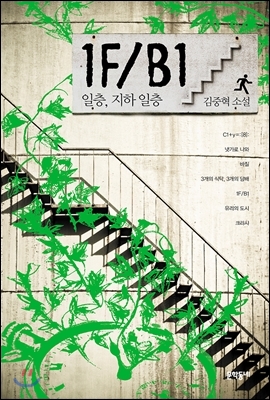
1F/B1 ground floor, basement level 1
 |
Description
Book Introduction
At first glance, Kim Jung-hyuk, an author who deals with cutting-edge media and seems to represent the digital generation, has been writing analog sentences and stories for a long time.
Something that creates long waves over a long period of time and is continuously connected to the present.
In his third novel collection, “First Floor, Basement, First Floor,” Kim Jung-hyuk’s uniquely fresh sensibility does not let go of the long thread of analog.
If the previous two short story collections, 『Penguin News』(2006) and 『Library of Musical Instruments』(2008), featured a museum of various analog tools—LPs, radios, bicycles, maps, typewriters—and a special remix album by Kim Jung-hyuk, this time it's a city.
The city that the narrator in the novel wants to create is likely the city that the author himself wants to create.
The city is not a futuristic city filled with cutting-edge devices, but a place where the salty smell of the sea wafts in as you turn the alleys and cross the numerous forked paths.
There, Kim Jung-hyuk discovers and invents his own city.
The smell of water that suddenly comes upon you as you leave the alley, the abandoned alley, graffiti written on the walls of empty houses where people have moved away, and certain hallucinations/illusions that still remain in the place of the building that has turned into ruins.
And, even to the signs engraved on the body after the breakup.
The city that Kim Jung-hyuk depicts in this collection of short stories is not a physical space, but a place embroidered with memories and experiences.
From objects to humans, and from humans back to space, Kim Jung-hyuk's brilliant urban production story connects alleyways and cities with a long string of analog.
As you explore every nook and cranny of the city he has newly created with his sparkling, cutting-edge sensibility, you will soon find yourself in the reader's mind, with alleyways emerging, empty lots appearing, power lines tangled one by one, and old houses taking their place, each building their own unique city.
What was initially a place that flickered discontinuously eventually became a single picture, with trees growing within it and people who had been forgotten for a while coming back to life, becoming a living city.
In the city that Kim Jung-hyuk created and that we created, we will continue to live like that.
Looking into all the 'in-between', filling in the gaps with my own memories and experiences, and seeking new questions rather than answers.
Something that creates long waves over a long period of time and is continuously connected to the present.
In his third novel collection, “First Floor, Basement, First Floor,” Kim Jung-hyuk’s uniquely fresh sensibility does not let go of the long thread of analog.
If the previous two short story collections, 『Penguin News』(2006) and 『Library of Musical Instruments』(2008), featured a museum of various analog tools—LPs, radios, bicycles, maps, typewriters—and a special remix album by Kim Jung-hyuk, this time it's a city.
The city that the narrator in the novel wants to create is likely the city that the author himself wants to create.
The city is not a futuristic city filled with cutting-edge devices, but a place where the salty smell of the sea wafts in as you turn the alleys and cross the numerous forked paths.
There, Kim Jung-hyuk discovers and invents his own city.
The smell of water that suddenly comes upon you as you leave the alley, the abandoned alley, graffiti written on the walls of empty houses where people have moved away, and certain hallucinations/illusions that still remain in the place of the building that has turned into ruins.
And, even to the signs engraved on the body after the breakup.
The city that Kim Jung-hyuk depicts in this collection of short stories is not a physical space, but a place embroidered with memories and experiences.
From objects to humans, and from humans back to space, Kim Jung-hyuk's brilliant urban production story connects alleyways and cities with a long string of analog.
As you explore every nook and cranny of the city he has newly created with his sparkling, cutting-edge sensibility, you will soon find yourself in the reader's mind, with alleyways emerging, empty lots appearing, power lines tangled one by one, and old houses taking their place, each building their own unique city.
What was initially a place that flickered discontinuously eventually became a single picture, with trees growing within it and people who had been forgotten for a while coming back to life, becoming a living city.
In the city that Kim Jung-hyuk created and that we created, we will continue to live like that.
Looking into all the 'in-between', filling in the gaps with my own memories and experiences, and seeking new questions rather than answers.
- You can preview some of the book's contents.
Preview
index
● c1+y=:[8]: ‥‥‥‥‥‥‥‥‥‥ 『Literature and Society』 Summer 2009
● Come out to the stream ‥‥‥‥‥‥‥‥‥‥‥ 『Korean Literature』 Summer 2011
● Basil ‥‥‥‥‥‥‥‥‥‥‥‥‥ 『Modern Literature』 December 2010
● Three tables, three cigarettes ‥‥‥‥‥‥ 『Creation and Criticism』 Spring 2009
● 1F/B1 ‥‥‥‥‥‥‥‥‥‥‥‥‥ 『Munhakdongne』 Fall 2009 (1st Young Writer Award Grand Prize Winner)
● City of Glass ‥‥‥‥‥‥‥‥‥‥‥『Modern Literature』 August 2009
● Kryasha ‥‥‥‥‥‥‥‥‥‥‥‥‥ 『Daesan Culture』2011 Winter
Commentary: Inventor Kim Jung-hyuk's City-Building Story (Cha Mi-ryeong, literary critic)
● Come out to the stream ‥‥‥‥‥‥‥‥‥‥‥ 『Korean Literature』 Summer 2011
● Basil ‥‥‥‥‥‥‥‥‥‥‥‥‥ 『Modern Literature』 December 2010
● Three tables, three cigarettes ‥‥‥‥‥‥ 『Creation and Criticism』 Spring 2009
● 1F/B1 ‥‥‥‥‥‥‥‥‥‥‥‥‥ 『Munhakdongne』 Fall 2009 (1st Young Writer Award Grand Prize Winner)
● City of Glass ‥‥‥‥‥‥‥‥‥‥‥『Modern Literature』 August 2009
● Kryasha ‥‥‥‥‥‥‥‥‥‥‥‥‥ 『Daesan Culture』2011 Winter
Commentary: Inventor Kim Jung-hyuk's City-Building Story (Cha Mi-ryeong, literary critic)
Into the book
There was a city I wanted to create.
I wanted to create a city where all the alleys are connected, the distinction between the maze and the main street is ambiguous, people are surprised by another scenery at every turn of the alley, and there are so many forks in the road that it is difficult to find your way back.
There is a sea on the outskirts of the city, and I wanted to present to people the scene of waves crashing into you when you have no expectations and then suddenly a fishy smell hits your nose.
When I first encountered 'Boardwinter' after hours of following skateboard graffiti, I saw the city I wanted to create.
The boardwalk was like a sea that suddenly appeared.
I wanted to create a city where all the alleys are connected, the distinction between the maze and the main street is ambiguous, people are surprised by another scenery at every turn of the alley, and there are so many forks in the road that it is difficult to find your way back.
There is a sea on the outskirts of the city, and I wanted to present to people the scene of waves crashing into you when you have no expectations and then suddenly a fishy smell hits your nose.
When I first encountered 'Boardwinter' after hours of following skateboard graffiti, I saw the city I wanted to create.
The boardwalk was like a sea that suddenly appeared.
---「c1+y = :[8]:」
Publisher's Review
From collector to inventor, from DJ to composer,
Inventor Kim Jung-hyuk, this time in the city!
There was a city I wanted to create.
I wanted to create a city where all the alleys are connected, the distinction between the maze and the main street is ambiguous, each turn of the alley reveals another surprising sight, and there are so many forks in the road that it is difficult to retrace your steps.
There is a sea on the outskirts of the city, and I wanted to present to people the scene of waves crashing into you when you have no expectations and then suddenly a fishy smell hits your nose.
_「C1+y=:[8]:」
From the underground to space, from alleyways to the forest of buildings, Kim Jung-hyuk in this collection of short stories rewrites every corner of the city.
A space that is strangely similar to the city we have perceived and recognized, yet also strangely unfamiliar.
Cha Mi-ryeong (literary critic)
In the digital age, writing analog with cutting-edge media
Analog | Things that have waves such as sound, light, and electricity are called analog.
If digital is expressed by changing it into an artificial signal called 0 or 1, analog is something that reproduces the waves generated in nature as much as possible.
In addition to this physical meaning, the term 'analog' is also used to refer to those who, in a society that is rapidly changing due to the development of digital devices, reminisce about the past and wish to return to that era.
To interpret it arbitrarily, analog is a continuous movement that draws a curve, and digital is a flash of discontinuous numbers (0s and 1s) (as in a digital clock).
At first glance, Kim Jung-hyuk, an author who deals with cutting-edge media and seems to represent the digital generation, has been writing analog sentences and stories for a long time.
Something that creates long waves over a long period of time and is continuously connected to the present.
In his third collection of short stories, “First Floor, Basement, First Floor,” Kim Jung-hyuk’s uniquely fresh sensibility does not let go of the long thread of analog.
If the previous two short story collections, 『Penguin News』(2006) and 『Library of Musical Instruments』(2008), featured a museum of various analog tools—LPs, radios, bicycles, maps, typewriters—and a special remix album by Kim Jung-hyuk, this time it's a city.
The city that the narrator in the novel wants to create is likely the city that the author himself wants to create.
The city is not a futuristic city filled with cutting-edge devices, but a place where the salty smell of the sea wafts in as you turn the alleys and cross the numerous forked paths.
There, Kim Jung-hyuk discovers and invents his own city.
The smell of water that suddenly comes upon you as you leave the alley, the abandoned alley, graffiti written on the walls of empty houses where people have moved away, and certain hallucinations/illusions that still remain in the place of the building that has turned into ruins.
And, even to the signs engraved on the body after the breakup.
It is a place where hidden alleys and unexpected empty spaces that cannot be created with urban planning (「C1+y=:[8]:」), a place where there is a stream where legends are created (「Come out to the stream」), and a place where strange plants grow in vines as you go around the narrow walls of houses in the city center (「Basil」).
It is also a place that exists in all 'in-between'.
This 'in-between' is a gap that cannot exist in the digital world that flickers and is disconnected/segmented with 0 and 1, and is a part of a continuous wave, a process.
Talking about all the 'between'
"1F/B1" shows us, with precision and composure, the vast, unfamiliar space of the "in-between" that we have overlooked, invisible to the eye.
I was amazed by the power of imagination that penetrated into that 'in-between' that I had never seen before.
Shin Kyung-sook (novelist)
The secret management office was a space that did not exist in numbers.
It was somewhere between the first floor and the basement, a very thin space like a slash (/) where no one would notice its existence. _「1F/B1」
People live happily in their own tiers, but we are always the ones who are stuck.
They are people who are neither here nor there, just in between.
We live between the basement and the first floor, the first floor and the second floor, the second floor and the third floor, and between the floors.
But we must remember.
If slashes were removed, people would be incredibly confused.
We are very small but essential beings.
_「1F/B1」
There—Kim Jung-hyuk's city—exists between fiction and reality ("Come Out to the Stream"), between walls ("1F/B1"), between disappeared alleys and collapsed ruins, between magic and illusion ("Kryasha").
In Megalo City, where the dwindling number of my lifespan soon becomes my name, people know when their lives will end (“Three Tables, Three Cigarettes”), and in Seoul, a modern city surrounded by tens of thousands of glasses, the glasses fall of their own accord (“City of Glass”).
In this city where life and magic, reality and illusion, are indistinguishable, the novel's protagonist sees and hears lost faces and voices.
Those who confuse life with magic cannot do real magic.
(……) Dabin gave up on life and chose magic.
People forget life and see hallucinations through his magic.
_「Kryasha」
I also have hallucinations sometimes.
There are times when things that were there and then disappeared are visible.
Sometimes my mother suddenly appears.
There was a time when I almost spoke to him.
_「Kryasha」
Kim Jung-hyuk creates new stories in all these ‘in-between’ places.
It will also be Kim Jung-hyuk's city, armed with analog weapons.
It is a world that cannot be quantified, a world that cannot be visualized, a hidden world, a space that exists in memory, a space that moves the heart.
So, what is lost, what has disappeared, what is forgotten, what is in between is restored anew at the writer's fingertips.
Perhaps it is not a restoration of a city from a bygone era, but a new city that has emerged with the label “made in Kim Jung-hyuk.”
Another question, asking a question
The city we live in now—the digital world—may be a place where there are answers but no questions.
The answers are everywhere.
There are model answers everywhere.
No one questions the answers that are already out there.
Just moving towards that answer.
Here again, Kim Jung-hyuk's 'Sai-gap' asks:
So the question is?
“To someone who knows he has only ninety-six hours left, dying is of no consequence.”
“Then what’s important?”
“I have a question.”
“What question?”
Any question is fine.
“I already know the answer, so all I need is a question.”
"I want to know the question." _「Three Tables, Three Cigarettes」
“If you have any last words, please do so.
(……) sorry.
I can't tell you.
“I’m just listening.”
“What does that mean?”
“I’m sorry you think that way.
I think it has great significance.
Because this is our last conversation.” _「Three Tables, Three Cigarettes」
Dying is of no consequence to a twenty-year-old girl who knows she has only ninety-six hours left.
Because the answer is already out there.
The important thing is the question.
Not a single correct answer given to each person living in a different time, but each of their questions, each of our questions.
To get the right answers, you have to ask the right questions, and to ask the right questions, you have to have the right questions.
_「City of Glass」
From 'made in Kim Jung-hyuk' to 'made in ***'
For Kim Jung-hyuk, a place is a medium that forms identity, a foundation for alternative culture, a human space where deep communication takes place, or a birthplace of legendary stories.
One of the things Kim Jung-hyuk does in this novel is to make us perceive the alleyways in a new way, which are now treated as objects of forgotten nostalgia or relics in need of redevelopment.
Cha Mi-ryeong (literary critic)
The city that Kim Jung-hyuk depicts in this collection of short stories is not a physical space, but a place embroidered with memories and experiences.
From objects to humans, and from humans back to space, Kim Jung-hyuk's brilliant urban production story connects alleyways and cities with a long string of analog.
As you explore every nook and cranny of the city he has newly created with his sparkling, cutting-edge sensibility, you will soon find yourself in the reader's mind, with alleyways emerging, empty lots appearing, power lines tangled one by one, and old houses taking their place, each building their own unique city.
What was initially a place that flickered discontinuously eventually became a single picture, with trees growing within it and people who had been forgotten for a while coming back to life, becoming a living city.
In the city that Kim Jung-hyuk created and that we created, we will continue to live like that.
Looking into all the 'in-between', filling in the gaps with my own memories and experiences, and seeking new questions rather than answers.
Inventor Kim Jung-hyuk, this time in the city!
There was a city I wanted to create.
I wanted to create a city where all the alleys are connected, the distinction between the maze and the main street is ambiguous, each turn of the alley reveals another surprising sight, and there are so many forks in the road that it is difficult to retrace your steps.
There is a sea on the outskirts of the city, and I wanted to present to people the scene of waves crashing into you when you have no expectations and then suddenly a fishy smell hits your nose.
_「C1+y=:[8]:」
From the underground to space, from alleyways to the forest of buildings, Kim Jung-hyuk in this collection of short stories rewrites every corner of the city.
A space that is strangely similar to the city we have perceived and recognized, yet also strangely unfamiliar.
Cha Mi-ryeong (literary critic)
In the digital age, writing analog with cutting-edge media
Analog | Things that have waves such as sound, light, and electricity are called analog.
If digital is expressed by changing it into an artificial signal called 0 or 1, analog is something that reproduces the waves generated in nature as much as possible.
In addition to this physical meaning, the term 'analog' is also used to refer to those who, in a society that is rapidly changing due to the development of digital devices, reminisce about the past and wish to return to that era.
To interpret it arbitrarily, analog is a continuous movement that draws a curve, and digital is a flash of discontinuous numbers (0s and 1s) (as in a digital clock).
At first glance, Kim Jung-hyuk, an author who deals with cutting-edge media and seems to represent the digital generation, has been writing analog sentences and stories for a long time.
Something that creates long waves over a long period of time and is continuously connected to the present.
In his third collection of short stories, “First Floor, Basement, First Floor,” Kim Jung-hyuk’s uniquely fresh sensibility does not let go of the long thread of analog.
If the previous two short story collections, 『Penguin News』(2006) and 『Library of Musical Instruments』(2008), featured a museum of various analog tools—LPs, radios, bicycles, maps, typewriters—and a special remix album by Kim Jung-hyuk, this time it's a city.
The city that the narrator in the novel wants to create is likely the city that the author himself wants to create.
The city is not a futuristic city filled with cutting-edge devices, but a place where the salty smell of the sea wafts in as you turn the alleys and cross the numerous forked paths.
There, Kim Jung-hyuk discovers and invents his own city.
The smell of water that suddenly comes upon you as you leave the alley, the abandoned alley, graffiti written on the walls of empty houses where people have moved away, and certain hallucinations/illusions that still remain in the place of the building that has turned into ruins.
And, even to the signs engraved on the body after the breakup.
It is a place where hidden alleys and unexpected empty spaces that cannot be created with urban planning (「C1+y=:[8]:」), a place where there is a stream where legends are created (「Come out to the stream」), and a place where strange plants grow in vines as you go around the narrow walls of houses in the city center (「Basil」).
It is also a place that exists in all 'in-between'.
This 'in-between' is a gap that cannot exist in the digital world that flickers and is disconnected/segmented with 0 and 1, and is a part of a continuous wave, a process.
Talking about all the 'between'
"1F/B1" shows us, with precision and composure, the vast, unfamiliar space of the "in-between" that we have overlooked, invisible to the eye.
I was amazed by the power of imagination that penetrated into that 'in-between' that I had never seen before.
Shin Kyung-sook (novelist)
The secret management office was a space that did not exist in numbers.
It was somewhere between the first floor and the basement, a very thin space like a slash (/) where no one would notice its existence. _「1F/B1」
People live happily in their own tiers, but we are always the ones who are stuck.
They are people who are neither here nor there, just in between.
We live between the basement and the first floor, the first floor and the second floor, the second floor and the third floor, and between the floors.
But we must remember.
If slashes were removed, people would be incredibly confused.
We are very small but essential beings.
_「1F/B1」
There—Kim Jung-hyuk's city—exists between fiction and reality ("Come Out to the Stream"), between walls ("1F/B1"), between disappeared alleys and collapsed ruins, between magic and illusion ("Kryasha").
In Megalo City, where the dwindling number of my lifespan soon becomes my name, people know when their lives will end (“Three Tables, Three Cigarettes”), and in Seoul, a modern city surrounded by tens of thousands of glasses, the glasses fall of their own accord (“City of Glass”).
In this city where life and magic, reality and illusion, are indistinguishable, the novel's protagonist sees and hears lost faces and voices.
Those who confuse life with magic cannot do real magic.
(……) Dabin gave up on life and chose magic.
People forget life and see hallucinations through his magic.
_「Kryasha」
I also have hallucinations sometimes.
There are times when things that were there and then disappeared are visible.
Sometimes my mother suddenly appears.
There was a time when I almost spoke to him.
_「Kryasha」
Kim Jung-hyuk creates new stories in all these ‘in-between’ places.
It will also be Kim Jung-hyuk's city, armed with analog weapons.
It is a world that cannot be quantified, a world that cannot be visualized, a hidden world, a space that exists in memory, a space that moves the heart.
So, what is lost, what has disappeared, what is forgotten, what is in between is restored anew at the writer's fingertips.
Perhaps it is not a restoration of a city from a bygone era, but a new city that has emerged with the label “made in Kim Jung-hyuk.”
Another question, asking a question
The city we live in now—the digital world—may be a place where there are answers but no questions.
The answers are everywhere.
There are model answers everywhere.
No one questions the answers that are already out there.
Just moving towards that answer.
Here again, Kim Jung-hyuk's 'Sai-gap' asks:
So the question is?
“To someone who knows he has only ninety-six hours left, dying is of no consequence.”
“Then what’s important?”
“I have a question.”
“What question?”
Any question is fine.
“I already know the answer, so all I need is a question.”
"I want to know the question." _「Three Tables, Three Cigarettes」
“If you have any last words, please do so.
(……) sorry.
I can't tell you.
“I’m just listening.”
“What does that mean?”
“I’m sorry you think that way.
I think it has great significance.
Because this is our last conversation.” _「Three Tables, Three Cigarettes」
Dying is of no consequence to a twenty-year-old girl who knows she has only ninety-six hours left.
Because the answer is already out there.
The important thing is the question.
Not a single correct answer given to each person living in a different time, but each of their questions, each of our questions.
To get the right answers, you have to ask the right questions, and to ask the right questions, you have to have the right questions.
_「City of Glass」
From 'made in Kim Jung-hyuk' to 'made in ***'
For Kim Jung-hyuk, a place is a medium that forms identity, a foundation for alternative culture, a human space where deep communication takes place, or a birthplace of legendary stories.
One of the things Kim Jung-hyuk does in this novel is to make us perceive the alleyways in a new way, which are now treated as objects of forgotten nostalgia or relics in need of redevelopment.
Cha Mi-ryeong (literary critic)
The city that Kim Jung-hyuk depicts in this collection of short stories is not a physical space, but a place embroidered with memories and experiences.
From objects to humans, and from humans back to space, Kim Jung-hyuk's brilliant urban production story connects alleyways and cities with a long string of analog.
As you explore every nook and cranny of the city he has newly created with his sparkling, cutting-edge sensibility, you will soon find yourself in the reader's mind, with alleyways emerging, empty lots appearing, power lines tangled one by one, and old houses taking their place, each building their own unique city.
What was initially a place that flickered discontinuously eventually became a single picture, with trees growing within it and people who had been forgotten for a while coming back to life, becoming a living city.
In the city that Kim Jung-hyuk created and that we created, we will continue to live like that.
Looking into all the 'in-between', filling in the gaps with my own memories and experiences, and seeking new questions rather than answers.
GOODS SPECIFICS
- Date of publication: June 13, 2012
- Page count, weight, size: 304 pages | 368g | 135*200*30mm
- ISBN13: 9788954618472
- ISBN10: 8954618472
You may also like
카테고리
korean


korean

![GQ KOREA Mark (Monthly): December [2025]](http://librairie.coreenne.fr/cdn/shop/files/8ef265dbbfbf186523ed75ba7319009d.jpg?v=1765340328&width=3840)


