

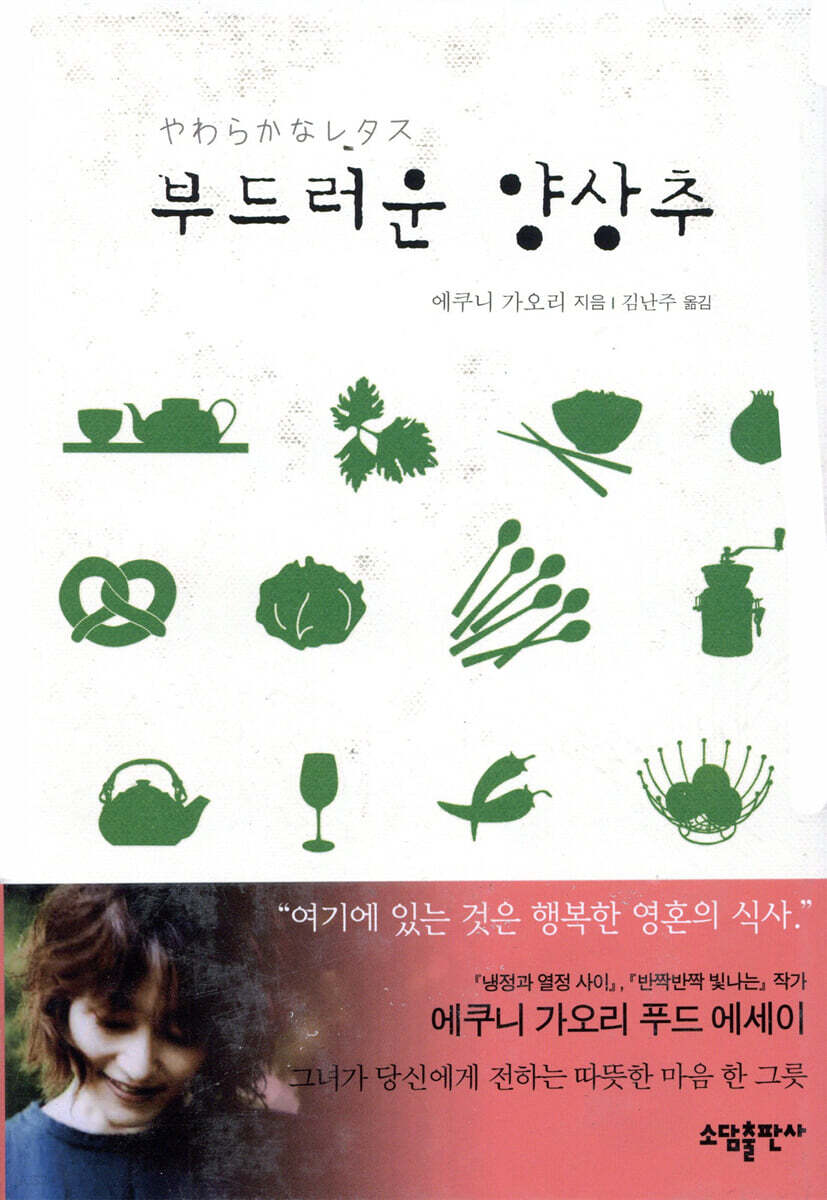
soft lettuce
 |
Description
Book Introduction
Kaori Ekuni, author of “Between Coolness and Passion” and “Sparkling”
A bowl of warm heart for you
Ekuni's latest work, published in Japan in February 2011, is a collection of essays that gently unfold Ekuni's daily life and the food that accompanies it, in Ekuni's signature writing style.
This is a story about the stories, memories, scenery, and people who were with the author Ekuni Kaori's favorite foods.
She whispers every day, as if writing a diary, about what food (or what ingredient) she likes, why she likes it, who she was with at the time, and what happened.
Although it is entirely his own story, it is a collection of short stories about ordinary daily life that we commonly encounter around us, so anyone can easily relate to it.
Ekuni Kaori captures the small moments of everyday life and, with her signature delicate and sensuous writing style, naturally unfolds the foods she treasures, the people she met, and the scenery she experienced in those places in 40 essays.
In each essay, there is the fun of encountering a variety of foods and Ekuni Kaori's daily life outside of the novel.
You can see a variety of scenes from her extremely ordinary daily life, such as shopping at the supermarket with her husband, writing a manuscript in her studio, and walking down the street while shopping with her younger sibling, as well as her memories of her childhood, when she loved the frilly white fat that swells like 'kkodulkkodul' when grilling thinly sliced beef, and only ate lemon shaved ice at the beach.
Also, you can get a glimpse of Ekuni Kaori's human(?) side, such as being afraid of using machines and being proud when she, a road idiot, arrives at the meeting place on time safely, so it seems worth looking forward to.
The lovely illustrations in the book are also enough to capture our attention.
A bowl of warm heart for you
Ekuni's latest work, published in Japan in February 2011, is a collection of essays that gently unfold Ekuni's daily life and the food that accompanies it, in Ekuni's signature writing style.
This is a story about the stories, memories, scenery, and people who were with the author Ekuni Kaori's favorite foods.
She whispers every day, as if writing a diary, about what food (or what ingredient) she likes, why she likes it, who she was with at the time, and what happened.
Although it is entirely his own story, it is a collection of short stories about ordinary daily life that we commonly encounter around us, so anyone can easily relate to it.
Ekuni Kaori captures the small moments of everyday life and, with her signature delicate and sensuous writing style, naturally unfolds the foods she treasures, the people she met, and the scenery she experienced in those places in 40 essays.
In each essay, there is the fun of encountering a variety of foods and Ekuni Kaori's daily life outside of the novel.
You can see a variety of scenes from her extremely ordinary daily life, such as shopping at the supermarket with her husband, writing a manuscript in her studio, and walking down the street while shopping with her younger sibling, as well as her memories of her childhood, when she loved the frilly white fat that swells like 'kkodulkkodul' when grilling thinly sliced beef, and only ate lemon shaved ice at the beach.
Also, you can get a glimpse of Ekuni Kaori's human(?) side, such as being afraid of using machines and being proud when she, a road idiot, arrives at the meeting place on time safely, so it seems worth looking forward to.
The lovely illustrations in the book are also enough to capture our attention.
- You can preview some of the book's contents.
Preview
index
warm juice
Seollal, or another warm juice
The story of grocery shopping, or refreshing stir-fried squid
daegu
The day before the beginning of spring
Frying pan and fried egg
It's raining outside
The Wandering Waiter
Taste of Heaven
New York, snowstorms and donuts
New York, Pig Nose
Stir-fried seaweed
white bread and black bread
The lingering feeling of travel
Eight
Train travel and extinction lunchbox
'Crunch crunch'
Umu hymn
Rose and grilled eel
Delicious food, or the fascinating Yokkaichi
The pride of 'Doenjang'
Gilchi, or the full story of the pre-meeting
Rainy morning in the kitchen
Reservist
Fruit, fruit, fruit!
Hospital and pig's feet
Kim Dosirak
And life goes on
The Mystery of Buttermilk
Sugar from the Showa era
cold meat
Summer vacation, udon, and Sudoku
Viva, Massage
Food at the bar and Alaska
a grape
And the hippos were cooked to death in the tanks
Asahikawa's soda water
Potage and Machine
Bread and the Unwritten Rule
soft lettuce
Translator's Note
Seollal, or another warm juice
The story of grocery shopping, or refreshing stir-fried squid
daegu
The day before the beginning of spring
Frying pan and fried egg
It's raining outside
The Wandering Waiter
Taste of Heaven
New York, snowstorms and donuts
New York, Pig Nose
Stir-fried seaweed
white bread and black bread
The lingering feeling of travel
Eight
Train travel and extinction lunchbox
'Crunch crunch'
Umu hymn
Rose and grilled eel
Delicious food, or the fascinating Yokkaichi
The pride of 'Doenjang'
Gilchi, or the full story of the pre-meeting
Rainy morning in the kitchen
Reservist
Fruit, fruit, fruit!
Hospital and pig's feet
Kim Dosirak
And life goes on
The Mystery of Buttermilk
Sugar from the Showa era
cold meat
Summer vacation, udon, and Sudoku
Viva, Massage
Food at the bar and Alaska
a grape
And the hippos were cooked to death in the tanks
Asahikawa's soda water
Potage and Machine
Bread and the Unwritten Rule
soft lettuce
Translator's Note
Detailed image

Into the book
One drink will warm your heart and make you feel like your stomach is on fire.
Sweetness will spread in your mouth, and your strength will surge.
It will be a moderately warm temperature, not too hot.
A temperature suitable for a liquid that slowly penetrates and warms the body while slightly satisfying hunger, soothing the mood, and also giving energy. --- Among warm juices
I can't help but think about my favorite fried eggs.
When I was a kid, I used to fry eggs beautifully in a dark, heavy frying pan with a lot of oil.
A fried egg with a golden border that wavy like frills or lace, and a yolk that is just right, even though the white is bumpy.
I was worried that the yolk might burst when I moved it to the plate, but no matter how nervous I was, I had no choice but to move it. ---From the frying pan and the fried egg
Instead, my dad developed a strange hobby.
“Close your eyes tightly and say, ‘Ah, try it.’”
Then he fed my brother and I small kimbap.
Kimbap is made with rice and roasted seaweed in a can, and is a snack just for dad.
The side dish was sometimes just salted seafood, sometimes salted mackerel ovary, and sometimes blanched spinach with just a sprinkle of soy sauce.
And sometimes it was fava beans, sometimes it was dried fish, sometimes it was canned salmon mixed with mayonnaise.
You shouldn't ask, "What's inside?"
He carefully opened his mouth and said, “I trust you, Dad.”
And if you chew it carefully, it's usually something delicious—most of the side dishes go well with rice—but sometimes there are things that are out of the ordinary.
A round slice of lemon or a slice of tangerine (of course, the tangerine is not a side dish)
I think my dad would secretly peel and prepare it under the table in the ashtray that was always next to him.)
When we flinched, he would pretend not to notice, saying, “Sometimes you have to take risks to eat something delicious.”
---Among the little things
So, when I went out to cover a story for a novel and saw a bucket of water dripping from the uncut burdock, I thought, 'That's it!'
Of course, if you buy the burdock, it seems like they'll cut it on the spot, but if you ask, they can sell it as is, and then I can cut it and eat it with my beautiful 'burdock cutter'.
If I lived next to this store… … .
While I was having such a dream, Umu suddenly appeared in the novel.
The current Umu store is the fourth place I wish was right next to my house, after the animal hospital, post office, and sports center.
---From the song of Umu
I think language is truly amazing.
On a rainy morning in the kitchen, I became convinced that loquats are not kind because they have this color, shape, and taste, but because they are kind, they are this color, shape, and taste like this fruit.
---In the kitchen on a rainy morning
In my 20s, especially when planning a trip, I liked to go without reservations.
I thought making reservations was old-fashioned and unfashionable.
I also thought that the true joy of traveling was going wherever your feet took you.
Buying a cheap, one-year open ticket, boarding a plane, and leaving without even deciding where to stay or where to go is considered free travel.
Those times were fun in their own way.
I guess he wanted to prove to himself that he could do anything on his own, no matter where he set foot.
But now you don't have to prove it.
Since there is nothing safe in the world or in life, I want to enjoy small pleasures like traveling or eating out without worry, so I make reservations and go out. --- From the reservation disease
While piping hot meat dishes are certainly delicious, cold meat has a certain warmth, like meeting an old friend.
So I just give in to it.
It's good to eat anytime.
It doesn't make you feel full or bloated.
And what's even better is the coldness, or rather the spiciness and politeness of cold meat.
Although we are old friends, he doesn't act overly happy.
It's not annoying because it doesn't act friendly.
During the day, when I feel like just eating fruit is a bit lacking, I often eat cold meat.
Cold meat is moist.
Be careful.
But it also has the taste and chewiness of processed meat itself.
The flavors of the seasonings—pepper for pepper, smoked chips for smoked chips, bell pepper for bell pepper, consommé for consommé—are simple but sufficient to fulfill their role.
Simple, really easy to understand taste.---From cold meat
I love potage so much I don't know what to do.
Corn potage, vichyssoise, pea potage.
These three are the shining protagonists.
However, you can make a variety of potages with different vegetables.
Mushrooms, cress, carrots, and zucchini.
My favorite is celery potage.
Eat it cool in the summer and warm in the winter.
I think the good thing about potage is, first of all, the temperature - the warmth when it's warm, the coolness when it's cold - then the texture on the tongue - not too soft, and you can feel the presence of the vegetables slightly - and the rich but not too sharp taste.
When you eat a delicious potage, you feel the taste spreading throughout your body, into every cell.
It's a quiet food (there are quiet and noisy foods).
The potage is utterly quiet, and I may like that.
---Among potage and machines
But there is an unwritten rule between me and my brother regarding bread.
The thing about baguettes is that you eat them the day you buy them, no matter what.
Since that unwritten rule was established—I don't know exactly when, but it was probably when my brother was in elementary school and I was in college—we've been stubbornly faithful to it.
Needless to say, baguettes lose their flavor after a night, to the point where you'll think they've turned into a different kind of bread.
First of all, the crispy, crumbly skin disappears.
Then, the moist, soft flesh, with the sweetness of flour, dries out on the inside.
So, we keep an unwritten rule of eating food on the day we buy it. The reason we keep promises that no one will be bothered by if we don't keep them is probably because we are stubborn.
Sweetness will spread in your mouth, and your strength will surge.
It will be a moderately warm temperature, not too hot.
A temperature suitable for a liquid that slowly penetrates and warms the body while slightly satisfying hunger, soothing the mood, and also giving energy. --- Among warm juices
I can't help but think about my favorite fried eggs.
When I was a kid, I used to fry eggs beautifully in a dark, heavy frying pan with a lot of oil.
A fried egg with a golden border that wavy like frills or lace, and a yolk that is just right, even though the white is bumpy.
I was worried that the yolk might burst when I moved it to the plate, but no matter how nervous I was, I had no choice but to move it. ---From the frying pan and the fried egg
Instead, my dad developed a strange hobby.
“Close your eyes tightly and say, ‘Ah, try it.’”
Then he fed my brother and I small kimbap.
Kimbap is made with rice and roasted seaweed in a can, and is a snack just for dad.
The side dish was sometimes just salted seafood, sometimes salted mackerel ovary, and sometimes blanched spinach with just a sprinkle of soy sauce.
And sometimes it was fava beans, sometimes it was dried fish, sometimes it was canned salmon mixed with mayonnaise.
You shouldn't ask, "What's inside?"
He carefully opened his mouth and said, “I trust you, Dad.”
And if you chew it carefully, it's usually something delicious—most of the side dishes go well with rice—but sometimes there are things that are out of the ordinary.
A round slice of lemon or a slice of tangerine (of course, the tangerine is not a side dish)
I think my dad would secretly peel and prepare it under the table in the ashtray that was always next to him.)
When we flinched, he would pretend not to notice, saying, “Sometimes you have to take risks to eat something delicious.”
---Among the little things
So, when I went out to cover a story for a novel and saw a bucket of water dripping from the uncut burdock, I thought, 'That's it!'
Of course, if you buy the burdock, it seems like they'll cut it on the spot, but if you ask, they can sell it as is, and then I can cut it and eat it with my beautiful 'burdock cutter'.
If I lived next to this store… … .
While I was having such a dream, Umu suddenly appeared in the novel.
The current Umu store is the fourth place I wish was right next to my house, after the animal hospital, post office, and sports center.
---From the song of Umu
I think language is truly amazing.
On a rainy morning in the kitchen, I became convinced that loquats are not kind because they have this color, shape, and taste, but because they are kind, they are this color, shape, and taste like this fruit.
---In the kitchen on a rainy morning
In my 20s, especially when planning a trip, I liked to go without reservations.
I thought making reservations was old-fashioned and unfashionable.
I also thought that the true joy of traveling was going wherever your feet took you.
Buying a cheap, one-year open ticket, boarding a plane, and leaving without even deciding where to stay or where to go is considered free travel.
Those times were fun in their own way.
I guess he wanted to prove to himself that he could do anything on his own, no matter where he set foot.
But now you don't have to prove it.
Since there is nothing safe in the world or in life, I want to enjoy small pleasures like traveling or eating out without worry, so I make reservations and go out. --- From the reservation disease
While piping hot meat dishes are certainly delicious, cold meat has a certain warmth, like meeting an old friend.
So I just give in to it.
It's good to eat anytime.
It doesn't make you feel full or bloated.
And what's even better is the coldness, or rather the spiciness and politeness of cold meat.
Although we are old friends, he doesn't act overly happy.
It's not annoying because it doesn't act friendly.
During the day, when I feel like just eating fruit is a bit lacking, I often eat cold meat.
Cold meat is moist.
Be careful.
But it also has the taste and chewiness of processed meat itself.
The flavors of the seasonings—pepper for pepper, smoked chips for smoked chips, bell pepper for bell pepper, consommé for consommé—are simple but sufficient to fulfill their role.
Simple, really easy to understand taste.---From cold meat
I love potage so much I don't know what to do.
Corn potage, vichyssoise, pea potage.
These three are the shining protagonists.
However, you can make a variety of potages with different vegetables.
Mushrooms, cress, carrots, and zucchini.
My favorite is celery potage.
Eat it cool in the summer and warm in the winter.
I think the good thing about potage is, first of all, the temperature - the warmth when it's warm, the coolness when it's cold - then the texture on the tongue - not too soft, and you can feel the presence of the vegetables slightly - and the rich but not too sharp taste.
When you eat a delicious potage, you feel the taste spreading throughout your body, into every cell.
It's a quiet food (there are quiet and noisy foods).
The potage is utterly quiet, and I may like that.
---Among potage and machines
But there is an unwritten rule between me and my brother regarding bread.
The thing about baguettes is that you eat them the day you buy them, no matter what.
Since that unwritten rule was established—I don't know exactly when, but it was probably when my brother was in elementary school and I was in college—we've been stubbornly faithful to it.
Needless to say, baguettes lose their flavor after a night, to the point where you'll think they've turned into a different kind of bread.
First of all, the crispy, crumbly skin disappears.
Then, the moist, soft flesh, with the sweetness of flour, dries out on the inside.
So, we keep an unwritten rule of eating food on the day we buy it. The reason we keep promises that no one will be bothered by if we don't keep them is probably because we are stubborn.
---Among bread and unwritten rules
Publisher's Review
“What we have here is a meal for the happy soul.”
Kaori Ekuni, author of “Between Coolness and Passion” and “Sparkling”
A bowl of warm heart for you
“Memories of delicious food always accompany our joys and sorrows.
A cold beer at the end of the day makes us happy, and a flat beer makes us angry.
Any drink that those in love drink is sweet and refreshing, and any drink that those who have turned their backs on love drink is bitter and painful.
Just as good music evokes the joys of life along with its ups and downs, and squeezes out tears of love and hate.
The reason food touches our primal senses so much is probably because it is life itself.
“In the face of life, no one can avoid fiercely sharpening their senses.”
-Kim Nan-ju-
“How wonderful it is to be able to eat the food you love.”
This is the third collection of essays published in Korea, following “How Many Weekends Do You Have?” in 2004 and “Not Enough to Get Drunk” in 2009.
This work is Ekuni's latest work, published in Japan in February 2011. It is a collection of essays that gently unravel Ekuni's daily life and the food that accompanies it, in Ekuni's signature writing style.
Let's meet the real Ekuni outside of the novels in the essay collection "Soft Lettuce," which is made up of language, novels, travel, and the small moments of everyday life surrounding food.
# One bite will warm your heart and make your stomach feel like it's on fire.
Sweetness will spread in your mouth, and your strength will surge.
Something that warms your body, slightly satisfies your hunger, soothes your mood, and gives you energy.
"Soft Lettuce" is a story about the stories, memories, landscapes, and people who were with the author Ekuni Kaori's favorite foods.
She whispers every day, as if writing a diary, about what food (or what ingredient) she likes, why she likes it, who she was with at the time, and what happened.
Although it is entirely his own story, it is a collection of short stories about ordinary daily life that we commonly encounter around us, so anyone can easily relate to it.
Ekuni Kaori also talks about the preciousness of daily life, such as finding comfort in eating things like 'warm juice', which is rich, warm, and not too hot, that soothes and energizes you when you drink a glass of it, or 'cold meat', which gives you a warm feeling like meeting an old friend, or thinking about things you ate in the past.
Many people are constantly stressed in their daily lives, but when you have a good time laughing and chatting with a good friend while eating delicious food, the stress you felt during the day can disappear without you noticing.
Perhaps what can truly move your heart more than the common words of comfort is the warmth and happiness conveyed through a bowl of soup shared together.
Readers tired of the repetitive daily routine will find solace in the lovely days and delicious food stories told by Ekuni Kaori in "Soft Lettuce," and they may even come up with their own unique food that energizes them.
# “It was only two days of eating like that, but there is one sight I will never forget.
“It wasn’t what I ate, it was what a stranger drank, and the scenery.”
Pilaf, a dish that tastes like a sunny day, friendly loquat, quiet potage, and unflattering cup ramen - all these foods that captured Ekuni Kaori's heart, along with the time and place he spent with them.
Ekuni Kaori captures the small moments of everyday life and, with her signature delicate and sensuous writing style, naturally unfolds the foods she treasures, the people she met, and the scenery she experienced in those places in 40 essays.
In each essay, there is the fun of encountering a variety of foods and Ekuni Kaori's daily life outside of the novel.
You can see a variety of scenes from her extremely ordinary daily life, such as shopping at the supermarket with her husband, writing a manuscript in her studio, and walking down the street while shopping with her younger sibling, as well as her memories of her childhood, when she loved the frilly white fat that swells like 'kkodulkkodul' when grilling thinly sliced beef, and only ate lemon shaved ice at the beach.
Also, you can get a glimpse of Ekuni Kaori's human(?) side, such as being afraid of using machines and being proud when she, a road idiot, arrives at the meeting place on time safely, so it seems worth looking forward to.
The lovely illustrations in the book are also enough to capture our attention.
If you're curious about why it's soft lettuce and not crunchy lettuce, if you want to know the real Ekuni beyond the novel, and if you're a reader who loves Ekuni Kaori and her work, you shouldn't miss this work, which gives you a full glimpse into the daily life and inner self of Ekuni Kaori, a charming writer and an extremely ordinary person, something you couldn't know just by reading the novel, or something you became more curious about the more you read.
Kaori Ekuni, author of “Between Coolness and Passion” and “Sparkling”
A bowl of warm heart for you
“Memories of delicious food always accompany our joys and sorrows.
A cold beer at the end of the day makes us happy, and a flat beer makes us angry.
Any drink that those in love drink is sweet and refreshing, and any drink that those who have turned their backs on love drink is bitter and painful.
Just as good music evokes the joys of life along with its ups and downs, and squeezes out tears of love and hate.
The reason food touches our primal senses so much is probably because it is life itself.
“In the face of life, no one can avoid fiercely sharpening their senses.”
-Kim Nan-ju-
“How wonderful it is to be able to eat the food you love.”
This is the third collection of essays published in Korea, following “How Many Weekends Do You Have?” in 2004 and “Not Enough to Get Drunk” in 2009.
This work is Ekuni's latest work, published in Japan in February 2011. It is a collection of essays that gently unravel Ekuni's daily life and the food that accompanies it, in Ekuni's signature writing style.
Let's meet the real Ekuni outside of the novels in the essay collection "Soft Lettuce," which is made up of language, novels, travel, and the small moments of everyday life surrounding food.
# One bite will warm your heart and make your stomach feel like it's on fire.
Sweetness will spread in your mouth, and your strength will surge.
Something that warms your body, slightly satisfies your hunger, soothes your mood, and gives you energy.
"Soft Lettuce" is a story about the stories, memories, landscapes, and people who were with the author Ekuni Kaori's favorite foods.
She whispers every day, as if writing a diary, about what food (or what ingredient) she likes, why she likes it, who she was with at the time, and what happened.
Although it is entirely his own story, it is a collection of short stories about ordinary daily life that we commonly encounter around us, so anyone can easily relate to it.
Ekuni Kaori also talks about the preciousness of daily life, such as finding comfort in eating things like 'warm juice', which is rich, warm, and not too hot, that soothes and energizes you when you drink a glass of it, or 'cold meat', which gives you a warm feeling like meeting an old friend, or thinking about things you ate in the past.
Many people are constantly stressed in their daily lives, but when you have a good time laughing and chatting with a good friend while eating delicious food, the stress you felt during the day can disappear without you noticing.
Perhaps what can truly move your heart more than the common words of comfort is the warmth and happiness conveyed through a bowl of soup shared together.
Readers tired of the repetitive daily routine will find solace in the lovely days and delicious food stories told by Ekuni Kaori in "Soft Lettuce," and they may even come up with their own unique food that energizes them.
# “It was only two days of eating like that, but there is one sight I will never forget.
“It wasn’t what I ate, it was what a stranger drank, and the scenery.”
Pilaf, a dish that tastes like a sunny day, friendly loquat, quiet potage, and unflattering cup ramen - all these foods that captured Ekuni Kaori's heart, along with the time and place he spent with them.
Ekuni Kaori captures the small moments of everyday life and, with her signature delicate and sensuous writing style, naturally unfolds the foods she treasures, the people she met, and the scenery she experienced in those places in 40 essays.
In each essay, there is the fun of encountering a variety of foods and Ekuni Kaori's daily life outside of the novel.
You can see a variety of scenes from her extremely ordinary daily life, such as shopping at the supermarket with her husband, writing a manuscript in her studio, and walking down the street while shopping with her younger sibling, as well as her memories of her childhood, when she loved the frilly white fat that swells like 'kkodulkkodul' when grilling thinly sliced beef, and only ate lemon shaved ice at the beach.
Also, you can get a glimpse of Ekuni Kaori's human(?) side, such as being afraid of using machines and being proud when she, a road idiot, arrives at the meeting place on time safely, so it seems worth looking forward to.
The lovely illustrations in the book are also enough to capture our attention.
If you're curious about why it's soft lettuce and not crunchy lettuce, if you want to know the real Ekuni beyond the novel, and if you're a reader who loves Ekuni Kaori and her work, you shouldn't miss this work, which gives you a full glimpse into the daily life and inner self of Ekuni Kaori, a charming writer and an extremely ordinary person, something you couldn't know just by reading the novel, or something you became more curious about the more you read.
GOODS SPECIFICS
- Date of issue: November 14, 2011
- Format: Hardcover book binding method guide
- Page count, weight, size: 244 pages | 404g | 131*187*20mm
- ISBN13: 9788973812608
- ISBN10: 8973812602
You may also like
카테고리
korean


korean

![ELLE 엘르 스페셜 에디션 A형 : 12월 [2025]](http://librairie.coreenne.fr/cdn/shop/files/b8e27a3de6c9538896439686c6b0e8fb.jpg?v=1766436872&width=3840)


