

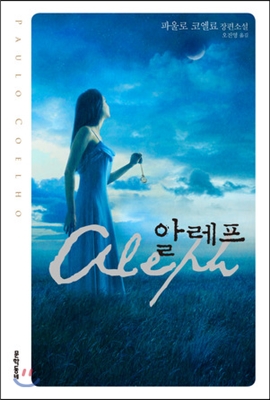
Aleph
 |
Description
Book Introduction
A new work from Paulo Coelho, author of "The Alchemist" and "Brida," released in 2011 A work that represents everything about Coelho and signals a new beginning. "Aleph" encompasses the world of Paulo Coelho, who has been a writer for over 20 years, while also signaling a new beginning by returning to his roots. "Aleph" is the first letter of Hebrew, Arabic, and Aramaic, and in mathematics, it refers to "the number that contains all numbers." The great Argentine author Jorge Luis Borges left behind a short story called "The Aleph." The Aleph in this novel is a small bead about 2-3 centimeters in diameter, and it contains an incomprehensible universe. In 2006, Paulo Coelho set out on a pilgrimage to Santiago de Compostela again, 20 years after his previous one. This was the third 'Sacred Way' I set out on, following the 'Camino de Santiago' in 1986 and the 'Roman Way' three years later. Following his teacher's strong advice, which was almost like a recommendation, Coelho blindly sets out on a journey following the signs. Starting with the London Book Fair, I traveled through Africa and Europe, and then embarked on a long journey across the Eurasian continent on the Trans-Siberian Railway, a journey that had been my long-held dream. And on that road he meets a woman. And through the special place he discovered by chance on the train, the Aleph, Coelho travels back in time 500 years with Hilal. And he discovers that she is the woman he loved in one of his many past lives, the woman he never got to love and who deeply hurt him. From Moscow to Yekaterinburg, Novosibirsk, and finally to Vladivostok, Coelho rediscovers the 'myth of the self' while traveling with Hilal. The reason for our lives is to live each of our lives as if we were traveling through the infinite universe without beginning or end, and to discover what the myth of the self is within it. Paulo Coelho encourages us by living out the message he preaches. Sometimes you have to go far to know that something is near. Believing that treasure exists and that our lives are a miracle is what makes life interesting. * Go to related video |
- You can preview some of the book's contents.
Preview
index
King of my kingdom
Chinese bamboo
The Light of the Stranger
When the cold wind blows
Share your soul
9288
Eye of Hilal
Ipatiev House
Aleph
Dreamers cannot be tamed
Like tears in the rain
Chicago of Siberia
The Way of Harmony
Ring of Fire
Believe even when no one believes in you
tea leaves
Five times? Woman
Ad Extirpanda
Neutralize the force without moving
golden rose
Baikal Eagle
fear of fear
city
phone call
The Soul of Türkiye
Moscow, June 1, 2006
Author's Note
Chinese bamboo
The Light of the Stranger
When the cold wind blows
Share your soul
9288
Eye of Hilal
Ipatiev House
Aleph
Dreamers cannot be tamed
Like tears in the rain
Chicago of Siberia
The Way of Harmony
Ring of Fire
Believe even when no one believes in you
tea leaves
Five times? Woman
Ad Extirpanda
Neutralize the force without moving
golden rose
Baikal Eagle
fear of fear
city
phone call
The Soul of Türkiye
Moscow, June 1, 2006
Author's Note
Detailed image
Into the book
About my new book, Aleph
Aleph is the first book I've written publicly (meaning I felt like many eyes were watching me).
Of course, I wrote it alone, but I updated Twitter every day about what I was feeling while writing.)
And at 2:00 a.m. on Thursday, March 11, 2010, I finished writing this book.
In 2006, I set out on my third sacred pilgrimage, following God's will.
My first pilgrimage was the Camino de Santiago in 1986.
What I did then was a pilgrimage of space.
It is the physical distance traveled between two points.
I walked almost 600 kilometers from the French border to O Cebreiro (Galicia).
And this journey was compiled into a book called The Pilgrim.
My second pilgrimage, the Roman Way, which I embarked on in 1989, was a pilgrimage of time.
I wasn't actually on my way to Rome, but I had to choose a place to walk for seventy days, and the place I chose was the Pyrenees region of France.
During that pilgrimage, I had a dream and had to wake up the next day and do exactly what I had dreamed.
No matter how absurd the dream was, it had to be done.
I remember dreaming about a bus stop and spending three hours at the bus stop the next day doing nothing.
On this pilgrimage, I encountered feminine energy, and as I watched the feminine side within me reveal itself, I wrote Brida and On the Banks of the River Pietras I Wept.
The third pilgrimage I am embarking on is the ‘Way of Jerusalem’.
This time, I didn't actually go all the way to Jerusalem.
Instead, we had to travel through time and space.
The only mission I had at the time was to be away from home for four months.
During my pilgrimage, I visited many countries, but my realization came while on the Trans-Siberian Railway across the Asian continent.
It was a 9,288-kilometer journey from Moscow to Vladivostok, crossing seven time zones over a fortnight.
I was with a Turkish girl named Hilal (not her real name).
Her and my story can be found in the book.
This point where time and space exist together is called the Aleph (Jorge Luis Borges wrote a beautiful short story about it).
For that reason, I titled my new work “Aleph.”
Why did it take so long to write a book about this pilgrimage? Because it took me three full years to understand this journey.
This book is not a travel guide.
Of course, I wrote this book to describe what it means to be on a long train journey, but it was also to take my soul on a long journey into my past, present, and future.
Aleph is the first book I've written publicly (meaning I felt like many eyes were watching me).
Of course, I wrote it alone, but I updated Twitter every day about what I was feeling while writing.)
And at 2:00 a.m. on Thursday, March 11, 2010, I finished writing this book.
In 2006, I set out on my third sacred pilgrimage, following God's will.
My first pilgrimage was the Camino de Santiago in 1986.
What I did then was a pilgrimage of space.
It is the physical distance traveled between two points.
I walked almost 600 kilometers from the French border to O Cebreiro (Galicia).
And this journey was compiled into a book called The Pilgrim.
My second pilgrimage, the Roman Way, which I embarked on in 1989, was a pilgrimage of time.
I wasn't actually on my way to Rome, but I had to choose a place to walk for seventy days, and the place I chose was the Pyrenees region of France.
During that pilgrimage, I had a dream and had to wake up the next day and do exactly what I had dreamed.
No matter how absurd the dream was, it had to be done.
I remember dreaming about a bus stop and spending three hours at the bus stop the next day doing nothing.
On this pilgrimage, I encountered feminine energy, and as I watched the feminine side within me reveal itself, I wrote Brida and On the Banks of the River Pietras I Wept.
The third pilgrimage I am embarking on is the ‘Way of Jerusalem’.
This time, I didn't actually go all the way to Jerusalem.
Instead, we had to travel through time and space.
The only mission I had at the time was to be away from home for four months.
During my pilgrimage, I visited many countries, but my realization came while on the Trans-Siberian Railway across the Asian continent.
It was a 9,288-kilometer journey from Moscow to Vladivostok, crossing seven time zones over a fortnight.
I was with a Turkish girl named Hilal (not her real name).
Her and my story can be found in the book.
This point where time and space exist together is called the Aleph (Jorge Luis Borges wrote a beautiful short story about it).
For that reason, I titled my new work “Aleph.”
Why did it take so long to write a book about this pilgrimage? Because it took me three full years to understand this journey.
This book is not a travel guide.
Of course, I wrote this book to describe what it means to be on a long train journey, but it was also to take my soul on a long journey into my past, present, and future.
---From the author's note
Publisher's Review
A new work from Paulo Coelho, author of "The Alchemist" and "Brida," in 2011!
A work that shows Coelho's 'everything' and 'new beginning'
“How many lives are you living now?”
Published in 43 countries and 32 languages worldwide
#1 bestseller on the first day of publication!
9,288 kilometers across Europe, Africa, Asia, and the Trans-Siberian Railway
Let go of your fears and trembling and start again,
A heartwarming journey, one step at a time, etched into my body… …
Paulo Coelho is back.
100 million readers around the world eagerly await Coelho's new book, which comes out every two years.
What Coelho brought this year, surprisingly, was his own story.
Yes, "Aleph" is a work that encompasses the world of Paulo Coelho, who has been a writer for over 20 years, and at the same time, it is a turning point that signals a new beginning by returning to his roots.
This is the first novel in which Coelho puts himself at the forefront and reveals his inner story so truthfully.
Perhaps that is why readers are sending their warm support and love to his new work.
After its debut in his home country of Brazil last fall, "The Aleph" has once again sparked the "Coelho Syndrome" by rising to the top of bestseller lists in Turkey, Portugal, Serbia, Croatia, Spain, Hungary, Bulgaria, and the Netherlands on its first day of publication.
In 2006, Paulo Coelho set out on a pilgrimage to Santiago de Compostela again, 20 years after his previous one.
This was the third 'Sacred Way' I set out on, following the 'Camino de Santiago' in 1986 and the 'Roman Way' three years later.
This pilgrimage, which Coelho called "The Way of Jerusalem," was broadcast almost in real time on the author's blog (paulocoelhoblog.com).
But this pilgrimage was not meant to celebrate 20 years.
It was an 'adventure road' that a writer at the peak of his career embarked on, realizing he was in serious trouble and deciding to give up everything and start over.
And along this path, he has a wondrous experience that will completely change his life.
Dreamers are never tamed
Only those adventurers who enjoy failure realize the joy and meaning of life.
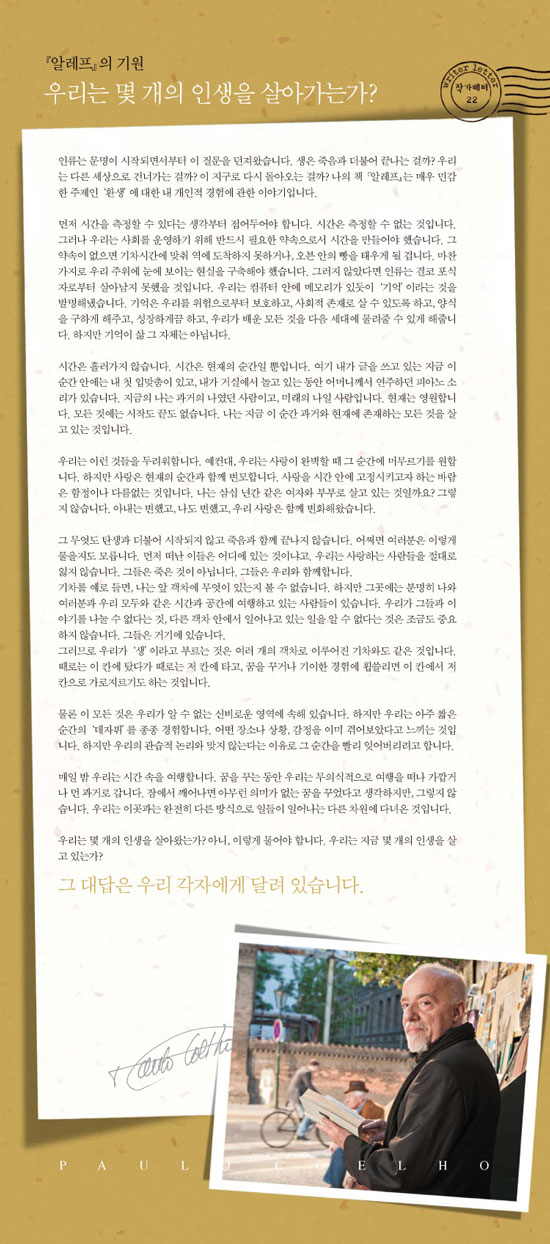
“Does life end with death? Do we pass on to another world? Do we return to this Earth? The Aleph is a story based on my personal experience with the very sensitive subject of reincarnation.” _Paulo Coelho, from “The Origin of the Aleph”
"Aleph" is a story based on Coelho's personal experience with 'reincarnation', which can be a very sensitive subject.
He meets Hilal, a talented violinist, just before his final leg of his pilgrimage, the Trans-Siberian Journey.
Together, they embark on a mystical journey through time and space, learning about love, forgiveness, and overcoming life's challenges.
In this novel, Coelho talks about a soul that sheds its old routine and is reborn, and about a new beginning where the end is nothing but another beginning.
But he says.
A new beginning can only have true meaning by atonement for and rectification of the past.
A new beginning is impossible without that process, and that is only possible by living solely in the present.
"Aleph" is even more authentic because it is the story of Coelho himself, who lived this message.
After four months on the road and the 9,288-kilometer journey on the Trans-Siberian Railway, we are filled with a sense of excitement that the journey is finally over, and a deep sense of emotion as we reflect on the enlightenment the author had along the way.
And then you realize.
If you have a dream, it's time to set out on the road again. If you just want to be safe, you can be ordinary, but if not, you must have the courage to enjoy failure and try again.
Only adventurers who enjoy failure open new paths and discover the joy and meaning of life within them.
As Coelho says in this book, dreamers are never tamed.
We never live one life.
“If you want to be safe, just be ordinary.
But if you want to do what you really want, you have to take risks.
Look for people who aren't afraid of failure, and who enjoy it.
Their achievements are sometimes not recognized because of their failures.
But it's ultimately these people who change the world, and through trial and error, they achieve something that completely transforms their communities.”
p.
130~131
I am in 'Aleph'.
A point where everything exists in one space-time.
I'm standing in front of a door that opens for a split second and then closes again.
But even in that short time, we can glimpse what's hidden behind that door.
Treasures, traps, roads never taken, and journeys never imagined…
'Aleph' is the first letter of Hebrew, Arabic, and Aramaic, and in mathematics it means 'the number that includes all numbers.'
And according to Kabbalah, the Jewish mystical philosophy, the Aleph is the spiritual root of all letters and the letter that contains all human discourse.
Jorge Luis Borges, the great Argentine writer who was famous for being absorbed in Kabbalah along with Umberto Eco and Hermann Hesse, left behind a short story called "The Aleph." The Aleph that appears in this novel is a small bead about 2 to 3 centimeters in diameter, and it contains an incomprehensible universe.
So to speak, Aleph is a point where the infinite universe converges and multiplies endlessly, that is, it is none other than 'God'.
Borges is said to have been inspired to write "The Aleph" by Siddhartha's awakening, the realization that the chain of cause and effect is intricate as a human being breaks through the time and space that was fatefully given to him and witnesses the entire universe changing through the passage of time.
Based on this concept of Aleph, Paulo Coelho talks about Aleph, the time in which we human beings live as the 'eternal present without past or future', Aleph, a specific space where we communicate with the universe, the energy generated by those who fatefully meet in that space, and our souls that grow spiritually together within the vast body of the universe.
“We are all souls wandering in space,
At the same time, it is the soul that lives our lives.”
In The Aleph, Coelho constantly asks us questions.
How many lives have you lived and how are you living them?
Coelho uses the metaphor of a train to talk about the secrets of our lives.
Our life is a train journey through the infinite universe with no beginning or end, and the only reason for our lives is to discover what the 'myth of the self' is and to live it out until God stops the train for some reason.
Coelho's story that humans live multiple lives, each of which is a carriage on a train, and that the only thing that matters is the 'present' resonates deeply.
“We never lose our loved ones.
They are with us.
They don't disappear from our lives.
But we're just staying in different rooms.
I can't see what's in the next car.
But there are definitely people out there who are traveling in the same time as me, you, and all of us.
It doesn't matter one bit that we can't talk to them or know what's going on in the other carriages.
They are there.
Therefore, what we call 'life' is like a train made up of many carriages.
Sometimes I ride in this compartment, sometimes in that compartment, and sometimes I cross from compartment to compartment when I have a dream or am swept up in a strange experience.” p.
179~180
“Everything is here, in the present.
We are always, now, here, condemning or saving ourselves.
We are constantly changing positions, moving from one carriage to another, from one parallel universe to another, condemning or saving ourselves at every moment.
You have to believe it.” p.
250
Some books are meant to be read,
"Aleph" is a book we must "live" with our whole being.
Paulo Coelho once again lived out the message he preached.
Just like when I set out on a pilgrimage to Santiago de Compostela over 20 years ago and embarked on the path of becoming a writer.
He encourages us to live like a river that flows to the sea without stopping and without staying still.
Perhaps that is why Paulo Coelho continues to receive love and support from readers.
A journey where I let go of my fears and trembling and began again, engraving the time on the road with my body.
Readers rediscover that within the trials we face as humans, not gods, lies much unexpected beauty, and that in those trying moments, there is someone to light the fire of friendship for us. … With this realization, readers rediscover.
We too, like Coelho, are ‘born pilgrims.’
It is up to each person to know when it is time to leave.
But to know when the Chinese bamboo within us will grow tall in the sky, we must always listen to the voice of our heart.
Even Coelho had to overcome endless anguish and inner fear before he could stand on the road again.
Now it's our turn.
Some books are meant to be read, but The Aleph is a book we must 'live' with our whole being.
An odyssey of spiritual transformation.
At the center of the story is Paulo Coelho.
Deeply disillusioned with contemporary reality, tormented by internal conflict, and losing faith in himself and the world, he begins to ask deeply personal questions that transcend time and space.
And as he travels the world, he reflects on his past lives and comes to understand that “my path is reflected in the eyes of others, and that I need that very map if I want to be my own.”
He meets many people who mean a lot to him along the way, but it is his reunion with the woman he loved but could not be with five hundred years ago that becomes the key to his awakening and salvation.
_Booklist (USA)
A work that shows Coelho's 'everything' and 'new beginning'
“How many lives are you living now?”
Published in 43 countries and 32 languages worldwide
#1 bestseller on the first day of publication!
9,288 kilometers across Europe, Africa, Asia, and the Trans-Siberian Railway
Let go of your fears and trembling and start again,
A heartwarming journey, one step at a time, etched into my body… …
Paulo Coelho is back.
100 million readers around the world eagerly await Coelho's new book, which comes out every two years.
What Coelho brought this year, surprisingly, was his own story.
Yes, "Aleph" is a work that encompasses the world of Paulo Coelho, who has been a writer for over 20 years, and at the same time, it is a turning point that signals a new beginning by returning to his roots.
This is the first novel in which Coelho puts himself at the forefront and reveals his inner story so truthfully.
Perhaps that is why readers are sending their warm support and love to his new work.
After its debut in his home country of Brazil last fall, "The Aleph" has once again sparked the "Coelho Syndrome" by rising to the top of bestseller lists in Turkey, Portugal, Serbia, Croatia, Spain, Hungary, Bulgaria, and the Netherlands on its first day of publication.
In 2006, Paulo Coelho set out on a pilgrimage to Santiago de Compostela again, 20 years after his previous one.
This was the third 'Sacred Way' I set out on, following the 'Camino de Santiago' in 1986 and the 'Roman Way' three years later.
This pilgrimage, which Coelho called "The Way of Jerusalem," was broadcast almost in real time on the author's blog (paulocoelhoblog.com).
But this pilgrimage was not meant to celebrate 20 years.
It was an 'adventure road' that a writer at the peak of his career embarked on, realizing he was in serious trouble and deciding to give up everything and start over.
And along this path, he has a wondrous experience that will completely change his life.
Dreamers are never tamed
Only those adventurers who enjoy failure realize the joy and meaning of life.
“Does life end with death? Do we pass on to another world? Do we return to this Earth? The Aleph is a story based on my personal experience with the very sensitive subject of reincarnation.” _Paulo Coelho, from “The Origin of the Aleph”
"Aleph" is a story based on Coelho's personal experience with 'reincarnation', which can be a very sensitive subject.
He meets Hilal, a talented violinist, just before his final leg of his pilgrimage, the Trans-Siberian Journey.
Together, they embark on a mystical journey through time and space, learning about love, forgiveness, and overcoming life's challenges.
In this novel, Coelho talks about a soul that sheds its old routine and is reborn, and about a new beginning where the end is nothing but another beginning.
But he says.
A new beginning can only have true meaning by atonement for and rectification of the past.
A new beginning is impossible without that process, and that is only possible by living solely in the present.
"Aleph" is even more authentic because it is the story of Coelho himself, who lived this message.
After four months on the road and the 9,288-kilometer journey on the Trans-Siberian Railway, we are filled with a sense of excitement that the journey is finally over, and a deep sense of emotion as we reflect on the enlightenment the author had along the way.
And then you realize.
If you have a dream, it's time to set out on the road again. If you just want to be safe, you can be ordinary, but if not, you must have the courage to enjoy failure and try again.
Only adventurers who enjoy failure open new paths and discover the joy and meaning of life within them.
As Coelho says in this book, dreamers are never tamed.
We never live one life.
“If you want to be safe, just be ordinary.
But if you want to do what you really want, you have to take risks.
Look for people who aren't afraid of failure, and who enjoy it.
Their achievements are sometimes not recognized because of their failures.
But it's ultimately these people who change the world, and through trial and error, they achieve something that completely transforms their communities.”
p.
130~131
I am in 'Aleph'.
A point where everything exists in one space-time.
I'm standing in front of a door that opens for a split second and then closes again.
But even in that short time, we can glimpse what's hidden behind that door.
Treasures, traps, roads never taken, and journeys never imagined…
'Aleph' is the first letter of Hebrew, Arabic, and Aramaic, and in mathematics it means 'the number that includes all numbers.'
And according to Kabbalah, the Jewish mystical philosophy, the Aleph is the spiritual root of all letters and the letter that contains all human discourse.
Jorge Luis Borges, the great Argentine writer who was famous for being absorbed in Kabbalah along with Umberto Eco and Hermann Hesse, left behind a short story called "The Aleph." The Aleph that appears in this novel is a small bead about 2 to 3 centimeters in diameter, and it contains an incomprehensible universe.
So to speak, Aleph is a point where the infinite universe converges and multiplies endlessly, that is, it is none other than 'God'.
Borges is said to have been inspired to write "The Aleph" by Siddhartha's awakening, the realization that the chain of cause and effect is intricate as a human being breaks through the time and space that was fatefully given to him and witnesses the entire universe changing through the passage of time.
Based on this concept of Aleph, Paulo Coelho talks about Aleph, the time in which we human beings live as the 'eternal present without past or future', Aleph, a specific space where we communicate with the universe, the energy generated by those who fatefully meet in that space, and our souls that grow spiritually together within the vast body of the universe.
“We are all souls wandering in space,
At the same time, it is the soul that lives our lives.”
In The Aleph, Coelho constantly asks us questions.
How many lives have you lived and how are you living them?
Coelho uses the metaphor of a train to talk about the secrets of our lives.
Our life is a train journey through the infinite universe with no beginning or end, and the only reason for our lives is to discover what the 'myth of the self' is and to live it out until God stops the train for some reason.
Coelho's story that humans live multiple lives, each of which is a carriage on a train, and that the only thing that matters is the 'present' resonates deeply.
“We never lose our loved ones.
They are with us.
They don't disappear from our lives.
But we're just staying in different rooms.
I can't see what's in the next car.
But there are definitely people out there who are traveling in the same time as me, you, and all of us.
It doesn't matter one bit that we can't talk to them or know what's going on in the other carriages.
They are there.
Therefore, what we call 'life' is like a train made up of many carriages.
Sometimes I ride in this compartment, sometimes in that compartment, and sometimes I cross from compartment to compartment when I have a dream or am swept up in a strange experience.” p.
179~180
“Everything is here, in the present.
We are always, now, here, condemning or saving ourselves.
We are constantly changing positions, moving from one carriage to another, from one parallel universe to another, condemning or saving ourselves at every moment.
You have to believe it.” p.
250
Some books are meant to be read,
"Aleph" is a book we must "live" with our whole being.
Paulo Coelho once again lived out the message he preached.
Just like when I set out on a pilgrimage to Santiago de Compostela over 20 years ago and embarked on the path of becoming a writer.
He encourages us to live like a river that flows to the sea without stopping and without staying still.
Perhaps that is why Paulo Coelho continues to receive love and support from readers.
A journey where I let go of my fears and trembling and began again, engraving the time on the road with my body.
Readers rediscover that within the trials we face as humans, not gods, lies much unexpected beauty, and that in those trying moments, there is someone to light the fire of friendship for us. … With this realization, readers rediscover.
We too, like Coelho, are ‘born pilgrims.’
It is up to each person to know when it is time to leave.
But to know when the Chinese bamboo within us will grow tall in the sky, we must always listen to the voice of our heart.
Even Coelho had to overcome endless anguish and inner fear before he could stand on the road again.
Now it's our turn.
Some books are meant to be read, but The Aleph is a book we must 'live' with our whole being.
An odyssey of spiritual transformation.
At the center of the story is Paulo Coelho.
Deeply disillusioned with contemporary reality, tormented by internal conflict, and losing faith in himself and the world, he begins to ask deeply personal questions that transcend time and space.
And as he travels the world, he reflects on his past lives and comes to understand that “my path is reflected in the eyes of others, and that I need that very map if I want to be my own.”
He meets many people who mean a lot to him along the way, but it is his reunion with the woman he loved but could not be with five hundred years ago that becomes the key to his awakening and salvation.
_Booklist (USA)
GOODS SPECIFICS
- Date of publication: September 23, 2011
- Page count, weight, size: 410 pages | 500g | 128*188*30mm
- ISBN13: 9788954616126
- ISBN10: 8954616127
You may also like
카테고리
korean


korean

![GQ KOREA Mark (Monthly): December [2025]](http://librairie.coreenne.fr/cdn/shop/files/8ef265dbbfbf186523ed75ba7319009d.jpg?v=1765340328&width=3840)


