

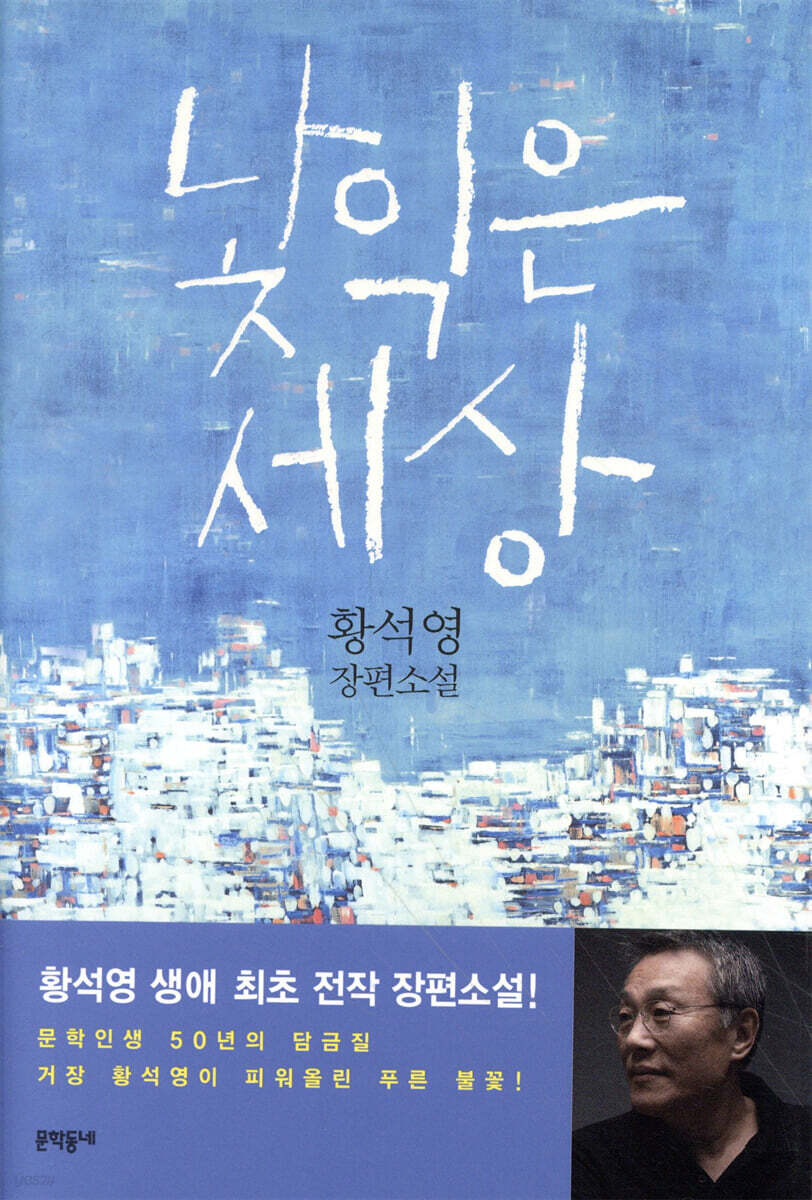
A familiar world
 |
Description
Book Introduction
A new novel by Hwang Seok-young, a master of Korean literature! Is this place I live in really the world I know? In an age where massive capitalism is seen as the fate of the world, open the door to another world! In 1962, fifty years have passed since Hwang Seok-young, then a high school student, debuted in the literary world with “Near the Standing Stone.” From the time a child is born, through adolescence and middle age, and becomes an adult, bearing the entirety of one's personal history, the author has lived a life that has embraced the great currents of contemporary Korean history with his whole body as an individual, and as an author, he has opened up new horizons for Korean realism literature, and even now, as he approaches his seventies, he continues to display a fiery creative passion. The main setting of the new novel from 2011 is a garbage dump called Flower Island. This is not a metaphorical reference to a world overflowing with all kinds of dirty garbage, but rather a real garbage dump, a mountain of all the things people use and throw away. This huge, hideous landfill is home to people who make a living there. These are the people of 'Flower Island'. For the boy Takburi, who can be considered one of the main characters of the work, Flower Island is on the one hand a poor, dirty, and bleak environment, but on the other hand, it is a wonderful environment for growing up. Although it is a mountain village, Takburi, who had been part of the 'city', suddenly enters a world called a garbage dump - a world completely different from the city - and there, he encounters supernatural things and begins to learn about humanity and society. "A Familiar World" is a novel about the dark side of civilization, which touts a consumer paradise, and a coming-of-age story about the learning and awakening of a boy who spends his formative years in the lowest social class. In the poorest things there is the greatest wealth. Hwang Sok-young reminds us that the ancient source of resistance to civilization lies in the destination of objects and humans discarded by civilization. * Go to related video |
- You can preview some of the book's contents.
Preview
index
A familiar world
Author's Note
Author's Note
Publisher's Review
Hwang Seok-young's first full-length novel!
The blue flame lit by the master Hwang Sok-young, a literary genius who has been pickling for 50 years!
It was a very lonely scene that showed the transience of time and space.
How can it be only family? In Buddhism, the transformation and emergence of the entire world in a hundred years is likened to a 'rotation of a wheel', like the giant London Eye.
In a hundred years, everyone currently living on Earth will have disappeared, and those living there will be new people we don't know at all.
And perhaps, all the people will disappear, leaving behind only the lush jungle, birds, and butterflies, like the traces of Angkor Wat. _From the author's note
Is that really still alive inside me?
“I wanted to call out the spirits within us and ask them questions.
“Is that really still alive inside me?”
In the summer of 2011, the master Hwang Sok-young asks himself and his readers, "Where is this place, here and now?" "What must we discard here?" and "What must we absolutely not lose?"
This place, a strange and unfamiliar paradise, a place like hell, a place that has already become our daily life, a world built on ruins after everything has been swept away.
What kind of world will he open to us?
Stranger than heaven… …
The story of growth that grows on the other side of an abandoned civilization.
Flower Island, the main stage of 'Familiar World', is a garbage dump.
This is not a metaphorical reference to a world overflowing with all kinds of dirty garbage, but rather a real garbage dump, a mountain of all the things people use and throw away.
This huge, hideous landfill is home to people who make a living there.
These are the people of 'Flower Island'.
Hwang Seok-young's depiction of the Flower Island/landfill site and the lifestyle of the poor who make a living by collecting scrap metal is rich in detail and has a considerable sense of realism.
People driven out of the city, like trash thrown away by people—their wild lives are depicted with a skill that evokes the admiration of Hwang Sok-young.
For the boy Takburi, who can be considered one of the main characters of the work, Flower Island is on the one hand a poor, dirty, and bleak environment, but on the other hand, it is a wonderful environment for growing up.
Although it is a mountain village, Takburi, who had been part of the 'city', suddenly enters a world called a garbage dump - a world completely different from the city - and there, he encounters supernatural things and begins to learn about humanity and society.
The story of the crowbar exemplifies the growth of the self free from reason and discipline, which is the antithesis of school education.
At first glance, 『A Familiar World』, which seems like a warm and sad fairy tale by a master, is a novel whose nature changes depending on whether one views it from the perspective of the space called Flower Island or the experiences of the magpie.
If we take the former perspective, the novel stands out as a novel about the dark side of civilization, which preaches a consumer paradise. If we take the latter perspective, the novel stands out as a coming-of-age story about the learning and awakening of a boy who spends his formative years in the lowest social class.
The message of “A Familiar World” is powerful.
In the poorest things there is the greatest wealth.
Hwang Sok-young reminds us that the ancient source of resistance to civilization lies in the destination of objects and humans discarded by civilization.
Flower Island is the border between humans and spirits, civilization and nature, and Pepe's Mom is the representative of the Flower Island residents who live in both worlds.
The mother, who has the appearance of a shaman, and the children who play with the Kims (spirits) in the forest form a fairytale-like antithesis to the human world from which gods, spirits, and ghosts have been banished, the so-called demagogic world.
So, once again, it's time for everyday life to become a magic festival...
Again, this is a place where both objects and people are 'abandoned'.
A place where 'unusable' things and people gather.
But even here, of course, there is life.
Laughter and tears intersect in everyday life here, and people sing songs over drinks and food to liven things up.
In "A Familiar World," the author focuses on a fairytale-like narrative structure that recalls the magic of the world: the meal the poor eat among the garbage heaps as if it were a community festival, the innocence of children who struggle or refuse to grow up, a shamanistic belief in the order of nature, images of idyllic rural life... Above all, he focuses on a fairytale-like narrative structure that recalls the magic of the world.
So, the writer is always by our side, but he leads the readers into a world that we have forgotten and live in.
The place where human desires never cease to reach their final destination.
As the meaning of the title is clearly revealed in the author's note, the scenery of this novel is one that "can be found on the outskirts of any city in the world."
More production and consumption have become the purpose of life, and the whole world is wasting all its energy and even dreams on it.
Therefore, the landscape depicted in this work is a very familiar world that can be found on the outskirts of any city in the world.
(……) Like Chernobyl and Fukushima, that world as a ‘matrix’ is right around our corner. _From the author’s note
In 『A Familiar World』, the author's touch is more poignant than in any of his recent works.
Although it is based on a true story that is more distant in time, it does not exist as a prehistory we have passed through, but as the present we face and the future to come.
The master's insight, which simultaneously reads the past, present, and future, coldly interrogates us, who internally "have over 3.5 million lives buried alive in the land we live in" and externally tremble in fear of the Fukushima nuclear power plant.
Isn't the suffering that humans are experiencing and must experience simply a product of their own desire to write more?
The author writes.
“I was drawn to the garbage dump on the outskirts of the city because I thought that the present life of people living on the surface is sustained by the endless desire to create, use, and throw away.”
Author Hwang Seok-young does not portray the garbage dump that serves as the setting for his novel as a miserable wasteland where only animalistic survival reigns.
Of course, there is a reality there that is so miserable that it cannot even be compared to 'life on earth'.
Among the things that were discarded because no one 'gave affection', discarded humans will also be included.
However, the people who came to the island for various reasons are not portrayed as monsters that cannot be approached.
Through the untainted eyes of a boy, the author does not miss the fact that they too are noble human beings.
Finally, once again, hope is with us.
In this novel, 'life' is our soul, which we were born with, but have since completely forgotten.
For example, the insight of author Hwang Seok-young, who overlaps the past, present, and future, is realized in the novel as ‘layers of time’ and ‘layers of space.’
The novel's spatiotemporal imagination, guided by the 'blue light,' eloquently expresses the aesthetics of 'A Familiar World,' while also taking us to the empty space of the soul that has been discarded in the pursuit of material things.
The scene of the village that the solder and the magpie enter following the little spirit of Mr. Kim's family is the most beautiful moment the novel creates, and it is also the prelude to a ritual of invocation that calls to us all the souls that "always live beside us"—the souls of the objects we have grown attached to, the flowers, new leaves, and buds, and even the souls of the discarded things.
If the final cry of the mother goddess of Trash Island, Peppe's mother (Buddanggoo's grandmother), "Do you think you're the only ones living in the world?" is unforgettable, it is because the author is asking us about the whereabouts of a piece of our soul that remains somewhere.
Even though “all the people living in the world have created such tremendous things,” the novel’s ending, in which grass flowers sway through the ashes, may be the old writer’s last trust and request to the readers who close the book and suddenly become lost in thought, to our souls who “do not want to be trapped” in the wreckage and ruins of desire.
It has been fifty years since Hwang Seok-young, then a high school student, debuted in the literary world with “Near the Standing Stones” in 1962.
From the time a child is born, through adolescence and middle age, and becomes an adult, bearing the entirety of one's personal history, the author has lived a life that has embraced the great currents of contemporary Korean history with his whole body as an individual, and as an author, he has opened up new horizons for Korean realism literature, and even now, as he approaches his seventies, he continues to display a fiery creative passion.
That person, Hwang Seok-young, calls his new full-length novel, "A Familiar World," which he is publishing as his first full-length work in his fifty years as a writer, his first work to cross the threshold of "perennial literature."
The blue flame lit by the master Hwang Sok-young, a literary genius who has been pickling for 50 years!
It was a very lonely scene that showed the transience of time and space.
How can it be only family? In Buddhism, the transformation and emergence of the entire world in a hundred years is likened to a 'rotation of a wheel', like the giant London Eye.
In a hundred years, everyone currently living on Earth will have disappeared, and those living there will be new people we don't know at all.
And perhaps, all the people will disappear, leaving behind only the lush jungle, birds, and butterflies, like the traces of Angkor Wat. _From the author's note
Is that really still alive inside me?
“I wanted to call out the spirits within us and ask them questions.
“Is that really still alive inside me?”
In the summer of 2011, the master Hwang Sok-young asks himself and his readers, "Where is this place, here and now?" "What must we discard here?" and "What must we absolutely not lose?"
This place, a strange and unfamiliar paradise, a place like hell, a place that has already become our daily life, a world built on ruins after everything has been swept away.
What kind of world will he open to us?
Stranger than heaven… …
The story of growth that grows on the other side of an abandoned civilization.
Flower Island, the main stage of 'Familiar World', is a garbage dump.
This is not a metaphorical reference to a world overflowing with all kinds of dirty garbage, but rather a real garbage dump, a mountain of all the things people use and throw away.
This huge, hideous landfill is home to people who make a living there.
These are the people of 'Flower Island'.
Hwang Seok-young's depiction of the Flower Island/landfill site and the lifestyle of the poor who make a living by collecting scrap metal is rich in detail and has a considerable sense of realism.
People driven out of the city, like trash thrown away by people—their wild lives are depicted with a skill that evokes the admiration of Hwang Sok-young.
For the boy Takburi, who can be considered one of the main characters of the work, Flower Island is on the one hand a poor, dirty, and bleak environment, but on the other hand, it is a wonderful environment for growing up.
Although it is a mountain village, Takburi, who had been part of the 'city', suddenly enters a world called a garbage dump - a world completely different from the city - and there, he encounters supernatural things and begins to learn about humanity and society.
The story of the crowbar exemplifies the growth of the self free from reason and discipline, which is the antithesis of school education.
At first glance, 『A Familiar World』, which seems like a warm and sad fairy tale by a master, is a novel whose nature changes depending on whether one views it from the perspective of the space called Flower Island or the experiences of the magpie.
If we take the former perspective, the novel stands out as a novel about the dark side of civilization, which preaches a consumer paradise. If we take the latter perspective, the novel stands out as a coming-of-age story about the learning and awakening of a boy who spends his formative years in the lowest social class.
The message of “A Familiar World” is powerful.
In the poorest things there is the greatest wealth.
Hwang Sok-young reminds us that the ancient source of resistance to civilization lies in the destination of objects and humans discarded by civilization.
Flower Island is the border between humans and spirits, civilization and nature, and Pepe's Mom is the representative of the Flower Island residents who live in both worlds.
The mother, who has the appearance of a shaman, and the children who play with the Kims (spirits) in the forest form a fairytale-like antithesis to the human world from which gods, spirits, and ghosts have been banished, the so-called demagogic world.
So, once again, it's time for everyday life to become a magic festival...
Again, this is a place where both objects and people are 'abandoned'.
A place where 'unusable' things and people gather.
But even here, of course, there is life.
Laughter and tears intersect in everyday life here, and people sing songs over drinks and food to liven things up.
In "A Familiar World," the author focuses on a fairytale-like narrative structure that recalls the magic of the world: the meal the poor eat among the garbage heaps as if it were a community festival, the innocence of children who struggle or refuse to grow up, a shamanistic belief in the order of nature, images of idyllic rural life... Above all, he focuses on a fairytale-like narrative structure that recalls the magic of the world.
So, the writer is always by our side, but he leads the readers into a world that we have forgotten and live in.
The place where human desires never cease to reach their final destination.
As the meaning of the title is clearly revealed in the author's note, the scenery of this novel is one that "can be found on the outskirts of any city in the world."
More production and consumption have become the purpose of life, and the whole world is wasting all its energy and even dreams on it.
Therefore, the landscape depicted in this work is a very familiar world that can be found on the outskirts of any city in the world.
(……) Like Chernobyl and Fukushima, that world as a ‘matrix’ is right around our corner. _From the author’s note
In 『A Familiar World』, the author's touch is more poignant than in any of his recent works.
Although it is based on a true story that is more distant in time, it does not exist as a prehistory we have passed through, but as the present we face and the future to come.
The master's insight, which simultaneously reads the past, present, and future, coldly interrogates us, who internally "have over 3.5 million lives buried alive in the land we live in" and externally tremble in fear of the Fukushima nuclear power plant.
Isn't the suffering that humans are experiencing and must experience simply a product of their own desire to write more?
The author writes.
“I was drawn to the garbage dump on the outskirts of the city because I thought that the present life of people living on the surface is sustained by the endless desire to create, use, and throw away.”
Author Hwang Seok-young does not portray the garbage dump that serves as the setting for his novel as a miserable wasteland where only animalistic survival reigns.
Of course, there is a reality there that is so miserable that it cannot even be compared to 'life on earth'.
Among the things that were discarded because no one 'gave affection', discarded humans will also be included.
However, the people who came to the island for various reasons are not portrayed as monsters that cannot be approached.
Through the untainted eyes of a boy, the author does not miss the fact that they too are noble human beings.
Finally, once again, hope is with us.
In this novel, 'life' is our soul, which we were born with, but have since completely forgotten.
For example, the insight of author Hwang Seok-young, who overlaps the past, present, and future, is realized in the novel as ‘layers of time’ and ‘layers of space.’
The novel's spatiotemporal imagination, guided by the 'blue light,' eloquently expresses the aesthetics of 'A Familiar World,' while also taking us to the empty space of the soul that has been discarded in the pursuit of material things.
The scene of the village that the solder and the magpie enter following the little spirit of Mr. Kim's family is the most beautiful moment the novel creates, and it is also the prelude to a ritual of invocation that calls to us all the souls that "always live beside us"—the souls of the objects we have grown attached to, the flowers, new leaves, and buds, and even the souls of the discarded things.
If the final cry of the mother goddess of Trash Island, Peppe's mother (Buddanggoo's grandmother), "Do you think you're the only ones living in the world?" is unforgettable, it is because the author is asking us about the whereabouts of a piece of our soul that remains somewhere.
Even though “all the people living in the world have created such tremendous things,” the novel’s ending, in which grass flowers sway through the ashes, may be the old writer’s last trust and request to the readers who close the book and suddenly become lost in thought, to our souls who “do not want to be trapped” in the wreckage and ruins of desire.
It has been fifty years since Hwang Seok-young, then a high school student, debuted in the literary world with “Near the Standing Stones” in 1962.
From the time a child is born, through adolescence and middle age, and becomes an adult, bearing the entirety of one's personal history, the author has lived a life that has embraced the great currents of contemporary Korean history with his whole body as an individual, and as an author, he has opened up new horizons for Korean realism literature, and even now, as he approaches his seventies, he continues to display a fiery creative passion.
That person, Hwang Seok-young, calls his new full-length novel, "A Familiar World," which he is publishing as his first full-length work in his fifty years as a writer, his first work to cross the threshold of "perennial literature."
GOODS SPECIFICS
- Date of issue: June 1, 2011
- Format: Hardcover book binding method guide
- Page count, weight, size: 236 pages | 348g | 128*188*20mm
- ISBN13: 9788954615037
- ISBN10: 8954615031
You may also like
카테고리
korean


korean

![GQ KOREA Mark (Monthly): December [2025]](http://librairie.coreenne.fr/cdn/shop/files/8ef265dbbfbf186523ed75ba7319009d.jpg?v=1765340328&width=3840)


