

A wonderful world for curious children
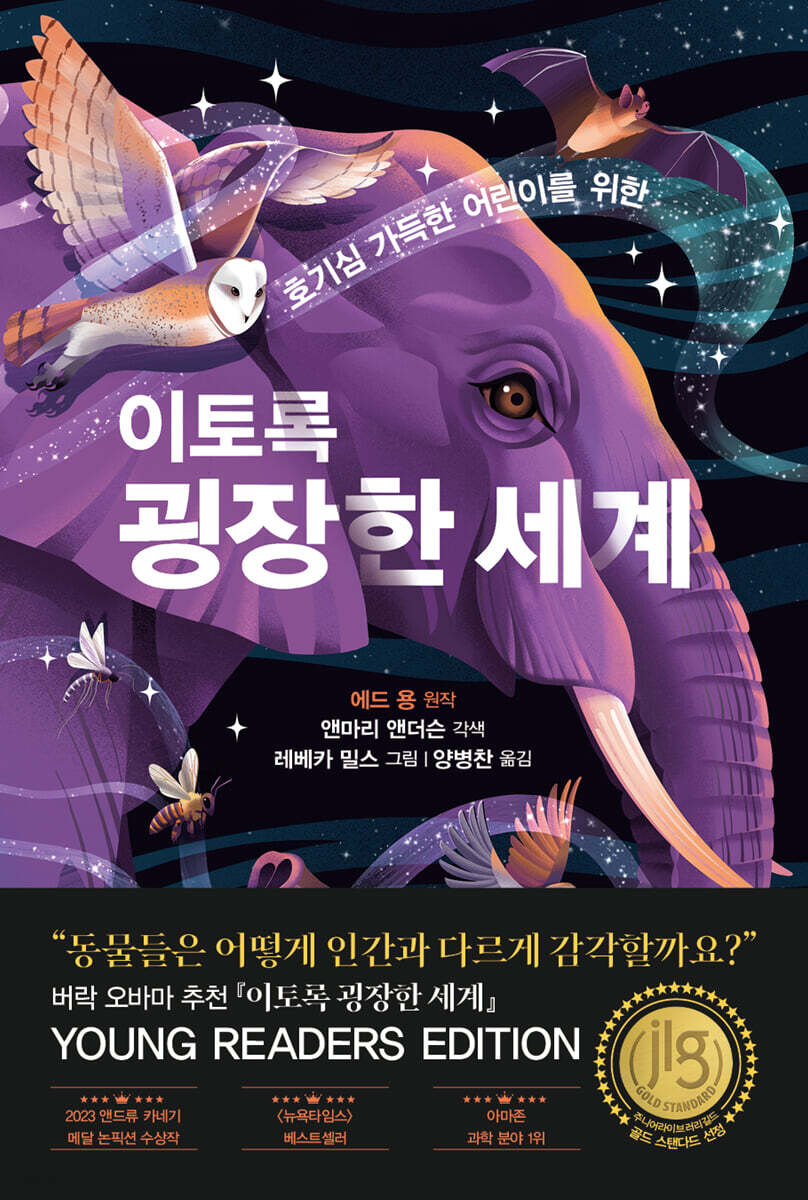 |
Description
Book Introduction
- A word from MD
-
To the world of senses that exist but are not visibleA children's version of Pulitzer Prize-winning author Ed Yong's "This Wonderful World."
It introduces the fascinating world of animals with senses that humans cannot perceive, inviting children on a sensory journey to experience the world in a new way.
November 4, 2025. Children's PD Baek Jeong- min
A book for curious children by Ed Yong, the author praised by Bill Gates!
“How do animals sense things differently from humans?”
Into the secret and even wondrous sensory world of animals, unknown to humans!
Pulitzer Prize-winning author Ed Yong meets young readers.
"Such a Wonderful World," which was selected as a 2022 Book of the Year by over 20 publications including the New York Times, Wall Street Journal, Washington Post, and Guardian, won the 2023 Andrew Carnegie Medal for Nonfiction, ranked #1 in the Amazon science category, and was a Barack Obama-recommended 2022 Best Book, is now easily accessible to children.
The concise explanations and colorful illustrations will captivate our eyes.
Would you like to embark on a journey into the mysterious sensory world of animals unknown to humans? So, let's begin our journey together.
“How do animals sense things differently from humans?”
Into the secret and even wondrous sensory world of animals, unknown to humans!
Pulitzer Prize-winning author Ed Yong meets young readers.
"Such a Wonderful World," which was selected as a 2022 Book of the Year by over 20 publications including the New York Times, Wall Street Journal, Washington Post, and Guardian, won the 2023 Andrew Carnegie Medal for Nonfiction, ranked #1 in the Amazon science category, and was a Barack Obama-recommended 2022 Best Book, is now easily accessible to children.
The concise explanations and colorful illustrations will captivate our eyes.
Would you like to embark on a journey into the mysterious sensory world of animals unknown to humans? So, let's begin our journey together.
- You can preview some of the book's contents.
Preview
index
Introduction: A New Way of Understanding the Earth
1.
Smell and Taste: The Chemical Senses That Detect Molecules
2.
Light: Hundreds of universes each eye sees
3.
Colors: A world that cannot be expressed in red, green, and blue
4.
Pain: A sensation no one wants
5.
Ten: People with great abilities
6.
Touch and Flow: A somewhat rough sensation
7.
Surface vibration: shaking ground
8.
Sound: Different types of ears
9.
Echoes: The Silent World's Clapping
10.
Electric and Magnetic Fields: A Living Battery and a Compass
11.
Integration of the senses: parts and wholes
12.
Sensory Landscapes in Crisis: Saving Stillness and Preserving Darkness
Acknowledgements
Life Science Terms You Should Know
1.
Smell and Taste: The Chemical Senses That Detect Molecules
2.
Light: Hundreds of universes each eye sees
3.
Colors: A world that cannot be expressed in red, green, and blue
4.
Pain: A sensation no one wants
5.
Ten: People with great abilities
6.
Touch and Flow: A somewhat rough sensation
7.
Surface vibration: shaking ground
8.
Sound: Different types of ears
9.
Echoes: The Silent World's Clapping
10.
Electric and Magnetic Fields: A Living Battery and a Compass
11.
Integration of the senses: parts and wholes
12.
Sensory Landscapes in Crisis: Saving Stillness and Preserving Darkness
Acknowledgements
Life Science Terms You Should Know
Detailed image

Into the book
We interpret animal sensations through our human senses, which can be dangerous.
We tend to change our environment without consideration for our companion animals.
For example, coastal lights installed near beaches attract baby turtles heading to the sea.
Also, it prevents dogs from sniffing around because they don't realize how important smell is to them.
--- p.13
The real difference between smell and taste is how they work.
While our sense of taste is largely fixed at birth, our sense of smell changes with experience.
For example, newborns dislike bitter tastes, but not the smell of sweat or poop.
You will come to hate it later through learning.
--- p.37
Cows have a very fixed gaze and rarely turn to look at you.
Why is that? It's not because I'm indifferent, it's because I don't need to be.
A cow's vision captures the entire horizon at once.
Therefore, the cow can see you approaching from the front, the dog approaching from behind, and the other cow standing next to you.
--- p.59
Fruit flies can detect temperatures around 25 degrees Celsius and stay there thanks to sensors on the tips of their antennae.
In fact, fruit flies can quickly sense when one antenna is just 0.1 degrees Celsius warmer than the other! They use this information to avoid dangerous areas, too cold or too hot, and instead steer toward more comfortable, more relaxed locations.
--- p.120
The small, unassuming kangaroo rat is surprisingly good at kicking the side of the heretic.
Thanks to their middle ear, which is larger than their brain, kangaroo rats can hear the low-frequency sounds of an approaching owl's wings.
Therefore, it would be virtually impossible for a squirrel owl to catch a kangaroo rat.
Even kangaroo rats can hear the sound of an approaching rattlesnake.
This allows the kangaroo rat to not only jump far and early, but also perform a feat like turning mid-air and delivering a double side kick to the rattlesnake's face!
--- p.182
In the 1960s, the U.S. Navy trained dolphins to rescue lost divers, locate sunken equipment, and detect mines buried on the seabed.
Dolphins can distinguish objects based on shape, size, and material.
It could even locate objects buried several meters deep in sand and determine whether they were made of brass or steel.
--- p.218
The electric eel's power generating organ occupies most of its two-meter body length and is made up of 5,000 to 10,000 electrocytes stacked in about 100 layers.
Of the three species of electric eel, the most powerful can generate 860 volts of electricity.
This is enough to subdue a horse!
We tend to change our environment without consideration for our companion animals.
For example, coastal lights installed near beaches attract baby turtles heading to the sea.
Also, it prevents dogs from sniffing around because they don't realize how important smell is to them.
--- p.13
The real difference between smell and taste is how they work.
While our sense of taste is largely fixed at birth, our sense of smell changes with experience.
For example, newborns dislike bitter tastes, but not the smell of sweat or poop.
You will come to hate it later through learning.
--- p.37
Cows have a very fixed gaze and rarely turn to look at you.
Why is that? It's not because I'm indifferent, it's because I don't need to be.
A cow's vision captures the entire horizon at once.
Therefore, the cow can see you approaching from the front, the dog approaching from behind, and the other cow standing next to you.
--- p.59
Fruit flies can detect temperatures around 25 degrees Celsius and stay there thanks to sensors on the tips of their antennae.
In fact, fruit flies can quickly sense when one antenna is just 0.1 degrees Celsius warmer than the other! They use this information to avoid dangerous areas, too cold or too hot, and instead steer toward more comfortable, more relaxed locations.
--- p.120
The small, unassuming kangaroo rat is surprisingly good at kicking the side of the heretic.
Thanks to their middle ear, which is larger than their brain, kangaroo rats can hear the low-frequency sounds of an approaching owl's wings.
Therefore, it would be virtually impossible for a squirrel owl to catch a kangaroo rat.
Even kangaroo rats can hear the sound of an approaching rattlesnake.
This allows the kangaroo rat to not only jump far and early, but also perform a feat like turning mid-air and delivering a double side kick to the rattlesnake's face!
--- p.182
In the 1960s, the U.S. Navy trained dolphins to rescue lost divers, locate sunken equipment, and detect mines buried on the seabed.
Dolphins can distinguish objects based on shape, size, and material.
It could even locate objects buried several meters deep in sand and determine whether they were made of brass or steel.
--- p.218
The electric eel's power generating organ occupies most of its two-meter body length and is made up of 5,000 to 10,000 electrocytes stacked in about 100 layers.
Of the three species of electric eel, the most powerful can generate 860 volts of electricity.
This is enough to subdue a horse!
--- p.231
Publisher's Review
A wondrous world of the senses, where what you see is not everything
The world is much bigger and more amazing than we experience.
Humans can see many colors and feel many senses, but there are some senses that are completely inaccessible.
The electric fields that sharks and platypuses can detect, the magnetic fields that robins and sea turtles can detect, the highest sounds that rodents make, the lowest sounds that elephants and whales make, the infrared that rattlesnakes can detect, and the ultraviolet that birds and bees can detect—all of these are things that humans cannot sense.
But why should we explore these senses and the animals that use them? Exploring the remarkable ways animals perceive the world is a wonderful way to help us understand it.
Paying attention to other animals can help us experience an expansion of our world.
This book explores the chemical senses of smell and taste, as well as the senses of sight and color, pain and heat.
Tell me about the mechanical senses: touch, vibration, hearing, and echolocation.
And we also uncover the strange senses of animals that allow them to detect electric and magnetic fields that humans cannot perceive.
As we explore the senses we are unaware of, we will gain new perspectives on those senses and a new understanding of the world around us.
The one and only book you need to develop your knowledge of life sciences!
This book tells the story of a wonderful sensory world, while also introducing bits of knowledge that children might be curious about.
For example, 'Are human noses inferior to dog noses?', 'Why don't many animals taste sweetness?', 'Evolution quiz', 'Hibernation isn't real sleep', 'Where are insect ears?', etc.
The little nuggets of knowledge hidden amidst unfamiliar and new scientific theories are enough to stimulate children's curiosity.
There is also a 'Inside the Field' corner where you can get a glimpse into Ed Yong's research site.
Through that corner, we get a glimpse into researchers struggling to experience the world through the senses of animals.
In the Sahara Desert, we study why zebras have stripes, and we study red diamondback rattlesnakes to understand their heat-sensing abilities.
In addition, various animals such as moths, whales, and corals appear.
This book is full of knowledge about the sensory world of other animals, acquired through centuries of hard work.
We've come closer than ever to understanding what it's like to be other animals, but we've also made it harder for them to simply exist.
This book talks about how children living in the future should understand and live together with other animals.
We are told to think of nature not as something ‘separate from us’ but as something ‘we exist within’.
Ed Yong encourages us to observe and study other animals, and above all, to try to step into their world through curiosity and imagination.
Because those are things we all should cherish for a long time.
Recommended articles
★ Selected as a Junior Library Guild Gold Standard
★ An insightful and informative book that will appeal to lovers of nature and science - Kirkus Reviews
★ Easy to access and enjoyable.
It challenges readers to think about their senses and animals in new ways.
-Booklist
★ An interesting and thought-provoking book.
A fascinating journey exploring the world of animal senses, it will be a hit with animal lovers and nature collectors.
-School Library Journal
★ An easily digestible and surprisingly fascinating read for a wide range of ages.
-Bulletin
The world is much bigger and more amazing than we experience.
Humans can see many colors and feel many senses, but there are some senses that are completely inaccessible.
The electric fields that sharks and platypuses can detect, the magnetic fields that robins and sea turtles can detect, the highest sounds that rodents make, the lowest sounds that elephants and whales make, the infrared that rattlesnakes can detect, and the ultraviolet that birds and bees can detect—all of these are things that humans cannot sense.
But why should we explore these senses and the animals that use them? Exploring the remarkable ways animals perceive the world is a wonderful way to help us understand it.
Paying attention to other animals can help us experience an expansion of our world.
This book explores the chemical senses of smell and taste, as well as the senses of sight and color, pain and heat.
Tell me about the mechanical senses: touch, vibration, hearing, and echolocation.
And we also uncover the strange senses of animals that allow them to detect electric and magnetic fields that humans cannot perceive.
As we explore the senses we are unaware of, we will gain new perspectives on those senses and a new understanding of the world around us.
The one and only book you need to develop your knowledge of life sciences!
This book tells the story of a wonderful sensory world, while also introducing bits of knowledge that children might be curious about.
For example, 'Are human noses inferior to dog noses?', 'Why don't many animals taste sweetness?', 'Evolution quiz', 'Hibernation isn't real sleep', 'Where are insect ears?', etc.
The little nuggets of knowledge hidden amidst unfamiliar and new scientific theories are enough to stimulate children's curiosity.
There is also a 'Inside the Field' corner where you can get a glimpse into Ed Yong's research site.
Through that corner, we get a glimpse into researchers struggling to experience the world through the senses of animals.
In the Sahara Desert, we study why zebras have stripes, and we study red diamondback rattlesnakes to understand their heat-sensing abilities.
In addition, various animals such as moths, whales, and corals appear.
This book is full of knowledge about the sensory world of other animals, acquired through centuries of hard work.
We've come closer than ever to understanding what it's like to be other animals, but we've also made it harder for them to simply exist.
This book talks about how children living in the future should understand and live together with other animals.
We are told to think of nature not as something ‘separate from us’ but as something ‘we exist within’.
Ed Yong encourages us to observe and study other animals, and above all, to try to step into their world through curiosity and imagination.
Because those are things we all should cherish for a long time.
Recommended articles
★ Selected as a Junior Library Guild Gold Standard
★ An insightful and informative book that will appeal to lovers of nature and science - Kirkus Reviews
★ Easy to access and enjoyable.
It challenges readers to think about their senses and animals in new ways.
-Booklist
★ An interesting and thought-provoking book.
A fascinating journey exploring the world of animal senses, it will be a hit with animal lovers and nature collectors.
-School Library Journal
★ An easily digestible and surprisingly fascinating read for a wide range of ages.
-Bulletin
GOODS SPECIFICS
- Date of issue: October 25, 2025
- Format: Hardcover book binding method guide
- Page count, weight, size: 304 pages | 740g | 149*224*14mm
- ISBN13: 9791167742452
- ISBN10: 1167742451
- KC Certification: Certification Type: Conformity Confirmation
You may also like
카테고리
korean


korean

![GQ KOREA Mark (Monthly): December [2025]](http://librairie.coreenne.fr/cdn/shop/files/8ef265dbbfbf186523ed75ba7319009d.jpg?v=1765340328&width=3840)


