

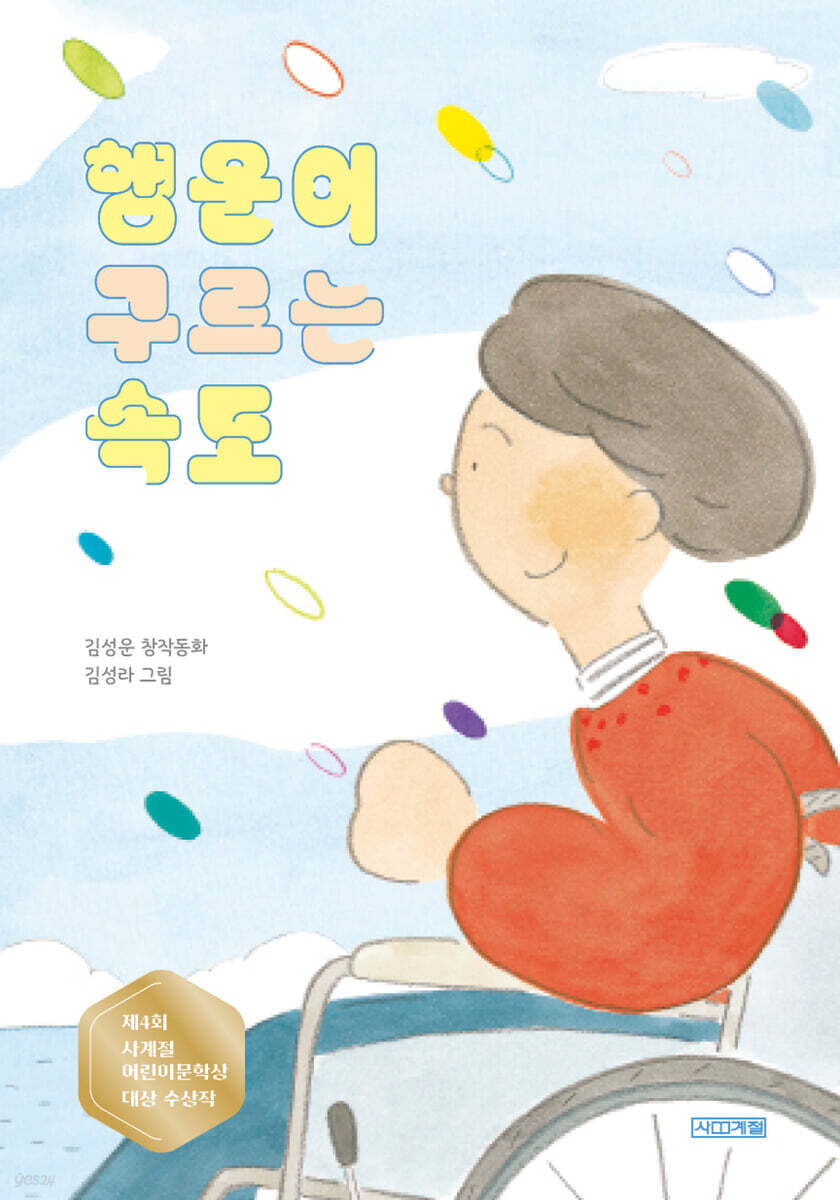
The speed at which luck rolls
 |
Description
Book Introduction
- A word from MD
-
Four Seasons Children's Literature Award Grand Prize WinnerHaneul, in a wheelchair, sees a genie appear before her! The genie promises to grant her one wish...
What kind of wish will Haneul make? Through Haneul, who grows into a child with a firm belief in herself, grounded in friendship, affection, and acceptance, we are led to reflect on the irreplaceable uniqueness of myself.
September 20, 2024. Children's PD Kim Hyun-joo
The 4th Four Seasons Children's Literature Award Grand Prize Winner
The emergence of a child who powerfully crosses the threshold, fueled by friendship and recognition.
People tend to make wishes about what they desperately want in their lives.
If a genie appeared before a child in a wheelchair, what would he wish for? Why would he seek out that child out of all the others? These are the thoughts that immediately come to mind, and this work delightfully transcends those prejudices.
Haneul, the protagonist of the 4th Four Seasons Children's Literature Award winner, "The Speed at which Luck Rolls," has a disability, but she has friends who see her as she is and are with her anytime, anywhere, and neighbors who share her concerns about the difficulties children face in society.
Thanks to them, Haneul grows into a child with strong self-confidence.
By the end of the story, when readers learn what Haneul's wish is, they will be left pondering deeply about what the greatest fortune in their lives is.
Like Haneul, who confidently declares, “From now on, I will set my own pace,” this work encourages all children to not be swayed by the gaze of others and to have the strength to love themselves, who cannot be exchanged for anyone else.
The Four Seasons Children's Literature Award has been discovering children's literature that considers today's children.
Following 『Monster Child』, which was loved by 100,000 readers, this year, we will approach readers with 『The Speed of Luck』, a ‘disability narrative fit for a new era.’
The emergence of a child who powerfully crosses the threshold, fueled by friendship and recognition.
People tend to make wishes about what they desperately want in their lives.
If a genie appeared before a child in a wheelchair, what would he wish for? Why would he seek out that child out of all the others? These are the thoughts that immediately come to mind, and this work delightfully transcends those prejudices.
Haneul, the protagonist of the 4th Four Seasons Children's Literature Award winner, "The Speed at which Luck Rolls," has a disability, but she has friends who see her as she is and are with her anytime, anywhere, and neighbors who share her concerns about the difficulties children face in society.
Thanks to them, Haneul grows into a child with strong self-confidence.
By the end of the story, when readers learn what Haneul's wish is, they will be left pondering deeply about what the greatest fortune in their lives is.
Like Haneul, who confidently declares, “From now on, I will set my own pace,” this work encourages all children to not be swayed by the gaze of others and to have the strength to love themselves, who cannot be exchanged for anyone else.
The Four Seasons Children's Literature Award has been discovering children's literature that considers today's children.
Following 『Monster Child』, which was loved by 100,000 readers, this year, we will approach readers with 『The Speed of Luck』, a ‘disability narrative fit for a new era.’
- You can preview some of the book's contents.
Preview
index
A guest came to our house
Friendship Affection Recognition Fairy
Master of Wishes
A day like a gift
Really lucky
Backstory
Author's Note
Commentary on the work
Friendship Affection Recognition Fairy
Master of Wishes
A day like a gift
Really lucky
Backstory
Author's Note
Commentary on the work
Detailed image
Into the book
I opened the refrigerator door and pulled the wheelchair close.
And then he tapped his thigh with his hand.
“Want to come up and see?”
The little guest hesitated for a moment, then took off his shoes and climbed up my thighs.
I held onto the little guest's leg tightly to keep him from falling.
“Can you touch it?”
"yes!"
--- pp.50~52
“I can decide who will grant my wish.
When you live in a lamp, the person who picks up the lamp is the owner.
Not now.
“I choose who will grant my wish, and I take responsibility for it.”
“Oh, oh.”
An exclamation came out without me knowing.
To decide one's own path without being led around by others.
It sounded like a great idea.
--- pp.68~69
Wangbyeol asked me to do it again, so I rolled the hand rim again.
Shake your shoulders like a model, and swing your arms vigorously.
Wangbyeol put her hands together and spoke with a moved look in her eyes.
“I’ve never seen a wheelchair as confident as yours.”
--- pp.103~104
“There are several reasons.
One thing I can say for sure is that the genie of the lamp will find the one he loves.”
Sister Maram winked, saying she could only say that much.
A person who loves himself… … .
Well then, you've come to the right place.
Because I like myself.
Because it's really good.
And then he tapped his thigh with his hand.
“Want to come up and see?”
The little guest hesitated for a moment, then took off his shoes and climbed up my thighs.
I held onto the little guest's leg tightly to keep him from falling.
“Can you touch it?”
"yes!"
--- pp.50~52
“I can decide who will grant my wish.
When you live in a lamp, the person who picks up the lamp is the owner.
Not now.
“I choose who will grant my wish, and I take responsibility for it.”
“Oh, oh.”
An exclamation came out without me knowing.
To decide one's own path without being led around by others.
It sounded like a great idea.
--- pp.68~69
Wangbyeol asked me to do it again, so I rolled the hand rim again.
Shake your shoulders like a model, and swing your arms vigorously.
Wangbyeol put her hands together and spoke with a moved look in her eyes.
“I’ve never seen a wheelchair as confident as yours.”
--- pp.103~104
“There are several reasons.
One thing I can say for sure is that the genie of the lamp will find the one he loves.”
Sister Maram winked, saying she could only say that much.
A person who loves himself… … .
Well then, you've come to the right place.
Because I like myself.
Because it's really good.
--- p.126
Publisher's Review
Our world surrounded by friendship, affection, acceptance, and fairies.
One day, Maram, an Iraqi man, comes to Haneul's rented house and wants to stay there for just one month.
Not only is he a welcome guest, but Haneul also hears some disturbing stories from Maram.
There are countless genies of lamps in the world, and I am a genie of the lamp who failed the exam and was sent to Korea, far away from my hometown.
Moreover, he said he would grant his wish.
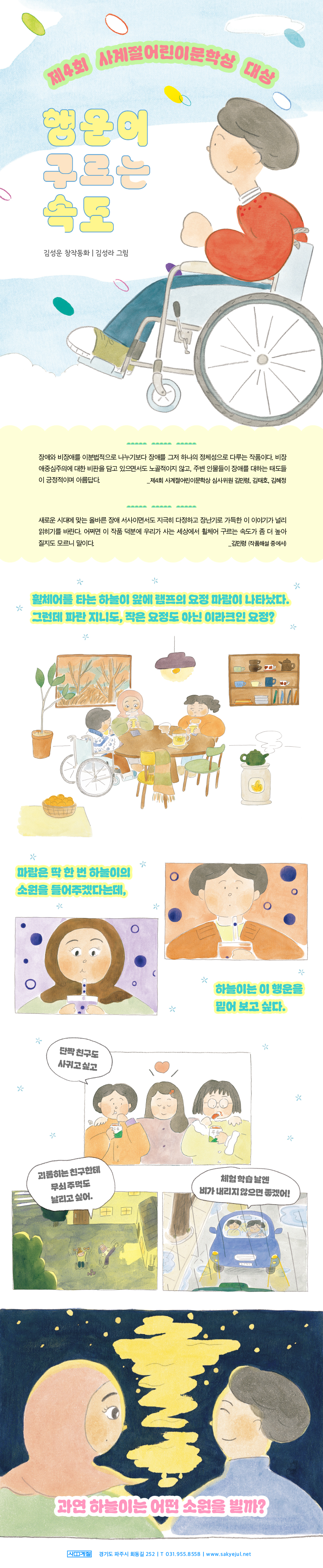
Although it was absurd, Haneul, who wanted to believe it once, connects every moment of her daily life with her wish from that day on.
I want to go to a snack bar with my friends after school without my mom pushing me in a wheelchair, I want an iron fist to hit the kid who bullies my classmates, and I hope it doesn't rain on my first ever field trip.
However, Haneul is able to erase countless wishes one by one thanks to the loving beings who “pull me from behind with all their might whenever something bad happens to me.”
Crunch, slurp… The sound of our footsteps rolled across the snow.
Four footprints and a long wheelchair mark were drawn in that spot.
At that moment, I realized.
The good fortune that came to me was not a magical wish, but friends.
(Page 137)
Haneul attends school in a regular class, not a special class.
Sometimes, Haneul blends in so naturally into the classroom that it makes you forget that he is disabled.
Because her friends just accept her as a member of their class.
Dam-dam, who brings Haneul's food tray, is simply returning the favor to her family, and her best friends Wang-byeol and Bora think of ways for Haneul to play together at school instead of going to places she cannot go.
It is also worth noting that Pakgu, who had been treating Haneul coldly because she was disabled, gradually changes as he watches his classmates' attitudes sideways.
In this way, "The Speed of Fortune" removes all prejudices related to disability, gender, race, and identity, and warmly shows children's lives with others in the small society called school.
Friendship, affection, recognition… Haneul, who lives surrounded by so much affection, shares her goodwill with others.
By stepping up when your classmates are having a hard time and helping children younger than you, to the extent that you can.
Following numerous affections, fairies are added to the world of Haneul.
When love and kindness come together and roll into another fortune, children grow a little taller.
If the unconditional goodness depicted in this work takes root in our lives, children will be armed with kindness to face the harsh world.
About the preciousness of 'me', the unchangeable luck that can never be changed
Haneul runs a small supermarket and a rental house in a quiet seaside village.
The reason why he stays here, where not only guests but even seagulls rarely come, is because it is a perfect place for Haneul, who uses a wheelchair, to live.
The family accepted Haneul's disability and created a comfortable living environment for Haneul instead of a two-story house where she would have difficulty climbing stairs.
But the moment she leaves home, Haneul faces all kinds of difficulties.
Everywhere I go, I have to check for ramps, elevators, or wheelchair-accessible restrooms, and even at school, I sometimes get into unexpected fights with friends because of wheelchair use.
Sometimes he gets discouraged, but he always shakes it off and moves on again.
Wangbyeol asked me to do it again, so I rolled the hand rim again.
Shake your shoulders like a model, and swing your arms vigorously.
Wangbyeol put her hands together and spoke with a moved look in her eyes.
“I’ve never seen a wheelchair as confident as yours.” (pp. 103-104)
For Haneul, who has spent more than half of her life in a wheelchair, disability is a natural condition, and it is an identity that cannot be separated from or hidden.
That is why Haneul does not turn the arrow of the problem onto herself.
While the protagonists with disabilities have focused on accepting themselves, Haneul turns her attention to the society in which she lives.
Haneul, who said she would not go to a place where she would “feel rejected,” instead of stopping, shows a bold attitude that she will go further.
In this turbulent world, we hope to find more places to roam, and we ask ourselves whether we are ready to live together with the world.
Furthermore, this work focuses on the importance of living happily as ‘me’.
He can help a little customer who came to the supermarket alone or a friend carrying a heavy load with a wheelchair, and he can also show off his own wheelchair walking skills instead of idol choreography.
People sometimes blame their own circumstances in the face of adversity and yearn for a better life.
The environment may change at any time, but the one constant is yourself.
“Because I like myself.
As Haneul softly says, “It’s really good,” children will ponder the opportunities in life given equally to everyone and their uniqueness that cannot be exchanged for anyone else’s.
My lifelong wish is Jang Ha-neul
A powerful voice of hospitality to me and the world!
The day when Sister Maram leaves is approaching.
It's not an easy decision to make, considering it's only one wish.
Just then, Maram nods at Haneul's leg, asking what she was thinking about for so long.
Yes, that's what happened! Haneul, being cautious, subtly asks her mother if she's ever made a wish.
Haneul's nose gets tingly at her mother's unexpected wish, but she decides to keep the wish buried in her heart.
“Some wishes are better when they don’t come true,” and it’s far from the true heart of the sky.
After much thought, Haneul shouts out her final wish related to her legs to her older sister Maram.
Sister Maram tilted her head as if surprised.
“Why?”
“This is me.
“I have never thought that anyone else was better than me.” (p. 123)
Despite Haneul's continued acceptance of her disability, her wish exceeds the expectations of both Maram and the reader.
Just like the proverb "A lifelong wish is like scorched rice," which metaphorically describes how asking for something so trivial is, Haneul's wish may feel like throwing away a golden opportunity to some.
But isn't this simply because we're looking at it from the perspective of a non-disabled person? "The Speed of Fortune" listens attentively to the voices of those who clearly exist but are intentionally erased from the world.
Maram unconditionally confronts those who do not hesitate to make rude remarks based on race, and Haneul finally rebukes her friend who uses his disability as an excuse, saying it was just a joke.
It is unknown whether Maram truly granted Haneul's wish or if another stroke of luck appeared, but what is certain is that as the world continues to show hospitality, it will reach me as I live with them.
Like the luck that the heavens have by your side.
Fairy tales have always been concerned with the young and the weak, and one of their important functions is to convey an optimistic outlook on the world.
In that sense, the value of this work seems clear.
I hope this story, which is a fitting narrative for the new era, yet also filled with tenderness and playfulness, will be widely read.
Maybe thanks to this work, the world we live in will get a little faster at rolling wheelchairs.
- Kim Min-ryeong (children's literature critic), from the commentary on the work
Recommended reviews
Although it begins with a provocative question about disability, it treats disability as simply an identity rather than dichotomizing it into disability and non-disability.
It contains criticism of ableism, but it is not overt, and the attitudes of the people around the film toward disabilities are positive and beautiful.
- [4th Four Seasons Children's Literature Award Judges: Kim Min-ryeong, Kim Tae-ho, and Kim Hye-jeong]
One day, Maram, an Iraqi man, comes to Haneul's rented house and wants to stay there for just one month.
Not only is he a welcome guest, but Haneul also hears some disturbing stories from Maram.
There are countless genies of lamps in the world, and I am a genie of the lamp who failed the exam and was sent to Korea, far away from my hometown.
Moreover, he said he would grant his wish.
Although it was absurd, Haneul, who wanted to believe it once, connects every moment of her daily life with her wish from that day on.
I want to go to a snack bar with my friends after school without my mom pushing me in a wheelchair, I want an iron fist to hit the kid who bullies my classmates, and I hope it doesn't rain on my first ever field trip.
However, Haneul is able to erase countless wishes one by one thanks to the loving beings who “pull me from behind with all their might whenever something bad happens to me.”
Crunch, slurp… The sound of our footsteps rolled across the snow.
Four footprints and a long wheelchair mark were drawn in that spot.
At that moment, I realized.
The good fortune that came to me was not a magical wish, but friends.
(Page 137)
Haneul attends school in a regular class, not a special class.
Sometimes, Haneul blends in so naturally into the classroom that it makes you forget that he is disabled.
Because her friends just accept her as a member of their class.
Dam-dam, who brings Haneul's food tray, is simply returning the favor to her family, and her best friends Wang-byeol and Bora think of ways for Haneul to play together at school instead of going to places she cannot go.
It is also worth noting that Pakgu, who had been treating Haneul coldly because she was disabled, gradually changes as he watches his classmates' attitudes sideways.
In this way, "The Speed of Fortune" removes all prejudices related to disability, gender, race, and identity, and warmly shows children's lives with others in the small society called school.
Friendship, affection, recognition… Haneul, who lives surrounded by so much affection, shares her goodwill with others.
By stepping up when your classmates are having a hard time and helping children younger than you, to the extent that you can.
Following numerous affections, fairies are added to the world of Haneul.
When love and kindness come together and roll into another fortune, children grow a little taller.
If the unconditional goodness depicted in this work takes root in our lives, children will be armed with kindness to face the harsh world.
About the preciousness of 'me', the unchangeable luck that can never be changed
Haneul runs a small supermarket and a rental house in a quiet seaside village.
The reason why he stays here, where not only guests but even seagulls rarely come, is because it is a perfect place for Haneul, who uses a wheelchair, to live.
The family accepted Haneul's disability and created a comfortable living environment for Haneul instead of a two-story house where she would have difficulty climbing stairs.
But the moment she leaves home, Haneul faces all kinds of difficulties.
Everywhere I go, I have to check for ramps, elevators, or wheelchair-accessible restrooms, and even at school, I sometimes get into unexpected fights with friends because of wheelchair use.
Sometimes he gets discouraged, but he always shakes it off and moves on again.
Wangbyeol asked me to do it again, so I rolled the hand rim again.
Shake your shoulders like a model, and swing your arms vigorously.
Wangbyeol put her hands together and spoke with a moved look in her eyes.
“I’ve never seen a wheelchair as confident as yours.” (pp. 103-104)
For Haneul, who has spent more than half of her life in a wheelchair, disability is a natural condition, and it is an identity that cannot be separated from or hidden.
That is why Haneul does not turn the arrow of the problem onto herself.
While the protagonists with disabilities have focused on accepting themselves, Haneul turns her attention to the society in which she lives.
Haneul, who said she would not go to a place where she would “feel rejected,” instead of stopping, shows a bold attitude that she will go further.
In this turbulent world, we hope to find more places to roam, and we ask ourselves whether we are ready to live together with the world.
Furthermore, this work focuses on the importance of living happily as ‘me’.
He can help a little customer who came to the supermarket alone or a friend carrying a heavy load with a wheelchair, and he can also show off his own wheelchair walking skills instead of idol choreography.
People sometimes blame their own circumstances in the face of adversity and yearn for a better life.
The environment may change at any time, but the one constant is yourself.
“Because I like myself.
As Haneul softly says, “It’s really good,” children will ponder the opportunities in life given equally to everyone and their uniqueness that cannot be exchanged for anyone else’s.
My lifelong wish is Jang Ha-neul
A powerful voice of hospitality to me and the world!
The day when Sister Maram leaves is approaching.
It's not an easy decision to make, considering it's only one wish.
Just then, Maram nods at Haneul's leg, asking what she was thinking about for so long.
Yes, that's what happened! Haneul, being cautious, subtly asks her mother if she's ever made a wish.
Haneul's nose gets tingly at her mother's unexpected wish, but she decides to keep the wish buried in her heart.
“Some wishes are better when they don’t come true,” and it’s far from the true heart of the sky.
After much thought, Haneul shouts out her final wish related to her legs to her older sister Maram.
Sister Maram tilted her head as if surprised.
“Why?”
“This is me.
“I have never thought that anyone else was better than me.” (p. 123)
Despite Haneul's continued acceptance of her disability, her wish exceeds the expectations of both Maram and the reader.
Just like the proverb "A lifelong wish is like scorched rice," which metaphorically describes how asking for something so trivial is, Haneul's wish may feel like throwing away a golden opportunity to some.
But isn't this simply because we're looking at it from the perspective of a non-disabled person? "The Speed of Fortune" listens attentively to the voices of those who clearly exist but are intentionally erased from the world.
Maram unconditionally confronts those who do not hesitate to make rude remarks based on race, and Haneul finally rebukes her friend who uses his disability as an excuse, saying it was just a joke.
It is unknown whether Maram truly granted Haneul's wish or if another stroke of luck appeared, but what is certain is that as the world continues to show hospitality, it will reach me as I live with them.
Like the luck that the heavens have by your side.
Fairy tales have always been concerned with the young and the weak, and one of their important functions is to convey an optimistic outlook on the world.
In that sense, the value of this work seems clear.
I hope this story, which is a fitting narrative for the new era, yet also filled with tenderness and playfulness, will be widely read.
Maybe thanks to this work, the world we live in will get a little faster at rolling wheelchairs.
- Kim Min-ryeong (children's literature critic), from the commentary on the work
Recommended reviews
Although it begins with a provocative question about disability, it treats disability as simply an identity rather than dichotomizing it into disability and non-disability.
It contains criticism of ableism, but it is not overt, and the attitudes of the people around the film toward disabilities are positive and beautiful.
- [4th Four Seasons Children's Literature Award Judges: Kim Min-ryeong, Kim Tae-ho, and Kim Hye-jeong]
GOODS SPECIFICS
- Date of issue: September 10, 2024
- Page count, weight, size: 148 pages | 268g | 147*210*10mm
- ISBN13: 9791169813341
- ISBN10: 1169813348
- KC Certification: Certification Type: Conformity Confirmation
You may also like
카테고리
korean


korean

![ELLE 엘르 스페셜 에디션 A형 : 12월 [2025]](http://librairie.coreenne.fr/cdn/shop/files/b8e27a3de6c9538896439686c6b0e8fb.jpg?v=1766436872&width=3840)


