

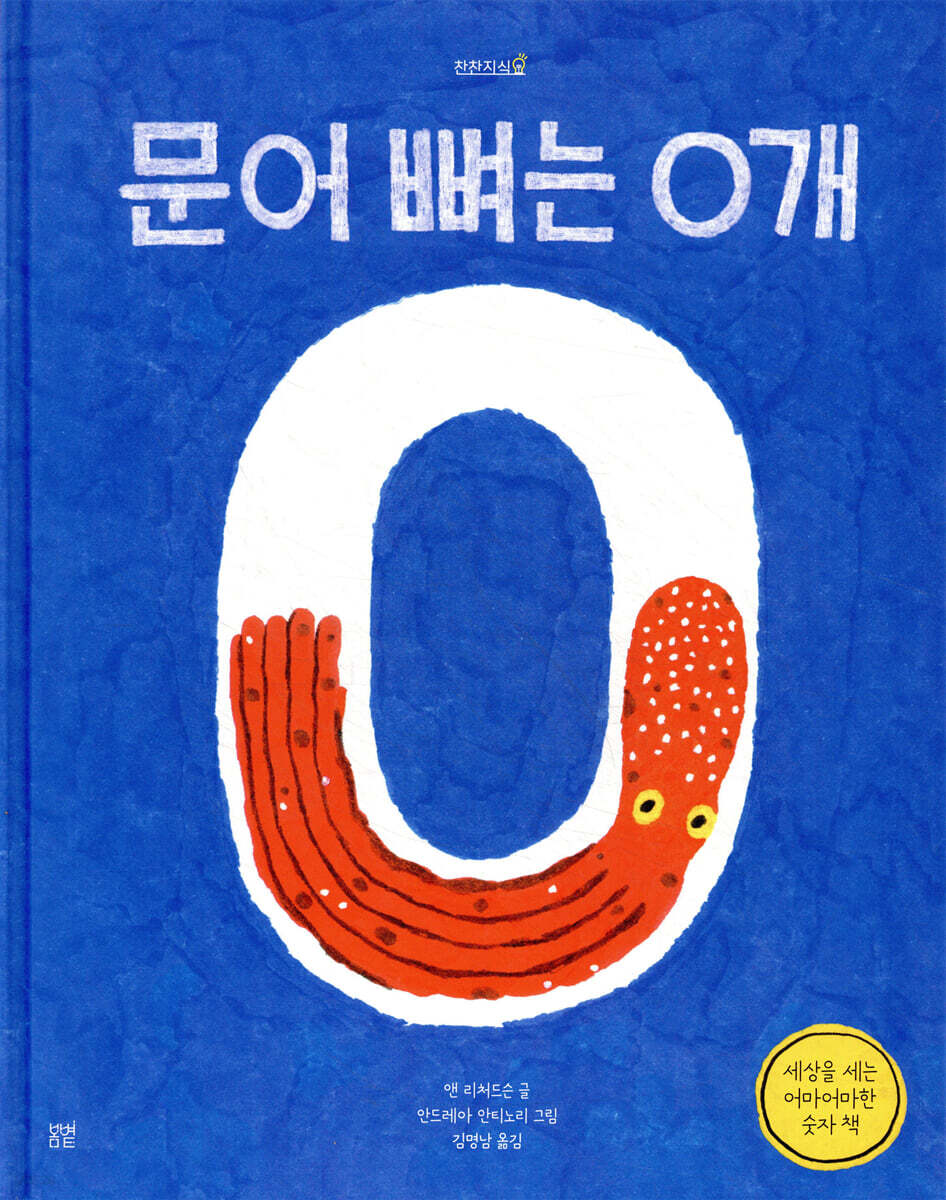
Octopus has 0 bones
 |
Description
Book Introduction
A number book that counts from 0 to 9 billion and learns amazing facts about the world.
From nothing to infinite worlds,
A feast of curious numbers!
How many times do we breathe a day?
How many kilometers would it be to go to the moon and back?
Solving the curiosities surrounding the world
A book that will make you fall in love with numbers
From nothing to infinite worlds,
A feast of curious numbers!
How many times do we breathe a day?
How many kilometers would it be to go to the moon and back?
Solving the curiosities surrounding the world
A book that will make you fall in love with numbers
- You can preview some of the book's contents.
Preview
Detailed image

Publisher's Review
A world of numbers starting from a round octopus and a round zero
Round eyes staring straight ahead.
A round spot with dots on a round head.
An octopus lying flexibly curled inside the round number '0'.
Just like a dot on a series of circular shapes, it is said that the number of bones an octopus has is 0.
The bright red octopus leads us into the world of numbers, crossing the starting line of zero and poking its face out from time to time in the bowhead whale's tail, among the colorful sponges, and next to the unicorn whale.
How far away are the clouds floating in the sky from us? How many snowflakes are needed to make a snowball? Many children's questions revolve around numbers.
《Octopus Bones Have 0》 is a book that answers curiosity about this world with numbers.
As you turn the pages, captivated by the colorful and adorable illustrations, you will learn about a wide range of subjects, including humans, nature, and the universe, while also accumulating mathematical knowledge.
Difficult math concepts made cute and friendly
The way this book counts numbers is unique.
First, we start counting from 0, which is nothing, rather than 1, which is a definite entity.
After that, it doesn't increase by 1 like 1, 2, 3, but jumps to 10, 200, 3000.
By adding one 0 to 1, we can explain that the sound of breathing is 10 decibels, and by adding two 0s to 2, we can explain that there are 200 types of cells in the human body.
At the end of the increasingly dense rows of zeros, we reach 9 billion, which is 9 with nine zeros attached to it.
Unlike other number books that usually count from 1 to 9 and up to 100, the vast range from 0 to 9 billion expands the horizon of thought.
Zero and exponentiation can be difficult concepts for children to understand, but the book explains them in a friendly way using related examples from everyday life or the wider world.
You can learn unit nouns naturally by counting various objects with different units, such as 'one avocado seed', '4,000 meters of water depth', and '500,000 leaves'.
Andrea Antinori's paintings also help to bridge the gap between us and numbers.
He gave personality to even inanimate objects such as clouds and water droplets by drawing faces on them, as well as on very small animals and insects.
You can read the situation and content by inferring it from the facial expressions of these people, which can be indifferent, smiling, or frowning.
Meanwhile, pictures that are not directly related to the text add humor between the pages of the book.
Aliens playing tennis in space, birds peeking out from between oak trees, monkeys, cats, and unidentified creatures mingling in the crowds are scattered throughout the game like a hidden picture puzzle, making it a lot of fun to look for these elements.
The infinite possibilities of 0
《Octopus Bones: 0》 starts with a number of nothing and looks to 9 billion and beyond.
The same goes for children's imagination and thinking skills.
Author Ann Richardson says that just as adults can't arbitrarily allow or celebrate children's curiosity, there's no need to intentionally inspire them either.
Combining counting with natural numbers and their exponents, incorporating surprising and surprising facts about the world, and featuring illustrations that convey more information than words, this book is designed to naturally engage children and help them explore the world beyond the pages.
There is an anecdote that Anne Richardson introduces along with the above story.
One time, my oldest child showed me a seed pod from a California poppy, something I had passed by countless times without ever noticing.
Like the seed pod that the child held out, "Octopus Bones Have 0" is also full of surprising and new worlds that even adults can see.
For children, this book immerses them in a world they have been curious about but have not yet found the answers to or are unaware of, while for adults, it makes them look back on a world they have known about but overlooked or temporarily forgotten.
Author's Note
One day, while I was busy writing this book, I saw sixteen ants fly by in front of my back door in one minute.
I crouched in front of the door and counted the ants.
There always seem to be ants passing by there.
If the ants continued on that path at the same speed, about 23,000 ants would pass by my back door every day.
There are so many!
To be honest, I can't tell the difference between individual ants, so I don't know if there are really 23,000 ants passing by or if there are fewer ants coming and going multiple times.
I didn't even check to see if the ants were really there all day.
I wonder how many steps an ant walks a day.
Will you walk more than me?
Biologist E.
O. Wilson said that there are over 1,000 trillion ants living on Earth.
If that's true, there are more ants on Earth than there are stars in our galaxy.
I wonder how many of them are in our backyard.
In the spring of 2020, my two children and I began counting, measuring, and wondering about all the numbers in the world.
How many seeds are in an apple? How small are hummingbird eggs?
How far away is Saturn? We figured it out and wrote it down.
As time went by, the numbers piled up, and I organized them and wrote this book.
I want you to go outside and count and measure something.
Can you count how many sounds you hear in a minute, or how many cars pass by in an hour? Can you recall how to measure the amount of rainwater falling on the ground during a single rainstorm, or how to calculate the number of bananas you eat in a year? Have you ever wondered how big a cloud is, or how long it takes for an apple to grow to its full size?
Counting and measuring is a great way to learn about the world around us.
Numbers and the units we use to count and measure them allow us to describe and compare how much something is, how far away it is, how long it is, how loud it is, and so on.
Having this ability will help you when you want to understand the world, when you want to communicate with others in society, and when you want to find answers to problems.
This work is even fun.
It would be fun to know how many sides a snowflake is and how many of them you need to pack together to make a snowball.
So, you too, count or measure something, be amazed, and look more closely.
I hope you discover lots of great things.
- Anne Richardson
Round eyes staring straight ahead.
A round spot with dots on a round head.
An octopus lying flexibly curled inside the round number '0'.
Just like a dot on a series of circular shapes, it is said that the number of bones an octopus has is 0.
The bright red octopus leads us into the world of numbers, crossing the starting line of zero and poking its face out from time to time in the bowhead whale's tail, among the colorful sponges, and next to the unicorn whale.
How far away are the clouds floating in the sky from us? How many snowflakes are needed to make a snowball? Many children's questions revolve around numbers.
《Octopus Bones Have 0》 is a book that answers curiosity about this world with numbers.
As you turn the pages, captivated by the colorful and adorable illustrations, you will learn about a wide range of subjects, including humans, nature, and the universe, while also accumulating mathematical knowledge.
Difficult math concepts made cute and friendly
The way this book counts numbers is unique.
First, we start counting from 0, which is nothing, rather than 1, which is a definite entity.
After that, it doesn't increase by 1 like 1, 2, 3, but jumps to 10, 200, 3000.
By adding one 0 to 1, we can explain that the sound of breathing is 10 decibels, and by adding two 0s to 2, we can explain that there are 200 types of cells in the human body.
At the end of the increasingly dense rows of zeros, we reach 9 billion, which is 9 with nine zeros attached to it.
Unlike other number books that usually count from 1 to 9 and up to 100, the vast range from 0 to 9 billion expands the horizon of thought.
Zero and exponentiation can be difficult concepts for children to understand, but the book explains them in a friendly way using related examples from everyday life or the wider world.
You can learn unit nouns naturally by counting various objects with different units, such as 'one avocado seed', '4,000 meters of water depth', and '500,000 leaves'.
Andrea Antinori's paintings also help to bridge the gap between us and numbers.
He gave personality to even inanimate objects such as clouds and water droplets by drawing faces on them, as well as on very small animals and insects.
You can read the situation and content by inferring it from the facial expressions of these people, which can be indifferent, smiling, or frowning.
Meanwhile, pictures that are not directly related to the text add humor between the pages of the book.
Aliens playing tennis in space, birds peeking out from between oak trees, monkeys, cats, and unidentified creatures mingling in the crowds are scattered throughout the game like a hidden picture puzzle, making it a lot of fun to look for these elements.
The infinite possibilities of 0
《Octopus Bones: 0》 starts with a number of nothing and looks to 9 billion and beyond.
The same goes for children's imagination and thinking skills.
Author Ann Richardson says that just as adults can't arbitrarily allow or celebrate children's curiosity, there's no need to intentionally inspire them either.
Combining counting with natural numbers and their exponents, incorporating surprising and surprising facts about the world, and featuring illustrations that convey more information than words, this book is designed to naturally engage children and help them explore the world beyond the pages.
There is an anecdote that Anne Richardson introduces along with the above story.
One time, my oldest child showed me a seed pod from a California poppy, something I had passed by countless times without ever noticing.
Like the seed pod that the child held out, "Octopus Bones Have 0" is also full of surprising and new worlds that even adults can see.
For children, this book immerses them in a world they have been curious about but have not yet found the answers to or are unaware of, while for adults, it makes them look back on a world they have known about but overlooked or temporarily forgotten.
Author's Note
One day, while I was busy writing this book, I saw sixteen ants fly by in front of my back door in one minute.
I crouched in front of the door and counted the ants.
There always seem to be ants passing by there.
If the ants continued on that path at the same speed, about 23,000 ants would pass by my back door every day.
There are so many!
To be honest, I can't tell the difference between individual ants, so I don't know if there are really 23,000 ants passing by or if there are fewer ants coming and going multiple times.
I didn't even check to see if the ants were really there all day.
I wonder how many steps an ant walks a day.
Will you walk more than me?
Biologist E.
O. Wilson said that there are over 1,000 trillion ants living on Earth.
If that's true, there are more ants on Earth than there are stars in our galaxy.
I wonder how many of them are in our backyard.
In the spring of 2020, my two children and I began counting, measuring, and wondering about all the numbers in the world.
How many seeds are in an apple? How small are hummingbird eggs?
How far away is Saturn? We figured it out and wrote it down.
As time went by, the numbers piled up, and I organized them and wrote this book.
I want you to go outside and count and measure something.
Can you count how many sounds you hear in a minute, or how many cars pass by in an hour? Can you recall how to measure the amount of rainwater falling on the ground during a single rainstorm, or how to calculate the number of bananas you eat in a year? Have you ever wondered how big a cloud is, or how long it takes for an apple to grow to its full size?
Counting and measuring is a great way to learn about the world around us.
Numbers and the units we use to count and measure them allow us to describe and compare how much something is, how far away it is, how long it is, how loud it is, and so on.
Having this ability will help you when you want to understand the world, when you want to communicate with others in society, and when you want to find answers to problems.
This work is even fun.
It would be fun to know how many sides a snowflake is and how many of them you need to pack together to make a snowball.
So, you too, count or measure something, be amazed, and look more closely.
I hope you discover lots of great things.
- Anne Richardson
GOODS SPECIFICS
- Date of issue: April 26, 2024
- Page count, weight, size: 76 pages | 241*305*12mm
- ISBN13: 9791193150269
- ISBN10: 1193150264
- KC Certification: Certification Type: Conformity Confirmation
You may also like
카테고리
korean


korean

![ELLE 엘르 스페셜 에디션 A형 : 12월 [2025]](http://librairie.coreenne.fr/cdn/shop/files/b8e27a3de6c9538896439686c6b0e8fb.jpg?v=1766436872&width=3840)


