

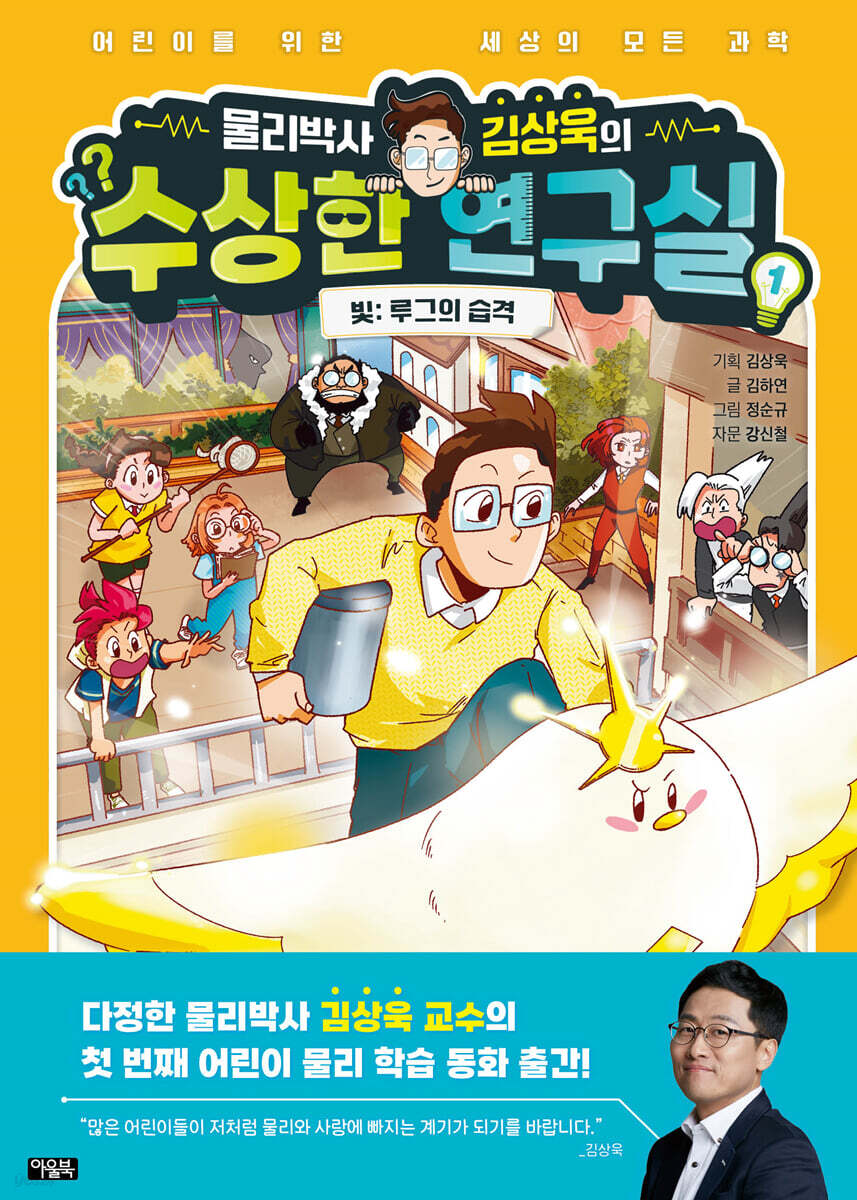
Physics Ph.D. Kim Sang-wook's Suspicious Lab 1
 |
Description
Book Introduction
We invite you to Professor Sangwook Kim's lab, where the secrets of science are revealed! The first children's physics learning fairy tale by the caring physics doctor, Sangwook Kim, has been published! The first volume of the children's science fiction series by the kind physicist Professor Sang-wook Kim, titled "The Suspicious Laboratory of Physicist Sang-wook Kim," has been published. In an age where we cannot survive even a single moment without science and technology, this book was created to help children retain their pure curiosity about the world and their interest in science, and to motivate them to learn about science. Although physics may seem far removed from reality, surrounded by complex laws and difficult mathematics, the concept of physics is alive and breathing right next to us under the name of 'idea', and causes trouble, in order to teach children in an easy and friendly way that physics is actually close to us. As you read the interesting and entertaining stories told by Professor Sang-wook Kim, who has been working hard to popularize science, saying, "Science is also a liberal art," you will naturally learn physics and even fall in love with it like Professor Sang-wook Kim. |
- You can preview some of the book's contents.
Preview
index
About the Author … 2
Planner's Note… 4
Character introduction… 8
Chapter 1.
Meet the new owner of Tteokbokki... 10
Secret Research Journal ① What is Physics?
Chapter 2.
Twinkle, twinkle! A magical bird has appeared! … 32
Secret Research Journal② What does it mean to see?
Chapter 3.
Gunwoo's Teeth and the Creepy Basement… 54
Secret Research Journal ③ What is an optical illusion?
Chapter 4.
Chairman Madu Sik, a global hero(?)… 76
Secret Research Journal④ Types of Light①
Chapter 5.
Sunlight Hospital commotion…92
Secret Research Journal⑤ Types of Light②
Chapter 6.
Catch the Light Dove! … 116
Secret Research Journal ⑥ Reflection of Light and Concave Mirrors
Chapter 7.
Revealing identity… 136
Secret Research Journal ⑦ Reflection of Light and Convex Mirrors
Physical Idea Encyclopedia … 150
Cookies… 152
Preview of Volume 2 … 158
Planner's Note… 4
Character introduction… 8
Chapter 1.
Meet the new owner of Tteokbokki... 10
Secret Research Journal ① What is Physics?
Chapter 2.
Twinkle, twinkle! A magical bird has appeared! … 32
Secret Research Journal② What does it mean to see?
Chapter 3.
Gunwoo's Teeth and the Creepy Basement… 54
Secret Research Journal ③ What is an optical illusion?
Chapter 4.
Chairman Madu Sik, a global hero(?)… 76
Secret Research Journal④ Types of Light①
Chapter 5.
Sunlight Hospital commotion…92
Secret Research Journal⑤ Types of Light②
Chapter 6.
Catch the Light Dove! … 116
Secret Research Journal ⑥ Reflection of Light and Concave Mirrors
Chapter 7.
Revealing identity… 136
Secret Research Journal ⑦ Reflection of Light and Convex Mirrors
Physical Idea Encyclopedia … 150
Cookies… 152
Preview of Volume 2 … 158
Detailed image
.jpg)
Into the book
The three children, who had just finished school, were chattering away as they observed the strange man standing in front of the old building.
--- p.12
The new owner seemed kinder than the previous owner.
--- p.20
The bird nodded its head, looking at the children beyond the window with a playful expression.
--- p.37
As Terry lifted the handle on the trapdoor, a staircase leading down to a dark basement was revealed.
--- p.50
It's already too late to regret.
It wasn't like I was inviting kids over just to run a successful tteokbokki restaurant.
--- p.73
Sunlight Hospital was a mess from the entrance.
There were screams and the sound of people running everywhere.
--- p.104
A suspicious bird resembling a dove emitting a strong light was flying somewhere.
--- p.113
Taeri jumped much higher than the old man and swung her net, but the little pigeon seemed surprised and flew higher.
--- p.12
The new owner seemed kinder than the previous owner.
--- p.20
The bird nodded its head, looking at the children beyond the window with a playful expression.
--- p.37
As Terry lifted the handle on the trapdoor, a staircase leading down to a dark basement was revealed.
--- p.50
It's already too late to regret.
It wasn't like I was inviting kids over just to run a successful tteokbokki restaurant.
--- p.73
Sunlight Hospital was a mess from the entrance.
There were screams and the sound of people running everywhere.
--- p.104
A suspicious bird resembling a dove emitting a strong light was flying somewhere.
--- p.113
Taeri jumped much higher than the old man and swung her net, but the little pigeon seemed surprised and flew higher.
--- p.125
Publisher's Review
No more difficult physics! Physics made easy.
What comes to mind when you hear the word "physics"? Do you immediately think of complex laws and dazzling, arcane mathematics? Most people know the equation F=ma, but they don't fully grasp its meaning.
What about the law of action and reaction, the second law of thermodynamics? At this point, you might wave your hand and ask why you need to know it.
But physics is not about these laws and formulas.
Physics is in our daily lives.
In fact, everything we experience is physics.
As you can see from the meaning of the word physics, physics is the principle of everything in the world.
[Physics Doctor Kim Sang-wook's Suspicious Lab] easily explains physics stories we encounter every moment through examples and stories.
'Seeing the words written on the blackboard', 'Jumps bring you back to the ground', 'Salt and sugar taste different'.
Can you believe that physics is hidden in these seemingly simple things? Discover the physics alive and breathing all around us with this book.
Meet the living, breathing, mischievous physics.
Physics is invisible to the eye.
That is why it is not easy for children to understand the abstract statement that ‘physics is alive.’
To address this issue and visually demonstrate physics concepts to children, we used a setting where physics concepts come alive, breathing, and in action.
And so we gave the name 'idea' to this actual living physical concept.
Ideas cause trouble and incidents related to their physics concepts around Mr. Kim Sang-wook, Gun-woo, Tae-ri, and Ha-na.
Through the [Physics Doctor Kim Sang-wook's Suspicious Lab] series, children will experience the fascinating phenomena caused by ideas and naturally learn each physics concept, as well as learn how closely each physics concept is related to our lives.
Furthermore, children will be able to become more familiar with physics by looking at the charming and cute idea characters that best embody the characteristics of each physical concept.
Let your pure curiosity shine through this book.
We encounter science at every moment of our lives.
When we wake up in the morning, we open our eyes to the sound of our phone's alarm, eat food cooked by a home appliance, and cry and laugh together while watching TV.
But adults think that science is only for experts and scholars.
As our lives are closely related to science, science is our common sense and culture in modern times.
What about children, on the other hand? Children have a pure curiosity.
We try burning paper with a magnifying glass and making paper boats and floating them on water.
Even without any specialized theory or knowledge about convex lenses or buoyancy.
It all starts with curiosity.
If we can maintain and develop children's genuine curiosity about science, it may not be so difficult to make science a liberal art.
I hope that [The Suspicious Lab of Physics Doctor Sangwook Kim] will awaken children's curiosity about physics and, beyond that, motivate them to want to gain a deeper understanding of physics.
Planner's note
Knowing physics makes science easy.
Would you believe we were all scientists as children? If you ever dug into the ground out of curiosity, walked endlessly to reach the end of a rainbow, or took apart a toy to see how it worked, you were a scientist.
Perhaps a scientist is someone who has retained the interests of childhood.
So shouldn't we protect our children from losing interest in science?
Physics is special among sciences.
It is no exaggeration to say that the discipline we call science today began with Newtonian physics in the 17th century.
Roughly speaking, modern science is an activity carried out by physical methods, using the language and concepts of physics.
Just like calculating atomic structure in chemistry, talking about energy in life sciences, using quantum mechanics in electronics, and applying the theory of relativity in astronomy.
Because physics is a discipline that deals with the most fundamental principles contained in all of nature.
So, if you don't know physics, it's hard to understand science.
If you don't become a scientist, do you really need to know physics? We live in an age of science and technology.
Most of the significant changes that have occurred over the past 200 years have been the result of science and technology.
This means that we live in an era where we cannot live even for a single moment without science and technology.
Now, science is not just knowledge for experts, but has become common sense and a way of life for modern people.
Children are already familiar with, and even enjoy, many of the challenging topics covered in physics. Examples include black holes, the Big Bang, time machines, teleportation, invisibility cloaks, atomic bombs, and parallel universes, all of which are staples of science fiction films.
However, when you actually encounter textbook physics armed with mathematics, you lose interest.
To properly understand physics, you must ultimately know mathematics, but mathematics is not absolutely necessary to understand physics as a liberal arts subject.
In fact, even for physicists, an intuitive understanding of nature is often more important than rigorous mathematical formulas.
I believe it's more important to awaken children's existing curiosity about physics and motivate them to want to learn proper knowledge.
When I received the publishing offer, I was reminded of my childhood when I used to read science educational comic series from time to time.
I remember being fascinated by stories about dinosaurs and insects, but finding stories about physics boring.
I sometimes wonder if, if I had read physics stories as interestingly as dinosaurs or insects, I might have been able to dream of becoming a physicist earlier.
In preparing this series, Dr. Kang Shin-cheol and I organized the physics concepts that absolutely had to be covered, and based on that, author Kim Ha-yeon created a story that children would really enjoy.
I especially like the premise that I appear and solve mysteries with the kids, and along the way, important physics concepts are introduced one by one.
Above all, I expect that I will be able to immerse myself even more because the illustrations by Jeong Sun-gyu are so wonderful and lovely.
I hope that reading this book, which I have put my best effort into, will be an opportunity for many children to fall in love with physics.
What comes to mind when you hear the word "physics"? Do you immediately think of complex laws and dazzling, arcane mathematics? Most people know the equation F=ma, but they don't fully grasp its meaning.
What about the law of action and reaction, the second law of thermodynamics? At this point, you might wave your hand and ask why you need to know it.
But physics is not about these laws and formulas.
Physics is in our daily lives.
In fact, everything we experience is physics.
As you can see from the meaning of the word physics, physics is the principle of everything in the world.
[Physics Doctor Kim Sang-wook's Suspicious Lab] easily explains physics stories we encounter every moment through examples and stories.
'Seeing the words written on the blackboard', 'Jumps bring you back to the ground', 'Salt and sugar taste different'.
Can you believe that physics is hidden in these seemingly simple things? Discover the physics alive and breathing all around us with this book.
Meet the living, breathing, mischievous physics.
Physics is invisible to the eye.
That is why it is not easy for children to understand the abstract statement that ‘physics is alive.’
To address this issue and visually demonstrate physics concepts to children, we used a setting where physics concepts come alive, breathing, and in action.
And so we gave the name 'idea' to this actual living physical concept.
Ideas cause trouble and incidents related to their physics concepts around Mr. Kim Sang-wook, Gun-woo, Tae-ri, and Ha-na.
Through the [Physics Doctor Kim Sang-wook's Suspicious Lab] series, children will experience the fascinating phenomena caused by ideas and naturally learn each physics concept, as well as learn how closely each physics concept is related to our lives.
Furthermore, children will be able to become more familiar with physics by looking at the charming and cute idea characters that best embody the characteristics of each physical concept.
Let your pure curiosity shine through this book.
We encounter science at every moment of our lives.
When we wake up in the morning, we open our eyes to the sound of our phone's alarm, eat food cooked by a home appliance, and cry and laugh together while watching TV.
But adults think that science is only for experts and scholars.
As our lives are closely related to science, science is our common sense and culture in modern times.
What about children, on the other hand? Children have a pure curiosity.
We try burning paper with a magnifying glass and making paper boats and floating them on water.
Even without any specialized theory or knowledge about convex lenses or buoyancy.
It all starts with curiosity.
If we can maintain and develop children's genuine curiosity about science, it may not be so difficult to make science a liberal art.
I hope that [The Suspicious Lab of Physics Doctor Sangwook Kim] will awaken children's curiosity about physics and, beyond that, motivate them to want to gain a deeper understanding of physics.
Planner's note
Knowing physics makes science easy.
Would you believe we were all scientists as children? If you ever dug into the ground out of curiosity, walked endlessly to reach the end of a rainbow, or took apart a toy to see how it worked, you were a scientist.
Perhaps a scientist is someone who has retained the interests of childhood.
So shouldn't we protect our children from losing interest in science?
Physics is special among sciences.
It is no exaggeration to say that the discipline we call science today began with Newtonian physics in the 17th century.
Roughly speaking, modern science is an activity carried out by physical methods, using the language and concepts of physics.
Just like calculating atomic structure in chemistry, talking about energy in life sciences, using quantum mechanics in electronics, and applying the theory of relativity in astronomy.
Because physics is a discipline that deals with the most fundamental principles contained in all of nature.
So, if you don't know physics, it's hard to understand science.
If you don't become a scientist, do you really need to know physics? We live in an age of science and technology.
Most of the significant changes that have occurred over the past 200 years have been the result of science and technology.
This means that we live in an era where we cannot live even for a single moment without science and technology.
Now, science is not just knowledge for experts, but has become common sense and a way of life for modern people.
Children are already familiar with, and even enjoy, many of the challenging topics covered in physics. Examples include black holes, the Big Bang, time machines, teleportation, invisibility cloaks, atomic bombs, and parallel universes, all of which are staples of science fiction films.
However, when you actually encounter textbook physics armed with mathematics, you lose interest.
To properly understand physics, you must ultimately know mathematics, but mathematics is not absolutely necessary to understand physics as a liberal arts subject.
In fact, even for physicists, an intuitive understanding of nature is often more important than rigorous mathematical formulas.
I believe it's more important to awaken children's existing curiosity about physics and motivate them to want to learn proper knowledge.
When I received the publishing offer, I was reminded of my childhood when I used to read science educational comic series from time to time.
I remember being fascinated by stories about dinosaurs and insects, but finding stories about physics boring.
I sometimes wonder if, if I had read physics stories as interestingly as dinosaurs or insects, I might have been able to dream of becoming a physicist earlier.
In preparing this series, Dr. Kang Shin-cheol and I organized the physics concepts that absolutely had to be covered, and based on that, author Kim Ha-yeon created a story that children would really enjoy.
I especially like the premise that I appear and solve mysteries with the kids, and along the way, important physics concepts are introduced one by one.
Above all, I expect that I will be able to immerse myself even more because the illustrations by Jeong Sun-gyu are so wonderful and lovely.
I hope that reading this book, which I have put my best effort into, will be an opportunity for many children to fall in love with physics.
GOODS SPECIFICS
- Date of issue: October 11, 2023
- Format: Hardcover book binding method guide
- Page count, weight, size: 168 pages | 410g | 148*210*20mm
- ISBN13: 9791171171019
- ISBN10: 1171171013
You may also like
카테고리
korean


korean

![ELLE 엘르 스페셜 에디션 A형 : 12월 [2025]](http://librairie.coreenne.fr/cdn/shop/files/b8e27a3de6c9538896439686c6b0e8fb.jpg?v=1766436872&width=3840)


