

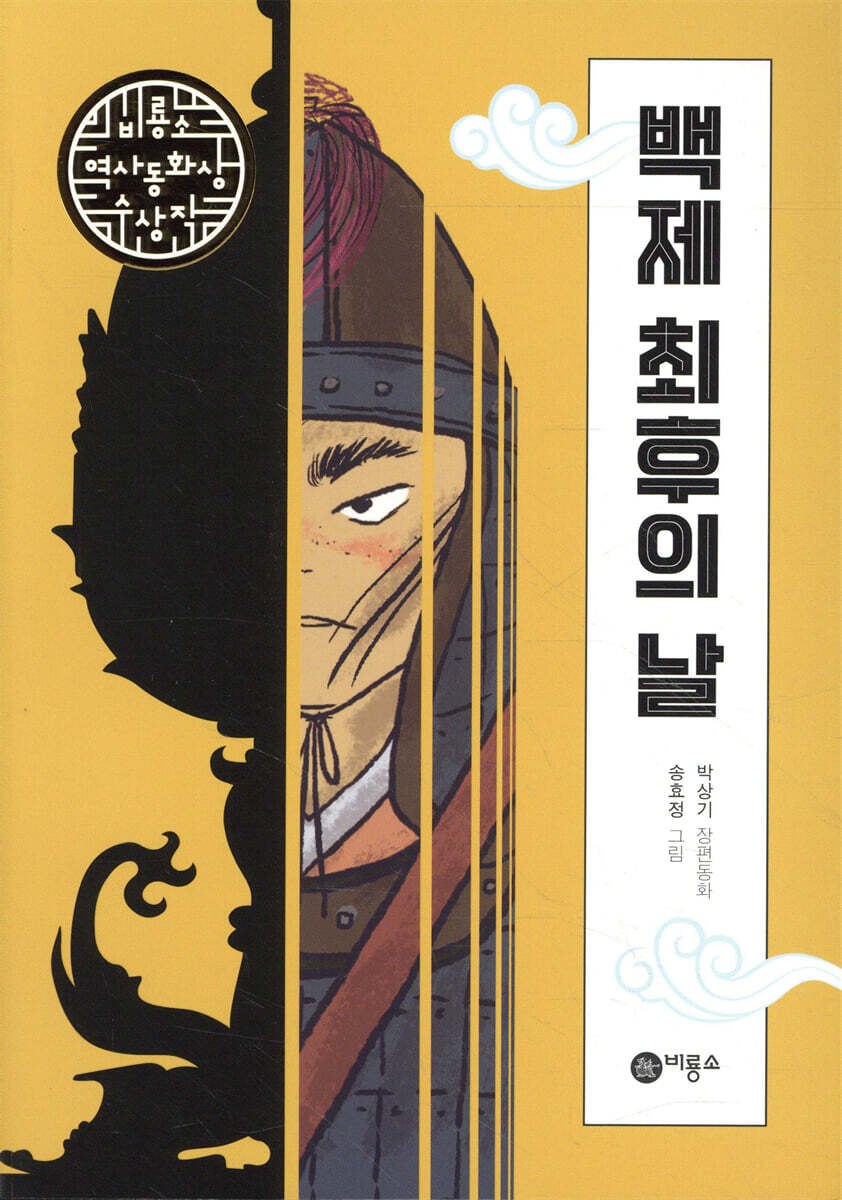
The Last Days of Baekje
 |
Description
Book Introduction
- A word from MD
-
The first Biryongso Historical Fairy Tale Award winnerThe story of a twelve-year-old boy standing in the middle of Baekje's final moments in 660.
The story begins when Seok-sol, a commoner boy who happens to visit the palace, meets King Uija, who is lost in thought, on a full moon night.
The truth about the fall of Baekje, hidden in the back alleys of history, is now revealed.
January 3, 2023. Children's PD Park Eun-young
The first 'Biryongso Historical Fairy Tale Award' winner, Sangki Park's full-length fairy tale 'The Last Day of Baekje' has been published.
The 'Biryongso Historical Fairy Tale Award' is a new award established by Biryongso, which has published fairy tales of various genres and promoted the development of domestic creative children's literature by establishing the Golden Goblin Award, the first children's literature award in Korea, as well as the Biryongso Literature Award, Story King, and Marshmallow Fiction. It aims to discover novel stories that will provide a broader perspective on the present world through the past.
History is essentially a story.
History is filled with the lives and stories of countless people who lived in previous eras.
Even in a past that feels like it's far away, there is a person who lived in the middle of it.
And among them there were always children.
As you delve deeper into a historical narrative with unique and fresh storytelling, the rigid walls of historical background crumble away, and you experience a wonderful moment of warm connection between past and present.
Through the Biryongso Historical Fairy Tale Award, we aim to convey interesting stories that add literary imagination to various historical events to young readers.
The 'Biryongso Historical Fairy Tale Award' is a new award established by Biryongso, which has published fairy tales of various genres and promoted the development of domestic creative children's literature by establishing the Golden Goblin Award, the first children's literature award in Korea, as well as the Biryongso Literature Award, Story King, and Marshmallow Fiction. It aims to discover novel stories that will provide a broader perspective on the present world through the past.
History is essentially a story.
History is filled with the lives and stories of countless people who lived in previous eras.
Even in a past that feels like it's far away, there is a person who lived in the middle of it.
And among them there were always children.
As you delve deeper into a historical narrative with unique and fresh storytelling, the rigid walls of historical background crumble away, and you experience a wonderful moment of warm connection between past and present.
Through the Biryongso Historical Fairy Tale Award, we aim to convey interesting stories that add literary imagination to various historical events to young readers.
- You can preview some of the book's contents.
Preview
index
663, late autumn
1.
July 660
2.
Woongjin Seong
3.
closed gates
4.
wrestling
5.
The commotion at the wall
6.
Prince Yeon's Invitation
7.
Curved jade
8.
surprise attack
9.
Oh my
10.
infiltration
11.
bias
12.
General
13.
prisoner procession
14.
wooden boat
Two years later, summer
Author's Note
1.
July 660
2.
Woongjin Seong
3.
closed gates
4.
wrestling
5.
The commotion at the wall
6.
Prince Yeon's Invitation
7.
Curved jade
8.
surprise attack
9.
Oh my
10.
infiltration
11.
bias
12.
General
13.
prisoner procession
14.
wooden boat
Two years later, summer
Author's Note
Detailed image
.jpg)
Into the book
To protect is to win.
People knew it that way.
--- p.7
Among them stood a boy soldier.
The name is Seoksol.
Instead of grabbing the window, the boy took out two objects from his bosom and stared blankly at them for a long time.
It was an investment and a broken jade ring.
--- p.8
“An enemy is an enemy, and I have to eat to survive.”
--- p.13
There was nothing to eat, there was a sick younger sibling at home, Seok-sol had plenty to say.
But all these answers were not satisfactory.
--- p.33
“But what does it have to do with us whether they take the castle or not?”
The diagram was silent for a moment.
Then he looked at the sack of barley and replied.
“That’s what I mean.
“It’s not like they’re going to give us a sack of barley just because we win.”
--- p.37
“If we can’t do it because it’s dangerous, if we can’t do it because we’ve never done it, if we can’t do it because we’re young, then how are we supposed to make a living?”
--- p.46
Some of the mill guests grumbled that they did not understand why the king did not surrender and instead turned this place into a battlefield.
Even though the Tang army had not yet arrived, anxiety was already lurking in the hearts of the people.
--- p.56
“By the way, why is Geon Gil-ji waging war against Silla?”
“Silla and we have a long-standing grudge.”
"Grudge? Is there anyone who doesn't have grudge? Why fight until the people are on the verge of collapse just because of that?"
--- p.102
It was difficult to accept this situation because Dohae had always been by his side as if it were natural.
The sobbing grew louder.
The hand holding the diagram trembled.
Even though the Tang army had invaded the country, it had not mattered to Seoksol, but only then did he feel like an enemy.
--- p.124
The king, who was deep in thought with his chin resting on his hand, looked much more ordinary than he had imagined.
Even now, the way he was worrying about himself seemed human.
--- p.133
“Hey you thieves!”
Seoksol jumped up and threw a stone with all his might.
A stone that flew with a wind noise hit the ceremonial helmet squarely.
The roar of the iron helmet echoed far and wide.
--- p.171
“Why does this happen?
“It would be nice if we could all live happily together.”
People knew it that way.
--- p.7
Among them stood a boy soldier.
The name is Seoksol.
Instead of grabbing the window, the boy took out two objects from his bosom and stared blankly at them for a long time.
It was an investment and a broken jade ring.
--- p.8
“An enemy is an enemy, and I have to eat to survive.”
--- p.13
There was nothing to eat, there was a sick younger sibling at home, Seok-sol had plenty to say.
But all these answers were not satisfactory.
--- p.33
“But what does it have to do with us whether they take the castle or not?”
The diagram was silent for a moment.
Then he looked at the sack of barley and replied.
“That’s what I mean.
“It’s not like they’re going to give us a sack of barley just because we win.”
--- p.37
“If we can’t do it because it’s dangerous, if we can’t do it because we’ve never done it, if we can’t do it because we’re young, then how are we supposed to make a living?”
--- p.46
Some of the mill guests grumbled that they did not understand why the king did not surrender and instead turned this place into a battlefield.
Even though the Tang army had not yet arrived, anxiety was already lurking in the hearts of the people.
--- p.56
“By the way, why is Geon Gil-ji waging war against Silla?”
“Silla and we have a long-standing grudge.”
"Grudge? Is there anyone who doesn't have grudge? Why fight until the people are on the verge of collapse just because of that?"
--- p.102
It was difficult to accept this situation because Dohae had always been by his side as if it were natural.
The sobbing grew louder.
The hand holding the diagram trembled.
Even though the Tang army had invaded the country, it had not mattered to Seoksol, but only then did he feel like an enemy.
--- p.124
The king, who was deep in thought with his chin resting on his hand, looked much more ordinary than he had imagined.
Even now, the way he was worrying about himself seemed human.
--- p.133
“Hey you thieves!”
Seoksol jumped up and threw a stone with all his might.
A stone that flew with a wind noise hit the ceremonial helmet squarely.
The roar of the iron helmet echoed far and wide.
--- p.171
“Why does this happen?
“It would be nice if we could all live happily together.”
--- p.198
Publisher's Review
The first Biryongso Historical Fairy Tale Award winner
The last moments of Baekje in 660,
The story of the boy standing in the middle of it all
“To protect is to win,
“I will definitely protect what is precious with my own hands.”
The story is firmly held by a three-dimensional protagonist who is unswayed by authority and true to his own desires, a rarity in historical fairy tales.
The author's skill stands out in that he does not sentimentalize the horrors of war.
The detailed and stable narrative enriched the story.
--- Judges: Choi Na-mi (children's story writer), Lee Hyeon (children's story writer)
● Review comments
The author's skill was evident in not sentimentalizing the horrors of war.
The story is enriched by detailed and stable descriptions, such as the clear depiction of the limits of what Seok-sol can do in the face of a predetermined historical conclusion, and the contrast in attitude between the lord of Ungjinseong and the soldiers and the people toward war.
Above all, it is noteworthy that the story is firmly anchored by a three-dimensional protagonist, a rarity in historical tales.
Not only the main character Seok-sol, who is true to his own desires and not swayed by authority, but also Do-hae, who survives alone without parents and relies on his friends to stay with him, was impressive.
--- Choi Nami (children's story writer)
From the impressive introduction to the conclusion, interesting events unfold amidst tension.
The protagonist who steals and then gets away with it was also attractive, unlike the somewhat 'upright' protagonists of existing historical fairy tales.
It was a new experience worthy of the first Historical Fairy Tale Award.
--- Lee Hyeon (children's story writer)
The first 'Biryongso Historical Fairy Tale Award' winner, Sangki Park's full-length fairy tale 'The Last Day of Baekje' has been published.
The 'Biryongso Historical Fairy Tale Award' is a new award established by Biryongso, which has published fairy tales of various genres and promoted the development of domestic creative children's literature by establishing the Golden Goblin Award, the first children's literature award in Korea, as well as the Biryongso Literature Award, Story King, and Marshmallow Fiction. It aims to discover novel stories that will provide a broader perspective on the present world through the past.
History is essentially a story.
History is filled with the lives and stories of countless people who lived in previous eras.
Even in a past that feels like it's far away, there is a person who lived in the middle of it.
And among them there were always children.
As you delve deeper into a historical narrative with unique and fresh storytelling, the rigid walls of historical background crumble away, and you experience a wonderful moment of warm connection between past and present.
Through the Biryongso Historical Fairy Tale Award, we aim to convey interesting stories that add literary imagination to various historical events to young readers.
The first award-winning work, "The Last Days of Baekje," is a dense historical tale that is faithful to historical plausibility while also having an exciting narrative. It contains the story of a boy who passionately experienced the last moments of Baekje in 660 years.
It received favorable reviews from the judges for its high level of completion, fresh characters, and suspenseful plot.
Twelve-year-old Baekje boy Seok-sol steals every day to keep himself from starving while caring for his sick younger brother, even when war breaks out in his country.
Seok-sol, who began to frequent the palace after meeting Prince Yeon, finds himself right in front of the final, decisive moment of Baekje and stands right in the middle of it.
Seok-sol witnesses the deaths of those close to him and the destruction of his country due to war, and he strengthens his resolve to protect what is precious to him with his own hands.
A kingdom that collapsed in an instant, a child who might have lived through that time is portrayed in three dimensions, and the scene where the whirlwind of history was raging is vividly brought to life.
Baekje, which was the first of the three kingdoms to fall, has significantly fewer records and relics left behind compared to Silla or Goguryeo.
Therefore, historical fairy tales set in Baekje were also difficult to find.
"The Last Days of Baekje" is a work of even greater significance in that it faithfully reflects newly discovered or re-examined historical data based on recently discovered artifacts, realistically depicting the fall of Baekje.
Author Park Sang-gi won the Changbi Children's New Writer's Award in 2013 (for "Corn Hit-and-Run"), the Nun-no-pi Children's Literature Award in 2016 (for "Su-mong-jo's Special Gift"), and the Golden Goblin Award in 2018 (for "Change!"). He is much loved for his works that feature solid writing and a variety of stories that resonate with children and young adults.
Through this award-winning work, 『The Last Days of Baekje』, a more dynamic narrative is presented.
The illustrations were done by artist Song Hyo-jeong, who had already worked with Park Sang-gi on his previous sports fairy tale, "Teaball Starting Today!"
The weighty and powerful illustrations, based on thorough research, bring the story to life and realistically portray the Baekje period.
● The last summer of Baekje, the lost kingdom, was a passionate experience.
A vivid re-enactment of a historical scene through the eyes of a boy!
How did children live during the Baekje period? Food was scarce, so the issue of food and shelter must have been a much more pressing and pressing issue than it is today.
For Seok-sol, a twelve-year-old commoner boy from Baekje, finding food each day was a matter of survival, a struggle to survive.
Seok-sol, who lost his parents in the war and has a sick younger sibling, lives a desperate life.
This is not only the case with Seoksol.
Even if a raid were to occur on a distant castle, it would not be a threat to the common people compared to the difficulties they faced in making a living.
“But what does it have to do with us whether they take the castle or not?”
The diagram was silent for a moment.
Then he looked at the sack of barley and replied.
“That’s what I mean.
“It’s not like they’re going to give us a sack of barley just because we win.”_From the text
Seok-sol, who went on a deer hunt with the adults, yells at the adults who try to give him a smaller portion of meat, saying, “How can you give me less just because I’m young!”
Although he loses his temper at his younger brother's childish remark about wanting to eat rice porridge, he takes a long walk to Ungjinseong Fortress, where food is piled up the next day.
However, unlike his sad friend Do-hae, Seok-sol is stubborn and proud, and instead of begging, he steals to make a living.
In the end, Seok-sol is caught stealing a sack of rice and is taken to the ceremony of the Lord of Ungjinseong, where he is beaten and returned.
In difficult times, the image of Seok-sol, a mischievous and ill-mannered person, is more convincing than that of a purely upright and exemplary person, and a natural understanding of the historical background follows.
The three-dimensional, living and breathing protagonist Seok-sol breathes life into the story, drawing readers in deeply and naturally evoking immersion and empathy.
Two boys, Seok-sol and Do-hae, who have walked a hundred li again and arrived at Ungjinseong, enter the village inside the castle to find work.
The two wandered around the marketplace and workshop streets, being rejected here and there because they were young and inexperienced.
The detailed descriptions of scenes unfold before your eyes as you follow the footsteps of the two boys, allowing you to vividly imagine the lifestyle of the time, adding to the enjoyment of reading.
Seoksol, a commoner boy from Baekje who came to visit the palace
A conversation between royalty and the people as seen in today's light
Seoksol and Dohae are trapped inside Ungjinseong Fortress when the gates suddenly close.
This is because King Uija moved the capital to Ungjin after the capital, Sabi, fell to the Tang-Silla allied forces.
In fact, the reason King Uija moved to Ungjinseong, which is located in the mountains, as opposed to Sabiseong, which is located on the plains, is not for the purpose of escape as has been easily known, but is being reinterpreted as a part that reveals the will to reorganize the military and confront the Tang-Silla allied forces, supporting the fact that King Uija had no intention of surrendering until the end.
Seok-sol, who was unable to return home and found work at the north gate of Ungjinseong, rescues Princess Bi-hwa, who fell from a partially dried earthen wall.
Seok-sol, who had met the royal family in this way, enters the palace at the invitation of Prince Yeon.
Even in front of Prince Yeon, Seok-sol is not intimidated by the difference in social status, and does not hesitate to ask bold questions, telling him in detail about the plight of the common people who have to dig up grass roots.
The conversation between the two clearly reveals the differences in opinions between the royal family and the common people.
“Even if we are starving, we still offer grain because they say it is to take good care of the country.
But what if it's hard? Who would understand that you're worried and struggling? The best ruler is one who keeps his people from starving and protects them from threats."
There was an inexplicable sadness in Seoksol's words.
_In the text
And on that night when the distorted full moon rose, Seoksol saw King Uija leaning against a pillar in the palace, lost in thought.
Seoksol had no idea that the king she had just seen would look so pitiful.
Even if he is the king of a country, he realizes that he is just a human being, not much different from other ordinary people.
Seoksol infiltrates the Tang army's camp
The truth behind Baekje's downfall, hidden in the back alleys of history 1,360 years ago.
Seok-sol, who succeeded in sneaking in and out of the palace and stealing the treasure, plans to lure Do-hae into stealing the treasure.
At the moment when he filled his sack with treasures, the Tang army suddenly attacked, causing chaos. Seok-sol hurriedly put on his armor and ran away.
In a tense situation where he is being chased by soldiers and the lord of Ungjinseong, Seoksol takes off his armor and throws it into the pond in the village inside the castle.
Armored helmet excavated from the bottom of a pond in Seongan Village.
The author says the story began with the question, “Who would throw this here and why?”
In the end, Seok-sol is captured by soldiers and taken to the Ungjinseongju ceremony, where he faces King Uija.
Instead of punishing Seoksol for his crimes, King Uija gives him an unexpected mission: infiltrate the Tang army's camp.
After a bitter conflict, Seok-sol strengthens his resolve by holding tightly to the only investment (old dice) that Do-hae left behind and the broken jade ring that he shared with Prince Yeon.
The situation of the Tang army that Seoksol saw and experienced was not good.
After completing his mission, Seok-sol sets out to find King Uija to deliver the news and is met with a surprising sight.
It was at this very moment that the ceremony captured the King of Chairs and forced his surrender.
The fact that the Ungjinseongju ceremony betrayed the country, captured King Uija, and forced him to surrender is a newly discovered historical fact, and it sheds a different light on King Uija, who was previously stigmatized as the last leader of a fallen nation by later writers, such as one of the "Three Thousand Palace Ladies."
This work, which unfolds the final days of Baekje through the eyes of a boy, features tense narrative elements such as war and infiltration, and also invites us to revisit historical errors that have long been well known, and further encourages us to reflect deeply on our own history.
As Seok Sol concluded, if at the last moment, Seok Sol had acted slightly differently, would the course of our history have been altered? It seems unlikely, but just as our lives are a series of coincidences and choices, history, too, could have taken a completely different turn due to a single choice someone made.
Likewise, if there had been no betrayal of the rites, it is unknown how Baekje would have fallen, let alone how the Three Kingdoms period would have unfolded.
The burden on young Seok-sol, who feels helpless and has to shoulder responsibility, seems heavy, and at the same time, it painfully reminds us of the tragedy of war.
The reason why the straightforward pledge, “I will protect what is precious with my own hands,” resonates so deeply that no one can criticize it can also be understood through the power of the story.
The last moments of Baekje in 660,
The story of the boy standing in the middle of it all
“To protect is to win,
“I will definitely protect what is precious with my own hands.”
The story is firmly held by a three-dimensional protagonist who is unswayed by authority and true to his own desires, a rarity in historical fairy tales.
The author's skill stands out in that he does not sentimentalize the horrors of war.
The detailed and stable narrative enriched the story.
--- Judges: Choi Na-mi (children's story writer), Lee Hyeon (children's story writer)
● Review comments
The author's skill was evident in not sentimentalizing the horrors of war.
The story is enriched by detailed and stable descriptions, such as the clear depiction of the limits of what Seok-sol can do in the face of a predetermined historical conclusion, and the contrast in attitude between the lord of Ungjinseong and the soldiers and the people toward war.
Above all, it is noteworthy that the story is firmly anchored by a three-dimensional protagonist, a rarity in historical tales.
Not only the main character Seok-sol, who is true to his own desires and not swayed by authority, but also Do-hae, who survives alone without parents and relies on his friends to stay with him, was impressive.
--- Choi Nami (children's story writer)
From the impressive introduction to the conclusion, interesting events unfold amidst tension.
The protagonist who steals and then gets away with it was also attractive, unlike the somewhat 'upright' protagonists of existing historical fairy tales.
It was a new experience worthy of the first Historical Fairy Tale Award.
--- Lee Hyeon (children's story writer)
The first 'Biryongso Historical Fairy Tale Award' winner, Sangki Park's full-length fairy tale 'The Last Day of Baekje' has been published.
The 'Biryongso Historical Fairy Tale Award' is a new award established by Biryongso, which has published fairy tales of various genres and promoted the development of domestic creative children's literature by establishing the Golden Goblin Award, the first children's literature award in Korea, as well as the Biryongso Literature Award, Story King, and Marshmallow Fiction. It aims to discover novel stories that will provide a broader perspective on the present world through the past.
History is essentially a story.
History is filled with the lives and stories of countless people who lived in previous eras.
Even in a past that feels like it's far away, there is a person who lived in the middle of it.
And among them there were always children.
As you delve deeper into a historical narrative with unique and fresh storytelling, the rigid walls of historical background crumble away, and you experience a wonderful moment of warm connection between past and present.
Through the Biryongso Historical Fairy Tale Award, we aim to convey interesting stories that add literary imagination to various historical events to young readers.
The first award-winning work, "The Last Days of Baekje," is a dense historical tale that is faithful to historical plausibility while also having an exciting narrative. It contains the story of a boy who passionately experienced the last moments of Baekje in 660 years.
It received favorable reviews from the judges for its high level of completion, fresh characters, and suspenseful plot.
Twelve-year-old Baekje boy Seok-sol steals every day to keep himself from starving while caring for his sick younger brother, even when war breaks out in his country.
Seok-sol, who began to frequent the palace after meeting Prince Yeon, finds himself right in front of the final, decisive moment of Baekje and stands right in the middle of it.
Seok-sol witnesses the deaths of those close to him and the destruction of his country due to war, and he strengthens his resolve to protect what is precious to him with his own hands.
A kingdom that collapsed in an instant, a child who might have lived through that time is portrayed in three dimensions, and the scene where the whirlwind of history was raging is vividly brought to life.
Baekje, which was the first of the three kingdoms to fall, has significantly fewer records and relics left behind compared to Silla or Goguryeo.
Therefore, historical fairy tales set in Baekje were also difficult to find.
"The Last Days of Baekje" is a work of even greater significance in that it faithfully reflects newly discovered or re-examined historical data based on recently discovered artifacts, realistically depicting the fall of Baekje.
Author Park Sang-gi won the Changbi Children's New Writer's Award in 2013 (for "Corn Hit-and-Run"), the Nun-no-pi Children's Literature Award in 2016 (for "Su-mong-jo's Special Gift"), and the Golden Goblin Award in 2018 (for "Change!"). He is much loved for his works that feature solid writing and a variety of stories that resonate with children and young adults.
Through this award-winning work, 『The Last Days of Baekje』, a more dynamic narrative is presented.
The illustrations were done by artist Song Hyo-jeong, who had already worked with Park Sang-gi on his previous sports fairy tale, "Teaball Starting Today!"
The weighty and powerful illustrations, based on thorough research, bring the story to life and realistically portray the Baekje period.
● The last summer of Baekje, the lost kingdom, was a passionate experience.
A vivid re-enactment of a historical scene through the eyes of a boy!
How did children live during the Baekje period? Food was scarce, so the issue of food and shelter must have been a much more pressing and pressing issue than it is today.
For Seok-sol, a twelve-year-old commoner boy from Baekje, finding food each day was a matter of survival, a struggle to survive.
Seok-sol, who lost his parents in the war and has a sick younger sibling, lives a desperate life.
This is not only the case with Seoksol.
Even if a raid were to occur on a distant castle, it would not be a threat to the common people compared to the difficulties they faced in making a living.
“But what does it have to do with us whether they take the castle or not?”
The diagram was silent for a moment.
Then he looked at the sack of barley and replied.
“That’s what I mean.
“It’s not like they’re going to give us a sack of barley just because we win.”_From the text
Seok-sol, who went on a deer hunt with the adults, yells at the adults who try to give him a smaller portion of meat, saying, “How can you give me less just because I’m young!”
Although he loses his temper at his younger brother's childish remark about wanting to eat rice porridge, he takes a long walk to Ungjinseong Fortress, where food is piled up the next day.
However, unlike his sad friend Do-hae, Seok-sol is stubborn and proud, and instead of begging, he steals to make a living.
In the end, Seok-sol is caught stealing a sack of rice and is taken to the ceremony of the Lord of Ungjinseong, where he is beaten and returned.
In difficult times, the image of Seok-sol, a mischievous and ill-mannered person, is more convincing than that of a purely upright and exemplary person, and a natural understanding of the historical background follows.
The three-dimensional, living and breathing protagonist Seok-sol breathes life into the story, drawing readers in deeply and naturally evoking immersion and empathy.
Two boys, Seok-sol and Do-hae, who have walked a hundred li again and arrived at Ungjinseong, enter the village inside the castle to find work.
The two wandered around the marketplace and workshop streets, being rejected here and there because they were young and inexperienced.
The detailed descriptions of scenes unfold before your eyes as you follow the footsteps of the two boys, allowing you to vividly imagine the lifestyle of the time, adding to the enjoyment of reading.
Seoksol, a commoner boy from Baekje who came to visit the palace
A conversation between royalty and the people as seen in today's light
Seoksol and Dohae are trapped inside Ungjinseong Fortress when the gates suddenly close.
This is because King Uija moved the capital to Ungjin after the capital, Sabi, fell to the Tang-Silla allied forces.
In fact, the reason King Uija moved to Ungjinseong, which is located in the mountains, as opposed to Sabiseong, which is located on the plains, is not for the purpose of escape as has been easily known, but is being reinterpreted as a part that reveals the will to reorganize the military and confront the Tang-Silla allied forces, supporting the fact that King Uija had no intention of surrendering until the end.
Seok-sol, who was unable to return home and found work at the north gate of Ungjinseong, rescues Princess Bi-hwa, who fell from a partially dried earthen wall.
Seok-sol, who had met the royal family in this way, enters the palace at the invitation of Prince Yeon.
Even in front of Prince Yeon, Seok-sol is not intimidated by the difference in social status, and does not hesitate to ask bold questions, telling him in detail about the plight of the common people who have to dig up grass roots.
The conversation between the two clearly reveals the differences in opinions between the royal family and the common people.
“Even if we are starving, we still offer grain because they say it is to take good care of the country.
But what if it's hard? Who would understand that you're worried and struggling? The best ruler is one who keeps his people from starving and protects them from threats."
There was an inexplicable sadness in Seoksol's words.
_In the text
And on that night when the distorted full moon rose, Seoksol saw King Uija leaning against a pillar in the palace, lost in thought.
Seoksol had no idea that the king she had just seen would look so pitiful.
Even if he is the king of a country, he realizes that he is just a human being, not much different from other ordinary people.
Seoksol infiltrates the Tang army's camp
The truth behind Baekje's downfall, hidden in the back alleys of history 1,360 years ago.
Seok-sol, who succeeded in sneaking in and out of the palace and stealing the treasure, plans to lure Do-hae into stealing the treasure.
At the moment when he filled his sack with treasures, the Tang army suddenly attacked, causing chaos. Seok-sol hurriedly put on his armor and ran away.
In a tense situation where he is being chased by soldiers and the lord of Ungjinseong, Seoksol takes off his armor and throws it into the pond in the village inside the castle.
Armored helmet excavated from the bottom of a pond in Seongan Village.
The author says the story began with the question, “Who would throw this here and why?”
In the end, Seok-sol is captured by soldiers and taken to the Ungjinseongju ceremony, where he faces King Uija.
Instead of punishing Seoksol for his crimes, King Uija gives him an unexpected mission: infiltrate the Tang army's camp.
After a bitter conflict, Seok-sol strengthens his resolve by holding tightly to the only investment (old dice) that Do-hae left behind and the broken jade ring that he shared with Prince Yeon.
The situation of the Tang army that Seoksol saw and experienced was not good.
After completing his mission, Seok-sol sets out to find King Uija to deliver the news and is met with a surprising sight.
It was at this very moment that the ceremony captured the King of Chairs and forced his surrender.
The fact that the Ungjinseongju ceremony betrayed the country, captured King Uija, and forced him to surrender is a newly discovered historical fact, and it sheds a different light on King Uija, who was previously stigmatized as the last leader of a fallen nation by later writers, such as one of the "Three Thousand Palace Ladies."
This work, which unfolds the final days of Baekje through the eyes of a boy, features tense narrative elements such as war and infiltration, and also invites us to revisit historical errors that have long been well known, and further encourages us to reflect deeply on our own history.
As Seok Sol concluded, if at the last moment, Seok Sol had acted slightly differently, would the course of our history have been altered? It seems unlikely, but just as our lives are a series of coincidences and choices, history, too, could have taken a completely different turn due to a single choice someone made.
Likewise, if there had been no betrayal of the rites, it is unknown how Baekje would have fallen, let alone how the Three Kingdoms period would have unfolded.
The burden on young Seok-sol, who feels helpless and has to shoulder responsibility, seems heavy, and at the same time, it painfully reminds us of the tragedy of war.
The reason why the straightforward pledge, “I will protect what is precious with my own hands,” resonates so deeply that no one can criticize it can also be understood through the power of the story.
GOODS SPECIFICS
- Publication date: December 12, 2022
- Page count, weight, size: 220 pages | 380g | 147*210*14mm
- ISBN13: 9788949121987
- ISBN10: 8949121980
- KC Certification: Certification Type: Conformity Confirmation
You may also like
카테고리
korean


korean

![ELLE 엘르 스페셜 에디션 A형 : 12월 [2025]](http://librairie.coreenne.fr/cdn/shop/files/b8e27a3de6c9538896439686c6b0e8fb.jpg?v=1766436872&width=3840)


