

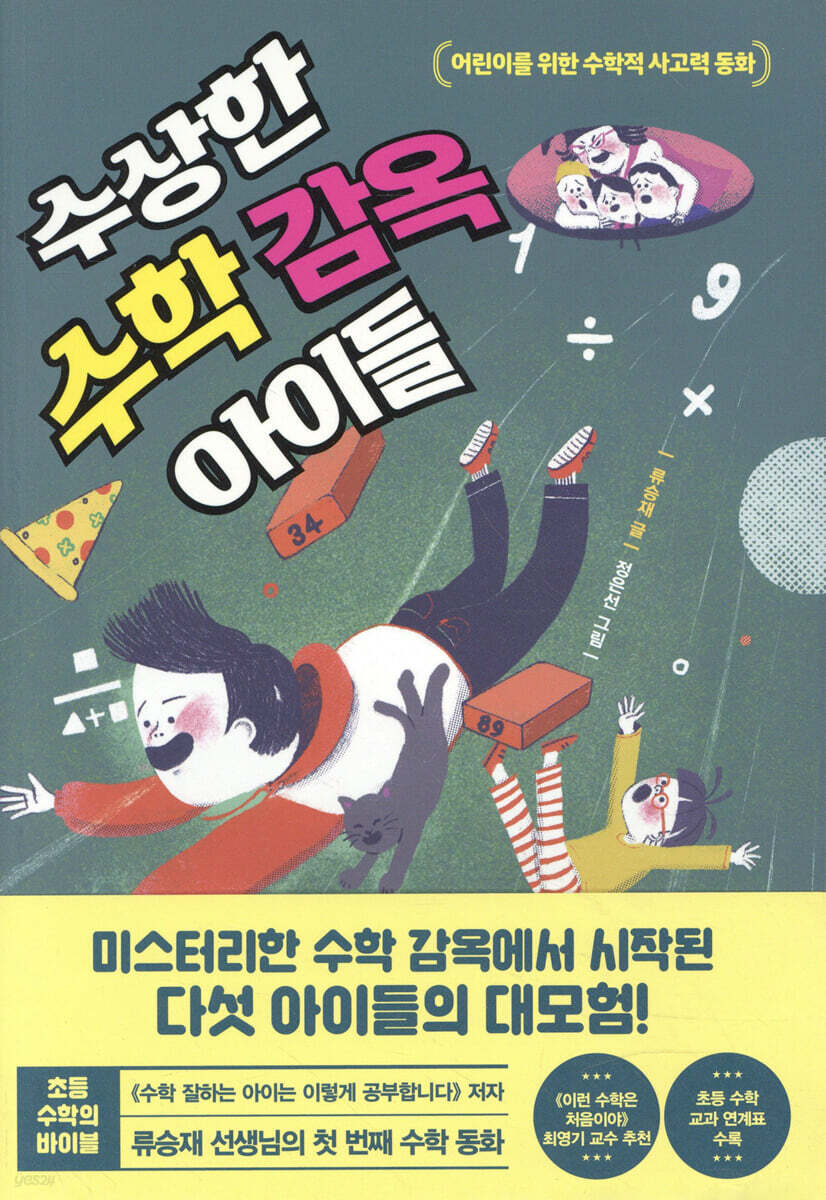
Suspicious Math Prison Kids
 |
Description
Book Introduction
- A word from MD
- The bible of elementary math, "This is how children who are good at math do it", the first math fairy tale by teacher Seungjae Ryu.
The author naturally shows the process of developing mathematical thinking and problem-solving skills through the story of Yeongsil and her friends who discovered mathematics.
The adventures of five children as they think for themselves, discuss together, solve problems, and finally escape from prison teach us the joy of mathematics and remind us of the essence of mathematical thinking.
- Children's PD Park Eun-young
Five children's grand adventure unfolds in a mysterious math prison!
The Elementary Math Bible: "This is What Kids Do Well at Math"
Teacher Ryu Seung-jae's first math fairy tale
★ "This is the first time I've seen math like this" Highly recommended by Professor Choi Young-gi of the Department of Mathematics Education at Seoul National University
★ Highly recommended YouTube channel "Lee Sang-yeop Math"
★ Includes elementary school mathematics curriculum correlation table
After her father, who used to tell her interesting math stories, passed away, Yeongsil decided to become a 'math dropout'.
At the new school, I meet my friends from the "Discovery of Mathematics" club and their crazy teacher. Huh? These guys are having so much fun with math?
The principles of multiplication hidden in bicycle gears and pedals, the relationship between manhole covers and the diagonal lengths of shapes, and even the concept of fractions learned while enjoying a delicious pizza. One day, while laughing and chatting together, the members of Discovery of Math discover the true fun of math. They end up falling into a math prison in the basement of a pharmacy run by a mysterious old man...
Will the children be able to break out of the prison and escape safely?
"Suspicious Math Prison Kids" is the first fairy tale by Seungjae Ryu, a bestselling author in the field of mathematics education.
The author naturally shows the process of developing mathematical thinking and problem-solving skills through the story of Yeongsil and her friends who discovered mathematics.
The adventures of five children who think for themselves, discuss together, solve problems, and finally escape from prison teach us the joy of mathematics and remind us of the essence of mathematical thinking.
The Elementary Math Bible: "This is What Kids Do Well at Math"
Teacher Ryu Seung-jae's first math fairy tale
★ "This is the first time I've seen math like this" Highly recommended by Professor Choi Young-gi of the Department of Mathematics Education at Seoul National University
★ Highly recommended YouTube channel "Lee Sang-yeop Math"
★ Includes elementary school mathematics curriculum correlation table
After her father, who used to tell her interesting math stories, passed away, Yeongsil decided to become a 'math dropout'.
At the new school, I meet my friends from the "Discovery of Mathematics" club and their crazy teacher. Huh? These guys are having so much fun with math?
The principles of multiplication hidden in bicycle gears and pedals, the relationship between manhole covers and the diagonal lengths of shapes, and even the concept of fractions learned while enjoying a delicious pizza. One day, while laughing and chatting together, the members of Discovery of Math discover the true fun of math. They end up falling into a math prison in the basement of a pharmacy run by a mysterious old man...
Will the children be able to break out of the prison and escape safely?
"Suspicious Math Prison Kids" is the first fairy tale by Seungjae Ryu, a bestselling author in the field of mathematics education.
The author naturally shows the process of developing mathematical thinking and problem-solving skills through the story of Yeongsil and her friends who discovered mathematics.
The adventures of five children who think for themselves, discuss together, solve problems, and finally escape from prison teach us the joy of mathematics and remind us of the essence of mathematical thinking.
- You can preview some of the book's contents.
Preview
index
Author's Note
Chapter 1 I Will Become a 'Sufferer'
Abandoned math books
The Discovery of Mathematics
Dad's Memories in a Cart
Chapter 2: The Math Master's Pharmacy
Grandpa and the yaknyang
Special Prescription
Pizza made with fountain
Chapter 3 In the Basement of the Pharmacy
The lost key
The kids who went down to the basement
Principal Asura of Golchi Elementary School
Chapter 4: Together We Can Solve Any Problem
Match fish eating plastic grass
Math Principles Taught by a Hundred Children
How to cross a bridge in the shortest time
Chapter 5: Escape! Breaking Out of the Math Prison
The Secret of the Math Prison Bricks
Back to the herbal medicine shop
Chapter 1 I Will Become a 'Sufferer'
Abandoned math books
The Discovery of Mathematics
Dad's Memories in a Cart
Chapter 2: The Math Master's Pharmacy
Grandpa and the yaknyang
Special Prescription
Pizza made with fountain
Chapter 3 In the Basement of the Pharmacy
The lost key
The kids who went down to the basement
Principal Asura of Golchi Elementary School
Chapter 4: Together We Can Solve Any Problem
Match fish eating plastic grass
Math Principles Taught by a Hundred Children
How to cross a bridge in the shortest time
Chapter 5: Escape! Breaking Out of the Math Prison
The Secret of the Math Prison Bricks
Back to the herbal medicine shop
Detailed image

Into the book
“Let me explain it simply with an example.
Let's say that bicycle number 1 has the same number of cogs on both wheels, 10.
That is, while the front wheel connected to the pedal gear rotates once, the rear wheel also rotates once.”
The teacher said this and looked at Yeongsil and Jusung in turn.
Yeongsil was so nervous that cold sweat seemed to run down her back.
“Let’s say that bicycle number 2 has 20 cogs on the pedals and 4 cogs on the rear wheel.
For every revolution of the pedals, the four-toothed rear wheel turns five times.
“It rotates 5 times, so you can run faster.”
“I understand.”
Shin Joo-seong said in a confident voice.
"good.
So, which of the two bicycles would make it easier to climb that hill over there with less effort?”
"hmm……."
Shin Joo-seong was lost in thought for a moment, then raised his hand.
“Me!”
“No, you don’t have to tell me the answer.
“You two, choose between bikes 1 and 2, whichever one can climb the hill with less effort, and then try climbing that hill yourself.”
--- From "The Discovery of Mathematics"
“Hey! Who is that?”
Grandpa! I know who's written here."
Everyone's attention was focused on Kyung-ha, who was looking through the pharmacy drawer.
Each drawer had a list of terms written on it, and it seemed like Kyung-ha recognized one of them.
“Let’s see, it’s talking about ‘same number of people’.”
The grandfather approached Gyeongha and said.
"that's right.
"Dongsu-nu-ga! I learned it last time, but I only remember Nu-ga-ba."
“Heh heh, isn’t that the name of the ice cream that thieves hate?”
Kihyun asked, holding back laughter.
“I guess it was hard to understand because ‘Dongsu-nu-ga’ is a Chinese character.
If we break it down into Korean, it means ‘adding the same number multiple times.’”
"aha!"
Kyung-ha's eyes sparkled as he nodded.
“Do you guys know what 2x3 is?”
“It’s 6!”
"that's right.
If you solve 2×3 as a multiple of 2, it means adding 2 three times.
So, if you write it as a formula, it becomes 2×3=2+2+2=6.”
“Wow! That was so easy.”
--- From "Special Prescription"
"that's right.
Instead, you shouldn't step on it carelessly.
“You have to do it in order.”
Principal Asura said.
“What is the order?”
“The three shapes have the same perimeter.
“You must step on the three shapes in order, starting with the one with the largest area, and follow the rules.”
“What if I’m wrong?”
Kihyun's voice was terrified.
“Of course, it’s like falling off a cliff.
Hahahaha! Don't worry! It won't hurt you.
Instead, you will be taken down to a very interesting room!”
Yeongsil didn't want to know what Principal Asura meant.
I didn't have time to compare the sizes of the mats that were moving around in a dizzying manner.
“It would be fun if it were a game, but it’s horrible that this is real.”
Kihyun said.
“Let’s think about it calmly.”
Yeongsil first remembered the method used to calculate the area of a shape during her math discovery class.
And then I remembered the memories of making various shapes with a single string with my dad.
--- From "Golchi Elementary School Principal Asura"
“Guys, this is the wall.
“If you look closely, there are bricks with numbers written on them.”
“Oh! I saw one earlier too.”
Kihyun said.
“Where? What number is it?”
Hani approached Kihyun and asked.
“Look here.
8 and 13, can you see?”
“That’s true.
Kyungha, is the number you found the same?”
"no.
“What’s written here is 1 and 2.”
“Oh! I found it too! There’s a 21 and a 34 here?”
Yeongsil said.
Hani and Juseong looked closely at the three numbers.
“Well, what’s unique is that all the numbers are engraved above and below the brick line in the middle.”
"that's right.
“Like a fountain?”
At Hani's words, Joo-seong suddenly felt as if a hundred fluorescent lights had turned on in his head.
“Hani, do you have a pen and notebook in your bag?”
"there is.
That's basic."
Hani handed Joo-seong a pen and a notebook.
“Kids, tell me the numbers you’ve found so far in fraction form.”
Let's say that bicycle number 1 has the same number of cogs on both wheels, 10.
That is, while the front wheel connected to the pedal gear rotates once, the rear wheel also rotates once.”
The teacher said this and looked at Yeongsil and Jusung in turn.
Yeongsil was so nervous that cold sweat seemed to run down her back.
“Let’s say that bicycle number 2 has 20 cogs on the pedals and 4 cogs on the rear wheel.
For every revolution of the pedals, the four-toothed rear wheel turns five times.
“It rotates 5 times, so you can run faster.”
“I understand.”
Shin Joo-seong said in a confident voice.
"good.
So, which of the two bicycles would make it easier to climb that hill over there with less effort?”
"hmm……."
Shin Joo-seong was lost in thought for a moment, then raised his hand.
“Me!”
“No, you don’t have to tell me the answer.
“You two, choose between bikes 1 and 2, whichever one can climb the hill with less effort, and then try climbing that hill yourself.”
--- From "The Discovery of Mathematics"
“Hey! Who is that?”
Grandpa! I know who's written here."
Everyone's attention was focused on Kyung-ha, who was looking through the pharmacy drawer.
Each drawer had a list of terms written on it, and it seemed like Kyung-ha recognized one of them.
“Let’s see, it’s talking about ‘same number of people’.”
The grandfather approached Gyeongha and said.
"that's right.
"Dongsu-nu-ga! I learned it last time, but I only remember Nu-ga-ba."
“Heh heh, isn’t that the name of the ice cream that thieves hate?”
Kihyun asked, holding back laughter.
“I guess it was hard to understand because ‘Dongsu-nu-ga’ is a Chinese character.
If we break it down into Korean, it means ‘adding the same number multiple times.’”
"aha!"
Kyung-ha's eyes sparkled as he nodded.
“Do you guys know what 2x3 is?”
“It’s 6!”
"that's right.
If you solve 2×3 as a multiple of 2, it means adding 2 three times.
So, if you write it as a formula, it becomes 2×3=2+2+2=6.”
“Wow! That was so easy.”
--- From "Special Prescription"
"that's right.
Instead, you shouldn't step on it carelessly.
“You have to do it in order.”
Principal Asura said.
“What is the order?”
“The three shapes have the same perimeter.
“You must step on the three shapes in order, starting with the one with the largest area, and follow the rules.”
“What if I’m wrong?”
Kihyun's voice was terrified.
“Of course, it’s like falling off a cliff.
Hahahaha! Don't worry! It won't hurt you.
Instead, you will be taken down to a very interesting room!”
Yeongsil didn't want to know what Principal Asura meant.
I didn't have time to compare the sizes of the mats that were moving around in a dizzying manner.
“It would be fun if it were a game, but it’s horrible that this is real.”
Kihyun said.
“Let’s think about it calmly.”
Yeongsil first remembered the method used to calculate the area of a shape during her math discovery class.
And then I remembered the memories of making various shapes with a single string with my dad.
--- From "Golchi Elementary School Principal Asura"
“Guys, this is the wall.
“If you look closely, there are bricks with numbers written on them.”
“Oh! I saw one earlier too.”
Kihyun said.
“Where? What number is it?”
Hani approached Kihyun and asked.
“Look here.
8 and 13, can you see?”
“That’s true.
Kyungha, is the number you found the same?”
"no.
“What’s written here is 1 and 2.”
“Oh! I found it too! There’s a 21 and a 34 here?”
Yeongsil said.
Hani and Juseong looked closely at the three numbers.
“Well, what’s unique is that all the numbers are engraved above and below the brick line in the middle.”
"that's right.
“Like a fountain?”
At Hani's words, Joo-seong suddenly felt as if a hundred fluorescent lights had turned on in his head.
“Hani, do you have a pen and notebook in your bag?”
"there is.
That's basic."
Hani handed Joo-seong a pen and a notebook.
“Kids, tell me the numbers you’ve found so far in fraction form.”
--- From "The Secret of the Math Prison Bricks"
Publisher's Review
“I wanted to write a math book that my child would enjoy.”
Bestselling math education author Seungjae Ryu returns with a fairy tale.
Teacher Seungjae Ryu, who has been gaining attention as the hottest mentor in the field of elementary math education with the publication of “This is How Kids Who Are Good at Math Study” and “In-Depth Study Methods for Elementary Math,” has returned with an exciting math fairy tale.
The author of two bestselling books on mathematics education has a simple reason for introducing mathematics into a new format: the fairy tale.
Because most children hate math.
While learning the formula, "The sum of the three interior angles of a triangle is 180 degrees," you should ask yourself, "Why is that so?" and explore the principles to make math fun. However, the reality of education, which focuses on entrance exams, simply encourages people to quickly memorize formulas.
Current math education, which involves passively memorizing numerous formulas and mechanically solving a large number of problems, fails to impart joy to children.
It may be natural that math feels boring and difficult.
The author wrote this fairy tale in the hope that children would experience the true charm of mathematics.
By organically weaving mathematical content into an interesting story and demonstrating the specific process of solving problems, students can naturally acquire mathematical thinking skills.
Meanwhile, I took care to make the story the main focus and the mathematical content a secondary element.
This is because most existing math fairy tales focus on math content and are not fun to read because they are made up of stories that fit into the content.
I wanted to create a book that was fun and readable enough for my child to read all the way through.
Talking cats, matchstick fish, brick prisons made of fountains…
Five children who fall into a suspicious prison solve the mathematical principles of everyday life.
《Suspicious Math Prison Kids》 is composed of everyday mathematical principles that the author used to tell his children.
It unfolds mathematical stories that can be found everywhere in life, such as the properties of multiplication and equality that can be learned from the relationship between bicycle gears and pedal gears, the reason why manhole covers are circular and the length of the diagonal of a shape, and the concept of fractions hidden in a slice of pizza.
The main character, Yeongsil, who was on the verge of becoming a 'mathematical failure', transfers to a new school and meets a teacher with a bomb head and friends from the 'Discovery of Mathematics' club, where she begins to explore mathematical principles in everyday life.
One day, as they were gradually discovering the fun of math, they discovered the mysterious basement of the 'Master's Pharmacy'. All the members of the Discovery of Math group entered it and were locked in a math prison, and the five children's full-fledged adventure began.
As you immerse yourself in the story of children solving missions to escape prison, you will naturally learn 16 carefully selected mathematical concepts and learn how to think for yourself.
*Recommendations from friends who read it first
I liked it because the content was realistic and the fairy tale ended neatly.
I enjoyed the fantasy elements, like the talking cat and the appearance of the dungeon.
The fact that the main characters were as ordinary as friends you might see at school made the book feel more real while reading.
And the math problems weren't difficult and were well integrated into the story, so I was able to solve them naturally.
_Ryu Si-heon, the first child to escape the math prison
Most math books are just full of concepts or, even if they do have a story, they aren't that interesting.
But in this book, the story and mathematical concepts were connected very naturally.
The concepts and problems presented were neither too difficult nor too easy, and were varied, making the book more enjoyable to read.
I think it will also help me prepare for middle school.
Park Si-hoo, the first child to escape the math prison
I usually like fairy tales like “The Math Ghost,” “Math Flipped Around That Surprised Even the Teacher,” and “Math Stories Told by a Mathematician,” so I read them with great enjoyment.
The problems were more interesting than those in other books, and I especially liked that it taught me to think for myself and solve problems without memorizing the types.
I think it's more enjoyable to think deeply about problems that seem a bit difficult rather than just memorizing the types over and over again.
Kim Geon-hee, the first child to escape the math prison
I enjoyed reading it and learning new math terms, and it made solving difficult problems easier.
I think that friends who are not interested in math or are interested but find math difficult will gain more confidence in math if they read this.
_Kwon Min-kyung, the first child to escape the math prison
*Recommendations from parents who read it first
It was gratifying to see Min-kyung reading the book and enjoying it, wondering what would happen next.
Even when a somewhat difficult concept comes up, I read the explanation while thinking deeply and asking questions to solve it.
Although I couldn't solve all the problems, I thought that if I continued to find my own solutions, I would be able to get better at math.
_Min Young-ae, the mother who escaped the math prison together
A book that makes you smarter while reading fairy tales! Once I started, I couldn't put it down because of the solid storyline.
It was a time when I could think about mathematical concepts that were difficult to explain in various ways.
As the exciting adventure story of the math dropout Youngsil and her friends from the Math Discovery Club unfolded, it was impressive to see them solving problems in the math prison.
This book allows you to learn the principles of mathematics and have deeper fun.
_Mom Oh Seon-ok, who escaped the math prison together
There are many math fairy tales for children, but not many for elementary school students, especially middle and high school students. This book is a great fairy tale for elementary school children to expand the principles and concepts of math.
The story of Yeongsil discovering the fun of math with her friends and falling into that joy is a great read for parents and children alike.
As you progress at your own pace, you'll find yourself breaking free from the learning curve and gaining confidence.
_Kang Jeong-ok, the mother who escaped the math prison together
*Elementary Mathematics Curriculum Correlation Table
3-1
Unit 1 Addition and Subtraction
Unit 3 Division
Unit 6 Fractions and Decimals
4-2
Unit 2 Triangles
Unit 4: Squares
5-1
Unit 2: Factors and Multiples
Unit 6: Perimeter and Area of Polygons
6-1
Unit 2 Prisms and Pyramids
6-2
Unit 4 Proportional Formulas and Proportional Distribution
Unit 5 Area of a Circle
Bestselling math education author Seungjae Ryu returns with a fairy tale.
Teacher Seungjae Ryu, who has been gaining attention as the hottest mentor in the field of elementary math education with the publication of “This is How Kids Who Are Good at Math Study” and “In-Depth Study Methods for Elementary Math,” has returned with an exciting math fairy tale.
The author of two bestselling books on mathematics education has a simple reason for introducing mathematics into a new format: the fairy tale.
Because most children hate math.
While learning the formula, "The sum of the three interior angles of a triangle is 180 degrees," you should ask yourself, "Why is that so?" and explore the principles to make math fun. However, the reality of education, which focuses on entrance exams, simply encourages people to quickly memorize formulas.
Current math education, which involves passively memorizing numerous formulas and mechanically solving a large number of problems, fails to impart joy to children.
It may be natural that math feels boring and difficult.
The author wrote this fairy tale in the hope that children would experience the true charm of mathematics.
By organically weaving mathematical content into an interesting story and demonstrating the specific process of solving problems, students can naturally acquire mathematical thinking skills.
Meanwhile, I took care to make the story the main focus and the mathematical content a secondary element.
This is because most existing math fairy tales focus on math content and are not fun to read because they are made up of stories that fit into the content.
I wanted to create a book that was fun and readable enough for my child to read all the way through.
Talking cats, matchstick fish, brick prisons made of fountains…
Five children who fall into a suspicious prison solve the mathematical principles of everyday life.
《Suspicious Math Prison Kids》 is composed of everyday mathematical principles that the author used to tell his children.
It unfolds mathematical stories that can be found everywhere in life, such as the properties of multiplication and equality that can be learned from the relationship between bicycle gears and pedal gears, the reason why manhole covers are circular and the length of the diagonal of a shape, and the concept of fractions hidden in a slice of pizza.
The main character, Yeongsil, who was on the verge of becoming a 'mathematical failure', transfers to a new school and meets a teacher with a bomb head and friends from the 'Discovery of Mathematics' club, where she begins to explore mathematical principles in everyday life.
One day, as they were gradually discovering the fun of math, they discovered the mysterious basement of the 'Master's Pharmacy'. All the members of the Discovery of Math group entered it and were locked in a math prison, and the five children's full-fledged adventure began.
As you immerse yourself in the story of children solving missions to escape prison, you will naturally learn 16 carefully selected mathematical concepts and learn how to think for yourself.
*Recommendations from friends who read it first
I liked it because the content was realistic and the fairy tale ended neatly.
I enjoyed the fantasy elements, like the talking cat and the appearance of the dungeon.
The fact that the main characters were as ordinary as friends you might see at school made the book feel more real while reading.
And the math problems weren't difficult and were well integrated into the story, so I was able to solve them naturally.
_Ryu Si-heon, the first child to escape the math prison
Most math books are just full of concepts or, even if they do have a story, they aren't that interesting.
But in this book, the story and mathematical concepts were connected very naturally.
The concepts and problems presented were neither too difficult nor too easy, and were varied, making the book more enjoyable to read.
I think it will also help me prepare for middle school.
Park Si-hoo, the first child to escape the math prison
I usually like fairy tales like “The Math Ghost,” “Math Flipped Around That Surprised Even the Teacher,” and “Math Stories Told by a Mathematician,” so I read them with great enjoyment.
The problems were more interesting than those in other books, and I especially liked that it taught me to think for myself and solve problems without memorizing the types.
I think it's more enjoyable to think deeply about problems that seem a bit difficult rather than just memorizing the types over and over again.
Kim Geon-hee, the first child to escape the math prison
I enjoyed reading it and learning new math terms, and it made solving difficult problems easier.
I think that friends who are not interested in math or are interested but find math difficult will gain more confidence in math if they read this.
_Kwon Min-kyung, the first child to escape the math prison
*Recommendations from parents who read it first
It was gratifying to see Min-kyung reading the book and enjoying it, wondering what would happen next.
Even when a somewhat difficult concept comes up, I read the explanation while thinking deeply and asking questions to solve it.
Although I couldn't solve all the problems, I thought that if I continued to find my own solutions, I would be able to get better at math.
_Min Young-ae, the mother who escaped the math prison together
A book that makes you smarter while reading fairy tales! Once I started, I couldn't put it down because of the solid storyline.
It was a time when I could think about mathematical concepts that were difficult to explain in various ways.
As the exciting adventure story of the math dropout Youngsil and her friends from the Math Discovery Club unfolded, it was impressive to see them solving problems in the math prison.
This book allows you to learn the principles of mathematics and have deeper fun.
_Mom Oh Seon-ok, who escaped the math prison together
There are many math fairy tales for children, but not many for elementary school students, especially middle and high school students. This book is a great fairy tale for elementary school children to expand the principles and concepts of math.
The story of Yeongsil discovering the fun of math with her friends and falling into that joy is a great read for parents and children alike.
As you progress at your own pace, you'll find yourself breaking free from the learning curve and gaining confidence.
_Kang Jeong-ok, the mother who escaped the math prison together
*Elementary Mathematics Curriculum Correlation Table
3-1
Unit 1 Addition and Subtraction
Unit 3 Division
Unit 6 Fractions and Decimals
4-2
Unit 2 Triangles
Unit 4: Squares
5-1
Unit 2: Factors and Multiples
Unit 6: Perimeter and Area of Polygons
6-1
Unit 2 Prisms and Pyramids
6-2
Unit 4 Proportional Formulas and Proportional Distribution
Unit 5 Area of a Circle
GOODS SPECIFICS
- Publication date: June 15, 2022
- Pages, weight, size: 226 pages | 422g | 152*220*14mm
- ISBN13: 9788947548304
- ISBN10: 8947548308
- KC Certification: Certification Type: Conformity Confirmation
You may also like
카테고리
korean


korean

![ELLE 엘르 스페셜 에디션 A형 : 12월 [2025]](http://librairie.coreenne.fr/cdn/shop/files/b8e27a3de6c9538896439686c6b0e8fb.jpg?v=1766436872&width=3840)


