

Dreaming Korean History 1
 |
Description
Book Introduction
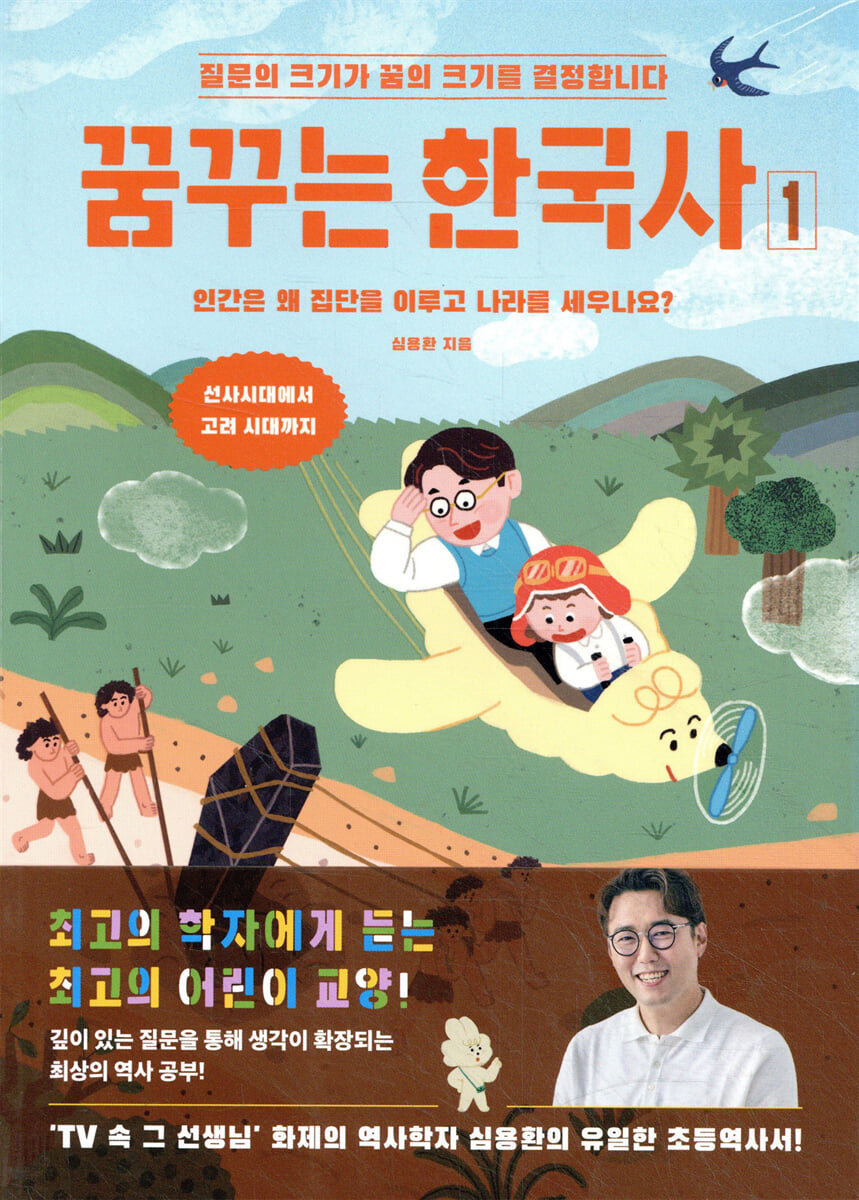
The size of your questions determines the size of your dreams! "Thinking Korean History" for elementary school students by historian Sim Yong-hwan, Korea's leading educator! A Korean history book for upper elementary school students that helps elementary school students, who have only learned Korean history through educational comics, learn about major events in Korean history through in-depth questions and engaging storytelling. Author Sim Yong-hwan, the most trusted educator in the history field in Korea, wrote this story in a friendly manner, as if he were telling it to his two sons. |
- You can preview some of the book's contents.
Preview
index
[Introduction] History belongs to children who dream and ask questions.
[Character Introduction] A delightful journey through Korean history with Professor Sim Yong-hwan!
Chapter 1: From Prehistoric Times to a Powerful Monarchy
[Prehistoric Times and the Discovery of Tools]
How did such a weak human being survive among wild beasts?
The Neolithic Age and the Agricultural Revolution
Why don't we wander and live like birds or fish?
Bronze Age
Why do humans fight each other and wage war?
[Iron Age and Chinese Civilization]
What does it have to do with me if my country becomes strong?
[Dangun and Gojoseon]
How can we know the history of the past accurately?
[Mythical Story]
Could humans really be born from eggs?
[The Federation Kingdom Era and Various Laws and Orders]
How should we view the evil laws of the past?
[Pungnap Earthen Fortress and Mongchon Earthen Fortress]
How do the discoveries of historians differ from those of archaeologists?
The arduous and complex story of the founding of Silla and Gaya
Who wins the war?
[From the Confederated Kingdoms to the Three Kingdoms Period]
What happens when the king's power grows stronger?
Chapter 2: The Three Kingdoms Competed and Developed Their Nation
[The Age of Fierce Competition: Gwanggaeto the Great vs. King Jinheung]
Why do humans compete?
[Goguryeo's Great Struggle and Fall]
Why is the Gwanggaeto Stele in China?
[King Muryeong and King Seong, the History of Baekje's Revival]
If I lose in the end, is it meaningless?
[Turtle Silla's Unification of the Three Kingdoms]
How was Silla able to unify the three kingdoms under such poor conditions?
[Kangsu, Wonhyo, and Hyecho set out in search of love and truth]
Did we live only for war and victory in the past?
Hyecho, Bulguksa Temple, and Seokguram Grotto: A Journey in Search of Truth
Why build a temple when no one lives there?
[The Birth of Balhae]
How do we know that Balhae succeeded Goguryeo?
The Flower of Unified Silla Withers
Why do large and splendid countries disappear?
Chapter 3: The True Korean Nation, Goryeo, is Born
The Leadership of Gung Ye, Gyeon Hwon, and Wang Geon
Is there no way to win a war without fighting?
The Birth of Goryeo and the Rapidly Changing International Order in East Asia
What kind of systems are needed to run a country?
Goryeo's Multilateral Diplomacy
Why should we be friendly with other countries?
[Musin Coup]
Wouldn't it be good if soldiers ruled the country with strong power?
[Goryeo in Chaos Amid Repeated Invasion]
What happens if a country doesn't protect its people?
A world shaped by curiosity and competitiveness
Why does a small country like ours boast the best technology?
[Goryeo's Last Flame, King Gongmin]
Why is it so difficult for reform to succeed?
[Character Introduction] A delightful journey through Korean history with Professor Sim Yong-hwan!
Chapter 1: From Prehistoric Times to a Powerful Monarchy
[Prehistoric Times and the Discovery of Tools]
How did such a weak human being survive among wild beasts?
The Neolithic Age and the Agricultural Revolution
Why don't we wander and live like birds or fish?
Bronze Age
Why do humans fight each other and wage war?
[Iron Age and Chinese Civilization]
What does it have to do with me if my country becomes strong?
[Dangun and Gojoseon]
How can we know the history of the past accurately?
[Mythical Story]
Could humans really be born from eggs?
[The Federation Kingdom Era and Various Laws and Orders]
How should we view the evil laws of the past?
[Pungnap Earthen Fortress and Mongchon Earthen Fortress]
How do the discoveries of historians differ from those of archaeologists?
The arduous and complex story of the founding of Silla and Gaya
Who wins the war?
[From the Confederated Kingdoms to the Three Kingdoms Period]
What happens when the king's power grows stronger?
Chapter 2: The Three Kingdoms Competed and Developed Their Nation
[The Age of Fierce Competition: Gwanggaeto the Great vs. King Jinheung]
Why do humans compete?
[Goguryeo's Great Struggle and Fall]
Why is the Gwanggaeto Stele in China?
[King Muryeong and King Seong, the History of Baekje's Revival]
If I lose in the end, is it meaningless?
[Turtle Silla's Unification of the Three Kingdoms]
How was Silla able to unify the three kingdoms under such poor conditions?
[Kangsu, Wonhyo, and Hyecho set out in search of love and truth]
Did we live only for war and victory in the past?
Hyecho, Bulguksa Temple, and Seokguram Grotto: A Journey in Search of Truth
Why build a temple when no one lives there?
[The Birth of Balhae]
How do we know that Balhae succeeded Goguryeo?
The Flower of Unified Silla Withers
Why do large and splendid countries disappear?
Chapter 3: The True Korean Nation, Goryeo, is Born
The Leadership of Gung Ye, Gyeon Hwon, and Wang Geon
Is there no way to win a war without fighting?
The Birth of Goryeo and the Rapidly Changing International Order in East Asia
What kind of systems are needed to run a country?
Goryeo's Multilateral Diplomacy
Why should we be friendly with other countries?
[Musin Coup]
Wouldn't it be good if soldiers ruled the country with strong power?
[Goryeo in Chaos Amid Repeated Invasion]
What happens if a country doesn't protect its people?
A world shaped by curiosity and competitiveness
Why does a small country like ours boast the best technology?
[Goryeo's Last Flame, King Gongmin]
Why is it so difficult for reform to succeed?
Detailed image

Into the book
Myself, the people around me, the places and things where I and the people live, all these events happen in the same 'space' and at the same time, they are also things that happen as 'time' passes.
is it so.
People live in time and space.
We are not just living, but creating stories, rejoicing together, getting angry together, reminiscing about the past, and dreaming of the future, creating something called 'life'.
The process of building a house called life between time and space.
That may be life for each person, but when you take it all together, it becomes the history of mankind.
Humans are beings who create history.
--- p.
15 From “How did such a weak human being survive among wild beasts?”
The nobles could have multiple wives, and women had difficulty participating in society.
Because it was a male-centered society and gender discrimination was natural.
Looking back now, there are many things that are very strange and wrong, but at the time, I lived my life taking that for granted.
This is because people's thoughts differed over time and there were also big differences in systems and culture.
It's natural to think that this kind of behavior is wrong.
History is always like that.
The world changes and develops as things we believe to be right and natural are questioned and criticized.
However, I think it would be good to compare the past and present, keeping in mind that just as we have many limitations today and the society we live in has many problems, there must have been limitations and problems in the past as well.
--- p.
69 From “How should we view the evil laws of the past?”
The kings of Baekje made many efforts to save their country, but unfortunately, Silla grew stronger and more powerful, and above all, Baekje was destroyed by the Tang army that had colluded with Silla.
Nevertheless, we need to remember that Baekje really developed its nation through continuous struggles.
Because results don't tell the whole story.
There are truly dry successes, but there are also many things in the world that, despite failure, are recognized as meaningful processes.
--- p.
128 From "If I Lose in the End, Would It Be Meaningless?"
"Couldn't the Three Kingdoms have gotten along?", "If they had known that the Tang Dynasty had become incredibly powerful after absorbing the Turks and other northern tribes, wouldn't it have been much more advantageous for the Three Kingdoms to unite and block the Tang invasion?", "Even though international relations were rapidly changing, did they really have to fight among themselves like this?" Of course, no matter how many times you think about these things, the past won't change.
Because it's a story from 1,000 years ago.
But thinking seriously about the past can be a great help in understanding the present.
--- p.
148 From “Did we live only for war and victory in the past?”
There was a change in thinking.
The centers of the Korean Peninsula are usually Seoul, Gaeseong, and Pyongyang, right? At the time, it was probably Gyeongju or Ulsan.
However, since the flow of exchange and trade was centered around the West Sea, Jang Bogo focused on Wando.
'The center can always change, and new strongholds can be created depending on the situation.' With this kind of thinking, he expanded military power with strong leadership and even led maritime trade, so he was a remarkable figure.
--- p.
176 "Why do great and magnificent countries disappear?"
I think it would be really hard to be born in a time like this.
Those in power are corrupt, exploit the people, and commit all kinds of evil deeds.
There is no place to appeal for redress, and many who demand reform are forced to fail and be driven out.
But history progresses.
Just as light overcomes darkness, the people, yearning for a better world, cheer on reformers, and new leaders emerge to change history.
It was exactly like that at the end of the Goryeo Dynasty.
It was extremely chaotic and eventually Goryeo was destroyed.
However, a country called Joseon appears.
is it so.
People live in time and space.
We are not just living, but creating stories, rejoicing together, getting angry together, reminiscing about the past, and dreaming of the future, creating something called 'life'.
The process of building a house called life between time and space.
That may be life for each person, but when you take it all together, it becomes the history of mankind.
Humans are beings who create history.
--- p.
15 From “How did such a weak human being survive among wild beasts?”
The nobles could have multiple wives, and women had difficulty participating in society.
Because it was a male-centered society and gender discrimination was natural.
Looking back now, there are many things that are very strange and wrong, but at the time, I lived my life taking that for granted.
This is because people's thoughts differed over time and there were also big differences in systems and culture.
It's natural to think that this kind of behavior is wrong.
History is always like that.
The world changes and develops as things we believe to be right and natural are questioned and criticized.
However, I think it would be good to compare the past and present, keeping in mind that just as we have many limitations today and the society we live in has many problems, there must have been limitations and problems in the past as well.
--- p.
69 From “How should we view the evil laws of the past?”
The kings of Baekje made many efforts to save their country, but unfortunately, Silla grew stronger and more powerful, and above all, Baekje was destroyed by the Tang army that had colluded with Silla.
Nevertheless, we need to remember that Baekje really developed its nation through continuous struggles.
Because results don't tell the whole story.
There are truly dry successes, but there are also many things in the world that, despite failure, are recognized as meaningful processes.
--- p.
128 From "If I Lose in the End, Would It Be Meaningless?"
"Couldn't the Three Kingdoms have gotten along?", "If they had known that the Tang Dynasty had become incredibly powerful after absorbing the Turks and other northern tribes, wouldn't it have been much more advantageous for the Three Kingdoms to unite and block the Tang invasion?", "Even though international relations were rapidly changing, did they really have to fight among themselves like this?" Of course, no matter how many times you think about these things, the past won't change.
Because it's a story from 1,000 years ago.
But thinking seriously about the past can be a great help in understanding the present.
--- p.
148 From “Did we live only for war and victory in the past?”
There was a change in thinking.
The centers of the Korean Peninsula are usually Seoul, Gaeseong, and Pyongyang, right? At the time, it was probably Gyeongju or Ulsan.
However, since the flow of exchange and trade was centered around the West Sea, Jang Bogo focused on Wando.
'The center can always change, and new strongholds can be created depending on the situation.' With this kind of thinking, he expanded military power with strong leadership and even led maritime trade, so he was a remarkable figure.
--- p.
176 "Why do great and magnificent countries disappear?"
I think it would be really hard to be born in a time like this.
Those in power are corrupt, exploit the people, and commit all kinds of evil deeds.
There is no place to appeal for redress, and many who demand reform are forced to fail and be driven out.
But history progresses.
Just as light overcomes darkness, the people, yearning for a better world, cheer on reformers, and new leaders emerge to change history.
It was exactly like that at the end of the Goryeo Dynasty.
It was extremely chaotic and eventually Goryeo was destroyed.
However, a country called Joseon appears.
--- p.
239 From “Why is it so difficult for reform to succeed?”
239 From “Why is it so difficult for reform to succeed?”
Publisher's Review
“History belongs to children who dream and ask questions.”
The best way to study history is to expand your thinking through deep questions!
Historian Sim Yong-hwan shares everything you need to know about Korean history for elementary school students!
“Die, Hegel, you are already dead, but die again.” (Gl*******)
This is said to be the cry of a test taker posted on Twitter on the evening after the 2022 College Scholastic Ability Test.
The controversial issue is about 'Hegel's Dialectics', which appeared in the Korean language section of the first period, and it is said that six problems were presented in a passage of approximately 2,000 characters in length.
At a time when declining literacy was already a serious social problem, concerns were high about the educational gap caused by COVID-19, so the 'Hegel incident' was a huge shock not only to the test takers themselves, but also to students and parents who will be taking the CSAT in the future.
History is undoubtedly the most desirable literacy text.
Records of past events and human heritage serve as a source of high-level storytelling for understanding humans and the environment surrounding them, while also serving as a medium for in-depth learning.
This is also proven by the fact that the most read texts by Korean children before and after entering school are educational comics on the topic of history.
However, it is difficult to learn history only through educational cartoons.
Because history has greater meaning when we cultivate the ability to understand and interpret the context surrounding the event rather than simply knowing the event itself.
It is because of this power of context and interpretation that everyone firmly believes that history is a mirror that illuminates the future through the past.
Historian Shim Yong-hwan's "Dreaming Korean History" series focuses on fostering the ability to understand and interpret this context.
The first book in the series, “Dreaming Korean History 1,” does not stop at describing dolmens and lute-shaped bronze daggers as Bronze Age relics.
It goes without saying that these two artifacts are evidence of class creation.
Ask the question in return.
"How did such a weak human being overcome his limitations?", "Why do humans wage war and strive to occupy territory?" The moment the book begins with these questions, its techniques are no longer limited to "elementary history."
It naturally leads to the topic of philosophy.
It tells us what humans are for, what they do, and what defines them and how they live.
The 25 questions that define the period from prehistoric times to the Goryeo Dynasty help our children develop the 'power of philosophizing' by applying knowledge through questioning.
For children with the power to philosophize, the above Hegelian problem becomes rather a 'safe question'.
This is because the ability that the CSAT is trying to 'distinguish' is precisely this 'thinking ability to answer questions.'
Correct and just historical writing for children
A history book that strives to record peace instead of war, and the small, not the great.
The author, Sim Yong-hwan, wrote this book while pondering what healthy values our children should have, considering the current situation where the values of peace and diversity are more important than ever.
As a father of two elementary school-aged children, before becoming a historian and author, I've been pondering what values should be prioritized to help our children build a peaceful and healthy future.
Therefore, the book does not romanticize the history of war and conquest.
While covering the heyday of the Three Kingdoms and the greatness of Balhae's history, it also provides a balanced description of the hardships faced by the common people mobilized for war during the same period, helping readers develop a more mature understanding of history.
Furthermore, by describing the narratives of women that have not been explored in history and the hidden sides of various customs that were once right but are now considered unethical, we have tried to provide young readers with a basis for rational judgment on the issues facing us.
If we treat martyrdom not simply as a horrific and ignorant custom, but as part of a system chosen by a society that operated around class, it will lead to critical thinking about how just the system in our society today is.
Explain difficult terms easily
A friendly Korean history written based on children's experiences
Each of the 25 chapters begins with a real-life episode that young readers can relate to and understand.
When dealing with the Jumong myth, we ask questions about the prenatal dreams our parents had when we were born, and when dealing with the birth of Goryeo, we introduce the representative election system of the Republic of Korea, which elects a president once every five years.
Because it describes past history based on children's experiences, it naturally has the characteristic of a three-dimensional and vivid connection between the past and present.
Additionally, we took care to ensure that you do not miss the overall context due to a lack of understanding of the words by explaining each term that is not easily encountered in real life using speech bubbles.
This book, written with care and attention to detail for children, will provide a valuable experience that makes learning Korean history more engaging and engaging through in-depth questions.
The best way to study history is to expand your thinking through deep questions!
Historian Sim Yong-hwan shares everything you need to know about Korean history for elementary school students!
“Die, Hegel, you are already dead, but die again.” (Gl*******)
This is said to be the cry of a test taker posted on Twitter on the evening after the 2022 College Scholastic Ability Test.
The controversial issue is about 'Hegel's Dialectics', which appeared in the Korean language section of the first period, and it is said that six problems were presented in a passage of approximately 2,000 characters in length.
At a time when declining literacy was already a serious social problem, concerns were high about the educational gap caused by COVID-19, so the 'Hegel incident' was a huge shock not only to the test takers themselves, but also to students and parents who will be taking the CSAT in the future.
History is undoubtedly the most desirable literacy text.
Records of past events and human heritage serve as a source of high-level storytelling for understanding humans and the environment surrounding them, while also serving as a medium for in-depth learning.
This is also proven by the fact that the most read texts by Korean children before and after entering school are educational comics on the topic of history.
However, it is difficult to learn history only through educational cartoons.
Because history has greater meaning when we cultivate the ability to understand and interpret the context surrounding the event rather than simply knowing the event itself.
It is because of this power of context and interpretation that everyone firmly believes that history is a mirror that illuminates the future through the past.
Historian Shim Yong-hwan's "Dreaming Korean History" series focuses on fostering the ability to understand and interpret this context.
The first book in the series, “Dreaming Korean History 1,” does not stop at describing dolmens and lute-shaped bronze daggers as Bronze Age relics.
It goes without saying that these two artifacts are evidence of class creation.
Ask the question in return.
"How did such a weak human being overcome his limitations?", "Why do humans wage war and strive to occupy territory?" The moment the book begins with these questions, its techniques are no longer limited to "elementary history."
It naturally leads to the topic of philosophy.
It tells us what humans are for, what they do, and what defines them and how they live.
The 25 questions that define the period from prehistoric times to the Goryeo Dynasty help our children develop the 'power of philosophizing' by applying knowledge through questioning.
For children with the power to philosophize, the above Hegelian problem becomes rather a 'safe question'.
This is because the ability that the CSAT is trying to 'distinguish' is precisely this 'thinking ability to answer questions.'
Correct and just historical writing for children
A history book that strives to record peace instead of war, and the small, not the great.
The author, Sim Yong-hwan, wrote this book while pondering what healthy values our children should have, considering the current situation where the values of peace and diversity are more important than ever.
As a father of two elementary school-aged children, before becoming a historian and author, I've been pondering what values should be prioritized to help our children build a peaceful and healthy future.
Therefore, the book does not romanticize the history of war and conquest.
While covering the heyday of the Three Kingdoms and the greatness of Balhae's history, it also provides a balanced description of the hardships faced by the common people mobilized for war during the same period, helping readers develop a more mature understanding of history.
Furthermore, by describing the narratives of women that have not been explored in history and the hidden sides of various customs that were once right but are now considered unethical, we have tried to provide young readers with a basis for rational judgment on the issues facing us.
If we treat martyrdom not simply as a horrific and ignorant custom, but as part of a system chosen by a society that operated around class, it will lead to critical thinking about how just the system in our society today is.
Explain difficult terms easily
A friendly Korean history written based on children's experiences
Each of the 25 chapters begins with a real-life episode that young readers can relate to and understand.
When dealing with the Jumong myth, we ask questions about the prenatal dreams our parents had when we were born, and when dealing with the birth of Goryeo, we introduce the representative election system of the Republic of Korea, which elects a president once every five years.
Because it describes past history based on children's experiences, it naturally has the characteristic of a three-dimensional and vivid connection between the past and present.
Additionally, we took care to ensure that you do not miss the overall context due to a lack of understanding of the words by explaining each term that is not easily encountered in real life using speech bubbles.
This book, written with care and attention to detail for children, will provide a valuable experience that makes learning Korean history more engaging and engaging through in-depth questions.
GOODS SPECIFICS
- Publication date: May 23, 2022
- Page count, weight, size: 252 pages | 464g | 153*218*13mm
- ISBN13: 9791191439137
- ISBN10: 1191439135
You may also like
카테고리
korean


korean

![GQ KOREA Mark (Monthly): December [2025]](http://librairie.coreenne.fr/cdn/shop/files/8ef265dbbfbf186523ed75ba7319009d.jpg?v=1765340328&width=3840)


