

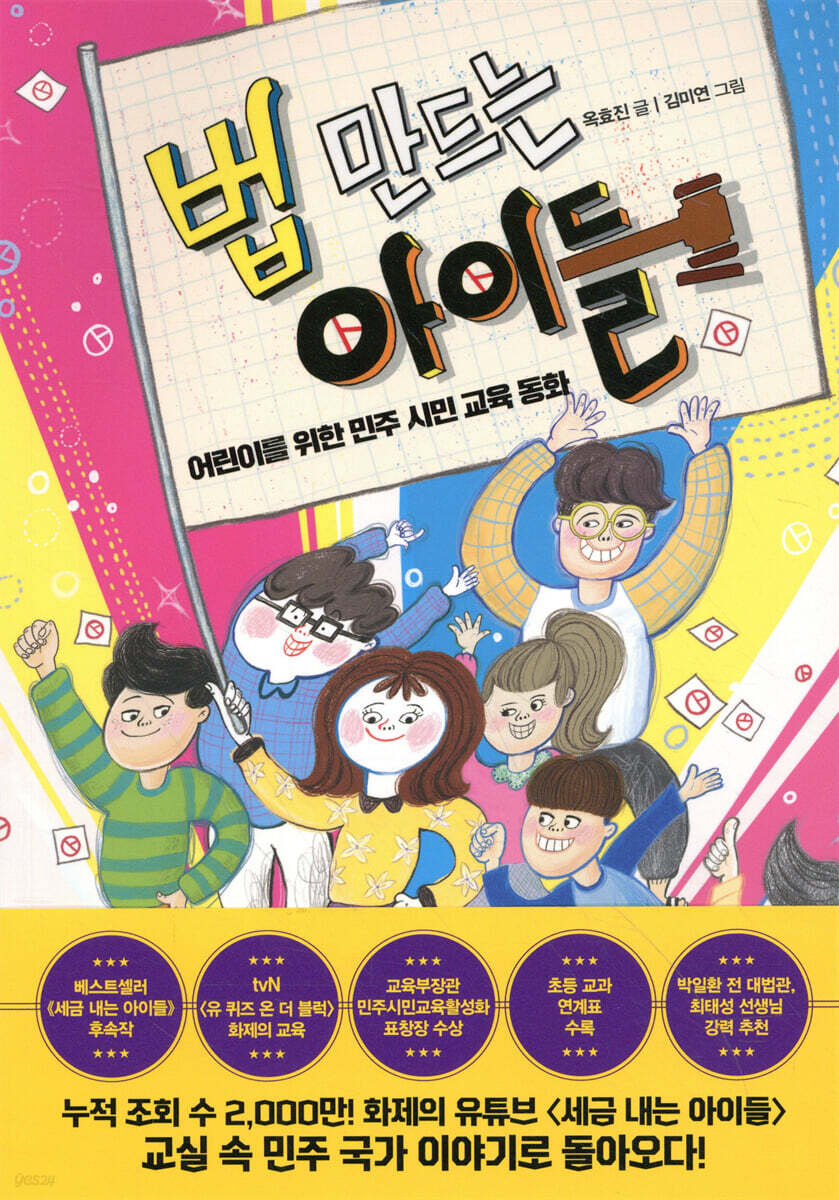
Children Who Make Laws
 |
Description
Book Introduction
- A word from MD
-
A democratic nation created by childrenThe second story of Teacher Ok Hyo-jin's 'Tax-Paying Classroom'.
It focuses on law and politics, telling the story of a democratic country where children make their own laws and run the country.
What kind of things will happen in the world's only classroom 'of Hwalmyeongsu, by Hwalmyeongsu, for Hwalmyeongsu'?April 29, 2022. Children's PD Park Eun-young
'Class 1, Grade 6, Declares Independence!'
20 million cumulative views! The hot YouTube hit "Taxpaying Kids"
Back to the story of a democratic nation in the classroom
The second story in the "Tax-Paying Classroom" series by teacher Ok Hyo-jin, which became a hot topic as soon as it was published and opened a new horizon for children's educational fairy tales, "Children Who Make Laws," has been published.
If the previous work, "Children Who Pay Taxes," was about the economy in a country where children earn, save, spend, and invest money on their own, this book broadens the scope a bit and focuses on law and politics as a story about a democratic country where children make their own laws and run the country.
What kind of things will happen in the world's only classroom 'of Hwalmyeongsu, by Hwalmyeongsu, for Hwalmyeongsu'?
On the first day of school, the homeroom teacher declares Class 1, Grade 6, an independent nation and announces that the classroom will be run by laws set by the students instead of school rules.
The children become citizens of the country of Hwalmyeongsu (lively and cheerful chatterboxes) with the duty to pay taxes and the right to vote, and Sujeong, who was elected president, Geonhyeok and Yeongjin as vice prime ministers, and Min Jeong-hyeon, who was appointed prime minister, form a government and take charge of running the country...
Children create their own laws for the country of Hwalmyeongsu by creating and abolishing new laws through meetings.
However, an incident occurred where someone secretly used the people's precious tax money, and even while some people were indifferent to politics, they passed the 'Lunch Order by Grades Act' that only benefited a few, and Hwalmyeongsu was divided into two sides and became increasingly divided...
Can Sujeong and her friends overcome the crisis in the land of Hwalmyeongsu and create a country where everyone can live well?
20 million cumulative views! The hot YouTube hit "Taxpaying Kids"
Back to the story of a democratic nation in the classroom
The second story in the "Tax-Paying Classroom" series by teacher Ok Hyo-jin, which became a hot topic as soon as it was published and opened a new horizon for children's educational fairy tales, "Children Who Make Laws," has been published.
If the previous work, "Children Who Pay Taxes," was about the economy in a country where children earn, save, spend, and invest money on their own, this book broadens the scope a bit and focuses on law and politics as a story about a democratic country where children make their own laws and run the country.
What kind of things will happen in the world's only classroom 'of Hwalmyeongsu, by Hwalmyeongsu, for Hwalmyeongsu'?
On the first day of school, the homeroom teacher declares Class 1, Grade 6, an independent nation and announces that the classroom will be run by laws set by the students instead of school rules.
The children become citizens of the country of Hwalmyeongsu (lively and cheerful chatterboxes) with the duty to pay taxes and the right to vote, and Sujeong, who was elected president, Geonhyeok and Yeongjin as vice prime ministers, and Min Jeong-hyeon, who was appointed prime minister, form a government and take charge of running the country...
Children create their own laws for the country of Hwalmyeongsu by creating and abolishing new laws through meetings.
However, an incident occurred where someone secretly used the people's precious tax money, and even while some people were indifferent to politics, they passed the 'Lunch Order by Grades Act' that only benefited a few, and Hwalmyeongsu was divided into two sides and became increasingly divided...
Can Sujeong and her friends overcome the crisis in the land of Hwalmyeongsu and create a country where everyone can live well?
- You can preview some of the book's contents.
Preview
index
Author's Note: Who is the master of the classroom?
Chapter 1 Class 1, Grade 6, Declaring Independence!
Our class presidential election
The Housekeepers of the Land of Hwalmyeongsu
A promise you can't keep?!
Chapter 2: Children Who Make Laws
Does it make sense that you can't even go to the bathroom?
Thirteen-year-old congressmen
1st National Assembly Plenary Session
Chapter 3: Of the water of life, by the water of life, for the water of life!
From now on, physical education will be five times a week.
Isn't this a huge waste of tax money?
Hwalmyeongsu tax embezzlement case
Chapter 4: Sun Party vs. Together Party
Laws created in indifference
The country of Hwalmyeongsu, divided into two
Opposition for the sake of opposition
Chapter 5: Hwalmyeongsu Emergency Response Committee
Laws that missed their time
Patbingsu Hoedong
Let's all take one step together
Chapter 6: For a Better Life
new prime minister
Help the people in crisis!
A sad farewell
Chapter 1 Class 1, Grade 6, Declaring Independence!
Our class presidential election
The Housekeepers of the Land of Hwalmyeongsu
A promise you can't keep?!
Chapter 2: Children Who Make Laws
Does it make sense that you can't even go to the bathroom?
Thirteen-year-old congressmen
1st National Assembly Plenary Session
Chapter 3: Of the water of life, by the water of life, for the water of life!
From now on, physical education will be five times a week.
Isn't this a huge waste of tax money?
Hwalmyeongsu tax embezzlement case
Chapter 4: Sun Party vs. Together Party
Laws created in indifference
The country of Hwalmyeongsu, divided into two
Opposition for the sake of opposition
Chapter 5: Hwalmyeongsu Emergency Response Committee
Laws that missed their time
Patbingsu Hoedong
Let's all take one step together
Chapter 6: For a Better Life
new prime minister
Help the people in crisis!
A sad farewell
Detailed image

Into the book
“Teacher, our class isn’t even a country, so why does it have a president?”
"That's a good question! From today on, our 6th grade class 1 is one nation.
So, there are rules that we have to follow in our class.
And the President will run our country's affairs.
Of course, there are also the Prime Minister and Deputy Prime Ministers who assist the President.”
“If the president takes care of our class..., what about you, teacher?”
Soo-Jung tilted her head and asked.
“Teachers, like you, must live in the classroom according to the laws of our class and according to the way our country’s president conducts his affairs.
“Of course, the teacher will teach the class.”
--- p.
15
"If you need to go to the bathroom, shouldn't you be able to? I was in a real hurry!"
“I can tell just by looking at your face.”
Sujeong chuckled as she remembered Kijeong fidgeting.
“Sujeong, since you are the president, change the law!”
“Can I… change it?”
“The president is the highest person in the country, so shouldn’t he be able to change the law?”
“Is that so?”
Sujeong wondered if, as Kijeong had said, the president could change the country's laws at will.
At that time, Deputy Prime Minister Geon-hyeok suddenly appeared.
“Even the president can’t change the law, right?”
“That’s right, the president isn’t a king.”
--- pp.
49~50
“Isn’t it discrimination to determine the order of meal intake based on grades?”
“Isn’t this advantageous for Representative Heo Tae-yang, who is good at math?”
Taeyang, who proposed the law, did not back down.
“If you want to eat lunch first, just study math hard.”
The children who were close to Taeyang gave him strength.
“If school lunches are served in order of grades, it may also have the effect of making children study more in math to eat their lunch faster.”
Kijung was worried inside.
I thought it was discriminatory to determine the order in which students eat lunch based on their grades, but I also thought that since I was good at math, I would be able to eat lunch quickly.
--- pp.
112~113
“Because of you guys, I can’t play dodgeball!”
“Why is it our fault? It’s your fault.”
“I can’t even have Songi’s farewell party because of you guys.”
Once again, the Sun Party and the Together Party clashed fiercely.
“Because of the Together Party, Hwalmyeongsu is in disarray!”
“What are you talking about! It’s all your fault that Hwalmyeongsu is in shambles!”
Due to the strife between political parties, laws for the country's livelihood were not properly created.
As a result, the people of the country of Hwalmyeongsu had to suffer inconveniences in many ways.
"That's a good question! From today on, our 6th grade class 1 is one nation.
So, there are rules that we have to follow in our class.
And the President will run our country's affairs.
Of course, there are also the Prime Minister and Deputy Prime Ministers who assist the President.”
“If the president takes care of our class..., what about you, teacher?”
Soo-Jung tilted her head and asked.
“Teachers, like you, must live in the classroom according to the laws of our class and according to the way our country’s president conducts his affairs.
“Of course, the teacher will teach the class.”
--- p.
15
"If you need to go to the bathroom, shouldn't you be able to? I was in a real hurry!"
“I can tell just by looking at your face.”
Sujeong chuckled as she remembered Kijeong fidgeting.
“Sujeong, since you are the president, change the law!”
“Can I… change it?”
“The president is the highest person in the country, so shouldn’t he be able to change the law?”
“Is that so?”
Sujeong wondered if, as Kijeong had said, the president could change the country's laws at will.
At that time, Deputy Prime Minister Geon-hyeok suddenly appeared.
“Even the president can’t change the law, right?”
“That’s right, the president isn’t a king.”
--- pp.
49~50
“Isn’t it discrimination to determine the order of meal intake based on grades?”
“Isn’t this advantageous for Representative Heo Tae-yang, who is good at math?”
Taeyang, who proposed the law, did not back down.
“If you want to eat lunch first, just study math hard.”
The children who were close to Taeyang gave him strength.
“If school lunches are served in order of grades, it may also have the effect of making children study more in math to eat their lunch faster.”
Kijung was worried inside.
I thought it was discriminatory to determine the order in which students eat lunch based on their grades, but I also thought that since I was good at math, I would be able to eat lunch quickly.
--- pp.
112~113
“Because of you guys, I can’t play dodgeball!”
“Why is it our fault? It’s your fault.”
“I can’t even have Songi’s farewell party because of you guys.”
Once again, the Sun Party and the Together Party clashed fiercely.
“Because of the Together Party, Hwalmyeongsu is in disarray!”
“What are you talking about! It’s all your fault that Hwalmyeongsu is in shambles!”
Due to the strife between political parties, laws for the country's livelihood were not properly created.
As a result, the people of the country of Hwalmyeongsu had to suffer inconveniences in many ways.
--- p.
141
141
Publisher's Review
The first step toward creating a better future,
The power of democratic citizenship education, where the more you grow, the more you can expand your capabilities!
The "Tax-Paying Classroom" from the children's economics bestseller "Children Who Pay Taxes" returns as a story about democracy!
After elementary school teacher Ok Hyo-jin revealed the 'class currency' activity she personally experienced with children through the YouTube channel "Children Who Pay Taxes," Ok Hyo-jin's special classes received a lot of attention from parents and the education community, to the point that people started shouting "One teacher, one classroom."
Teacher Ok Hyo-jin, who has consistently emphasized the importance of education that fosters children's independence and self-reliance, focused on fostering economic common sense and planned and proactive financial habits in her previous work, "Children Who Pay Taxes." In her new book, "Children Who Make Laws," she includes methods for realizing national sovereignty through rational and democratic communication processes and political participation to ensure that all members of society are happy while protecting individual freedom and rights.
Just as the people are the masters of a country, we are the masters of our classroom!
What does it take to create a classroom where everyone can thrive?
『The Children Who Make Laws』 is a story about children who become the masters of their own classrooms, make laws, and run the country in the same setting as the previous work, the country of 'Hwalmyeongsu' (lively and cheerful chatterboxes).
Within this framework, children can form a government through presidential elections and, as citizens and members of the National Assembly, propose and discuss various bills to promote their well-being.
At first, children may express discomfort about having to pay taxes to run the country, and they may even create laws that benefit themselves rather than everyone else.
Some children are also indifferent to this process.
However, these attitudes and actions bring about conflict and division in Hwalmyeongsu, and ultimately, everyone feels uncomfortable.
Through the story of the protagonist Soo-Jeong and her friends growing together to solve the problems of the country of Hwalmyeongsu and make it a better country, children can learn about the significance and procedures of elections in a democratic society, and the roles of the government, National Assembly, and courts. They can also experience the legislative process through the process of citizens themselves creating, amending, and abolishing laws necessary for the country, and they can also learn about the process of political parties naturally forming.
Also, what is the proper use of taxes, why democratic decision-making and citizen participation in politics are important, etc.
You can learn the social knowledge necessary for future leaders who will live in a democratic society.
This book introduces the democracy that we breathe together in our daily lives in an easy and fun way through the story of Sujeong and her friends' ups and downs in running a country. It also reminds elementary school children of the meaning of democracy that they must know and the necessity of democratic citizenship education.
This will be a great opportunity and help for me to think about how we, as citizens of one country, can all live together happily.
When I first heard the term "National Assembly plenary session," it felt awkward and the first thought that came to mind was, "Aren't only members of the National Assembly responsible for making laws?"
However, by making laws with my friends and learning about various terms such as enactment, amendment, and abolition of laws through experience, I came to think, 'We can also express our opinions.'
Thank you, teacher! _Bang Yeon-ju, the child who makes laws
Through various activities with the teacher over the past year, I learned a lot about politics, a subject I had never been familiar with.
We had a really fruitful time making laws, listening to each other's opinions, and discussing them.
I hope that elementary school students who find politics too difficult will read this book.
_The Lawmaker Oh Jun-ho
It was a very new and fun experience to create, change, and abolish laws in our class.
Through class currency activities, I was able to directly participate in plenary sessions of the National Assembly, which gave me an understanding of how the National Assembly operates and also gave me an interest in political issues.
I felt proud when the proposed law passed and sad when it was rejected, but my relationship with my friends also improved as we discussed it together.
I learned a lot from meeting the teacher and participating in activities.
_The Law-Making Child Jo Sa-bin
*Main Activities and Awards*
-2021 Deputy Prime Minister and Minister of Education Award for Promotion of Democratic Citizenship Education
-2021 Deputy Prime Minister and Minister of Strategy and Finance Award for Contribution to National Economic Development
-2020 Korea Economic Education Award (President's Award from the Economic Education Association)
-2019 Korea Economic Education Award, Chamber of Commerce and Industry President Award
- Lecture on the "Children Who Pay Taxes" training program for teachers at the "EBS Distance Education Training Center with Teachers"
*Elementary Curriculum Correlation Table*
society
5-1
- Learn what the law is
-Understanding the role of law
- Find out why you must obey the law
- Understanding the meaning of the Constitution
-Learn about the basic rights and duties of citizens as stated in the Constitution.
6-1
- Learn how today's citizens participate in solving common social problems.
-Learn the meaning and importance of democracy through everyday examples.
-Learn about the principles of democratic decision-making.
-Understanding the meaning of popular sovereignty
- Find out what happens in the National Assembly
- Find out what the government is doing
- Find out what happens in court
- Find out why we need to share the work of the state.
Korean
4-1
-Familiarize yourself with meeting procedures and participant roles.
-Hold meetings while following procedures and rules
5-1
-Read the text while understanding the appropriateness of the basis
- Share your opinions for and against the claim
- Know how to coordinate opinions during the discussion process
- Discuss and coordinate opinions
morality
5-2
-Learn the right conversation techniques to resolve conflicts.
- Finding a desirable way to resolve conflict
-Talk with empathy
The power of democratic citizenship education, where the more you grow, the more you can expand your capabilities!
The "Tax-Paying Classroom" from the children's economics bestseller "Children Who Pay Taxes" returns as a story about democracy!
After elementary school teacher Ok Hyo-jin revealed the 'class currency' activity she personally experienced with children through the YouTube channel "Children Who Pay Taxes," Ok Hyo-jin's special classes received a lot of attention from parents and the education community, to the point that people started shouting "One teacher, one classroom."
Teacher Ok Hyo-jin, who has consistently emphasized the importance of education that fosters children's independence and self-reliance, focused on fostering economic common sense and planned and proactive financial habits in her previous work, "Children Who Pay Taxes." In her new book, "Children Who Make Laws," she includes methods for realizing national sovereignty through rational and democratic communication processes and political participation to ensure that all members of society are happy while protecting individual freedom and rights.
Just as the people are the masters of a country, we are the masters of our classroom!
What does it take to create a classroom where everyone can thrive?
『The Children Who Make Laws』 is a story about children who become the masters of their own classrooms, make laws, and run the country in the same setting as the previous work, the country of 'Hwalmyeongsu' (lively and cheerful chatterboxes).
Within this framework, children can form a government through presidential elections and, as citizens and members of the National Assembly, propose and discuss various bills to promote their well-being.
At first, children may express discomfort about having to pay taxes to run the country, and they may even create laws that benefit themselves rather than everyone else.
Some children are also indifferent to this process.
However, these attitudes and actions bring about conflict and division in Hwalmyeongsu, and ultimately, everyone feels uncomfortable.
Through the story of the protagonist Soo-Jeong and her friends growing together to solve the problems of the country of Hwalmyeongsu and make it a better country, children can learn about the significance and procedures of elections in a democratic society, and the roles of the government, National Assembly, and courts. They can also experience the legislative process through the process of citizens themselves creating, amending, and abolishing laws necessary for the country, and they can also learn about the process of political parties naturally forming.
Also, what is the proper use of taxes, why democratic decision-making and citizen participation in politics are important, etc.
You can learn the social knowledge necessary for future leaders who will live in a democratic society.
This book introduces the democracy that we breathe together in our daily lives in an easy and fun way through the story of Sujeong and her friends' ups and downs in running a country. It also reminds elementary school children of the meaning of democracy that they must know and the necessity of democratic citizenship education.
This will be a great opportunity and help for me to think about how we, as citizens of one country, can all live together happily.
When I first heard the term "National Assembly plenary session," it felt awkward and the first thought that came to mind was, "Aren't only members of the National Assembly responsible for making laws?"
However, by making laws with my friends and learning about various terms such as enactment, amendment, and abolition of laws through experience, I came to think, 'We can also express our opinions.'
Thank you, teacher! _Bang Yeon-ju, the child who makes laws
Through various activities with the teacher over the past year, I learned a lot about politics, a subject I had never been familiar with.
We had a really fruitful time making laws, listening to each other's opinions, and discussing them.
I hope that elementary school students who find politics too difficult will read this book.
_The Lawmaker Oh Jun-ho
It was a very new and fun experience to create, change, and abolish laws in our class.
Through class currency activities, I was able to directly participate in plenary sessions of the National Assembly, which gave me an understanding of how the National Assembly operates and also gave me an interest in political issues.
I felt proud when the proposed law passed and sad when it was rejected, but my relationship with my friends also improved as we discussed it together.
I learned a lot from meeting the teacher and participating in activities.
_The Law-Making Child Jo Sa-bin
*Main Activities and Awards*
-2021 Deputy Prime Minister and Minister of Education Award for Promotion of Democratic Citizenship Education
-2021 Deputy Prime Minister and Minister of Strategy and Finance Award for Contribution to National Economic Development
-2020 Korea Economic Education Award (President's Award from the Economic Education Association)
-2019 Korea Economic Education Award, Chamber of Commerce and Industry President Award
- Lecture on the "Children Who Pay Taxes" training program for teachers at the "EBS Distance Education Training Center with Teachers"
*Elementary Curriculum Correlation Table*
society
5-1
- Learn what the law is
-Understanding the role of law
- Find out why you must obey the law
- Understanding the meaning of the Constitution
-Learn about the basic rights and duties of citizens as stated in the Constitution.
6-1
- Learn how today's citizens participate in solving common social problems.
-Learn the meaning and importance of democracy through everyday examples.
-Learn about the principles of democratic decision-making.
-Understanding the meaning of popular sovereignty
- Find out what happens in the National Assembly
- Find out what the government is doing
- Find out what happens in court
- Find out why we need to share the work of the state.
Korean
4-1
-Familiarize yourself with meeting procedures and participant roles.
-Hold meetings while following procedures and rules
5-1
-Read the text while understanding the appropriateness of the basis
- Share your opinions for and against the claim
- Know how to coordinate opinions during the discussion process
- Discuss and coordinate opinions
morality
5-2
-Learn the right conversation techniques to resolve conflicts.
- Finding a desirable way to resolve conflict
-Talk with empathy
GOODS SPECIFICS
- Publication date: April 27, 2022
- Page count, weight, size: 194 pages | 368g | 152*220*13mm
- ISBN13: 9788947548137
- ISBN10: 8947548138
- KC Certification: Certification Type: Conformity Confirmation
You may also like
카테고리
korean


korean

![GQ KOREA Mark (Monthly): December [2025]](http://librairie.coreenne.fr/cdn/shop/files/8ef265dbbfbf186523ed75ba7319009d.jpg?v=1765340328&width=3840)


