

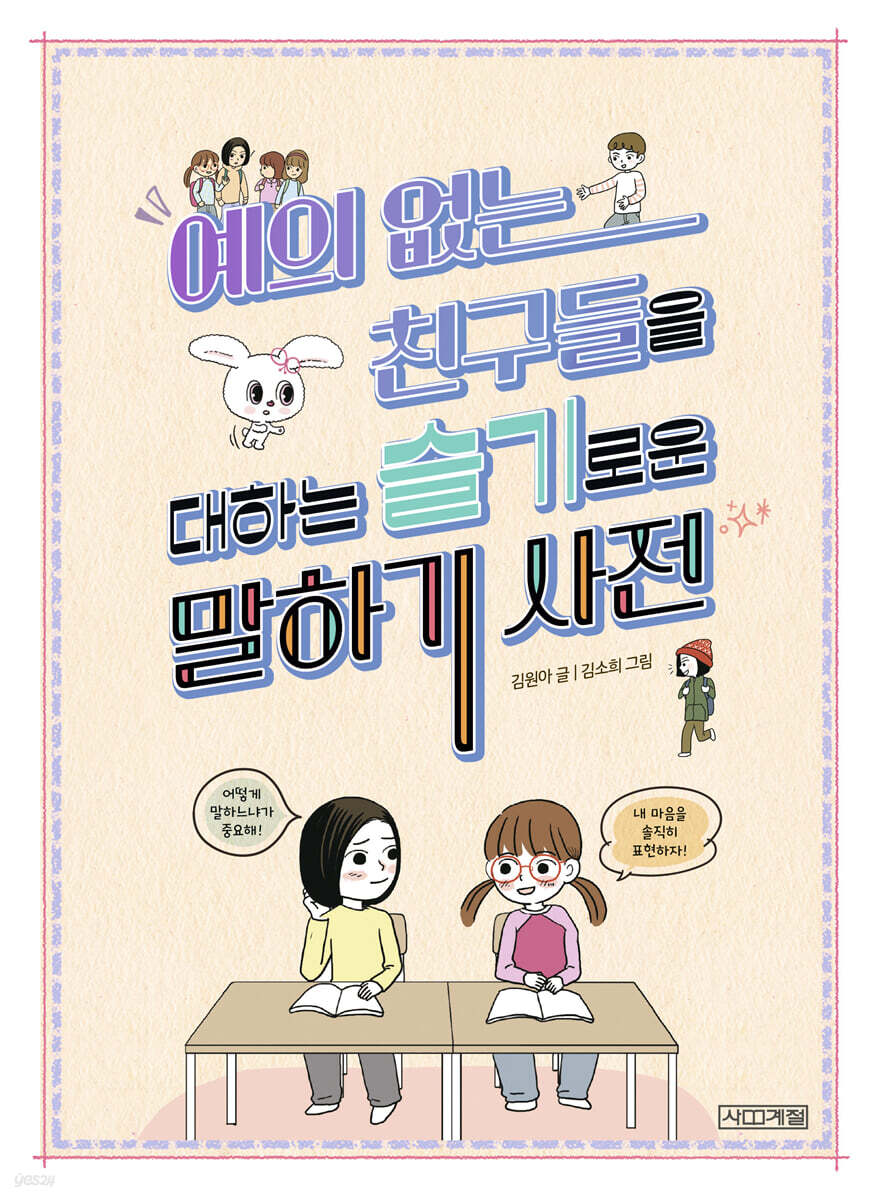
A Dictionary of Smart Phrases for Dealing with Rude Friends
 |
Description
Book Introduction
Human relationships are difficult even for adults, and it can be said that they begin in elementary school. In elementary school, many difficult situations arise among friends who are not yet accustomed to social life. A friend who asks me to return something I gave him as a gift, a friend who loses something of his own and then suspects me, a friend who nags me because I lost a game, etc. In higher grades, situations arise that can lead to school violence. Wouldn't it be better if we could express our intentions more politely and learn how to handle crisis situations without offending others? This is a practical guide to human relations for children, helping them wisely maintain their self-esteem and navigate the various situations they encounter at school. |
- You can preview some of the book's contents.
Preview
index
Practice_Speak Wisely!
[During class]
1.
10 When Your Friend Is Insistent That His Opinion Is Right
2.
12 When Your Friend Keeps Making You Do Things You Don't Want to Do
3.
When a friend does a group activity carelessly 14
4.
When you lose a match and you blame yourself 16
5.
18 When I ignore the picture I drew
6.
20 When your friends are talking next to you during class
[About the item]
7.
22 When you keep borrowing my stuff
8.
23 When you ask to borrow something you don't want to lend
9.
24 When someone takes my stuff without permission
10.
25 When you borrow something and don't return it
11.
26 When I return something I borrowed without permission
12.
28 When a friend asks you to return a gift you gave him
13.
When you ask to borrow money again without paying it back 30
14.
When you keep asking for something delicious 31
15.
32 When your friend has the exact same item you lost
16.
34 When a friend loses something and suspects me
[Getting to know each other]
17.
36 When you want to join your friends' conversation
18.
When you envy your friends 38
19.
40 When You Feel Distant from Your Friends
20.
When your friend who is alone looks lonely 42
21.
When we decided to play together but our opinions differ 44
22.
46 When you want to help a friend who seems to be struggling
23.
48 When a friend compliments me
24.
50 When Your Friend Seems to Be in a Bad Mood
Apologize
25.
52 When you fight with a friend and want to apologize first
26.
53 When Your Friend Doesn't Accept Your Apology
27.
54 When You're Still Angry Even After Your Friend's Apology
28.
56 When you make a mistake
[Reject]
29.
When your friends recommend you run for president, but you don't want to run 58
30.
When I play dodgeball and my friend who is good at it asks for the ball I got, 60
31.
62 When your friend keeps asking you difficult questions
32.
64 When you want to refuse an unreasonable request
33.
When a friend offers to help but you want to do it yourself 66
34.
68 When you receive a confession and want to reject it
[Make a promise]
35.
70 When a friend suddenly cancels a date
36.
72 When I Broke My Promise
37.
74 When you want to change an appointment
38.
76 When you want to decline a friend's unilateral invitation
[Conflict Resolution]
39.
78 When a friend who lost a match picks a fight
40.
80 when you interrupt while I'm talking
41.
When a friend tells you he's going to tell you 82
42.
84 When you leave your work to me
43.
I didn't do well on the test, but my friend was trying to get me to score 86.
44.
88 When you don't follow the rules while playing
45.
90 When my friend told my secret
46.
92 When we bumped into each other in the hallway
47.
When you lose your temper over something trivial 94
48.
96 when my friend was a thief
49.
98 When your friend talks about himself all the time
50.
100 When a friend does something wrong and I make excuses
51.
102 When a friend meddles in my work and nags me
52.
104 When a friend asks you to do something bad with him
53.
When my friends laugh while telling my story, I feel bad 106
[School Violence]
54.
108 When evaluating my appearance
55.
110 When a friend tells another friend not to play with him
56.
When you suddenly pretend not to hear me, dial 112
57.
When you single out a friend and tell them not to play 114
58.
116 When someone talks to you in a chat room without you
59.
When you glance at me and whisper in my ear 118
60.
When a friend upsets you and then tries to cover it up by saying it was a joke 120
61.
When you keep ignoring my words not to do it 122
62.
124 When I found out my friend was talking bad about me behind my back
Guide_What is speaking wisely?
1.
The Importance of Speaking Wisely 128
2.
What does it mean to speak wisely? 130
3.
Listening Wisely 132
4.
Thinking Wisely 133
5.
How to Speak Wisely 134
6.
When to Stop Speaking Wisely 136
7.
Praise the Wise You 138
[During class]
1.
10 When Your Friend Is Insistent That His Opinion Is Right
2.
12 When Your Friend Keeps Making You Do Things You Don't Want to Do
3.
When a friend does a group activity carelessly 14
4.
When you lose a match and you blame yourself 16
5.
18 When I ignore the picture I drew
6.
20 When your friends are talking next to you during class
[About the item]
7.
22 When you keep borrowing my stuff
8.
23 When you ask to borrow something you don't want to lend
9.
24 When someone takes my stuff without permission
10.
25 When you borrow something and don't return it
11.
26 When I return something I borrowed without permission
12.
28 When a friend asks you to return a gift you gave him
13.
When you ask to borrow money again without paying it back 30
14.
When you keep asking for something delicious 31
15.
32 When your friend has the exact same item you lost
16.
34 When a friend loses something and suspects me
[Getting to know each other]
17.
36 When you want to join your friends' conversation
18.
When you envy your friends 38
19.
40 When You Feel Distant from Your Friends
20.
When your friend who is alone looks lonely 42
21.
When we decided to play together but our opinions differ 44
22.
46 When you want to help a friend who seems to be struggling
23.
48 When a friend compliments me
24.
50 When Your Friend Seems to Be in a Bad Mood
Apologize
25.
52 When you fight with a friend and want to apologize first
26.
53 When Your Friend Doesn't Accept Your Apology
27.
54 When You're Still Angry Even After Your Friend's Apology
28.
56 When you make a mistake
[Reject]
29.
When your friends recommend you run for president, but you don't want to run 58
30.
When I play dodgeball and my friend who is good at it asks for the ball I got, 60
31.
62 When your friend keeps asking you difficult questions
32.
64 When you want to refuse an unreasonable request
33.
When a friend offers to help but you want to do it yourself 66
34.
68 When you receive a confession and want to reject it
[Make a promise]
35.
70 When a friend suddenly cancels a date
36.
72 When I Broke My Promise
37.
74 When you want to change an appointment
38.
76 When you want to decline a friend's unilateral invitation
[Conflict Resolution]
39.
78 When a friend who lost a match picks a fight
40.
80 when you interrupt while I'm talking
41.
When a friend tells you he's going to tell you 82
42.
84 When you leave your work to me
43.
I didn't do well on the test, but my friend was trying to get me to score 86.
44.
88 When you don't follow the rules while playing
45.
90 When my friend told my secret
46.
92 When we bumped into each other in the hallway
47.
When you lose your temper over something trivial 94
48.
96 when my friend was a thief
49.
98 When your friend talks about himself all the time
50.
100 When a friend does something wrong and I make excuses
51.
102 When a friend meddles in my work and nags me
52.
104 When a friend asks you to do something bad with him
53.
When my friends laugh while telling my story, I feel bad 106
[School Violence]
54.
108 When evaluating my appearance
55.
110 When a friend tells another friend not to play with him
56.
When you suddenly pretend not to hear me, dial 112
57.
When you single out a friend and tell them not to play 114
58.
116 When someone talks to you in a chat room without you
59.
When you glance at me and whisper in my ear 118
60.
When a friend upsets you and then tries to cover it up by saying it was a joke 120
61.
When you keep ignoring my words not to do it 122
62.
124 When I found out my friend was talking bad about me behind my back
Guide_What is speaking wisely?
1.
The Importance of Speaking Wisely 128
2.
What does it mean to speak wisely? 130
3.
Listening Wisely 132
4.
Thinking Wisely 133
5.
How to Speak Wisely 134
6.
When to Stop Speaking Wisely 136
7.
Praise the Wise You 138
Detailed image
.jpg)
Publisher's Review
A society of children that adults seem unaware of
“That’s nothing.”, “Why is something like that so hard?” Having already grown up and become adults, we are largely indifferent to children’s suffering.
However, there are still so many difficult things for young friends who have entered full-fledged social life with the label of elementary school student.
This is because we are in the process of socializing and learning manners through direct encounters with various situations.
There are many conflict situations that arise between friends, such as a child asking for something given to them as a gift back, a child who loses something and becomes suspicious of others, and there is a high probability that they will be exposed to rough and violent situations, such as comments about their appearance, hateful remarks, and excessive pranks, such as “Are you a girl or a boy?” or “Your mom is a kimchi stew master.”
This trend is accelerating as the age of access to unrefined media content is lowering.
Human relationships are difficult!
But it's not just children who find this situation difficult.
Parents are also at a loss as to how to help or guide their children when they are faced with an embarrassing situation, and whether it is a situation that requires discussion with the homeroom teacher.
In line with the trends and demands of the times, Sageseul Publishing Co., Ltd. has published a practical book on human relations for children, 『Wise Speaking Dictionary for Dealing with Rude Friends』, which helps children wisely maintain their self-esteem and live wisely in society in the various situations they encounter at school.
Wise speaking suggestions and mindset guide from a current elementary school teacher!
"A Dictionary of Wise Talking to Deal with Rude Friends" is a book written by Won-ah Kim, an elementary school teacher who has observed elementary school students for a long time and up close.
The teacher shows various examples of conflicts he has experienced or encountered while guiding students.
And I offer comfort to students who have experienced or may experience similar situations, and suggest ways to speak wisely without offending others while still preserving my self-esteem.
After indirectly encountering the various situations in "A Dictionary of Wise Talk to Deal with Rude Friends," wouldn't you be able to feel a little more at ease when unexpectedly facing an embarrassing situation? Wouldn't it be better to learn how to express your feelings politely and handle crisis situations in advance without offending others? I hope that with "A Dictionary of Wise Talk to Deal with Rude Friends," you can navigate this period of growth more wisely and intelligently.
Features of this book
Warm and to-the-point advice from a current elementary school teacher.
Kim Won-ah, the author of this book, is a veteran elementary school teacher with countless and diverse experiences working with children.
Through a survey, we collected the concerns that elementary school students are actually experiencing these days.
And he did not spare his support, encouragement, and realistic advice for those concerned.
Throughout the case, the valuable message that we must start by loving and caring for ourselves is never forgotten.
Supporting children's growth!
"A Dictionary of Wise Words for Dealing with Rude Friends" provides guidance without missing even the most trivial examples.
Through this book, readers will encounter various examples of conflict and realize that these conflicts are not caused by their own fault, nor are they unique to them, but are something that everyone naturally experiences.
Just being aware of that fact is quite comforting.
I encourage children to grow up with a more stable emotional foundation.
Reflection on the reality of transitional growth
Children are in the process of growing up.
As we develop social skills, we sometimes hurt others and sometimes get hurt by others.
It's not just one person giving, it's a reciprocal exchange.
To reflect this reality, the characters that drive the story were not divided into good and bad characters.
A sophisticated and practical approach
“You should have told the teacher in that case!” Stop the after-the-fact guidance.
It provides a basic guide to determining whether this problem is something that children can solve among themselves or whether it requires intervention by a teacher or adult.
With "Wise Talking Dictionary for Dealing with Rude Friends," you can expect to respond more wisely and practically to embarrassing situations.
“That’s nothing.”, “Why is something like that so hard?” Having already grown up and become adults, we are largely indifferent to children’s suffering.
However, there are still so many difficult things for young friends who have entered full-fledged social life with the label of elementary school student.
This is because we are in the process of socializing and learning manners through direct encounters with various situations.
There are many conflict situations that arise between friends, such as a child asking for something given to them as a gift back, a child who loses something and becomes suspicious of others, and there is a high probability that they will be exposed to rough and violent situations, such as comments about their appearance, hateful remarks, and excessive pranks, such as “Are you a girl or a boy?” or “Your mom is a kimchi stew master.”
This trend is accelerating as the age of access to unrefined media content is lowering.
Human relationships are difficult!
But it's not just children who find this situation difficult.
Parents are also at a loss as to how to help or guide their children when they are faced with an embarrassing situation, and whether it is a situation that requires discussion with the homeroom teacher.
In line with the trends and demands of the times, Sageseul Publishing Co., Ltd. has published a practical book on human relations for children, 『Wise Speaking Dictionary for Dealing with Rude Friends』, which helps children wisely maintain their self-esteem and live wisely in society in the various situations they encounter at school.
Wise speaking suggestions and mindset guide from a current elementary school teacher!
"A Dictionary of Wise Talking to Deal with Rude Friends" is a book written by Won-ah Kim, an elementary school teacher who has observed elementary school students for a long time and up close.
The teacher shows various examples of conflicts he has experienced or encountered while guiding students.
And I offer comfort to students who have experienced or may experience similar situations, and suggest ways to speak wisely without offending others while still preserving my self-esteem.
After indirectly encountering the various situations in "A Dictionary of Wise Talk to Deal with Rude Friends," wouldn't you be able to feel a little more at ease when unexpectedly facing an embarrassing situation? Wouldn't it be better to learn how to express your feelings politely and handle crisis situations in advance without offending others? I hope that with "A Dictionary of Wise Talk to Deal with Rude Friends," you can navigate this period of growth more wisely and intelligently.
Features of this book
Warm and to-the-point advice from a current elementary school teacher.
Kim Won-ah, the author of this book, is a veteran elementary school teacher with countless and diverse experiences working with children.
Through a survey, we collected the concerns that elementary school students are actually experiencing these days.
And he did not spare his support, encouragement, and realistic advice for those concerned.
Throughout the case, the valuable message that we must start by loving and caring for ourselves is never forgotten.
Supporting children's growth!
"A Dictionary of Wise Words for Dealing with Rude Friends" provides guidance without missing even the most trivial examples.
Through this book, readers will encounter various examples of conflict and realize that these conflicts are not caused by their own fault, nor are they unique to them, but are something that everyone naturally experiences.
Just being aware of that fact is quite comforting.
I encourage children to grow up with a more stable emotional foundation.
Reflection on the reality of transitional growth
Children are in the process of growing up.
As we develop social skills, we sometimes hurt others and sometimes get hurt by others.
It's not just one person giving, it's a reciprocal exchange.
To reflect this reality, the characters that drive the story were not divided into good and bad characters.
A sophisticated and practical approach
“You should have told the teacher in that case!” Stop the after-the-fact guidance.
It provides a basic guide to determining whether this problem is something that children can solve among themselves or whether it requires intervention by a teacher or adult.
With "Wise Talking Dictionary for Dealing with Rude Friends," you can expect to respond more wisely and practically to embarrassing situations.
GOODS SPECIFICS
- Date of issue: January 13, 2022
- Page count, weight, size: 140 pages | 254g | 153*210*9mm
- ISBN13: 9791160948929
- ISBN10: 1160948925
You may also like
카테고리
korean


korean

![ELLE 엘르 스페셜 에디션 A형 : 12월 [2025]](http://librairie.coreenne.fr/cdn/shop/files/b8e27a3de6c9538896439686c6b0e8fb.jpg?v=1766436872&width=3840)


