

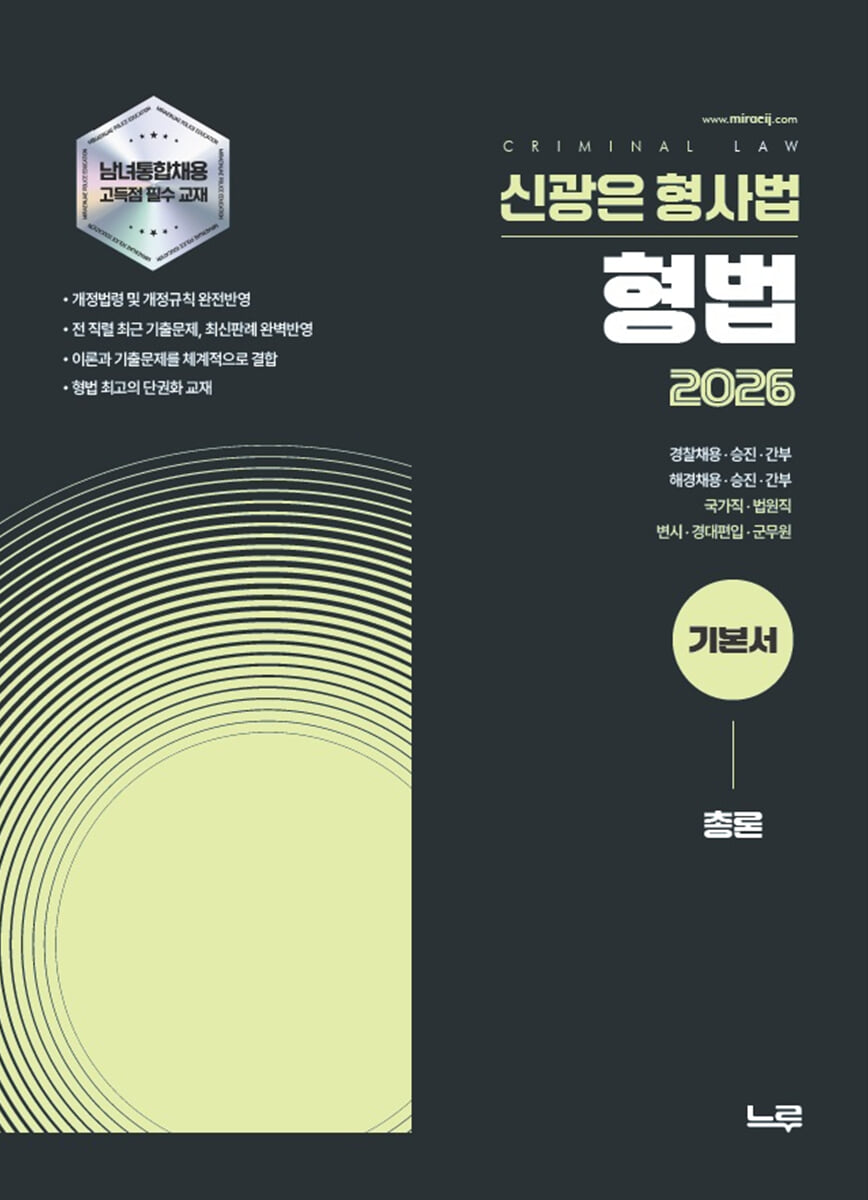
2026 Shin Gwang-eun Criminal Law General Theory Basic Book
 |
Description
Book Introduction
[Essential textbook for achieving high scores in integrated recruitment]
- Full reflection of revised laws and regulations
- Fully reflects the latest exam questions and case law from previous series
- Systematically combine theory and past exam questions
- The best single-volume criminal law textbook
- Full reflection of revised laws and regulations
- Fully reflects the latest exam questions and case law from previous series
- Systematically combine theory and past exam questions
- The best single-volume criminal law textbook
- You can preview some of the book's contents.
Preview
index
Part 1: Introduction
Chapter 1: Basic Concepts of Criminal Law 3
Section 1. Significance of Criminal Law 3
Ⅰ.
Criminal Law Concept 3
Ⅱ.
Criminal law in the formal sense and criminal law in the substantive sense 3
Section 2 Status and Character of Criminal Law 3
Ⅰ.
Status of Criminal Law in the Legal System 3
Ⅱ.
The nature of criminal law 3
Section 3 Functions of Criminal Law 4
Ⅰ.
Function of Criminal Law 4
Ⅱ.
Dangerous Crimes Act 5
Chapter 2 Criminal Law Theory 6
Section 1: Criminal Theory 6
Section 2: Theory of Punishment 7
Section 3 Criminal Law School 8
Section 4: Criminal System Theory 8
Chapter 3: The Principle of Legality 10
Section 1: Significance and Function 10
Section 2 Contents of the Principle of Legality 10
Ⅰ.
Legalism (the principle of written law, prohibition of customary criminal law) 11
Ⅱ.
Principle of Clarity 15
Ⅲ.
Principle of Appropriateness 19
Ⅳ.
Principle 20 of Prohibition of Analogical Interpretation
V.
Principle of Prohibition of Retroactive Effect (Principle of Prohibition of Retroactive Legislation) 41
Chapter 4 Scope of Application of Criminal Law 49
Section 1 Temporal Scope 49
Ⅰ.
Act-time Principle and Trial-time Principle 49
Ⅱ.
Article 1, Paragraph 1 (Application of Old Law, Application of Act-Time Law, Recognition of Retroactive Effect) 49
Ⅲ.
Article 1, Paragraph 2 (Application of new law, application of trial law, recognition of retroactive effect) 50
Ⅳ.
Article 1, Paragraph 3, Clause 55
V.
Article 1, Paragraphs 2 and 3, Exclusions 55
Ⅵ.
Limited Time Act 57
Ⅶ.
Blank Criminal Law 58
Section 2: Scope of application 58
Ⅰ.
Legislative 58
Ⅱ.
Principle of Territoriality 59
Ⅲ.
Supplement 60 by the principle of deception
Ⅳ.
61 Supplement by Protectionism
V.
Globalism 63
Ⅵ.
The effect of execution of sentences received abroad 63
Section 3 Scope of application to persons 65
Ⅰ.
Principle 65
Ⅱ.
Exception to Personal Scope 65
Section 4 Scope of Application of General Provisions of the Criminal Act 66
Part 2: Criminology
Chapter 1: Foundations of Criminology 69
Section 1. Meaning and Elements of Crime 69
Ⅰ.
The Meaning of Crime 69
Ⅱ.
Components of the Formal Concept of Crime 69
Section 2 Elements of a Crime 69
Ⅰ.
Elements of a crime 69
Section 3 Conditions for Punishment and Prosecution 71
Ⅰ.
Punishment Condition 71
Ⅱ.
Prosecution Conditions (Litigation Conditions) 72
Section 4 Types of Crimes 72
Chapter 2: Theory of Action 77
Section 1: The Significance and Function of the Theory of Action 77
Ⅰ.
Meaning 77
Ⅱ.
Function 77
Section 2: Theory of Action 77
Ⅰ.
Types of Actualism 77
Ⅱ.
Criminal Act 78
Chapter 3: Theory of Composition 79
Section 1 General Theory of Composition Elements 79
Ⅰ.
The significance of the constituent elements 79
Ⅱ.
The Relationship Between Elements of Crime and Illegality 79
Ⅲ.
Element 81 of the composition requirement
Ⅳ.
Classification of components 81
Section 2 Subject of the Act (Criminal Capacity of a Corporation) 82
Ⅰ.
Subject of Action 82
Ⅱ.
Criminal Capacity of Corporations 82
Ⅲ.
The criminal capacity of a corporation 83
Ⅳ.
Punishment Regulation 84
Section 3 Objects of Acts and Objects of Protection 90
Ⅰ.
Object of Action 90
Ⅱ.
Object of Protection 90
Ⅲ.
Distinction 90
Section 4: Offenses of Omission 91
Ⅰ.
Meaning 91
Ⅱ.
Offenses of omission and negligence 93
Ⅲ.
Requirements for the crime of omission 94
Ⅳ.
The Equivalence of the Offense of a Negative Government Act 96
V.
Related Issue 103
Section 5: Causality and Objective Attribution 106
Ⅰ.
The Meaning of Causality 106
Ⅱ.
Theory of Causality 106
Ⅲ.
Objective Attribution Theory (Legitimate Conditionalism) 108
Ⅳ.
Types of Causality (Legally Conditional Theory and Objective Attribution Theory) 109
V.
Whether or not causality is recognized (case law) 110
Section 6 Elements of Intent 117
Ⅰ.
Introduction 117
Ⅱ.
Systematic status of intention 118
Ⅲ.
The Existence and Proof of Intention 118
Ⅳ.
Intentional Content 119
V.
Type 121 of Intention
Ⅵ.
Intentional Recognition (Case Law) 122
Section 7: Elementary Errors 125
Ⅰ.
The Meaning of Mistake in Criminal Law 125
Ⅱ.
The significance and scope of application of constitutive errors 126
Ⅲ.
Type 126 of Constitutive Errors
Ⅳ.
Criminal Code Provisions on Constitutive Mistakes (Article 15, Paragraph 1) 127
V.
Resolution (non-compliance) in cases where Article 15, Paragraph 1 does not apply 128
Ⅵ.
Related Issue 134
Section 8 Negligence 136
Ⅰ.
Meaning 136
Ⅱ.
Types of Fruit 137
Ⅲ.
Elements of a Negligence Crime 140
Ⅳ.
Limitation Principle of Objective Duty of Care 147
V.
Illegalities and Responsibilities 152
Ⅵ.
Related Issue 152
Section 9. Consequential Aggravation of Crime 153
Ⅰ.
Introduction 153
Ⅱ.
Requirements for the establishment of a consequential aggravated crime 154
Ⅲ.
True and false consequential aggravated crimes (types) 156
Ⅳ.
157 prisoners convicted of aggravated felony offenses
V.
Related Issue 159
Chapter 4: Theory of Illegality 162
Section 1 General Theory of Illegality 162
Section 2 Illegal 163
Ⅰ.
Consequences and Acts (Illegal Consequences and Illegal Acts) 163
II. The Nature of Illegality 164
Section 3. Reasons for Excluding Illegality 165
Ⅰ.
Reason for exclusion of illegality 165
Ⅱ.
The Need for Subjective Justification Elements 165
Ⅲ.
Effects of Lack of Subjective Justification Elements (Intentional Accidental Defense) 166
Ⅳ.
Effects of Lack of Subjective Justification Elements (Negligence and Accidental Defense) 168
Section 4 Self-Defense 169
Ⅰ.
Meaning 169
Ⅱ.
Reason 169
Ⅲ.
Establishment requirements 170
Ⅳ.
Excessive Defense 177
V.
180 Over- and Over-direction
Section 5 Emergency Evacuation 180
Ⅰ.
Significance and Basis 180
Ⅱ.
The Essence of Emergency Evacuation 181
Ⅲ.
Requirements for Emergency Evacuation 182
Ⅳ.
Special provisions (restrictions) for emergency evacuation 185
V.
Excessive and Misplaced Evacuation 186
Ⅵ.
Conflict of Duties 186
Section 6 Self-help Act 188
Ⅰ.
Meaning 188
Ⅱ.
Establishment requirements 188
Ⅲ.
Excessive and Misdirected Self-Rescue 191
Section 7: Victim's Consent 192
Ⅰ.
Meaning 192
Ⅱ.
Understanding (Component Fragment) 192
Ⅲ.
Victim's consent 194
Ⅳ.
Presumptive Consent 197
Section 8 Legitimate Acts 198
Ⅰ.
Meaning 198
Ⅱ.
Acts by Law 198
Ⅲ.
Work-related acts 204
Ⅳ.
Other acts that do not violate social norms 205
Chapter 5: Responsibility 215
Section 1 Theory of Liability 215
Ⅰ.
Responsibility and Accountability 215
Ⅱ.
Basis of Responsibility 216
Ⅲ.
The Nature of Responsibility 217
Section 2 Capacity for Responsibility 219
Ⅰ.
Meaning 219
Ⅱ.
Method of determining responsibility capacity 219
Ⅲ.
Persons incapable of responsibility (minors and persons with mental incapacity) 219
Ⅳ.
Persons with limited liability (mentally and physically impaired persons and deaf and dumb persons) 225
V.
Special Act Restrictions 226
Section 3: Free Actions in Cause 227
Ⅰ.
Meaning 227
Ⅱ.
The subject of the problem (relationship with responsibility) 227
Ⅲ.
Theory of Punishment 228
Ⅳ.
Interpretation of Article 10, Paragraph 3 of the Criminal Act 230
V.
Type 230
Section 4 Recognition of Illegality 232
Meaning 232
Systematic Status of Illegality Recognition 232
Section 5 Errors of Law (Prohibited Errors) 234
Ⅰ.
Meaning 234
Ⅱ.
Types of Legal Mistakes 234
Ⅲ.
Interpretation of Article 16 235
Ⅳ.
Mistake regarding the prerequisite facts for the grounds for exemption from illegality 245
Section 6: Expected Possibilities 249
Ⅰ.
Meaning 249
Ⅱ.
The Status and Function of Expectancy 249
Ⅲ.
Criteria for Judging Expectation Possibility 250
Ⅳ.
Reasons for exemption from liability due to impossibility of expectation 252
V.
Forced Act 252
Chapter 6: Theory of Numbers 256
Section 1 General Theory of Attempted Crimes 256
Ⅰ.
Stage 256 of the crime
Ⅱ.
Grounds for Punishment of Attempted Crimes 256
Section 2: Preparatory and Conspiracy Crimes 257
Ⅰ.
Meaning 257
Ⅱ.
Legal nature and enforceability 257
Ⅲ.
Establishment requirements 259
Ⅳ.
Related Issue 261
Section 3 Attempted Disability 262
Ⅰ.
Meaning 262
Ⅱ.
Establishment requirements 262
Ⅲ.
Punishment 266
Ⅳ.
Related Issue 268
Section 4 Attempted Suspension 269
Ⅰ.
Meaning 269
Ⅱ.
Legal nature (basis for necessary reduction) 269
Ⅲ.
Requirements for the Establishment of an Attempted Crime 269
Ⅳ.
Punishment for attempted murder 273
V.
Related Issue 273
Section 5 Impossible Attempt 275
Ⅰ.
Meaning 275
Ⅱ.
Establishment requirements 276
Ⅲ.
Punishment for attempted crimes 282
Ⅳ.
Related Issue 283
Chapter 7: Theory of Complicity 284
Section 1: General Theory of Accomplices 284
Ⅰ.
Criminal Participation Type 284
Ⅱ.
Necessary Accomplice 285
Ⅲ.
Voluntary Accomplice 288
Section 2: Accomplices 293
Ⅰ.
Meaning 293
Ⅱ.
The Nature of Joint Offenders (The Meaning of Joint) 294
Ⅲ.
Establishment requirements 294
Ⅳ.
Issues related to joint execution 298
V.
Issues Related to Joint Execution 302
Ⅵ.
Punishment of Accomplices 307
Section 3 Joint and Concurrent Offenders 308
Ⅰ.
Joint Crime 308
Ⅱ.
Simultaneous Offender 311
Section 4 Indirect Perpetrators 315
Ⅰ.
Meaning 315
Ⅱ.
Establishment Requirements 316
Ⅲ.
Punishment 318
Ⅳ.
Indirect Principal Offenders and Mistakes 318
V.
Limits of indirect perpetrators 319
Ⅵ.
Special Education Teacher/Assistant 320
Section 5: Teacher's Crime 321
Ⅰ.
Meaning 321
Ⅱ.
Establishment Requirements 321
Ⅲ.
Punishment of Teacher Offenders 326
Ⅳ.
Teacher's Attempt 327
V.
Teacher's Mistake 328
Section 6: Accessories (Aiding and Abetting) 330
Ⅰ.
Meaning 330
Ⅱ.
Establishment Requirements 331
Ⅲ.
Punishment of accomplices 336
Ⅳ.
Jongbeom's Mistake 337
V.
Related Issue 338
Section 7: Accomplices and Status 339
Ⅰ.
Meaning 339
Ⅱ.
The Meaning and Types of Status 339
Ⅲ.
Interpretation of Article 33 340
Ⅳ.
Application of Article 33 341
V.
Article 33 Application Effect 344
Ⅵ.
Passive Status and Accomplice 347
Part 3: Prisoners and Punishment
Chapter 1: Prisoner Theory 351
Section 1 General Theory of Prisoners 351
Ⅰ.
The Significance of Prisoner Theory 351
Ⅱ.
Criteria for Prisoner Decisions 351
Section 2: One Sin 354
Ⅰ.
Meaning 354
Ⅱ.
Legal Affairs Competition 354
Ⅲ.
Comprehensive Crime 363
Section 3: Crimes 376
Ⅰ.
Imaginary Competition 376
Ⅱ.
Substantive Conflict 387
Chapter 2: Theory of Punishment 395
Section 1: The Meaning and Types of Punishment 395
Ⅰ.
Meaning 395
Ⅱ.
Death Penalty 395
Ⅲ.
Freestyle 396
Ⅳ.
Honorary Type 397
V.
Property-type (fines, penalties, confiscation) 398
Ⅵ.
My brother's severity level 410
Section 2: The Type of the Elderly 411
Ⅰ.
Meaning 411
Ⅱ.
Brother's Sentence Increase/Decrease 411
Ⅲ.
Brother's Gagamrye 413
Ⅳ.
Yanghyeong (Hyeong's Yangjeong) 415
Section 3 Exemption from punishment 415
Section 4: Pre-sentence detention and public announcement of the verdict 416
Section 5: Self-Confession and Self-Confession 417
Ⅰ.
Meaning 417
Ⅱ.
Timing and Method 417
Section 6 Repeat Offenders 419
Ⅰ.
Meaning 419
Ⅱ.
Repeated Offenders and Accountability 419
Ⅲ.
Repeat Offender Aggravated Requirements 420
Ⅳ.
The Effects of Repeat Offenders 423
V.
Discovery of a repeat offender after sentencing (Article 36) 423
Ⅵ.
Repeat offender 424 under the Act on the Aggravated Punishment, etc. of Specific Crimes
Section 7 Suspended Sentence 424
Ⅰ.
Meaning 424
Ⅱ.
Requirements for Suspended Sentence 425
Ⅲ.
The Effects of Suspended Sentence 426
Ⅳ.
Lapse of suspended sentence 427
Section 8 Suspended Sentence 428
Ⅰ.
Meaning 428
Ⅱ.
Requirements for Probation 428
Ⅲ.
The Effects of Probation 430
Ⅳ.
Lapse and Cancellation of Probation 433
Section 9 Parole 435
Ⅰ.
Meaning 435
Ⅱ.
Requirements for Parole 435
Ⅲ.
The Effects of Parole 436
Ⅳ.
Lapse and Cancellation 436
Section 10: Prescription, Expiration, and Duration of Punishment 437
Ⅰ.
Statute of limitations for brother 437
Ⅱ.
The Disappearance of My Brother 438
Ⅲ.
Brother's period 440
Section 11 Security Measures 441
Ⅰ.
Meaning 441
Ⅱ.
Distinction from Punishment 441
Ⅲ.
Types of Security Measures 441
Ⅳ.
Relationship with Punishment 441
V.
Security measures under current law 442
Appendix Supplementary Case Law / 443
Chapter 1: Basic Concepts of Criminal Law 3
Section 1. Significance of Criminal Law 3
Ⅰ.
Criminal Law Concept 3
Ⅱ.
Criminal law in the formal sense and criminal law in the substantive sense 3
Section 2 Status and Character of Criminal Law 3
Ⅰ.
Status of Criminal Law in the Legal System 3
Ⅱ.
The nature of criminal law 3
Section 3 Functions of Criminal Law 4
Ⅰ.
Function of Criminal Law 4
Ⅱ.
Dangerous Crimes Act 5
Chapter 2 Criminal Law Theory 6
Section 1: Criminal Theory 6
Section 2: Theory of Punishment 7
Section 3 Criminal Law School 8
Section 4: Criminal System Theory 8
Chapter 3: The Principle of Legality 10
Section 1: Significance and Function 10
Section 2 Contents of the Principle of Legality 10
Ⅰ.
Legalism (the principle of written law, prohibition of customary criminal law) 11
Ⅱ.
Principle of Clarity 15
Ⅲ.
Principle of Appropriateness 19
Ⅳ.
Principle 20 of Prohibition of Analogical Interpretation
V.
Principle of Prohibition of Retroactive Effect (Principle of Prohibition of Retroactive Legislation) 41
Chapter 4 Scope of Application of Criminal Law 49
Section 1 Temporal Scope 49
Ⅰ.
Act-time Principle and Trial-time Principle 49
Ⅱ.
Article 1, Paragraph 1 (Application of Old Law, Application of Act-Time Law, Recognition of Retroactive Effect) 49
Ⅲ.
Article 1, Paragraph 2 (Application of new law, application of trial law, recognition of retroactive effect) 50
Ⅳ.
Article 1, Paragraph 3, Clause 55
V.
Article 1, Paragraphs 2 and 3, Exclusions 55
Ⅵ.
Limited Time Act 57
Ⅶ.
Blank Criminal Law 58
Section 2: Scope of application 58
Ⅰ.
Legislative 58
Ⅱ.
Principle of Territoriality 59
Ⅲ.
Supplement 60 by the principle of deception
Ⅳ.
61 Supplement by Protectionism
V.
Globalism 63
Ⅵ.
The effect of execution of sentences received abroad 63
Section 3 Scope of application to persons 65
Ⅰ.
Principle 65
Ⅱ.
Exception to Personal Scope 65
Section 4 Scope of Application of General Provisions of the Criminal Act 66
Part 2: Criminology
Chapter 1: Foundations of Criminology 69
Section 1. Meaning and Elements of Crime 69
Ⅰ.
The Meaning of Crime 69
Ⅱ.
Components of the Formal Concept of Crime 69
Section 2 Elements of a Crime 69
Ⅰ.
Elements of a crime 69
Section 3 Conditions for Punishment and Prosecution 71
Ⅰ.
Punishment Condition 71
Ⅱ.
Prosecution Conditions (Litigation Conditions) 72
Section 4 Types of Crimes 72
Chapter 2: Theory of Action 77
Section 1: The Significance and Function of the Theory of Action 77
Ⅰ.
Meaning 77
Ⅱ.
Function 77
Section 2: Theory of Action 77
Ⅰ.
Types of Actualism 77
Ⅱ.
Criminal Act 78
Chapter 3: Theory of Composition 79
Section 1 General Theory of Composition Elements 79
Ⅰ.
The significance of the constituent elements 79
Ⅱ.
The Relationship Between Elements of Crime and Illegality 79
Ⅲ.
Element 81 of the composition requirement
Ⅳ.
Classification of components 81
Section 2 Subject of the Act (Criminal Capacity of a Corporation) 82
Ⅰ.
Subject of Action 82
Ⅱ.
Criminal Capacity of Corporations 82
Ⅲ.
The criminal capacity of a corporation 83
Ⅳ.
Punishment Regulation 84
Section 3 Objects of Acts and Objects of Protection 90
Ⅰ.
Object of Action 90
Ⅱ.
Object of Protection 90
Ⅲ.
Distinction 90
Section 4: Offenses of Omission 91
Ⅰ.
Meaning 91
Ⅱ.
Offenses of omission and negligence 93
Ⅲ.
Requirements for the crime of omission 94
Ⅳ.
The Equivalence of the Offense of a Negative Government Act 96
V.
Related Issue 103
Section 5: Causality and Objective Attribution 106
Ⅰ.
The Meaning of Causality 106
Ⅱ.
Theory of Causality 106
Ⅲ.
Objective Attribution Theory (Legitimate Conditionalism) 108
Ⅳ.
Types of Causality (Legally Conditional Theory and Objective Attribution Theory) 109
V.
Whether or not causality is recognized (case law) 110
Section 6 Elements of Intent 117
Ⅰ.
Introduction 117
Ⅱ.
Systematic status of intention 118
Ⅲ.
The Existence and Proof of Intention 118
Ⅳ.
Intentional Content 119
V.
Type 121 of Intention
Ⅵ.
Intentional Recognition (Case Law) 122
Section 7: Elementary Errors 125
Ⅰ.
The Meaning of Mistake in Criminal Law 125
Ⅱ.
The significance and scope of application of constitutive errors 126
Ⅲ.
Type 126 of Constitutive Errors
Ⅳ.
Criminal Code Provisions on Constitutive Mistakes (Article 15, Paragraph 1) 127
V.
Resolution (non-compliance) in cases where Article 15, Paragraph 1 does not apply 128
Ⅵ.
Related Issue 134
Section 8 Negligence 136
Ⅰ.
Meaning 136
Ⅱ.
Types of Fruit 137
Ⅲ.
Elements of a Negligence Crime 140
Ⅳ.
Limitation Principle of Objective Duty of Care 147
V.
Illegalities and Responsibilities 152
Ⅵ.
Related Issue 152
Section 9. Consequential Aggravation of Crime 153
Ⅰ.
Introduction 153
Ⅱ.
Requirements for the establishment of a consequential aggravated crime 154
Ⅲ.
True and false consequential aggravated crimes (types) 156
Ⅳ.
157 prisoners convicted of aggravated felony offenses
V.
Related Issue 159
Chapter 4: Theory of Illegality 162
Section 1 General Theory of Illegality 162
Section 2 Illegal 163
Ⅰ.
Consequences and Acts (Illegal Consequences and Illegal Acts) 163
II. The Nature of Illegality 164
Section 3. Reasons for Excluding Illegality 165
Ⅰ.
Reason for exclusion of illegality 165
Ⅱ.
The Need for Subjective Justification Elements 165
Ⅲ.
Effects of Lack of Subjective Justification Elements (Intentional Accidental Defense) 166
Ⅳ.
Effects of Lack of Subjective Justification Elements (Negligence and Accidental Defense) 168
Section 4 Self-Defense 169
Ⅰ.
Meaning 169
Ⅱ.
Reason 169
Ⅲ.
Establishment requirements 170
Ⅳ.
Excessive Defense 177
V.
180 Over- and Over-direction
Section 5 Emergency Evacuation 180
Ⅰ.
Significance and Basis 180
Ⅱ.
The Essence of Emergency Evacuation 181
Ⅲ.
Requirements for Emergency Evacuation 182
Ⅳ.
Special provisions (restrictions) for emergency evacuation 185
V.
Excessive and Misplaced Evacuation 186
Ⅵ.
Conflict of Duties 186
Section 6 Self-help Act 188
Ⅰ.
Meaning 188
Ⅱ.
Establishment requirements 188
Ⅲ.
Excessive and Misdirected Self-Rescue 191
Section 7: Victim's Consent 192
Ⅰ.
Meaning 192
Ⅱ.
Understanding (Component Fragment) 192
Ⅲ.
Victim's consent 194
Ⅳ.
Presumptive Consent 197
Section 8 Legitimate Acts 198
Ⅰ.
Meaning 198
Ⅱ.
Acts by Law 198
Ⅲ.
Work-related acts 204
Ⅳ.
Other acts that do not violate social norms 205
Chapter 5: Responsibility 215
Section 1 Theory of Liability 215
Ⅰ.
Responsibility and Accountability 215
Ⅱ.
Basis of Responsibility 216
Ⅲ.
The Nature of Responsibility 217
Section 2 Capacity for Responsibility 219
Ⅰ.
Meaning 219
Ⅱ.
Method of determining responsibility capacity 219
Ⅲ.
Persons incapable of responsibility (minors and persons with mental incapacity) 219
Ⅳ.
Persons with limited liability (mentally and physically impaired persons and deaf and dumb persons) 225
V.
Special Act Restrictions 226
Section 3: Free Actions in Cause 227
Ⅰ.
Meaning 227
Ⅱ.
The subject of the problem (relationship with responsibility) 227
Ⅲ.
Theory of Punishment 228
Ⅳ.
Interpretation of Article 10, Paragraph 3 of the Criminal Act 230
V.
Type 230
Section 4 Recognition of Illegality 232
Meaning 232
Systematic Status of Illegality Recognition 232
Section 5 Errors of Law (Prohibited Errors) 234
Ⅰ.
Meaning 234
Ⅱ.
Types of Legal Mistakes 234
Ⅲ.
Interpretation of Article 16 235
Ⅳ.
Mistake regarding the prerequisite facts for the grounds for exemption from illegality 245
Section 6: Expected Possibilities 249
Ⅰ.
Meaning 249
Ⅱ.
The Status and Function of Expectancy 249
Ⅲ.
Criteria for Judging Expectation Possibility 250
Ⅳ.
Reasons for exemption from liability due to impossibility of expectation 252
V.
Forced Act 252
Chapter 6: Theory of Numbers 256
Section 1 General Theory of Attempted Crimes 256
Ⅰ.
Stage 256 of the crime
Ⅱ.
Grounds for Punishment of Attempted Crimes 256
Section 2: Preparatory and Conspiracy Crimes 257
Ⅰ.
Meaning 257
Ⅱ.
Legal nature and enforceability 257
Ⅲ.
Establishment requirements 259
Ⅳ.
Related Issue 261
Section 3 Attempted Disability 262
Ⅰ.
Meaning 262
Ⅱ.
Establishment requirements 262
Ⅲ.
Punishment 266
Ⅳ.
Related Issue 268
Section 4 Attempted Suspension 269
Ⅰ.
Meaning 269
Ⅱ.
Legal nature (basis for necessary reduction) 269
Ⅲ.
Requirements for the Establishment of an Attempted Crime 269
Ⅳ.
Punishment for attempted murder 273
V.
Related Issue 273
Section 5 Impossible Attempt 275
Ⅰ.
Meaning 275
Ⅱ.
Establishment requirements 276
Ⅲ.
Punishment for attempted crimes 282
Ⅳ.
Related Issue 283
Chapter 7: Theory of Complicity 284
Section 1: General Theory of Accomplices 284
Ⅰ.
Criminal Participation Type 284
Ⅱ.
Necessary Accomplice 285
Ⅲ.
Voluntary Accomplice 288
Section 2: Accomplices 293
Ⅰ.
Meaning 293
Ⅱ.
The Nature of Joint Offenders (The Meaning of Joint) 294
Ⅲ.
Establishment requirements 294
Ⅳ.
Issues related to joint execution 298
V.
Issues Related to Joint Execution 302
Ⅵ.
Punishment of Accomplices 307
Section 3 Joint and Concurrent Offenders 308
Ⅰ.
Joint Crime 308
Ⅱ.
Simultaneous Offender 311
Section 4 Indirect Perpetrators 315
Ⅰ.
Meaning 315
Ⅱ.
Establishment Requirements 316
Ⅲ.
Punishment 318
Ⅳ.
Indirect Principal Offenders and Mistakes 318
V.
Limits of indirect perpetrators 319
Ⅵ.
Special Education Teacher/Assistant 320
Section 5: Teacher's Crime 321
Ⅰ.
Meaning 321
Ⅱ.
Establishment Requirements 321
Ⅲ.
Punishment of Teacher Offenders 326
Ⅳ.
Teacher's Attempt 327
V.
Teacher's Mistake 328
Section 6: Accessories (Aiding and Abetting) 330
Ⅰ.
Meaning 330
Ⅱ.
Establishment Requirements 331
Ⅲ.
Punishment of accomplices 336
Ⅳ.
Jongbeom's Mistake 337
V.
Related Issue 338
Section 7: Accomplices and Status 339
Ⅰ.
Meaning 339
Ⅱ.
The Meaning and Types of Status 339
Ⅲ.
Interpretation of Article 33 340
Ⅳ.
Application of Article 33 341
V.
Article 33 Application Effect 344
Ⅵ.
Passive Status and Accomplice 347
Part 3: Prisoners and Punishment
Chapter 1: Prisoner Theory 351
Section 1 General Theory of Prisoners 351
Ⅰ.
The Significance of Prisoner Theory 351
Ⅱ.
Criteria for Prisoner Decisions 351
Section 2: One Sin 354
Ⅰ.
Meaning 354
Ⅱ.
Legal Affairs Competition 354
Ⅲ.
Comprehensive Crime 363
Section 3: Crimes 376
Ⅰ.
Imaginary Competition 376
Ⅱ.
Substantive Conflict 387
Chapter 2: Theory of Punishment 395
Section 1: The Meaning and Types of Punishment 395
Ⅰ.
Meaning 395
Ⅱ.
Death Penalty 395
Ⅲ.
Freestyle 396
Ⅳ.
Honorary Type 397
V.
Property-type (fines, penalties, confiscation) 398
Ⅵ.
My brother's severity level 410
Section 2: The Type of the Elderly 411
Ⅰ.
Meaning 411
Ⅱ.
Brother's Sentence Increase/Decrease 411
Ⅲ.
Brother's Gagamrye 413
Ⅳ.
Yanghyeong (Hyeong's Yangjeong) 415
Section 3 Exemption from punishment 415
Section 4: Pre-sentence detention and public announcement of the verdict 416
Section 5: Self-Confession and Self-Confession 417
Ⅰ.
Meaning 417
Ⅱ.
Timing and Method 417
Section 6 Repeat Offenders 419
Ⅰ.
Meaning 419
Ⅱ.
Repeated Offenders and Accountability 419
Ⅲ.
Repeat Offender Aggravated Requirements 420
Ⅳ.
The Effects of Repeat Offenders 423
V.
Discovery of a repeat offender after sentencing (Article 36) 423
Ⅵ.
Repeat offender 424 under the Act on the Aggravated Punishment, etc. of Specific Crimes
Section 7 Suspended Sentence 424
Ⅰ.
Meaning 424
Ⅱ.
Requirements for Suspended Sentence 425
Ⅲ.
The Effects of Suspended Sentence 426
Ⅳ.
Lapse of suspended sentence 427
Section 8 Suspended Sentence 428
Ⅰ.
Meaning 428
Ⅱ.
Requirements for Probation 428
Ⅲ.
The Effects of Probation 430
Ⅳ.
Lapse and Cancellation of Probation 433
Section 9 Parole 435
Ⅰ.
Meaning 435
Ⅱ.
Requirements for Parole 435
Ⅲ.
The Effects of Parole 436
Ⅳ.
Lapse and Cancellation 436
Section 10: Prescription, Expiration, and Duration of Punishment 437
Ⅰ.
Statute of limitations for brother 437
Ⅱ.
The Disappearance of My Brother 438
Ⅲ.
Brother's period 440
Section 11 Security Measures 441
Ⅰ.
Meaning 441
Ⅱ.
Distinction from Punishment 441
Ⅲ.
Types of Security Measures 441
Ⅳ.
Relationship with Punishment 441
V.
Security measures under current law 442
Appendix Supplementary Case Law / 443
Publisher's Review
We have integrated the texts and theories, case law, and past exam questions into a single textbook.
First, Shin Kwang would like to express his sincere gratitude to the many test takers for their love and unstinting support, which has made the basic book Criminal Law (General Theory) truly the best textbook for the exam.
To repay the affection of test takers and live up to their expectations, we have included all the essential and crucial surveys and case law that are essential for accurate understanding and memorization, and to serve as a foundation for test takers' success as a helper who does not disgrace their expectations.
- Key features of "Shingwang's Basic Book of Criminal Law (General Provisions)"
1. Fully reflecting revised laws and regulations in accordance with changes in examination trends.
We have reflected all recent revisions to the criminal law, removed unnecessary content, and included changed or added content.
In addition, as the recent exam trend has been to ask more questions about legal provisions and rules, we have reflected not only revised criminal law laws and rules, but also previously tested legal provisions and rules, and even important laws and regulations that may be tested, so that you can sufficiently prepare without having to look at the laws separately.
2. Perfect reflection of the most recent past questions from the previous series
We have strived to make this a suitable textbook for test takers preparing for future exams by perfectly reflecting the existing questions for police recruitment and promotions before the reorganization, as well as the questions for court positions, prosecutorial positions, correctional positions, and protective positions.
3. Perfect reflection of the latest case law and previously published case law
We have included all the case law that appeared in the exams of all series, including the most recent exam, the latest case law that has been changed or added this year, and even case law that is likely to appear on the exam, so that you can sufficiently prepare for the exam with just the basic book without having to use a separate case law book.
4. By displaying icons for past exam passages and important questions, you can understand the exam trends and improve your ability to adapt to problems. Major past exam passages, important questions, and keywords are marked as Tips, and passages and keywords that are easy to fall into are marked as Caution, etc., so that you can see at a glance where the important parts and parts that are easy to make mistakes are, allowing you to understand the exam trends and improve your ability to adapt to problems.
5 By emphasizing the core contents of the textbook, we have improved the learning effect and solved the problem of lack of time. Important contents that must be seen are marked in color, and the next most important contents are marked in bold to check the importance of the textbook contents and to ensure that all major core contents can be grasped just by looking at the marked contents.
- In order to help you get closer to passing the exam in the shortest time possible through the upgraded basic textbook of “2026 Shin Gwang-eun Criminal Law (General Theory),” the following improvements have been made.
1 Appendix - Learning by Difficulty Level through Supplementary Case Laws
Cases with a high level of difficulty or a low probability of appearing on the exam are provided as optional study materials through the 'Appendix - Supplementary Cases', allowing students to study at a level of difficulty appropriate to their abilities.
2 Add underline to the incorrect part of the sentence
We have clearly identified which parts of the previous exam questions are incorrect from the beginning and have added underlining to the incorrect parts so that you can grasp the key points in the shortest possible time.
3. Saving space by using abbreviations for previous exam questions
We have summarized long sentences concisely to make it easier to understand multiple sentences at a glance.
· Changes in the presentation method of past questions
· 1st, 2nd, 3rd Patrol → 1st, 2nd, 3rd Patrol/Special Police Force → Special Police/Police Promotion → Superintendent/Police Officer → Superintendent/Superintendent → Superintendent/Police University Transfer → Superintendent
· Grade 9 National Language/Introduction → National Language 9/Grade 9 National Language → National Language 9/Grade 9 Introduction → National Language 9 Introduction/Grade 7 National Language → National Language 7
· Coast Guard 1st, Coast Guard 2nd, Coast Guard 3rd → Coast Guard 1st, Coast Guard 2nd, Coast Guard 3rd/Coast Guard Special Recruitment 1st, Coast Guard Special Recruitment 2nd → Coast Guard 1st, Coast Guard 2nd/Coast Guard Promotion → Coast Guard Crew/Coast Guard Officer → Coast Guard Officer
· Bar exam → Bar exam · Special recruitment for law school → Special recruitment for law · Court administration exam → Law practice
· Intelligence special recruitment → Intelligence · Correctional special recruitment → Education special recruitment
※ Previous questions from 10 years ago have been removed. (Independent questions remain the same.)
-In closing
Since the author emphasizes the study method of "Singwang Eun Criminal Law (General Theory)" through "single-volume textbooks," this time as well, I have tried to include all the essential and important content for the exam, such as key case laws and important questionnaires, without leaving out any other content, so that you can sufficiently prepare for the exam with just this one textbook without having to refer to a separate case law or problem book.
Meanwhile, Shingwang would like to express his sincere gratitude to the many examinees who have generously provided support and advice prior to the publication of this criminal law textbook. He hopes that this book will help examinees achieve perfect scores in criminal law.
I also hope that you will not lose your health despite the difficult times of preparing for the exam, and that you will be able to achieve your dream of becoming a conscientious and capable civil servant.
Bravo your life!!
Editor Shin Gwang-eun
First, Shin Kwang would like to express his sincere gratitude to the many test takers for their love and unstinting support, which has made the basic book Criminal Law (General Theory) truly the best textbook for the exam.
To repay the affection of test takers and live up to their expectations, we have included all the essential and crucial surveys and case law that are essential for accurate understanding and memorization, and to serve as a foundation for test takers' success as a helper who does not disgrace their expectations.
- Key features of "Shingwang's Basic Book of Criminal Law (General Provisions)"
1. Fully reflecting revised laws and regulations in accordance with changes in examination trends.
We have reflected all recent revisions to the criminal law, removed unnecessary content, and included changed or added content.
In addition, as the recent exam trend has been to ask more questions about legal provisions and rules, we have reflected not only revised criminal law laws and rules, but also previously tested legal provisions and rules, and even important laws and regulations that may be tested, so that you can sufficiently prepare without having to look at the laws separately.
2. Perfect reflection of the most recent past questions from the previous series
We have strived to make this a suitable textbook for test takers preparing for future exams by perfectly reflecting the existing questions for police recruitment and promotions before the reorganization, as well as the questions for court positions, prosecutorial positions, correctional positions, and protective positions.
3. Perfect reflection of the latest case law and previously published case law
We have included all the case law that appeared in the exams of all series, including the most recent exam, the latest case law that has been changed or added this year, and even case law that is likely to appear on the exam, so that you can sufficiently prepare for the exam with just the basic book without having to use a separate case law book.
4. By displaying icons for past exam passages and important questions, you can understand the exam trends and improve your ability to adapt to problems. Major past exam passages, important questions, and keywords are marked as Tips, and passages and keywords that are easy to fall into are marked as Caution, etc., so that you can see at a glance where the important parts and parts that are easy to make mistakes are, allowing you to understand the exam trends and improve your ability to adapt to problems.
5 By emphasizing the core contents of the textbook, we have improved the learning effect and solved the problem of lack of time. Important contents that must be seen are marked in color, and the next most important contents are marked in bold to check the importance of the textbook contents and to ensure that all major core contents can be grasped just by looking at the marked contents.
- In order to help you get closer to passing the exam in the shortest time possible through the upgraded basic textbook of “2026 Shin Gwang-eun Criminal Law (General Theory),” the following improvements have been made.
1 Appendix - Learning by Difficulty Level through Supplementary Case Laws
Cases with a high level of difficulty or a low probability of appearing on the exam are provided as optional study materials through the 'Appendix - Supplementary Cases', allowing students to study at a level of difficulty appropriate to their abilities.
2 Add underline to the incorrect part of the sentence
We have clearly identified which parts of the previous exam questions are incorrect from the beginning and have added underlining to the incorrect parts so that you can grasp the key points in the shortest possible time.
3. Saving space by using abbreviations for previous exam questions
We have summarized long sentences concisely to make it easier to understand multiple sentences at a glance.
· Changes in the presentation method of past questions
· 1st, 2nd, 3rd Patrol → 1st, 2nd, 3rd Patrol/Special Police Force → Special Police/Police Promotion → Superintendent/Police Officer → Superintendent/Superintendent → Superintendent/Police University Transfer → Superintendent
· Grade 9 National Language/Introduction → National Language 9/Grade 9 National Language → National Language 9/Grade 9 Introduction → National Language 9 Introduction/Grade 7 National Language → National Language 7
· Coast Guard 1st, Coast Guard 2nd, Coast Guard 3rd → Coast Guard 1st, Coast Guard 2nd, Coast Guard 3rd/Coast Guard Special Recruitment 1st, Coast Guard Special Recruitment 2nd → Coast Guard 1st, Coast Guard 2nd/Coast Guard Promotion → Coast Guard Crew/Coast Guard Officer → Coast Guard Officer
· Bar exam → Bar exam · Special recruitment for law school → Special recruitment for law · Court administration exam → Law practice
· Intelligence special recruitment → Intelligence · Correctional special recruitment → Education special recruitment
※ Previous questions from 10 years ago have been removed. (Independent questions remain the same.)
-In closing
Since the author emphasizes the study method of "Singwang Eun Criminal Law (General Theory)" through "single-volume textbooks," this time as well, I have tried to include all the essential and important content for the exam, such as key case laws and important questionnaires, without leaving out any other content, so that you can sufficiently prepare for the exam with just this one textbook without having to refer to a separate case law or problem book.
Meanwhile, Shingwang would like to express his sincere gratitude to the many examinees who have generously provided support and advice prior to the publication of this criminal law textbook. He hopes that this book will help examinees achieve perfect scores in criminal law.
I also hope that you will not lose your health despite the difficult times of preparing for the exam, and that you will be able to achieve your dream of becoming a conscientious and capable civil servant.
Bravo your life!!
Editor Shin Gwang-eun
GOODS SPECIFICS
- Date of issue: October 2, 2025
- Page count, weight, size: 502 pages | 190*260*35mm
- ISBN13: 9791194635208
- ISBN10: 1194635202
You may also like
카테고리
korean


korean

![GQ KOREA Mark (Monthly): December [2025]](http://librairie.coreenne.fr/cdn/shop/files/8ef265dbbfbf186523ed75ba7319009d.jpg?v=1765340328&width=3840)


