

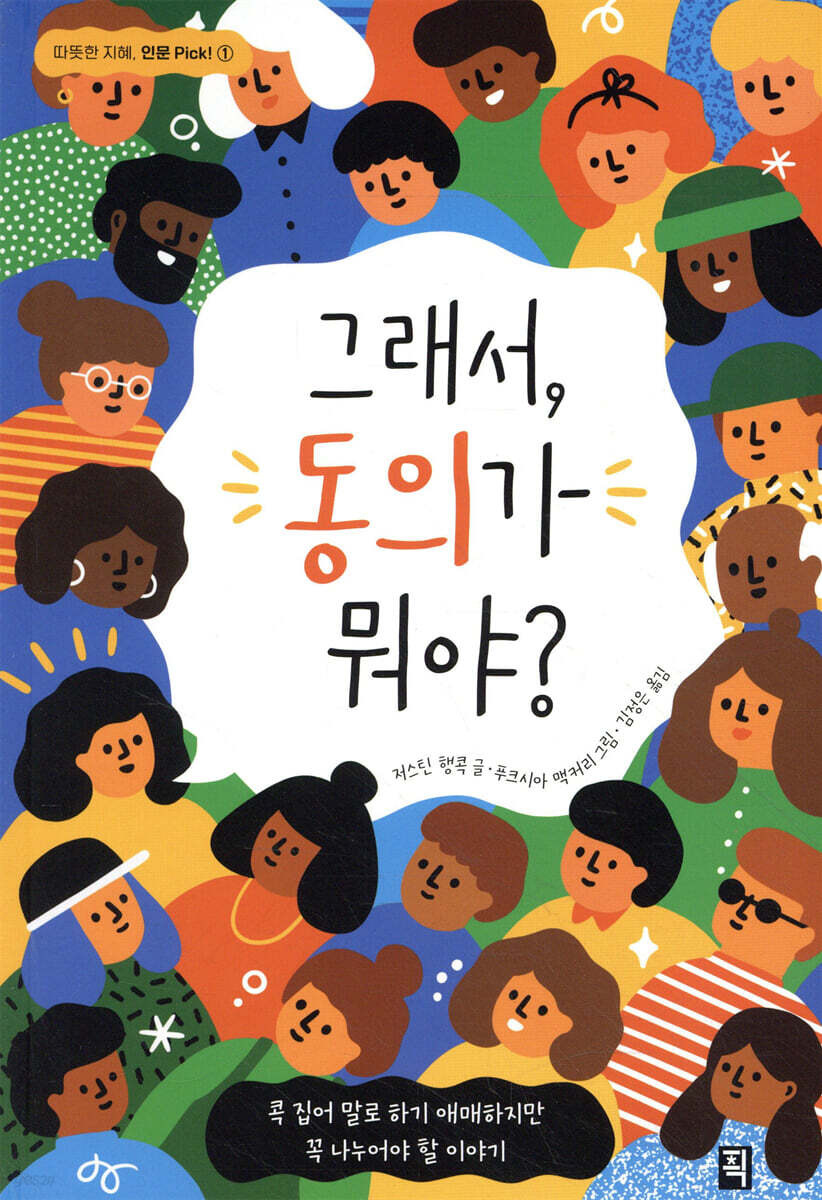
So, what is consent?
 |
Description
Book Introduction
- A word from MD
-
Choosing what you really want, agreeingThis book teaches us how to respect ourselves and others through the concept of 'consent', and considers what is needed to create a fair and equal world together.
Although it covers a fairly heavy subject, the bright and unique illustrations make it more enjoyable to read, making it easily accessible to children.
Let's think about what I really want and my precious choices!July 9, 2021. Children's PD Kim Hyun-ki
“Everything that concerns you is up to you.”
The Story of 'Consent': What You Need to Know to Become the True Master of Your Life
"So, What is Consent?" is a book that teaches us how to respect ourselves and others through the concept of "consent," and considers what is needed to create a fair and equal world together.
By reading this book, you will learn what consent is, why we need to know about it, and how to practice consent in our daily lives.
Above all, this book makes us realize that we have the power, the right, and the freedom to choose.
The words, “You have a choice,” give us courage.
Also, knowing that you don't have to choose something if you don't want to increases the number of things you can do.
People who know their inner strength will live more joyfully and actively, and will be able to overcome difficulties they encounter.
I hope this book will help you take the time to think about what you really want and how to achieve it.
The Story of 'Consent': What You Need to Know to Become the True Master of Your Life
"So, What is Consent?" is a book that teaches us how to respect ourselves and others through the concept of "consent," and considers what is needed to create a fair and equal world together.
By reading this book, you will learn what consent is, why we need to know about it, and how to practice consent in our daily lives.
Above all, this book makes us realize that we have the power, the right, and the freedom to choose.
The words, “You have a choice,” give us courage.
Also, knowing that you don't have to choose something if you don't want to increases the number of things you can do.
People who know their inner strength will live more joyfully and actively, and will be able to overcome difficulties they encounter.
I hope this book will help you take the time to think about what you really want and how to achieve it.
- You can preview some of the book's contents.
Preview
index
· Introduction
Chapter 1: Let's go eat pizza
Chapter 2: The Power to Choose Freely
Chapter 3 When with Others
Chapter 4: How to Ask and Request Questions
Chapter 5: On Rejection
Chapter 6: Agreeing and Greetings
Chapter 7: About Sex
Chapter 8: Not really, let's not do it.
Chapter 9: Consent in Groups
Chapter 10 Gender
Chapter 11: Why Discrimination Makes Consent Difficult
Chapter 12 Empowering Each Other Through Agreement
· Practice putting consent into practice
· Concept organization
· Author's Note
Chapter 1: Let's go eat pizza
Chapter 2: The Power to Choose Freely
Chapter 3 When with Others
Chapter 4: How to Ask and Request Questions
Chapter 5: On Rejection
Chapter 6: Agreeing and Greetings
Chapter 7: About Sex
Chapter 8: Not really, let's not do it.
Chapter 9: Consent in Groups
Chapter 10 Gender
Chapter 11: Why Discrimination Makes Consent Difficult
Chapter 12 Empowering Each Other Through Agreement
· Practice putting consent into practice
· Concept organization
· Author's Note
Detailed image

Into the book
We often rush.
Don't take the time to listen to your own needs and desires, and instead keep being distracted by the constant stories you hear instead of what you really want.
Sometimes, we don't take the time to think about what we want for no particular reason.
Because you think you don't deserve what you really want.
---p.18
Imagine a world where everyone can do what they want without harming anyone else.
A world where people help each other make good choices, a world where people live in freedom without harming each other, would be truly wonderful.
---p.22
Some people prefer to do everything alone to avoid fitting in with others.
That's okay too.
Sometimes I think I'm better off alone.
But if you just avoid being with other people, you might miss out on opportunities to develop good relationships.
The secret to building a good relationship is talking about what you want and finding ways to align it with what the other person wants.
---p.31
But you need to be careful if you send text messages that go beyond just sharing this kind of conversation.
In other words, when sending text messages that suggest or express sexual activity, you must make sure that it is sent safely and with mutual consent.
---p.95
Sometimes in life, not doing something can be the truly brave thing to do.
It just means that it might be easier to do something than not to do it.
It's like watching a movie you don't like because everyone else is watching it.
But when we do something because we feel pressured to do it, it means we haven't thought about what we or others really want or need.
So, rather, we may end up hurting ourselves or other people.
This is far from a life of practicing consent.
Don't take the time to listen to your own needs and desires, and instead keep being distracted by the constant stories you hear instead of what you really want.
Sometimes, we don't take the time to think about what we want for no particular reason.
Because you think you don't deserve what you really want.
---p.18
Imagine a world where everyone can do what they want without harming anyone else.
A world where people help each other make good choices, a world where people live in freedom without harming each other, would be truly wonderful.
---p.22
Some people prefer to do everything alone to avoid fitting in with others.
That's okay too.
Sometimes I think I'm better off alone.
But if you just avoid being with other people, you might miss out on opportunities to develop good relationships.
The secret to building a good relationship is talking about what you want and finding ways to align it with what the other person wants.
---p.31
But you need to be careful if you send text messages that go beyond just sharing this kind of conversation.
In other words, when sending text messages that suggest or express sexual activity, you must make sure that it is sent safely and with mutual consent.
---p.95
Sometimes in life, not doing something can be the truly brave thing to do.
It just means that it might be easier to do something than not to do it.
It's like watching a movie you don't like because everyone else is watching it.
But when we do something because we feel pressured to do it, it means we haven't thought about what we or others really want or need.
So, rather, we may end up hurting ourselves or other people.
This is far from a life of practicing consent.
---p.109
Publisher's Review
Choosing what you really want, agreeing
Choosing what you really want, agreeing
Consent is not just a question of 'yes' or 'no'.
Consent, as discussed in this book, refers to 'giving consent based on one's own free choice.'
This book says that consent is about having the freedom to choose.
So, from the small choices of what snacks to eat, what TV shows to watch, and what games to play, to the important choices of whether to be friends with this person, what to study later, and when to have sex, we must consider whether we truly agree with this and strive to make the right choice.
It's not always easy to figure out what you want and choose what you need.
Also, you can't always live the way you want.
But the more you think about what you want, the more likely you are to make a good choice.
So, we need to keep practicing making good choices, starting with small things.
This book begins with the practice of choosing a pizza, something that everyone has experienced at least once.
Even if you're a pizza lover, you've probably never thought this carefully about what type of dough, what toppings, and what style of pizza to eat.
The lesson of 'Choosing Your Pizza Carefully' is to listen to your own voice and live more sincerely.
By consciously examining and judging many things that you had previously overlooked and making the best choices, you will gain the strength to lead in the direction you desire when faced with important moments of choice.
Before nodding your head to something, think twice, and choose carefully those things that concern you with self-compassion.
This is what the book recommends.
Respecting all people living together, agreement
This book makes me think not only about my own choices, but also about the choices of others.
It teaches us that the other person's choices are just as important as our own, and that we must be careful when seeking and negotiating with others to live together.
This book is great at explaining how to ask and request consent from others, as well as how to refuse something you don't want to do.
We've all had the experience of finding it difficult to say no, whether it's because we're afraid of being hated, ostracized, or because we don't want to be seen as a bad person.
But it's not necessarily my fault that I'm in a situation where I have to say no, and it's not necessarily something I feel bad about for the other person.
Learning about consent will give you a broader perspective on the complexities and nuances of human relationships.
It covers not only one-on-one relationships but also multi-person work and teamwork, so you will gain valuable insights into communication in various social settings, such as at home, in the classroom, and at work.
In particular, this book deals with sexual relations quite seriously.
Even though sex is a serious activity that involves physical contact with another person, sex education rarely addresses the issue of choice, or consent.
Sex is an area where we need to ask ourselves, "Is this what I really want? Does my partner really want it? What's best for our relationship?"
This is why I highly recommend this book to upper elementary school students and teenagers who are just beginning to open their eyes to sex.
Concepts you must know to develop cognitive sensitivity
This book is not just about the freedom of individual choice.
If 'consent' is about the freedom to choose, the author argues that we must also recognize that that freedom is not given equally to everyone.
There are people in our society who are unable to make free choices, and discrimination based on gender, race, class, sexual identity, disability, etc. makes it even harder for them.
After reading this book, you will realize that some people's freedom of choice is limited due to discrimination, and that when there is a difference in the freedom and power granted to them, unreasonable things happen.
We are increasingly moving toward a society that recognizes each other's differences and respects diversity.
Many people work to create a fair and equal world and reduce unfair practices such as discrimination, harassment, and violence.
In the future, cognitive sensitivity to detect imbalances and discriminatory elements in our society will become increasingly important.
This book will be a great help in teaching cognitive sensitivity in the classroom or at home.
A book that gives strength to anyone, a book I'd recommend to someone special.
Although it covers a range of topics from lighthearted to quite weighty, this book is actually incredibly entertaining no matter where you open it.
This is partly due to the illustrations, which are bright and impressive with a variety of colors that fill every page, making it a pleasure to look at.
Even if the content is a bit unfamiliar, it doesn't feel boring thanks to the illustrations.
This book is also very satisfying from a visual perspective.
The author of this book describes practicing consent as "empowering each other."
If we look out for each other, talk to each other, give each other choices, and find ways to do good for ourselves and each other, it would be a wonderful world.
After reading this book, you will find hope and a more positive outlook on yourself and society.
Although it is a book for children and teenagers, it is suitable for people of all ages.
If you want someone special to live their life more wisely, this book would make a great gift.
Curriculum linkage
Elementary Korean 5-1 1.
Dialogue and empathy
Elementary Korean 5-2 3.
Discuss and adjust opinions
Elementary Social Studies 6-2 3.
Respect for human rights and a just society
Elementary Morality 6 1.
I am the master of my life
Secondary Social Studies Social and Cultural Area: 'Individuals and Society'
Secondary Morality: Relationships with Oneself / Relationships with Others / Relationships with Society and the Community
Consent is not just a question of 'yes' or 'no'.
Consent, as discussed in this book, refers to 'giving consent based on one's own free choice.'
This book says that consent is about having the freedom to choose.
So, from the small choices of what snacks to eat, what TV shows to watch, and what games to play, to the important choices of whether to be friends with this person, what to study later, and when to have sex, we must consider whether we truly agree with this and strive to make the right choice.
It's not always easy to figure out what you want and choose what you need.
Also, you can't always live the way you want.
But the more you think about what you want, the more likely you are to make a good choice.
So, we need to keep practicing making good choices, starting with small things.
This book begins with the practice of choosing a pizza, something that everyone has experienced at least once.
Even if you're a pizza lover, you've probably never thought this carefully about what type of dough, what toppings, and what style of pizza to eat.
The lesson of 'Choosing Your Pizza Carefully' is to listen to your own voice and live more sincerely.
By consciously examining and judging many things that you had previously overlooked and making the best choices, you will gain the strength to lead in the direction you desire when faced with important moments of choice.
Before nodding your head to something, think twice, and choose carefully those things that concern you with self-compassion.
This is what the book recommends.
Respecting all people living together, agreement
This book makes me think not only about my own choices, but also about the choices of others.
It teaches us that the other person's choices are just as important as our own, and that we must be careful when seeking and negotiating with others to live together.
This book is great at explaining how to ask and request consent from others, as well as how to refuse something you don't want to do.
We've all had the experience of finding it difficult to say no, whether it's because we're afraid of being hated, ostracized, or because we don't want to be seen as a bad person.
But it's not necessarily my fault that I'm in a situation where I have to say no, and it's not necessarily something I feel bad about for the other person.
Learning about consent will give you a broader perspective on the complexities and nuances of human relationships.
It covers not only one-on-one relationships but also multi-person work and teamwork, so you will gain valuable insights into communication in various social settings, such as at home, in the classroom, and at work.
In particular, this book deals with sexual relations quite seriously.
Even though sex is a serious activity that involves physical contact with another person, sex education rarely addresses the issue of choice, or consent.
Sex is an area where we need to ask ourselves, "Is this what I really want? Does my partner really want it? What's best for our relationship?"
This is why I highly recommend this book to upper elementary school students and teenagers who are just beginning to open their eyes to sex.
Concepts you must know to develop cognitive sensitivity
This book is not just about the freedom of individual choice.
If 'consent' is about the freedom to choose, the author argues that we must also recognize that that freedom is not given equally to everyone.
There are people in our society who are unable to make free choices, and discrimination based on gender, race, class, sexual identity, disability, etc. makes it even harder for them.
After reading this book, you will realize that some people's freedom of choice is limited due to discrimination, and that when there is a difference in the freedom and power granted to them, unreasonable things happen.
We are increasingly moving toward a society that recognizes each other's differences and respects diversity.
Many people work to create a fair and equal world and reduce unfair practices such as discrimination, harassment, and violence.
In the future, cognitive sensitivity to detect imbalances and discriminatory elements in our society will become increasingly important.
This book will be a great help in teaching cognitive sensitivity in the classroom or at home.
A book that gives strength to anyone, a book I'd recommend to someone special.
Although it covers a range of topics from lighthearted to quite weighty, this book is actually incredibly entertaining no matter where you open it.
This is partly due to the illustrations, which are bright and impressive with a variety of colors that fill every page, making it a pleasure to look at.
Even if the content is a bit unfamiliar, it doesn't feel boring thanks to the illustrations.
This book is also very satisfying from a visual perspective.
The author of this book describes practicing consent as "empowering each other."
If we look out for each other, talk to each other, give each other choices, and find ways to do good for ourselves and each other, it would be a wonderful world.
After reading this book, you will find hope and a more positive outlook on yourself and society.
Although it is a book for children and teenagers, it is suitable for people of all ages.
If you want someone special to live their life more wisely, this book would make a great gift.
Curriculum linkage
Elementary Korean 5-1 1.
Dialogue and empathy
Elementary Korean 5-2 3.
Discuss and adjust opinions
Elementary Social Studies 6-2 3.
Respect for human rights and a just society
Elementary Morality 6 1.
I am the master of my life
Secondary Social Studies Social and Cultural Area: 'Individuals and Society'
Secondary Morality: Relationships with Oneself / Relationships with Others / Relationships with Society and the Community
GOODS SPECIFICS
- Date of issue: July 7, 2021
- Page count, weight, size: 108 pages | 384g | 152*221*12mm
- ISBN13: 9791187903734
- ISBN10: 1187903736
- KC Certification: Certification Type: Conformity Confirmation
You may also like
카테고리
korean


korean

![ELLE 엘르 스페셜 에디션 A형 : 12월 [2025]](http://librairie.coreenne.fr/cdn/shop/files/b8e27a3de6c9538896439686c6b0e8fb.jpg?v=1766436872&width=3840)


