

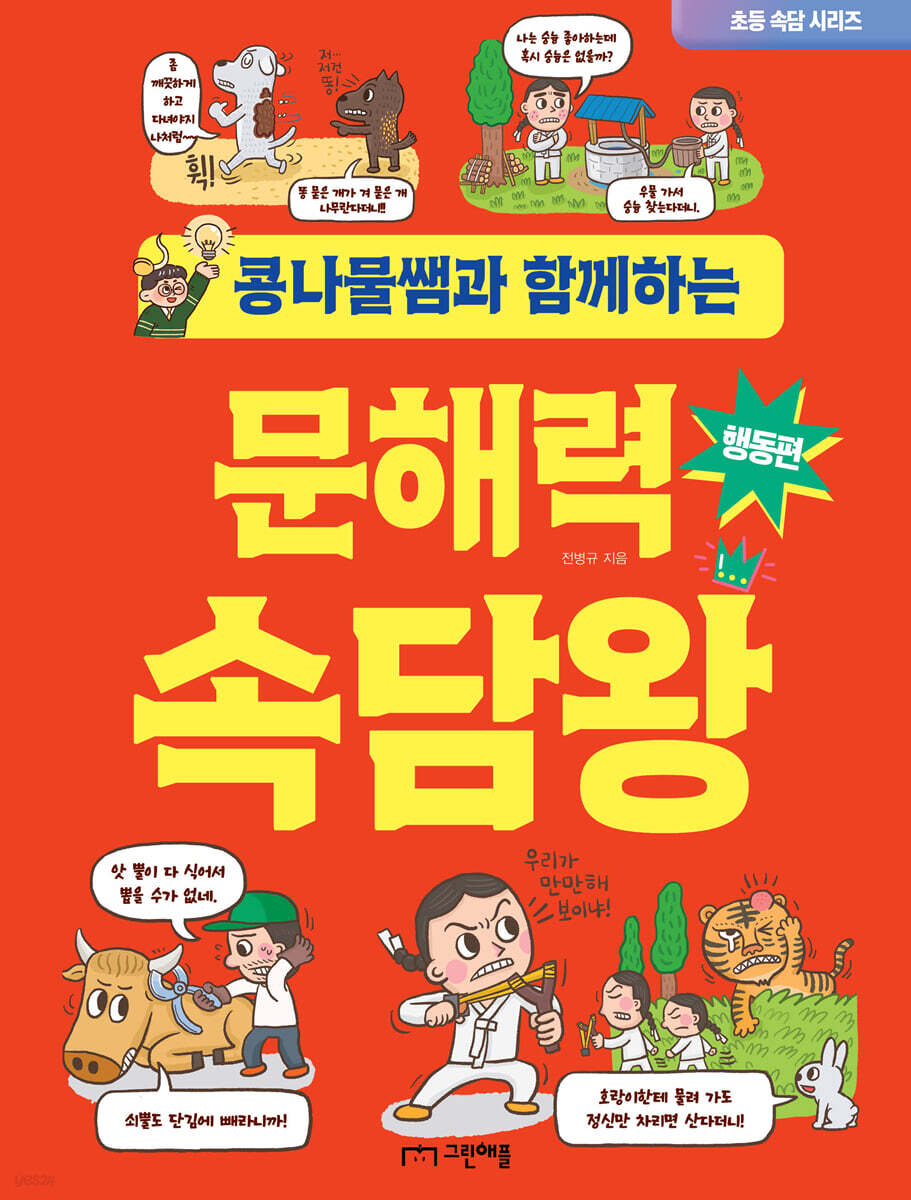
Literacy Proverb King: Action Edition with Teacher Kongnamul
 |
Description
Book Introduction
Understanding metaphors is the true literacy king of proverbs! Stop studying proverbs just to memorize their meanings. The most important thing about proverbs is how you learn them! What life lessons can we learn from the proverb, "Even an earthworm will squirm if you step on it"? It's not simply a reminder of what happens when you step on an earthworm. It also carries a broader message: we shouldn't bully the weak. If you understand the various uses of words in proverbs and the corresponding situations, your vocabulary and literacy will naturally improve. Moreover, if we can recall the wisdom of our ancestors in our daily lives, not only children but also adults can live wiser lives. This is why we need to know proverbs well. Author Jeon Byeong-gyu, a former elementary school teacher with 20 years of experience and well-known as the YouTuber ‘Kongnamul Teacher’. He has been researching and teaching how to develop children's literacy skills more effectively. And I realized that the most basic thing I needed was vocabulary learning. Vocabulary has the greatest impact on literacy, and for learning vocabulary correctly, there is no better material than proverbs. "Literacy Proverbs with Teacher Bean Sprouts" is a book that captures the author's extensive experience teaching children in elementary schools. This is not simply a study of proverbs that convey their meanings, but rather a study that allows students to infer and explore the meaning of the vocabulary within the proverbs, and even learn foreign proverbs, allowing them to learn proverbs through various situations and background knowledge. The second topic of ‘Literacy Proverb King with Teacher Bean Sprout’ is ‘action.’ We can easily understand how our actions affect our lives and what consequences they bring about through proverbs that contain the wisdom of our ancestors. You can also learn not only Korean proverbs but also foreign proverbs with similar meanings, so after studying this book, you will be able to learn about other countries' cultures. In particular, this book is structured so that students can learn five proverbs per week, making a total of 30 proverbs their own in six weeks. In addition to literacy, you can also improve your vocabulary by studying words found in proverbs, and by understanding the hidden meanings of words, you can develop your reasoning skills and apply them to various situations. Moreover, you can develop your creativity by learning background knowledge and creating your own new proverbs through related foreign proverbs. Learn 30 proverbs, one a day. Master vocabulary, reasoning, background knowledge, and creativity all at once! |
- You can preview some of the book's contents.
Preview
index
Recommendation
Prologue: Understanding metaphors is the king of literacy proverbs!!
How to use this book
Week 1
If you speak kindly, you will hear kind words in return.
Watching the fire across the river
A long tail will get stepped on.
Eat the pheasant and the eggs
Spitting while lying down
Week 1 Review
Week 2
To kill a chicken, you need a slaughter knife.
Even if you cross a stone bridge, test it first.
A dog covered in shit calls a dog covered in bran.
I'm going to try stabbing an inedible persimmon
One loach muddies the whole pond.
Week 2 Review
Week 3
Even a blank sheet of paper is better if you hold it up
Give me a bottle and I'll give you medicine
Adding fuel to the fire
A clumsy carpenter blames his tools.
Catch a mouse by backing off
Week 3 Review
Week 4
Pull out the bull's horns in one go
Scratching the surface of a watermelon
Remove the lower stone and place the upper stone on top
Don't even look at a tree you can't climb.
A crying child gets milk
Week 4 Review
Week 5
Go to the well and look for a needle
Thanks to you, my lord, I'm going crazy
Small peppers are spicy
Blind men touching the elephant
The bear does the tricks, but the owner gets the money.
Week 5 Review
Week 6
Get slapped in Jongno and glared at by the Han River
See one, know ten
Listen with one ear and let it go out the other
If you want to catch a tiger, you have to go to the tiger's den.
Even if you get bitten by a tiger, you can survive if you keep your wits about you.
Week 6 Review
Correct answer
Prologue: Understanding metaphors is the king of literacy proverbs!!
How to use this book
Week 1
If you speak kindly, you will hear kind words in return.
Watching the fire across the river
A long tail will get stepped on.
Eat the pheasant and the eggs
Spitting while lying down
Week 1 Review
Week 2
To kill a chicken, you need a slaughter knife.
Even if you cross a stone bridge, test it first.
A dog covered in shit calls a dog covered in bran.
I'm going to try stabbing an inedible persimmon
One loach muddies the whole pond.
Week 2 Review
Week 3
Even a blank sheet of paper is better if you hold it up
Give me a bottle and I'll give you medicine
Adding fuel to the fire
A clumsy carpenter blames his tools.
Catch a mouse by backing off
Week 3 Review
Week 4
Pull out the bull's horns in one go
Scratching the surface of a watermelon
Remove the lower stone and place the upper stone on top
Don't even look at a tree you can't climb.
A crying child gets milk
Week 4 Review
Week 5
Go to the well and look for a needle
Thanks to you, my lord, I'm going crazy
Small peppers are spicy
Blind men touching the elephant
The bear does the tricks, but the owner gets the money.
Week 5 Review
Week 6
Get slapped in Jongno and glared at by the Han River
See one, know ten
Listen with one ear and let it go out the other
If you want to catch a tiger, you have to go to the tiger's den.
Even if you get bitten by a tiger, you can survive if you keep your wits about you.
Week 6 Review
Correct answer
Detailed image
.jpg)
Publisher's Review
“In the information age, literacy is competitiveness!”
Proverbs Class to Improve Children's Literacy
A recent survey found that a significant number of elementary school teachers have great difficulty teaching textbook vocabulary to their students.
According to the results of a survey conducted by the Korea Educational Development Institute on 'Teachers' Perceptions of Vocabulary Instruction in Elementary School Korean and Math Textbooks' targeting 257 first and second grade teachers across the country, 67% of Korean language subjects and 60.3% of math subjects responded that they were 'difficult'.
In order to do well in Korean or math at school, as well as to express your thoughts well in speech or writing in everyday life, you need to know the exact meaning of the words that form the material of speech and writing, and you also need to know how to accurately understand the situation and what expressions are appropriate for that situation.
These days, children are more exposed to videos than books, and they find it easier to communicate using jargon than using precise vocabulary. Fostering literacy is not only important in the realm of learning, but also an essential quality for communicating effectively in our society.
Based on the power of metaphor
Step 4 Proverbs Lesson
Most of the books on proverbs published so far have focused solely on understanding the proverbs themselves through comics or stories.
There are limits to connecting proverbs to real-world situations, and no book has approached the topic with interest in understanding the power of metaphors.
Author Jeon Byeong-gyu organized the content of this book to help readers understand metaphors rather than the proverbs themselves.
Instead of tiring children out by memorizing proverbs themselves, we encourage them to take more initiative in their studies by encouraging them to apply them to real-life situations and creating their own proverbs.
The author says that through this book, children can expect the following learning effects:
● You will learn various vocabulary that appears in proverbs.
● You will come to understand the hidden meaning of words in proverbs.
● You will be able to understand the culture of society related to proverbs.
● You will learn the wisdom of our ancestors contained in proverbs.
To improve literacy, you must understand the use of vocabulary appropriate to the situation in the text and the background culture.
If you learn the wrong way, you will only waste time and effort and your skills will not improve much.
This book is structured around the four-step learning principle for improving literacy.
Step 1 - Guess the meaning of the proverb!
Let's guess the meaning of new proverbs through fun cartoons.
A related cartoon is introduced along with the proverb.
Here, children read proverbs and look at cartoon pictures to think for themselves about what the proverbs mean.
If you guess the meaning of the 30 proverbs in this book, your child's creativity will be fully developed.
Step 2 - Think about the hidden meaning of the word!
The words used in proverbs have both an apparent meaning and a hidden, real meaning.
Just memorizing proverbs doesn't allow you to fully understand the meaning of the words in the proverbs.
We need to understand what the words in the proverbs mean on the surface and what meaning they actually have in the proverbs.
Also, through the meaning of the words learned in this way, you will be trained to infer what wisdom the proverb is trying to convey.
Step 3 - Use proverbs!
Check whether your guess and understanding of the proverb's meaning is correct by reading the detailed explanation of the proverb.
And you increase your understanding by explaining what you understand yourself.
By thinking about and writing down situations in which proverbs can be applied, you can develop the ability to connect proverbs to your own life.
Step 4 - Expand your background knowledge!
It is important to understand the context in which a proverb is used. By understanding proverbs used in other countries, we can gain a deeper understanding of the meaning of the proverbs we learned today, and we can also indirectly understand the culture of other countries.
Also, practicing creating and writing your own proverbs is a great help in expanding your vocabulary, literacy, and situational understanding.
Proverbs Class to Improve Children's Literacy
A recent survey found that a significant number of elementary school teachers have great difficulty teaching textbook vocabulary to their students.
According to the results of a survey conducted by the Korea Educational Development Institute on 'Teachers' Perceptions of Vocabulary Instruction in Elementary School Korean and Math Textbooks' targeting 257 first and second grade teachers across the country, 67% of Korean language subjects and 60.3% of math subjects responded that they were 'difficult'.
In order to do well in Korean or math at school, as well as to express your thoughts well in speech or writing in everyday life, you need to know the exact meaning of the words that form the material of speech and writing, and you also need to know how to accurately understand the situation and what expressions are appropriate for that situation.
These days, children are more exposed to videos than books, and they find it easier to communicate using jargon than using precise vocabulary. Fostering literacy is not only important in the realm of learning, but also an essential quality for communicating effectively in our society.
Based on the power of metaphor
Step 4 Proverbs Lesson
Most of the books on proverbs published so far have focused solely on understanding the proverbs themselves through comics or stories.
There are limits to connecting proverbs to real-world situations, and no book has approached the topic with interest in understanding the power of metaphors.
Author Jeon Byeong-gyu organized the content of this book to help readers understand metaphors rather than the proverbs themselves.
Instead of tiring children out by memorizing proverbs themselves, we encourage them to take more initiative in their studies by encouraging them to apply them to real-life situations and creating their own proverbs.
The author says that through this book, children can expect the following learning effects:
● You will learn various vocabulary that appears in proverbs.
● You will come to understand the hidden meaning of words in proverbs.
● You will be able to understand the culture of society related to proverbs.
● You will learn the wisdom of our ancestors contained in proverbs.
To improve literacy, you must understand the use of vocabulary appropriate to the situation in the text and the background culture.
If you learn the wrong way, you will only waste time and effort and your skills will not improve much.
This book is structured around the four-step learning principle for improving literacy.
Step 1 - Guess the meaning of the proverb!
Let's guess the meaning of new proverbs through fun cartoons.
A related cartoon is introduced along with the proverb.
Here, children read proverbs and look at cartoon pictures to think for themselves about what the proverbs mean.
If you guess the meaning of the 30 proverbs in this book, your child's creativity will be fully developed.
Step 2 - Think about the hidden meaning of the word!
The words used in proverbs have both an apparent meaning and a hidden, real meaning.
Just memorizing proverbs doesn't allow you to fully understand the meaning of the words in the proverbs.
We need to understand what the words in the proverbs mean on the surface and what meaning they actually have in the proverbs.
Also, through the meaning of the words learned in this way, you will be trained to infer what wisdom the proverb is trying to convey.
Step 3 - Use proverbs!
Check whether your guess and understanding of the proverb's meaning is correct by reading the detailed explanation of the proverb.
And you increase your understanding by explaining what you understand yourself.
By thinking about and writing down situations in which proverbs can be applied, you can develop the ability to connect proverbs to your own life.
Step 4 - Expand your background knowledge!
It is important to understand the context in which a proverb is used. By understanding proverbs used in other countries, we can gain a deeper understanding of the meaning of the proverbs we learned today, and we can also indirectly understand the culture of other countries.
Also, practicing creating and writing your own proverbs is a great help in expanding your vocabulary, literacy, and situational understanding.
GOODS SPECIFICS
- Date of issue: January 10, 2024
- Page count, weight, size: 176 pages | 462g | 190*250*10mm
- ISBN13: 9791192527444
- ISBN10: 1192527445
- KC Certification: Certification Type: Conformity Confirmation
You may also like
카테고리
korean


korean

![ELLE 엘르 스페셜 에디션 A형 : 12월 [2025]](http://librairie.coreenne.fr/cdn/shop/files/b8e27a3de6c9538896439686c6b0e8fb.jpg?v=1766436872&width=3840)


