

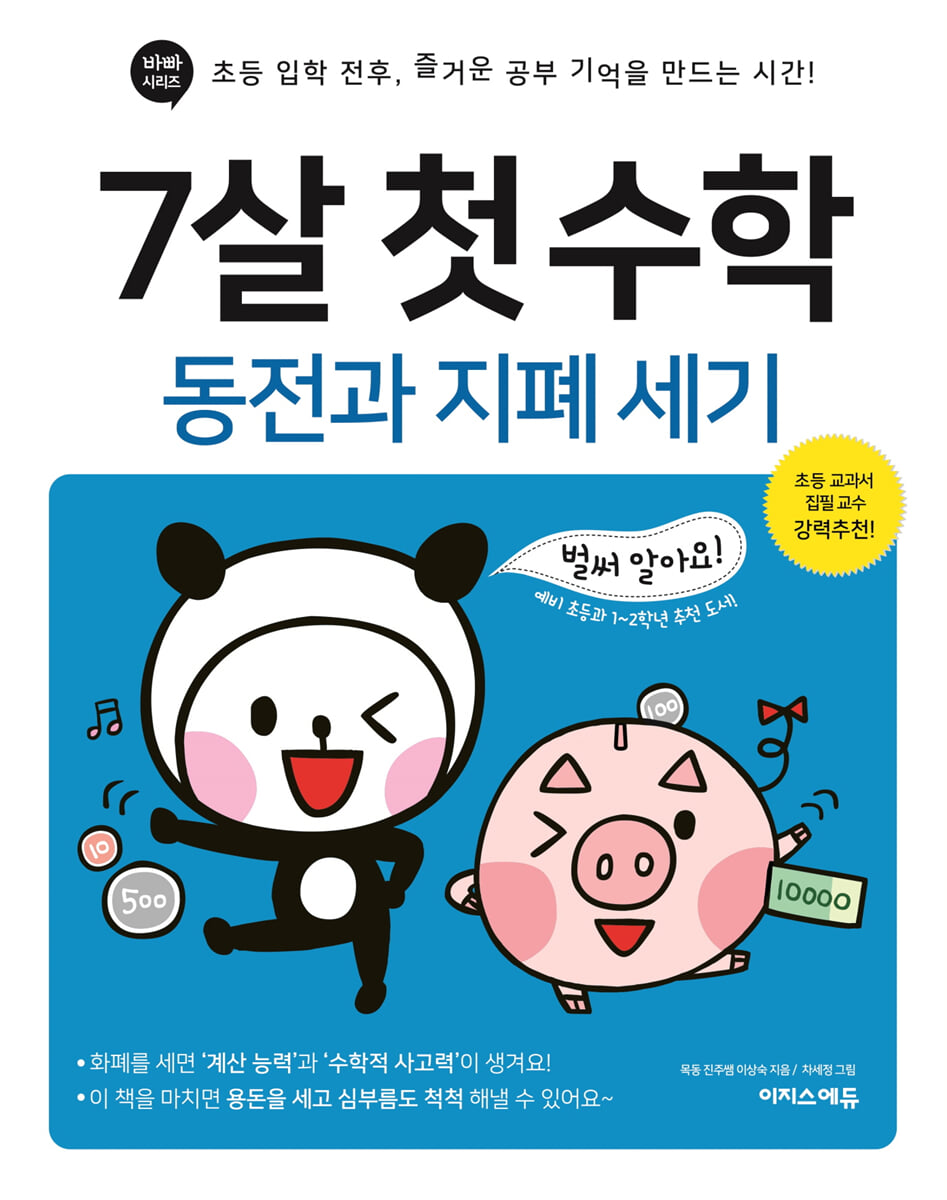
First Math for 7-Year-Olds: Counting Coins and Bills
 |
Description
Book Introduction
“Counting money is about ‘calculation ability’ and “Mathematical thinking skills are developed!” Mokdong Jinju Teacher, a math textbook expert and teacher with 21 years of experience A step-by-step, customized math study method for 7-year-olds! Money frequently appears as a material for learning 'numbers and operations' in elementary school math textbooks. Because children can easily understand difficult calculations involving large numbers using familiar money. Professor Jin-ho Kim, who is in charge of writing elementary school math textbooks, strongly recommended this book, saying, “If you apply what you learned in ‘First Math for 7-Year-Olds - Counting Coins and Bills’ to real life, you will also be able to better understand the concepts of place value and carry that you learn in grades 1-3.” In particular, through the 'Allowance and Errands' section of this book, children can indirectly experience calculating their own allowance and running errands. Children can develop a sense of money through fun, everyday play! For new parents, this book is packed with helpful tips on how to praise your child and how reading can help you become a great teacher. Create enjoyable learning memories for your precious child before and after entering elementary school with "First Math at 7 Years Old"! Recommended for children from pre-elementary school students to first and second graders! |
- You can preview some of the book's contents.
Preview
index
First Yard │ Let’s learn about our country’s coins!
★Coins of our country
Day 1: Learn and count 10-won coins
Day 2: Learn and count 100 won coins
Day 3: Learn and count 50-won coins
Day 4: Learn about the 500 won coin
Second Yard │ I can count coins!
Day 5: Counting coins worth more than 10 won - 10 won
Day 6: Counting coins worth more than 10 - 50 won
Day 7: Count two coins (1) - (50 won, 10 won), (100 won, 10 won)
Day 8: Count two coins (2) - (100 won, 50 won), (500 won, 10 won)
Day 9: Count two coins (3) - (500 won, 50 won), (500 won, 100 won)
Day 10: Mix and Count Coins
Third Yard │ Get to know our country's banknotes!
★Our country's banknotes
Day 11: Learn and count 1,000 won bills
Day 12: Learn and count 5,000 won bills
Day 13: Learn and count 10,000 won bills.
Day 14: Learn about the 50,000 won bill.
Fourth Yard │ I can count bills!
Day 15: Counting bills and coins (1) - Counting 1,000 won and one coin
Day 16: Counting bills and coins (2) - Counting 1,000 won and coins
Day 17: Counting Two Bills (1) - 5,000 Won and 1,000 Won
Day 18: Counting Two Bills (2) - 10,000 Won and 1,000 Won
Day 19: Counting Two Bills (3) - 10,000 Won and 5,000 Won
★Coins of our country
Day 1: Learn and count 10-won coins
Day 2: Learn and count 100 won coins
Day 3: Learn and count 50-won coins
Day 4: Learn about the 500 won coin
Second Yard │ I can count coins!
Day 5: Counting coins worth more than 10 won - 10 won
Day 6: Counting coins worth more than 10 - 50 won
Day 7: Count two coins (1) - (50 won, 10 won), (100 won, 10 won)
Day 8: Count two coins (2) - (100 won, 50 won), (500 won, 10 won)
Day 9: Count two coins (3) - (500 won, 50 won), (500 won, 100 won)
Day 10: Mix and Count Coins
Third Yard │ Get to know our country's banknotes!
★Our country's banknotes
Day 11: Learn and count 1,000 won bills
Day 12: Learn and count 5,000 won bills
Day 13: Learn and count 10,000 won bills.
Day 14: Learn about the 50,000 won bill.
Fourth Yard │ I can count bills!
Day 15: Counting bills and coins (1) - Counting 1,000 won and one coin
Day 16: Counting bills and coins (2) - Counting 1,000 won and coins
Day 17: Counting Two Bills (1) - 5,000 Won and 1,000 Won
Day 18: Counting Two Bills (2) - 10,000 Won and 1,000 Won
Day 19: Counting Two Bills (3) - 10,000 Won and 5,000 Won
Detailed image

Publisher's Review
The basics of numbers and operations found in elementary school math textbooks
You can use 'coins and bills'!
Money frequently appears as a material for learning 'numbers and operations' in elementary school math textbooks.
However, with the advent of the credit card era, the reality is that children have fewer opportunities to use coins and bills.
This book provides children with valuable experiences in which they learn about money and actually count and use it, allowing them to pay for things with cash instead of credit cards and cell phones.
■ If you learn with money, you will quickly understand large units of numbers!
Calculating how much money you have is actually calculating very large numbers.
Many children find it difficult to write down these large calculations on paper.
But when you do it with coins or bills, you end up calculating without even realizing it as a large number.
If you learn naturally like this in your daily life, you will be able to easily learn how to count and add large numbers.
■ Help them learn about money sizes using real banknotes!
It is very difficult to approach the unit size of a banknote that is larger than four digits in terms of the size of the number.
In fact, counting four-digit numbers is something that is learned in the second semester of the second grade in elementary school.
It is natural for children to have difficulty calculating money.
In these cases, use model money or real money to help children learn the sizes of money by counting them one by one.
To prevent counting bills from becoming a dull pastime, try to be patient and adapt to your child's needs by breaking free from the obsession with learning.
Because practicing calculations comes naturally!
■ Learn in a fun way with the ‘Pocket Money and Errands’ corner!
For children beginning math, the best learning comes naturally through play.
This book has a 'Allowance and Errands' corner on the last page of each day, allowing children to indirectly experience calculating their own allowance and running errands.
Children can develop their sense of money and number sense by buying things with money through market play and calculating the price of the items they choose!
And most importantly! The "joy of learning" experienced in childhood enhances self-directed learning abilities.
Please be generous with your encouragement and praise so that your study time becomes a happy memory!
■ Structure and features of this book
[4-Step Study Method for Creating Enjoyable Study Memories]
If you study through play with this book, you will develop 'calculation skills' and 'mathematical thinking skills'!
Build your foundation in numbers and operations with 'Counting Coins and Bills'!
Step 1) Talk about coins and bills
Before you begin this lesson, spark your child's interest in money by talking about coins and banknotes.
You can provide background knowledge to your child by simply reading along with the text that contains the oral language of your parents!
Step 2) Learn the concept by following along
You can naturally learn to count large numbers and jump counting by following the method of counting and reading coins and bills.
Step 3) Solve problems and solidify concepts
Now let's try to solve the problem ourselves.
You can learn in a variety of fun ways, such as connecting lines appropriately and marking the correct value! Parents, please wait patiently for your child to solve each problem on their own.
Step 4) Developing a sense of money in everyday life
Through the 'Allowance and Errands' corner, children can enjoy the indirect experience of calculating their own allowance and running errands.
Real-life situations double your interest and enhance your learning experience!
[Introducing the 7-Year-Old First Series] The 7-Year-Old First Series is a book that creates enjoyable study memories for children before and after entering elementary school.
Rather than teaching study skills, we help students experience the joy of studying.
It's packed with great teaching tips for new parents to follow along and become a great teacher, making it a great homeschooling resource!
1) 7-Year-Old First Math Series: Contains all the math activities that children must experience before entering elementary school.
It consists of a total of 5 books including 'Clock and Calendar', the #1 best-selling book for preschoolers, 'Numbers to 100', 'Addition and Subtraction of Numbers to 20', 'Addition and Subtraction of Numbers to 100', and 'Counting Coins and Bills'. 2) 7-Year-Old First Korean Language Series: This book contains the teaching secrets of Bundang Youngjae Love Education Research Institute, and can help children complete their Korean writing with vocabulary from first grade elementary school textbooks.
The series of books includes ① 'Textbook Words Without Final Consonants' and ② 'Textbook Words With Final Consonants'. 3) First English Series for 7-Year-Olds: Before entering elementary school, there is 'Alphabet ABC' to learn the shapes and names of the alphabet with the national alphabet song 'Cone Hat Song', and 'Phoenix (Alphabet Sounds)' to study phonics in an exciting way with the secret chant of 'Bibi Phonics', the representative YouTube channel for phonics for young children.
Learn the shapes and names of the alphabets with the ABC alphabet, then study phonics! 4) 7-year-old's first Chinese character series: This book helps develop not only Chinese characters but also elementary school Korean language textbook vocabulary.
It consists of ‘Basic Chinese characters ①, ②’.
You can use 'coins and bills'!
Money frequently appears as a material for learning 'numbers and operations' in elementary school math textbooks.
However, with the advent of the credit card era, the reality is that children have fewer opportunities to use coins and bills.
This book provides children with valuable experiences in which they learn about money and actually count and use it, allowing them to pay for things with cash instead of credit cards and cell phones.
■ If you learn with money, you will quickly understand large units of numbers!
Calculating how much money you have is actually calculating very large numbers.
Many children find it difficult to write down these large calculations on paper.
But when you do it with coins or bills, you end up calculating without even realizing it as a large number.
If you learn naturally like this in your daily life, you will be able to easily learn how to count and add large numbers.
■ Help them learn about money sizes using real banknotes!
It is very difficult to approach the unit size of a banknote that is larger than four digits in terms of the size of the number.
In fact, counting four-digit numbers is something that is learned in the second semester of the second grade in elementary school.
It is natural for children to have difficulty calculating money.
In these cases, use model money or real money to help children learn the sizes of money by counting them one by one.
To prevent counting bills from becoming a dull pastime, try to be patient and adapt to your child's needs by breaking free from the obsession with learning.
Because practicing calculations comes naturally!
■ Learn in a fun way with the ‘Pocket Money and Errands’ corner!
For children beginning math, the best learning comes naturally through play.
This book has a 'Allowance and Errands' corner on the last page of each day, allowing children to indirectly experience calculating their own allowance and running errands.
Children can develop their sense of money and number sense by buying things with money through market play and calculating the price of the items they choose!
And most importantly! The "joy of learning" experienced in childhood enhances self-directed learning abilities.
Please be generous with your encouragement and praise so that your study time becomes a happy memory!
■ Structure and features of this book
[4-Step Study Method for Creating Enjoyable Study Memories]
If you study through play with this book, you will develop 'calculation skills' and 'mathematical thinking skills'!
Build your foundation in numbers and operations with 'Counting Coins and Bills'!
Step 1) Talk about coins and bills
Before you begin this lesson, spark your child's interest in money by talking about coins and banknotes.
You can provide background knowledge to your child by simply reading along with the text that contains the oral language of your parents!
Step 2) Learn the concept by following along
You can naturally learn to count large numbers and jump counting by following the method of counting and reading coins and bills.
Step 3) Solve problems and solidify concepts
Now let's try to solve the problem ourselves.
You can learn in a variety of fun ways, such as connecting lines appropriately and marking the correct value! Parents, please wait patiently for your child to solve each problem on their own.
Step 4) Developing a sense of money in everyday life
Through the 'Allowance and Errands' corner, children can enjoy the indirect experience of calculating their own allowance and running errands.
Real-life situations double your interest and enhance your learning experience!
[Introducing the 7-Year-Old First Series] The 7-Year-Old First Series is a book that creates enjoyable study memories for children before and after entering elementary school.
Rather than teaching study skills, we help students experience the joy of studying.
It's packed with great teaching tips for new parents to follow along and become a great teacher, making it a great homeschooling resource!
1) 7-Year-Old First Math Series: Contains all the math activities that children must experience before entering elementary school.
It consists of a total of 5 books including 'Clock and Calendar', the #1 best-selling book for preschoolers, 'Numbers to 100', 'Addition and Subtraction of Numbers to 20', 'Addition and Subtraction of Numbers to 100', and 'Counting Coins and Bills'. 2) 7-Year-Old First Korean Language Series: This book contains the teaching secrets of Bundang Youngjae Love Education Research Institute, and can help children complete their Korean writing with vocabulary from first grade elementary school textbooks.
The series of books includes ① 'Textbook Words Without Final Consonants' and ② 'Textbook Words With Final Consonants'. 3) First English Series for 7-Year-Olds: Before entering elementary school, there is 'Alphabet ABC' to learn the shapes and names of the alphabet with the national alphabet song 'Cone Hat Song', and 'Phoenix (Alphabet Sounds)' to study phonics in an exciting way with the secret chant of 'Bibi Phonics', the representative YouTube channel for phonics for young children.
Learn the shapes and names of the alphabets with the ABC alphabet, then study phonics! 4) 7-year-old's first Chinese character series: This book helps develop not only Chinese characters but also elementary school Korean language textbook vocabulary.
It consists of ‘Basic Chinese characters ①, ②’.
GOODS SPECIFICS
- Date of issue: August 25, 2023
- Page count, weight, size: 96 pages | 225*285*6mm
- ISBN13: 9791163034926
- ISBN10: 1163034924
- KC Certification: Certification Type: Conformity Confirmation
You may also like
카테고리
korean


korean

![GQ KOREA Mark (Monthly): December [2025]](http://librairie.coreenne.fr/cdn/shop/files/8ef265dbbfbf186523ed75ba7319009d.jpg?v=1765340328&width=3840)


