

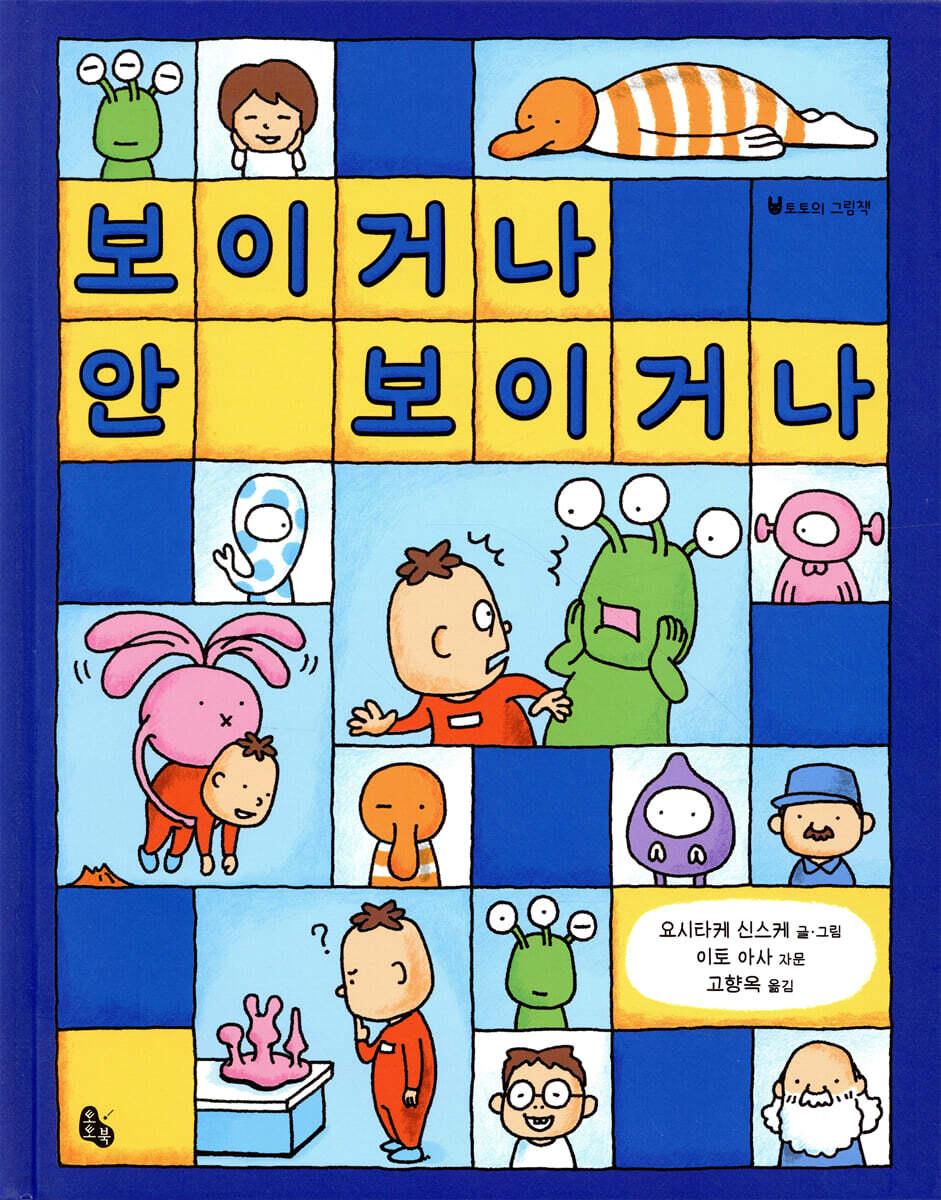
Visible or invisible
 |
Description
Book Introduction
A picture book author who is receiving worldwide attention
A genius with a quirky and unique imagination
Shinsuke Yoshitake throws
About all the 'obvious things'
An unexpected question
Shinsuke Yoshitake is rewriting the history of picture books by creating all kinds of buzz with each work he releases, such as 'Bologna International Book Fair Ragazzi Award Special Award', 'Picture book that sold over 200,000 copies in just 6 months', and 'Immediate bestseller'.
As if responding most actively to Pablo Neruda's poem asking, "Where is the child that was me? Is he still inside me or has he disappeared?", Yoshitake Shinsuke's world of works always features a harmonious coexistence of both adults and children.
Shinsuke's new work, "Visible or Invisible" (Toto Book), which will be available in Korea in April 2019, is also a work where the deep insight of an adult and the bright imagination of a child run wild together.
This picture book, which addresses weighty questions in a refreshing and lighthearted manner, is based on the book "How Do Blind People See the World" by humanist Asa Ito. It was created by Shinsuke Yoshitake, who thought of the story and exchanged opinions with Asa Ito.
A genius with a quirky and unique imagination
Shinsuke Yoshitake throws
About all the 'obvious things'
An unexpected question
Shinsuke Yoshitake is rewriting the history of picture books by creating all kinds of buzz with each work he releases, such as 'Bologna International Book Fair Ragazzi Award Special Award', 'Picture book that sold over 200,000 copies in just 6 months', and 'Immediate bestseller'.
As if responding most actively to Pablo Neruda's poem asking, "Where is the child that was me? Is he still inside me or has he disappeared?", Yoshitake Shinsuke's world of works always features a harmonious coexistence of both adults and children.
Shinsuke's new work, "Visible or Invisible" (Toto Book), which will be available in Korea in April 2019, is also a work where the deep insight of an adult and the bright imagination of a child run wild together.
This picture book, which addresses weighty questions in a refreshing and lighthearted manner, is based on the book "How Do Blind People See the World" by humanist Asa Ito. It was created by Shinsuke Yoshitake, who thought of the story and exchanged opinions with Asa Ito.
- You can preview some of the book's contents.
Preview
Detailed image

Publisher's Review
Metaphor for 'difference'
“I am an astronaut.
My job is to travel around and investigate all kinds of stars.
“On a planet full of people who have eyes behind them and can see both in front and behind them at the same time, I became a special person who couldn’t see behind them.” The planets that the astronauts arrived at were completely unfamiliar worlds where the natural ‘self’ was not taken for granted.
I was 'normal' in the space I lived in, but I was a rare being in another world.
The way people who are visible and those who are invisible perceive the world is completely different.
Although we live in a 'different' world that feels interesting, we are happy to see similarities and are amazed when we encounter differences, and we realize that we can remain good friends who respect each other.
A storyteller who expands the boundaries of picture books
Yoshitake Shinsuke's story naturally progresses from a story of 'visible people' and 'invisible people' to a story of 'normal' and 'abnormal', 'disabled' and 'non-disabled', 'ordinary' and 'special', 'me' and 'you', 'us' and 'them'.
A refreshing reversal by Shinsuke Yoshitake that makes us think about the 'gaze' that looks at 'difference'.
What kind of world will we find ourselves in when we turn the last page? Right now, encounter the work of Yoshitake Shinsuke, who "speaks without saying a word" about consideration and respect for "difference."
Author's Note
"To See or Not to See" is based on the book "How Do Blind People See the World" by humanist Asa Ito. Author Shinsuke Yoshitake came up with the story and created it through discussions with Asa Ito.
Let me briefly introduce what the two people were thinking and what they exchanged before this book was born.
What would you say to a child who thinks disability is fun?
Yoshitake: When I was little, I saw a blind person walking and asked my mother, “Why is that person like that?”
When my mother said, “I can’t see, so I walk with a cane,” I said, “That sounds fun!”
“That person doesn’t want to be blind.
“You shouldn’t stare or be funny,” my mother scolded me harshly.
I thought I was very wrong.
But recently, while watching TV at home, we were talking about visual impairment, and my son said, “That sounds fun!”
My childhood memories came back to me and I thought, "Oh, that's right."
If children didn't know about visual impairment, they would watch them walk blindly with anticipation, like playing a game of breaking a watermelon while blindfolded.
Ito: When it comes to disability issues, we often turn away, saying, "You shouldn't look at it," without even thinking about it or trying to figure it out.
Yoshitake: I thought about how I should answer my son.
There is a scene in the picture book where the main character asks a blind astronaut, “Wouldn’t it be fun if you couldn’t see?”
The astronaut said, “Hmm-.
I think it would be fun to see,” he replies, and that’s what I want to say to the child who says, “That would be fun!”
Since we cannot choose what we see and what we do not see, isn't it possible that we find others who are different from us interesting?
? 'Normal' and 'normal' are relative concepts.
Yoshitake: The concept of "normal" or "ordinary" varies from era to era and country to country, so it's unreliable.
So, from the beginning, I had no choice but to draw a situation where there was no such thing as 'normal'.
After much thought, I thought about it.
Let's go to space! (Laughs)
Ito: The Earthling protagonist meets an alien with eyes that can see behind him.
It was impressive to see the astronauts being concerned when they meet Earthlings who can only see forward, even though it is 'normal' there.
Yoshitake: But when you close the book, this is Earth, a society that revolves around non-disabled people.
So, I couldn't just draw stories about space, so it ended up being a dizzying book that went to space, to Earth, and even rode a Viking.
Ito: (Laughs) These days, when kids grow up, there's a chance they'll go to another planet.
The further humans go into space, the more likely it is that they will realize that they are not the center of the world.
Then, I wonder if the concepts of ‘normal’, ‘normality’, and ‘disability’ that have been ingrained in our minds will also change.
? Accepting others who are different from me
Yoshitake: At the end of the book, there's a sentence that says, "If you look for similarities and find differences, you can say, 'Wow!' and have fun."
At first, I didn't put the word 'each other' here.
Ito: It's a kind of 'fun' that is possible only when there is tolerance and agreement to accept others who are different from me.
Otherwise, it might be a reckless thing to say.
Yoshitake: I hope that children will just laugh and read it with enjoyment at first.
If I may be a little greedy, I'd be even happier if, after reading this book, you change your mind a little, thinking, "Oh, come to think of it, that's true," or if, after a long time, you reread it and realize, "Is this a book about looking at differences?"
Since this book was made possible thanks to Mr. Ito's book, I hope that the children who read this book will grow up to become readers of Mr. Ito's books.
“I am an astronaut.
My job is to travel around and investigate all kinds of stars.
“On a planet full of people who have eyes behind them and can see both in front and behind them at the same time, I became a special person who couldn’t see behind them.” The planets that the astronauts arrived at were completely unfamiliar worlds where the natural ‘self’ was not taken for granted.
I was 'normal' in the space I lived in, but I was a rare being in another world.
The way people who are visible and those who are invisible perceive the world is completely different.
Although we live in a 'different' world that feels interesting, we are happy to see similarities and are amazed when we encounter differences, and we realize that we can remain good friends who respect each other.
A storyteller who expands the boundaries of picture books
Yoshitake Shinsuke's story naturally progresses from a story of 'visible people' and 'invisible people' to a story of 'normal' and 'abnormal', 'disabled' and 'non-disabled', 'ordinary' and 'special', 'me' and 'you', 'us' and 'them'.
A refreshing reversal by Shinsuke Yoshitake that makes us think about the 'gaze' that looks at 'difference'.
What kind of world will we find ourselves in when we turn the last page? Right now, encounter the work of Yoshitake Shinsuke, who "speaks without saying a word" about consideration and respect for "difference."
Author's Note
"To See or Not to See" is based on the book "How Do Blind People See the World" by humanist Asa Ito. Author Shinsuke Yoshitake came up with the story and created it through discussions with Asa Ito.
Let me briefly introduce what the two people were thinking and what they exchanged before this book was born.
What would you say to a child who thinks disability is fun?
Yoshitake: When I was little, I saw a blind person walking and asked my mother, “Why is that person like that?”
When my mother said, “I can’t see, so I walk with a cane,” I said, “That sounds fun!”
“That person doesn’t want to be blind.
“You shouldn’t stare or be funny,” my mother scolded me harshly.
I thought I was very wrong.
But recently, while watching TV at home, we were talking about visual impairment, and my son said, “That sounds fun!”
My childhood memories came back to me and I thought, "Oh, that's right."
If children didn't know about visual impairment, they would watch them walk blindly with anticipation, like playing a game of breaking a watermelon while blindfolded.
Ito: When it comes to disability issues, we often turn away, saying, "You shouldn't look at it," without even thinking about it or trying to figure it out.
Yoshitake: I thought about how I should answer my son.
There is a scene in the picture book where the main character asks a blind astronaut, “Wouldn’t it be fun if you couldn’t see?”
The astronaut said, “Hmm-.
I think it would be fun to see,” he replies, and that’s what I want to say to the child who says, “That would be fun!”
Since we cannot choose what we see and what we do not see, isn't it possible that we find others who are different from us interesting?
? 'Normal' and 'normal' are relative concepts.
Yoshitake: The concept of "normal" or "ordinary" varies from era to era and country to country, so it's unreliable.
So, from the beginning, I had no choice but to draw a situation where there was no such thing as 'normal'.
After much thought, I thought about it.
Let's go to space! (Laughs)
Ito: The Earthling protagonist meets an alien with eyes that can see behind him.
It was impressive to see the astronauts being concerned when they meet Earthlings who can only see forward, even though it is 'normal' there.
Yoshitake: But when you close the book, this is Earth, a society that revolves around non-disabled people.
So, I couldn't just draw stories about space, so it ended up being a dizzying book that went to space, to Earth, and even rode a Viking.
Ito: (Laughs) These days, when kids grow up, there's a chance they'll go to another planet.
The further humans go into space, the more likely it is that they will realize that they are not the center of the world.
Then, I wonder if the concepts of ‘normal’, ‘normality’, and ‘disability’ that have been ingrained in our minds will also change.
? Accepting others who are different from me
Yoshitake: At the end of the book, there's a sentence that says, "If you look for similarities and find differences, you can say, 'Wow!' and have fun."
At first, I didn't put the word 'each other' here.
Ito: It's a kind of 'fun' that is possible only when there is tolerance and agreement to accept others who are different from me.
Otherwise, it might be a reckless thing to say.
Yoshitake: I hope that children will just laugh and read it with enjoyment at first.
If I may be a little greedy, I'd be even happier if, after reading this book, you change your mind a little, thinking, "Oh, come to think of it, that's true," or if, after a long time, you reread it and realize, "Is this a book about looking at differences?"
Since this book was made possible thanks to Mr. Ito's book, I hope that the children who read this book will grow up to become readers of Mr. Ito's books.
GOODS SPECIFICS
- Date of issue: March 25, 2019
- Format: Hardcover book binding method guide
- Page count, weight, size: 32 pages | 322g | 196*245*15mm
- ISBN13: 9788964963999
- ISBN10: 8964963997
- KC Certification: Certification Type: Conformity Confirmation
You may also like
카테고리
korean


korean

![ELLE 엘르 스페셜 에디션 A형 : 12월 [2025]](http://librairie.coreenne.fr/cdn/shop/files/b8e27a3de6c9538896439686c6b0e8fb.jpg?v=1766436872&width=3840)


