

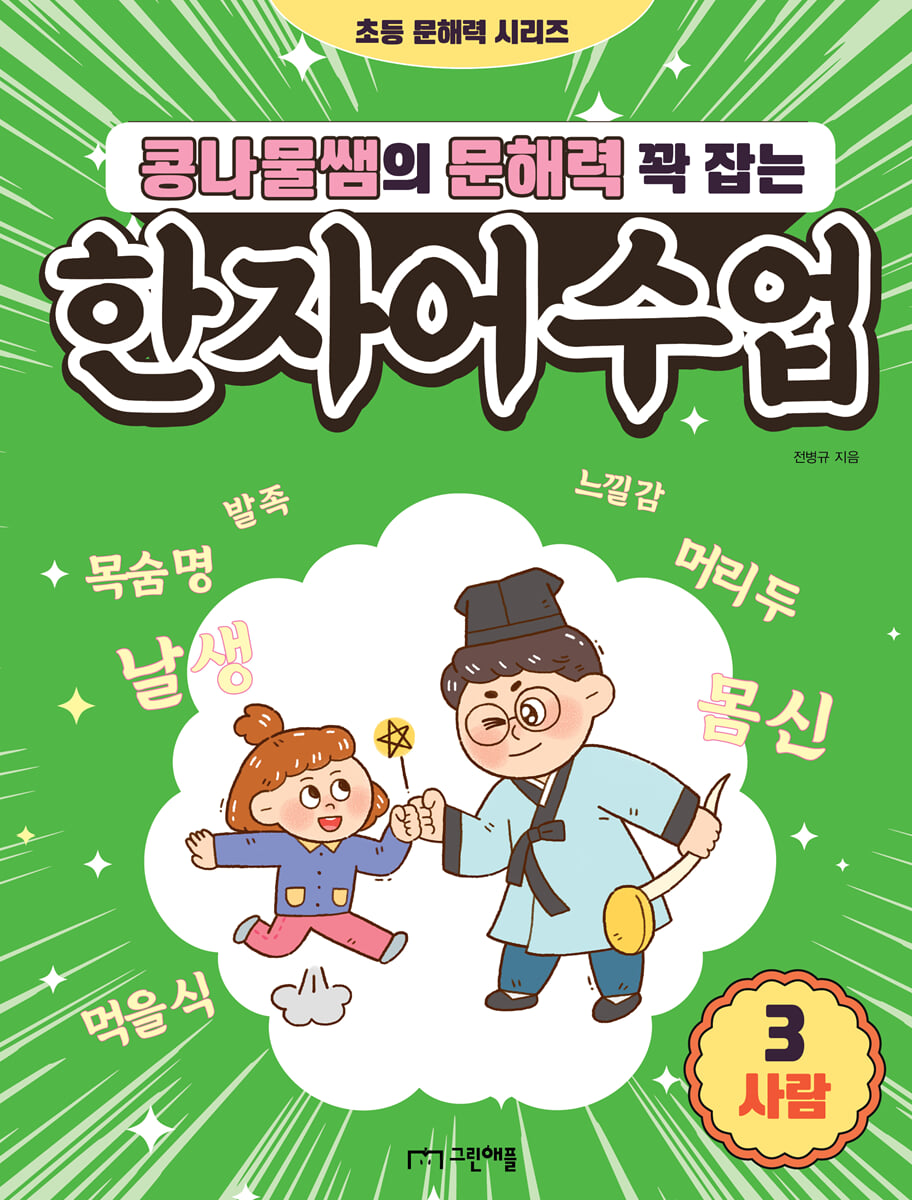
Teacher Kongnamul's Chinese character class that will help you master literacy for 3 people
 |
Description
Book Introduction
A current elementary school teacher and education influencer with 190,000 followers. A journey to improve your Chinese character literacy with Teacher Kongnamul! In the information society, literacy is a life skill that our children must have! What are the Chinese characters in the sentence, "The student with the highest grades will be given priority?" "Best," "grades," "student," "first," "priority," and "award" are all Chinese characters. Did you know that 60% of our vocabulary is comprised of Chinese characters? Even the words we use most commonly in our daily lives are often composed of Chinese characters. Therefore, education in Chinese characters is essential to develop literacy. Author Jeon Byeong-gyu, an elementary school teacher with 20 years of experience and well-known as the YouTuber ‘Kongnamul Teacher’. He has been researching and teaching for over 20 years on how to develop children's literacy skills more effectively. And I realized that the most basic thing needed was Chinese character education. The thing that has the greatest impact on literacy is vocabulary, and in order to learn vocabulary correctly, you must first know Chinese characters. First, the author looked for Chinese character textbooks to teach his children, but none of the books on the market helped them properly understand and use the meaning of the vocabulary. So, the author, a literacy expert, created a Chinese character textbook that directly improves literacy. The special feature of the [Elementary Literacy Series] is that it is based on the experience accumulated over a long period of time while teaching children in elementary schools, and rather than studying Chinese characters by reading and memorizing them, it focuses on inferring and exploring the meaning of words based on 'Chinese characters'. The third book in the series, “Kongnamul Teacher’s Chinese Character Class that Tightens Literacy,” is about “people.” In Volume 3, Chinese characters related to people appear. There are life stages that a person must go through, such as birth, aging, illness, and death, and physical bodies, such as the sphere, aspect, number, and foot. And you will learn Chinese words derived from these Chinese characters. After studying Volume 3, you will be able to learn many Chinese characters and words related to people. In particular, this book is designed so that students can learn a total of 120 core Chinese characters in 30 days, one Chinese character per day for 30 different topics. Through this book, students can develop literacy, reasoning skills, vocabulary, creativity, and inquiry skills all at once. |
- You can preview some of the book's contents.
Preview
index
Recommendation
Prologue: The Power of Literacy
Vocabulary learning principles and how to use this book to improve vocabulary.
Week 1
My birthday / my biological birthday / my biological mother / my biological mother
Life / Lifespan / Fate / Human life
Old age / old age / old and young / birth, aging, illness, and death
disease disease name / sick person / disease / longevity without illness
Death / death / casualties / life and death
Week 1 Review
Week 2
Surname / Surname / Name / Same surname and same clan
Name / Nickname / Alias / Quote / Nameless person
Body God Body / Height / New Life / Receiver
Body strength / body temperature / physical education / military affairs
Two heads / headache / lead / thorough
Week 2 Review
Week 3
Eyes, neck, witness / blind / face / eye contact
Entrance relief / family / entrance / same-sex couple
Face-to-face interview / mask / front / unfamiliar person
Hand towel / Manual / Technique / Self-made
Foot and ankle sprain / shackles / four-legged / foot and ankle sprain
Week 3 Review
Week 4
Drinking food / beverages / drinking / abstaining from eating and drinking
Food restaurants / Dining out / Drinking water / Free meals
shit pee poop toilet / latrine / defecation / excrement
Lively life / active life / active / nomadic life
The fact of the matter / everything / circumstances / if it is to be done
Week 4 Review
Week 5
Rest / Holiday / Holidays / Open all year round
Mind, heart, mind and body / anxiety / mindfulness / three days of determination
Thinking / Thinking / Thinking / Thinking / Thinking in another's shoes
Feeling / feeling / empathy / feeling deeply moved
Personality / personality / eating habits / gender equality
Week 5 Review
Week 6
Meaning: emotion / feeling / coolness / cognitive assumption
Opinion / desire / agreement / meaningful
Power / National power / Strong / Violent / Force majeure
Convenient / Inconvenient / Convenience store / General location
owner owner owner / claim / stock / democracy
Week 6 Review
Correct answer
Prologue: The Power of Literacy
Vocabulary learning principles and how to use this book to improve vocabulary.
Week 1
My birthday / my biological birthday / my biological mother / my biological mother
Life / Lifespan / Fate / Human life
Old age / old age / old and young / birth, aging, illness, and death
disease disease name / sick person / disease / longevity without illness
Death / death / casualties / life and death
Week 1 Review
Week 2
Surname / Surname / Name / Same surname and same clan
Name / Nickname / Alias / Quote / Nameless person
Body God Body / Height / New Life / Receiver
Body strength / body temperature / physical education / military affairs
Two heads / headache / lead / thorough
Week 2 Review
Week 3
Eyes, neck, witness / blind / face / eye contact
Entrance relief / family / entrance / same-sex couple
Face-to-face interview / mask / front / unfamiliar person
Hand towel / Manual / Technique / Self-made
Foot and ankle sprain / shackles / four-legged / foot and ankle sprain
Week 3 Review
Week 4
Drinking food / beverages / drinking / abstaining from eating and drinking
Food restaurants / Dining out / Drinking water / Free meals
shit pee poop toilet / latrine / defecation / excrement
Lively life / active life / active / nomadic life
The fact of the matter / everything / circumstances / if it is to be done
Week 4 Review
Week 5
Rest / Holiday / Holidays / Open all year round
Mind, heart, mind and body / anxiety / mindfulness / three days of determination
Thinking / Thinking / Thinking / Thinking / Thinking in another's shoes
Feeling / feeling / empathy / feeling deeply moved
Personality / personality / eating habits / gender equality
Week 5 Review
Week 6
Meaning: emotion / feeling / coolness / cognitive assumption
Opinion / desire / agreement / meaningful
Power / National power / Strong / Violent / Force majeure
Convenient / Inconvenient / Convenience store / General location
owner owner owner / claim / stock / democracy
Week 6 Review
Correct answer
Detailed image

Publisher's Review
In the information age, literacy is competitiveness.
Chinese character classes to improve your child's literacy skills
Recently, a company posted a notice on social media saying, “We offer our deepest apologies.”
Then, many netizens posted comments in protest, saying, "Why are you so upset when you should have apologized sincerely?"
This is because there was a lack of literacy that could interpret the 'simsim (甚深)' apology as meaning a 'deep and earnest apology.'
There was even an absurd incident where a politician recently said, “I wish you good luck in battle,” and a current reporter interpreted it as “I wish you no luck,” and reported it.
So, it seems natural that netizens are protesting against the film critic's comment that it is "clearly woven."
There is a reason why these things cannot be passed off as a single incident.
This is because a recent survey found that a significant number of elementary school teachers are having great difficulty teaching textbook vocabulary to students.
According to the results of a survey conducted by the Korea Educational Development Institute on 'Teachers' Perceptions of Vocabulary Instruction in Korean and Math Textbooks for 1st and 2nd Grade Elementary School Students' conducted on 257 homeroom teachers of 1st and 2nd grade elementary schools nationwide, 67% of Korean teachers and 60.3% of math teachers answered that they 'found it difficult.'
Although most experts agree that basic Chinese character education is necessary for vocabulary development, proper Chinese character education is not provided in elementary school curricula.
In this reality, in order to develop children's literacy, it is important for parents to first recognize the need to study Chinese characters and teach their children the right way to learn vocabulary.
Literacy is not only the foundation for lifelong learning, but also the competitive edge children need to survive.
Based on the principles of vocabulary learning
Step 4 Chinese Character Class
Most Chinese character textbooks published on the market so far focus solely on the Chinese characters themselves.
Studying only how to write Chinese characters and memorizing their meanings may help you obtain a Chinese character certificate, but it has limited potential to improve your vocabulary.
Author Jeon Byeong-gyu organized the contents of this book to help readers deeply and properly understand vocabulary rather than the Chinese characters themselves.
Instead of tiring out children by memorizing how to write Chinese characters, we chose to stimulate their interest by using a variety of vocabulary.
The author says that the following learning effects can be expected for children through this book.
● Learn a variety of vocabulary.
● You will gain a deeper understanding of the meaning of words.
● You will be able to infer the meaning of unknown words on your own.
● You will be able to use words in actual sentences.
To increase your vocabulary, it is important to first learn how to learn vocabulary.
If you learn the wrong way, you will only waste time and effort and your skills will not improve much.
This book is structured based on the four-step principle of vocabulary learning.
Step 1: Guess the vocabulary!
When you first encounter a new word, it is important to first guess its meaning.
A topic Chinese character is presented, and four Chinese character words using the Chinese character are introduced below it.
Here, we pay attention to the meaning of each Chinese character that makes up each word and try to guess the meaning of the word.
This book contains 30 thematic Chinese characters and 120 core Chinese character words.
By guessing the meaning of these 120 key Chinese characters, your child's reasoning skills and vocabulary will be enriched.
Step 2: Understand the vocabulary through examples!
Vocabulary has many hidden aspects, so learning it by memorizing the definitions of words alone is not the same as learning it.
We need to train ourselves to look at vocabulary that is naturally incorporated into sentences and think about what it actually means.
The second page of this book contains the meanings and example sentences for the four words we guessed earlier.
Compare the meaning you guessed before with the meaning presented in the book.
It is important not just to check the meaning, but to try to understand how it came to be this way.
Try using the 3-step vocabulary!
Now that you've guessed the vocabulary and understood it in sentences, it's time to try using it yourself.
On the third page, try writing.
You can use the four words you learned earlier to fill in the blanks or continue part of the given sentence.
If possible, it would be a good idea to try writing completely new sentences using the Chinese characters you have learned.
Pay attention to the 4th level vocabulary!
To have a rich vocabulary, you must pay attention to vocabulary on a daily basis.
To get children interested in vocabulary in a fun way, like playing with words, the fourth page features a 'Creativity Corner' where children write sentences using two or more key Chinese characters.
This is an activity that combines word play and writing.
Below, in 'Tighten Your Inquiry Power', you can explore new words you haven't learned yet by finding and writing words around you that contain Chinese characters you learned before in the blank spaces.
GOODS SPECIFICS
- Publication date: December 12, 2022
- Page count, weight, size: 168 pages | 596g | 190*250*20mm
- ISBN13: 9791192527161
- ISBN10: 119252716X
- KC Certification: Certification Type: Conformity Confirmation
You may also like
카테고리
korean


korean

![GQ KOREA Mark (Monthly): December [2025]](http://librairie.coreenne.fr/cdn/shop/files/8ef265dbbfbf186523ed75ba7319009d.jpg?v=1765340328&width=3840)


