

Age of Void
 |
Description
Book Introduction
- A word from MD
-
You can live well without a purposeWhy do we live so intensely, yet ultimately feel so empty? Cho Nam-ho, CEO of Lifecode and author of this book, argues that the reason lies not in individual problems, but in the social structure that revolves around purpose.
What we need now is not a goal, but the fulfillment of cultivating ourselves by focusing on the process.
September 12, 2025. Self-Development PD Oh Da-eun
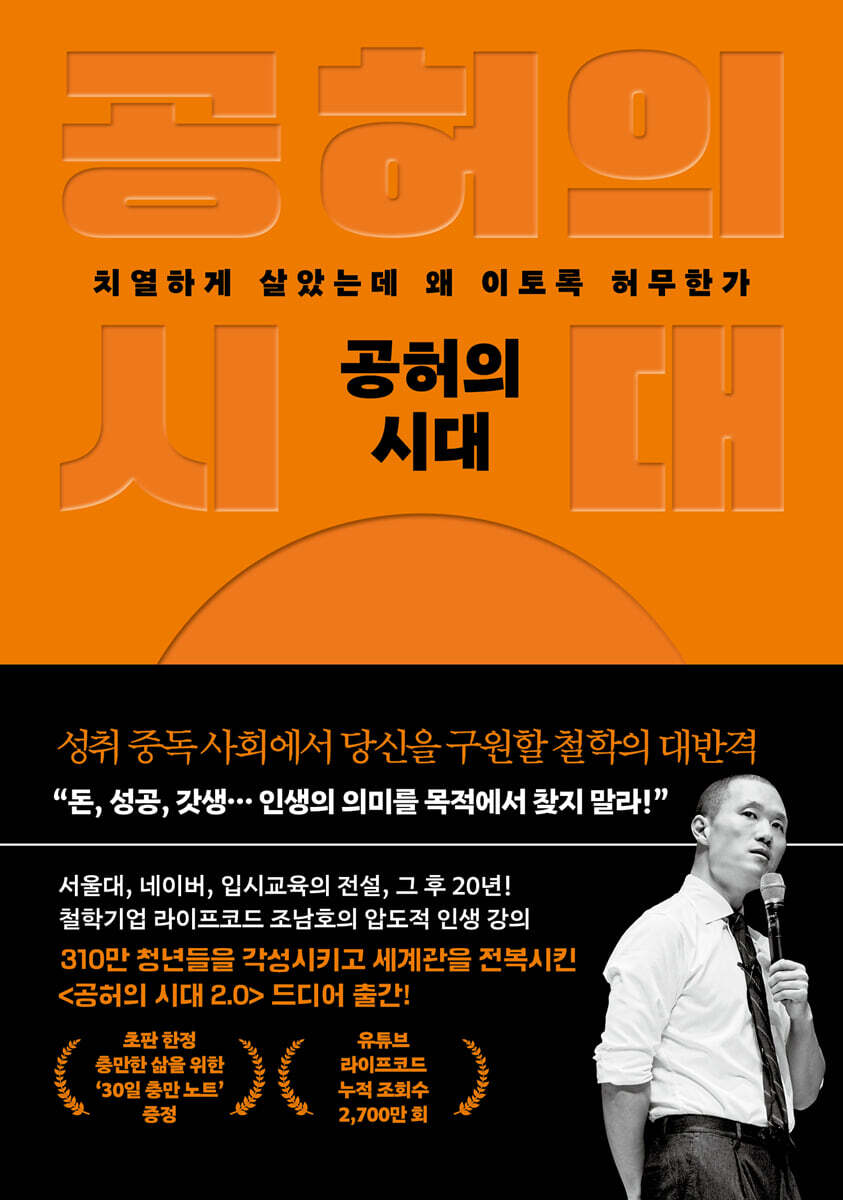
★Lecture Concert "The Age of Emptiness" Cumulative Views 3.1 Million★
Seoul National University, Naver, the legend of entrance exam education, the CEO of Study Code, and 20 years later...
An overwhelming life lecture from Namho Cho, CEO of philosophy company Lifecode!
“All the success you have believed in is an illusion.
Stop belittling yourself by saying you failed because you were weak or lazy!”
Debunking the myth of success that consumes life
A revolution in perspective that restores lost values and meaning
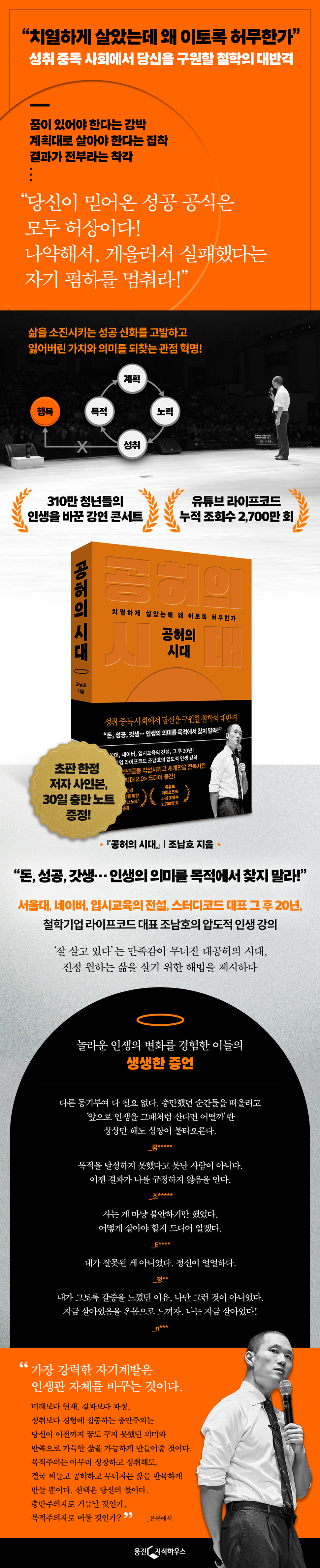
"The Age of Emptiness" is a book that accuses us of feeling empty, not because of a lack of personal ability or effort, but because of the old frame of "purposefulness" that has been internalized within us.
Purposiveness is a value system that places the meaning of life solely on achieving and accomplishing future goals.
Author Namho Cho graduated from Seoul National University's Department of Computer Science and Engineering and joined Naver, but left the company with the goal of researching "what constitutes a good life" and developing solutions that can be applied to real life.
After 20 years of research, he founded the philosophy company Lifecode and published the results in a lecture of the same name, “The Age of Emptiness,” which received an explosive response from people and set an unprecedented record of 3.1 million cumulative views.
Placing meaning and value solely on future goals leaves today empty, ultimately leading to apathy, self-reproach, and emptiness.
The author presents a new alternative to purpose-oriented philosophy, a philosophy of life called 'fulfillment-oriented philosophy.'
Enrichment is a life philosophy that focuses on the present rather than the future, on the process rather than the outcome, and on the experience rather than the achievement.
Drawing on philosophy, evolution, and brain science, the author directly refutes purposiveness, meticulously analyzes emptiness, and logically argues how living fully leads to a meaningful life.
"The Age of Emptiness" is not simply a book of comfort or self-improvement, but a manifesto that fundamentally overturns the framework of life we have believed in until now.
Seoul National University, Naver, the legend of entrance exam education, the CEO of Study Code, and 20 years later...
An overwhelming life lecture from Namho Cho, CEO of philosophy company Lifecode!
“All the success you have believed in is an illusion.
Stop belittling yourself by saying you failed because you were weak or lazy!”
Debunking the myth of success that consumes life
A revolution in perspective that restores lost values and meaning
"The Age of Emptiness" is a book that accuses us of feeling empty, not because of a lack of personal ability or effort, but because of the old frame of "purposefulness" that has been internalized within us.
Purposiveness is a value system that places the meaning of life solely on achieving and accomplishing future goals.
Author Namho Cho graduated from Seoul National University's Department of Computer Science and Engineering and joined Naver, but left the company with the goal of researching "what constitutes a good life" and developing solutions that can be applied to real life.
After 20 years of research, he founded the philosophy company Lifecode and published the results in a lecture of the same name, “The Age of Emptiness,” which received an explosive response from people and set an unprecedented record of 3.1 million cumulative views.
Placing meaning and value solely on future goals leaves today empty, ultimately leading to apathy, self-reproach, and emptiness.
The author presents a new alternative to purpose-oriented philosophy, a philosophy of life called 'fulfillment-oriented philosophy.'
Enrichment is a life philosophy that focuses on the present rather than the future, on the process rather than the outcome, and on the experience rather than the achievement.
Drawing on philosophy, evolution, and brain science, the author directly refutes purposiveness, meticulously analyzes emptiness, and logically argues how living fully leads to a meaningful life.
"The Age of Emptiness" is not simply a book of comfort or self-improvement, but a manifesto that fundamentally overturns the framework of life we have believed in until now.
- You can preview some of the book's contents.
Preview
index
prolog
Part 1.
The Counterattack of Purposefulness
Chapter 1.
Dissecting "Purposefulness," a common life standard for modern people
Where did my meaningful and valuable life go?
The basic mechanism of feeling emptiness
Purposefulness: The Unconscious Standard of Life
Chapter 2.
The Identity of Purposefulness and the Mechanism of Its Fascination
What is the purpose
What have we been planning and making plans for our entire lives?
Live each day for a purpose
Chapter 3.
The ruling structure of objectiveism that has become the absolute standard
We have been struggling to make our 'purpose' clear.
We have been struggling to clarify the 'method and plan'.
We have been struggling to make 'the day' clearer.
We have been living within a purposeful schema.
It's not that you're wrong, it's that the standards are wrong.
Part 2.
Deconstruction of Purpose
Chapter 4.
The purpose is an illusion
Purpose is an Illusion 1: Questions
Purpose is an Illusion 2: Philosophy and Evolution
Purpose is an Illusion 3: The Capitalist Illusion
The Purpose is an Illusion 4: Counterexample
Chapter 5.
The plan is an illusion
Plans are a Fiction 1: Variables
Plans Are Illegible 2: Complexity and Change
Plans Are Illusions 3: The High-Growth Illusion
Plans are a Fake 4: Counterexamples
Chapter 6.
Will is an illusion
Will is an Illusion 1: Extrinsic Motivation
Will is an Illusion 2: Sick Fierce
Will is an Illusion 3: Empty Everyday Life
Will is an Illusion 4: Counterexamples
Chapter 7.
Achievement is an illusion
Achievement is an Illusion 1: Variables
Achievement is an Illusion 2: Self-Reproach
Achievement is an Illusion 3: It's All Empty
Achievement is an Illusion 4: Counterexamples
Chapter 8.
Achievement is an illusion
Achievement is an Illusion 1: Momentary Achievement and Questions
Achievement is an Illusion 2: Change in Society and Me
Achievement is an Illusion 3: The Fundamental Contradiction
Purposiveness is an illusion: The final counterexample
Chapter 9.
Purpose-based thinking is wrong
A journey to prove, not assert
Comfort, not logic, comfort, logic, not comfort
Escape from purposeism
Part 3.
The Restoration of Fullness
Chapter 10.
The Awakening of "Fulfillmentism," the True Meaning of Humanity and the Value Mechanism
The true nature of human beings regarding the meaning and value of life
We have already felt the meaning and value of life without purpose.
The principle of feeling 'well-lived'
One word, 'fullness'
'Sufficiency': The True Mechanism of Human Nature
Where does the meaning and value of life lie?
Achievementism is not nihilism
Chapter 11.
Applying the doctrine of abundance, a revolution in life
Abundanceism, not discriminating between experiences
Obsolescence, being indifferent to the outcome
The Third Race, the Satisfiers
Purpose vs.
The Difference Between Two Perspectives That Determine Life
Chapter 12.
Your future begins with fullness
Beyond theory to practice, become a full-timer starting today.
Our Perfect Days
Live Fully
Epilogue_The Renaissance of My Life
Part 1.
The Counterattack of Purposefulness
Chapter 1.
Dissecting "Purposefulness," a common life standard for modern people
Where did my meaningful and valuable life go?
The basic mechanism of feeling emptiness
Purposefulness: The Unconscious Standard of Life
Chapter 2.
The Identity of Purposefulness and the Mechanism of Its Fascination
What is the purpose
What have we been planning and making plans for our entire lives?
Live each day for a purpose
Chapter 3.
The ruling structure of objectiveism that has become the absolute standard
We have been struggling to make our 'purpose' clear.
We have been struggling to clarify the 'method and plan'.
We have been struggling to make 'the day' clearer.
We have been living within a purposeful schema.
It's not that you're wrong, it's that the standards are wrong.
Part 2.
Deconstruction of Purpose
Chapter 4.
The purpose is an illusion
Purpose is an Illusion 1: Questions
Purpose is an Illusion 2: Philosophy and Evolution
Purpose is an Illusion 3: The Capitalist Illusion
The Purpose is an Illusion 4: Counterexample
Chapter 5.
The plan is an illusion
Plans are a Fiction 1: Variables
Plans Are Illegible 2: Complexity and Change
Plans Are Illusions 3: The High-Growth Illusion
Plans are a Fake 4: Counterexamples
Chapter 6.
Will is an illusion
Will is an Illusion 1: Extrinsic Motivation
Will is an Illusion 2: Sick Fierce
Will is an Illusion 3: Empty Everyday Life
Will is an Illusion 4: Counterexamples
Chapter 7.
Achievement is an illusion
Achievement is an Illusion 1: Variables
Achievement is an Illusion 2: Self-Reproach
Achievement is an Illusion 3: It's All Empty
Achievement is an Illusion 4: Counterexamples
Chapter 8.
Achievement is an illusion
Achievement is an Illusion 1: Momentary Achievement and Questions
Achievement is an Illusion 2: Change in Society and Me
Achievement is an Illusion 3: The Fundamental Contradiction
Purposiveness is an illusion: The final counterexample
Chapter 9.
Purpose-based thinking is wrong
A journey to prove, not assert
Comfort, not logic, comfort, logic, not comfort
Escape from purposeism
Part 3.
The Restoration of Fullness
Chapter 10.
The Awakening of "Fulfillmentism," the True Meaning of Humanity and the Value Mechanism
The true nature of human beings regarding the meaning and value of life
We have already felt the meaning and value of life without purpose.
The principle of feeling 'well-lived'
One word, 'fullness'
'Sufficiency': The True Mechanism of Human Nature
Where does the meaning and value of life lie?
Achievementism is not nihilism
Chapter 11.
Applying the doctrine of abundance, a revolution in life
Abundanceism, not discriminating between experiences
Obsolescence, being indifferent to the outcome
The Third Race, the Satisfiers
Purpose vs.
The Difference Between Two Perspectives That Determine Life
Chapter 12.
Your future begins with fullness
Beyond theory to practice, become a full-timer starting today.
Our Perfect Days
Live Fully
Epilogue_The Renaissance of My Life
Detailed image
Into the book
Through this book, you will experience a 'change in life'.
Anyone reading this book will have constantly pondered, "Is this the right way to live?" and "What exactly constitutes a good life?"
And you may have read many books on humanities and philosophy to find the answer.
But those abstract and metaphysical stories, while good words, would have ended up as nothing more than 'inspiration'.
It would not have been absorbed into life.
This book is both a philosophical and practical book.
It is the result of a disciplined company that has long been grafting abstractions onto reality.
This book will get you started right away.
This is a book that can really change your life.
--- p.12, from "Prologue"
One night, as you lay down to sleep, a thought suddenly crossed your mind.
"ah.
“I don’t know if living like this is meaningful.” A huge emptiness spreads strongly from the depths of my heart.
Some people may experience such feelings as a passing discomfort, while others may feel an extreme sense of emptiness that makes their lives miserable.
I think everyone has felt it, although to varying degrees.
The reason you opened this book now is probably because of the feeling of emptiness that suddenly struck the back of your head one day, a feeling that was difficult to ignore.
--- p.22, from “Chapter 1: Anatomy of ‘Purposefulness,’ a Common Life Standard for Modern People”
A life that follows purpose is destined to be eternally empty.
Because no one can reach the goal.
Yet, we are collectively engaging in acts of self-destruction to reach that standard.
You push yourself, change your methods, design each day and pour all your energy into it.
But no matter how hard you try, when you look back, all that will remain is self-reproach and emptiness, thinking, 'Why couldn't I do better than this?'
Perhaps you are currently content with a lifestyle that follows a purpose-driven paradigm.
But sooner or later, there will inevitably be a departure from that formula.
Because the purposive schema is not a formula that fits human life.
--- p.47, from “Chapter 3: The Governing Structure of Purpose-Oriented Absolute Standards”
Many people say, “I don’t have a dream,” or “I’m looking for a dream.”
It may not be that they don't have dreams, but rather that they have asked themselves too many fundamental questions about whether this purpose is truly complete.
Conversely, people who have a clear dream or purpose may not be asking themselves that question yet.
But every human being eventually faces these questions.
And at the end of the encounter, most people will say something like this.
“I don’t know,” he said.
--- From Chapter 4, p.58, “Purpose is an illusion”
Now we understand why plans don't move forward, why motivational videos and lectures spark a brief but fleeting spark.
The purposive schema may seem very plausible, but it is a flawed schema that does not take human nature into account at all.
External motivation might get you moving for a while, but it's nearly impossible to sustain it.
--- p.88, from “Chapter 6: Will is an Illusion”
The reason we set goals is to live a meaningful and valuable life.
But it is too 'dangerous a gamble' to make your entire life worthless just because of 'that day' of achievement.
“Why don’t you just achieve it?” is an overly naive approach.
As we have seen, achieving the goal is not guaranteed.
It's not that I'm not trying hard enough, it's that my efforts only have 10-30 percent of the impact.
Because variables beyond my control determine my success and failure.
In this situation, purposefulness, which judges the meaning and value of life solely on the achievement of goals, is a gamble.
--- p.104, from “Chapter 7 Achievement is an Illusion”
The attitude of 'I will experience 100 percent' is a declaration that I will live my finite life to the fullest.
It doesn't even consider results or achievements.
There is a saying, “Even if the world were to end tomorrow, I would still plant an apple tree.”
This is a statement that cannot be explained by purpose.
A life where you dedicate 100 percent of your time to planting trees, even if they disappear tomorrow.
This proverb is not meant to be romantic.
This is a sentence that provides insight into the essence of life and human nature.
The desire to live life to the fullest is the most fundamental human instinct.
--- p.148, from “Chapter 10: The True Meaning of Humanity, the Awakening of the Value Mechanism ‘Fulfillmentism’”
“Instead of wandering around looking for something that is missing in my life, let’s start living my life properly now.
“Life is filled with life.” This is a new definition and response to the emptiness that comes when we change our perspective on life.
--- p.165, from “Chapter 10: The True Meaning of Humanity, the Awakening of the Value Mechanism ‘Fulfillmentism’”
Fullness can revolutionarily save us.
Because it is a logical proof that I can restore a sense of meaning and value in my life not only through grandiose experiences, but also through any experience.
Because we can even recover from everyday experiences that we took for granted.
As the saying goes, "the darkness is under the lamp," meaning that we can recover the meaning of life from the daily life that is always close by.
Stop searching for something grand.
--- p.181, from “Chapter 11 Application of Fullness, Revolution in Life”
The most powerful self-improvement is changing your outlook on life.
Fullness will make possible a life filled with meaning and satisfaction I could never have dreamed of before.
Purpose-based thinking, no matter how much you develop, grow, and achieve, will ultimately lead you to a life of exhaustion, emptiness, and collapse.
Just changing your outlook on life can make a huge difference in your life.
--- p.204, from “Chapter 11 Application of Fullness, Revolution in Life”
It is also important to remember that just because the majority says something, it doesn't prove it is human nature.
Face it, this is simply the result of being swept up in the illusion of the high-growth era and having no choice but to believe that purposefulness is right.
Don't forget the contradiction that among the many who live with a purpose-oriented outlook on life, none of them ever achieves perfection in their lives.
Ultimately, in this 'age of emptiness' where the majority is unhappy, don't forget that you have willingly chosen to become a 'full minority' for your own life.
Anyone reading this book will have constantly pondered, "Is this the right way to live?" and "What exactly constitutes a good life?"
And you may have read many books on humanities and philosophy to find the answer.
But those abstract and metaphysical stories, while good words, would have ended up as nothing more than 'inspiration'.
It would not have been absorbed into life.
This book is both a philosophical and practical book.
It is the result of a disciplined company that has long been grafting abstractions onto reality.
This book will get you started right away.
This is a book that can really change your life.
--- p.12, from "Prologue"
One night, as you lay down to sleep, a thought suddenly crossed your mind.
"ah.
“I don’t know if living like this is meaningful.” A huge emptiness spreads strongly from the depths of my heart.
Some people may experience such feelings as a passing discomfort, while others may feel an extreme sense of emptiness that makes their lives miserable.
I think everyone has felt it, although to varying degrees.
The reason you opened this book now is probably because of the feeling of emptiness that suddenly struck the back of your head one day, a feeling that was difficult to ignore.
--- p.22, from “Chapter 1: Anatomy of ‘Purposefulness,’ a Common Life Standard for Modern People”
A life that follows purpose is destined to be eternally empty.
Because no one can reach the goal.
Yet, we are collectively engaging in acts of self-destruction to reach that standard.
You push yourself, change your methods, design each day and pour all your energy into it.
But no matter how hard you try, when you look back, all that will remain is self-reproach and emptiness, thinking, 'Why couldn't I do better than this?'
Perhaps you are currently content with a lifestyle that follows a purpose-driven paradigm.
But sooner or later, there will inevitably be a departure from that formula.
Because the purposive schema is not a formula that fits human life.
--- p.47, from “Chapter 3: The Governing Structure of Purpose-Oriented Absolute Standards”
Many people say, “I don’t have a dream,” or “I’m looking for a dream.”
It may not be that they don't have dreams, but rather that they have asked themselves too many fundamental questions about whether this purpose is truly complete.
Conversely, people who have a clear dream or purpose may not be asking themselves that question yet.
But every human being eventually faces these questions.
And at the end of the encounter, most people will say something like this.
“I don’t know,” he said.
--- From Chapter 4, p.58, “Purpose is an illusion”
Now we understand why plans don't move forward, why motivational videos and lectures spark a brief but fleeting spark.
The purposive schema may seem very plausible, but it is a flawed schema that does not take human nature into account at all.
External motivation might get you moving for a while, but it's nearly impossible to sustain it.
--- p.88, from “Chapter 6: Will is an Illusion”
The reason we set goals is to live a meaningful and valuable life.
But it is too 'dangerous a gamble' to make your entire life worthless just because of 'that day' of achievement.
“Why don’t you just achieve it?” is an overly naive approach.
As we have seen, achieving the goal is not guaranteed.
It's not that I'm not trying hard enough, it's that my efforts only have 10-30 percent of the impact.
Because variables beyond my control determine my success and failure.
In this situation, purposefulness, which judges the meaning and value of life solely on the achievement of goals, is a gamble.
--- p.104, from “Chapter 7 Achievement is an Illusion”
The attitude of 'I will experience 100 percent' is a declaration that I will live my finite life to the fullest.
It doesn't even consider results or achievements.
There is a saying, “Even if the world were to end tomorrow, I would still plant an apple tree.”
This is a statement that cannot be explained by purpose.
A life where you dedicate 100 percent of your time to planting trees, even if they disappear tomorrow.
This proverb is not meant to be romantic.
This is a sentence that provides insight into the essence of life and human nature.
The desire to live life to the fullest is the most fundamental human instinct.
--- p.148, from “Chapter 10: The True Meaning of Humanity, the Awakening of the Value Mechanism ‘Fulfillmentism’”
“Instead of wandering around looking for something that is missing in my life, let’s start living my life properly now.
“Life is filled with life.” This is a new definition and response to the emptiness that comes when we change our perspective on life.
--- p.165, from “Chapter 10: The True Meaning of Humanity, the Awakening of the Value Mechanism ‘Fulfillmentism’”
Fullness can revolutionarily save us.
Because it is a logical proof that I can restore a sense of meaning and value in my life not only through grandiose experiences, but also through any experience.
Because we can even recover from everyday experiences that we took for granted.
As the saying goes, "the darkness is under the lamp," meaning that we can recover the meaning of life from the daily life that is always close by.
Stop searching for something grand.
--- p.181, from “Chapter 11 Application of Fullness, Revolution in Life”
The most powerful self-improvement is changing your outlook on life.
Fullness will make possible a life filled with meaning and satisfaction I could never have dreamed of before.
Purpose-based thinking, no matter how much you develop, grow, and achieve, will ultimately lead you to a life of exhaustion, emptiness, and collapse.
Just changing your outlook on life can make a huge difference in your life.
--- p.204, from “Chapter 11 Application of Fullness, Revolution in Life”
It is also important to remember that just because the majority says something, it doesn't prove it is human nature.
Face it, this is simply the result of being swept up in the illusion of the high-growth era and having no choice but to believe that purposefulness is right.
Don't forget the contradiction that among the many who live with a purpose-oriented outlook on life, none of them ever achieves perfection in their lives.
Ultimately, in this 'age of emptiness' where the majority is unhappy, don't forget that you have willingly chosen to become a 'full minority' for your own life.
--- p.218, from “Chapter 12: Your Future: Starting Fullness”
Publisher's Review
“I lived so fiercely, but why am I so empty?”
In an era of great emptiness, where the sense of satisfaction with 'living well' has collapsed,
Providing solutions for living the life you truly desire.
We live in an 'age of emptiness'.
Even though I try harder than ever to reach my 'dream', I can't stop doubting whether I'm on the wrong path in life and constantly blame myself for my failures.
In it, even the meaning of life is blurred.
For modern people, emptiness is not an individual emotion, but a symptom created by the social structure.
Many people are dissatisfied with their lives and, instead, they fall into a state of apathy, blaming themselves for their weakness and incompetence.
Many indicators, such as the yearly increase in the percentage of "young people who have given up on finding a job" and the fact that more than 69 percent of workers have experienced burnout, indicate that our current achievement-oriented society has reached its limits.
This suggests that a new value paradigm different from the past is needed.
"A meaningful life, fulfillment, purpose." The book "The Age of Emptiness" has been published, which directly dismantles the keywords of life that everyone pursues but no one is certain of.
The author, Namho Cho, graduated from the Department of Computer Engineering at Seoul National University, worked at Naver, and became known in the college entrance exam education world with his "Study Method."
After 20 years of research on the topic of “How to live well,” he developed abstract and theoretical philosophy into concrete practices for living a truly meaningful life. He then founded the philosophy company Life Code and began presenting his philosophy to the public in 2024 through lectures titled “The Age of Emptiness.”
The lecture video attracted attention, garnering an unusually high number of views, 3.1 million, despite being over three hours long.
This book is the result of developing a lecture of the same name into a book.
"The Age of Emptiness" is neither a sentimental essay offering simple comfort nor a motivational self-help book that carefully calculates the next step.
This is a philosophical and practical book that, through logical language and academic evidence, dismantles the "purposeful" framework that has been considered the formula for life, allowing readers to break free from old thought patterns and ask new questions.
The question, “Why am I so empty?” is the reality and challenge that our generation most resonates with and is deeply connected to.
"The Age of Emptiness" forces readers to face that question head-on, rather than avoid it.
“The formula for success you’ve been believing in is wrong!”
Common standards of life for modern people,
A philosophical counterattack that overturns the "purposeful" frame.
Modern society constantly demands that we find purpose, make plans, and achieve our dreams.
We have been brainwashed throughout our lives to believe that we must meticulously plan and achieve our goals to truly live a fulfilling life.
However, the author says that the entire process is an illusion, and what awaits at the end of the process is not a meaningful life, but only emptiness.
『The Age of Emptiness』 first and foremost questions the old success myth of ‘purposefulness.’
Purposiveness is a view of life that believes that the meaning of life lies in a specific purpose and that running toward that purpose is the right way to live.
Up until now, countless self-help books have emphasized achieving a purpose in order to live a meaningful life.
Achieving financial freedom, living happily with your family, and building a stable life—these are all other names for “purpose.”
Our society has stigmatized a life without dreams or purpose as worthless.
Just like schools demand good grades and workplaces demand achievement of KPIs.
To live a good and worthwhile life, certain standards had to be reached.
However, the author points out that this purposefulness is the main cause of human emptiness.
It is precisely this very purposefulness that forces people into constant comparison and competition.
A life that follows purpose is destined to be eternally empty.
Because no one can reach the goal.
Yet, we are collectively engaging in acts of self-destruction to reach that standard.
You push yourself, change your methods, design each day and pour all your energy into it.
But no matter how hard you try, when you look back, all that will remain is self-reproach and emptiness, thinking, 'Why couldn't I do better than this?'
(Page 47)
If you only run towards your goal, the present moment is ignored and life becomes a means.
Because the question “Why do we live?” is evaluated as more important than “How should we live?”, the entire life becomes subordinated to purpose.
But the purpose always changes.
Times change, circumstances change, and the human ego also constantly changes.
Therefore, a fixed purpose does not exist in the first place, and cannot exist.
Nevertheless, in a social atmosphere that still forces purposefulness as the right answer, modern people feel anxious if they don't set goals, and consider them worthless if they don't achieve them.
People constantly make plans and pursue achievements, but now only emptiness remains.
"The Age of Emptiness" sharply points out the contradictions of modern society.
The author asserts that “the formula for success we cling to is nothing but an illusion,” and thoroughly dissects that purposefulness is no longer valid and is the root cause of today’s emptiness.
“Purposes waver, plans fall apart, and accomplishments disappear.”
The truth behind the success formula we have believed in
Dissecting it from the perspectives of evolution, brain science, and economics
The book revolves around three propositions: purpose, planning, and achievement are illusions.
Within these three structures, the author theoretically analyzes how the existing framework through which we have understood and evaluated life is a myth of unstable proportions, and logically dismantles the formula for life we have clung to by mobilizing arguments from philosophy, evolutionary chemistry, brain science, and economics.
First, from an evolutionary perspective, humans are not born to do anything, but are a product of chance, existing because they exist.
For example, the human body and instincts are not optimized for survival and have many structural weaknesses.
Yet we delude ourselves into thinking that life has a fixed purpose.
Second, brain science shows that the essence of achievement is futility.
Dopamine provides a momentary feeling of pleasure when you achieve a goal, but it quickly fades and makes you crave new goals.
Therefore, achievement never leads to lasting satisfaction.
Third, examples from economics and management reveal that the formula for success in the high-growth era was merely the luck of the times.
In the past, it seemed like setting goals and working hard was enough to guarantee success, but in reality, it was thanks to structural growth.
Even if you repeat that formula now, you won't get the same result.
The reason it seemed like there was a method, a formula, was because the flow of the times, the development of society, and the policies and systems pushed it forward.
It was not a result of individual ability or judgment, but rather the result of everything working together in a complex manner.
There is no absolute formula for success in life.
(Omitted) The fact that there were people who failed even in the era of high growth, and that the formula was constantly being revised and overturned, is clear evidence that there was no such formula in the first place.
(Page 81)
Considering all this evidence, the conclusion is clear.
The formula for success we believed in has deceived us.
Goals are always changing, plans fail to control countless variables, and achievements quickly lead to futility.
The author exposes the uncomfortable truth that "the belief that goals and achievements will guarantee life never existed in the first place," forcing readers to face reality.
Beyond the era of emptiness to fullness,
Life is not something to be achieved, but something to be filled.
The author proposes a new alternative to the goal-oriented view of life that has so firmly brainwashed people: 'fulfillmentism.'
Enrichment is a life philosophy that places meaning on being fully immersed and absorbed in the present moment, rather than focusing on achieving one's goals.
Accordingly, we provide specific practical guidance so that readers can accept and immediately apply the fullness philosophy as their own life philosophy.
For example, when exercising, it is more important to feel alive through the current exercise than to focus on the 'result' of building muscle or losing a certain number of kilograms.
When eating, rather than just eating something quickly or for the purpose of dieting, it is more essential to savor the food in front of you and the mealtime itself.
The same applies when working or studying.
If you realize that focusing on and growing in the process itself is more valuable than the results, you can live a fulfilling life.
The most powerful self-improvement is changing your outlook on life.
Fullness will make possible in my reality a life filled with meaning and satisfaction I could never have dreamed of before.
Purpose-based thinking, no matter how much you develop, grow, and achieve, will ultimately lead you to a life of exhaustion, emptiness, and collapse.
Just changing your outlook on life can make a huge difference in your life.
(Page 204)
The Age of Emptiness asks:
So, will you still pursue your purpose, or will you choose a fulfilling life?
This is not a simple matter of choice.
It is an essential transition to live in a new era and to escape the wrong standards of life that have worn me out and consumed me like a hamster wheel.
And this book will change your life completely, right now.
In an era of great emptiness, where the sense of satisfaction with 'living well' has collapsed,
Providing solutions for living the life you truly desire.
We live in an 'age of emptiness'.
Even though I try harder than ever to reach my 'dream', I can't stop doubting whether I'm on the wrong path in life and constantly blame myself for my failures.
In it, even the meaning of life is blurred.
For modern people, emptiness is not an individual emotion, but a symptom created by the social structure.
Many people are dissatisfied with their lives and, instead, they fall into a state of apathy, blaming themselves for their weakness and incompetence.
Many indicators, such as the yearly increase in the percentage of "young people who have given up on finding a job" and the fact that more than 69 percent of workers have experienced burnout, indicate that our current achievement-oriented society has reached its limits.
This suggests that a new value paradigm different from the past is needed.
"A meaningful life, fulfillment, purpose." The book "The Age of Emptiness" has been published, which directly dismantles the keywords of life that everyone pursues but no one is certain of.
The author, Namho Cho, graduated from the Department of Computer Engineering at Seoul National University, worked at Naver, and became known in the college entrance exam education world with his "Study Method."
After 20 years of research on the topic of “How to live well,” he developed abstract and theoretical philosophy into concrete practices for living a truly meaningful life. He then founded the philosophy company Life Code and began presenting his philosophy to the public in 2024 through lectures titled “The Age of Emptiness.”
The lecture video attracted attention, garnering an unusually high number of views, 3.1 million, despite being over three hours long.
This book is the result of developing a lecture of the same name into a book.
"The Age of Emptiness" is neither a sentimental essay offering simple comfort nor a motivational self-help book that carefully calculates the next step.
This is a philosophical and practical book that, through logical language and academic evidence, dismantles the "purposeful" framework that has been considered the formula for life, allowing readers to break free from old thought patterns and ask new questions.
The question, “Why am I so empty?” is the reality and challenge that our generation most resonates with and is deeply connected to.
"The Age of Emptiness" forces readers to face that question head-on, rather than avoid it.
“The formula for success you’ve been believing in is wrong!”
Common standards of life for modern people,
A philosophical counterattack that overturns the "purposeful" frame.
Modern society constantly demands that we find purpose, make plans, and achieve our dreams.
We have been brainwashed throughout our lives to believe that we must meticulously plan and achieve our goals to truly live a fulfilling life.
However, the author says that the entire process is an illusion, and what awaits at the end of the process is not a meaningful life, but only emptiness.
『The Age of Emptiness』 first and foremost questions the old success myth of ‘purposefulness.’
Purposiveness is a view of life that believes that the meaning of life lies in a specific purpose and that running toward that purpose is the right way to live.
Up until now, countless self-help books have emphasized achieving a purpose in order to live a meaningful life.
Achieving financial freedom, living happily with your family, and building a stable life—these are all other names for “purpose.”
Our society has stigmatized a life without dreams or purpose as worthless.
Just like schools demand good grades and workplaces demand achievement of KPIs.
To live a good and worthwhile life, certain standards had to be reached.
However, the author points out that this purposefulness is the main cause of human emptiness.
It is precisely this very purposefulness that forces people into constant comparison and competition.
A life that follows purpose is destined to be eternally empty.
Because no one can reach the goal.
Yet, we are collectively engaging in acts of self-destruction to reach that standard.
You push yourself, change your methods, design each day and pour all your energy into it.
But no matter how hard you try, when you look back, all that will remain is self-reproach and emptiness, thinking, 'Why couldn't I do better than this?'
(Page 47)
If you only run towards your goal, the present moment is ignored and life becomes a means.
Because the question “Why do we live?” is evaluated as more important than “How should we live?”, the entire life becomes subordinated to purpose.
But the purpose always changes.
Times change, circumstances change, and the human ego also constantly changes.
Therefore, a fixed purpose does not exist in the first place, and cannot exist.
Nevertheless, in a social atmosphere that still forces purposefulness as the right answer, modern people feel anxious if they don't set goals, and consider them worthless if they don't achieve them.
People constantly make plans and pursue achievements, but now only emptiness remains.
"The Age of Emptiness" sharply points out the contradictions of modern society.
The author asserts that “the formula for success we cling to is nothing but an illusion,” and thoroughly dissects that purposefulness is no longer valid and is the root cause of today’s emptiness.
“Purposes waver, plans fall apart, and accomplishments disappear.”
The truth behind the success formula we have believed in
Dissecting it from the perspectives of evolution, brain science, and economics
The book revolves around three propositions: purpose, planning, and achievement are illusions.
Within these three structures, the author theoretically analyzes how the existing framework through which we have understood and evaluated life is a myth of unstable proportions, and logically dismantles the formula for life we have clung to by mobilizing arguments from philosophy, evolutionary chemistry, brain science, and economics.
First, from an evolutionary perspective, humans are not born to do anything, but are a product of chance, existing because they exist.
For example, the human body and instincts are not optimized for survival and have many structural weaknesses.
Yet we delude ourselves into thinking that life has a fixed purpose.
Second, brain science shows that the essence of achievement is futility.
Dopamine provides a momentary feeling of pleasure when you achieve a goal, but it quickly fades and makes you crave new goals.
Therefore, achievement never leads to lasting satisfaction.
Third, examples from economics and management reveal that the formula for success in the high-growth era was merely the luck of the times.
In the past, it seemed like setting goals and working hard was enough to guarantee success, but in reality, it was thanks to structural growth.
Even if you repeat that formula now, you won't get the same result.
The reason it seemed like there was a method, a formula, was because the flow of the times, the development of society, and the policies and systems pushed it forward.
It was not a result of individual ability or judgment, but rather the result of everything working together in a complex manner.
There is no absolute formula for success in life.
(Omitted) The fact that there were people who failed even in the era of high growth, and that the formula was constantly being revised and overturned, is clear evidence that there was no such formula in the first place.
(Page 81)
Considering all this evidence, the conclusion is clear.
The formula for success we believed in has deceived us.
Goals are always changing, plans fail to control countless variables, and achievements quickly lead to futility.
The author exposes the uncomfortable truth that "the belief that goals and achievements will guarantee life never existed in the first place," forcing readers to face reality.
Beyond the era of emptiness to fullness,
Life is not something to be achieved, but something to be filled.
The author proposes a new alternative to the goal-oriented view of life that has so firmly brainwashed people: 'fulfillmentism.'
Enrichment is a life philosophy that places meaning on being fully immersed and absorbed in the present moment, rather than focusing on achieving one's goals.
Accordingly, we provide specific practical guidance so that readers can accept and immediately apply the fullness philosophy as their own life philosophy.
For example, when exercising, it is more important to feel alive through the current exercise than to focus on the 'result' of building muscle or losing a certain number of kilograms.
When eating, rather than just eating something quickly or for the purpose of dieting, it is more essential to savor the food in front of you and the mealtime itself.
The same applies when working or studying.
If you realize that focusing on and growing in the process itself is more valuable than the results, you can live a fulfilling life.
The most powerful self-improvement is changing your outlook on life.
Fullness will make possible in my reality a life filled with meaning and satisfaction I could never have dreamed of before.
Purpose-based thinking, no matter how much you develop, grow, and achieve, will ultimately lead you to a life of exhaustion, emptiness, and collapse.
Just changing your outlook on life can make a huge difference in your life.
(Page 204)
The Age of Emptiness asks:
So, will you still pursue your purpose, or will you choose a fulfilling life?
This is not a simple matter of choice.
It is an essential transition to live in a new era and to escape the wrong standards of life that have worn me out and consumed me like a hamster wheel.
And this book will change your life completely, right now.
GOODS SPECIFICS
- Date of issue: September 5, 2025
- Page count, weight, size: 236 pages | 362g | 137*195*20mm
- ISBN13: 9788901297002
- ISBN10: 8901297000
You may also like
카테고리
korean


korean

![ELLE 엘르 스페셜 에디션 A형 : 12월 [2025]](http://librairie.coreenne.fr/cdn/shop/files/b8e27a3de6c9538896439686c6b0e8fb.jpg?v=1766436872&width=3840)


