

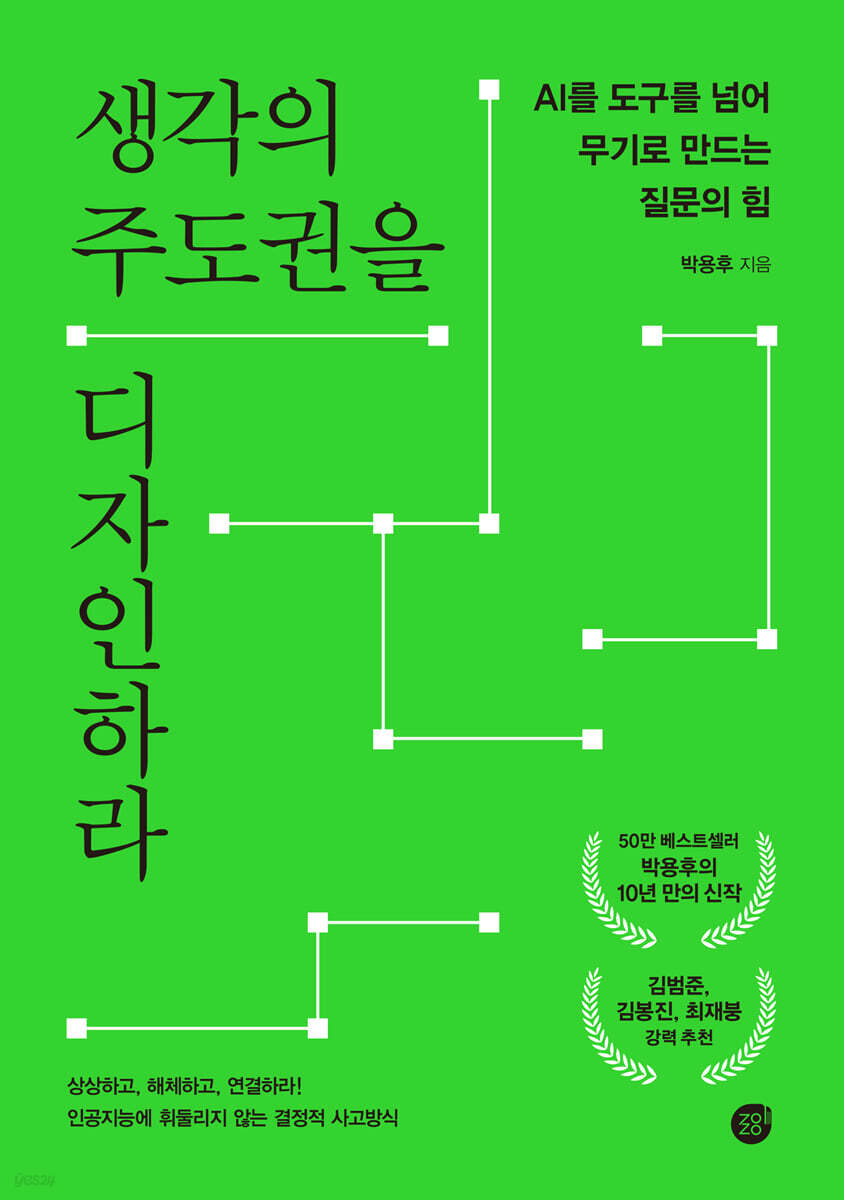
Design the leadership of thought
 |
Description
Book Introduction
- A word from MD
-
The leadership of thought that reflects the timesA new book by Park Yong-hu, South Korea's first perspective designer, serves as a warning to modern people who are losing the ability to think and question for themselves in the age of AI.
By asking questions, we cultivate the power to design a framework for thinking and remind ourselves of our inherent human values so that we can use AI as a tool to open up new possibilities rather than a threat.
June 27, 2025. Self-Development PD Oh Da-eun
** The latest work from Park Yong-hu, a bestseller with 500,000 copies sold, after 10 years!
** Strongly recommended by Naver's Kim Beom-jun, Baedal Minjok's Kim Bong-jin, and 『AI Sapiens』 Choi Jae-boong!
In the AI era, do you want to seize the initiative of thinking?
Reclaim your questioning power before AI takes over your thinking!
In a 'hurry hurry' culture that values growth and speed, Korean society has lost the time to train its own thoughts.
So we've become adept at copying answers without asking questions.
The author speaks decisively.
“When the AI era arrives, humans who don’t ask questions will ultimately become tools of AI.” The power of questioning is the last sovereignty we must protect in the AI era.
"Designing the Dominance of Thought" is a book that asks what and how we should think in this era where AI has deeply penetrated human daily life.
In this book, author Yong-Hoo Park, Korea's first perspective designer, reflects on the unique abilities that only humans can possess in this era of rapid technological evolution.
This book begins with one question:
“In the future, will I be able to think with my own head alone, without using AI?”
The world is now in an unprecedented state of sensory confusion.
Information is overflowing, but the line between truth and lies is blurred, and while everyone is sharing information and connected, we are actually distancing ourselves from ourselves.
Moreover, generative AI, which has taken over ‘industry,’ ‘culture,’ ‘economy,’ and ‘politics’ since the advent of Chat GPT, is fading our habit of searching for information and making us lose the power to ask questions.
In these times, this book suggests where we should start to rediscover the 'power to question.'
The book aims to restore thinking by focusing on five themes.
First, questions are the seeds of thought, and we must develop our ability to ask questions before we develop our ability to find answers.
Second, AI is not simply a tool, but a ‘mirror’ that reflects the human way of thinking.
Third, as information overflows, the ability to design perspectives becomes more important as it leads to the power to design a 'frame of thought'.
Fourth, we must be able to question the obvious.
Designing the leadership of thought means not blindly following fixed truths, but rather questioning the framework and discovering gaps.
Fifth, we must adopt an attitude that transcends the relationship with machines through questioning, rather than competing with them. Humans who partner with AI will survive in the AI era.
We've long been obsessed with performance and speed, and the AI era is one that amplifies this speed and productivity.
The author directly asks readers in Korean society who are losing control of their own thinking as they are swept away by the flow of the times.
“What was the last question you came up with on your own?” While AI can answer questions, only humans can “ask the right question” and “determine whether the AI’s answer is appropriate.”
"Design the Leadership of Thought" will be a solid philosophical guide for those who wish to retain the last sovereignty, the "power of questioning."
** Strongly recommended by Naver's Kim Beom-jun, Baedal Minjok's Kim Bong-jin, and 『AI Sapiens』 Choi Jae-boong!
In the AI era, do you want to seize the initiative of thinking?
Reclaim your questioning power before AI takes over your thinking!
In a 'hurry hurry' culture that values growth and speed, Korean society has lost the time to train its own thoughts.
So we've become adept at copying answers without asking questions.
The author speaks decisively.
“When the AI era arrives, humans who don’t ask questions will ultimately become tools of AI.” The power of questioning is the last sovereignty we must protect in the AI era.
"Designing the Dominance of Thought" is a book that asks what and how we should think in this era where AI has deeply penetrated human daily life.
In this book, author Yong-Hoo Park, Korea's first perspective designer, reflects on the unique abilities that only humans can possess in this era of rapid technological evolution.
This book begins with one question:
“In the future, will I be able to think with my own head alone, without using AI?”
The world is now in an unprecedented state of sensory confusion.
Information is overflowing, but the line between truth and lies is blurred, and while everyone is sharing information and connected, we are actually distancing ourselves from ourselves.
Moreover, generative AI, which has taken over ‘industry,’ ‘culture,’ ‘economy,’ and ‘politics’ since the advent of Chat GPT, is fading our habit of searching for information and making us lose the power to ask questions.
In these times, this book suggests where we should start to rediscover the 'power to question.'
The book aims to restore thinking by focusing on five themes.
First, questions are the seeds of thought, and we must develop our ability to ask questions before we develop our ability to find answers.
Second, AI is not simply a tool, but a ‘mirror’ that reflects the human way of thinking.
Third, as information overflows, the ability to design perspectives becomes more important as it leads to the power to design a 'frame of thought'.
Fourth, we must be able to question the obvious.
Designing the leadership of thought means not blindly following fixed truths, but rather questioning the framework and discovering gaps.
Fifth, we must adopt an attitude that transcends the relationship with machines through questioning, rather than competing with them. Humans who partner with AI will survive in the AI era.
We've long been obsessed with performance and speed, and the AI era is one that amplifies this speed and productivity.
The author directly asks readers in Korean society who are losing control of their own thinking as they are swept away by the flow of the times.
“What was the last question you came up with on your own?” While AI can answer questions, only humans can “ask the right question” and “determine whether the AI’s answer is appropriate.”
"Design the Leadership of Thought" will be a solid philosophical guide for those who wish to retain the last sovereignty, the "power of questioning."
- You can preview some of the book's contents.
Preview
index
Introduction - Can AI Surpass Humans?
Recommendation
PART 1: The Key to Thinking Is in the Question
- One question we must face in the AI era.
- Are you Geppetto or Frankenstein?
- The ghost of prompt engineering
- The question begins with being asked.
- Keep your thoughts fresh
PART 2 Thinking Machines and Questioning Humans
Innovation: Technology has answered the questions of our time.
Where is AI headed in the 21st century?
- What does the probabilistic parrot say?
- The end of AI evolution, humanoids
Is AI a Pandora's Box or a Black Box?
AI and Big Data: Disrupting the World of Y=aX+b
PART 3: If you stop thinking, you'll be trapped in a maze designed by AI.
- It's wrong to say that AI will change the future.
- Is the Google era coming to an end?
- Creativity, that's the problem.
- How does Samantha's words come across?
PART 4: Will you be swayed by information or design your perspective?
- Umberto Eco predicted 2025
- A new customer has appeared.
- What will AI agents replace?
The Path Education Should Take in the AI Era: From Competition to Creativity
AI Innovation vs. AI Washing: Where Does Real Change Come From?
PART 5: The Leadership of Thought that Can Think About the Era
- People who have applied AI to their work
- The true completion of augmentation
- Enjoy the experiment of disassembling and combining.
- Design the leadership of thought
Recommendation
PART 1: The Key to Thinking Is in the Question
- One question we must face in the AI era.
- Are you Geppetto or Frankenstein?
- The ghost of prompt engineering
- The question begins with being asked.
- Keep your thoughts fresh
PART 2 Thinking Machines and Questioning Humans
Innovation: Technology has answered the questions of our time.
Where is AI headed in the 21st century?
- What does the probabilistic parrot say?
- The end of AI evolution, humanoids
Is AI a Pandora's Box or a Black Box?
AI and Big Data: Disrupting the World of Y=aX+b
PART 3: If you stop thinking, you'll be trapped in a maze designed by AI.
- It's wrong to say that AI will change the future.
- Is the Google era coming to an end?
- Creativity, that's the problem.
- How does Samantha's words come across?
PART 4: Will you be swayed by information or design your perspective?
- Umberto Eco predicted 2025
- A new customer has appeared.
- What will AI agents replace?
The Path Education Should Take in the AI Era: From Competition to Creativity
AI Innovation vs. AI Washing: Where Does Real Change Come From?
PART 5: The Leadership of Thought that Can Think About the Era
- People who have applied AI to their work
- The true completion of augmentation
- Enjoy the experiment of disassembling and combining.
- Design the leadership of thought
Detailed image

Into the book
The concept of 'prompt engineering' lingers like a ghost these days.
But we must now determine what this concept truly is, whether this ability is a core competency that can be continuously expanded in future society, or whether it is merely a temporary fad, consumed and then disappearing according to a specific technological trend, like the "information searcher" of the past.
This will depend on how deeply you think about the nature of AI literacy.
--- p.49
The key is to not unconditionally trust the results produced by AI. AI is merely a tool, and it's up to humans to decide how to utilize and control it. The moment we assume AI's judgments are always correct, we delegate important decisions to the machine.
Therefore, decision-making using AI must be accompanied by human critical thinking.
Humans must review AI's results and determine what assumptions and limitations it was derived from.
Only in these cases can AI function as an effective technology.
--- p.137
Art has always been accompanied by emotions.
We read poetry and feel our hearts ache, watch movies and cry, and listen to music and find comfort.
This emotional response makes art not merely information or entertainment, but an essential part of the human experience.
So now we must ask: Can AI-generated creations evoke these same emotions in us? And if they do, are they "real"? And furthermore, whose source is this emotion? The AI, or the human who designed it?
--- p.183
Laziness is the most insidious enemy of the AI era.
Thanks to ChatGPT summarizing, organizing, and structuring, we are increasingly 'thinking less'.
The more comfortable we are with getting answers, the fewer questions we ask, and the less likely we are to break out of our comfort zones, the less likely we are to explore new things.
So, what is needed to achieve essential augmentation is friction.
Only when we encounter friction—resistance, the shock of the unknown, uncomfortable questions—that disrupts our inertia of thought can we experience true insight and expanded thinking. AI is not simply a tool to accelerate thinking; it becomes truly valuable when it is used as a crucial weapon to break our inertia.
But we must now determine what this concept truly is, whether this ability is a core competency that can be continuously expanded in future society, or whether it is merely a temporary fad, consumed and then disappearing according to a specific technological trend, like the "information searcher" of the past.
This will depend on how deeply you think about the nature of AI literacy.
--- p.49
The key is to not unconditionally trust the results produced by AI. AI is merely a tool, and it's up to humans to decide how to utilize and control it. The moment we assume AI's judgments are always correct, we delegate important decisions to the machine.
Therefore, decision-making using AI must be accompanied by human critical thinking.
Humans must review AI's results and determine what assumptions and limitations it was derived from.
Only in these cases can AI function as an effective technology.
--- p.137
Art has always been accompanied by emotions.
We read poetry and feel our hearts ache, watch movies and cry, and listen to music and find comfort.
This emotional response makes art not merely information or entertainment, but an essential part of the human experience.
So now we must ask: Can AI-generated creations evoke these same emotions in us? And if they do, are they "real"? And furthermore, whose source is this emotion? The AI, or the human who designed it?
--- p.183
Laziness is the most insidious enemy of the AI era.
Thanks to ChatGPT summarizing, organizing, and structuring, we are increasingly 'thinking less'.
The more comfortable we are with getting answers, the fewer questions we ask, and the less likely we are to break out of our comfort zones, the less likely we are to explore new things.
So, what is needed to achieve essential augmentation is friction.
Only when we encounter friction—resistance, the shock of the unknown, uncomfortable questions—that disrupts our inertia of thought can we experience true insight and expanded thinking. AI is not simply a tool to accelerate thinking; it becomes truly valuable when it is used as a crucial weapon to break our inertia.
--- p.285
Publisher's Review
A person who constantly questions rather than accepting what is given
We will become pioneers leading the AI era!
"Design the Leadership of Thought" is a book that calls for the recovery of the power of "thinking" and "questioning," which are unique abilities of humans in a rapidly changing era.
Author Yong-hu Park has observed the business world and everyday life for a long time and has confirmed that your entire life changes depending on how you see things. He has spread the message of "Design your perspective" to the world.
And now, ten years later, in the age of AI, which is completely changing existing values and ways of thinking, I feel the need for a new definition of perspective.
Accordingly, we have published a guidebook for designing a way of thinking that cannot be replaced by AI, using the keyword “initiative of thought.”
Through various thought experiments, the author meticulously examines the adversities and joys that humans may face in the AI era.
The first challenge to consider is the question, 'Will AI replace jobs?'
The author does not give a clear 'yes' or 'no' answer to this question.
Instead, it asks the reader again, "What constitutes a job?" AI will undoubtedly impact countless jobs.
However, depending on whether we view a job as a simple collection of tasks or as an organic system that includes relationships, emotions, situational judgments, and social context, humans can either be 'taken away from their jobs' or 'redesign the definition of jobs.'
We live in an era where AI draws and writes.
Therefore, many people feel fearful that 'AI will threaten human creativity.'
This question also requires a redesign of thinking, starting from the question, "What is creativity?"
Creativity is the result of a thought process.
And AI's creativity is closer to the result of analyzing data and flexibly following existing methods.
Therefore, in the future, creative humans should be able to use AI as a weapon to look at the structure of problems from a new perspective, rather than repeating the same patterns.
To achieve this, humans must possess the perspective and questioning power to reinterpret anything in a new way.
So, is AI unconditionally beneficial to humans? The author predicts that a bright future awaits when true "AI ethics" are established. Since AI is no longer solely used by developers, AI ethics is no longer the exclusive domain of developers.
Every user who asks a question, every individual who types a prompt, must now bear some responsibility for the outcome of their thinking.
The author warns, “AI moves based on questions, and depending on the question, it can harm or save people.”
Therefore, even when entering a single prompt, we must consider where it will reach and who it might affect. Ultimately, AI ethics is about "ethics of thought."
Therefore, only when we combine the power to design questions, the ability to design the initiative of thought, and the responsibility to interpret the results, can we truly remain "thinking humans."
It is clear why this book must be published now.
We talk about the AI era, but we don't deeply reflect on what humans are actually losing.
The disappearance of thought hidden behind smartness, convenience, and efficiency could be a more dangerous crisis than any technological advancement.
We must now evolve from being mere information consumers or instructors to beings who 'think together' with AI.
With the power of questioning, which is the most powerful weapon of mankind.
We will become pioneers leading the AI era!
"Design the Leadership of Thought" is a book that calls for the recovery of the power of "thinking" and "questioning," which are unique abilities of humans in a rapidly changing era.
Author Yong-hu Park has observed the business world and everyday life for a long time and has confirmed that your entire life changes depending on how you see things. He has spread the message of "Design your perspective" to the world.
And now, ten years later, in the age of AI, which is completely changing existing values and ways of thinking, I feel the need for a new definition of perspective.
Accordingly, we have published a guidebook for designing a way of thinking that cannot be replaced by AI, using the keyword “initiative of thought.”
Through various thought experiments, the author meticulously examines the adversities and joys that humans may face in the AI era.
The first challenge to consider is the question, 'Will AI replace jobs?'
The author does not give a clear 'yes' or 'no' answer to this question.
Instead, it asks the reader again, "What constitutes a job?" AI will undoubtedly impact countless jobs.
However, depending on whether we view a job as a simple collection of tasks or as an organic system that includes relationships, emotions, situational judgments, and social context, humans can either be 'taken away from their jobs' or 'redesign the definition of jobs.'
We live in an era where AI draws and writes.
Therefore, many people feel fearful that 'AI will threaten human creativity.'
This question also requires a redesign of thinking, starting from the question, "What is creativity?"
Creativity is the result of a thought process.
And AI's creativity is closer to the result of analyzing data and flexibly following existing methods.
Therefore, in the future, creative humans should be able to use AI as a weapon to look at the structure of problems from a new perspective, rather than repeating the same patterns.
To achieve this, humans must possess the perspective and questioning power to reinterpret anything in a new way.
So, is AI unconditionally beneficial to humans? The author predicts that a bright future awaits when true "AI ethics" are established. Since AI is no longer solely used by developers, AI ethics is no longer the exclusive domain of developers.
Every user who asks a question, every individual who types a prompt, must now bear some responsibility for the outcome of their thinking.
The author warns, “AI moves based on questions, and depending on the question, it can harm or save people.”
Therefore, even when entering a single prompt, we must consider where it will reach and who it might affect. Ultimately, AI ethics is about "ethics of thought."
Therefore, only when we combine the power to design questions, the ability to design the initiative of thought, and the responsibility to interpret the results, can we truly remain "thinking humans."
It is clear why this book must be published now.
We talk about the AI era, but we don't deeply reflect on what humans are actually losing.
The disappearance of thought hidden behind smartness, convenience, and efficiency could be a more dangerous crisis than any technological advancement.
We must now evolve from being mere information consumers or instructors to beings who 'think together' with AI.
With the power of questioning, which is the most powerful weapon of mankind.
GOODS SPECIFICS
- Date of issue: July 2, 2025
- Page count, weight, size: 304 pages | 432g | 148*210*20mm
- ISBN13: 9791194508236
- ISBN10: 1194508235
You may also like
카테고리
korean


korean

![ELLE 엘르 스페셜 에디션 A형 : 12월 [2025]](http://librairie.coreenne.fr/cdn/shop/files/b8e27a3de6c9538896439686c6b0e8fb.jpg?v=1766436872&width=3840)


